
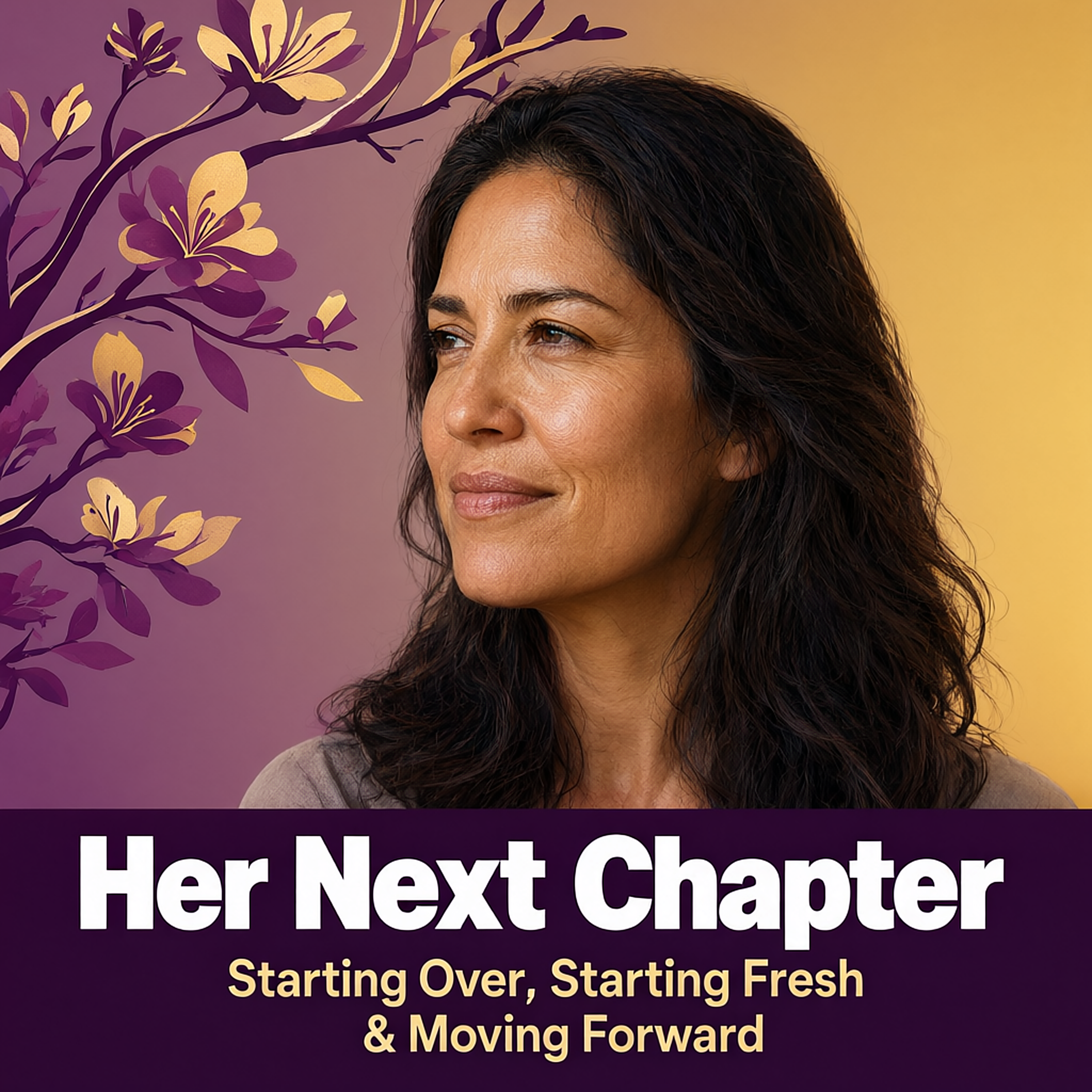
Her Next Chapter: Starting Over, Starting Fresh & Moving Forward · Natalie Baker
In this deeply intimate episode of 'Her Next Chapter,' host Natalie Baker explores the profound and often unsettling realization that we can become strangers to the people we love most, specifically focusing on the complex dynamic between adult daughters and their aging mothers. The narrative begins with a quiet, rainy Tuesday in the kitchen, where a simple moment—holding a plate of cookies while observing her mother’s hands—triggers a cascade of introspection about familiarity versus true understanding. This episode is essential listening for women navigating midlife transitions, those experiencing empty nest syndrome, or anyone seeking to deepen their familial bonds beyond surface-level interactions. It addresses the common but painful assumption that knowing someone's history equates to knowing their present soul, challenging the listener to recognize the 'quiet erosion of intimacy' that occurs when we stop actively looking at our loved ones. The conversation delves into the psychological shift from viewing parents as static fixtures to recognizing them as fluid, evolving individuals with their own fears, dreams, and second acts. Natalie shares a pivotal conversation where she asks her mother what she is most afraid of, leading to the heartbreaking yet liberating admission that her mother feels like an 'epilogue' rather than a protagonist in her own life. This segment offers concrete takeaways on how to move from transactional relationships—where visits are given for comfort—to genuine connection rooted in curiosity and presence. Listeners will gain insight into the importance of asking better questions, such as 'Who are you outside of your roles?' and learning to listen to the pauses and unsaid words that reveal a person's current reality. The episode emphasizes that love without curiosity is merely projection, and that maintaining relationships requires the same tending and watering as a garden, not just preserving memories in a museum. Ultimately, this episode serves as a gentle but powerful call to action for re-engaging with our closest relationships. It encourages listeners to put down their phones, close their laptops, and practice radical presence with partners, children, or friends who may feel familiar but distant. By sharing personal anecdotes of rediscovering her mother’s love for jazz, her fear of technology, and her unfulfilled dreams, Natalie illustrates that it is never too late to redraw the map of a relationship. The story highlights that seeing someone clearly—acknowledging their complexity, fears, and hopes—is an act of profound respect and love. Whether you are dealing with generational gaps, societal pressures on aging women, or simply the natural drift of time, this episode provides the emotional permission and practical framework needed to start fresh. It reminds us that we are all writing our next chapters, and no one should have to walk that path alone, especially not the people who have loved us the longest. Join...
I stood in the kitchen, holding a plate of cookies my mother had baked for me, and realized I didn’t know how she took her coffee. Not the brand, not the sugar, but the actual, physical way she held the mug when she was tired. It was a Tuesday. Rain was hitting the windowpane in that specific, heavy way that makes you want to pull the duvet over your head and pretend the world doesn’t exist. I was visiting home for the weekend, a routine I’d maintained since I moved across the country for work. We were sitting at the same oak table we’d eaten breakfast at every morning for eighteen years. The wood was worn smooth in the center, polished by decades of elbows, notebooks, and hurried meals before school or work. She was talking about the neighbor’s dog, something trivial, something safe. And I looked at her hands. They were resting on the table, fingers curled slightly inward, knuckles prominent against the pale skin. I remembered those hands tying my shoelaces when I was six. I remembered them steering me through crowded airports when I was twelve. I remembered them waving from the porch when I left for college, tears streaming down my face. But now, they just sat there. Quiet. Still. And I felt this sudden, terrifying gap open up between us. It wasn’t that she had changed. It was that I had stopped looking. I had been so busy building my own life, editing my own story, that I had forgotten to read the one right in front of me. Let’s unpack that. Because it’s not just about cookies or coffee. It’s about the quiet erosion of intimacy that happens when we assume we know someone because we’ve known them for a long time. We grow up believing that family is static. That parents are fixtures, like trees or houses. You learn their rhythms, their preferences, their favorite sayings, and you tuck that knowledge away like a safety blanket. It feels permanent. But people aren’t furniture. They are fluid, shifting, evolving organisms. And somewhere along the line, I mistook familiarity for understanding. I thought because I knew her childhood stories, I knew her current soul. I was wrong. And realizing that doesn’t make you a bad daughter. It doesn’t make you negligent or uncaring. It just makes you human. It makes you aware of the blind spots in your own narrative. For years, I operated under the assumption that if I loved her enough, I would always be able to predict her. That love was a substitute for curiosity. But love without curiosity is just projection. You’re projecting your memory of who they were onto who they are becoming. And that’s dangerous. It denies them their present reality. It denies you the chance to see them clearly. I remember thinking, as I sat there with that plate of cookies, that I had lost the map to her inner world. And maps can be redrawn. They can be updated. But only if you’re willing to put down the old one and look at the terrain fresh. It’s okay to be messy in progress when it comes to relationships. You don’t have to have it all figured out to start asking better questions. So I asked her. Not about the neighbor’s dog. Not about the weather. I asked her what she was afraid of. Just that. What are you most afraid of right now? The silence that followed was thick. Heavy. I could hear the refrigerator humming in the background, a low, steady drone that seemed to amplify the weight of the question. She didn’t answer immediately. She picked up her tea, blew on it, stared into the dark liquid. I watched her shoulders rise and fall with a breath she seemed to be holding back. And then she said, ‘That I’m running out of time to matter.’ I froze. That wasn’t the answer I expected. I expected something practical. Maybe health. Maybe loneliness. But ‘mattering’? That struck a chord deep in my chest. Because in my rush to build my own chapter, I had inadvertently made her feel like an epilogue. A footnote. Someone whose role was defined by her past utility—raising me, cleaning my room, making sure I had clean socks. But who was she when I wasn’t needing anything? Who was Natalie Baker’s mother when she wasn’t being a mom? I hadn’t thought to ask. I had assumed the title was enough. But titles don’t fill cups. Connection does. Purpose does. I realized then that our relationship had become transactional in the worst possible way. I gave her visits; she gave me comfort. But neither of us was giving each other the gift of being seen. Truly seen. Not as a role, but as a person. A complex, frightened, hopeful, complicated person. And that realization hurt. It hurt more than any argument ever could. Because arguments imply conflict. This implied absence. An absence of presence. After that day, everything shifted. Slowly. Unevenly. Like trying to walk on ice after years of pavement. I started paying attention. Not just to what she said, but to how she said it. To the pauses. To the things she left unsaid. I noticed that she still liked jazz, even though she never played it anymore because she thought it was ‘too loud’ for a quiet house. I noticed that she was scared of technology, not because she was stubborn, but because she felt left behind by a world that moved too fast. I started asking her about her dreams, not the ones she had for me, but the ones she had for herself. Did she want to travel? Did she want to write? Did she want to paint? She laughed at first. Said it was silly. Too late. But I kept asking. Gently. Firmly. Because it matters. It matters that we keep asking. What’s the next right move? For us, it was small steps. I sent her articles about women who started businesses in their sixties. I recommended books by female authors she might like. I listened when she talked about her friends, really listened, instead of just nodding while checking my phone. And slowly, the stranger in my kitchen began to disappear. In her place came a woman I didn’t fully know yet, but was eager to meet. It wasn’t instant. There were still days where we fell back into old patterns. Days where I talked at her instead of with her. Days where I assumed I knew what she needed. But the awareness remained. The intent remained. And that changed the texture of our time together. It became less about obligation and more about discovery. I wasn’t visiting my mother anymore. I was meeting her. Again. For the first time. Here’s the thing nobody tells you about these moments of realization: they are rarely cinematic. There is no swelling orchestra. No dramatic rainstorm outside (though it did rain that day). Just a quiet kitchen and a hard truth settling into your bones. And sometimes, that’s enough. You don’t need a grand gesture to repair a disconnect. You just need to show up. To pay attention. To accept that you will get it wrong sometimes. That you will say the wrong thing. That you will miss the mark. And that’s okay. It’s okay to be messy in progress. Relationships are not museums where we preserve memories. They are gardens. They require tending. Weeding. Watering. Sometimes they bloom beautifully. Sometimes they go dormant. But they never stop growing unless we stop engaging with them. I used to think that loving someone meant knowing them completely. Now I know that loving someone means committing to learning them forever. People change. Circumstances change. And if we cling to the version of them we once knew, we rob ourselves of the richness of who they are becoming. My mother is not the woman who raised me. She is also a woman who is navigating her own second act, her own fears, her own desires. And I am honored to witness it. Not as a spectator, but as a participant. As a friend. As a fellow traveler. That shift in perspective—from duty to delight—is profound. It takes the weight off both of us. It allows us to breathe. To laugh. To simply be. Without the pressure of performance. Without the burden of expectation. Just two humans, sharing space, sharing stories, sharing the quiet joy of being known. So I want to turn this back to you. Because I suspect you have your own strangers. Maybe it’s your partner. Maybe it’s your child. Maybe it’s a friend you’ve known for decades. Someone who feels familiar, but whom you haven’t truly seen in a long time. Look at them today. Really look. Put down the phone. Close the laptop. Stop planning what you’re going to say next. Just watch. Listen. Ask a question that surprises you. Ask them what they’re dreaming of. Ask them what scares them. Ask them who they are outside of their roles. You might be surprised by the answers. You might be uncomfortable. You might realize you’ve been projecting your own insecurities onto them. Or you might find a depth you never imagined. Either way, it’s worth it. Because connection is the antidote to isolation. And in a world that constantly pulls us apart, choosing to stay present with someone is a radical act of love. It’s messy. It’s imperfect. It requires courage. But it’s the only way we survive this thing called life together. So go home. Call your friend. Sit with your partner. Be curious. Be brave. Be kind. To them. And to yourself. Because we are all writing our next chapters. And none of us should have to do it alone. Especially not the people who have loved us the longest. Thank you for letting me sit in the kitchen with you today. I hope you found some clarity, or maybe just a little permission to be curious again. Take care of yourself, and remember: the best stories are the ones we write together. Until next time.
More Her Next Chapter: Starting Over, Starting Fresh & Moving Forward episodes →