
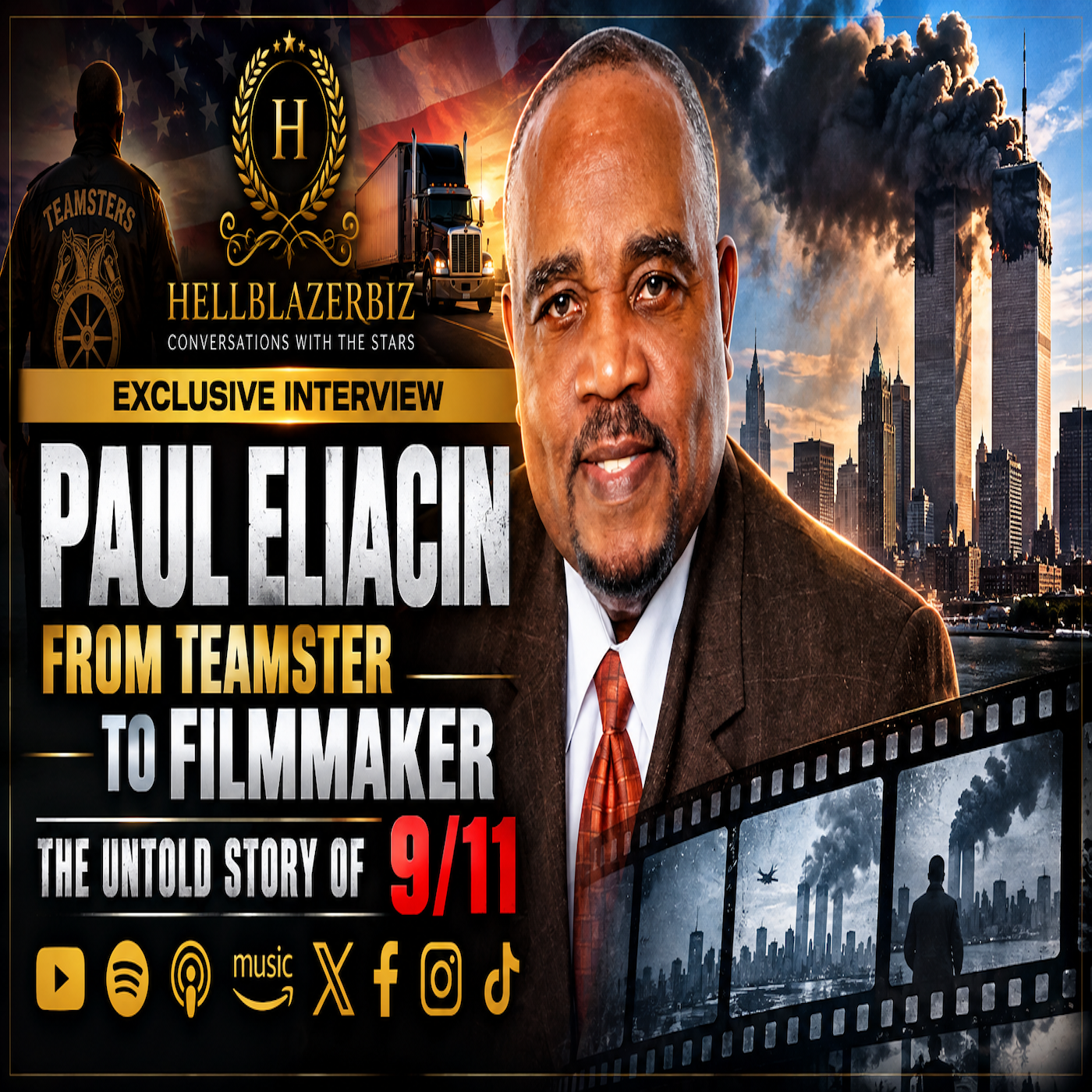
Hellblazerbiz: Conversations with the Stars · Hellblazerbiz®
What does it take to go from working alongside legends like Martin Scorsese and Spike Lee to serving as a first responder on one of America’s darkest days? In this powerful episode of Hellblazer Biz, we sit down with filmmaker and 30-year Teamster veteran Paul Eliacin. From hustling on Brooklyn sets to contributing to iconic productions like The Sopranos and Men in Black, Paul’s 30-year career behind the camera is full of incredible lessons on grit, filmmaking, and storytelling. Beyond the silver screen, Paul shares his deeply moving experience serving at Ground Zero during the 9/11 attacks, using his industry expertise to bring light to the rescue efforts. 👉 In this video, you’ll discover: How a letter from Spike Lee sparked Paul’s film career The reality of working 30 years as a Teamster on blockbuster sets Behind-the-scenes filmmaking lessons learned from observing elite directors Paul’s powerful story as a 9/11 first responder The inspiration behind his film Up in Harlem If you’re an aspiring filmmaker, movie buff, or just love inspiring human stories of resilience, hit that Like button, Subscribe to Hellblazer Biz, and ring the notification bell for more extraordinary conversations! 💬 Question of the day: What is your favorite movie or TV show Paul worked on (The Sopranos, Men in Black, or Boomerang)? Let us know in the comments below!
Chris: Welcome to Hellblazer Biz, everyone. Today I'm delighted to welcome a very special guest to the show. He's a man whose life has taken him from behind the scenes of some of the most iconic films and television shows of our time to becoming a filmmaker in his own right. Paul Elierson spent more than thirty years working in the entertainment industry, credits The Sopranos, Law and Order, Men in Black conspiracy theory, some of my favorites there, and many more. And he went on to write and direct his own feature film up in Harlem. Which is now set to reach a new audience as well. But Paul's story goes far beyond filmmaking. He was also a first responder during the 911 rescue and recovery efforts at Ground Zero. An experience that changed his life forever. I'm not surprised. And today we're going to talk about his remarkable journey, his career, filmmaking, experiences during one of the most significant events in modern history, and the work con he's continuing to do today. So, Paul, it is an absolute pleasure to have you on the show. Welcome to Hellblazer Biz Paul Eliacin: Thank you. Thank you for having me. Chris: You're welcome. You've had such an extraordinary journey. It's taken you, like I said, from working behind some of the scenes on some of these the biggest shows and and films and TVs in New York to writing and directing your own feature film and obviously the re first responder, like I mentioned, down at ground zero on nine eleven. So when you look back on your life so far, what do you think has been the driving force that's kept you moving forward? Paul Eliacin: I my driving force was the desire to get in the film industry to be part of what's going on in the film industry. I remember as a child growing up, I've always wanted to somehow, somehow be involved in the film industry. So what I did was I I wrote to Spike Lee and Spike Lee sent me a manuscript on the movie School Days and I was amazed by what I saw and the writing and the format of it. I said, this is exactly what I want to do. This is where I want to be. And so after after reading his manuscript, I went around and and to backstage and got myself a headshot and I was r walk going around to different film set, submitting my headshot. Wanted to be an actor. And lo and behold, I met this gentleman doing boomerang, who's a captain for local 817 Theatrical Teamsters. And I saw a bunch, bunch of them, they were getting ready to do something. So I offered my headshot to the security. He said, No, I can't let you upstairs. He said, These gentlemen work for Boomerang, give them your headshot. So I say, he said, they're Teamsters. I said, Teamsters. I said, I've always wanted to be working in the film industry. How can I get in? And then the captain, which is the leader of Chris: Mm-hmm. Paul Eliacin: the job, offered me a number. And then I call and it was his brother who's the president of the union and the secretary pick up and said, My name is Paula Lyson. I'd like to know how I joined the Teamsters Union. She passed me over to him and All of a sudden he said, When you can when can you come in for an interview? And from there on it went you know, i that was it. Matter of fact I Chris: Wow. Paul Eliacin: ended up working on Boomerang as my first film. Chris: Wow. That's that's a fantastic story to to say how you got into it. Paul Eliacin: Yes, yes, yes. Prior to that, I worked Chris: Mm-hmm. Paul Eliacin: on a small independent film called Straight Out of Brooklyn by a gentleman Chris: Mm-hmm. Paul Eliacin: named Matty Rich. And that also inspired me to go further because I watched him and I helped them and I wore many hats for his production. So I was fascinated by what what was what I saw. So I said this Chris: Yeah. Paul Eliacin: is exactly what I wanna do. Yeah. Chris: Brilliant. That sounds a really inspiring story, Paul. That really is. And I mean you also you grew up in Brooklyn as well, and you have spoken before obviously about experiencing difficult times when you were younger. So how much do you think those early experiences have shaped the man and the filmmaker and the mentor that you've become now? Paul Eliacin: my early experiences was like, you know, it's you know, I I grew up in you know, without without a father and and I grew up around my siblings, brothers and sisters with one mother who who w had two jobs trying to make ends meet to raise us. And so th that alone made me wanted to be somebody or be something so that I could help my mother out. So those are the experiences that I have growing up in Brooklyn. I remember going to Wingate High School, which is, you know, just blocks from where I live. And Chris: Mm-hmm. Paul Eliacin: I recall my mother coming to work every day and then going right back out to work again, trying to feed us and trying to raise us. And my mother my father had passed. So I had to look up to her as a motherly and a fatherly love, you know, for the help. So Chris: Yeah. Paul Eliacin: there's there's some struggles, you know, in the past and you know, from that struggle I you know, I learned. Chris: Mm. Okay. And d d do you kind of think adversity can sometimes give a person a different perspective on storytelling? So do you think that's yeah, a different that's just obviously someone else. So yeah, maybe that. Paul Eliacin: Yes, yes, of course. I mean if you if you if you if you went through the stuff that I went through, you've seen a lot, you know, you've heard a lot. So that Chris: Mm-hmm. Paul Eliacin: give you the mind setting of storytelling, you know? So that that helps. Chris: Mm-hmm. Excellent. I mean you mentioned it there as well, so thirty years working as a teamster. It in for those who might not understand what that role involves, what was day to day life for you on a major production? How how did that work? Paul Eliacin: well a Teamster's life is i it could be exciting and it could also be boring. Chris: Mm-hmm. Paul Eliacin: Because a Teamster's job first l let me let me explain to you to your audience that a bus driver is a teamster. Every truck driver is a teamster, a garbage man is a teamster. I know I I I know you've heard of Jimmy Hoffa. He was the president of Teamster, they're Chris: Mm-hmm. Yeah, yeah. Paul Eliacin: still looking for him. And so that's his Teamsters life. They they are basically truck drivers. But in my case, as Theatrical Teamsters, Local 817, we work only on film commercials and television shows. So Chris: Mm-hmm. Paul Eliacin: we are theatrical teamsters. So we've Chris: Okay. Paul Eliacin: got a variety of film and commercials and T V shows that's going on in New York City. So Chris: Mm-hmm. Paul Eliacin: you get assigned to one of these film or TV shows and you're there for duration until the end of the show and then you call what what they call shape. You call the union, you say I'm available and they'll assign you to another another television or T V show. But once you once you on set, depending on the equipment you're driving, and there is grip, there's electric, there's prop, there's camera. depending on the equipment you're driving, you require to open up the gate and dispense the equipment to the local fifty-two guys, which are the mechanics Chris: Okay. Paul Eliacin: of grips and electric. So you Chris: Mm-hmm. Paul Eliacin: if you were if you in a grip, you you hand them the grip stand. And so you once you hand it to them, they go out to the set, they set it up, and then the electric put the lights on it. Which which by the way bring to you know bring me to say at ground zero we did precisely the same thing. We Chris: Okay. Paul Eliacin: went there with generators, we went there with lights, Chris: Mm-hmm. Paul Eliacin: and there is if you if you look at one of the one of the videos three days after nine eleven, my name three days after, it was an interview held by the Daily News. In the background, I I donated a few footage from ground zero. And in the background you see this move the the the the grip stand and you also see the movie light. So Chris: Mm-hmm. All right. Paul Eliacin: the rental houses donated generators, Chris: Mm-hmm. Paul Eliacin: donated lights, donated Chris: Yeah. Paul Eliacin: cameras, I'm sorry, donated lights, donated grip grip stand. So my job Chris: Mm-hmm. Paul Eliacin: was to drive it there along with my cousin Dimitri and then Chris: Yeah. Paul Eliacin: we would plug into the generator and then Chris: Mm-hmm. Paul Eliacin: at nighttime the illuminate the power while the firefighters and police officers dig in trying to save life. I'm sorry, I got off topic. Chris: that's all right, no, no, it's fine. We'll be covering that Paul Eliacin: Right. Chris: as well at some point. So I'm worried that's fascinating that's fascinating. But it is it's it's good to see how you can you know, you've been able to well, yeah, put those skills that you'd learnt through the you know, Paul Eliacin: Yeah, yeah. Chris: been learning through Teamsters into something when obviously everyone had to band together that that that you know, those you had that knowledge and the skill set to be able to to to help on the day. and and the obviously the subsequent days and weeks afterwards as well. It's really, really, really interesting. obviously, I mean you've obviously we mentioned some of the huge productions, Law and Order, Law Criminal Intent, Sopranos, you know, New York Undercover, Men in Black, Conspiracy Theory, First Wives Club, everything like that. What Paul Eliacin: Worked at all of them. Chris: you worked with all these mass huge things. What's the biggest thing that you've learned from spending so many years on these professional film and TV sets? Paul Eliacin: I've learned how to make movies. That's the biggest thing. Chris: Mm-hmm. Paul Eliacin: Because there is an area when they're shooting a film or T V show that's called Video Village. And Video Village, if you walk in by a by a film set in New York, you'll see a lot of people congregating in one section with a tent over and you see a lot of the you director's chair, actors chair, and their name is in the back of that chair. So when I'm not doing anything after I dispense the equipment or whatever department that that I'm assigned to as a teamster, Chris: Mm-hmm. Paul Eliacin: I would mosey around and go to video village and I would stand behind big guys like Skoscasey, Spike Lee or or any one of those guys, and I listen to the lingo and I listen to the selection shots. And so that helps me a lot. And There's something that they hand you prior to the day business is called call sheet. And I think now if you Google call sheet, I think someone created some kind of website. If you wanna work, you could type in call sheet on Google or and then there's a section that you could find where they're looking for work. But call sheet Chris: Okay. Paul Eliacin: they've give you every day that's gonna everything that's gonna happen during that day from location Chris: Mm-hmm. Paul Eliacin: to how long they plan on shooting, where the Chris: Mm-hmm. Paul Eliacin: craft services to eat. it also give you how many actors they need for that day, how many Chris: Right. Paul Eliacin: background they need for that day, and there's a section everywhere, and then it has the actors name on there. So those are the things that I look at from your question, that's get me to where I am today. I learn Chris: Yeah. Paul Eliacin: all these things by sitting behind these directors and finding out how he's done. Chris: Yeah, you couldn't have learned for some some better directors there. Your name dropping Spike Lee and Scorsese as well, you know, you're some of the you know, the absolute masters. Paul Eliacin: Yes. Yeah, yeah, yeah. I I I I some of my earning I'm self thought. I didn't go to school to learn how to make a movie. I'm self thought. So some of some of some of the earnings from came from Maddie Richie's movie straight out of Brooklyn. And Chris: Mm-hmm. Paul Eliacin: I think remember I recall a time where all the cameras was on the shelf and nobody was working. And so I see, you know what, this will be a perfect opportunity for me to start shooting my movie straight out of Brooklyn because I could get professional help for a little money because nobody's Chris: Mm-hmm. Paul Eliacin: working. Everybody wanna work. And that's precisely what happened. I put an ad in backstage, I give the location where I'm auditioning, and I had a Chris: Mm-hmm. Paul Eliacin: line around the corner people that wanted to work on my film. So my attorney created a deferred payment contract to give to some of the people that I couldn't pay. And then I hired a a director photographer that came with his own camera, and then I hired the sound lady. Those are the two elements, it's a must that you gotta have in your film in order to make your film. So when it was time for me to shoot, I would have my Chris: Mm-hmm. Paul Eliacin: friend park in the area that I'm shooting at, and before I get there, they would move their car and my truck would come in. Because I didn't have no permit, you know, because I couldn't Chris: Yeah. Paul Eliacin: afford it. and so this is how I improvise. You know, I also remember a time when I had to get a train shot for my movie open Harlem. And I asked for insurance, it was an extra modical amount of money. So I called a production meeting and I asked Chris: Yeah. Mm-hmm. Paul Eliacin: my crew if we could sneak there and get the shot. I'd give you guys the rest of the day off. You could go home. And they agreed. So I went down and get the shot. Chris: Mm-hmm. Paul Eliacin: And you see that in Up in Harlem, if you ever watch the movie, there's a train shot. And so pretty I pretty much gorilla style my film. I didn't have any CD permit. I just went around with a super sixteen, which you could blow up into a thirty-five, Chris: Right. Paul Eliacin: with my D P and and I shot. And I was able to get the help from Ice T. I was able Chris: Mm-hmm. Paul Eliacin: to get the help from Med Lion, who's an a gay rapper, and I was Chris: Mm-hmm. Paul Eliacin: able to get help from Malayra Jones, who's a singer. And and I met these people throughout my my my job as a teamster and became friend with them and I Chris: Right. Mm-hmm. Paul Eliacin: called in to them for help and they helped me. They didn't even charge me any money. Phenomenal. Phenomenal. Chris: That's that's amazing. That is very phenomenal. That's really, really kind of them, phenomenal to do. it's obviously talking about up in Harlem now as well. deals with people facing difficult circumstances and trying to overcome adversity. So how much of that story came from things you you're have personally seen or experienced? Paul Eliacin: How much that story b about my personal experience? Chris: Mm-hmm. Paul Eliacin: I a a lot of it. A lot of it. for for instance, because I couldn't get I couldn't get a backgrounds of individuals in my film. So we did we shot the average everyday people that's walking around and I didn't even asked them to sign a waiver or release. And I they didn't care. They didn't mind. You know, later on I would ask my my production assistant to go check. They said, I don't care, you you could you could film me if you want to. But because of my my my struggle in the past Chris: Mm-hmm. Paul Eliacin: growing up without a without a father, and also trying to make it in life with a s a single mother. a lot of it, you know, a lot of it came through from my struggling, trying to make it in life. You know, that's a lot of it in my film. there's a scene with me and Ice T talking on the telephone about Chris: Mm-hmm. Paul Eliacin: a gentleman that was delivering some money for me that I was supposed to take to Ice T and he told me that you know, it's a lot of paper, be careful with it and things of that nature, you know. Those type of the thing growing up in in in Brooklyn, you know, I had to go through a lot to be Chris: Yeah. Paul Eliacin: where I am today and to do what I'm doing now. Chris: Right. That sounds that sounds really good, the fact that you've been able to positively change and pos you know, you guys obviously such a hard upbringing and like you say, so faced such adversity and you've you've been able to take the positive so much positive out of that and and you know, you've been able to and turn things around so much that now look at you, you know, you're making films and and getting films produced, your own films, which is what your dream Paul Eliacin: Exactly, exactly. Chris: was. You've worked towards that dream for your life and you're here now. I don't I I know with up in Harlem I think you put a significant amount of your own money and effort to making the film. was there any point when you thought to yourself, What have I got myself into? Paul Eliacin: you know, it it it when when we got c close to the middle of up in Chris: Mm-hmm. Paul Eliacin: Harlem, I I ran out of money. And that's the point I said, whatever I got myself into. You know, where am I gonna get the funds to finish this film? And and and and in this type of back in the days, back in the days, those are the big element into making a film funding. If you didn't have your own funding or studio back in or a rich parent that wanna see you through and wanna see you make it in life, you were doomed. You know, the money you have, you have to make good of it to finish the film. And if you Chris: Mm-hmm. Paul Eliacin: don't, then you have to stop and look for money and at which point most of your production people, they're gonna look for a better opportunity somewhere they where they can make money. So you're gonna lose them. And so Chris: Mm-hmm. Paul Eliacin: you're gonna have to start all over again with new production people to finish shooting. So it was a struggle and and that's like I said, when I got halfway through, that's when I said, What have I got myself into? But luckily I was able to borrow some money and continue Chris: Yeah. Paul Eliacin: filming and I was able to call I Steve. By the way, I met Ice T in nineteen ninety four. And New York Undercover. He flew from New from LA to New York to shoot New York Undercover. And Chris: Mm-hmm. Paul Eliacin: I befriended him. And I befriended another one of his friends called Shiny Shine. And so we stayed in touch. While he's in LA, we're talking to each other on the phone. Chris: Yeah. Paul Eliacin: Not so much with Ice T a lot, but I was talking with his friend. And I brought the idea to his attention that I'm I'm probably gonna make a film you think ICE might be able to give me a hand. He said, Don't worry, I'm gonna talk to him for you. He's a good dude, you know, contrary to popular belief, because popular belief is he's a gangster rapper, you know. But he Chris: Yeah. Paul Eliacin: has a little soft side to himself. If he likes you and and he embraced you, he think you're a nice guy, he doesn't mind, you know, lending a hand. And the things that he did for me, he would charge the studios lots, lots of money. Chris: Yeah. Paul Eliacin: You know, but he did it for me for free. He said, I hope and wish you could make it, you know. Chris: Wow. That's really that's a that's Paul Eliacin: That's the topic. Chris: that's a really decent human being. Paul Eliacin: Of course, of course. Today we we're friends today. I don't know, I mean we didn't discuss I have another film coming up which is called Chris: Mm-hmm. Paul Eliacin: The Lights on Nine Eleven. Chris: Yeah. Paul Eliacin: And in that film, I have Obama and Chris: Mm-hmm. Paul Eliacin: that film I'm also gonna have Iced T. And and it's basically me, you know, me interacting with everyone because I'm retired now. Chris: Yeah. Paul Eliacin: I spent twenty four years working on lower and order SBU and Chris: Mm-hmm. Paul Eliacin: I'm I'm retired f a year now. And so I'm gonna go back and my my D P gonna gonna film me interacting with people on the set and I'm gonna walk in ICT's camp or interact with him. So that's how we're gonna get him. And we Chris: Yeah. Paul Eliacin: already have Obama because I have a firefighter who was and the only firehouse that Obama visited. when he came to the annual ceremony. So Chris: Mm-hmm. Paul Eliacin: there's a scene in archive of them shaking hand, interacting, speaking, and him going to lunch with them. So I interviewed that guy. I rented an entire top of a floor of a restaurant and interviewed Chris: Yeah. Paul Eliacin: him. So we're gonna go back. And I I was also there when he went there, it was I think on fifty street, I think f I think engine Chris: Mm-hmm. Paul Eliacin: engine number fifty. Chris: Right. Paul Eliacin: I when I heard he was gonna be there, I ran over there and I interviewed myself and I was pointing at the fire department at the firehouse and Chris: Mm-hmm. Paul Eliacin: and you could see all of the Secret Service agent running around trying to secure the area and then putting pulling up on garbage truck to block the firehouse. And Chris: Yeah. Paul Eliacin: so that interview is there, and also I have Obama and I have the the fire gentleman. Which is also he's also a teamster. He was moonlighting Chris: right. Okay. Paul Eliacin: as a teamster and also working as a firefighter. So Chris: Yeah. Paul Eliacin: that movie is a must see because it talks about the resilience of on darkest day and Chris: Mm-hmm. Paul Eliacin: how everybody came together no matter what grade, what color, what nationality, Chris: Yeah. Paul Eliacin: just to for one point to save lives. And there is no higher calling than to save lives. So it's a very good film. The light on nine eleven, that's it's gonna be a great film. Chris: It is. That's what I was gonna about to come on to as well on that one, Paul. But you mentioned Obama then, who's like I I really miss that guy as a president. I'm sure many people do. He was, I think, the best president America has had in a long time. And that's as much Paul Eliacin: Yeah, I mean we're gonna commemorate and honor all the falling heroes and Chris: Yeah. Paul Eliacin: and also d those who are still alive. And also there was something else I was gonna say. You know, since I've I've worked nine eleven, you know, I I became ill with several illnesses. You Chris: Mm-hmm. Paul Eliacin: know, I have I'm I have a falling type of health. My health is deteriorating. And a lot of us, believe it or not, are passing, you know, the the the first responders like myself. Every other Chris: Mm-hmm. Paul Eliacin: month of the week, somebody's dying from s you know, smelling the dust, you know, the toxic dust that was there. And it's by Chris: I've heard man. Paul Eliacin: the grace of God that I'm that I'm here talking to you and I want to make sure that somet if something happened to me, you know, my legacy is to leave behind my film, telling my story about Chris: Mm-hmm. Paul Eliacin: how the film industry played a big role in helping out during nine eleven. And which by the way, I've received several accommodation letters from from Joe Biden all the way down to Christine Gillibrand praising me and thanking me for, you know, being there and helping out. I got letter familiar from governor, from commissioner, from city council. You know, and I framed it all and put it in in my my living room. Chris: I'm not surprised. That's really that's really it's nice to have that recognition from there. I mean I've I was I was talking about the film and talking about that kind of period. It was obviously the like you say, it was the darkest period in recent history. for those kind of what do you remember most clearly from those days? Because you were right there at the very begin you know, when it happened, like you said, setting things up. What and without obviously trying to go into too much t to Make the memories come back. But what kind of stuff can you remember most clearly from those days before we mention more about the film? Paul Eliacin: from nine from nine eleven. Chris: Yeah. Paul Eliacin: The the worst thing that I could remember was the one of the firefighters came next to the truck, the Teamster's truck, and he says that all hands on deck because they were tired. So Chris: Mm-hmm. Paul Eliacin: a lot of us ran there and give them a relief and I was one of the guys there and as I was there helping out I was there now. one of the firefighters said so pass a body bag. So that was the worst. That was the Chris: Yeah. Paul Eliacin: worst. And I'm still today I'm still traumatized by it. And Chris: Yeah, I'm I'm sorry I brought that up, to be honest. I'm apologize for bringing that up. Paul Eliacin: Yeah. but outside of that when when there is a when there is a a body part that's found Chris: Mm-hmm. Paul Eliacin: a body that's found you could tell because everybody's stand up in attention is Luke. So that's That was the worst moment w when I see that. And to me, no civilization should ever have to go through something like that because I'm I'm by nature I'm I'm kind, you know. Chris: Mm-hmm. Paul Eliacin: It it's it's it's in my heart to always try to help humanity or whatever I could let ahead. And so to see what was going on there. it was like a war zone. You see FBI agents jackets, you see army agent jacket, you see your everyday people walking around helping wherever they can. Everybody was really united, no matter Chris: Mm-hmm. Paul Eliacin: who you were, helping out. And it was like you you would see prayer station. You would see a lady giving a massage to someone that's leaning over on a chair that's made for massage. You see a dog going through rubber trying to sniff out the human. you see cranes trying to move memento so they could get around to get to where all the rubbers are. you see tents and firefighters. You see firefighters sitting down really tired and they're waiting to go back in again. And as I said before my job there was is precisely the same thing I do as a filmmaker. And the feminist tree play a major role in helping out at at nine eleven. So what else could I remember? You see people donating their not only their time, boots, clothing, shorts, water, you you name him. And my shift there was was a night shift. So Chris: Mm-hmm. Paul Eliacin: I was there a lot of a lot of the nights was sleep that sleepless night with tears in my eyes. And I'm I was required to stay up because I have to help make sure that the light is on and we Chris: Mm-hmm. Paul Eliacin: didn't need an equipment from the truck. I have to make sure that they have that equipment. You know? So I was there several nights, you know, doing that. And then we were not giving the on top of it we did were not giving the proper masks. We were giving paper masks at the beginning. And I remember Christy Todd Whitman Yeah, I think EP E P D I I forgot her title, but she said that the air was was fine, that it was okay to breathe the air down there. And we find out later, as you know, it's not true. There is more of fi there is more of non-eleven first responder who died than the actual attack itself. The attack was close to three thousand, two thousand seven hundred and something. But firefighters, police officers, and people like me, first responders, there's over five thousand of us who passed away from smelling that tuxing. And I talk about that in my in my film, you know, the the Chris: Mm-hmm. Paul Eliacin: public don't know about this. And then also some of the stuff that I filmed there, it was deep, deep, deep inside that nobody was allowed to go in. But Chris: Mm-hmm. Paul Eliacin: I had the pass so they won't stop me where I had a all access pass. Chris: Yeah. Paul Eliacin: So I sneaked in the camera under my jacket, my demon jacket, and I when I get close to the area, I will pull it out and I'll I'll film. And so I captured about five hours of footage Chris: Mm-hmm. Paul Eliacin: and over three hundred photos. Chris: Yeah, I've s I saw that and that's obviously what the basis for the film is. It's based on all the footage that you managed to get. And what you've Paul Eliacin: Yeah, yeah. Chris: touched on there, Paul, but what I think people forget is what you've just detailed in great obviously really very emotional and it I I feel myself here as well from fucking feel it through you. Is people forget that for many first responders and the volunteers like yourself that nine eleven never didn't end when the T V coverage stopped because that's and that's what you've we know, it's not something to answer you need to answer but that's just what you've just explained, is it's it's continued twenty five years later and here you are still suffering and many of you are still suffering. Like you said, that five thousand that I I didn't know that. That's shocking to know. Paul Eliacin: Yes, yes. Chris: But when you think about all the dust and all the the poisons and and the different plastic everything that would have been in that dust, what you've had to breathe in when you were just selflessly giving your your time and your and your and yourselves away to to help people. you can und you can see where you know, in the hindsight you can s obviously it didn't help people telling you they was trying to breathe the air down below and then just not realising it's it's yeah, yeah, it's it's continued obviously yeah, to to move forward there. Paul Eliacin: Sure. So Chris: so it's not I mean, you have said that the documentary is not just your story, it's actually part of New York's story and America's story. So Paul Eliacin: Sure. Chris: why do you think it's i is is it important that ordinary people document their experiences of major events? why is it important for ordinary people to document their experiences of major events? Paul Eliacin: it's imp well it's important it's important because of the historic nature of it. And then also you have young kids twenty five years later who was not born at the time. They need to remember this. They need to to know about it, just like there's a word that's out there among our everybody, you must never forget. Because you have Chris: Mm-hmm. Paul Eliacin: this this attack was the biggest thing that ever happened to the country outside of Pearl Harbor. You know, it was the biggest thing that ever happened. So not only that, you also you need to keep this event alive to commemorate and honor the falling heroes as well as the victim of this of this tragic. You know, so So yeah, I I I think I think that's the reason why people need to document it. I I know my Chris: Yeah. Paul Eliacin: film, the ones that I the the film and the photos that I got, I Chris: Mm-hmm. Paul Eliacin: put them in a fireproof safe in my house. And Chris: Right. Paul Eliacin: I kept it up until this time to Chris: Mm-hmm. Paul Eliacin: release it because I know the milestone is gonna be twenty five years later, if I survive to twenty five. And and you know, luckily I did. I I have so much illnesses, some I can't even pronounce, you know, Chris: Right. Paul Eliacin: from chronic rhythmorais, I can't even pronounce chronic cough, TSD, I have mental I have I go to a mental health program, I have sleep apnea, you name You know, and before we end this program, I want to make sure that I send out a thank you to the US government, Congress and the senators that signed the Redruga bill to give us free medical treatment for us being a nine eleven. So I thank them, you know, I thank the US government for that. You know, that was a good Chris: Yeah, that's Paul Eliacin: thing. Without their without their help. I may not have been talking to you today because Chris: Yeah. Paul Eliacin: I'm on a lot of medications. Chris: Mm-hmm. That's that's always shocking for me as a British guy to hear because obviously for over here, you know, our medication is free with the NHS. So, you know, I know how big a thing that is for you to be able to get that because I've got friends who were diabetic and the amount of money that they in America and the amount of money they've got to spend or even just for asthma, it's just disgustingly shocking of a of a greedy corporate society. sorry. That's my that's my take on it. But yeah, that's it's it is. It's it's crazy that, you know, that that that can happen. And and and Paul Eliacin: Yeah, yeah. Chris: programmes like the Medicaid and things like that, which go then just get rubbished off by other people and you know, which and they're there to help the American people. And then yeah. I'm not gonna get into the politics, don't worry, Paul, but I just see but I see certain certain people that just completely just throwing it out of the window and and and ruining. You know, so many people's lives. So yeah, that's a that's a good thing they signed that. So you guys, because you obviously you've gave everything to help in America's Paul Eliacin: Yeah, I mean as long as Chris: in a time of need, in the biggest time of need, like you say, since Pearl Harbor. So the the least they can do is provide you that free medical. Paul Eliacin: Yep, yep, yep. As long as it's nine eleven related, y you know, we don't pay for it. And Chris: Yeah. Paul Eliacin: we have a nine eleven yearly program that they Chris: Mm-hmm. Paul Eliacin: do check up. So we gotta go into Mod Sinai Hospital and at least you you go through a lot of different sections, even from taking x rays and it takes a half a day to get through everything. And then they send you a result. And they asked you to keep coming because they wanna know, they wanna n know how to treat us and they wanna continue keeping Chris: Yeah. Paul Eliacin: us involved in the in the medical situation. Chris: Mm-hmm. Excellent. I mean, mean despite all of this as well, try I'll bring a little more positive, despite everything you've experienced, everything you've gone through, everything you're still going through with with, you know, the illnesses that you've had and the and the and the conditions since then, you continue to mentor and volunteer as an outreach coordinator for homeless and needy people as well. and that's so commendable. It's like, you know, Why is why is giving back still such an important part of your life? Paul Eliacin: it's one word I could sum it up is it's in my nature to help others. I it's just the way I can't say it's the way I was raised, but my mother Chris: Mm-hmm. Paul Eliacin: maybe I learned f through my mother because my mother was the very same way. You know, very, very, very same way. It's in my nature. believe it or not, you know, working as a theatrical team star on film commissions and television show. I was able to help my cousin, my sister, my brother, and some friend of mine get in the union so they could have a job as well. And I I did it naturally. a couple of them didn't even have to ask me. You know, I just seemed at the meter and I see that they're not working, they need a job and I would tell Look, I have a little bit of connection, you know, I could speak to them. But you must get your license, which is a requirement in this job, you must have a truck license because you're driving a truck. But sometime, Chris: Yeah. Paul Eliacin: you know, you drive a van, or sometime you drive a SUV. So like I might be assigned to drive Denzel Washington on a movie set, like Michael X. So then my job would be to bring him from the hotel to the set. Bring him from the set to the hotel. You know, that's my job. So y it requires strategic driving lessons and you gotta you gotta be on point and you gotta be on time, you know. Chris: Mm-hmm. Paul Eliacin: Phil, I've helped a lot of people like that. So it's it's just in my nature. Recently I was doing some outreach in which they wrote a letter for me. I didn't ask them, they just wrote a a thank you letter where Chris: Yeah. Paul Eliacin: I was helping feed some Chinese folks Chris: Mm-hmm. Paul Eliacin: downtown near Chinatown. And there's a building like a lot of old folks that is they they they're not, you know, like the they can't get around much, you know, because Chris: But we Paul Eliacin: they have some kind of mobility physical thing. So like Chris: Yeah. Paul Eliacin: they're in a wheelchair or they have a broken limb or whatever. So I would go from door to door along with three other guys and we will write down what door we fed, what floor we fed, and we go all the way up to the tenth floor, all the way down to the bottom floor. And this is something I did daily. I think he's in one of my pictures and my not on my website, but one of the pictures when you Google me, that I'm standing there with a lower and order t shirt and you see me closing the food bags so we could take him to the place. You know, I mean to answer your question, it's just in my nature to help others. I I it doesn't it makes my heart so content to see Chris: Mm-hmm. Paul Eliacin: a smile in somebody else's face. It really does. Chris: Yeah, I know that feeling. Yeah, it's yeah. It's nowhere near like you, but yeah, as as someone who's given devoted as much. But that's yeah, it's it's that's a really noble type thing. If you found I know you're very faith plays an important role in your life as well. So I'm I'm presuming a lot of your faith has helped you through all that and helps you to to guide yourself and guide your spirit into into that kind of a nature as well. Paul Eliacin: Sure, sure, sure. Chris: Well, before I close now, I I want one more question 'cause it's been absolutely fascinating, but I'm gonna have to draw it to a close sadly. But is if there's one message you want people listening to this podcast or watching this show to take away from your life story, what would it be? Paul Eliacin: one thing that I would want you listeners to list to take away from my life story is that we should all Be content and happy with one another. no matter if you're poor, no matter if you're rich, just like 9-11, you know, we should all be kind to one another. We should all be helpful to one another. And I know what I'm saying may fall into some deaf ears, and it also will fall into some ears of people. That's already embody that people that's already doing that. Because there's all walks of life, you know. But I would encourage everyone just just be loving and kind and caring to one another. So you know, that's what I would like for them to take away from my from my experience and my message. And Chris: Really that's really really beautiful. I mean, Paul, your story Paul Eliacin: It's true. Chris: is one of resilience, determination, creativity, and service to others, which you've just so eloquently put. So you've worked behind the scenes of incredible productions, you've stepped in front of the camera as a filmmaker yourself. You've witnessed one of the most defining and horrific moments in modern history. And you continue to use your experiences to help other people. Thank you so so much for sharing your story and joining me on this podcast. It's been an absolute Honor and privilege to talk to you. Paul Eliacin: It's my pleasure. one more thing I wanted to say that my my film up in Harlem. I attend to do a re-release. So eventually I'm looking for the distributors and also my film the lights on nine eleven, you know, also I'm I'm I'm gonna be looking for distributor on that. So I like to end by letting that out there and People could search me on imdb dot com.