
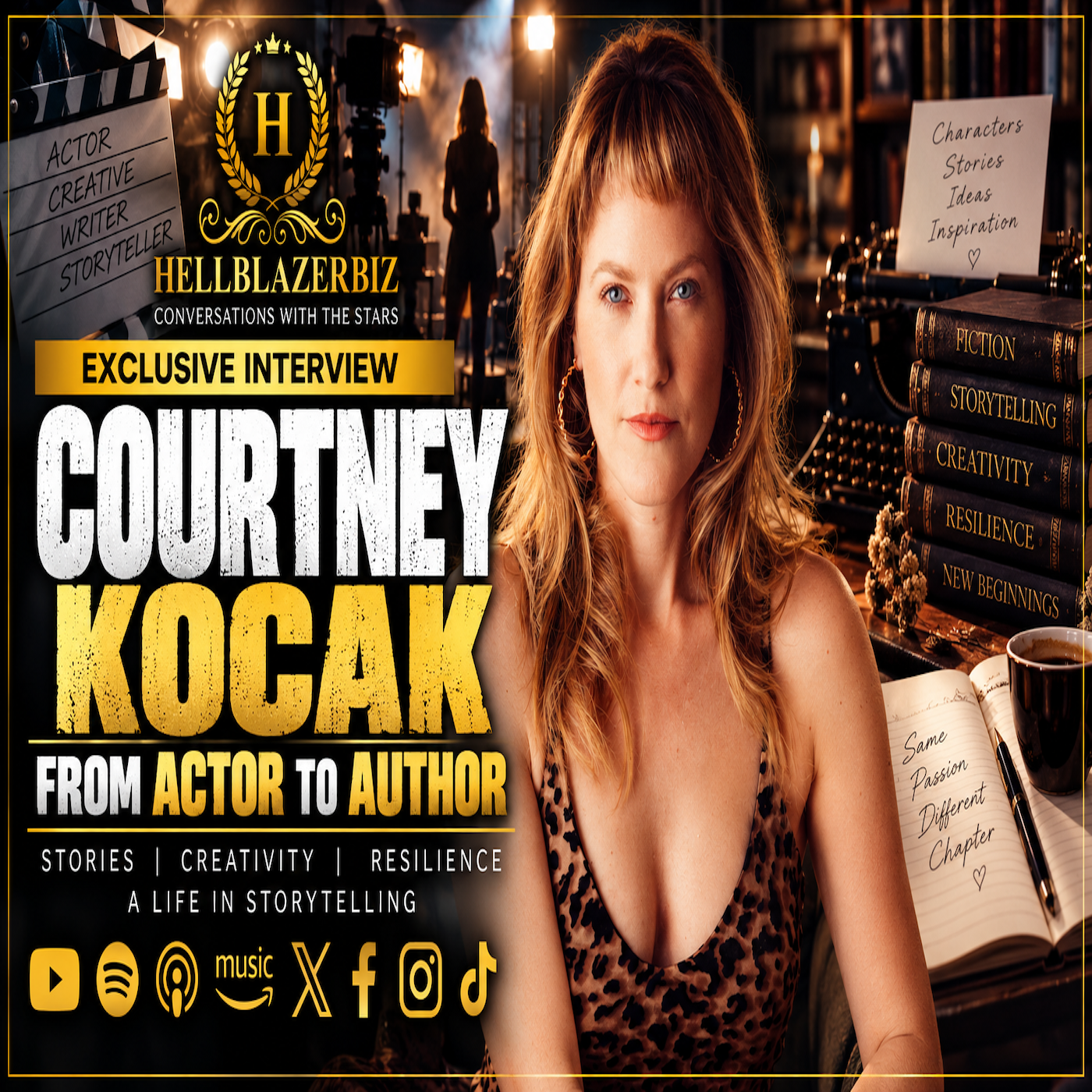
Hellblazerbiz: Conversations with the Stars · Hellblazerbiz®
Summary Courtney Kocak, a writer, producer, and comedian, discusses her multifaceted career, transition from acting to writing, and the evolution of her podcast, Private Parts Unknown. She shares impactful conversations from her podcast, the significance of her memoir 'Girl Gone Wild,' and reflections on her experiences during the Girls Gone Wild tour. The conversation covers a range of topics, including addressing toxic culture, the writing and revision process, impact on readers, unaddressed conversations, challenges in legislation, embracing identity, podcasting and connection, personal insights, and future plans. The discussion also delves into the choice of a Muppet that represents the individual's personality. Takeaways * Multifaceted career in writing, producing, and podcasting * Transition from acting to writing * Impactful conversations and reflections on Girls Gone Wild tour Speaking out against toxic culture and addressing unaddressed conversations * The impact of writing on personal transformation and empowering readers * Challenges in legislation and the importance of embracing one's true self * Utilizing email lists and Substack Live for engagement in podcasting * Lessons from podcasting and future plans for creative projects Chapters * 00:00 Introduction to Courtney Kocak * 08:44 Impactful Conversations * 16:04 Writing and Publishing Memoir * 22:07 Addressing Toxic Culture * 27:28 Unaddressed Conversations * 32:34 Embracing Identity * 39:36 Personal Insights and Future Plans
Chris Gordon: hey everyone, I'm Chris Gordon on Hellblazer Biz. Welcome and I'm here with Courtney Kocak who's a writer, producer, comedian and producer as well and hosts of Parts Unknown which is a sex positive travel style podcast. which explores relationships and culture. you've also got a debut memoir of Girl Gone Wild, which explores ambition, sexuality, misogyny, and your own experiences, including working on a Girls Gone Wild tour. And been quite a long time in development, obviously, from early essays to finally getting your published occasion as well. So welcome, Courtney. Thank you for joining me. Courtney Kocak: Thank you so much for having me. I'm excited to be here. Chris Gordon: Excellent great. I'm excited to have you here as well. You'll have to bear with me because it's been a while since I've my last one My nerves are getting to me a little bit. I'll crack on Okay, so you've worn so many hats. I mean as I just mentioned like writer podcaster producer What feels most you today? Courtney Kocak: Oh man, I think what feels most me is chasing all of them. I mean, I've never been someone who can easily put myself into a box. I think my career would be easier if I could. But yeah, I really love being able to do all of them. And I found that it all feeds into each other. like having a podcast has made promoting Girl Gone Wild so much easier. It made me able to produce the audiobook and narrate it myself. And so, I cannot pick a lane. Chris Gordon: fair enough. That's fair enough. I guess it all does roll into one as well. So when you got the podcasting, because you've used to that ⁓ and you can, know, and who knows their own book better than someone who can do this audio for their own books and someone's written it. ⁓ Courtney Kocak: Yeah. I have to say, obviously, the book is my whole story. you when you're interviewing people for your show, as you know, ⁓ know, you're doing a lot of storytelling through the questions that you ask and who you're choosing to platform and all of those things. And a memoir, I'm really like putting my whole like heart and soul and story out there. So that is that does make it the most me. Chris Gordon: Mm-hmm. fantastic. Yeah, you're right. Because when you do this kind of thing for ⁓ or whatever, you always you are putting yourself in someone else's shoes the whole time. So yeah, imagine it's quite daunting as well for you to actually have it finally published your own story. ⁓ Courtney Kocak: Yeah. It is, there's complicated emotions for sure. Chris Gordon: So what originally pulled you towards the storytelling? Courtney Kocak: So I was an actor first. That was my big dream. I grew up in a small town and I just always wanted to be an actor. And I chased that dream as hard as I could. And ultimately I went to college to do a BFA in acting. And then I did some independent films and then I went out to LA. And then I became sort of disillusioned with acting at about 27. I was just... Chris Gordon: Mm-hmm. Courtney Kocak: realized I hated auditioning. I hated being the last person brought on a project. I think from the outside, it seems like acting's the most exciting part of the entertainment industry, but then you realize, they don't have a lot of control over the projects that they do and what represent and all of that. And so I started writing as a way to create opportunities for myself. Chris Gordon: Mm-hmm. Mm-hmm. Courtney Kocak: as an actor and then I realized like, this is the, love doing the world building. I love doing the storytelling. I love, so I was screenwriting and I was, then I started writing essays and then I realized like, ⁓ shit, I have to pivot. ⁓ Chris Gordon: That's fantastic. and I think a lot of people, some people still, you know, don't understand the life of an actor. I mean, that's what I've done is interview actors. So I love hearing those stories because there's so much people don't know. And like you say, the auditions they're just nonstop you know, for every what 30, 40 auditions, you might get one roll out of it. So ⁓ I understand how, you know, how it can just be like. Courtney Kocak: Yeah. Yeah. Yeah. Chris Gordon: tiresome and despondent. You get so despondent from it as well. So it's good to actually get into that, you know, move into the storytelling from there and it builds you up there. ⁓ parts unknown itself, has got ⁓ a distinctive voice. So how did you get that concept? How did that come together? Courtney Kocak: Yeah. Hahaha Well, it's been an evolution. I started my first podcast was a comedy podcast that I did in 2013 with my writing partner at the time. And then in 2016, I was a frustrated dater. was, you know, on Tinder and trying to find love. And my best friend at the time was also going through a similar kind of thing. And so we started a podcast called Reality Bites and Chris Gordon: Mm-hmm. Okay. Right. Courtney Kocak: that is actually the precursor to Private Parts Unknown. It was on the same feed. And then I went through, I did a season with her, I did a season with rotating co-hosts, I did a season with different co-host. And anyway, I went through about four seasons of Reality Bites and then I realized, ⁓ instead of... it just being so focused on dating and entirely US based, like I wanna broaden the aperture a little bit and I wanna cover international things and I wanna broaden the topics and really as way for me to stay engaged because I was growing. had found... you know, I'd started dating my husband, my now husband at the time. And so I was kind of over the frustrated data phase and enter like I was interested in these other topics were sort of still related, but a little a little further out in up into including ⁓ rights ⁓ ⁓ like Giselle Pellicoe. And we did you know, when it turned into Private Parts Unknown, trip to Helsinki, a trip to Mexico City, ⁓ trip to Tokyo, and all of those were incredible opportunities to really see how other people live and love. And we could do our kind of Anthony Bourdain thing with it. so, yeah, I've been unfortunately after COVID, there was only one trip after that a Belize series that I'm actually going to be releasing shortly. love that I have more leeway in terms of topics and I'm actually going to do a rebrand ⁓ the 10 year anniversary in September and I'm going to broaden the topics even more. So I'm excited about the change and just I think if you podcast for a long time, it's good to ⁓ your show to evolve with you. Chris Gordon: ⁓ fantastic. Yeah, that's really good. It's really interesting to hear how you're coming along and what you've done to sort of, you know, you've reinvented after your first four seasons and then moving on. I kind of, I understand that from my point of view as well. been doing this like 15 years, I know exactly where you're coming from. I just haven't got the ideas to evolve to. I mean, yeah, that is really interesting. I mean, I started out doing impressions, that's all mine started as, we're saving the show. Courtney Kocak: Yeah. Yeah. ⁓ interesting. Chris Gordon: Constantine TV show. That was that's why the hell blazer came into it. So we're just doing that. And was people despondent because it was canceled. And so I just try to cheer people not comedy show, was cheering people up. So come on. And I was like, do Yoda for five or 10 minutes or stuff like that. And try to get people laughing. So yeah. But yeah, it's really, think podcasting is a great way to evolve and you do you evolve as a person, you can actually ⁓ evolve what your show your dynamics and how you actually do things as well. Courtney Kocak: That's so funny. Yeah. Chris Gordon: Yes, brilliant. What's one conversation or episode that's changed your perspective personally? Courtney Kocak: ⁓ my God, there's so many, it's so hard to pick. I just did an episode about forgiveness ⁓ ⁓ guest, Dravon James was the guest and ⁓ she framed ⁓ an act of It's for the other person, it's actually for you. ⁓ Chris Gordon: you Mm-hmm. Courtney Kocak: so that you don't carry around those toxic feelings. I loved that reframe, but I mean, that's just like one of the latest episodes. I learned something from every one of my guests and that's one of the best parts of podcasting is you get to build those relationships and you get to learn things from other people. ⁓ Chris Gordon: No, I definitely agree with that. That's actually a really interesting perspective to look at as well, isn't ⁓ Because yeah, you suppose you are, you you kind of letting go, it's your final act of letting go, isn't it really? And just like moving on from that toxic. Courtney Kocak: Yeah. Yeah, and like resentment, I think we all can feel that in our body. And when you actually let it go, that's why it feels like you're letting a weight off your shoulders. Chris Gordon: Hmm. ⁓ yeah, yeah, exactly. No, I like that. that's good. ⁓ podcast, obviously, because you're the author as well. So how would you say it's ⁓ We're talking about shaping your identity as you move along. So how's it shaped your identity compared to writing? Courtney Kocak: Well, it's allowed me to explore lot of the ⁓ topics I'm interested in and get other people's perspectives. And it's also just given me a place to start talking about some things. So like I had a lot of shame around my abortion that I had when I was 23 for a long time and I didn't tell a soul for over two years. And then realized maybe in like 2018, Chris Gordon: Mm-hmm. Courtney Kocak: that I wasn't talking about it publicly. Even though I had this podcast about sex and love and dating, I never said, that's happened to me. And through podcasting, been able to do a bunch of series ⁓ about ⁓ rights I've had some amazing conversations and I feel like I can sort of give back to my younger self a little bit and kind of normalize the conversation. ⁓ Chris Gordon: Mm-hmm. Courtney Kocak: that so shameful for me. ⁓ yeah, I think it's really powerful in that way. Chris Gordon: start by saying you shouldn't feel ashamed of that at all. I don't know which office you've come through. I know ⁓ your country, I'm not going to politics, but I know your country, it's a very hot topic. ⁓ ⁓ be honest, sitting over in the UK, we're frankly quite disgusted. attitudes. really shocking. And so you really can see where how valuable what you do ⁓ to women. ⁓ exactly. technically, it's not a taboo subject. It's not Courtney Kocak: Yeah. Yeah. Yeah, that's why we have to talk about it, I feel like. Chris Gordon: women shouldn't feel marginalized and trodden on basically by, you say, that misogyny, which we mentioned before, yeah, that is great. ⁓ And yeah, the fact that you've found that in yourself to be able to this medium actually express that, come to terms and come to heal yourself. And I say your younger self as well as reach out to everybody out there now and all the women who might be going through very similar, especially with that they've going on from the pressures from the society over America and Cool. So moving on to book as well. Courtney Kocak: Mm-hmm. Yeah. Chris Gordon: story we're looking at the stories and themes of your girl gone wild. of all I'm going to go into why the title? What does it mean to you beyond the obvious reference of... Courtney Kocak: ⁓ well, so really what I unpack is, you know, I sold t-shirts on the Girls Gone Wild Tour when I was 21. the title essay of the collection. And I think the whole book is an unwitting feminist coming of age. ⁓ so I went through a lot of experiences, especially in my early twenties, that sort of showed me what society thinks about women. Chris Gordon: Mm-hmm. Courtney Kocak: and showed me misogyny, showed me the patriarchy. ⁓ me, Girl Gone Wild is sort of a reclamation. it takes, know, girls that were coerced into doing things that they didn't want to do on the Girls Gone Wild tour were not Girls Gone Wild. They were girls done wrong. And ⁓ really a Girl Gone Wild is... involves agency and control over your destiny and rewriting some of those negative scripts around the patriarchal kind of rules that we have in our society. And that's powerful. In fact, the patriarchy doesn't want you to do that. so that's really like a big takeaway from the book. Chris Gordon: Mm-hmm. Exactly. No, that's really good. It touches on many, many themes there, like you say, which is still, you you'd think in 2026 that we just actually moved on, but no, we haven't. And it's, you know, when girls are sexually assaulted and stuff like that, and then, you know, they're the ones made to be a victim because they're wearing a skirt or something. They say, well, you must have been asking for it. That's what they say. You know, you must have been asking for it. Wearing a skirt. Why not? You know, what about the guy with actually walking with his shirt off? Is he asking for it? He's got no shirt. Yeah, it's no. Courtney Kocak: No, you're right, we have not. Yeah. Chris Gordon: It really gets to me as well, to be fair. It's, it's the society needs to change a lot. It started to, but there's too many deep rooted deep rooted atlas and misogynistic. Yeah. Exactly. I did quickly flipping back to a previous guest who did the same. She was a lovely lady, Alexandra Yenny, and she'd made a short film about menstruation and obviously, you know, trying to push the taboos about that. obviously the, ⁓ Courtney Kocak: Yeah. Well, this is my contribution to sort of undoing some of that. great. Chris Gordon: difficulties that some people can have with it. it was uncomfortable for me to talk about in fairness. But I actually really enjoyed it. It one of my favorite interviews because it took me right out of my comfort zone and that way of thinking has been brought up thinking, you know, you can't discuss it to like break the taboos and stuff. it was, yeah, I'm all for that. was really like break the taboos of all, why should it be taboo to talk about these things and let women express how they, you know, what it does feel like and, know. Courtney Kocak: Uh-huh. Hahaha. Yeah. Yeah. Totally. Chris Gordon: rather than have them all just sitting there like the zip over their mouth. can't discuss it. great. And obviously the book itself is described as a mix of emotion, delusion, sex and misogyny. So what made you want to tell it now? And obviously we just touched on it all there. So why did you want to tell this story now? Courtney Kocak: Well, it's been a dream since I made that pivot to writing when I was 27. I had this little idea in my head like, ⁓ someday I would love to write a memoir. But I didn't really know how to started. I... Chris Gordon: Mm-hmm. Courtney Kocak: was inspired by Cheryl Strayed is the author of Wild and she wrote Tiny Beautiful Things. I had this I was like, I would love to be like Cheryl, like my own version of Cheryl someday. And so I really just started writing essays and, you know, working towards the goal, but unsure of how to exactly do it. And then in 2020, I really started working on the book in earnest, I took a year long incubator with one of my favorite writers, Chloe Caldwell. And then I could really get started. And, you know, the story kind of came bubbling out of me. Like I'd been waiting to tell this story for a long time. And the Girls Gone Wild piece quickly appeared. A lot of the story of, you know, trying to make it in Hollywood quickly emerged. And so by the end of that year, I had a really solid draft and It wasn't, I could feel like it wasn't done. So I, but I didn't really know what to do. And so I sort of sat on it for a little bit. And then in 2023, I did another year long incubator. Cause I was frustrated with myself of like, why am I not getting this done? And I really knew how to, you know, I really took that one seriously. And so by the end of 2023, I had a version that looks similar to what it is today. I did a lot of revision after that, but it's been a long process, but I feel like it's ⁓ story that I've been wanting to tell even subconsciously for a really long time. Chris Gordon: Fantastic. guess, yeah, you want to make sure that's it takes long time because you want to get it right. And you want to, yeah, like I when you're going back and revising it, you want to make sure that it really is your story and that people really understand everything. You know, don't want to bypass anything or. Courtney Kocak: Yeah. Yeah, and some memoirs are about a, you know, a tiny slice of your life. And this one really is, you know, zero to 40 for me. And it also is my first memoir. So like I'm working on another one now. I don't think it's going to take nearly as long, but I am glad that I took my time with this first one and really tried to get it right because it's something that I can be really proud of. Chris Gordon: ⁓ huh. ⁓ definitely, definitely should be proud that, you know, you've been to get it out there and also, you know, you had your memoirs published. I started drafting one for myself about 10 years ago and I called it memoirs of a fat lad. This one I've put down, I've not touched it again for quite, for many years, for about five, six years. But yeah, it's, you kind of inspire me to kind of pick it up again and change it. just think no one wants to listen to me being dull. ⁓ Courtney Kocak: Ahahahahah You can always pick it back up. Yep. don't say that. Chris Gordon: with part of the years process and the experience with the Girls Gone Wild Tour as well. So what did you ultimately fully conclude about that time? About the tour itself, yeah. Courtney Kocak: about the tour itself? Yeah, I mean, it touched on it a little bit, but I just I my idea of which I don't know. Did you guys see the infomercials in the UK? Chris Gordon: about, no we didn't actually, no didn't get to see him. Courtney Kocak: So, you know, when I was growing up, if you watched late night TV, you could not miss these infomercials for Girls Gone Wild. And it was like, you know, censored, topless girls, but they were on a beach and it looked like a party and it looked like a really fun time. And there was lighthearted steel drum music and it seemed kind of innocent, but really they were selling porn. But that was not... Chris Gordon: And this. Mm-hmm. Courtney Kocak: totally obvious. guess it was in a way, but it was also sort of like hidden just with the vibe of it. And so when I took the job, I thought it was going to be the party that I saw on the infomercials. I didn't realize I was going to be part of making the porn. ⁓ and job was ⁓ really, know, official job was merch girl to sell t-shirts. But my. You know. Chris Gordon: Right. Right here Courtney Kocak: hidden job was to make the other girls feel comfortable enough to be exploited. And so I didn't understand that there was going to be so much exploitation. The girls were going to be drunk, expected to sign contracts. They were going to be coerced into doing things that they didn't want to do. to say that happened to everyone, but it happened to enough people that it was problematic. And Chris Gordon: Mm-hmm. Courtney Kocak: Yeah, I guess I just didn't know what I was getting into because the brand was such this powerful force and even politicians like John Kerry were making jokes about it. And so there was something that seemed kind of innocuous about it and that's not accurate. like today, you know, we understand what the company represents today, but we didn't know at that time. And so, yeah. Chris Gordon: Yeah. well, yeah, you can go into something quite innocent and thinking it's that, but I think that's something that's coming out a lot, obviously with, with the, with the Epstein, ⁓ stuff about how much, know, women and girls are being just traumatized abused and exploited as part of a system, you know, ⁓ make promises of this. then, you know, is that they're being Courtney Kocak: Yeah. Yeah. Chris Gordon: pulled into something that they've gotten lately like yourself, you know, like you did, you had no idea that that was, you were going to be part of a part of that itself. That's must be horrifying. You know, obviously it must be daunting and horrifying. And so, yeah, I'll say again, I'll give you so much kudos and credit for being able to come out and speak about this and give your experiences, will warn, be a warning and a lesson for others just to sort of, you know, take care because there, there just seems to be a hierarchy of men who do that and they you know and it's I can't say into words ⁓ know exactly what I mean it is it's just it's and it doesn't stop either does it no matter how hard people try but I think it's coming more to light and I think that's a good thing it's a more like you say more like you talk about it the more these your book comes out and ⁓ things like that and people can be open and start talking ⁓ Courtney Kocak: Yeah, it's ubiquitous. Yeah. Yeah, the Epstein files are, you know, it makes Girls Gone Wild seem like kid stuff. Like it's, you know, but I think they're part of the same toxic, you know, culture. And so if we can, I think, address the Epstein files in the way that it deserves to be addressed, it will have a trickle down effect in the same way that it's had a trickle down effect ⁓ Chris Gordon: Yeah Courtney Kocak: you know, all these other things like Girls Gone Wild happening. Chris Gordon: Yeah, yeah, exactly. So with the book itself, ⁓ we touched on quite a lot of that side things. But what was hardest part of it to in the hardest part to revisit? And I've got a feeling we've probably touched on some of that because it sounds quite. ⁓ Courtney Kocak: Um, you know, actually it was really cathartic to do a lot of the writing initially, like the generative writing. Obviously, like I cried, you know, during the more emotional parts. Um, but really the, the revision process was hard. It was pretty self-directed. And so it was really just me trying to live up to my own high standards and It was also a point, you know, when you're in the generative phase, you're not thinking about the book through other people's eyes. You're really just writing for yourself. But when you move into revision, especially when you have a book deal, which I did in the later stages of revision, you're thinking about what are the people that I'm writing about going to think about this? What are the, you know, Chris Gordon: Mm-hmm. Courtney Kocak: people, what are the writers that I admire gonna think about this? Like you're hearing all these other voices in your head as you're revising. you know, I think it's a valuable part of the process. I'm really glad I put a lot of time and effort into it, but it's different. It's not as fun for me as the generative phase. So that was definitely where I was like very emotional, very much. hearing lots of voices in my head. yeah, that was tough. Chris Gordon: can imagine I can imagine. And with all this topics that you cover with, obviously, sex, identity, substance use and things, was there anything that you'd almost left out? Obviously, even in the revision when you did through the revision stage, even that you're thinking, I'm just gonna leave that out. Courtney Kocak: ⁓ not really because I didn't want to say it or admit to it, or I thought it was too much. I did trim a couple things that were about other people that I just thought were like sort of gratuitous or not my story to tell, you know, even though I thought it was like a funny detail or whatever. just really, you know, that was part of the revision process is just Chris Gordon: Mm-hmm. Mm-hmm. Courtney Kocak: protecting the people that I love and even the people that I don't love deserve, you know, don't deserve me to talk out of turn about their story. And so, yeah, I did a little bit of censoring for other people, but I didn't do any of that for myself. Chris Gordon: Okay, thank you. This is a good answer. And what do you hope readers feel when they finish the book? We mentioned about readers how you but when you were doing the revision how you want to feel. So how do think they'd feel when they finish the book? Courtney Kocak: Well, I got so much out of the actual writing process. Like it changed me as a person. I sort of could take experiences that I'd felt a lot of shame about before and kind of unpack that. a of it dissipated in the process. And so it was really like an experience of liberation for me. And so what I hope readers get from it is you know, being able to unpack some of their own shame and being able to forgive their former selves for doing things that, you know, their current self wouldn't do. you that can be a really powerful lesson. So I hope to pass that on to others. Chris Gordon: Excellent, excellent. Some really great advice again there, Courtney. Thanks. And obviously with the work as well, obviously sits at the intersection of sex, media and culture, which we've obviously explained to her a few times, talked about what conversations do you think? And again, we touched on this, but what conversations do you think we're still not having openly enough? And I think we have, we've touched on this a few times already, but. Courtney Kocak: Yeah, well, I mean, it's just deeply embedded some of this ⁓ is with, you it's great when like Giselle Pellicoe ⁓ public with her, her story of her husband facilitating her rape, you know, dozens of times over. But like, we need to have a bigger conversation around that. in terms of like, that's not what every victim looks like. victims never get justice ⁓ sexual assault and things like that. And so, yeah, we need to be able to talk how to make that right and like how to stop those dynamics from happening in the beginning. also with... reproductive rights. mean, we sort of talked about this, you know, with rights being threatened in the States, the conversation needs to keep happening until those rights are able to be restored. And so, yeah, I think those are, I to have those conversations, but I don't know if culturally we're having them enough. Chris Gordon: Yeah, no, agree on that one as well. And I think it's, is it right? Because we got done, you that in America at the moment, woman can get shoved in prison or even, I guess, sentenced to death if they take go out of state, or state they're in. Courtney Kocak: depending on what state, yeah. Yeah, yeah, but some of the state laws are very draconian and some of them are trying to make them even more restrictive. it's insane because also, know, we think of abortion as, you know, terminating the pregnancy intentionally, but there's also miscarriages ⁓ there's people that have, you know, that want to keep their baby, but they have Chris Gordon: Mm-hmm. Courtney Kocak: health risks that come up during the pregnancy. And that the same process. To ⁓ them, they need an abortion. And it's the same. And so it's also affecting women that are trying to have a baby or ⁓ no desire to terminate their pregnancy, but they have to because of their health is at risk. Yeah. So I don't think that Chris Gordon: Yep. Yeah. complications Courtney Kocak: that nuances understood. Chris Gordon: No, there's lots of nuances, lots of different reasons why someone might have to have that and just to blanket draconian laws which are put in a crime. I I did see it. I don't know who it was. won't name and shame their name, but I can't remember which one. Some politician is pushing for women to have their votes removed as well in ⁓ wants That's how bad. said we shouldn't have women. Basically, just says that his words, I can't remember his words, but... Courtney Kocak: Mm-hmm. ⁓ God. Chris Gordon: transpose as something like pretty much they're just vest, vest, vesticles or vest, vestibules for carrying children. That's all they should be there for. And he's a politician in America. And it's like, really, you've got you're someone in power. And this is a kind of attitude. And, and you just I mean, you know, know which party he was in. That's obvious. But you just listen to it. And I just I was aghast. You know, I was just I was just looking at it. And I was just Courtney Kocak: That's horrible. Yeah. Chris Gordon: wanted to throw my phone and to be honest it's just shocking that that kind of conversation is happening today. Courtney Kocak: Well, Republicans are pushing the save act right now, which is, know, not everybody is as extreme as that comment, which ⁓ happy I missed because that's ⁓ But yeah, I they are trying to make it really hard for women to vote who don't have a passport or who changed their names when they got married, which is so dumb because also I think it's going to affect more Republican women than like I didn't change my name. Chris Gordon: and I'll out who it is, I'll send it after. Yeah. Courtney Kocak: So anyway, there's a lot of messed up shit that's happening here right now. Chris Gordon: ⁓ You It is. I really feel for you. I've got quite a few friends out in America as well. And it's just, I listened to the stories and it's, you just don't even have to listen to stories. Just look at the news ⁓ from our side and you know, people come across here and they don't realize when they see the news, it's, know, completely different to what's been put out across there. It's just, yeah, it will change people like you, you know, that's what we need. More people like you. There are a lot people like you out there just to push back and, and, fight against that system. ⁓ Courtney Kocak: Yeah. You Chris Gordon: What would you say to someone who feels like they're too much or not enough in their own identity? Because that's obviously something you really... Courtney Kocak: I think you gotta embrace who you are. love this Harris Whittles. Harris Whittles was a comedy writer who wrote on Parks and Rec and other shows and he was very funny. And then he passed away from a heroin overdose in his early ⁓ But he has this tweet that I think about all the time and he... ⁓ The tweet was, do you ever think somebody hates you and then they like something of yours on Instagram and then you realize in hundred years we'll all be dead? And I think about that all the time because it's like, we have this one precious life that we are living right now. And like, don't get too caught up in what other people think about you and don't, you know, try to talk yourself out of doing something because you feel like, It doesn't follow what other people expect of you. Like you have a hundred years if you're lucky, you you probably have less than that. And so like take advantage of all the time and like live your as long as you're not hurting anybody else, like live your best life and like make yourself happy. And I think everything else will fall into place. And, you know, the haters that think you're too much or not enough, you know, they'll be your haters. regardless of what you do. So don't worry about trying to please them. Chris Gordon: That's actually really good. I'll take that myself because that's advice for me as well, because I'm just like that. think I'm always trying to always try and please other people. it's like, you know, and then I find that thing. Yeah. Life and time has just passed by so quickly and you're like, I've just spent all that time worrying and wasting on why, you know, it's ridiculous. So a bit of advice for podcasters then like myself. So what separates for you as a successful podcaster? What separates a good show from one that truly connects? Courtney Kocak: Yeah. Yeah. Yeah. Well, I'm still trying to be a successful podcaster too, but I think right now, is a great place to set up shop. It's really good to have an email list along with your podcast. so, the of a podcast is like you're in somebody's ear for 30 minutes to an hour, ⁓ depending your show. And so you have a very intimate... relationship with them, but you're dependent on them to go back to your feed to stay in touch with you. So if you have a live show or you have else you want to promote, you don't have a way to do that unless they come back to your feed. ⁓ so having an email list alongside your podcast, which you can do on Substack, you can host your podcast on Substack for free. I only do that for one of my shows because like for ⁓ Chris Gordon: Mm-hmm. Courtney Kocak: Private Parts Unknown, I have ad sales through another network. But if I were just starting a podcast today, which I was a couple years ago with podcast Bestie, I just started it on Substack because why not? I figured I'll just move when I have a reason to move. And on Substack, you can do things like Substack Live, which I've been experimenting with. And so what I do sometimes, I don't do this for every episode, but like Chris Gordon: Mm-hmm. Courtney Kocak: you can connect the Substack Live to your YouTube channel. And so instead of, you know, I'm totally down to edit the audio podcast and I'm kind of a control freak about that, but like I do not have time to do the video as well. And so beauty of that is ⁓ I'll just record the audio like we would ⁓ we're recording now. I would start that with the person and then I move over to Substack Live with them. and we do a live and then we go back and close out the audio. And then I use the Substack Live video with the well edited audio version of the podcast. And it does the auto clips like we were talking about that are amazing. ⁓ just a new workflow that I'm experimenting with to make video easier because obviously YouTube is an incredible discovery platform. I have not cracked. Chris Gordon: Right. Yeah. Okay. Yeah. Courtney Kocak: this yet. This is an experiment that I'm running, but in light of recent trends, feeling bullish on the email list, ⁓ ⁓ YouTube aspects. But the problem is you don't want to create a ton of extra work for yourself. So that's why think the Substack Lives can be so helpful. ⁓ I I don't ⁓ not has to have a million downloads. I think if you're having valuable conversations with people and of the beautiful things is not only you're building an audience, but you're also ⁓ the connection. Like, you know, we're getting to have this conversation. I know you 40 minutes better now, you know, than I did before. And so those that you can build as a podcaster are so valuable. And so that's who... ⁓ Chris Gordon: Mm-hmm. Yeah. Courtney Kocak: former guest. That's who I asked to blurb my book. That's who I'm doing book events with. so just about how you can use your podcast to build your network can be a great way to leverage regardless of the size of your show. Chris Gordon: Excellent. That's really, really helpful and a really interesting answer as well. Accordingly, I love to check out sub stack. I've been using Riverside and that's great because after this, is a video when they've introduced some of their praise from it because we do this video and then afterwards, within about 20 minutes maximum, would have they do read AI would have completely redone the whole interview taking out all the pauses all the arms the ours and it gives a magic and then you get all the little magic clips but it does it completely Courtney Kocak: Yeah. Really? Chris Gordon: It gives you the full episode. is good quality. It's good. It comes out. just, think there's only once where I've had to change it slightly. ⁓ Courtney Kocak: And it's good. It's a good edit. I'm gonna experiment. I've been doing a lot of interviews for the book and lot of people are using Riverside these days and I am going to ⁓ with Riverside as well. But I just feel like sub-stacked lives ⁓ sort of, people expect different quality from it and so it's fine if you just release that video but I'm definitely have to check out Riverside. Chris Gordon: Mm-hmm. Yeah. Yeah, you can integrate YouTube live on this as well and do stuff as well. So it does it. Yeah, you can go live on YouTube and a couple of other channels as well. I've not tried it yet. Actually, no, did. did it with the Cobra Kai cast once and I went, I did a live through them and it went right live on the YouTube channel. It was pretty decent. But there's the tools and technology is fantastic out there now. Yeah, it is really good. So thank you. I'm going to do some quick fire. Courtney Kocak: ⁓ wow. ⁓ huh. ⁓ cool. Yeah. Chris Gordon: questions before we close. I'll say quick fire but the answers might interesting. One to describe your younger self during the Girl Gone era. Courtney Kocak: Okay. ambitious. Chris Gordon: Okay, a book that changed your life? Courtney Kocak: Tiny Beautiful Things by Cheryl Strayed. Chris Gordon: Excellent. Most unexpected lesson from podcasting. Courtney Kocak: ⁓ my God, there's so many. How can I just one? ⁓ Chris Gordon: That's a difficult one isn't it? Yeah, so much you learn. Courtney Kocak: I think was a surprise to me that podcasting would just be a huge part of my life. It sort of happened by accident. so I think the big lesson ⁓ ⁓ most surprising lesson is just like what a powerful medium it can be. Chris Gordon: Yeah, okay. Excellent. Thank you. A misconception people have about you. Courtney Kocak: my God, ⁓ try not to pay attention. I try not to pay attention to other people's misconceptions. think, you know, depending on how they know me from, you know, if they know me from standup, they probably don't understand, you the softer parts of me. If they know me from depending on they know me, because I do so many things, they might have misconceptions about who I am as a whole person. But that's OK. can think whatever they want. Chris Gordon: Yes. Okay. Courtney Kocak: Haha Chris Gordon: what's next for you? ⁓ Courtney Kocak: Well, I'm really excited to keep talking about Girl Gone Wild for the next year and a half or however long, maybe the rest of my life. am going to be, I'm so excited to return to the page and I've got about half of my second memoir done. And so in the summer and in the fall, I'm going to be really working on that. And I'm really excited about that process. And yeah, I'm going to be trying to sell the Chris Gordon: You Mm-hmm. Courtney Kocak: TV show related to Girl Gone Wild. I'm going to be rebranding my podcast. I've got a lot of things in the pipeline. So yeah, just keeping busy with all my creative stuff. Chris Gordon: That's fantastic. And my signature question, which is completely random, by the way, the reason I chose this is again, go back to the Muppets thing I did. had Mike Quinn. He was a Muppet. He was a puppeteer for Jim Henson. ⁓ And he played name num in Star Wars. He was on the show once. And a question was asked by guests. I used to reach out to people and send the questions in and I asked it of him and I thought this is such a cool question. It's a personality question. I've kept it. I asked pretty much everybody. So if you could have a Muppet. Courtney Kocak: ⁓ huh. Chris Gordon: created after you, what Muppet would it be and why? It could be a mix of any. It could be new one. It could be what an existing one. It's a hard question. Courtney Kocak: after it is a well, I don't know the Muppets as well as you do. So I'm really curious what you would Muppet you would assign to me. Chris Gordon: ⁓ God, don't ask me that. this is the problem. A lot of people are too young to remember the muppets properly. I'm stuck here. I don't know. Courtney Kocak: Yeah. I always liked, I don't know if it was, liked the drummer. Chris Gordon: animal. Courtney Kocak: Animal. So maybe I'd be an animal. Chris Gordon: Actually, yeah, that's probably right. Yeah. Free spirit and quite somewhat gathered from here. A free spirit and very lively. Animals are good on. I did my Kermit once. was like, you need to all sit. Excellent. Is there anything like you'd like to say, obviously before I wrap this up now for everyone, is there anything you'd like to say to people who will be watching or listening to this? Courtney Kocak: Yeah. Yeah. I encourage you to check out Girl Gone Wild. I'm really proud of this book and I've had a really great time chatting with you. Chris Gordon: Thank you. Have a great time chatting with you.