
Hellblazerbiz: Conversations with the Stars · Hellblazerbiz®
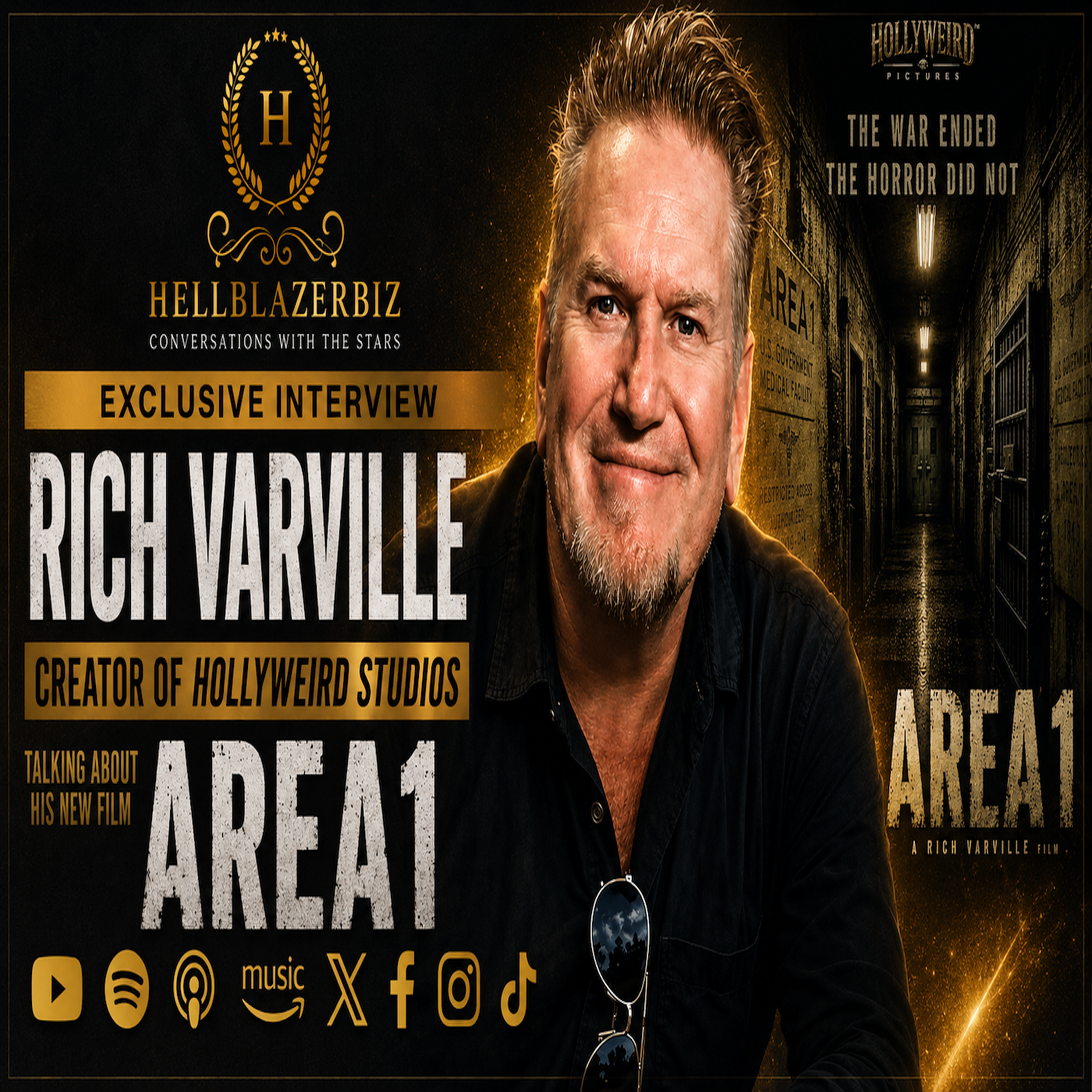
What actually makes a horror movie terrifying? 3-time Emmy-winning filmmaker Rich Varville (Area 1, Holly Weird Pictures) breaks down the craft of psychological terror, why he prefers suspense over cheap jump scares, and how he balances B-movie camp with deep, mind-bending dread. From drawing inspiration from historical events like Operation Paperclip to building a new home for indie thrillers, Rich reveals how to make stories that stay in your head long after the credits roll.
Chris: Welcome back to Hellblazer Biz. Today we're diving deep into the world of elevated horror, psychological thrillers and cult cinema. My guest today is a three-time Emmy Award winner over 25 years in production and 15 years in the director's chair. He's produced on a brand new legendary Killer Tomatoes franchise and now he's officially launching his brand new indie social studio banner, Holly Weird Pictures. The debut film being Area 1, currently taking off in the desert landscapes of New Mexico, blending deep atmospheric tension with grounded psychological dread. Joining me today to talk about building an indie genre powerhouse, modernizing classic B-movie cult royalty, and what it takes to bring pure tension to the screen, please welcome filmmaker, director and producer Rich Varville. Rich, welcome to the show. Rich Varville: Hey, thanks for having me. Chris: no, thanks for joining. really appreciate it. Looking forward to this chat. Rich Varville: Yeah, yeah. Chris: So, as I mentioned there, you kind of spent 25 over 25 years in production. You've picked up three Emmy Awards along the way after such an established career across TVs and documentaries. What was the precise spark that made you step out to launch Hollywood pictures and focus on that horror and psychological thrillers? Rich Varville: Well, it's it's pretty funny because out here in California, anytime we go to Hollywood, we always call it Hollyweird. And you know, common term. Chris: Mm-hmm. Rich Varville: And I was surprised it wasn't being used, so I I submitted for trademark right away. And Chris: You Rich Varville: because it it just fits. you know, I live a couple hours south of Hollywood, but it just really fit everything that I'm doing. Which for Chris: Mm-hmm. Rich Varville: the last few years, probably last eight years or so, I've done horror films and it's quite a bit of a little bit of everything. I actually do comedy and drama and but psychological thrillers and horror is where my heart's at. You know, I'm I'm I'm more of a a Hitchcock type of fan, where the films I like to make really evoke thought and I like Chris: Mm-hmm. Rich Varville: to allow the audience to create a much worse. version of what's going on in their own head, you know, instead of you know, like gore or shock value. Because for me, it's like, yeah, you know, it's been done. I mean, I guess it's it's fine it, you know, for like Ash versus Evil Dead and and you know, stuff like that, which is great, you know, and Terrifier and and those kind of things, which is is great and has a separate type of audience. But what really gets me is just the psychological elements of Chris: Mm-hmm. Rich Varville: fear. And particularly in this film coming up, Area One is is really it really dives into that, you know, kind of primal fears, like what if? Chris: Excellent, excellent. I love that kind of horror. I'm a huge horror fan myself. But the one which did doesn't still fear because there's so many, like you say, horror flicks out at the moment, which you find in their own genre where they're just like slatter flicks and gore and that's all it is. It's a shock of gore, I think. But ones that get in my mind are the ones that stick with me the most. Rich Varville: have their place. You know, I mean it's it's it it's all fine. I'm not I'm not being critical of any of those. Everyone has their own style and it's Chris: no no no no no no no no no no Rich Varville: you know, I I don't like to judge, you know. Chris: Yeah, no, no, it's not been not been critical at all. So I do love those films as well. And they, you know, they are great. But I prefer one, like you say, where it sticks in my head and I have to think and, you know, it has me looking around the room and, you know, thinking, hang on a minute, what's going on? Yeah, what's Rich Varville: Right. Right. Chris: going on? Yeah. So obviously, with the company that you set up 15 years with the director under your belt, how does it feel having your own banner like Holly weird pictures? Now, does it allow you to do creative? What does it allow you to do creatively that you couldn't do under standard client or commercial work? Rich Varville: Well, I think the be the reason for Hollyweird is to just define the genre that I like to create. it's Chris: Mm-hmm. Rich Varville: it's more about shifting a brand because like I said, I did a a lot of different types of of content, a lot of different types of genres over the years, but my heart lies with psychological thriller horror. And I just wanted a a studio label that really reflected that. You know, like you have Blumhouse and you get A twenty four. They're Chris: Mm-hmm. Rich Varville: known for a very specific type of film. And that's what I'm trying to trying to create as well. Chris: Excellent excellent. I have heard the her the phrase holly weird before so it's quite it's quite funny to hear that Yeah, it wasn't it wasn't actually a pinned name for anybody Rich Varville: Right, yeah. Yeah, yeah. And it surprised me as much as anyone. Chris: That's obviously, I'll say of course, like joining a cult. It's like your servant is the producer for the new Attack of the Killer Tomatoes organic intelligence film. That franchise is about B, it's absolute B movie royalty, should I say. know, it dates back decades. Yeah. Rich Varville: That's that's being kind. That's being kind, man. I mean, B, A, who got a great B. Now, yeah, yeah, yeah. I got involved a couple years ago and I was hired to script doctor and story consult. and that's kind of one of my specialties is taking a script and preparing it for production. making sure the formatting's correct and working on Chris: Yeah. Rich Varville: a lot of the character arcs and punching up some jokes and and things like that. So I was intimately involved with this story a couple of years ago. And we went Chris: Mm-hmm. Rich Varville: into production in May of of twenty twenty five. And it was it was quite a bit. It was it was a lot a lot Chris: Thank Rich Varville: to shoot and there was a lot of characters and a lot of locations and yeah it was crazy. It it was it it's fun, but it stays true to the whole franchise, that it's just silly fun. And it was actually Chris: Mm-hmm. Rich Varville: last Monday we had the premiere in LA. And it it just it was a great vibe to see it in a theater with I mean it was a packed theater. And Chris: Yeah. wow. Rich Varville: you know, and that's the way I've always felt films are really meant to be seen is in Chris: Mm-hmm. Rich Varville: a community of people that, you know, of like mine. And it just it's a shared experience. And it was it's just really it's therapeutic to be able to laugh, you know, with a big giant group of people or be scared together or cry together or whatever the emotion is. You know, I mean having that that communal effect is is a powerful thing. Chris: Definitely, definitely. What's it like striking the balance between obviously honouring the 70s and 80s camp like horror, which is what the originals were, and then bringing it to that modern cinema? Sounds like you've made a success if the theatre was packed. Rich Varville: Yeah, yeah. I mean it's I mean really not that far removed from what was done in the seventies, you know. Maybe a little bit more money to work with, you know, better sets. you know, we could bring in some name actors to it. And so yeah, it was it was it was interesting process. There's there's a couple other films. obviously the the second one was George Clooney's first big film. so Chris: Mm-hmm. Rich Varville: well big film it was his first film. And so it's kind of interesting. A lot of people like that one. so this Chris: Yeah. Rich Varville: one, this particular film stylistically is is a lot closer to Return of the Killer Tomatoes, that second one. so but it it has all the silly campiness, you know, government conspiracy, you know, corporate greed, you know, and then silly tomatoes. But there's really no message to it. I mean, there's no political message. There's it's just silly fun. And intent is for people to just just have fun with it and laugh. Chris: x x like I'll wait to see it. It's brilliant and Rich Varville: Yeah, it's fun. Chris: just produce it just producing a what I obviously a fun absurd horror comedy like killer tomorrow so sharpen a different set of filmmaking muscles than direct in the tents obviously psychological through like area one for example. Rich Varville: Yeah. actually repeat that again. I missed the first part. Cut off. Chris: I was going say, does producing an absurd horror comedy like Killer Tomatoes, does it sharpen a different set of filmmaking muscles than directing obviously like a psychological thriller like Area 1? Rich Varville: Yeah, okay. yeah, so on the Tomatoes film, I have a quite a bit different role on that. So I was part of the story Chris: Yeah Rich Varville: development, I was second unit director, which was just a lot of filler scenes here and there to, you know, for transition purposes. And I was a locations manager in San Diego, coordinating the the USS Midway battleship to shoot there and a lot of I mean a lot of very difficult locations to secure. So, so that's my producer hat, which is a lot of the same thing I'm doing on area one. I'm producing, directing, and and wrote the story. so it's it wears a lot of those same types of hats, but Chris: Yeah. Rich Varville: then you're directly involved in responsible for the creative process. So going through every shot of the film and the the feel, the vibe of the film. And and area one is quite a bit different. It's quite a bit removed from. Tomatoes. Chris: Yeah. Rich Varville: it it's it's a serious it's not a comedy, it's a serious thriller, captive survival type of story. And you know, I'm not reinventing the wheel on this. It's it's taking the same tropes that of that work, that people like. sometimes it's too much of a gamble, I think, to just go with something totally outrageous, different and new. And it it's not tested. And so that's it's a big gamble. So this is it's a little bit more safer genre, you know, it's but it it Chris: Mm-hmm. Rich Varville: definitely is in line with films like like Seven and Prisoners and Descent, Chris: Yeah. Rich Varville: you know, films like that, where the story is very it's very intense. And one of the the ways that I like to write and direct is the audience knows and is very aware of all of the danger. But the characters are not. So instead of Chris: Mm-hmm. Right. Rich Varville: these big jump scares and surprises, the audience already knows what the characters are getting themselves into and what they're walking into. Chris: Mm-hmm. Rich Varville: And you can't help them. So you you're you're like, you know, it's that whole watch out. You know, you know who's behind the door and that that Chris: Uh-huh. Rich Varville: kind of thing. So I love that kind of suspense thriller. it but the horror really is to me has always been human behavior. Chris: Mm-hmm. Rich Varville: Right. So I'm I'm not really into like paranormal and you know things like that, which is fine, you know, but I like the realism, plausible realism of Chris: Yeah. Rich Varville: this could actually happen. You know, this Chris: Mm-hmm. Rich Varville: could happen to you. And everything in this story, all of the science behind it, because there's a little bit of science going on, the location, the everything about it is plausible, like this could happen. And it's almost presented like this did happen, and it was classified files that were found and to tell this story. So it's really it kind of interesting in that respect. Chris: Excellent. I'll pull out my tinfoil hats to put on when I watch it because I'm a huge conspiracy theorist. Rich Varville: Yeah, well, you know, hey Yeah, I mean this one this one definitely I can't give away too much of it. We'll we'll talk about it when we get into Chris: yeah. Rich Varville: production and we start doing some little vignettes and stuff. But yeah, it really probably the marketing for this film will heavily target conspiracy theorists. because there's there's a Chris: Mm-hmm. Rich Varville: lot of that. And this this particular film and the history behind this location is goes back to post-World War two or during World War War two. And if you're familiar with like Operation Paperclip and you know, brought a lot of the scientists over, Nazis, and there's a lot of experimentation on people, things like that. So that's a little hint. but this is the Chris: Yeah. Okay. Rich Varville: story set in modern times. Chris: Fantastic. That sounds really good. Rich Varville: Yeah. Chris: It's is obviously Hollywood's inaugural projects and the filming is in New Mexico and we're kind of which I guess is famous for its history with nuclear testing and UFO laws and the dramatic desert landscapes, which I can imagine is really brings in for that psychological value. Rich Varville: And we're we're literally filming just miles away from that. So the on yeah, the Chris: Really? Wow. Rich Varville: authenticity of what we're doing too and the locations that we have are very close Chris: Mm-hmm. Rich Varville: to that geographically to that area. And that is there's there's some other things that I can't give away, but there's some modern controversial things happening Chris: Mm-hmm. Rich Varville: now that are are kind of implied or tied into the story. So Chris: Okay. Rich Varville: Yeah, it's it's pretty intriguing. Chris: Excellent. And you mentioned earlier as well, you've got to focus on the elevated horror and psychological suspense rather than just go aspect of things. So how do you have touched on it already, but how do you approach building dread on the screen through the atmosphere and the sound design? Obviously, because you've got a huge deep background in editing and audio. So can you give me some tips and hints on how you managed to get that into the film and use that? Rich Varville: Yeah, that's a great question. actually I'm not a hundred percent decided how I'm gonna approach the sound design, but Chris: Right. Rich Varville: I'm pretty darn close to deciding that the whole while while while our characters are trapped in this facility, which is a hundred feet underground. so if you're if you're claustrophobic, it's gonna be very, very intense for you. And everyone that's read it too, read the story so far is just like, my God. And they're just you know they had palpitations and and it's very intense and it's fast. The f the whole film's fast paced. There's no lull to it. But as far as the sound design, the I'm almost leaning toward no sound design. Like no well, no score rather. So it'll be sound design, obviously, but because the facility that we're filming in is It's an a an abandoned prison and with kind Chris: Right. Rich Varville: of medical facilities and stuff. And it's amazing. Chris: Mm-hmm. Rich Varville: So the production design is amazing on this thing. It's gonna look like a ten million dollar film, which it's not. It's very low budget, but s a lot of the sounds, creaking pipes and noises and just just this hollowed, you know, sound to it. And So there's probably not going to be a lot of sound like traditional horror type sounds because I want Chris: Mm-hmm. Rich Varville: to immerse people in this space and feel what the characters are feeling. And sometimes to me, so my background is producing music for many, many years before I went into filmmaking about 15 years ago. And the biggest accent in music is silence. So when you take away all sound, sometimes that makes more of an impact than. having all this, you know, lush, jarring sound design. So there will be a bit of that, obviously, but but probably not a traditional score that you would normally have in a film, you know, dread and that that underlying drony kind of, you know, atmospheric stuff. So we're probably not going to have that at all because the location is so creepy. And you know, the realism too that you're not going have music playing when you're down in this this facility and all the things are happening. You know, so so I yeah I'm kinda leaning on the the the side of realism. Chris: Excellent, That sounds really good. I can't imagine that you've got such a location where you can. You don't need to add all these atmospherics because you've got that. can just imagine the tension now. I'm just sitting here picturing it now going down and having those like the pipes and everything and the drips and the echoes going around. I mean, how did the cast find that? Did they get quite spooked as well? Because that sounds like a pretty spooky place. Rich Varville: Well, no one's been there yet. So we we start production first Chris: okay. Rich Varville: first of November. so nobody else on the whole crew or cast has actually been to this actual location. I'm the only one. but it's it's a real prison that shut down in the late 60s and it was opened in the 30s. Chris: Mm-hmm. Right. Rich Varville: And it was a pretty hellish place, the stories of things that happened, if the walls could talk. Chris: Mm-hmm. Rich Varville: And when you're walking through this place, you can feel it. I you know, I believe there's a real I don't whatever you want to call it, you know, spiritual, cosmic energy, whatever from dead souls Chris: We're here. Rich Varville: and people that have been through you know, torment. It's it really is a really fascinating place that's naturally creepy. Chris: Mm-hmm. Rich Varville: So I think the actors are gonna be just fine, Chris: you Rich Varville: you know, not having to use too much imagination because it's right there in front of them. So this isn't on like a Hollywood set, it's not a built set. This is an actual real location that real awful things happened to people years ago. And it was a prison that housed federal inmates, local, county, state women and children. It's it's a fascinating, Chris: Wow. Rich Varville: yeah. And it's it was at the time was kind of in the middle of nowhere. So it's a really Chris: Yeah. Rich Varville: fascinating real life historical place. So I'm I'm just Chris: Good. Rich Varville: I'm excited we were able to secure it and be able to film in there. So it's it's gonna be cool. You guys will see it on screen Chris: Yeah, that's awesome. Rich Varville: 'cause it's it I yeah, I c I can't oversell it enough 'cause it's really the the whole facility is a character in the film as well. Chris: I was about to mention that as well. sounds like it's like one of the main characters is this haunt. I say haunted. I'm quite happy to say haunted. I believe in that kind of thing anyway. So yeah, I wouldn't be surprised if you guys experienced some of that when you're actually on set as well. Even just with the atmosphere, whether it's like, know, what do they call it? Group. It's not a hysteria type thing where you all can witness something or yeah, I think it's going to make it. think it'll make the whole film. a lot closer because with cast and crew experiencing that same dread you'll be watching your backs, you'll be watching the shadows in case you see something slightly moving. I can imagine that's going to transfer to the screen. Rich Varville: Yeah. believe me, yeah, I I spent a half an hour in there by myself taking photographs and video and and after half an hour alone in there, it it's pretty unsettling, actually. Yeah, I mean, especially by yourself. Yeah, what's that? Chris: Yeah, you're a braver man than me. I can imagine you're a braver man. So you're a braver man than me spending even half an hour alone in a place like that. Rich Varville: Nah, it's you know, it's it it it's fine, but it's yeah, it's yeah, because the doors are open so you can get out. But if there were if the doors were closed, Chris: Yeah. Rich Varville: it would probably be quite terrifying in there. Anyone that's been Chris: I can imagine. Rich Varville: to Alcatraz can imagine. Chris: Mmm. Rich Varville: Imagine shooting a movie in you know, a psychological thriller horror inside Alcatraz Chris: Yeah. Rich Varville: and you're trying to get out of it. Yeah. So if you imagine that, then you can probably have a pretty decent idea of of what to expect. Chris: Fantastic, And obviously that's not the only atmospheric place you mentioned you you've got the USS Medway as well for the Tomatoes movie. So I guess that's Rich Varville: Yeah, for the tomatoes, yeah. Chris: pretty atmospheric as well being on there. Rich Varville: Well, I mean it's anyone that's been to San Diego, I mean, that's one of the main tourist attractions is the Midway, 'cause it sits right there in San Diego Harbor. it's an amazing ship. they, you know, do daily tours. So the the I filmed there a couple of times, a couple of different movies. And one of the tricks to the Midway is you have to film from four AM and you have to be off the ship by ten AM when they open, 'cause it's a museum. So whatever decorations, Chris: Right. Rich Varville: set decorations you're gonna do, moving things around, et cetera, you have to have it all shot and done by ten AM and off the ship, which is presents, you know, quite a few challenges. you know, getting a crew there at three in the morning to load on and you gotta load, Chris: Yeah. Rich Varville: you know, gear on the the plankways and the the whole thing. So it's yeah, Chris: Yeah. Rich Varville: it's it's a challenge, but but man, you can't beat, you know, being able to film on a battleship. It's pretty awesome. Chris: Exactly sounds brilliant. I guess a huge problem for continuity as well If you happen to change it, you've to get it back every single day. You it exactly the same as well Rich Varville: Yeah. Well, I mean, as filmmakers, we most times we know our like our locations and we know our limitations and we know our time constraints. Chris: Yeah. Rich Varville: And you know, we just shot on there for one day and then we shot an additional day outside on the perimeter of it. so that didn't obscure or halt any of the Chris: Alright. Rich Varville: museum op operations. And then you just kind of Chris: Yeah. Rich Varville: shoot below where all the people are on the deck, you know, looking down, go, Hey, you guys shooting a movie? So that's that's one of our challenges. Chris: All right. Rich Varville: The well the industry the industry standard is we're shooting a mayonnaise commercial. But they're like, what movie are you Chris: Fair enough. Rich Varville: shooting? it's just a mayonnaise commercial and they go, and they walk away. Chris: mayonnaise commercial with some tomatoes in it yeah. Because obviously you've got that extensive experience as an editor and post-production supervisor which we've touched on you've explained through as well does that make you direct differently on set as the director because are you already cutting the scene in your head when the camera's rolling? Rich Varville: That's that's a great question. No one's ever asked that question. So you actually know filmmaking to to a degree. I I'm what you call a three to one shooter. So I I every shot I intend to use in the edit. I don't set up any shots to like, maybe this will work or grabbing Chris: Yeah. Rich Varville: coverage of different angles, whatever. I know specifically every single camera setup, how we're gonna move the camera, Chris: Mm-hmm. Rich Varville: how it's gonna play into the story, how it evokes a certain emotion. so I am editing, pre editing the whole show in my head as we're shooting it. And I know what's gonna work and what's not gonna work. I mean I've edited probably a dozen feature films. So I've got plenty of experience to know what to shoot and what not to shoot and when to move on. You know, and Chris: Mm-hmm. Rich Varville: and this, you know, this this particular film is very low budget, so we have minimal days to shoot. So every every day has to be efficient. And as a filmmaker and any other filmmakers out there, they know that, you know, if you have a lot of dialogue, that's gonna eat up a lot of days. So this film, Chris: Yeah. Rich Varville: it really has in the script, when you when you read it, it has twenty seven percent dialogue, which is very low because a lot of scripts hover, you Chris: Mm-hmm. Yeah, yeah. Rich Varville: know, around sixty percent. There's a lot of dialogue going Chris: Mm-hmm. Rich Varville: on. So that's by design, you know. I I actually have about seven or eight pages of the script where there's one word of dialogue, but it's the most powerful word. And every other thing happening visually, you see what's leading up to it. So that's that's the challenge in shooting and editing is to have enough information for people to be absorbed, right? And Chris: Mm-hmm. Rich Varville: and obviously to me the most important thing is div is developing these characters that people care about, which is where I feel a lot of horror films fail. And it's not really the it's not the focal point anyway, which is which is fine. But I like the audience to actually care about these characters. And the these four characters are they're they seem like they would be your family members. Maybe a sister, a best friend, you know, a daughter, whatever. They're they're very they're very approachable, very likable characters. So you really Chris: Mm-hmm. Rich Varville: feel for what happens to them in this in this facility. And it's and it's not good. And there's a there's a reason for all of it. It's just not random stuff too. It's there's a reason why everything's happening to them. And it's Chris: Yeah. Rich Varville: yeah, and that's kind of the disheartening thing on a more large scale that you'll you'll learn in the film. Chris: Excellent, excellent. It sounds really good. As for the question, I mean, I've had the opportunity. I've talked to lots of filmmakers and I love asking questions where they've been the actors or the directors or because it is, I find it really fascinating how your minds work because you've got, you you do have that experience from a different angle or another side of the camera, for example, and it really does. I love those kinds of the answers to hear how it works in your heads and how, you know, how your mind works when you're doing that. That's fascinating. Thank you. Rich Varville: Yeah. Yeah, and there's and there's no right way, wrong way. Everyone has their own way. And that's the great thing Chris: Yeah. Rich Varville: with filmmaking. Approach it how you feel is best for your story, you know, that's yeah. Chris: Exactly, exactly. Looking past area one, what's like the broader vision for Hollywood pictures now? Are you aiming to be like a sandbox for indie genre filmmakers or maybe primarily maybe vehicle for your own original stories? Rich Varville: Well, for right now, the plan is my own stories. I have another film, another script that's ready to go that's actually being shopped around right now called Deathbed, which is another psychological thriller about a criminal FBI criminal profiler who is one of the leading fascinating characters who finds out that her famous novelist father, think of like a Stephen King kind of world famous author. That wrote stories Chris: Mm-hmm. Rich Varville: about serial killers. imagine finding out that your own father was actually the serial killer and was doing this to write these stories that made him wealthy, you know, as his driving motivation. So that's the that's the hook of the film. And there's a lot of so it's it's more of a procedural type of forensics. and there's Chris: Right. Rich Varville: a lot of intense psychological drama and Chris: Mm-hmm. Rich Varville: And it's it's interesting because the the father deathbed, he's he's ailing from dementia and he's dying, but he's kind of going in and out of lucidity and giving away these clues that she doesn't want Chris: Right. Rich Varville: to acknowledge, but she's kind of forced into this investigation of her own father. Yeah. And there's multiple layers to it. And then there's a there's a false ending that's that's that's I'm proud of and and and kind of takes a different turn and everyone's like, What? I didn't expect that. And like, whoa. So Yeah, it's one of those. And I and quite honestly, that the screenplay for that film was based on primarily how English writers write. I love English Chris: Right. Rich Varville: writing, English shows like Happy Valley is one of my favorite shows of all time. Chris: Mm-hmm. Rich Varville: but I love English writing to where there's a lot of times you kind of plant all these breadcrumbs and you think you got it figured out, and then there's just this twist, you're like, whoa, I didn't see that. And it's like, So it's very satisfying in that regard, where I think like American writing and film, it's a little bit more you know, predictable. And I think that probably is driven by commerce also, right? Like this predictable Chris: Right, okay, yeah. Rich Varville: kind of you know, storytelling in it because it's bankable, you know. And I I Chris: Yeah. Rich Varville: think a lot of most audience, you know, is that's I think that's why I like. psychological thriller and horror audiences. Because I Chris: Mm-hmm. Rich Varville: think not to not to sound bad, but I think there's a different type of intelligence that goes with it. Right. More Chris: Right, yeah, I understand. Rich Varville: critical thinking and and asking questions and and tying into those primal fears of, you know, I think they're much more imaginative. And so that's why, you know, at least from all the like conventions and people that I've met, talking about the genre specifically. That's that's what I have found is is just kind of this heightened awareness, which is is really kind of is pretty cool. Chris: Yeah, no, it's a nice way of explaining that. find it is, there is like, it's like a, it's not a niche as much, but it's that genre. You're right. I find the much more in-depth conversations I can have with people in that genre because you find, and there's so much I learned because I'll talk about certain films, which I like, and then someone else will bring that, you know, another fellow aficionado will bring up something about how they've seen it. And it's like, damn, you're actually, you know, I it does. That's why I can't wait to watch this area one when you've when you've got it ready because it sounds like it's going to be a real one which should be discussed for ages where you can you know all the different parts of it and I'll probably have to watch it several times to dig to go back and revisit and like you know Rich Varville: There yeah, there's actually a lot of that's to me, that's the biggest challenge in screenwriting. I I love I Chris: . Rich Varville: absolutely love writing. It's probably my favorite thing, is crafting the Chris: Yeah. Rich Varville: characters, crafting the story. But then you run into I don't know how other screenwriters write, but I I write very you know, I'll write the open to understand the characters and and what's happening and build the world, and then I'll write the ending. I know how it's gonna end and then start Chris: Yeah. Rich Varville: Piecing it together as I go. And then you get Chris: Okay. Rich Varville: to like the climax and the third act. And it's like, this is really working. But now I've got like five or six things I've got to go back and plant and make sure these things work. And the back and forth, you know, for weeks going over is the challenge. But when you finally put it all together, and then you know, like my whole team, when they read it, they're like, you know, they they really get it on that level. And I think, I think. I think the audience will appreciate that because there are probably Chris: Mm-hmm. Rich Varville: a dozen things during the story that seem kind of mundane and and then later they actually have a very big impact on the characters and the story, much later, you know, thirty minutes later in the film, you're like, that thing and and it they're subtle. So some people may not realize it, but they're there. So at least subliminally everything connects and makes sense, you know. Chris: Fantastic. That sounds really good. It's an interesting way to write it as well. yeah, just at the beginning of the end and then piece it all together in the middle. It's fantastic. Where can it? Yeah, yeah. Rich Varville: Yeah. And you know, and every screen plays different. You know, they don't they don't all work like that. This one did. This one worked like that for me, but I find when you when you use your imagination like where you want the story to go, or you know how it's gonna end. You know how it begins. Chris: Mm-hmm. Rich Varville: So the fun and the most challenge is to piece the middle of the story together, build tension each scene, and enough elements that don't see seem outlandish, you know, and you don't have large plot holes and the story just kind of goes off some other direction, which is very which happens in all stories. I'm sure all screenwriters go through that, where it's like you're trying to push, you know, a narrative or a character or your B storyline or something. And it's like, then it just kind of gets off the rails. You're like, what am I doing? And then you start deleting pages like this is horrible. You know, I had like probably 18 pages of this of this script. I'm like, what am I doing? This is this is awful. Just like delete it all and Chris: you Rich Varville: Like start over and then and then so that's part of the the pain of the process. But I think it's so important because if you don't have a great script to start with, you're not gonna make even a good movie, right? You know, I I mean I've I've seen plenty of lousy scripts. They never get made into good movies. You know, you have to start with a great script. And in one of those the ways, you know, I try to achieve that too is is getting a lot of feedback. Whereas years ago Chris: Mm-hmm. Rich Varville: I you know, I think I was insecure, so I didn't I wasn't confident enough to listen to feedback, but now you know I fully listened to all this feedback. And that's helped me to the point where now when I'm writing a script, it's it's pretty much like 95% there. And then you have a Chris: Excellent. Rich Varville: few people like my wife read it. She was the first one to read it. And and she goes, Yeah, but what about the that one thing? And I went, Yeah, but you're supposed to just like go with it. And she goes, I don't think so. And I went, okay. And I went back and like, darn it, she's right. And I had to fix this one little thing. And it was it was a minor thing, but it's interesting how like literally one visual and one line of dialogue can change and alter what you see in the whole ending sequence. And it was it was that minor, Chris: Right. Rich Varville: but I was like, kind of overlooking it, allowing the audience to kind of do the same thing, like, we'll overlook. And then it's like, no, you can't do that. You really gotta make sure all the the holes are plugged. So Chris: Yeah. Excellent. That sounds really good that you've got that feedback as well. And that your wife can do that. And I think it's good that you get that constructive feedback and learn from it as well, because, know, obviously that's a, think if I find it in my, in what I do as well, the feedback you get to learn, you build from it, you can tweak it and make sure that what you get at the end is actually a lot better because, you you know, you're what you can get so focused on, on the screenwriters, like you say, Like you just said there, know, could let it, you could all the audience will let it slide, you know, let it go. Cause I was going to let it go. But then when you took a step back, it's like actually, and your wife obviously looked at it. Actually, no, I'll have to fill that in. I think that's, Rich Varville: Yeah, yeah. Chris: it's a really good, it's a nice progressive and, means constantly learning while you're still, you know, you're writing as well. and it would. Yeah, exactly. Rich Varville: you're always learning. Yeah. That's the greatest thing with filmmaking. You never stop learning. You're every every project you learn something new. That's and I think that's I think there's a lot of people in the industry feel the same way. And that's one of the driving, you know, the motivations is that you're you're working with new people each time or a new story or new elements, new locations, or new techniques and all of that. And that's it's you know, you never learn. Even like I think Martin Scorsese's way he's like in his Late 80s or something now, says the same thing. He goes, every movie I do, I learn something new. You know, and I've been doing this 60 years, right? He also said something Chris: Mm-hmm. Yeah. yeah. Rich Varville: funny. I had it's I gotta I gotta inject this because he said, this is this is so true. He said that if your first cut of your film doesn't want to make you puke, you're not doing it right. Something like that. And it's so Chris: Yeah. Rich Varville: true. I had I was editing for another director a couple of years ago. And the first edit was just kind of what we call an assembly edit. And it was just the scenes just kind of laid out and it was really long. It was like half an hour longer than the film was going to be. And Chris: Yeah. Rich Varville: it's like, my God. And the reaction was just it was hilarious. Cause like, my God, you know, I'm never going to direct again. They're going to hate me. And this it's like it was a very visceral visceral reaction. And and I just I'm just kind of laughing because it's first time filmmakers kind of go through that. So you learn Chris: Mm-hmm. Rich Varville: that after you've done enough of these, that then you learn what you're shooting. is what you're gonna edit and make the film in your head far ahead of time. You know, work Chris: Mm-hmm. Rich Varville: out every detail and have a backup plan for each, you know, but yeah, but I mean it's still most of it comes down to performance, you know, actors having the right cast, is very important too. Chris: Yeah, yeah, definitely. It's fantastic. That really is to hear. I say, think, like you say, even with Scorsese, 80 years old, every time you work with someone new, obviously they bring their different ideas. They bring their different experiences as well. And, know, whether that's from the cast right through to the directors, to the screenwriters, to the audio technicians, anyone, know, it's a lovely ongoing project like that to work with. That's brilliant. So it's kind of... looking as just realize what the time is and I'm running away with you here. It's where can listeners and viewers watch and keep up with Aerie One's production updates and follow everything that you're building at Holly Weird Pictures and RSVP Films? Rich Varville: Well, we've got the Hollyweird Pictures website is up, HollyweirdPictures dot com. Chris: Yeah. Rich Varville: there's just there's we don't have a lot on there yet because we're just now going into pre production. So we have two months of pre production Chris: Mm-hmm. Rich Varville: and then we start shooting in November. so there's gonna be a lot of updates along the way. So you could check the website. there is Chris: for you. Rich Varville: actually area one movie dot com as well, but there's nothing there yet. So those two will be up and running in a couple months with behind the scenes footage. We'll be doing casting announcements here in a few weeks. And we Chris: Fantastic. Rich Varville: got some great actors in this. and some actors people have probably heard of, which is which is nice. and some actors I've worked with before. So sometimes we have a short list, you know. I Chris: Yeah. Rich Varville: know this person can do it. I don't want to take a risk on somebody else. So that's kind of how the industry runs. But yeah so those two also RSVP- Films dot com is my production company. So there's a lot of updates as well there. So i any any one of those? Yeah. Chris: Excellent, excellent. put those websites on the links when I send this out as well so people can have access to those straight away. That'd be great. Is there anything else you'd like to say before I finish recording? Rich Varville: my god, I could talk all day. I love this stuff. And great, hey, great questions. Really appreciate it. Chris: no, you're welcome. Thank you very much. I'll just stop the recording now.