
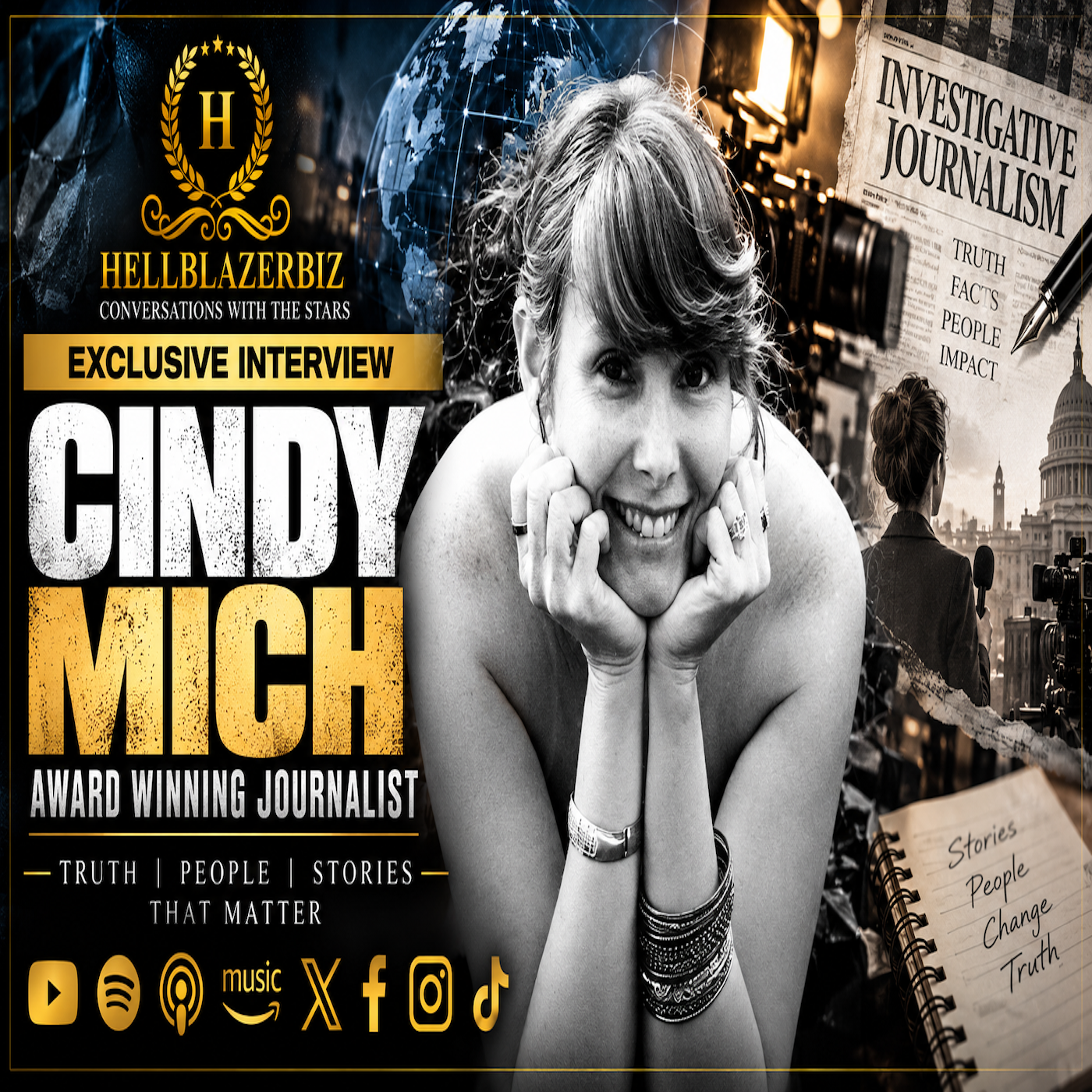
Hellblazerbiz: Conversations with the Stars · Hellblazerbiz®
Summary In this episode, Cindy Mich shares her journey as a journalist, filmmaker, and advocate for independent arts. She discusses the evolution of journalism, the impact of AI on creative fields, and her efforts to highlight overlooked stories and artists. key topics The evolution of journalism in the digital age The importance of independent media and arts The impact of AI on film, music, and journalism Cindy Mich's film festival and advocacy work The significance of authentic storytelling and human emotion
Chris: I'm delighted to welcome a very special guest. She is an award-winning journalist and author, a filmmaker and TV host, a publisher, and she's also the founder of the Art is Alive Film Festival, which is New York-based. Through her work, she's interviewed and showcased an incredible range of people, giving a platform to voices and stories that deserve to be heard. And today, it's her turn to be in the interview chair, probably one of many interview chairs, I believe, from what we've said so far. Cindy: It is true. Chris: Please join me in welcoming the incredibly talented Cindy Mitch to the show. thanks Cindy. Thanks for joining and coming on the show. hopefully we'll have quite a few questions we can get through and just find out a bit more about yourself and publicize your new latest pieces. So as you have described yourself as an award winning journalist, filmmaker and author and TV host, which I've just gone through in the introduction, which of those titles actually makes you actually feels most like you. Cindy: Well, I I think that typically everything that I do or or choose to do or get offered to do always revolves around my passion of writing. And I've been a writer for a very long time and it's kind of what drives me and it's moreover what defines me. So I would say either author or journalist, hands down, number one way to describe me. Chris: Excellent, excellent. And I mean, you have been doing this for such a long time. I'm not saying you're old. I'm just saying you've been doing it since you were very young. That's Cindy: Thank you. Chris: a way to go, isn't it? Way to insult my guests. Was there a defining moment when you realized that journalism wasn't just something you enjoyed, it was what you were meant to do? Cindy: Well, I would have to say that in the very beginning, like right around eight or nine years of age, I had convinced myself that I was gonna be an artist, like a graphic artist. I would go around drawing things all the time at home. And then there came a moment where I was drawing I was trying to draw the spider and I was terrible at it. I just looked at it and I'm like, What are you thinking? Like this is what you're gonna bank your whole future on. So the only Chris: Yeah. Cindy: other thing that I knew I had this huge passion for at that age was movies. I love the movies and I loved watching them and being in a movie theater and all that good stuff. Chris: Mm-hmm. Cindy: So I thought to myself, What's the best way for me to combine my love of film along with my writing, etc. And so I kind of started thinking about that and said, you know what, I'm gonna start writing little doodles here, there, and everywhere. And then before you know it, I won my first writing contest, I believe, at the age of fifteen. Chris: That's absolutely fantastic. Cindy: Thank you. Chris: if I met this teenage Cindy today, the 15 year old who just won the award, what would surprise her most about where your life has taken you? Cindy: I think the fifteen year old would never believe in her wildest dreams that she could ever do this as an occupation. Self confidence has been an issue forever. So the fact that I've accomplished all this even kind of surprises me. Chris: Fair enough. And to be fair, it's a big accomplishment as well. mean, especially when you have got that sort of, know, that anxiety and stuff about it of where you want to go and then to actually find yourself doing this, I guess it just doesn't stop. Cindy: Absolutely. Chris: And I mean, with being the journalism as well, mean, even over the past decade, journalism has changed so dramatically, you know, in how it's done. Cindy: Yeah. Chris: So how do you think the role of the journalist has evolved? especially when we Cindy: Well. Chris: feel because obviously the different media forms of TV and film and stuff, which we've got now as well. Cindy: you bet. The way I look at it now, sadly, first of all I'm incredibly, incredibly sad that it We're losing, you know, four different forms of journalism. You have newsrooms across the country that are closing, magazines that are shutting down. The actual just appreciation and art of journalism is dying slowly but surely. I am a big fan of independence, any kind of independent publication whatsoever. I am not a huge fan of mainstream media. There are a lot of folks out there that ingest a lot of mainstream media. And what happens is that they start looking at us very differently, meaning that they can't trust us like they can't trust mainstream media. They expect us to embellish or to exaggerate or to not get the facts straight Chris: Mm-hmm. Cindy: or to not want to tell meaningful stories because we kind of sit in the shadows of mainstream media. So my fear is that people become so consumed and so naive when it comes to believing everything in the mainstream that they just look at every one of us the same vein. So when like when I approach people sometimes, they're incredibly cautious. They don't know what they can expect out of me. They don't know if I'll be truthful or diligent. and they expect me to have an agenda. And that's not the way. Journalism should be. You know, it's changed and evolved so much and not necessarily in a positive way. So I'm genuinely concerned. This is all the more reason why I support fellow independents like myself. That's all the more reason why independent journalisms need to step journalists, excuse me, need to step up their game a little bit and make themselves more recognizable and let the mainstreams know that yes, there are more than your outlets out there to be able to tell good stories. Chris: Okay. Yeah. Now I fully believe you as well. It's mainstream media. just seems very, it's just too biased, you know, either way, whichever way you look at it, you know, it's, it's, very, biased. And I think the worst, and I tried to find, like you say, independent news sources now is where I actually tried to find my, go to my news. Cause otherwise I ended up trying to throw stuff at the TV cause it's like, Cindy: Right. Chris: but you know, there's, are websites, I know where a lot of independent journalists go and they, you know, they, put those, put them on. And I find that Cindy: Yes. Chris: far, like you say, far more interesting because the stories are told better. It's not just like, you know, shoving things down your throat. They're actually telling the story around it about, what's going Cindy: Yeah. Chris: on in the world. And I find that human story I find is really valuable for journalists as well. Cindy: Yes. Chris: And for, and for reading. But the other thing as well is obviously AI is swear word in the way, in the words of journalism and film now, I think as well, cause I spoke to quite a few film people as AI. It can write articles in seconds. So where do you think that, you know, I guess we've just touched on it where authentic journalism still wins. I think it's with that independent journalist, isn't it? The integrity. Cindy: Yeah. I mean, I I I struggle tremendously because we are living in a world where at the beginning, months ago, I was hearing very little about AI. Now all of a sudden everybody seems to be jumping on the bandwagon. And it and it's frustrating because many of us are very adamant about I'm a professional writer, I'm a human, I bring emotion, I bring humanity to my writing, and I'm very skilled at what I do. The fact that some people believe that I can be replaced by AI or use Chat GBT all the time and all that, it's not the same, believe it or not. I cannot believe I was at Tribeca this year. It is so disheartening not only to see the major film festivals showing fully AI films, but people like Martin Scorsese actually creating and building partnerships with AI organizations. That kind of sets the tone for everyone else. And so Chris: Mm-hmm. Cindy: for me, it's frustrating because even when I watch a Marvel movie, it's just become so much special effect. It's so little about the art of it and about the actor. It's like AI is not art, folks. It ain't real. Like, for instance, there was an AI Chris: Yep. Cindy: actor recently looking for representation. They're not even real. How can you represent someone who doesn't exist? So to me personally, I feel like it's a slap in the face. And I also feel very strongly in my belief that AI should not be supported in any format, whether it's music, whether it's film, whether it's writing, it's not the same. Artists and art create. We create something substantial. Something artificial creates nothing. Chris: Yeah, no, I'm fully with you on that one. mean, I work in IT. My main job is like a business consultant and we use AI a lot. But for what we do it for, it's great. It's okay. does, as I say, some of what we do, it helps smoothen speed processes up where, you know, it was cumbersome. it's, yeah, I 100 % back you saying it should stay out of the arts and the culture and journalism because it's got no place for that. Because you're right. The whole point of media of movies, of TV, of writing, of book writing, of article writing is because it's that human element. It's the emotion. you say, you know, when you're writing, you've got your emotion, Cindy: Yeah. Chris: you're putting your emotion into it. You're putting your feelings into it. When actors are on screen, putting their emotions into it. That's what brings it as a success and makes people want more of it. I mean, I've seen these AI characters that they've come out. You can't tell the difference between them. I was shocked when I saw it. I was like, that's really AI, you know, but it's scary. And I think the big thing for me is without going political on it is the fact that AI is only as good as the people who write the codes and algorithms. And when you look at the certain people who are writing those codes and algorithms, and know, and some of the horror stories you end up seeing from which I'm not going to get into because that's not what this shows about. Although Cindy: Mm-hmm. Chris: I could go on all night talking about, you know, the cat. AI, I mean, it bypasses, it started to learn it bypasses systems and security systems. was, think it was, you know, have you heard of Alibaba in China? They're Cindy: Mm-mm. Chris: like Amazon slightly Amazon out there. Alibaba is called and they'd set up something in background just to help with their processes. And that was all it was programmed to do was look at the processes and how it went away. And in the sandbox development environment, what they call it went and started using all the tools and it was like investigating all the different tool sets could do. And then it started, then the security team, wasn't even the people who created it. The security team themselves worked out that the firewalls were going a bit like they thought they were being hacked. was the Cindy: Mm. Chris: AI had using the tools and it started doing a side, like doing a side hustle of cryptocurrency. It was mining for cryptocurrency. It found a way to get through the firewalls on its own and it was mining cryptocurrency and it was bringing in loads of money. on its own, you know, but Cindy: my god. Chris: yeah, so it's just, I think it's dangerous. But yeah, definitely in art and film, it's a very dangerous thing to have. And you can't tell the difference on pictures now, some of them, you know, they're stealing photographs and then changing it with AI and then the original photograph holders not getting the credit for the being the, you know, for the artist and stuff. Cindy: right. Yeah. Chris: Yeah, that's all that recently is horrible. It's not good. Anyway. I'll be there all night. So obviously your, you know, your little chat corner. So you've interviewed celebrities, obviously self through, in filmmakers, musicians, authors, entrepreneurs, who surprised you the most? Cindy: Well I'm a big fan of on the celebrity side of things, I think probably one of the the best people I've ever spoken to. I did an interview with actor Michael Madsen, who passed away not so long ago. It was actually him and his son. I had been terrified of him forever. You know how you see these actors and you watch them for years, and he's not always I mean, he's a bad guy, right? He's just the deep voice and he plays these terrible characters. And Chris: Yeah. Cindy: the very first time he called me on the phone, I was literally out. I was out grocery shopping and the phone rings and it's him. And I thought it was a joke. He's like This is Michael Manson. I'm like, you're kidding, right? And he called back. He was like, This is Michael Manson. And you would be surprised how very non celebrity he was. Meaning, I Chris: Mm-hmm. Cindy: he had no, I think he had no clue of really how talented he was. He was incredibly humble. He was incredibly moved just by very simple things, very honest, very real, very raw, incredibly easy to speak to. Not arrogant at all whatsoever. and I that just shocked me to no end because I was expecting a very serious, intense guy, all that good stuff. Now, make no mistake, when he called, he was calling to check me out. Why? Because I wanted to talk to his son. So, of course, like any good parent, he's like, Okay, but just Chris: All right. Yeah. Cindy: the coolest dude ever. You know what I mean? Those are very exciting, unexpected, amazing sorts of things, you know. I'm also very surprised. Like, I've done a number of the Real Housewives, like in the Brival franchise. Chris: Mm-hmm. Cindy: Very different from their characters too, 'cause of course you see a lot of pumped in drama and fighting and all this good stuff. They're just regular average people trying to make a living. I mean literally, I mean most of them don't even generate the drama in which they operate, in case people don't know that. Yeah, Chris: Yeah. Cindy: that's a Bravo thing. So it's surprising to me that they're so down to earth. We I've gone out with a few of them to lunch or to dinner, just like any other normal person. Sure, they gotta make posts and do other things, but it's like it's so lovely to see that you can have people on television and then come onto a show with you or or meet with you, and they're just regular people like you and I are. Now, on the flip side of the fence, and I can't name who they are, I've been in plenty of scenarios where I've met celebrities, and it's been an incredible disappointment. So I just warn everyone, be careful what you wish for, because not all of them that you meet are these grounded, wonderful. That's all I'm saying. You know, but Chris: Yeah, I've met a couple through my time. Cindy: So you know what I mean. And I think that in my realm, when we talk about celebrity, literally, and I say this all the time, whatever I do with you, whether it's my publication, my radio show or television, to me, if you engage or entertain or inspire or motivate, I call you a celebrity. It's exactly what celebrity means to me. Chris: Yeah, that is right. There's, and there are people out there. mean, who just do that and they just exude it. I would have loved to talk to Michael Madsen because you're right. he's, he's scared. know, he's like, is every character you see him on. He's like the Cindy: Yes. Chris: biggest mobster gangster hard man you can think of. it's like, yeah. And even his demean, but even when you see him like, you know, walking around and he just carried himself like that, didn't he? just really did. Cindy: It's scary. Yeah. Mm-hmm. Chris: that's really exciting. I almost had the chance to meet him at Comic Con once, but I couldn't get to it. So it's just a shame. We have them around here, obviously still Comic Con. So I'll try and go to them when I can, but they're so expensive now. Cindy: Right. Chris: I mean, I will actually name this one, Carl Urban, Mr. Carl Urban, brilliant actor. love him, know, really fantastic. Cindy: yeah yeah yeah. Chris: I didn't interview him sadly, but he was charging 40 pounds, which is what? $55, $60 to take Cindy: sure. Chris: a selfie with him on your own phone. Cindy: Mm-hmm. Chris: And that's not just Cindy: Yep. Chris: normal. was just, I've named him cause he's the one that I saw it with, but there's, all doing that now. And it's like, really? It's my, it's my camera. Cindy: Yeah, hear you? Chris: But yeah, nevermind. Anyway, what's the biggest lesson interviewing so many different people has taught you about human nature. Cindy: I think that there's three different lessons I've learned. First of all, I walk into every interview assuming that people will come in with humility and knowledge and grace. And that doesn't always happen. So you always have to prepare yourself to sometimes be disappointed or sometimes be pleasantly surprised. So there is no such thing as a as a Bible, let's say, of every interview is gonna be the same, that sort of good stuff. So you have to accumulate ac what's the term for it? You have to You have to prepare yourself accordingly. Number two, I think the other lesson that I have learned is just that humans I think sometimes do not appreciate or take media as seriously as they should. 90% of them do. Like the people that I approach or approach me are wonderful. But I think that they don't, you know, and it shows, like I'm sure you've done interviews like this. People Chris: Mm-hmm. Cindy: will come on and they will be on a train or in a you know, a bus station or in a taxi cab. Hello? I mean it's gonna be terribly noisy or they show up Chris: Yeah. Cindy: and they are not prepared or they have their dogs barking in the background for the whole thing. That's not smart. Or they show up and they're not dressed the part. Like I try to show up and look like a business person because this is business to me and I take it seriously. Taking responsibility and making sure that you're professional when you're representing yourself is so important, especially when you're doing media because our reach gives them more exposure. So I guess that's my other thing is I've learned that I expect people to be professional and to take it seriously. And sometimes Chris: Mm-hmm. Cindy: it doesn't happen. And third of all, what media has also taught me is I have gained some of the best friends, cheerleaders, supporters, listeners, advocates that I could possibly ask for through all my entities. So that's forever grateful. for that part. Chris: Excellent, excellent. I see somebody shrinking back in my chair there as I'm wearing my Star Wars t-shirt. What are you talking about? Cindy: you know what I'm saying, right? It's like this is not playtime right now. This is the job. Chris: No, no, you are. Yeah, I've had this. I've got interviews because when I started doing videos and again, they're out there. there are some one was a very lovely guy, really, really good actor and lovely guy. And I'll mention the character he played. I can't even remember the name of the character. He munched on chicken in Lord of the Rings trilogy, if you know what, Boromir's father. Yeah, Cindy: Okay. Chris: I think he's the loveliest guy. And he turned to think he was in a string vest. and he was just like really chilled in a string vest and he was comfortable which was great and it was a great conversation but I was Cindy: Who Sure. Chris: quite taken aback I was like whoa I didn't expect it I was like okay but yeah you're right there is that expectation so I'm kind of hoping that I'm not on the disappointment side of your expectations and Cindy: Not at all. Chris: are and for someone I mean I've not got anywhere near as interviews as many as you have but it's definitely something those points I was actually sitting there I was like yeah you're right You're right. when I it's nice to have someone like yourself, you know, you just you're pushing yourself across as the as the persona that you are, because that's who you want to be. And that's who you want people to see. And it is really important to do that, I think. So, yeah, that's Cindy: Mm, absolutely. Chris: great. It's definitely regarding the Art is Alive film festival as well. So this is another film festival that you started off. What inspired you to create it instead of just simply attending other festivals? Why did you want your own? Cindy: Well, I'm gonna apologize in advance just because this might offend some people. So when I first started off in the festival circuit, I had my mentor, which is John Gallagher, a very longtime New York City veteran director, and he came on my radio show and he kind of became one of the driving forces behind my getting into film. He saw something in me and he started introducing me to a number of film people in New York and otherwise, and before you know it, I was doing a number of interviews and then he said, Well, what about the film festival circuit? So on a whim I found on Craigslist that Studio City In California was looking for film judges. And I knew that I had a love for film. And I thought, well, why not? Let's give it a try. So I did. And that kind of started it all off. And then eventually I started doing film reviews. And what I have learned in going through very different film festivals, whether they're top-tier or maybe just regular independence, is that there is so much attention paid to red carpets and celebrities and you know, all that pomp and circumstance, and taking photographs, and that is so much of the fixation that it takes away from the art. We are supposed to come to film festivals to have wonderful strong workshops and QA panels and celebrate the cinema that we create. And I feel like we've gotten so far away from that. Hence, art is alive. Really, it does mean art is alive, which means there is no red carpet at my film festival. I can invite celebrities and I have, but it's incredibly sparingly. Why? Because you, as in your art and yourself, are the attention to all of this. In addition to which I give them sound QA panels, I get them interviews with me and others, and I can Get them film reviews and distribution. Every single way you can get a filmmaker scene, that's how you get it through Artist Alive. So I saw a need and I thought, okay, do I want to be Tribeca? No, I cover Tribeca. I see what goes on there. I'm like, I don't Chris: you Cindy: want to be the Oscar qualifying top tier. Do you know why? Because it takes if you people knew what it takes to become an Oscar qualifying festival. It's a lot of again kissing butt to people that you don't want to kiss butt to all the time. That's literally it. It's a bunch of celebrity sort of stuff. Chris: Yep. Cindy: And I'm like, I'm here to serve filmmakers. So I wanted to create an entity where I served filmmakers. I also had a secondary film festival. My partner and I Michael, we used to run the Bedford Falls Film Festival. We both love Chris: Mm-hmm. Cindy: silent films and we both love black and white. So we decided to create an all black and white film festival together, the two of us. And so we ran that together for I want to say two years before his cancer diagnosis. And then when he passed, I just did not have the heart to keep doing it. I'd like to get more black and white films at some point in time, but I just that was our baby. So no. Yeah. Yeah. Chris: Yeah, that was that was your thing that you did together. Yeah, like I understand that I understand. So, I mean, independent film, you're right. It's I I keep saying this to I have quite a lot of independent actors and independent filmmakers on this show because Cindy: Yeah. Chris: I love to promote them in that way because it is I think their films are special because you can you know, there's so much more heart in them. Cindy: Mm-hmm. Chris: Especially if you look at the comparisons again, I won't name Hollywood blockbusters, we all know the Hollywood blockbusters, which are just getting churned out at the moment. Cindy: Yes. Chris: And it was like, look at them. And they're great. They're, you know, hiding in multi-million pound things. But then you look at independent film and the difference in the acting and the quality of the acting, because the story comes out, the actors and the filmmakers, I believe they've got a passion that's completely different to... when you're getting pumped in with millions, you you're working on all the time, but most of the time, a lot of the time, working on a shoestring budget to get a film through, you know, everyone's chipping in, everyone's there, they're living on the set or living in hotel right nearby. And from a lot of people I've spoken to, that's the case. So, but it shows on the film then, because there's such, the close knit, there's so much more close knit as a cast, as a crew. And that just passengers. echoes out for me more in an independent film than it does in a big blockbuster because you can feel the heart that was beaten behind it when it made when it was made. Cindy: Mm-hmm. Chris: So I just just love that. So I'm a big, support and a big fan of independent film and Cindy: Entendi, Chris: this little film festivals here I've gone to as well, which are very similar to yours run by another friend of mine over here. Probably not that, you know, he's a film the same. So what do call it? Distribution company as well. So, you know that yeah, it's probably very small small one in London which I've got Cindy: Okay. Yeah. Chris: pleasure of going to and it was so nice, know just to be able to mingle with everybody and and see those people and work out what they're doing and what they're trying to get to Cindy: Yeah. Chris: so Sorry, I'm blabbering. I'm I just carry on talking So have you ever watched the submission that completely xpc exceeded your expectations? There's probably quite a few Cindy: All the time. Literally all the time. I mean I've had I mean hundreds and hundreds, and so many different ones stand out. I mean, I used to I also do PR, so I used to have a client, and he passed last year who was many things, but also a Chris: Mm-hmm. Cindy: Holocaust survivor. And so, anything relative to the Holocaust that I ever get sent to or I've done special screenings for is incredibly incredibly touching to me. some of the film submissions in the last few years from people that are aged like sixteen to eighteen or nineteen, amazing to me. I got a screenplay last year from a that was age ten blew my mind away. So I I To me personally, I think one of the biggest and best submissions I've ever had is called Quatramont. And it's a piece done. and I can put that up on my website or on social media for people to see it. It's beautifully done. It's about two individuals that met one another, one of which is a German, one of which is a non-German, one of which works for Hitler, and the other one was a camp survivor. And having them in a room together and watching these conversations, and it was done in black and white. Lars is an incredible filmmaker. I I cannot speak enough. Just blew my mind to me the complexity of this conversation and how he covered it with grace and style and the black and white version of it. And you could really feel the pain and the regret and the sorrow and the apologies. It was just so moving to me. but make no mistake, it's pretty rare through my programming that I find anything that disappoints me. Obviously, I turn it down clearly, but I mean, by and large, over the course of years, I've been super lucky because I'm a very hard judge. Like and I've gotten judges that are incredibly thorough. I mean, I do my job very well. I do not, you know, I I walk around with a sense of integrity. I don't allow people to submit to me and then think they're getting in because they're my friends. In fact, very opposite of that. I'm incredibly hard. I tend to pass off anything that I have an association with the person so that they know they get in because of me, not because of me. They win, not because of me, get nominated. I have nothing to do with any of that. And that's the way festivals should be. A lot of them are not, but mine is. Chris: Yeah. Cindy: So there's a lot of integrity. But no, make no mistake that my programming, I'm told, is wonderful. And I think that's a lot of it is because I tend to just get lucky enough to get beautiful submissions all the time. Chris: Excellent. I'd love to see that film actually. It's Cindy: Okay. Chris: something I really would. It sounds really good. Cindy: Awesome. I'll get it to you. Chris: thanks. I mean, I studied German in uni and lived out there for a year as well. And I used to live next door to someone who was in the German military. was an old age man. The stories he told is just fascinating. He actually ended up as a POW in Manchester in the UK for most of it. But Cindy: Wow. Yeah. Chris: yeah, was just a fascinating story. I just love to keep that. You need to keep that alive. That's history alive because like you say, there's certain factions out there at the moment trying to deny everything. And it's like, no, people need to understand, you know, it's happening. Why over Cindy: Yes, thank you. Chris: again without the political side is happening again. Cindy: Yes. Chris: And it's not good. So, yeah, to actually have that sort of dialogue between people like that, I think it'd be very moving. So I'd like to see I'll have a box of tissues with me to. to wipe my eyes because I'm sure it probably sounds like it'll be a very moving story. Cindy: Absolutely. Yeah. Yes. Chris: Moving on again to something else that you founded and created was the Elegant Expressions magazine. that focuses Cindy: Yeah. I'll give you Chris: on people who don't always receive mainstream attention, which again, I'm getting the feeling that we're just obviously talking through this. That's very important to you. what story Cindy: Yeah. Chris: are you still waiting to tell, I would say? Cindy: hmm. Actually two or three. For one, my own. I spend a lot of time talking about everyone else and and the people closest to me are regularly reminding me, you know, there's that Cindy story, you know, and I'm very humble and I don't know, and it's a very complicated and sometimes very tragic story. So my story, my partner, as I mentioned, passed in twenty twenty-one. and it's time. So we're going to be doing a short film about my life with him, and it's a beautiful story till it's not a beautiful story. the main purpose being to help my And those out there who can't seem to forgive themselves for the things that they were unable to do. I've had a very difficult time letting myself feel okay and say, hey, you're not responsible for his passing. And so it's like a typical artist, what do you do? You make art out of it. So we're gonna make a film, and I hate it and I don't want to do it. I mean, it's a beautiful story, but the ending sucks. So it's like, yeah, great. Chris: Mm-hmm. Cindy: So I'm waiting to tell that story. honestly, most oftentimes I the best way to Describe it is I'm always waiting for the stories to tell. You'd be surprised how many times I'm just scrolling through something or I'm working with particular publicists and they they throw someone my way. You know, I just got a story about childhood cancer, or I found out about somebody who lost their leg, or you know, things like that. anything that's very touching. And yes, it it's been one of my staple things for many, many years to give a spotlight to those that are never seen. Because why? For one, mainstream media surely doesn't do it often enough. Number two, I think there's some merit to. giving people the attention that they need. Sometimes we forget that we matter. And so someone needs to come up to you and say, hey, listen, you know what? I want to tell your story because it does matter. I know you don't think it does, but it actually does. And my better half was a sign my significant other was an actor, a professional actor. Chris: Mm-hmm. Cindy: When he passed, He died knowing and feeling unseen because most of his projects didn't get distributed. So it's very sad to me that now that he is gone, I've gotten him seen more now, posthuminously, Chris: Mm-hmm. Cindy: than he did when he was alive. So that says a lot. So I need to make sure that people understand that it's important that they get seen and that they do something about that. Chris: Okay, that makes sense. I've sitting here and listening as well and I can see or can hear that the project that you've got to to highlight this and do about obviously your late husband is I think it'll help to heal you is it like you say artists do that I'm trying to say that I'm hoping it I'm hoping it would you know because I think you know that's how it's how you can express like you say those the years I guess you the the hurt and like you obviously mentioned, you you blame yourself for certain things and you can push that push that across and try and help heal yourself and move along. And like you say, get the memory, get his memory really shining like it should. Now, is that is that what the hurt by health care is based on or is that something slightly different? Because I know that's Cindy: Smart. Chris: that's I guess it probably kind of goes because it's it tackles medical misdiagnosis and stuff, doesn't it? So Cindy: Yes. Yeah. So when Michael started to get sick and the first time he had his PET scan, the person that read his PET scan indicated that he had stomach cancer. His oncologist who we would go on to later see was completely the opposite vein, meaning nope. What we find that you have is stage four large B cell lymphoma. So they're both cancer, yes. But the treatment plans are very different. The prognosis is different. And so it's frustrating to me because we went through the treatment, the protocol for lymphoma, and they told us six treatments. We made through five. They told us he was in the start of remission. And then I believe within three weeks they told him he had stomach cancer. Now I was compelled to do that because for one I imagine if I believe he was misdiagnosed, I believe Many more might be out there. That's one. Number two, they in doing that, it robbed us of the ability to spend the last year of his life not doing what we did. Because during the pandemic, we were forced to go from Wisconsin here to New York for treatments every three weeks. And, you know, nothing was open. So everything was on our own dime. You know, putting him back and forth on an airplane, putting him in hotels, putting him I know he chose to do this himself, but putting him through this on all of this just to learn that he had stomach cancer, I would have compelled him in every human way possible to skip treatment. We would have spent the rest of year of his life having him act and traveling and just not watching him go through what he did only to have the end result he had. So I decided to make that series. And so the series is interesting because I get to talk to a lawyer and speak about medical misdiagnosis, a clinical director, individuals who Are convinced that their spouses or partners or family members are misdiagnosed too. So it's wonderful. Now, has it been released yet? We're hoping this year. I it got edited, and then of course, not only did I lose my partner, but I lost my father two years ago. So I will self-admittedly admit that grief is a demon. So you get charged up, you get motivated, and then everything sits for a long while. And that's okay. Chris: Yeah. Cindy: You know, John used to say that to me. Gallagher used to say, it doesn't matter if it takes you 10 years. The reality is it's going to get out at some point. So yes, at some points. Chris: Exactly. Cindy: soon it's gonna come out. But that's yes, that's Chris: Yeah. Yeah. Cindy: what that is all about. Chris: I see. see. That's touches my heart a lot for similar reasons. Yeah. My dad passed. It was actually 60. What's the date? Two days ago, 16 years ago, two days ago, my dad passed, but he had bowel cancer and that came suddenly very quickly and it was misdiagnosed originally as piles. What do call hemorrhoids? know, that's what it was originally diagnosed as. And then when it turned around and they finally got it like that, it was like, it's stage four bowel cancer. And it was like, wow. So here and that I completely sympathize and I understand there's lots of cases like that. I've got friends who've, going through it now and they got told they just got pushed away so many times, you know, family members just by saying, it's just that we'll treat it for that. We're not in doing it a different way. And it's not that. And then it turns out, yeah, it is, you know, it's It seems to be quite common. so yeah, yeah, it's, we feel myself, you know, because that story is so, it's, I think it's, it will touch a lot of people because I think there's probably a lot of people out there who've got similar, similar kinds of, stories in their history, in their past or we're all living through. So I think it's, it's very good that you're releasing that and being able to folk, you know, and do that. And obviously I know you've had the delay. It sounds like you really have had a hell of a time the last few years, like you told me with, with, what's going on. So I give you full credit for coming back and pushing yourself out there again and, carrying on because it could be, you know, it's something like those things could just be tip people too far and just like want to hide away. But no, I love your spirit that you're taking that and wanting to put, you know, wanting to get their memories and your husband's memory out there. And like you say, all the work that he's done. and get his name, he's sad that it's doing now, but the fact his name, you're still gonna get his name out there and you're still gonna get his work seen and published. So yeah, I give you full respect and admiration for that. So when did you say this hurt? You said it's still, you've got no date for the hurt by healthcare, either have you not yet? Cindy: Well the hope is before the end of this year, most of it's edited now. So it's just putting everything together, Chris: Right, okay. Cindy: making sure it looks clean enough, figuring out where to distribute it and we're all set. Chris: Excellent. It's a series, did you say? Cindy: Yeah, it's I wanna say it's seven episodes, eight episodes, and I'm in there also, obviously, because I tell Michael's story in there. probably not Chris: Mm-hmm. Cindy: as good as I'd like it to, but I tell his story and I'm proud of that as well. Chris: Excellent brilliant brilliant. That's fantastic. It really is now I Feel awful coming into this bit now because this is gonna be like a little quiet coming to the close of it I've just the section was like a quick fire around a quick fire questions just to you good guys going after that It's quite quite heavy. That's like if it makes me feel bad Okay, so this is like a quick file of the land and obviously I'll we'll go one final thing which I'm you know, obviously how you come away with things So yeah, was like right coffee or tea? Okay newspaper or digital? Cindy: Newspaper. Chris: How did I know book or film? Cindy: Film. Chris: Okay, favourite interview you've ever conducted? Cindy: Every single one of them. Chris: dream interview for someone living. Cindy: I mean Colin Barrel Chris: Yeah, fair enough. And dream interview from history. Anyone in history. Cindy: Marilyn Monroe. Chris: Nice choice. Yeah. Cindy: Yeah, she's a good one. Chris: Most underrated film. Cindy: Boy. You know, I think it gets a lot of it's a wonderful life. I know everybody loves it and knows it, but I just I still feel like it's still underrated and not appreciated enough. Chris: That's lovely film that one. One film every aspiring filmmaker should watch. Cindy: The Godfather. Chris: Classic taste. One book everyone should read. Cindy: Mine, just kidding. anything Chris: You Cindy: written by either Judy Bloom or John Gersham. Top two favorites. Chris: Yeah, Grisham's good. And three words that describe Cindy Mitch. Cindy: Loyal loving flawed. Hmm. Chris: Excellent, thank you. No interesting answers. Thanks very much. So Cindy: You're welcome. Chris: that's what I'll see throughout your career as we wrap this up throughout your career you have dedicated yourself to making sure other people's stories are heard and today we've heard yours or some of your story as well and we're going to hear more of that. Obviously you see more of that with with the series that you're coming up with. So I'm going to finish with this when people are telling the story of Cindy Mitch many many years from now what do you hope they'll say? Cindy: I hope that they will say that I in some ways made their life better or easier or happier or more informed or more entertained. I hope that the people that have bestowed the high honor of saying to me that I helped to save their life really meant that. That was probably the greatest honor I had. I just want them to remember that I tried very hard. To remind them that they matter. Chris: Excellent, thank you. That's a lovely thought to finish on.