
Healthy Spaces · Trane Technologies
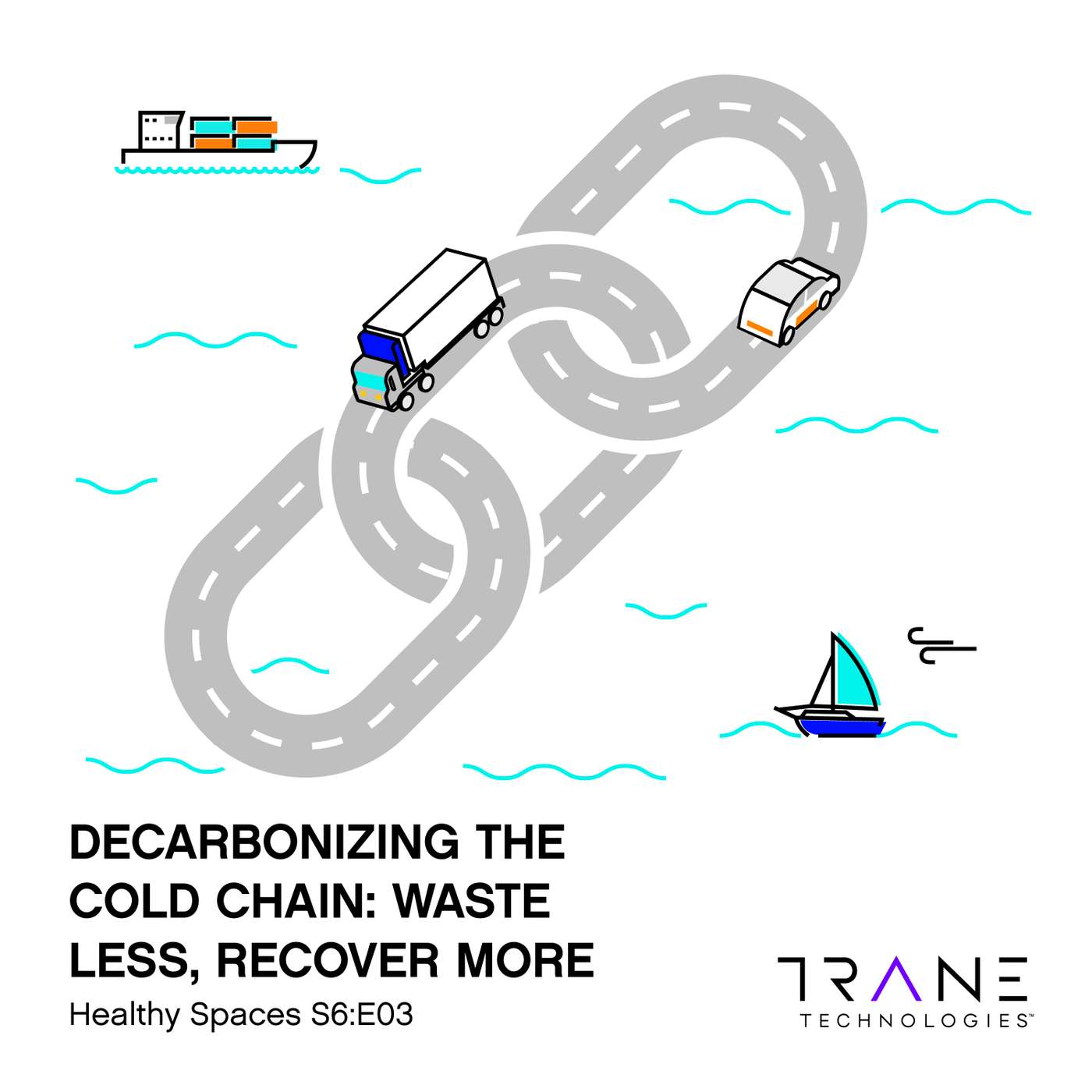
How do we decarbonize the chain that keeps the world's food fresh? Fresh food can travel for days or weeks, moving through farms, warehouses, ships, trucks, supermarkets and finally our homes. Much of it has to stay at the right temperature the whole way to stay safe to eat. That network of refrigerated storage and transport is the cold chain. It runs almost entirely on diesel, and demand for it keeps growing. Dr Liz Goodwin, Director of Food Loss and Waste at the World Resources Institute, sets the scale of the problem. Up to 40% of the food the world produces is lost or wasted. She explains why adding more refrigeration can't fix that on its own: a cold chain only works where there are formal markets, real demand and the skills to run it. Her point frames the rest of the episode. Better refrigeration matters, but only as part of a wider system. Then Claudio Zanframundo, President of Thermo King EMEA & APAC, takes us inside the technology that keeps the cold chain moving. He explains why maintaining temperature across a long, multi-stage journey is so difficult, and how digital tracking and AI now help operators protect the load and run more efficiently. He describes how energy recovery captures power a moving trailer would otherwise lose and uses it to run the refrigeration. He looks at what EU decarbonization targets ask of the industry, and whether today's technology can meet them. And he closes on what it takes beyond the equipment to keep a cold chain running: service, infrastructure and skilled people. Together, Liz and Claudio make the case that the biggest gains are in what the system already holds: the food it loses and the energy it wastes. Recovering those, with the right regulation and the people to run the network, is how the cold chain grows and gets cleaner at the same time. >>> Watch the episode on YouTube: https://youtu.be/3dsfSnD2Q-g EPISODE CHAPTERS 00:00 Introduction - The hidden chapter from farm to table 01:07 How large is the food waste problem? 03:17 Why more cold chain isn’t always the answer 05:01 Why households are a major source of food waste 08:13 What COVID taught us about reducing 10:13 Building a sustainable food system takes everyone 12:58 Why refrigeration alone isn’t enough 14:00 The complexity of the food chain 18:50 How digital tracking reduces waste 20:53 Where AI fits into the cold chain 23:43 Recovering otherwise wasted energy 30:54 Transforming the cold chain as a system LEARN MORE Sustainability Reports | Trane Technologies [https://www.tranetechnologies.com/en/index/sustainability/sustainability-reports.html] The Global Benefits of Reducing Food Waste — and How to Do It | World Resources Institute [https://www.wri.org/insights/reducing-food-loss-and-food-waste] Mitigating Food Loss | Trane Technologies [https://www.tranetechnologies.com/en/index/blog/sustainability-leadership/mitigating-food-loss-with-a-smarter-cold-chain.html] World Resources Institute [https://www.wri.org/] Scott Tew...
0:00- The era of the standard data center is over.
0:04- Okay, that's a big statement, Dominique.
0:06- Scott, just think about it, right?
0:08The technology is evolving so fast,
0:12whether that's cooling technology, the chip technology,
0:14even the demand, right, around AI.
0:17It's all changing so fast, we just can't standardize.
0:20- Innovation always happens when we view things
0:23as a problem that need a solution.
0:26And this is actually one of those moments
0:28where data centers are more complicated.
0:31We have to design them differently, so it's ripe
0:34for sustainable innovation.
0:36- Wherever there is a challenge,
0:37there's always an opportunity.