
HCI Deep Dives · Kai Kunze
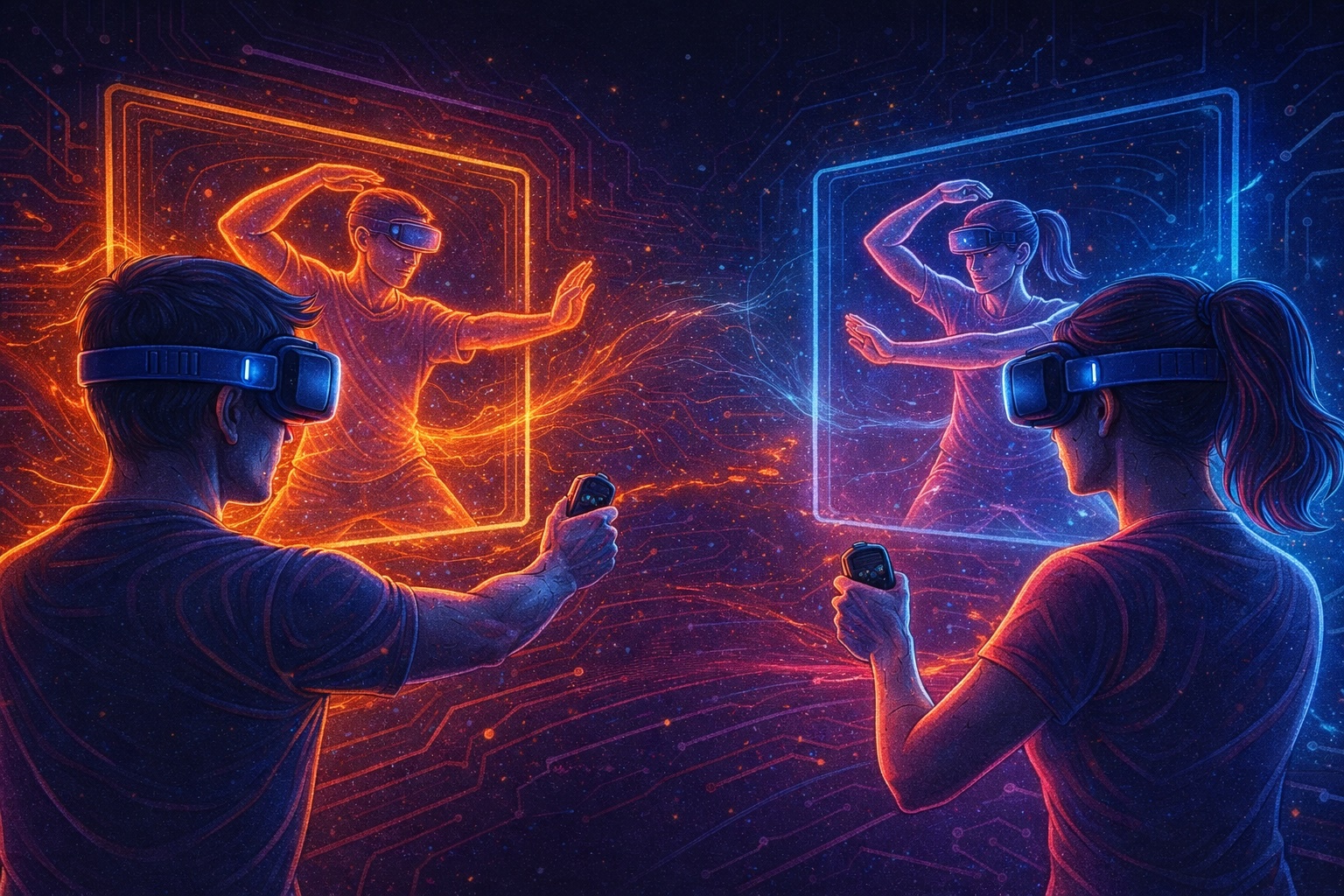
What happens when you watch yourself perform in VR—and then have to critique that performance? This study explored self-reflection in motor skill learning using a Karate training task. Participants were embodied as a "trainer" avatar and asked to give verbal feedback on a "trainee"—which was either their own 3D-scanned appearance or a stranger, performing either their own recorded movements or an expert's. The results revealed a psychological "role conflict": participants felt split between being the evaluator and being evaluated. Seeing their own appearance triggered deeper, more emotional reflection, while recognizing their own movements created bodily connection even in a stranger's avatar. The findings suggest VR embodiment isn't binary but multi-faceted, with implications for training and therapy. Dennis Dietz, Samuel Benjamin Rogers, Julian Rasch, Sophia Sakel, Nadine Wagener, Andreas Martin Butz, and Matthias Hoppe. 2025. The 2×2 of Being Me and You: How the Combination of Self and Other Avatars and Movements Alters How We Reflect on Ourselves in VR. In Proceedings of the 31st ACM Symposium on Virtual Reality Software and Technology (VRST '25). Association for Computing Machinery, New York, NY, USA, 11 pages. https://doi.org/10.1145/3756884.3765986
0:00Welcome to the Deep Dive. Today we're immersing ourselves in the cognitive science of learning. We're focusing on how we master complex motor skills when, well, when the teacher, the critic, and the subject are all the same person, all inside virtual reality. It's a fascinating area. And effective self-reflection is just so critical for skill mastery, isn't it? It's the engine that drives that whole cycle of what we call self-regulated learning.
0:26It is. And that engine often stalls with the traditional methods we use. Oh, how? Well, if you think about how we usually do self-observation, say, analyzing your performance on a standard 2D video, there are significant drawbacks. Okay. They struggle to diagnose the subtle three-dimensional posture errors you find in complex movements. And crucially, they enforce a kind of fundamental disembodiment. They separate you, the observer, from the performance you're supposed to be reviewing.
0:54I see. So there's a disconnect. Let's unpack that challenge then. The mission for this deep dive is to examine a study that proposes a genuine paradigm shift. It does. Moving from that passive, flat self-observation to something active. Embodied self-evaluation, all within a virtual environment. And the core goal is to investigate precisely how that combination of visual appearance, seeing yourself and observed movement, seeing your own performance,
1:21how that alters a user's sense itself, and of course, the quality of their reflection. This research touches on some profound psychological territory. It examines the emergence of a complex psychological duality, a role conflict, as the paper calls it. A role conflict. It's what surfaces when you are simultaneously the subject acting as the trainer providing critique and the object acting as the trainee being evaluated, all in the same virtual space.
1:48So how on earth did the researchers design an experiment to isolate those kinds of psychological forces? They developed a custom VR application. It was called copycata. Copycata. And it was centered around a foundational karate sequence, something suitable for novices. The genius of the study was in its very clean experimental design. A two-by-two matrix that systematically varied two independent variables. In all conditions, participants were embodied as a generic first-person trainer avatar.
2:17And their task was to give verbal feedback to a trainee avatar that they saw in front of them. Exactly. Continuous feedback. So let's isolate those two variables. They seem to define the core conflict here. What was variable number one? That was the avatar appearance. In the self-avatar conditions, the trainee they were criticizing was a personalized, photorealistic 3D scan of the participant. Of themselves.
2:40Of themselves, yes. And in the other avatar conditions, the trainee was a generic avatar of the opposite gender, just to ensure a clear visual distinction. Okay, so that isolates the impact of just visual recognition. And variable number two, manipulating the source of the performance. That was the observed movement. Participants either evaluated their own movement. The ones they'd recorded earlier, flaws and all.
3:02The very same. Pre-recorded actions from an initial imperfect training session. Or they evaluated other movements. These were expert movements pre-recorded by a martial arts master, representing, you know, peak proficiency. And that isolates the impact of motor congruence. Whether the movement feels like your own. Correct. So combining these creates four very distinct psychological scenarios. And these become critical reference points for the entire discussion.
3:30Indeed. First, we have what they call dissonance. That's the other avatar performing the participant's own movements. You see your own motor skills in a foreign body. I can imagine. That's quite strange. Then you have what is maybe the most psychologically intense condition. Direct confrontation. That's the self-avatar performing their own movements. An unfiltered, ego-involved self-assessment. No escaping yourself there. None at all. Thur is the ideal self.
3:56This is the self-avatar performing the expert's other movements. You see your own appearance achieving peak performance. A glimpse of your potential. In a way, yes. And finally, you have the baseline. The other avatar performing the other movements. This serves as the detached control condition. Just evaluating a stranger's expert performance. That gives us a clear framework. So before this VR confrontation even begins, we have to establish the starting line.
4:22When a novice, someone lacking expertise, approaches a critique task like this. What is their inherent reflective baseline? The data paints a very clear picture here. Novices adopt a coping strategy. The coping strategy. Because they lack the deep internal schema of an expert, they can't diagnose subtle timing or weight distribution issues. They focus almost entirely on visually obvious concrete details. Ah. So they can't offer nuanced feedback on the quality of the movement, so they focus on the
4:51presence of it. They gravitate toward tangible things they can just verify with their eyes. Exactly. This results in what's called descriptive reflection. It corresponds to the R0 or R1 levels in the Fleck and Fitzpatrick reflection framework. And for context, R0 and R1 is just simple description. What you see or naming an action. That's it. And the goal is to guide users toward R3, which is transformative reflection, understanding
5:14why an error occurred, and then formulating a detailed strategy for corrective action. And their verbal feedback actually reflected this descriptive baseline. It did. The verbal data was dominated by high instances of body part focus and movement focus. They confidently used concrete nouns, descriptive words like kick and punch. But the moment they had to shift to true evaluation or diagnosis, they frequently used hedge words.
5:41Things like, I think, or maybe. It expresses their fundamental uncertainty about the quality of what they were seeing. They knew what they saw, but not what it meant. Precisely. So this detached descriptive baseline is the setup for the psychological shift. When you introduce the self-avatar, when objective evaluation becomes an ego-involved self-assessment, what's the force that breaks through this descriptive detachment? The visual presence of the self-avatar acts as a significant psychological catalyst.
6:08The past is immediately transformed. It moves away from just technical analysis into this emotionally charged process of self-assessment. It elicited strong feelings that participants described as spanning from embarrassing and ashamed or disappointed to, well, to simply finding it funny how poorly they performed. That's a profound emotional fallout. And just from seeing a virtual copy of yourself doing a novice action, why is a self-avatar so much more potent than just watching a 2D video of the same performance?