
HCI Deep Dives · Kai Kunze
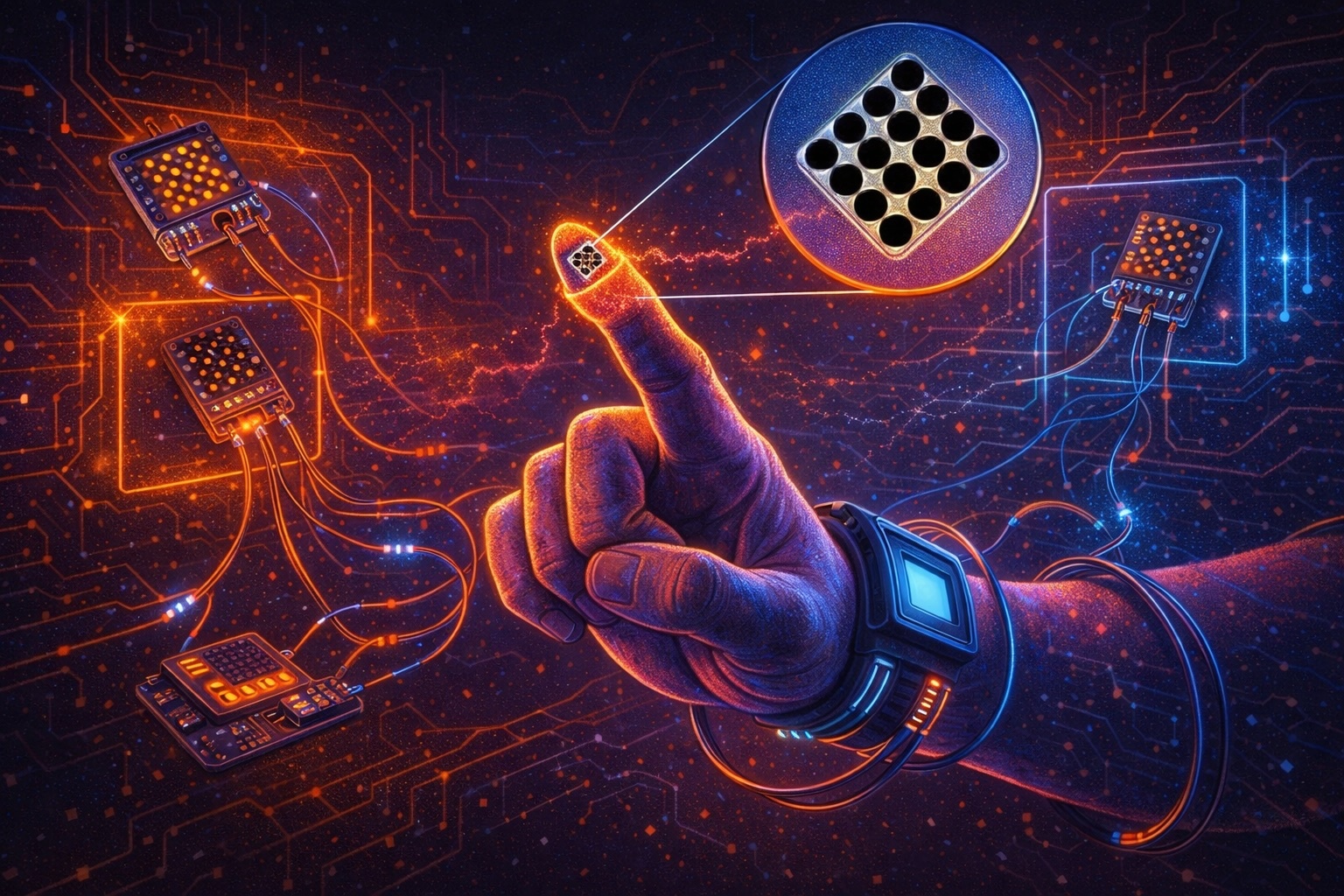
Electro-tactile interfaces—which deliver tactile sensations through electrical stimulation of skin nerves—offer unique advantages like fast response times, thin flexible form factors, and the ability to simulate textures, softness, and even coldness. But designing them has been notoriously difficult, requiring deep electronics expertise and custom hardware. eTactileKit changes that. This open-source toolkit provides end-to-end support: modular hardware that scales from 8 to 128+ electrodes, design tools for creating 2D and 3D electrode layouts, a Processing-based pattern creator with visual simulation, a GUI for real-time testing and calibration, and APIs for Python and Unity. A three-week study with both novice and experienced designers showed the toolkit significantly lowered the barrier to entry while improving design workflows—enabling rapid prototyping of applications from VR haptic buttons to 3D-printed interactive toys. Praneeth Bimsara Perera, Ravindu Madhushan Pushpakumara, Hiroyuki Kajimoto, Arata Jingu, Jürgen Steimle, and Anusha Withana. 2025. eTactileKit: A Toolkit for Design Exploration and Rapid Prototyping of Electro-Tactile Interfaces. In The 38th Annual ACM Symposium on User Interface Software and Technology (UIST '25). Association for Computing Machinery, New York, NY, USA, 17 pages. https://doi.org/10.1145/3746059.3747796
0:00Welcome back to the Deep Dive. Today we are immersing ourselves in the sophisticated world of haptic technology. Specifically, we're looking at electrotactile interfaces. These are the systems designed to, well, to bridge that gap between our digital interactions and a real physical sensation. Precisely. And they often come in these exceptionally thin, flexible forms you can wear right on your skin. So maybe we should start with a definition. What exactly is electrotactile stimulation?
0:28It's a method that uses precisely tuned, frequency-modulated electrical currents. These currents are directed at the sensory nerve fibers just under the skin. And this mechanism gives it some very clear benefits over, say, older vibrotactile methods that just rely on physical vibration. Okay, so what kind of benefits are we talking about? Well, for one, quicker response times, much better localization of the sensation, and, as you mentioned, the ability to create devices that
0:55are incredibly thin and flexible. And the sensory output itself is quite compelling. It's not just a simple buzz anymore. No, not at all. Our sources note that these interfaces can render complex, nuanced sensations. Think about the feeling of coldness, or a sense of softness, or even a detailed surface texture. That certainly expands the landscape for designers. It does. But despite all that promise,
1:18the field has historically struggled with a foundational hurdle, a very high barrier to entry for effective prototyping. What made it so difficult? Creating these devices requires specialized electrical circuitry. We're talking about systems that handle relatively high voltages and, critically, have precise current control to manage the wildly variable nature of human skin impedance. Right. Our skin isn't a perfect conductor. Not even close. So you add to that the need for complex firmware for the bespoke
1:49design of electrode arrays, and you can see why this was mostly restricted to specialized university labs. It sounds prohibitive unless you happen to have an advanced degree in electrical engineering. That's a good way to put it. The technical cost was far above the creative benefit. So our source material today details a solution designed to tackle this specific problem. An open source, scalable toolkit called a
2:12e-tactile kit. Okay. So our objective for this deep dive is to understand how this e-tactile kit provides that end-to-end support for designing, simulating, and exploring these stimuli. And in doing so, how it lowers that barrier to entry. Correct. For designers of all expertise levels. Before we get into the solution, the developers first had to fully understand the problem. I understand they ran a formative study with
2:36designers already in this field. What did that study reveal? It revealed four primary challenges, which then became the blueprint for the toolkit. The first, as we've discussed, was the high barrier to entry. Designers admitted they relied on personal networks, almost a kind of tribal knowledge, or on deciphering academic research papers. Which are often dense and not written for practical application. Exactly. They found the literature incredibly difficult to translate into a working
3:02prototype, especially without that specialized electronics background. So it's less a mature engineering field and more a collection of specialized hacks. You could say that. Yeah. The second theme was a major lack of accessible tools for design exploration. Designers were spending a huge portion of their project time, sometimes 80%, just developing the underlying technology, the hardware, the firmware. Which left very little time for the actual creative design of the
3:29tactile experience. Right. They lacked the tools for quick iterative design. The creative bandwidth was just consumed by technical overhead. That's a classic symptom of an emerging technology. The third theme was scalability. Designers found it extraordinarily difficult to increase the number of electrodes. Going from, say, four channels to 32 often meant a complete redesign of both the hardware and the firmware. So expanding your project scope meant starting over from scratch. Pretty much. And this
3:58severely restricted their ability to explore more intricate high-density designs. Finally, and this is fundamental, there was a pressing need for formalized protocols around safety and calibration. Which makes sense, given you're dealing with high voltages and direct human interaction. It's critical. They needed standard methods to ensure physical safety, alongside user-friendly tools that could consistently manage a user's unique comfort thresholds. Okay, let's unpack how eTactileKit addresses
4:25these demands. We should start with the hardware, the part that actually delivers this precise, controlled sensation. How did they solve that scalability problem? They used a modular design. The foundation is a simple stacking architecture. It's made of a main controller module and one or more switching circuit modules. This elegantly solves the scalability challenge. So you just add more modules as you need more electrodes. That's it. Each switching module handles up to 64 electrodes. An expansion to 128 or
4:53more is just a matter of stacking another module on top. That immediately shifts the problem from redesign everything to buy another component, a much simpler approach. And I read the main controller itself has a built-in validation feature. It does, which is a very practical touch. The main controller has eight built-in electrodes. This lets a designer validate the full system, test patterns, check the firmware,
5:16all without ever having to connect an external electrode interface. An immediate onboard testing mechanism. Yes, before you get into any bespoke interface design. Let's move to the electrical specifications. We know this requires high power to get through the skin to the nerve fibers. What are the key operational specs here? The system uses a high voltage supply of 270 volts. This is fairly standard for this
5:40application. Prior work usually falls between 200 and 300 volts to reliably overcome skin impedance. But the real innovation is in the control precision. Tell us about that. The current intensity, the pulse height, can be delivered per channel from zero up to 3.8 milliamps. And it's incremented in 200 distinct steps of 19 microamperes each. That is an extremely granular resolution. Why is that so important? It's crucial because it allows the
6:05software to create what feels like an imperceptibly smooth change in sensation. So the user experiences a slow fade or a ramp up, not a series of jarring on-off stages. Okay, and what about other parameters? The system can handle a peak maximum current of 10 milliamps, which is a key safety boundary. The stimulation frequency is in the typical tactile range of 1 to 250 hertz. And the pulse width is finely adjustable in 1 microsecond increments.