
HCI Deep Dives · Kai Kunze
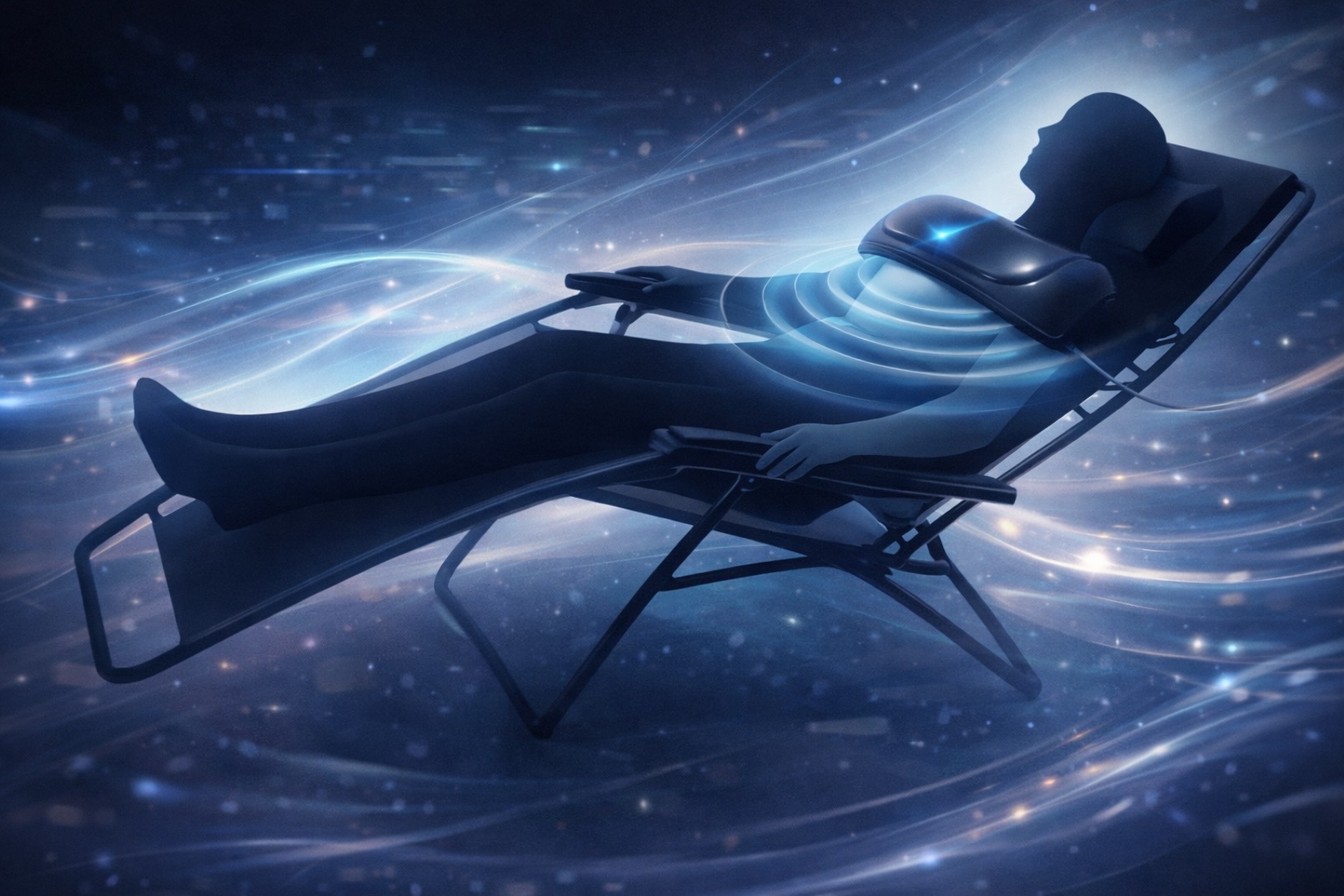
Taking a break at work should leave you refreshed—but often it doesn't. MindSpace is a pneumatically controlled haptic device worn on the upper chest that combines two calming sensations: gentle breathing-like movements and deep touch pressure similar to a hug. In a study with 24 participants performing demanding cognitive tasks, those who used MindSpace during their breaks showed significantly faster recovery of focus compared to those who simply rested. The device simulates the comforting sensation of being held while breathing together with someone, activating the parasympathetic nervous system to reduce stress. Participants reported feeling more relaxed and ready to return to work. This research suggests that active haptic interventions during breaks could be more effective than passive rest for restoring cognitive performance. Masaki Kikuchi, Kaining Chen, Robert Panskus, Dingding Chen, Kazuki Okawa, and Kai Kunze. 2025. MindSpace: Improving Relaxation Break and Performance Using a Device Exerting Tactile Sensation of Life-like Breathing Movement with Squeeze-like Deep Touch Pressure on Users' Upper Chest Area. In Proceedings of Mensch und Computer 2025 (MUC '25). ACM, New York, NY, USA, 255-269. https://doi.org/10.1145/3743049.3743054
0:00Welcome to the Deep Dive. For you, the core challenge of modern existence is, well, just maintaining focus. And achieving any kind of genuine rejuvenation. Exactly. When the lines between your professional and your personal life are continually blurred, remote work and constant connectivity, they've made true disengagement almost impossible. We're left feeling perpetually depleted. Our sources today point to a solution that's almost hidden in plain sight. The micro break.
0:30These are brief pauses, just a few minutes, and they're proven to restore cognitive resources. But for this to work, the pause has to be deliberate. It has to be. It requires activating the parasympathetic nervous system. The body's involuntary relaxation response. The whole rest and digest mode. That is the crux of the matter. The difficulty is engineering a micro break that is truly restorative.
0:51You can't just scroll or close your eyes. So you need a mechanism that compels a physiological shift. Precisely. Yeah. Something that guides you toward a deep embodied state of calm that goes beyond just, you know, visual or auditory stimuli. And that pursuit of an embodied state is exactly the focus of this deep dive. We are analyzing the mind space research from Moose 25.
1:13Okay. The study explores a pneumatically controlled haptic device. It's a piece of technology that applies deep touch pressure and it simulates lifelike breathing. So our mission here is to dissect how this multisensory approach affects the user's relaxation response. And crucially, how it impacts their performance when they return to a demanding task. To appreciate the device, we should probably start with its foundational design.
1:39It synthesizes two proven principles from therapeutic and physiological research. Let's start with the first one. The first is deep touch pressure or DTP. This is a firm tactile sensory input. It's known globally for its powerful calming effects. And it's used in clinical context, right? To manage anxiety and oversensitivity. It is. The physical compression provides this steady, reliable input that, well, it just quiets the nervous system.
2:03Okay. So that's the pressure component. What's the second principle? The second is breathing regulation. It is a well-established fact that slow-paced guided breathing significantly reduces physiological stress markers. I think many of us have experienced that. We have. Research consistently shows that a respiratory rate between four and six cycles per minute triggers specific autonomic responses. Such as? Lowering blood pressure and enhancing heart rate variability, which is a powerful metric for measuring improved parasympathetic tone.
2:34So Mindspace isn't just an app that tells you when to breathe. No. And it's not just a weighted blanket. It's a dynamic physical synthesis of these two potent techniques. Yes. Designed specifically for micro-break restoration. You could almost think of it as a physical focusing agent. It uses embodied input, actual physical sensation to guide you toward a relaxed state without you having to think about it.
2:56But I suppose the question is, why build complex machinery? Why not just use a timer and take deep breaths yourself? That is an excellent point. The research suggests the complexity is necessary to mimic a human interaction while maintaining very precise control. Okay. Let's get into that. The implementation. The prototype has three key parts. There's the zero-gravity chair, which ensures everyone rests in a neutral posture.
3:21Then you have the Mindspace arm itself. And the external air pump system that orchestrates the movement. Right. And the Mindspace arm features some very careful material selection. Its inner pneumatic actuator is made from something called EcoFlex 00030. And why that specific material? This silicone was chosen for its elasticity and weight. They work together to imitate the softness and feel of human skin and touch.
3:47And there's more to it than just the material. Yes. The bottom side of the actuator is covered with an unstretchable fabric. This construction ensures that when the device inflates, it causes a precise bending or wrapping motion. Creating a comfortable, compressive grip around the user's upper chest. Exactly. And its placement is critical, I presume. It is. The actuator is positioned high on the user's upper chest, with its edge aligned with the shoulders.
4:11So that targets a region central to breathing. And notably also a region linked to emotional comfort and expression. The goal is to maximize that sense of enveloping touch. The whole device is driven by an automated external air pump system. This uses a combination of four 500-milliliter vacuum syringe pumps and a linear actuator to execute the movement. And here is where the technical precision meets the physiological mandate.
4:37The system is programmed to operate at a frequency of 3.33 breaths per minute. Which sounds very specific. It is. The rhythm is achieved by programming the linear actuator to extend and retract for exactly 9 seconds during each phase. So that's an 18-second cycle. An 18-second cycle. And 3.33 breaths per minute is exactly 5 full cycles every 60 seconds. As we establish that 4 to 6 cycles per minute range is the optimal zone for parasympathetic activation.
5:04So the engineering is justified. It's hitting that physiological target precisely. Mm-hmm. The cycle delivers about 1.8 liters of air volume to provide the required soft yet substantial deep touch pressure. So we have a machine calibrated for ideal physiological calm. The next logical step is to see if it works. Right. The researchers conducted a within-subject study with 22 participants. And you, the listener, should note that a within-subject design is powerful.
5:31It is because every participant serves as their own control. They experience both conditions. Resting with mind space and resting without it. The protocol was designed to be relevant to a demanding work environment. The task used to induce cognitive fatigue was the Stroop test. Which requires high levels of selective attention and conflict resolution. It's mentally taxing. This test was given immediately before and immediately after the six-minute rest periods.
5:59And during the rest, participants were in that zero-gravity position wearing soundproof headphones. All to eliminate external variables. The measurement strategy was thorough. It relied on triangulation between self-reported perception and objective biology. Tell us how they measured these elusive states of calm and focus. Subjectively, they used two key measures. First, a 12-item relaxation self-report questionnaire. It assessed six facets of calmness. Mental quiet, aware, at peace, clear, distant, and rested.