
HCI Deep Dives · Kai Kunze
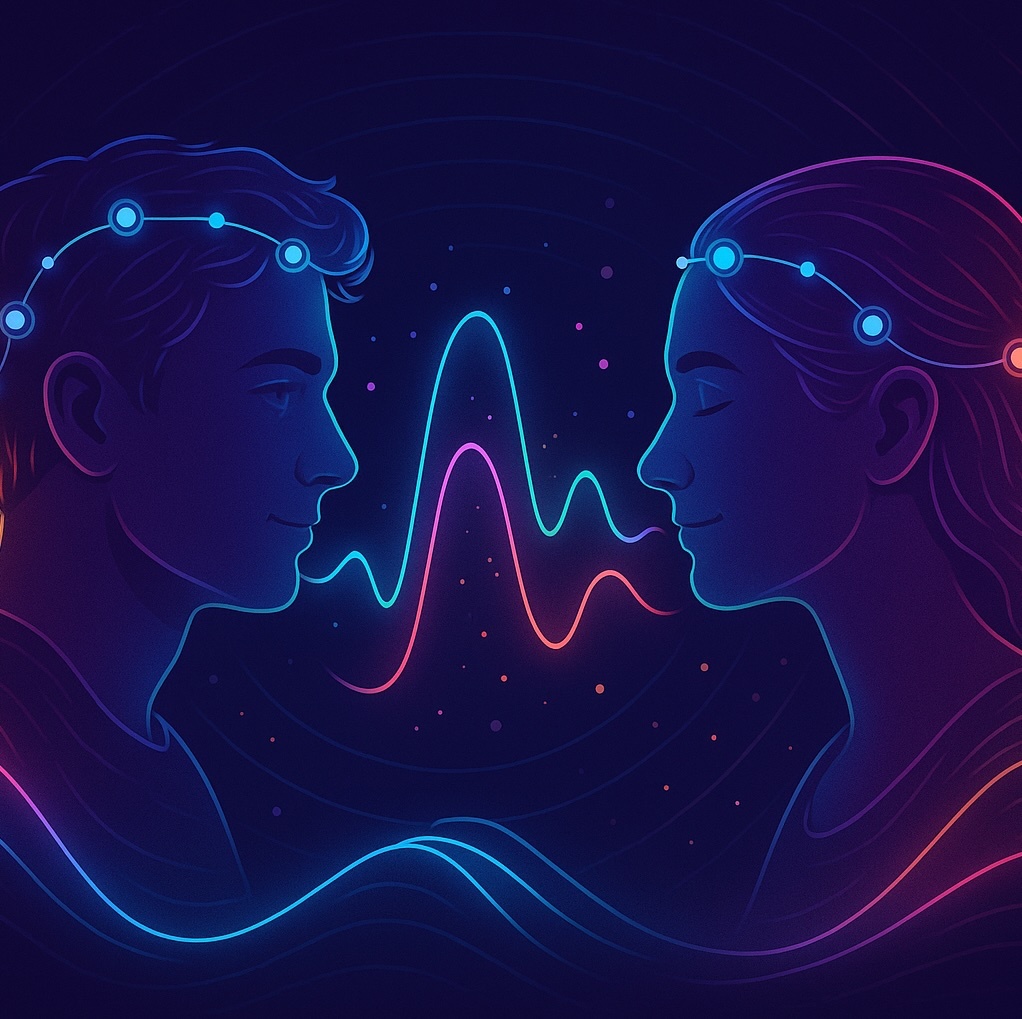
When several individuals collaborate on a shared task, their brain activities often synchronize. This phenomenon, known as Inter-brain Synchronization (IBS), is notable for inducing prosocial outcomes such as enhanced interpersonal feelings, including closeness, trust, empathy, and more. Further strengthening the IBS with the aid of external feedback would be beneficial for scenarios where those prosocial feelings play a vital role in interpersonal communication, such as rehabilitation between a therapist and a patient, motor skill learning between a teacher and a student, and group performance art. This paper investigates whether visual, auditory, and haptic feedback of the IBS level can further enhance its intensity, offering design recommendations for feedback systems in IBS. We report findings when three different types of feedback were provided: IBS level feedback by means of on-body projection mapping, sonification using chords, and vibration bands attached to the wrist. Jamie Ngoc Dinh, Snehesh Shrestha, You-Jin Kim, Jun Nishida, and Myungin Lee. 2025. NeuResonance: Exploring Feedback Experiences for Fostering the Inter-brain Synchronization. In Proceedings of the 2025 CHI Conference on Human Factors in Computing Systems (CHI '25). Association for Computing Machinery, New York, NY, USA, Article 363, 1–16. https://doi.org/10.1145/3706598.3713872
0:00Ever been so perfectly aligned with someone you know, a friend, finishing your sentence? Or maybe a bandmate hitting the exact same note. Oh, yeah, absolutely. Or like teammates just moving in perfect sync on the field. Exactly, that feeling. It's almost like your brains are literally connected, right? Oh. Well, science is increasingly showing that's not just a feeling. It's actually measurable. Mm-hmm.
0:23Welcome to the deep dive. Today we're not just talking about being on the same wavelength. We're really diving into the science of interbrain synchronization, IBS for short. Oh, right. And specifically how new technology is trying to, well, maybe amplify that connection. For this deep dive, we've really zeroed in on a specific research paper. Pretty groundbreaking stuff. Yeah, it's called NERR Resonance, exploring feedback experiences for fostering the interbrain synchronization.
0:50Comes from researchers at the University of Maryland and Texas A&M. So our mission today? Yeah. Figure out what IBS actually is. And then how these scientists tried to boost it using different kinds of feedback, like visual, audio, even touch. And crucially, what could this all mean? For teamwork, communication, maybe even physical therapy. That's the plan. So the big question we're tackling is, can we genuinely get a shortcut to being in sync with someone?
1:18And, you know, if we can, which way works best? Visual, audio, haptic. The answers might actually surprise you. Yeah. Okay. Let's get into it. Let's do it. So interbrain synchronization. IBS. When we talk about this phenomenon, what exactly are we talking about? Are our brains literally syncing up? Yeah, pretty much. When people work together on something, a shared task, their brain activity patterns often start to mirror each other.
1:47They synchronize. Wow. And it's not just, you know, a coincidence or some kind of metaphor. It's a real measurable neural thing. We've seen these shared patterns in, well, all sorts of cooperative activities. Like what kind of activities show this? My mind jumps to musicians playing together, obviously. Sure. Musicians are a classic example. But it's actually much broader. Studies have seen it when people watch the same movie together.
2:08Oh. Yeah. Or perform coordinated hand gestures, play online games together, even simple things like just holding hands or working on a puzzle together. Or I think I read collaboratively typing something. Exactly. Collaboratively typing passages. It really shows how our brains kind of automatically try to find a rhythm with another person when we're focused on the same goal. That's pretty amazing. But, okay, why does it matter?
2:33Is it just a cool scientific observation or does this brain sync actually have an impact? Oh, it definitely has an impact. This is where it gets really interesting, I think. Past research shows pretty clearly that IBS isn't just happening in the background. It's deeply connected to positive social stuff. Positive social stuff. Like what? Like stronger feelings of closeness, trust between people, even empathy.
2:57It seems to foster what researchers call behavioral coordination. Okay. Like moving together smoothly. Exactly. Think of dancers or rowers. And it boosts the sense of joint agency. That feeling of we're doing this together as a single unit. Right. That we're feeling. And being able to measure this sync, it might even help predict how well a collaboration will go. It helps us understand those, you know, subjective parts of working together.
3:20Okay. So brain sync is definitely a good thing. Makes sense. Which naturally leads to the next question. Yeah. Can we, like, make it happen more? Can we boost it? Oh, yes. Yes. Especially using ways that, you know, everyday people could potentially access, not just lab equipment. That is precisely the big question this new resonance paper dives into. We've known for a while that IBS correlates with good outcomes, but actively enhancing it.
3:48That's been relatively unexplored territory. Especially with external feedback. Exactly. There's been some work using things like magnetic brain stimulation, which is not exactly user-friendly. No kidding. So this study focused on things like visuals, sounds, vibrations, much more accessible. So if we could reliably strengthen this sync with feedback. Yeah. Wow. What are the potential implications there? Oh, that could be huge. Really huge.
4:11It could lead to totally new ways of working together in teams, creating synergies that maybe go beyond what individuals can do alone. Think about education students tackling complex problems together. Or in companies, improving teamwork and communication. Or even therapy. You mentioned that earlier. Yes, definitely. Imagine strengthening the connection, the rapport between a therapist and a patient. It could really open up some new possibilities for connection and collaboration.
4:38Okay. So that's the potential. Let's get into the experiment itself. New resonance. How did they actually try to sync people's brains? What was their main hypothesis? Well, their central idea, their hypothesis was basically, if we give people real-time feedback about how in sync their brains are using visual, sound, or touch, will that feedback itself increase the level of synchrony? So can these external cues actively push the brains to sync up more?
5:06That's the core question they wanted to answer. And measuring brain zinc in real time. That sounds incredibly difficult. How do they pull that off? It is complex, yeah. But they had a pretty smart setup. They used dual EG. EG, like the caps with electrodes. Exactly. Electroencephalography. Reading the brain's electrical activity. They used these specific headsets, Emotive Epoxy X, on two participants at the same time.
5:30Okay. And to make sure the signals were clean, because people move, right? They used a Vicon motion capture system. Ah. Like for movie CGI? Kind of, yeah. It helped remove the noise from physical movements, so they were getting cleaner brain data. Clever. And then how did they calculate the actual sync level? They used a measure called the Circular Correlation Coefficient, or C-Core.
5:52You can think of it as a way to measure how well the phases of the brainwaves from the two people line up. Phase angles. Like the peaks and troughs matching up. Precisely. A higher C-Core value, closer to one, meant the brainwaves were more aligned, more in sync, and the system was pretty fast. It could calculate and output a new C-Core value every one and a half seconds.