
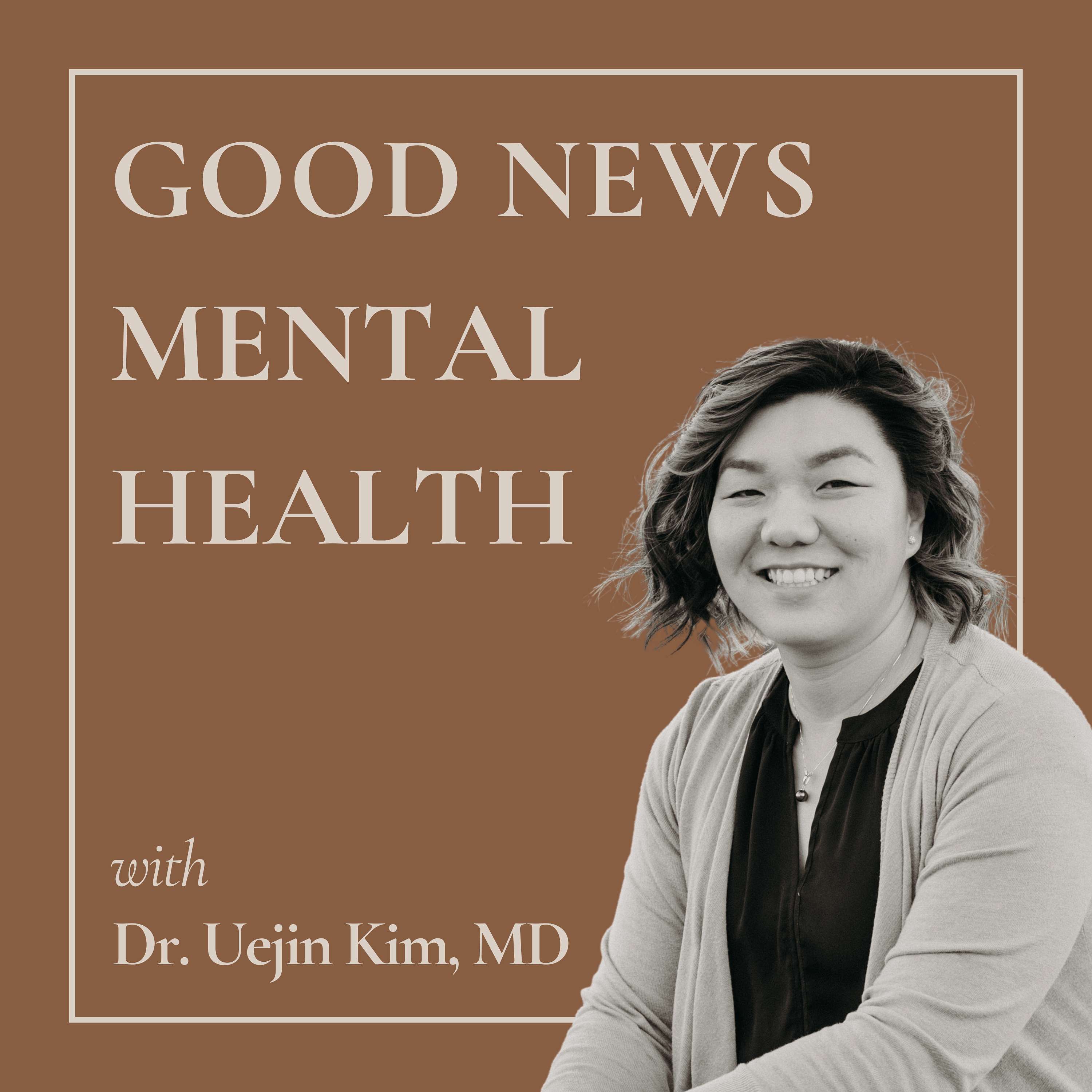
Good News Mental Health with Dr. Uejin Kim, MD · Dr. Uejin Kim
What happens when being responsible stops being something you do—and starts becoming who you are? For many high achievers, helpers, parents, and “responsible children,” caring about something can quietly become feeling responsible for it. Other people’s disappointment. Their emotions. Their outcomes. Keeping the peace. Making sure everyone is okay. In Episode 60, psychiatrist Dr. Uejin Kim explores four ideas we often confuse: responsibility, identity, worth, and calling. We’ll talk about why boundaries can feel surprisingly threatening, why achievement can never permanently settle the question of worth, and how to distinguish what you genuinely care about from what is actually yours to carry. You don’t have to become less responsible. The work is learning to carry responsibility without asking responsibility to carry your identity. And perhaps the deeper question is: Who are you when your hands are empty? parentified child quiz https://www.uejinkim.com/parentifiedchild_quiz #FaithByPsych #HighAchievers #Parentification #Boundaries #SelfWorth #ChristianMentalHealth #MentalHealth #EmotionalHealing #PeoplePleasing #Psychiatry
Dr. Uejin Kim, MD: Let me ask you a question. What would happen if you stop being the responsible one? Not forever, but just for a week. If you stop fixing, stop anticipating, stop making sure that everybody's okay. Do you think you'll feel relieved? Or would you feel guilty, anxious, and maybe a little bit lost? Because there's a big difference between I am a responsible person and I need to be responsible so that I feel safe and I'm okay with who I am. And sometimes we don't realize when we have crossed the line. Hi friends, I'm Dr. Uejin Kim, a child and adolescent and adult psychiatrist. in the last solo episode, I introduced this idea that responsibility started as something that we do and slowly became maybe part of your identity. today I want to slow down because I think we use four words almost interchangeably. Responsibility, identity, worth, and calling. But they're not the same. And when we confuse them, what started as our greatest strength starts to become our great started to become greatest burden that we have to carry. Responsibility is fundamentally about something entrusted to me. My children are my responsibility. My behavior is my responsibility. And if I make a commitment to work, following through is my responsibility. If I hurt somebody, repairing what I can is my responsibility. Responsibility is healthy. I don't want us to use psychology as an excuse to become irresponsible people. Sometimes it is really your job. but high achievers often have trouble distinguishing I care about this from I'm responsible for this. Those are not the same. When my kids were younger and tantrums was just like a day-to-day everything, whenever I go to a store like Target or Walmart, when my kids throw a massive tantrum, I felt like it was my responsibility to make my kids never throw a tantrum in public. But that was not my responsibility. Do you understand the difference? It's I care about my kids' behavior. in regards to them being able to regulate their emotions and control their behavior within their appropriate norms, but it was never my job to stop that behavior and control him. Or maybe I disappointed a colleague or family member. I felt like it was my responsibility for them to be never disappointed in me. There's a little bit of difference between I'll be responsible for what I do so that I'm not intentionally causing conflict, but it's never my job to never make other people feel disappointed. Caring about something doesn't automatically make it mine to carry. that is a distinction that I have to learn over and over again. So identity answers a different question. Not what am I responsible for, but who am I? And here's a thing that gets really complicated. Maybe growing up you were the mature one, the smart one, the good child, the helper, the peacemaker, the funny one that breaks everybody's tension. The mom that the one that mom didn't have to worry about. Those labels can be wonderful, But eventually you may stop thinking I am someone who behaves responsibly and began thinking being responsible is who I am. Now imagine saying no. You're not simply declining responsibility. It can feel like you're violating your identity. And that's why boundaries can feel so much more emotionally intense than they look on the outside. And underneath identity is even a deeper question worth. Do I still matter when I'm not useful? Am I still valuable when somebody's disappointed in me? Am I still okay if I fail? Can I be love without being needed? That's where achievement can feel so exhausting. Because there's no accomplishment large enough to permanently answer. All these questions about your worth. You get a degree, you get a job, you get kids, you get the promotion, and then the next goal after another. And for a moment you might feel briefly proud of yourself, but then your brain says, Okay, what's next? Achievement can give you a satisfaction, but it cannot give you your worth. And sometimes there is something weirdly comfortable about going up the ladder in education system. After fourth grade becomes fifth grade, fifth grade, sixth grade. You know, after your high school, you go to college. After college, I guess I'll go to medical school. There is something amazingly satisfying and secure about going up the ladder. But after residency and after fellowship, I had to create something of my own. And a lot of times In those structured setting, it was easy for me to find, okay, I'll find my worth by achieving the next level. But when it becomes free for all, it was weirdly ungrounding and made me feel really insecure because now I had to be secure on my own. And I wonder if that ever happened to you, where you knew what the next steps were. And after you reached the top, you're like, okay, what's next? What did it cost you? To run up the ladder. Now, underneath worth, now there's calling. And I think calling is especially important for people who genuinely love to serve others. Calling isn't, I have to fix everything because everyone depends on me. Calling says, this is mine to faithfully carry. It's a sense of duty and responsibility, obligation, but with purpose. And here's a beautiful thing about calling: calling has boundaries. There's things that are not mine and things they aren't. There are things that they are mine to carry and there are things that they aren't. There are people that I can love but not rescue. Problems I can influence but I cannot control. Outcomes I can work towards but cannot guarantee. Responsibility says this is mine to carry. Identity says this is who I am. Worth says I matter even when I can't carry it. And calling says this is what I choose or am invited to to faithfully carry. Do you realize when I'm asking those reflexive questions that something it feels so right and correct? And you know that internally you weren't thinking about it like that. So here's what I want to try this week. When you feel the familiar pressure, I need to fix this, or I should do more, or I cannot disappoint them, pause and ask: Is this my responsibility? And then ask yourself this. Am I carrying this because it belongs to me? or because putting it down feels dangerous and it threatens how I see myself? Now that is a very different question. You don't have to stop being responsible. You s I certainly haven't. And I'm still a recovering planner. The work is learning to carry responsibility without asking responsibility to carry your identity. Because responsibility has beautiful values. It can even be part of your character, but it can be a terrible measure of worth. You're allowed to be responsible without being responsible for everything. And the freedom begins when you finally ask and distinguish what is mine to carry what is not. And who am I even when my hands are empty? Next time we're gonna go one layer deeper. Because if responsibility isn't supposed to become our identity, then why does putting it down feel so unsafe? I want to talk about what I call home. The place that your nervous system learned to return to in order to feel safe. And remember what Jesus said that my burden is light and is not heavy. It's not burdensome. And I think he is really talking about the the yoke that we were supposed to carry, not the one that we put on ourselves or our childhood did. So I hope that you stay tuned and I'll see you in the next episode.
More Good News Mental Health with Dr. Uejin Kim, MD episodes →