
From Kitchen to C-Suite™ · HRBUniversal Group
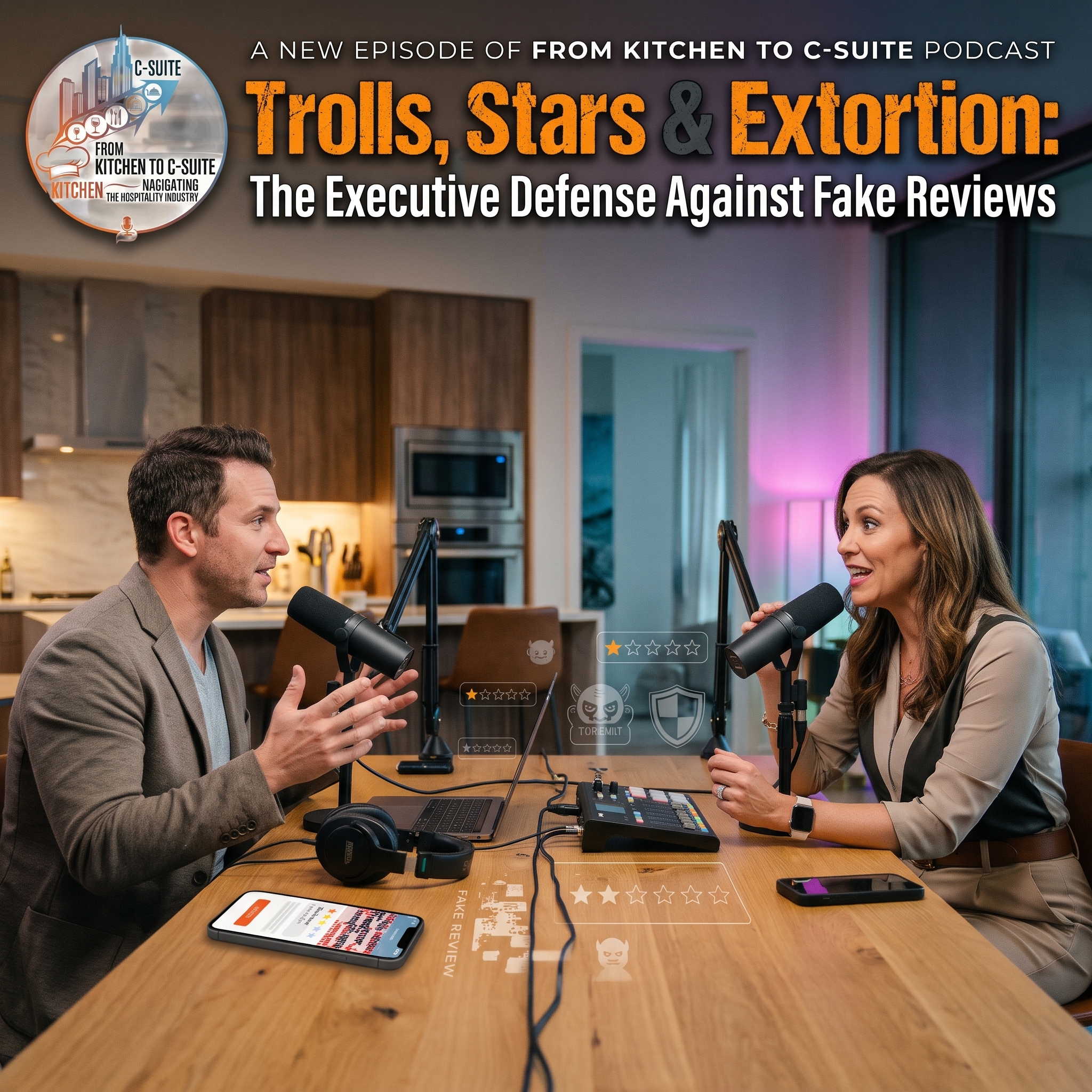
Welcome to 21st Century Dating Decoded! podcast's brand new episode: "Trolls, Stars & Extortion: The Executive Defense Against Fake Reviews." In this crucial session, we unpack modern executive defense tactics against review bombing, blackmail, and online reputation attacks. Key Highlights: • Digital evidence audits and SHA-256 hash logs • Strategic legal hold protocols for CCTV & POS • Formal platform removal notices for Google & Yelp We look forward to having you join us for our next episode of 'From Kitchen to C-Suite,' where we will continue to explore captivating topics designed to elevate your career and entrepreneurial drive. Don’t Miss a Beat! Whether you’re commuting or chilling on the couch, we’ve got you covered. 🎧 On the Go? Subscribe and listen via Riverside and fromkitchentocsuite.com or our website HRBUni.com. You can also search for us on Apple Podcasts, Spotify, YouTube, Amazon Music, Audible, iHeart Radio, or Deezer, or wherever you get your daily audio fix. 📲 Take HRB Network wherever you go. Download the new mobile web app: HHRBUni.com/App 📺 On the Big Screen? Level up your experience by watching the From Kitchen to C-Suite podcast on the HRB Network on Roku, Google TV or Fire TV. On social media: @HRBUni or @HRBUniversal Until our next broadcast, continue to innovate and strive for superior achievement. #21stCenturyDatingDecoded #ExecutiveDefense #FakeReviews #ReputationManagement #HRBNetwork
Trolls & Stars: So To the vision that This is Kitchen to see Sweet. Welcome to the show. You know, usually when we talk about a medical diagnosis, there's this expectation of precision. Right, like engineering. Yeah, exactly. You break your arm, the x ray shows that jagged white line, and the doctor just points at the screen and says, There it is. It's binary. I mean it's totally visible. Broken or not broken. It's clean, it's categorized, and honestly, it's comforting. Well, yeah, we like things to be visible. If there is a problem, you know, we want to be able to point to the source of the problem and just apply a direct fix. But then you step into the world of digital reputation and online sabotage, and suddenly that X-ray machine is completely broken. completely. We're looking at a diagnostic landscape that is, well, it's murky, it's invisible. And that feeling of sudden, invisible chaos perfectly describes what we are diving into today. Welcome to another deep dive on From Kitchen to C-suite. It is a landscape that can change overnight. Literally overnight. I want you to picture this. Put yourself into this exact scenario. You poured your life savings into a restaurant. You've, you know, you've sweat blood over the menu for months, tasting every single dish until it's perfect. The dream. Right. The dream. Your health inspector just walked out the door and gave you a flawless one hundred out of one hundred sanitary score. It's Friday afternoon. You look at your host stand system and your weekend reservations are fully booked. Not a single open table. The absolute peak of hospitality success. Exactly. Everything is finally clicking, you are on top of the world. Then your phone buzz is in your pocket. You pull it out thinking it's a text from your sous chef, but it's a notification. And then another. And then another. The dreaded cascade. In the span of two hours, thirty one star reviews have magically appeared on your Google and Yelp pages. And they are never subtle. No, they are brutal. They claim your kitchen is infested with rats. They claim you serve spoiled seafood and that I don't know, three people are currently in the hospital with food poisoning. Your four point eight star rating is plummeting in real time. That's just devastating. You were standing in the middle of your pristine dining room, completely paralyzed. And before you can even process the panic, a WhatsApp message pops up on your screen from an international number. It reads Pay five hundred dollars in crypto or the reviews keep coming. It is a total nightmare scenario. Your entire livelihood is suddenly held hostage by an invisible entity. And it is happening to hospitality leaders all over the globe every single day. So today's deep dive is an executive survival guide for that exact nightmare. And it's so needed right now. We have built this from a massive stack of crisis management protocols, legal frameworks, and digital forensics guides. Our mission today is to equip you, the culinary leader, with the exact operational, Digital and legal defense is required to combat fake review extortion, coordinated harassment, and digital block mail. It's an entire arsenal we're going through today. Okay, let's unpack this. Because before we can fight this enemy, we really have to understand their business model. why target a local restaurant? That is the critical first question. Because historically, when a restaurant got a fake bad review, it was usually petty competitor sabotage. Right. You assume it's the guy across the street who owns the rival pizza place. Sitting in his office fuming because your patio is full and his is empty. So he makes a fake Gmail account and leaves a one star review saying your crust is soggy. Exactly. It was localized, it was personal, and it was small scale. But what we are looking at today is an entirely different beast. Yeah. It's not the pizza guy. No. We have moved into an era of literal extortion. This operates exactly like digital ransomware, but instead of locking up your computer files, they are locking up your public reputation. And the scale of this is mind boggling. Looking at the data from our sources, the trading of fake reviews is highly standardized now. We are seeing payments ranging from 25 cents to $100 per review, depending on the platform and how aged the fake account is. It's a commodity. But here's the part that genuinely terrified me. There are bulk packages selling on the dark web and even the clear web for eleven thousand dollars for a thousand reviews. What's fascinating here is how incredibly organized this dark economy has become. They have adopted a full blown corporate B2B structure. You have these sophisticated review rings that actually have their own loyalty schemes for their workers. Wait, loyalty schemes? Like a frequent flyer program for extortionists? Basically, yes. The people running these rings need thousands of fake accounts to make their threats credible. So they recruit people online. And they manage it all in private Facebook groups or telegram channels, right out in the open, soliciting buyers daily. That is wild to me. Out in the open. yeah. They treat this like a legitimate digital marketing service. They offer commission structures to middle managers who recruit more fake reviewers and tiered pricing depending on how aggressive you want the attack to be. Okay. I have to ask the mechanical question here because my brain is stuck on the how. Sure. How do these extortion rings actually generate, say, a thousand fake Google accounts without triggering Google's massive multibillion dollar spam detection bots? If I try to make three Gmail accounts in a row from my house, Google asks me for a phone number and a blood sample to prove I'm a human. It's a great question, and it really speaks to the sophistication of the operation. They aren't just sitting in a basement clicking create account. They use SIM card farms. What is a SIM card farm? Imagine a massive rack of hardware, like a server rack, but instead of hard drives, it has hundreds or even thousands of physical mobile phone SIM cards plugged right into it. Whoa. Yeah, and these are linked to automated software that rotates through IP addresses using VPNs, virtual private networks. So when Google's security algorithm looks at the account creation, it sees a unique IP address and a unique valid mobile number capable of receiving a text message verification code. Wow. So to the algorithm, it genuinely looks like a thousand different people walking around a city with their iPhones. Precisely. And then they age these accounts. They don't just create an account and immediately review bomb your restaurant. Because that would do an immediate red flag. Exactly. They let the account sit. They have automated scripts that make the account watch a few YouTube videos, click on a recipe, maybe leave a four star review on a random gas station in another state. Just blending in. They build a digital history so that when they finally point that weapon at your restaurant The platforms register them as authentic high trust users. Aaron That is deeply unsettling. So when they finally unleash this weapon on you, what does the anatomy of that attack actually look like? It follows a very specific, predictable pattern. If you were targeted, what you will typically see is a sudden massive spike of one star reviews within a tight twenty-four to seventy-two hour window. They compress the timeline intentionally. To induce panic. Exactly. It's psychological warfare. If they trickled in one bad review a week, you might just get annoyed, but when thirty hit in two hours, you feel like your business is collapsing in real time. They would be hyperventilating for sure. But if you can push past the panic and look closely at these profiles, the facade starts to crack. They usually lack profile photos. They share strikingly similar grammar or repetitive phrasing. Because it's a script. Right. They might all use the word abysmal or complain about a very specific weird detail. Because the person running the sim farm is just copying a pasting from a spreadsheet. And boldly, I read in the source material that they sometimes even include suspicious WhatsApp numbers right in their user bios or in the review itself. Yes. They aren't even trying to hide the mechanism from you, the owner, because the goal isn't just to ruin your reputation for the sake of trolling. The goal is the shakedown. This review spike is the leverage. Almost immediately after the spike, you will get an email or a direct message to your restaurant's Instagram or a WhatsApp text. The number will almost certainly be from overseas. And they lay out the ransom. They demand free meals, VIP upgrades, which is wild to me, extorting a business for a free steak dinner, or direct cash and crypto transfers. And in some of the most insidious cases, they don't even frame it as a threat. They frame it as a service. The protection racket approach. Exactly. Nice restaurant you have here. Shame about all these terrible one star reviews you just got. But hey, for five hundred dollars, my reputation management firm can magically replace all those negative reviews with five-star reviews. It's classic mafia tactics digitized for the modern era. Now I have to push back here. Please do. Put yourself in the shoes of that stressed business owner. You're actively bleeding reservations. You are watching your open table cover count drop from one hundred and fifty to Down to forty for a Saturday night because people are reading about imaginary rats in your kitchen. The panic is very real. From a purely financial standpoint, isn't it tempting to just pay the two hundred and fifty or five hundred dollars? a lawyer's a retainer is five thousand dollars. A crisis PR firm is ten thousand. Fifty percent of small businesses fail in the first year anyway. Isn't paying the ransom the most pragmatic business decision to just make it stop? It is Entirely understandable why a panicked owner operating on zero sleep and tight margins would think that way. It feels like the quickest, cheapest tourniquet to stop the bleeding, but I want to be absolutely clear. Paying is the worst possible thing you can do. Okay, lay it out why. It is catastrophic. Because it pays a target on your back. Exactly. When you pay, you don't buy silence, you buy a subscription to future extortion. You are immediately added to what is known on the dark web as a sucker list. wow. So they actually share your data. They absolutely do. It marks your business on these underground forums as vulnerable, compliant, and liquid. It guarantees you will be repeat targeted either by the same group coming back three months later asking for a thousand dollars or by other syndicates they sold your contact information to. So you literally become an ATM for them. Exactly. That makes total sense. You're teaching them that the button works. They press the button, money comes out. Why would they ever stop pressing the button? Furthermore, paying them to manipulate reviews, even if they are removing their own fake ones and putting up fake five star ones to make up for it, that violates the core terms of service of platforms like Google and Yelp. Right. If Google's algorithm detects that you are engaging with a review farm to artificially inflate your score, they won't just remove the fake reviews, they will permanently suspend your entire business listing. Which is a death sentence for a local business. If you aren't on Google Maps, you basically don't exist. Correct. You lose your digital storefront entirely. And fundamentally, on a macro level, you are funding the very criminal syndicates that are destroying the hospitality industry. Every dollar you send them buys more SIM cards, more proxies, and funds the extortion of ten other restaurants. You are feeding the beast. Okay, so I am the owner. My phone is blowing up with one-star reviews. The WhatsApp extortion text just arrived. I am terrified, but I know I cannot pay. What actually happens the moment that tsunami hits? How do I fight back? We have to move from panic to precise digital forensics. You are entering the first twenty four hours of a crisis and the clock is ticking incredibly loudly. And the immediate priority from a legal standpoint is an evidentiary lockdown. You need to initiate what corporate legal teams call a litigation hold. Yes. For those who aren't familiar with the term, a litigation hold is an internal directive. It is an order you give to your entire staff to stop deleting anything. Right. You must immediately issue a written directive to all management, your back of house culinary staff, your front of house managers. You have to order them to preserve all internal communications. Everything. We are talking Slack channels, WhatsApp manager chats, seven shifts scheduling logs, emails, text messages, everything. From 14 days prior to the incident through the present. And you have to do this quickly because the instinct of a terrified employee is often to delete things thinking they might get in trouble, or just standard digital hygiene. But if you end up in a lawsuit or if you need to prove to a platform that a situation was fabricated, destroying internal communications is fatal to your case. Aaron The legal term for that is spoliation, right? That's right. Spoliation of evidence. It basically means you destroyed or altered evidence that you knew. or should have known was relevant to an investigation or lawsuit. Even if you do it accidentally because your systems auto-delete, courts can hold it against you. Because they assume the worst. They can assume whatever was deleted would have proven you guilty. Which brings us to the physical security systems in the restaurant, which is a massive vulnerability. Because securing the physical and digital footprint is critical here due to how our technology actually works. Let's talk about the cameras. This is where so many business owners lose their best evidence. Most commercial CCTV systems, your N VRs and D VRs, are programmed to automatically overwrite their storage to save hard drive space. Hold on. Let me play the role of the non-technical restaurant owner here. What is the difference between an N VR and a DVR and why do I care? Good clarification. A DVR is a digital video recorder. That's the older analog camera system where coaxial cables run from the cameras to a physical box in your back office. Got it. An NVR is a network video recorder. Those are the newer IP based cameras that send data over your Ethernet network or Wi Fi to a digital storage drive. But here is what they both have in common. Hard drives are expensive. So to keep costs down, the companies that install these systems set them to loop. Okay, loop how. They record for 14, maybe 30 days, and when the drive is full, it just goes back to the beginning and records right over the oldest footage. Like an old VHS tape. Exactly. So if a fake reviewer claims that on Friday the thirteenth, they sat at table twelve and the waiter spilled hot soup on them and swore at them. And you wait three weeks for Yelp to respond to your complaint, or you wait a month to hire a lawyer, that footage of table twelve from Friday the thirteenth will be permanently gone. Just wiped out. Overwritten by footage of someone mopping the floor three weeks later. That is terrifying. So the action item here is immediate extraction. You must export full resolution, multicamera video of the dining room, the specific tables mentioned in the fake reviews, and the kitchen immediately. Do not wait. And the recommendation from the sources is to back it up to two separate offline hard drives. Put one in your safe at the restaurant and take one home. You are building a digital vault. And alongside the video, you need to establish the digital chain of custody. It's not enough to just email Google and say, hey, this guy wasn't here. Right. They get that a thousand times a day. Exactly. If you want to prove defamation, the court and frankly the tech platforms, trusts and safety teams, Need a strict chain of custody. So we need the receipts. Literally. Literally. You must pull your POS daily search logs, your point of sale system, whether it's toast, square, aloha, whatever you use. You need to pull the raw data logs to prove that zero orders existed under the reviewer's name, or if they didn't leave a real name, you search for the highly specific fake meal they described. Right. We ordered the lobster thermidor and it was rancid. And you pull the toast log in a show. We haven't served lobster thermidor since twenty nineteen. Exactly. You are proving a negative, which is hard, but your POS logs are the objective truth of what happened in your building that day. Aaron It's like dusting for digital fingerprints. You are securing the crime scene. But wait, I'm gonna plead devil's advocate here. If I'm the Yelp platform moderator, or if I'm a judge looking at this case, how do you prove to me that you didn't just edit that? CCTV video. Okay. Yep. Or that you didn't just doctor a a toast POS screenshot in Photoshop to save your own reputation. with AI today, I could figure a receipt in three minutes. That is a brilliant question, and it is the exact defense the extortionists will use if they are ever caught. They will claim you fabricated the evidence. This is where basic digital forensics comes into play, and it is a step almost every small business misses. You defeat claims of digital tampering by using Cryptographic hashes. Okay, stop right there. I am a chef. I know how to perfectly sear a scallop. I do not know what a cryptographic hash is. Break that down for me. Think of it as a unique digital wax seal for a file. Back in the day, a king would drip hot wax on an envelope and press his heavy signet ring into it. Like in Game of Thrones. Yeah, exactly. If the messenger opened that envelope to read the letter, the wax seal would break into pieces. When it arrived, the recipient would know instantly if it had been tampered with because the seal was broken. Okay, I'm with you. A cryptographic hash is the mathematical version of that wax seal. Before you upload or transfer any of those downloaded CCTV video files or screen recordings of your POS, you run a simple built in command on your computer. Built in. You don't have to buy software. No, it's free. If you are on a Windows PC, you open the command prompt and use a command like certutil dash hash file file name SHA two fifty six. On a Mac, you open the terminal and type SHASOM. And what does that actually do? It reads the file and generates a long, unique string of letters and numbers. It looks like a random password, but it's not random. It is based on the exact pixel by pixel, byte by byte makeup of that specific file. Here's where I want to make sure I understand the mechanism. If I take that C C T V video and I drop it into Adobe Premier and I just trim two seconds off the end, or I use Photoshop to change one number on a POS receipt, what happens to that hash? The entire hash completely scrambles. It will generate a completely different string of letters and numbers. It doesn't just change a little bit, it completely changes. wow. So by generating and recording that hash signature in your incident log the exact moment you download the evidence from your camera system, you establish an undeniable, mathematically verifiable chain of custody. That is incredible. So if a lawyer accuses you of editing the video to remove the part where your waiter dropped the soup, you just say, Here is the original hash from the night of the incident and here is the file, run it yourself. If the hash is match, the file is pure. Exactly. It completely removes the he said she said from the digital evidence. Okay, I love that. So you have this bulletproof litigation binder. You've got the hashed videos, the POS logs, the screenshots of the WhatsApp extortion texts. You are armed to the teeth. You're ready. Now comes the hard part. How do you actually force a giant tech company, a faceless monolith like Google or Meta, to pull the fraudulent content down? This is where we move into escalation and platform warfare. And the first thing you have to understand is that navigating the labyrinth of platform policies is an art form in itself. You have to speak their language. And the biggest mistake people make here is emotional reporting, right? The owner logs in, hits the little flag icon next to the review and types, This person is a liar. Yes. That is the most common mistake. Why doesn't that work? Because to me, lying seems like a valid reason to remove a review. Because you have to think about who is on the other end of that report button. You have a content moderator, likely sitting in a cubicle halfway across the world, staring at a cue of thousands of reports a day. They have about thirty seconds to make a decision. To that moderator, food quality is entirely subjective. Right. They can't taste the food through the screen. Exactly. They cannot arbitrate whether your steak was actually overcooked or if your soup was cold. If you flag a post for lying about my food, The moderator dismisses that immediately as a customer service dispute. They just hit ignore. They are trained not to take sides in subjective arguments. You cannot flag based on subjective disputes. You must flag based on specific concrete violations of their terms of service. You have to give them a policy violation they can verify without tasting the food. So instead of claiming they are lying, how should we categorize these reports? You look at their terms of service rule book and you match the behavior. For example, you report for harassment and bullying. If the fake reviewer is doxing your staff by naming your 19-year-old hostess, providing her physical description, or posting her social media handles, that is a direct violation of safety policies. Boom. Instant removal. Or you report for conflict of interest. If you have proof, like security footage or internal emails, that the customer leaving the review is actually a disgruntled ex-employee who was fired two days ago, platforms will remove that. Because employees aren't allowed to review their own workplaces. And what about the extreme claims, like the rat infestation? That falls under fraudulent misinformation, which is huge right now. If a reviewer claims your kitchen has an active rat infestation or that they got severe food poisoning, but they provide zero health department evidence, you can fight that. You attach your certified 100 out of 100 health inspection report from that exact week. You prove that their objective claim of a health hazard is materially false. Okay. That makes sense. You have to attach your evidence directly to those specific policy violations. And I understand Google has actually built a specific pipeline just for this scenario now. Yes. Because this extortion became such a massive problem, Google created a dedicated merchant extortion report form. This is crucial. If you are being extorted, you do not just use the standard flag button on your Google business profile. That goes to the regular queue. You use the specialized extortion form. Aaron It's like it's like calling the detective instead of the become. Yeah, exactly. It routes to a specialized trust and safety team. You supply your evidence folder, your timestamps, the hashes we talked about, and crucially those screenshots of the WhatsApp extortion demands. Aaron And does this actually work? It does. The system does work. In 2025 alone, Google removed over 240 million policy violating reviews. The apparatus functions, but only if you feed it the right data in the right format. And every platform has its own quirks. I was reading in the guide that Yelp, for example, strictly bars secondhand information or non customer reviews. Yelp is very rigid about this. Their core philosophy is that a review must reflect a first hand consumer experience. If a troll leaves a review saying, I saw a TikTok that said this place has terrible service and the owner is mean, Yelp will remove that. Why? Because the reviewer is explicitly admitting they didn't dine there. They are just repeating internet gossip. That's a great loophole to look for when you are reading these fake reviews. Are they actually claiming they ate there or are they just repeating something they saw online? Exactly. Now when we talk about platforms like Meta, so Instagram and Facebook and TikTok, the documentation outlines a very specific best practice for submitting these legal takedown notices. It says you must submit your requests via verified Corporate domains. Why is that so important? It comes down to credibility and corporate triage. Do not use a free Gmail account to contact a legal department. If you email Meta's legal team from bobsburgers at gmail.com, you will be treated like a random unverified user. You could be anyone. You will be pushed to the absolute bottom of the queue or caught in an automated spam filter. But if I email from my domain. If you email from legal at bobsburgers.com or management at bobsburgers.com, you are signaling that this is an official corporate communication. You are verified by your domain registry, you are taken seriously, and you are routed to the teams that handle business to business legal disputes. And the formatting of your evidence matters just as much as the email address. The guidelines point out that you should attach PDFs or image files rather than just Dropping in a bunch of hyperlinks to your Google Drive or Dropbox. I would have thought a link is easier. Why PDFs? This is a cybersecurity protocol. Platform legal and trust and safety teams work in highly secure sandboxed environments. Aaron What does sandboxed mean in this context? It means their computer networks are walled off from the broader internet to prevent malware infections or phishing attacks. Because think about it, people send them malicious links all day long. So their internal systems routinely block or strip out external hyperlinks. wow. If your entire proof of extortion relies on a Dropbox link you paste it into the email, the moderator literally might not be able to click it. The link will just be dead text to them. So you spend days building this incredible case and they just delete the email because they can't see the evidence. Exactly. You have to embed your evidence directly as a PDF or as standard image attachments. So it clears their security protocols. And they can read it directly within their email client. Here's where it gets really interesting and terrifying. The cross-platform spillage. yes. The digital mob. Right. The modern internet is entirely interconnected. If a completely baseless, malicious TikTok video about your restaurant goes viral, you aren't just fighting a battle on TikTok. Thousands of people who have never even been to your state, let alone your city, will feel self-righteous, find your restaurant. And review bomb your Google and Yelp pages in retaliation for something that didn't even happen. It is the digital equivalent of a pitchfork mob. And the sheer volume is overwhelming. You might get 500 one-star reviews in an hour. You cannot fight them one by one. You cannot sit there and click report 500 times. So what is the tactical move there? In those viral mass spillage events, you must proactively contact Google and Yelp merchant support. And request what is known as an unusual activity alert or a review bombing incident lockout. A lockout. So you are basically pulling down the steel shutters on your digital storefront. Exactly. This temporarily freezes your page, it stops accepting any new reviews, positive or negative. And more importantly, it usually triggers their automated systems to auto purge the anomalous influx that occurred over the last twenty four hours. It gives you time to breathe, let the viral outrage cycle burn itself out, and work with their teams to restore your baseline rating. That is a crucial emergency break to know about. We are going to dive into how to handle the real, human customers who are watching all this chaos unfold. But first, a quick word from the organizations that make this deep dive possible. Sure. This podcast is supported by the generous commitment of our sponsors, and we extend a special thank you to HRB Universal. Their dedication to providing comprehensive resources and promoting excellence. is key to empowering professionals across the culinary and hospitality industries. We also want to acknowledge the Plate and Poor Collective Equity Partner Program. This initiative exemplifies a true commitment to fostering shared success and equitable growth within the food and beverage sector, helping entrepreneurs build a more inclusive and thriving future. The journey to the C-suite is fueled by innovation, relentless dedication and the right network. We encourage you to engage with the resources and support offered by our sponsors. For details on how to connect with HRB Universal and the Plate and Poor Collective Equity Partner Program, visit HRBUNI dot com or just Google HRB Universal. All right, we are back. Let's get into it. So we've talked about platform removals. We've submitted the extortion forms, we've attached our hashed PDFs, but here is the harsh reality of the internet. Platform removals take time. Days, sometimes weeks, if it requires human review. And the internet doesn't pause while you wait. Exactly. While you are sitting there waiting for Google to process your PDF, real paying customers in your city are deciding where to eat this weekend. And they are reading those one star reviews. How do you mitigate the bleeding in the public square while you wait for the cavalry? This is where you have to master the art of the public reply. And the fundamental shift in mindset here is understanding what crisis communicators call the silent secondary audience. Meaning you aren't actually replying to the troll. Never. That is the golden rule. Responding to a fake review is not about winning an argument with an extortionist. You will never convince them they are wrong because they know they are lying. They just want the five hundred bucks. Right. Your reply is a broadcast message to every single future customer who is scrolling your page trying to decide if they should book a table. You are performing for them. Therefore, you must remain clinical. factual and completely devoid of emotion. Which is so hard. think about the emotional toll on the restaurant owner. This is your life's work. You've missed birthdays, you've taken out second mortgages to keep this place afloat. And some anonymous person is claiming you serve rotten food, the instinct is to scream at them in all caps. It is incredibly difficult. It requires immense restraint, but emotion is your enemy here. If you sound angry, defensive or unhinged The casual reader scrolling by might think, well, maybe the owner is crazy and maybe this bad review is real. So you have to be the adult in the room. Always. You must never use defensive buffer words. Aaron What are buffer words? Phrases normally we're great, but we were short staffed that night, or the delivery app glitched and didn't send us the ticket in time. I see those all the time. Why are those bad? They provide context. Aaron Because the prospective diner reading that does not care about your back of house logistics. They don't care that your dishwasher called out sick. They only hear excuses. That makes sense. They think if I go there tonight, will they be shortstuffed again? It damages confidence. And crucially, never threaten defamation lawsuits publicly in the comment thread. Like saying, I'm calling my lawyer and suing you for slander? Yes. Never write that. It makes you look aggressive and litigious to the casual observer. It completely ruins the hospitable vibe of your brand. So what do you say? How do you defend yourself without looking defensive? The materials we are reviewing provide some incredible, battle-tested templates for this. Let's walk through a few. Let's do it. For a suspected fake review, where they were never in the building, you keep it surgical. You write, we have cross-referenced our logs for the past month and we cannot find any record of an order under your name. Furthermore, we do not carry the dish mentioned in your comment. Please contact our general manager directly at this email. So we can investigate this anomaly. It is perfect. It quietly and politely exposes the lie. Any reasonable person reading that immediately realizes the reviewer is full of it. Wait, they don't even serve lasagna? But at the same time, the restaurant looks incredibly professional, attentive, and eager to solve a problem. It's a velvet hammer. Or take the disgruntled ex-employee scenario. If a former line cook is disguising a workplace grievance as a diner complaint, claiming the kitchen is a mess. You publicly state, platform guidelines strictly prohibit reviews generated from workplace disputes. If you have unresolved matters regarding your past employment, please address them directly with our HR team at this number. It totally disarms the attack. It absolutely does. You aren't arguing about whether the kitchen was messy. You are simply stating a policy and exposing their true identity as a former employee. The reader instantly dismisses the review as sour grapes. Okay. But I want to pivot slightly. Because not every bad review is a dark web extortion plot. What if the review is real? That happens. What if a customer actually had a terrible time? The food was cold, the server was rude, the music was too loud, but they didn't say a single word to the waiter while they were in the building, and instead just went home and nuked you on Yelp. I'm totally guilty of this, by the way. We all are. Last month I was at this place and I was served a piece of chicken that was undeniably pink in the middle. And when the waiter came over and cheerfully asked, How was everything tasting? I just smiled, put my napkin over the chicken, and said, great, thanks. Because I hate confrontation. I didn't want to make a scene. But I definitely told my friends not to go there and I thought about leaving a bad review. This brings us to a critical concept in hospitality reputation management. The silent 71%. The silent 71%. Yes. Statistics show that up to 71% of dissatisfied customers will leave a business without ever uttering a single complaint to management. They will simply defect to a competitor. Or worse, they will wait until they are safely behind their keyboard to vent their frustrations online. As you said, most people fundamentally abhor face-to-face confrontation. Right. Nobody wants to be the guest yelling at a waiter in the middle of a crowded dining room while everyone stares. So to combat this, you have to employ what is called the interception strategy. You have to catch the issue before it goes public. And you do that by giving them a frictionless digital avenue to complain while they are still emotionally invested, but in private. The strategy highlights the necessity of digital, anonymous feedback tools. Things like opiniator, where a guest can scan a QR code on the table and text a complaint directly to the manager's phone. Or automated follow-up emails via reservation systems like Seven Rooms or Momos. They send a text 30 minutes after you pay the bill asking, How was your meal? You are building a digital off-ramp. You are telling the guest, tell us now, privately, while we can still fix it. It moves the interaction from a public shaming on Google Maps to a private recovery mission in your inbox. And when you get that private feedback, you have to move fast. You execute the 15-minute recovery call. Speed is everything here. If they are still driving home and the manager calls, the impact is massive. It shows you are actively monitoring your business and that you genuinely care. The guides provide the exact scripts for managers we're covering a real guest. You introduce yourself, you cite the exact issues so they know you actually read their complaint, you validate their frustration without making those defensive excuses we talked about earlier, and you present a concrete remedy. But there is one absolute golden rule for this phone call. I love this part. You must confirm the refund execution before you dial the phone. Yes. That is the tactical master stroke of service recovery. Walk me through that psychology. If you call a guest and say, I'm so sorry about we're chicken, if you come back, I'll give you a free dessert, you are asking them to do work. You are asking them to risk another bad meal. If you say, I'm so sorry, I would like to refund your meal, you are opening a negotiation and angry people love to negotiate. But if you pull up their ticket in the POS, you process the comp to their credit card, and then you call. Exactly. Within the first fifteen seconds of the conversation, you can say, Hi, I am so sorry about your undercooked chicken. That is unacceptable. I want you to know I have already refunded your check entirely to your Visa card. The psychology of that is brilliant. The data notes that this diffuses ninety percent of customer anger instantly. Because they were gearing up for a fight. They were rehearsing their arguments in their head about why they deserve their money back, and you just gave it to them before they could even ask. You took the wind completely out of their sails, but in the best way possible. You've transitioned them from an adversary to a loyal advocate. They will tell ten people about how amazingly you handled their complaint. It's the ultimate judo move. Okay, but we have to pivot back to the worst case scenario, the extortion. Right, back to the trolls. What happens if the platforms refuse to take down a coordinated smear campaign? You've flagged it, you've submitted the PDF forms, you've appealed. And the Google moderator just replies with an automated email saying, sorry, this doesn't violate our policies. And suddenly this fake campaign sits on your page for months and it starts costing you thousands of dollars in real, measurable revenue. That is the tipping point. That is when you stop playing nice with automated web forms. You stop worrying about public replies and you bring in the legal and financial heavy artillery. Because now it's not just a PR problem, it's a survival problem. Precisely. If you are gonna pursue legal action against these bad actors for tortious interference or trade libel, you have to prove what the courts call special damages. Okay. Let's define tortious interference real quick for the non lawyers out there. Tortious interference essentially means that someone intentionally damaged your business relationships or contracts. They interfered with your ability to do business, and they did it on purpose. Got it. And to sue for that, you need special damages, meaning You cannot just walk into court and say, Your Honor, my feelings are hurt, my chef is depressed, and the dining room feels less busy lately. The court does not care about your feelings. The court cares about math. You need a forensic CPA, a certified public accountant, to generate an expert witness report on economic damages. And the math on how they calculate this is fascinating. It's so precise. The CPA establishes what is called a but for baseline model. This is the crux of the financial argument. Meaning they calculate what your sales would have been but for this defamatory attack. They look at your trailing eight week baselines, they look at year over year data for that specific month, and they even control for variables like weather and seasonal shifts. it rained all week last year, but it was sunny this year, so sales should have been ten percent higher. It is a highly rigorous statistical model. Our materials give us a brilliant sample ledger that breaks this down into three schedules to present to a judge. let's walk through that ledger because I want people to hear how fast the financial carnage accumulates from just a few fake reviews. It is staggering. It is. So Schedule A is the lost dine-in gross margin. In the sample we reviewed, the restaurant lost an estimated four hundred and fifty covers, meaning four hundred and fifty individual guests over a three week span that directly correlated to the viral fake review attack. And you multiply that by their average check size minus the cost of goods sold. And that translated to $28,000 in lost gross margin. Just vanished. Then you move to Schedule B, which is tortiously canceled events. This is where third party contracts fall apart because of the online noise. Right. The ledger shows a massive $12,500 holiday corporate buyout that was canceled. Why? Because the corporate HR director Googled the restaurant, saw the fake reviews about rats and food poisoning, and cited reputational risk and employee safety. They pulled the contract. Add in a couple of canceled rehearsal dinners where the brides got spooked, and Schedule B totals $20,550. Finally, Schedule C tracks mitigation expenses. These are your direct out-of-pocket costs to stop the bleeding, the money you had to spend because of the attack. Like the $3,500 retainer for legal counsel to draft the seasoned assist letters, the $2,800 for a crisis PR firm to run targeted local ads to wimback community trust. And I thought this was brilliant. $1,250 for an emergency third party sanitation audit to publicly prove the rat rumors were false. Schedule C totals, $8,000. So when you add it all up, Schedule A, B, and C, the total special damages calculated for this one isolated incident is $56,550. $56,000. That is a devastating, potentially business ending hit for an independent restaurant operating on a five percent profit margin. So You have your damages quantified by the CPA. The next legal avenue is issuing a formal cease and desist notice. You demand immediate deletion of the fake posts of public retraction, and crucially you demand the preservation of evidence, warning them against that unlawful spoilation we talked about earlier. You tell them, Do not delete your hard drives because we are coming for you. It sets the legal trap. But I have to ask, how do you sue a ghost? That is the ultimate challenge of Internet Law. Right. If the troll orchestrating this attack is hiding behind the username Bood Critic 99, or using an anonymous Instagram burner account with a fake anime profile picture, a cease and desist letter just bounces off them. You don't know their real name. You don't know their address. Where do you even mail the lawsuit? It feels impossible, but the legal system has developed a very specific mechanism for this over the last two decades. The John Doe lawsuit. Okay, break that down for me. You literally file a defamation lawsuit against an unnamed defendant, John Doe. You file it in the court system presenting your CPA damages and your hashed evidence. Once the suit is officially filed and a judge signs off on it, you gain subpoena power. So you can force the tech companies to talk. Exactly. You serve a court-issued subpoena to Google, Meta, Yelp, or even the internet service provider, the ISP, like Comcast or Verizon. You legally compel them to reveal the IP address, the billing information, and the true identity of the account holder behind Food Critic 99. But the courts don't just hand that over willy-nilly, right? There are massive privacy protections and First Amendment concerns at play. We have a right to anonymous free speech in this country. Yes, and that is a very important right. To balance that right against a business's right to protect itself from defamation, you have to navigate stringent legal tests. The most notable ones are the dendrite and kahill tests. Dendrite and Cahill? What do those tests actually require you to prove? They require the plaintiff, the restaurant owner, to prove they have a legitimate prima fasci case for defamation. I'm not a lawyer. What does prima fasci mean in plain English? It's Latin for at first sight. It means that you have presented enough initial evidence, your POS logs, your camera footage, your CPA report, that if assumed to be true. proves you were defamed and suffered damages. You have to prove you aren't just suing someone because they left a legitimate bad review that hurt your feelings. Aaron You have to prove it's a real case of malicious falsehood. Exactly. Furthermore, these tests require that you have made genuine, documented efforts to notify the anonymous poster that they are being sued, like messaging them on the platform, before the court will strip away their First Amendment anonymity. It is a high bar to clear. But for provably false damaging claims like Fake rat infestations or coordinated extortion rings. It is the established pathway to unmasking the attacker. And it's worth noting that the federal government is finally catching up to how damaging this is to the economy. The Federal Trade Commission, the FTC, enacted a final rule on fake reviews that just went into effect on October 21st, 2024. And the penalties are severe. They are massive. It allows the agency to seek civil penalties up to $50,000 per fake review. So if they hit you with 30 fake reviews, that's $1.5 million in federal fines. The regulatory hammer is getting much, much heavier. It is, which is a great deterrent. But we also have to be realistic. Litigation is slow. It takes months, sometimes years, and it is expensive. So if we look at the ultimate long-term defense, how do we ensure our business is bulletproof against the next attack? You can't sue everyone on the internet. You'd go bankrupt paying lawyer fees. You build a fortress and you build it out of positive data. In the industry, it's called statistical dilution. Statistical dilution. Explain the math on that. The absolute best defense against a fake one star review is a mountain of authentic five star reviews. It's a simple numbers game. If your restaurant has been open for a year, but you only have 15 reviews total and five fake one stars hit you, your average rating is completely destroyed. You drop below a 4.0. And what happens when you drop below a four point You disappear from the Google Map Pack. The Map Pack are those top three results that show up when someone searches restaurants near me. If you aren't in those top three, your digital foot traffic effectively dies. But if you have proactively built a fortress. Exactly. If you have spent the year systematically building a profile with 200 or 500 4.8 star reviews, a fake one-star attack is a statistical blip. Five one star reviews against five hundred five star reviews won't even move your average by a tenth of a point. You won't even feel the attack. To achieve that level of volume, you cannot leave review generation to chance. You can't just hope people will review you. It must be institutionalized. The protocols we researched outline standard operating procedures or SOPs for daily review management. This is where reputation management moves from a reactive chore to a proactive strategy. Right. This isn't something the exhausted owner checks on a Sunday night at 2 A.M. while drinking a beer in the office. It is a twice daily sweep systematically executed by management at 10 AM during the morning pre-shift and at 4 p.m. right before the dinner service rush. And it is highly categorized. Every single incoming review gets routed into specific action tracks. Walk me through the tracks. Track A is your four to five star positive feedback. Track B is your one to three star legitimate negative feedback, the real customers who had a bad time. And track C is suspected fraud, abuse, and extortion. You handle each track completely differently based on the SOPs we discussed today. And I absolutely love how they integrate this into the daily staff lineup. every single pre-shift meeting, management reads one positive win from track A to boost morale and celebrate a specific server. And then they address one operational defect from track B. Completely neutrally. Neutrality is key. It instead of yelling at the kitchen, the manager says, Hey team, we had two reviews overnight mentioning a delay between the salads and the main courses. Let's tighten that up. Expo needs to space ticket fires by twelve minutes today. It removes the blame, it removes the shame, and it focuses entirely on the system. If we connect this to the bigger picture, reviews aren't just public relations crises to be managed. They are free, incredibly detailed market research. It's real time consulting. Exactly. Large hospitality groups are realizing this. They are now using AI and reputation management tools, software platforms like Momos, Tableau, Black Box Intelligence, Zion, to aggregate all this data across dozens of platforms like Yelp, Google, Open Table, TripAdvisor. And what does the AI do with all that text? It tracks sentiment trends over time. It can read 10,000 reviews and tell you your overall sentiment for Ambiance is up fifteen percent, but your sentiment For host stand wait times is down eight percent on Friday nights. Right, because if you are reading that data correctly, it identifies your kitchen bottlenecks, your staffing mismatches, or your training gaps before they harden into permanent reputation damage. It tells you exactly where your business is failing weeks or months before your profit and loss statement does. It is the ultimate leading indicator. It transforms a vulnerability into a massive operational advantage. So what does this all mean? We have journeyed today from the dark web extortion rings and SIM card farms all the way through digital forensics, cryptographic hashes, platform warfare, and complex legal calculus. But I want to leave you, our listener, with a final thought to mull over as you step back into your operations today. It's a rapidly evolving landscape. It is. As AI makes it incredibly cheap and easy to generate thousands of hyper realistic, localized fake reviews. Reviews that don't just use repetitive grammar. But sound exactly like real people? And as the economic stakes of restaurants continue to rise to survival level heights, are we heading toward a future where anonymous online reviews are banned entirely? It is a profound question. Will platforms eventually be forced, either by federal legislation or simply by market pressure, to require verified digital IDs linked to actual credit card transactions just to post a star rating? Will the era of Food Critic 99 coming to destroy your livelihood from the shadows finally come to an end. It's a profound shift to consider for the future of digital trust, and it might be the only way to save the integrity of the hospitality industry. We look forward to having you join us for our next episode of From Kitchen to Sea Suite, where we will continue to explore captivating topics designed to elevate your career and entrepreneurial drive. Don't miss a beat. Whether you're commuting or chilling on the couch, we've got you covered. On the go. Subscribe and listen via Riverside and FromKitchen2C Suite.com or our website HRBUnify dot com. You can also search for us on Apple Podcasts, Spotify, YouTube, Amazon Music, Audible, iHeartRadio, or Deezer, or wherever you get your daily audio fix. Take HRB Network wherever you go. Download the new mobile web app, hrbunified.com forward slash APP. On the big screen, level up your experience by watching the From Kitchen to C Suite podcast on the HRB Network. On Roku, Google TV, or Fire TV. On social media at HRB Uni or at HRB Universal. Until our next broadcast, continue to innovate and strive for superior achievement.