
Five Dubs Podcast · MDDC Press Association
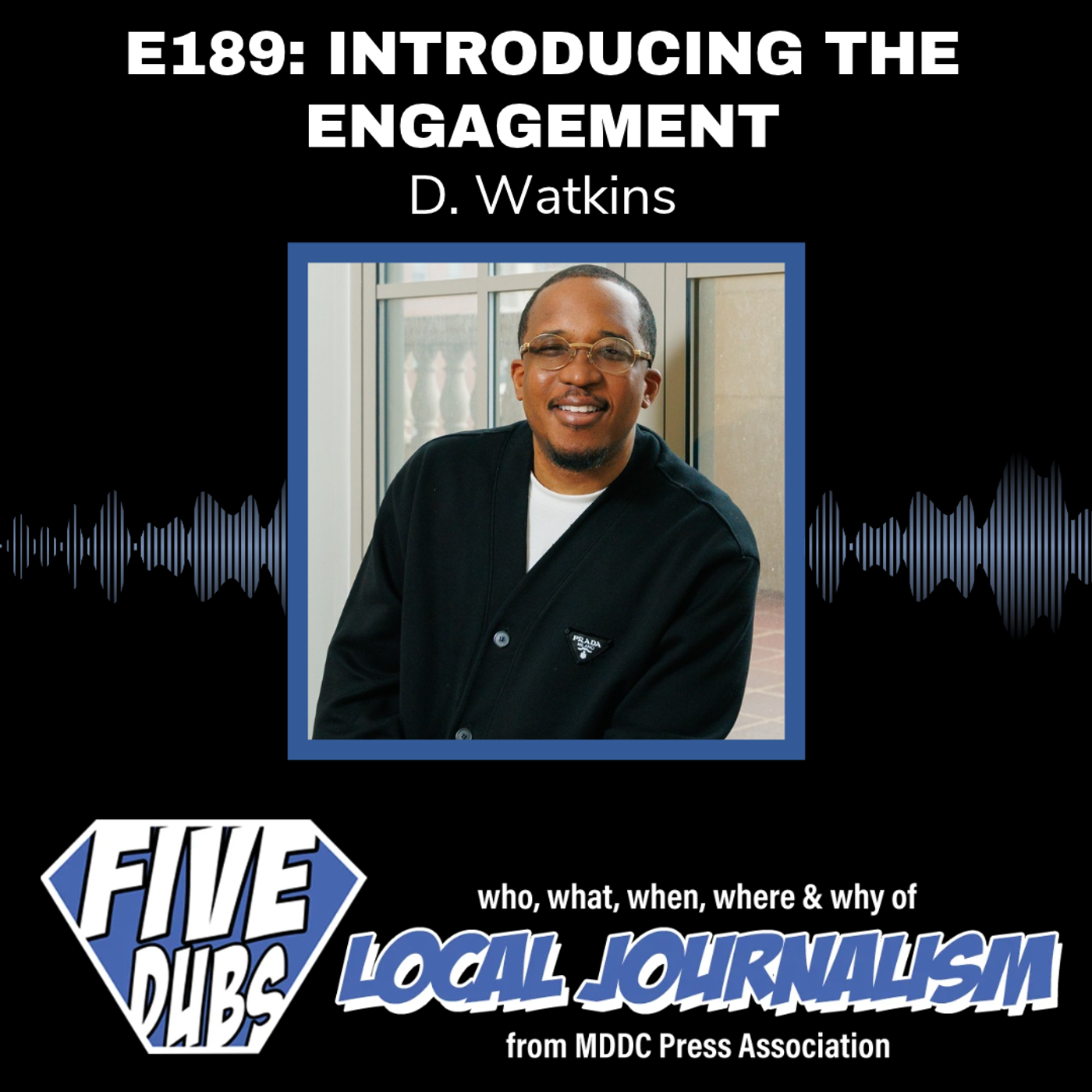
In this episode, Rebecca talks with Baltimore author, journalist, and educator D. Watkins about The Engagement, his new magazine-style radio show launching October 19th on WYPR and Baltimore Public Media. Watkins explains why he believes the best conversations happen on public radio, how the show will bring sources directly into dialogue with the audience, and why he’s committed to interviewing people with lived experience rather than relying only on credentialed experts. He also shares a story about a two-year investigation into workplace discrimination that never saw publication, and what it means to earn a source’s trust without asking anything transactional in return. They also dig into Watkins’ own storytelling roots, from the personal essay writing that shaped his memoirs to the childhood hours spent in NA meetings with his father that, he realizes in the conversation, taught him how to recognize when people are speaking from the heart. The two discuss the difference between journalism’s need for facts and memoir’s demand for vulnerability, and Watkins closes by describing what success looks like for the show six months in: a space where layered perspective replaces simple talking points.
Rebecca Snyder: Hi everyone. I am excited to have on Five Dubs today Baltimore author, journalist, and educator Dee Watkins. His work has spanned books, television, interviews, a whole host of things. He's originally from East Baltimore, and he's bringing that huge breadth of experience to WYPR and Baltimore Public Media with his new radio show, The Engagement, which will debut on October nineteenth. So welcome to the program, D. I'm really excited to have you. D Watkins: I'm happy to be here. Thank you for having me. Rebecca Snyder: So I I know you've you've done podcasts, you've done radio, but why this show and why now? D Watkins: I think that there's so many conversations that's not happening and I'm just a believer that the best conversations live on public radio. now we have all of this different technology where I can reach people through YouTube, I can reach people through many different podcasting sites, but at the end of the day, I I I wanna be here because we have a team of people who are gonna hold me accountable and make sure that I'm holding guests accountable and that we're having like the best conversations that we could potentially have. Rebecca Snyder: So I wanna ask you why you had said that the best conversations happen on public media or public radio. So why is that? D Watkins: think because it cultivates there's an audience of people who know that they that we don't know everything. We're hungry to learn. We're we're proud to not be know at us. We're proud to be challenged and to you know sometimes get it right and sometimes not get it right but walk away smarter and more connected to the people who we share space with. And I don't think you know i in this time and age where everyone on the internet is expert, everyone had it figured out since they came, you know, into the world. I think it's healthy for us to grow this space, to run towards this space and to bring others along for the ride. Rebecca Snyder: You know, for me it feels like continuous revelation that you know you nobody knows everything. And also that people are experts in themselves, you know, and and I think a lot of your work has has been grounded in you know your own experience. and so I wanted to know was there a time when you because the engagement has had sort of a slow burn and bubble up to to its launch? Did you have a moment where or a conversation where you're like, that needs to be on the radio? D Watkins: so many. Rebecca Snyder: Tell me about one. D Watkins: the last election. You know, there was commentary around it that I really appreciated, but you know, I I wanted to hear and I I wanted to be in conversation with people in in just in different parts of the state. people who were blindsided, people who didn't know what was gonna happen. And more importantly I wanted to hear about what's the plan moving forward. I still wanna know what's the plan moving forward. I I I wanna know what are we gonna do to to combat so many bad things that has happened to so many good people. what are we gonna do as a community? What are we gonna do as people in media? How are we gonna cover this and and with integrity and and and honestly? and and share the scary parts and work towards something that's not as scary. Rebecca Snyder: Yeah. And that makes a lot of sense. Now I think let's take a step back before because we have so much that we can talk about, but let's take a step back and talk about the mechanics of the program because it's gonna be a mix of reporting and interview styles. And I think I heard somewhere that it was going to be more of like a magazine type format. So tell us what people can expect on Monday. We're recording this right before it launches, so it's all gonna be A new experience, but tell us what what you expect to happen on Monday in your first show. D Watkins: So Monday, you first you can expect me to sound a little nervous. But Rebecca Snyder: Ha ha ha. D Watkins: but you know, all jokes aside, I think yes, magazine style. Magazine style, because my background is in magazine writing. I've been a journalist. I've written many magazines, New York Times magazine, The Atlantic, Esquire, stuff like that. some Rolling Stone stuff back in the day. So that's a space where I feel comfortable. I think where it's gonna be elevated from that magazine style is you're actually gonna get a chance to talk to the people who are in the stories. we're bringing people off the stage and putting them parking them in a place where the audience can have a back and forth. I don't know if you ever read a real good article and you find yourself saying, I wish I could have asked that, or I wish the journalists Rebecca Snyder: Yeah. D Watkins: would have talked about that. Well now We're gonna open up the lines for communication and allow people to actually do that. So the big component of the engagement as we grow the show out is for it to be interactive, for the community to have stake and be able to participate in the conversation as well. Rebecca Snyder: So now what types of things are you hoping to highlight? You had talked earlier about one of the the precipitating reasons for for conversations on radio was the last election, but we've got another the midterms hurtling towards us now. Are you going to be covering some of that or what are what are some of the topics you have up your sleeve? D Watkins: Yeah, we're we're gonna talk about it. we're going to talk about where does this country go to move forward? what do we do to make sure we still have a country to pass down to our children? Like we're going we're gonna have real conversations. I'm not just bringing in talking heads, I'm bringing in people who are actually in the community doing work. People who are have on the ground experience with the people who are feeling the most pain. The people who get a tear in their eye every time they pull up to a gas station and look at those prices. You know, these these are the people that I think we need to hear from. they make up the heart and soul of of of America. Rebecca Snyder: And I I think that makes a lot of sense in so many times, like when you're when you're in journalism school or or when you talk to reporters, they're sketching out an issue, and then what really makes that story come alive is talking to someone who's gonna be impacted by, you know, the change or the topic or the issue. How do you plan to reach out? You're really grounded in the community. You've got a a great network having you're a professor at the University of Baltimore, you have decades of of journalism experience, but how do you plan to bring, you know, those tears from the gas pump and and those stories really into the studio? D Watkins: You know, we're open. We're open for business. we're putting out calls to let people know that, you know, there's a a new way a new wave and a new kind of show in town, in this state. we're not, you know, we're vetting people, but we're not just closing the door on people who don't have a bunch of letters behind their names. while we value that insight, especially for high level conversations, sometimes You know, that could be they can offer a drone perspective where you get a chance to hover above the issues and look at them. and it's not exactly the same as a person who is going through it every day. And I wanna mix it up and invite all. Rebecca Snyder: So it also it kind of feels like you'll be the ringmaster of the circus in some ways because you're it sounds like you're not shy about difficult issues or issues with a lot of nuance. And so what's the what is that gonna be like when you have all those differing perspectives? When you're writing, you can kind of keep them at arm's length. When you're talking in an hour, they're all there. So w what are you gonna do? D Watkins: I'm going to be a thousand percent honest. one thing you'll hear me say over and over again is I'm a lifelong student. I don't know what it's like to walk in the shoes of Rebecca Snyder. You understand what I'm saying? But I if I get the luxury to talk to Rebecca, I can ask, I can listen, I can have an open mind and an open heart, and I can get some understanding that I can bring with me. As I've continued my own journey. I'm pretty sure I've been through some things that can help you and you've been through some things that can help me. And I think that's what it should be about. You know, taking the things that are different and mashing them up with the differences that exist in other people and then seeing how we come out on the other side. I truly believe that in my heart, my soul, my spirit. And I think I I believe that's gonna be the heart of this show. Rebecca Snyder: Yeah. And i everyone has something to bring and I think it'll it'll bring such a nuanced perspective to to the topics and issues. And so you've been a journalist for a long time, you've been a lot of things for a long time. What do you think is missing in journalism that maybe you want to bring forward with this show? D Watkins: So the main thing that is missing in my opinion is we're not having honest conversations around the pressure on journalists. Everyone is expected to get it first and to get it fast and they're judged by clicks. Not by conversations, not by research, not by the impact of their story, but how many people hit click. And I think that there's a number of there's a number of artists, journalists, creators, and people who are trying to go away from that. And I just feel like I'm a part of that pack. I'm one of the people who you know, if if I have a source on a story and some of my sources are are are vetted by producers here, some of my sources are people that I've been vetting for the last twenty years. And maybe they don't do media, but I can get them to come on and talk about something because I know what they've been through over the last two decades. And I it brings a different level, different layer of authenticity. it'll bring out a a it so many different perspectives and it'll make the story that much more relevant and important. Rebecca Snyder: So it sounds like you're dealing with some communities that and there's trust in media has diminished and certainly local media is still a very trusted news source and I think you see that with with public radio, you see that with local local digital news and and local newspapers. But trust is kind of waning in in a lot of our institutions. So how do you reach out to a community or to people you that don't have an inherent trust in those institutions and convince them that their story, that it's worth sharing their story with you. D Watkins: Well, I I think the main thing you do is you don't reach out to in a transactional way. You let them know that you're here. I'm here and you're welcome to the conversation. No, I'm not telling you to come on and say certain things. I'm not telling you to endorse me. I'm not telling you to agree with me or, you know, have a direct connection to anything I'm talking about, but we are here. We're having these conversations. We're trying to work through some of these issues and we want to include you. And if they feel comfortable with that, then you know, we're all taking a big step forward. And if they're not, then I I think we'll earn their trust over time. Rebecca Snyder: Can you tell me about a time where you brought someone forward that just was not like you felt was important to the story but was mistrustful and and like what what did that experience feel like for you to to get them on? D Watkins: I have a terrible story actually. of a of something Rebecca Snyder: Bring it on. D Watkins: that I reported for two years that didn't actually ever come out. It didn't run. Rebecca Snyder: Mm. D Watkins: it was a a guy who worked for a major company in Maryland and he was discriminated against. he was driving in the car with his training supervisor, and he was a black guy, the supervisor was a white guy, and as they're driving down the street, A car cut him off, and no, sorry, he cut a car off, and the car hit the horn, and he looks out the window and he says, Learn how to drive, you effing inwards. And the the guy who just got this job, who is happy Rebecca Snyder: my gosh. D Watkins: to have this job, is he's shaking out of anger, but then also out of fear. And because Getting this job for him was like hitting the lottery. It was like an impossible thing. because he had been applying for two years before he was actually able to get into this position. And it and, you know, he's has since moved on. he he made a complaint and he was fired, and it was devastating to him and his family. And he moved on. And he was given to me by a source. And I wanted to try to get this story out. And it took me a lot of convincing on how this is bigger than him. This is like something that as a community we should rally around you and try to get this out because they can't do this. And the story basically, you know, I wrote the story and and it it it was never the publisher said they can't put it out for whatever reason. I didn't they didn't give me a real reason. They didn't give me a real reason. It was and what I think the real reason was is I think I think the company had so much so much power that I think I think the publication who it was in attend who who it was intended for, maybe they worked out something behind my back. I have no idea. But it's Rebecca Snyder: Mm. D Watkins: just it was a powerful story and it hurt me because it took him a lot to tell that story. Like he was he was in tears telling me this. In tears. In tears, right? Because, you know, beyond the the being a tough guy and how you respond to being disrespected, we're not even talking about that. We're talking about somebody who f felt like they would s they he ate that for his family. He ate it for his family. He said, I'm just gonna deal with this, but then he had to I think he had to report it because I think it happened I think it happened a second time. It happened Rebecca Snyder: got it. D Watkins: a second time and he's like, All right, I gotta say something about this. And actually What he did was he didn't say he said basically this is insane. Basically he said he doesn't really want to say what happened. He doesn't really want to get the person in trouble. He just wants a different supervisor. Can he be moved to someone else? And HR X and HR Rebecca Snyder: That sounds legit. I mean, like that's a that's a reasonable thing. D Watkins: HR X why. They asked why. And when he told him why, then he was, you know, they found a reason to move him out and he was moved out. Rebecca Snyder: Mm. D Watkins: So, you know, it tore him apart. It tore him apart. it tore him apart and he's recovered in a way, but he's recovered in a way, but you know, it it hurt me that I wasn't able to do more with that story because it took him so much to tell the story. Rebecca Snyder: Right. Well and and putting that when a source kind of comes to you and says, Here's here's my trouble, here's here's what happened to me, what does that feel like for you? And then not to be able to kind of bring it bring it home or bring it to publication. D Watkins: I it hurts. it it it hurts because it's already scary. It's already scary. It's already like, you know, being vulnerable. I mean I write memoir, so I don't I don't you know, I don't have no problem being vulnerable. I write memoir. I would not have gotten chosen this genre, you know, outside of like the film stuff and like the the the you know the articles I've written on other people. that my entry into all of this was personal essay. You know what I'm saying? So, you know, I don't mind going there into them dark, scary places where people don't go. But that's that's not everyone's bag. And I realize that. I realized that early on. Some of the things I've written about my own life and people was like, yo, you put that out there. And I'm like, hey, you know, this, this is what happened. This is my emotional arc. This is what I've been through. This is My gift to somebody who hopefully can avoid that. Putting it out there. And I feel totally fine with that. But a lot of people aren't and I respect that as well. Rebecca Snyder: Were you always able to go into those dark, scary places? I mean, you you've been really vulnerable in in your memoirs and you've you've talked about a lot of the things that happened to you, but was that natural or did you have to kind of get over a a squeamishness to do that? D Watkins: I never thought about this, like ever, ever thought about this, right? Until just now, in this moment. I never thought about this. But I think I think it never bothered me that much. Because when I was a little kid, it was a time where my dad was like trying to be clean and he was going to these NA meetings. And personal essay just feels like a narcotics anonymous meeting. Like those people are in there. Like first I used to say, man, I don't feel like going in there. It's boring and everybody smells like cigarettes and it's like that old coffee and they just give you that stupid keychain. But I was a little kid, so you know, I'm like, I don't wanna you know, Rebecca Snyder: You're not gonna drink the coffee, you don't need the keychain, yeah. D Watkins: only kid in there. I'm like, I don't wanna sit in here. I'm like, you know, not even on drugs. But but but, you know, he would you know, I was a kid and I would be with him at this time of the day and Some you know, sometimes he didn't have anywhere for me to go at, you know, for me to go. So I was tagging along to the NA meeting with him. And Rebecca Snyder: Mm-hmm. D Watkins: I never thought about this until just now. But in those days is where I think I've learned layered storytelling. It's where I've learned how to strike nerves in people. Rebecca Snyder: Mm-hmm. D Watkins: I've It's where I've learned to tell when people are speaking from the heart and when people are full of it. I think I've learned from just sitting in those rooms as a student, not even knowing I was in class. Rebecca Snyder: it's so powerful and and you know, people are I I think it's really interesting that sometimes in those situations, people are willing to share everything about their lives to strangers in ways that they're not always able to share it with people they're close to. Do you did you see that at at those formative NA meetings or or am I off base there? D Watkins: No, no. I think it's because everyone in a room except for me was going through something similar. I think they Rebecca Snyder: Mm. D Watkins: all had they all shared a demon of addiction. So I think they felt more comfortable being vulnerable in that setting because you're not talking to a room full of do gutters. You're not talking to a room full of you know, people who straight lace, you're talking to a a room full of people who as a collective let a lot of people down. So I think You know, it wasn't really hard for wasn't really hard for them to open up, even if they normally don't open up because that was their space to open up. They weren't Rebecca Snyder: Yeah. D Watkins: going they weren't going to traditional therapy. They weren't talking to therapists. Maybe they couldn't afford it, maybe insurance didn't cover it back then. I don't know. But, you know, they weren't going to therapy. they were going to You know, first time my dad went to therapy is when he like moved away from I out of town. When he moved out of town and I you know, and I was an adult already. And he's like, we was we were on the phone when we was on a f we on a phone call and he's like, You should go to therapy. And I said, What? He said, You Rebecca Snyder: Yeah. D Watkins: should go to therapy. I said, What you talking about, man? I'm like twenty two years old or something like that. I'm like, What you talking about, man? I'm in therapy right now. It's changing my life. And I said Wow, you wait until you l move away from your family to try to go to therapy? Is this something you should do while we in a fire? Right. And we had a we Rebecca Snyder: Right. Would have been a a little timely earlier, but you know, everybody's on their journey, you know. D Watkins: had a laugh. I mean, we we had a laugh about it. And you know, life is life. Life is life. But those, you know, they you know, the stigma's a little different. It's not like it was even ten years ago. And he went through that and I I think those people were able to have those conversations and I think that was therapy for them in a way. Writing writing isn't therapy for me. It's something that I love to do, but I don't call it therapy because because I have the luxury of omitting and I can also control what I want you to take from what I'm trying to do. And I don't I don't think it's a hundred percent free. I don't think I'm like Even though I t I say a lot and I you know, I still have the luxury of manipulating feelings and emotions that flow along the arc of a narrative. So it's not like therapy for me. It's just something that I love to do. Rebecca Snyder: Yeah, it it sounds like, you know, there you you have the craft of storytelling in there because you're trying to you know, when like when you're writing, are you conscious of like where you wanna go and the message that you that you are trying to get across? And then do you put everything in place to kind of build to that or is it more free form? D Watkins: I think that's a great question. I think There's a lot of editing. There's a lot of of editing. what I sit down is and you know, plan out what I think I'm gonna do when I sit down is never what it's always different when I get up. It's always different. Rebecca Snyder: Hmm. What changes? D Watkins: Something in your something that happens with your brain. It just opens up. You know, I I I sat down to tell a story about a kid who was good at basketball, but fighting against toxic AAU culture and trying to find his place in that world. And it ended up being a whole murder mystery and like N I L. money and like it ended up being something so different. And I don't I don't know. I I think your brain starts cooking when you start getting things down, honestly. Rebecca Snyder: It like do you find out kind of what you think in that? 'Cause some people write and they're like, I find out what I think about this issue once I start writing about it or do the the storylines just seem more attractive in a different way? D Watkins: I don't know. I think the story evolves. I just think it evolves. I think it Rebecca Snyder: Mm-hmm. D Watkins: evolves. I think you know, I mean, I have so many conversations with writers about craft and especially in fiction. In fiction, you are you're still well, both in nonfiction. Let's just say if I go to interview a banker, right? where you are. wow, that was that's Syri talking to me. It's these phones are weird. Rebecca Snyder: Well, everybody wants to tell you where to go. D Watkins: I I sit down and write a story about a banker and you know, maybe my idea coming in is you know, you you guys only lend money to people who don't need it. Like, I think you're terrible. And maybe he became a banker to change that. Maybe she became a banker, For equal representation and maybe she found a community to invest in that we don't know about. Maybe they love to bake. Rebecca Snyder: Mm-hmm. D Watkins: And maybe, you know, they offset, you know, some of the the the the anxiety that comes with that position with making the best cupcakes anyone has ever had in life. I don't know. But it's just in fiction. you you get to play God, right? And you get to build a world out and just like in real life, as you build that world out, you continue to find new things. New things Rebecca Snyder: Mm-hmm. D Watkins: out about your characters, new personality traits. You know, maybe your character always scratches his nose when he talks. Maybe you have a character with a twitch and he like, you know, she winks. You know, and you know, maybe it was a trigger for her when she was a child and Now she fights not to do it, but as a result, you know, she hasn't blinked in four years. I don't know. But it's like and her eyes are super Rebecca Snyder: That's a good one. D Watkins: dry. You know, so it's these things just come to you as you're in the lab and you're you're trying to figure it out. And I you know, and that's and and I think that's the most magical part about it. Like if I was a driver, I know I'm gonna get on ways or maps and it's gonna tell me where to go, but You know, long gone are the days where you get in a car and you just wander and you f you find new things. Rebecca Snyder: Mm-hmm. You know, it strikes me in in hearing you kind of sketch out that process and and some of your earlier experiences that you're kind of holding space for people to be themselves and seeing where the conversation takes you. Like sitting as a a child in those NA meetings and like listening to all of that, you know, you weren't extracting those stories out or doing anything except bringing it in. You're holding space so that people can be themselves without a agenda. Does that sound like that just seems like you're a through line for you? Is that true? D Watkins: Yeah, I I I guess the main thing is that I just d to know that I don't know, and that's the beauty of life. I Rebecca Snyder: Mm-hmm. D Watkins: don't understand narcissists and people who know everything and people who just had it all figured out. I don't understand that. It's so boring. It's so boring. It's so boring to always have the answer. How exciting is it when you just don't know? And you get to do research and you get to talk to people and you get to have assumptions that and they're wrong. How beautiful is that? How beautiful is it when you get to try, you know, I I I I think that's what life is about. I wake up excited every day because I know I'm gonna learn something new. I know I'm gonna learn something new. I know something new is gonna come every day, and I'm so excited about that. Rebecca Snyder: So what topic are you in your sort of upcoming series, what is there a topic that you're really excited about kind of exploring and talking talking about? D Watkins: So many topics. I wanna talk about equality, but I wanna talk about dental work. I wanna talk about why people Rebecca Snyder: Mm. D Watkins: in twenty twenty six are scared to go to the dentist. I wanna talk about the power company being a monopoly and, you know, raising these prices and how we don't even have a choice because we have to pay them. what does that do? I wanna talk about Coach Calvin, who went to jail for a bank robbery and learned how to box while in prison and came home and trained a world champ. I want to talk about you know, environmental things and what's happening to our planet and what can we do as citizens? how can we combat this? I want to talk about all of the great food that exists in Baltimore and you know, and maybe sit down or go out to eat. with some of the great bloggers who are, you know, putting those beautiful plates on our Instagrams all day. I just wanted just so much to talk about. Like it's just it's infinite. Rebecca Snyder: So how are you gonna if for people who might have an idea but probably are not gonna pitch themselves to the show, or can people pitch themselves to the show? I mean it sounds so community in engaged that how do people reach you to share a topic or how do they how do they pitch themselves? D Watkins: So they can go right to the app and they can go right to WIPR app and they can record a message. They can email our producers. they read they re they check their emails. the best ones make it to me, you know. they can come and see us. We're having going live events this year. They can come see us in person, they can come meet us. I'm gonna be outside a lot. But there's there's a lot of different ways. There's a lot of different ways they can contact the studio, they can contact us. We can have on. Rebecca Snyder: Curious because you have, you know, some of the incendiary, not incendiary, but some of the nuanced topics that you're looking at, like the role of the power company when you know rates keep rising and people are are kind of forced to pay, or you know, sort of the water systems, all those infrastructure pieces. How do you how do you get people to answer questions you know they don't want to answer? Because I'm just picturing are you really gonna have the head of BGE? Trying to justify what's going on and how do you make sure that those questions are answered? what's your strategy? D Watkins: You know, it's it's weird because we have time slots and we Rebecca Snyder: Mm-hmm. D Watkins: have to fit inside of those time slots. the only plan that I have is to is to speak with integrity and be honest. And if a person wants to be dishonest, I you know, I I can't force them into that. but I will acknowledge it and I would let that person know that I don't really think, you know, that's the answer. I don't really think That's not what I was looking for with the question, you know, but in a respectful way, like respectfully. because people who are skilled in interviewing, they know how to dodge questions. Rebecca Snyder: Right. Like how do you is is there do you have a time honored technique for like nudging someone past that rehearsed answer? 'Cause people have things they talk about all the time. It's totally rehearsed. D Watkins: You know, it's only some it's only so much you can do in this in this medium, in any medium really, outside of calling the person out. And, you know, I I I I want to I want to build a an environment rooted in respect. Rebecca Snyder: Mm-hmm. D Watkins: So I don't want people to feel bullied, you know, ever. You know, but at the same time, I think our listeners will be smart enough to know when a person is being real and when a person is is faking and dodging. Rebecca Snyder: Yeah. So and I'm I just it occurred to me that when you had learned early on in those NA meetings, like to f hear when people are faking and dodging or so how do how do you know? What do you what do you think is your how do you know when someone's faking and dodging? D Watkins: so there's there's more it's more of a feeling. It's more of a feeling. you know, I don't want to say out then slice and make snap judgments. to not be too scientific. But when the person is is is talking about that pain, you feel it. And when a person is using that pain as a way to dodge something else, you feel it. So the pain may be real. But how you use that pain is something completely different. That's why I don't call writing therapy, you know. because I'm not aimlessly bleeding for the hope of healing. I am I am using my story to tell stories. You know, it's different. But there's a there's a feeling, there's a feeling, there's an energy, there is authenticity to it. And I mean we know. People know. We know. We know when you are, when you've done all you can do, and we know when you try to just brush us off to get to the next thing. We know. Rebecca Snyder: So you've worked with a lot of different people, a lot of young people, in in their own writing and helping them develop their own stories. and you're so localized in in Baltimore in some ways. What have those students or people that you've mentored noticed about Baltimore that ex more experienced journalists or writers overlook? D Watkins: I think they know that I'm mean. You know, Rebecca Snyder: Tell me more. D Watkins: I think they know that I'm mean, but I'm honest. You know, my my first mentor in writing is a woman named Marion Winnick, and she's a book critic. She teaches at University of Baltimore and she does she does a a a a segment here on WIPR on books like once a month. And she used to cut my stuff apart. rip it to shreds, right? Rebecca Snyder: What was she ripping? D Watkins: holes in my stories, as far as logistical mistakes, laziness in my writing, me trying to dance around emotional beats that are needed to make a complete story. She was training me, you know, to, you know, you know, to to to to be a a a good storyteller. And I I think I've provided that for a lot of younger writers and a lot of people who I've mentored and worked with. you know, not letting them off the hook, not having allowing them to introduce ideas and then abandon them, you know, making sure they they they they went there or they went, you know, either you're gonna go there or you're gonna go write about something else. Rebecca Snyder: Mm-hmm. So and w like how does it sounds like it's it's more discipline in if you're gonna take a topic, you're gonna go all in and sort of get past that squeamishness factor. does that happen in sort of journalistic storytelling in the same way, or is that unique to memoir writing? D Watkins: It's unique the memoir. I mean, journalists have a job. they need to report the facts. there's not a lot of space for pretty language. It's not a lot of space for personal you wanna be you know, you wanna remain biased in you know, you wanna you wanna draw that line, so that you can go and report both sides and tell the truth. You wanna bring in multiple perspectives so you don't look like you you know, You know, you you y your job is to report the facts. So it's different. It's different. It's a little different. That's why with this media magazine writing, we get to venture into you know, again, layer in a way where it's not just me, it's the people of the audience who get a chance to challenge the subjects as well. Rebecca Snyder: Mm-hmm. In some ways it feels like a little mix of journalism and memoirs because you're getting people's real experiences in there firsthand and you're also presenting like an issue and and and the the framework of facts. Is that am I getting that right? D Watkins: And we're p and we're performing, you know, we're we're putting on a show. Rebecca Snyder: So in this show, D Watkins: Putting on the show. Rebecca Snyder: if you fast forward six months from now, like what I you've talked a lot about sort of trust and engaging the community, like what does that look like? What w what will the show look like in six months if you feel successful? D Watkins: I think in six months people will have a strong understanding of what we were attempting to do. I don't think they know or gonna know initially, but I think after six months, you know, people are gonna say, okay, but this is the place where we can get layered perspective. This is a place where a collection of experienced people, intelligent in their own right, are expressing how they think and feel. And this is a space where We wouldn't allow, you know, we would never allow a politician to come on the show and say, I solved the murder rape by myself. Like we wouldn't take Rebecca Snyder: Mm-hmm. D Watkins: that. Like we're too we know the world is too complicated and too complex and there's too many things going on for one person to take credit for something that so many different people have been working on. you know, and and that's who we are. Like these are the kind of people that that that we are and the kind of conversations we're gonna be having. Rebecca Snyder: It sounds like it'll be a really authentic space that those people with rehearsed answers will know I gotta check my answers at the door because we're gonna have a real conversation. D Watkins: yeah, I throw curve balls. Rebecca Snyder: So what when you when you throw a curveball, what does that look like? how do you how do you do that? D Watkins: you know, if you answer a c a plant question too well or you leave the door open for a great follow up, then I have to follow I'm I'm chasing the best conversation. I'm not chasing whatever a plan we have for the interview. I'm chasing the best conversation in what I think what I hope would be most meaningful for our listeners. Rebecca Snyder: Mm-hmm. And is it I I'm just curious in in how you kind of craft your your hour. is it do you have a plan and a script or is it more of an organic conversation when you're within your slots? D Watkins: We prepare questions. but you know, we we we prepare questions, but sometimes you just don't know which way the conversation's gonna go. Rebecca Snyder: Mm. Yeah. Well, I am so excited to hear more about the conversation and listen to the engagement. So it's on WYPR. It will debut. What's what is your time slot? Are you midday are you during the midday? D Watkins: Eleven to twelve, Monday through Thursday. Rebecca Snyder: Okay, eleven to twelve Monday through Thursday on WYPR. I'm assuming you can also stream that. and YPR is eighty eight point one. So I hope people tune in and listen. D Watkins: Thank you so much. Rebecca Snyder: Yeah, thank you. I really appreciate you coming to be with us today. D Watkins: No, that's great. Thank you. Thank you for having me.