
Five Dubs Podcast · MDDC Press Association
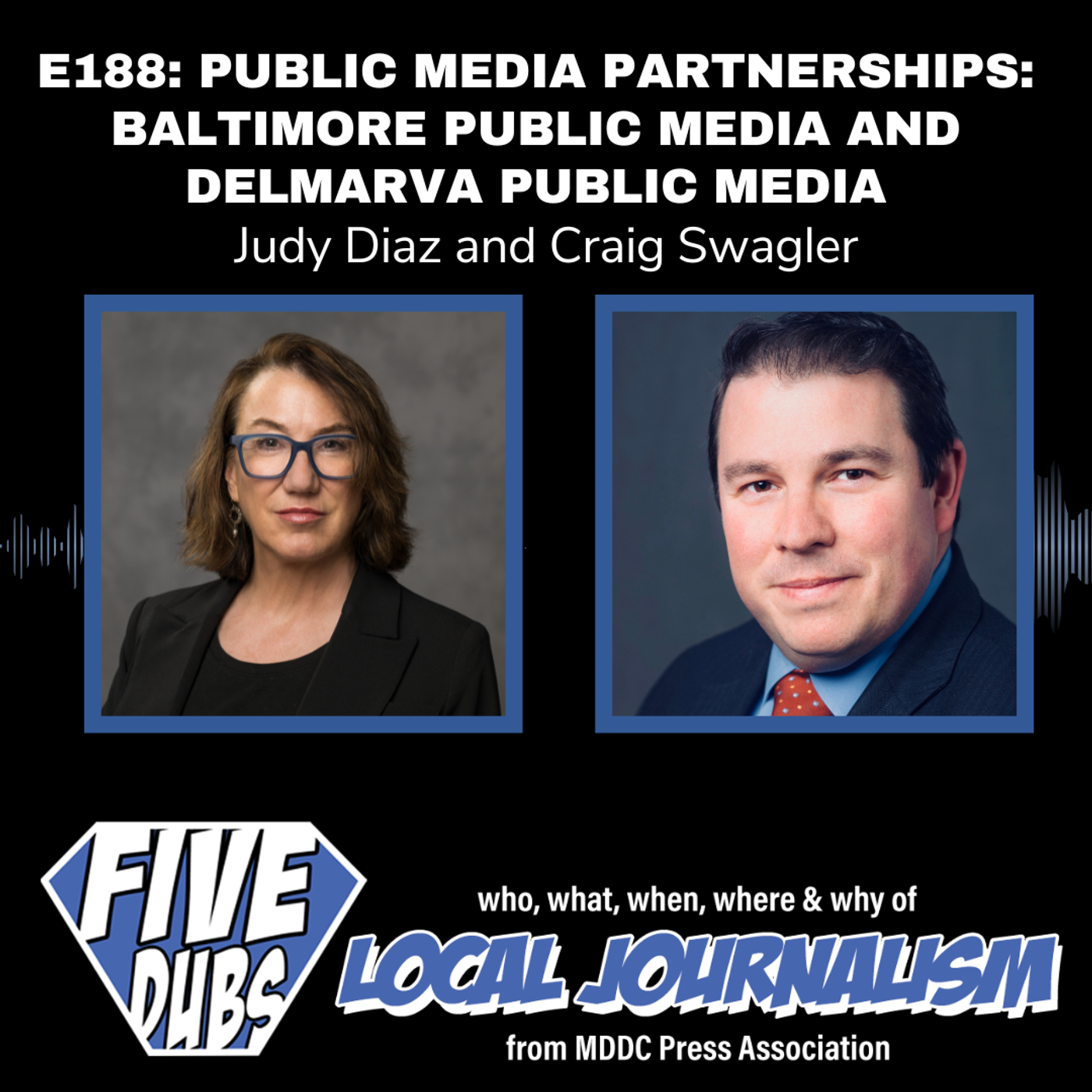
In this episode, Rebecca talks with Judy Diaz of Delmarva Public Media and Craig Swagler of Baltimore Public Media about the partnership their organizations announced this past July. Diaz and Swagler, who serve non-overlapping audiences across Maryland’s Eastern Shore and Baltimore, explain how the loss of federal funding (a 25% budget hit for Delmarva, 6% for Baltimore) pushed them toward collaboration rather than competition, and how they landed on environmental and agricultural reporting, from the impact of Haitian deportations on the Delmarva poultry industry to rising waters in Cambridge, Maryland, as their first shared beat. They also discuss how the two organizations plan to preserve their distinct local identities while sharing resources, student reporters, and eventually joint reporting on issues like transportation and the Chesapeake Bay, and what success will look like a year from now. The conversation closes with reflections on trust, transparency, and why public media’s mission-driven model may be uniquely suited to this kind of collaboration.
Rebecca Snyder: Welcome everyone. I am delighted to be talking about collaboration today with two of Public Radio's leaders in Maryland, Judy Diaz of Del Marva Public Radio and Craig Swaggler, who is president CEO of Baltimore Public Media, which is WYPR and WTMD. and Del Marva Public Media operates WS L C L and W S D L at Salisbury University and WESM at the University of Maryland Eastern Shore. So welcome to you both. Judy: That's right. Thank you. Thank you for having Craig Swagler: Thank you. Judy: us. Rebecca Snyder: Well, it's great to talk with both of you because I feel like you all announced a a collaborative partnership back in July that's nascent, taking shape, to work on some shared resources to better serve listeners. So tell me a little bit more about that partnership. Judy: So you you know, the loss of our federal funding was a blow across the system. Rebecca Snyder: Absolutely. Judy: Of course, between our three stations, we lost 25% of our budget. And you know, all of the stations had it had impact on all of them. But it also created something sort of positive, which was pushed a lot of us into really thinking about instead of competing to collaborate with some of our public radio colleagues. And so Craig. And I met, I think over a year ago, maybe it was two years ago. And Craig Swagler: I think it was two years ago. Yeah. Judy: I remember that meeting so well because I have had so many partnership experiences in my long career. And I felt completely sympathetical right away. One of the most important things is really having alignment and trust. And I felt like our we had shared values, we had shared direction, we had shared culture. So we immediately started talking. This was even before just when rescission was a possibility. we started talking about collaborating in some way. So it takes a little while in public media to get things done. So now here we are. We do intend Rebecca Snyder: In everywhere. Craig Swagler: Ha ha. Judy: to move faster on this collaboration now that it's in place. Rebecca Snyder: Yeah. Well, and there's nothing like announcing it to put the pressure on. and Judy: That's right. Rebecca Snyder: Craig, I saw you nodding along as Judy was was talking about sort of knowing that you were simpatico. So for you, like when did you how did you know this was the right fit and what did that mean to be the right fit? Craig Swagler: Well, you know, w as we look at how we serve our communities, one of the things that was really important is hearing of from Judy and her team about some of the core values in which they were trying to do hyperlocal content, as well as educational components because they're university based in bringing young journalists up through a track. and not just public radio but media in general has suffered through the last couple of years through fragmentation and challenges and then public media especially has been challenged through the loss of federal funding and as Judy shared her impact ours was about six percent so not not to the same degree in which Judy and Del Marvo was impacted. So We were very early on talking about that we both serve this great state of Maryland in different ways for different communities. And we have overlapping interests because we also have with WYPR's all news station a signal out an ocean signal, ocean city, excuse me, that also serves a little bit of her community. And so there was definitely Venn diagram pieces early on, as well as our shared interest in trying to elevate all of the state and those individual communities. And I I think the most important thing here is that as as Judy was speaking to is that we both value what we bring to the communities we serve and preserving that. That's the most important part is like how can we together be more powerful to the audiences we serve than necessary any other approach, right? And so how can we and Del Marva public media together help serve not just the audiences on the eastern shore but the audiences across the entire state because what happens out on the eastern shore does affect people across the entire state and so that's where we started drilling down and yes recision was a catalyst was a a creator of this in many ways but we were already thinking about how could we bring some of the things that were happening in as they say, her network of the woods in our neck of the woods. we we're hyper about covering politics across the state. We have a dedicated reporter in Annapolis. Things that happen in those places also affect the audiences that Judy serves. So we were identifying those things early on and we landed on kind of like where could we start? where was the most sensical place that we could join forces. And it really culminated around the environment. because that is a very important place of the whole region. we live on a massive amount of water. we are adjacent to so much of the business and the livelihood is supported by that, whether we're talking about shipping or we're talking about farming or we're talking about just where people choose to live. It was very important that we thought, okay, this area, this this beat was one that we both could have value around and elevate more journalism for both our audiences at the same time. So that's why we kind of aligned on that particular area, but it's a starting point, not not a fission sheeting line. Judy: Let's make them Rebecca Snyder: Sure. Well, and I'm curious because you know, public radio feels and radio in general feels very localized. It's very geographic. and by concentrating on the environment, that's I think a unique system. It's not a it is a beat, but it's it's sort of an a a underlying system that uniquely shapes those local areas. So tell me a little bit about. the environmental or or how the environmental beat shapes your coverage now and how you hope to it changes under this new partnership. And Judy, you have more water than Baltimore does. So let's Judy: But Rebecca Snyder: start with you. Judy: We have a lot more water. That's true. It's very watery around here. And I I want to underscore that it's the environment and agriculture. We look at those combined because it's very Rebecca Snyder: Thank you. Mm-hmm. Judy: it's the one of the most important, obviously, industries on the eastern shore. The whole Del Marva Peninsula, Delaware too, and Virginia. And we cover those some parts of those states as well. So we really wanted to focus that because on that because we both share those issues. Agriculture and the environment throughout Maryland is one of the most important topics. Right now we cover it, we have really one, just one news director. We have a couple of freelance people and but we our news team is pretty limited. So we're covering it by interviews, other reporters who cover the environment. This way we can have our own reporter and direct along with Baltimore public media that coverage that makes sense for our region and for the rest of Maryland. So that it would make a huge impact for us. Instead of just interviewing other people, we're actually deciding what that content looks like. Rebecca Snyder: So what kind of stories, and I know you haven't hired the reporter yet, so this might be a little premature, but what's can you give me an example of a story that you want to tell once you have this new Judy: Sure. Rebecca Snyder: capacity? Judy: Sure. One of them is in agriculture, and it's the Haitian community. We have an incredibly large Haitian community here. They work at Purdue and Mount Air. And now they are being deported. So what does that mean for the poultry industry on in Del Marva? And frankly, not just Del Marva, but the entire world, because our entire nation, because that chicken is feeding America. So that's one one area that we're covering on the agriculture side. And obviously, no surprise. On the environment side, it's global warming and what's happening in places like Cambridge, Maryland, where they're trying to stem that the the rise of water in Cambridge right up to some of the homes that are in the historic district. So those that kind of coverage as well that is really ubiquitous ubiquitous throughout the bay. Rebecca Snyder: Sounds like a really compelling story. And and when we think about agriculture, you know, in on on the Eastern Shore, you're right, it is all writ large, you know, it's the largest chicken manufacturing, guess it's manufacturing, in that area. And then when we compare contrast to Baltimore, which you know, urban farms are starting to come up a little bit more deeply, and environmental reporting maybe centers around different areas. Craig, what are you hoping, what stories are you hoping to tell? And how are you going to make them interesting to the Eastern Shore audience? Craig Swagler: Sure. It it's about bringing pieces that are across the entire state to our audience. and not just what's happening on the Asian shore, though that's a major impact of kind of what happens across the rest of the state and as Judy very well points out, in many ways drives a key part of industry for the entire United States. but also How we are so uniquely tied in this state to the water. I mean, we, you know, we don't have to look too far but the tragedy that happened with the Key Bridge collapse and how that massively impacted business, shipping, and jobs at the end of the day. So there's other economical components that have both regional and national impact across. And so our ability to kind of tie through more than just the surface headline. One of the unique things I think we do in public media, very different than happens anywhere else, is we spend a lot more time talking about the why. We dig deeper and we give meaning to the story and how it relates to not only the individuals that maybe you know your neighbor or or something that personally affects you, but also how does it affect the region and the national story. So we we're presenting something from a value proposition from an editorial perspective that is not being done anywhere else. And it's not just the this the this through line, this story about environmental and agricultural. It's holistic at our in overall approach of how we tell stories, how we bring conversation as forward for our community that we're serving across the whole state. Judy: I love that because also the the what Craig's team is doing is they're covering state politics and policy, right? And we don't have the opportunity to do that. So that's all part of the bigger picture that we're not able to do that with the partnership with Craig. It's that full perspective and that full story. Rebecca Snyder: No, and and knitting all those pieces. Go ahead. We are. Craig Swagler: Stronger together, right? That kind of s yeah, that stronger Judy: Yes, we are. Craig Swagler: together component, you know, and so that's that's the power, right? And and it's a Judy: Mm-hmm. Craig Swagler: unique position to be in because in the commercial world, which I hail from prior to coming here, there's a competitive nature that exists within the news environment, the media environment, and while we see the ecosystem of news in particular. changing massively before our eyes. You know, the trusted sources of information in which people turn to historically are starting to erode for a lot of reasons, including corporate consolidation. And while that is happening, we're also seeing the fragmentation of those audiences because of new media. A lot of different places to get information, but also then what is credible information? What is trusted information? What is vetted and verified information? and so being able to do that in a t in a way that only we kind of public media approach it and that is all you know, this all boats rise together approach, versus, you know, we're in some competitive component to beat out the station across town. there is greater value I think for a mission based community service that we're in, which is a very different and and for that reason I do believe that what we're endeavoring to do, what we're trying to do together, both of us will have much more longevity, more s and and matter more to our audience in a more authentic way. Rebecca Snyder: Well, and wanted to kind of dig into that idea of collaboration because Craig, you're totally right. In the in the commercial space and and across all types of news media, there's this push and pull. Like resources are scarcer and the like the philanthropic community wants people to work together in kind of this kumbaya moment. But there are real competitive pressures. And so, I want to better understand how do you preserve sort of your unique Outlook and space and you guys between the two of you have five different radio stations. so Craig Swagler: Mm-hmm. Rebecca Snyder: it's a lot of little chicks to feed in terms of of local presence. But how do you collaborate without losing yourself? Craig Swagler: Well, I think one of the unique things from a starting position is that, you know, Judy's organization is not trying to provide information in areas where we're currently already doing it. We don't have a lot of duplicity. It's why this partnership works really well. and so, Judy: Right. Geographically. Craig Swagler: you know, geogra yeah, our audiences are are different in that way. and so there is a lot of sense in why we've We've kind of started this partnership with Del Marva because they're they're essentially voids for us ultimately. And what she serves and what we serve, our hope is that we'll will will elevate both our brands. And I think it will, you know, across the state. And that will help in the longevity of the support that we're needed from government agencies, from foundations, from individuals from corporate organizations on a larger degree for both of us. because the sustainability that we need to find is not one through profitability or paying back some stockholders in an investment. It is the impact piece. And individuals Rebecca Snyder: Mm-hmm. Craig Swagler: and organizations and corporations you know we're are are is to continue that mission. To have those those values we have bak baked in together is to continue to serve those communities in an independent voice way, and to do it uniquely to each of them. and so to your question even more is like there is no interest we have in trying to serve the uniqueness of what Del Marva does. They do that very well. We do things very well. So it's where can we find those overlays? and this is that first attempt in one area that can serve both of us. And I think we'll continue to have conversations as we look at areas that could help both of us as we look at some of the things that are duplicative in the services and the back office things, you know, things that we both have to have or services we both have to have. Well at the core of everything we do is how do we continue to still provide the uniqueness locally into the communities we serve. we this does not work if at the end of the day Del Marva still isn't Del Marva and Baltimore public media is in Pol Baltimore Public Media. That's true partnership at the end of the day is utilizing the great gifts that Judy brings forward and expanding them to a larger degree across our platforms and vice versa. Judy: That's right. I'm watching some stations, for example, in Boston who are really talking about collaboration, been having trouble because they have overlapped. There's five stations, Craig Swagler: Mm-hmm. Judy: public radio stations, I think, in Boston. so they have overlapped and they're trying to figure out how do they remain unique. But because we don't overlap geographically, that helps. But also, even though we cover different regions, there's so many issues that overlap. We talked about the health of the Chesapeake Bay. There's transportation, there's healthcare access. How Housing, workforce, workforce development, we share all of those issues. And so if we cover something in that category, and or Baltimore covers something in that category, it has greater impact because now it's distributed throughout the entire state and more because we'll also be looking at collaborating and digital distribution as well. But I one of the things I'm very excited about being relatively new to the Eastern Shore. Well, we shouldn't really say that. We've had a house here since 2004. We moved here about five years ago permanently. Is that I think it could literally bridge the divides between the eastern shore and the rest of Maryland because I can't tell you how many people say those people over the bridge, they don't Rebecca Snyder: Mm. Judy: understand, but they do understand. And and the people on the other side, they understand that so I feel like it really could be a connector throughout Maryland. We cover arts and culture and and tourism in this area. I think that's attractive to the people throughout the rest of the state and vice versa. So I think it's a really can be a connector between or among all regions in Maryland. Rebecca Snyder: Yeah. Well it sounds like you've sketched out what the ideal collaboration, that you're not sort of in each other's back pocket like, you know, Boston competing in the same geographic area, and you've really discerned what where you both excel and are kind of uniting at that point. So not that you're trying to compete, but you're really weaving in where you are compatible. Am I getting that right? Yeah. Yeah. Craig Swagler: You are, yeah. That's a great Judy: Yes. Craig Swagler: way to describe it. I think the other piece of it which we haven't unlocked yet and I hope and I know we will, is when we start to talk about some of these stories and themes that Judy's talking about, transportation, economic impact, they're that it's not just that we'll have shared resources that a reporter from Del Marva is doing a story, it's that we can actually collaborate on the actual reporting itself. It can be more Rebecca Snyder: Right. Craig Swagler: impactful. So, you know, you you see this happen all the time with nonprofit organizations where two reporters will will get together and it will be a team where they cover different facets of a story. Sometimes those are geographical sometimes those are more you know different pillars that are around it. we're gonna be able to do that at a larger scale when we start to really get this thing lit up, where if we we come up with something that is an issue, something that needs to be addressed, something that needs to be unpacked, we're gonna be able to leverage our collective resources into it to put more attention to that that issue by having different facets within the story. It can be more complex, it can be more complete. so like Judy said, we cover policy. We keep an eye on Annapolis. We are deep into what's happening there at the State House. Many of these things we're talking about just around this facet of environmental and agricultural. there's nothing to say that we wouldn't have contribution from different reporters in that reporting to make it more holistic. So we're, you know, again, we're just just starting this process, but the hope is is that then all of this becomes a lot more elevated and we're serving our audiences better and demonstrating to those donors, those individuals, those organizations and those corporations that the value of public media is essential. And nonprofit news can do something very uniquely that commercial news just isn't built for. And is ha and and we're seeing it struggle right now and as a result of it there's less of it. There's less news about what's happening in Town Square, about what's happening at the school board meeting, about what's affecting your David li daily lives, what what are ki what I sometimes call kitchen table stakes. you know, Rebecca Snyder: Right. Craig Swagler: we we we're talking less about the things and you know, national stories are a plentiful that's out there. what is being lost is the voices within individual communities. And so you end up with these areas that are news deserts. You end up with a lot of voids in conversation about how does it impact, you know, our family and and that many times is where there's you know this horrible disconnect. Local newspapers do not exist to a large degree in most areas anymore that would have those beats. The associated press For a large degree, doesn't even have reporters in certain areas providing Wires Story as as backup. You know, it's it's a very challenged environment because of the economics and the fractionalization. Partnership is gonna have to be the way we serve these communities if we're really standing up for what journalism represents. And and that that also requires us as leaders to remove our egos to some degree around the the conversation. while still servicing our communities. And I think we can do that and we're we're starting to weave that. Rebecca Snyder: And I I you have other partnerships and I wanted to part of what I want to get out of our conversation is sort of that roadmap to collaboration. and but first Craig, I know you're you're already partnering with the banner locally. Judy, do you have and you're working with Salisbury University and the University of of Maryland Eastern Shore. What do those partnerships look like now and how do they benefit the the stated goals of getting deeper into local news. And Judy, let's let's start with you because you have that interesting overlay of university work. Judy: Yeah, we do. We do have that. But but I wanted to mention one of our spot partnerships in Delaware, Spotlight Delaware. yes, so and and they're just terrific. Rebecca Snyder: Yes. Also another proud MDDC member. Judy: Good, thank you. They're really terrific. So so we really achieve a lot of our Delaware coverage through their reporting, through relationship with them, interviewing their reporters, and that's probably our strongest news partnership. It's simply though on the Content sharing side. I don't know if this is going to go off the rails a little bit, but I think the difference we're looking at here is not just the content sharing side, but we're looking at more collaboration, deeper collaboration because we're the same kind of organization. So can we share software? Can we share back office staff? How do we collaborate? So we are, in addition to really improving our news cover, local news coverage. We're also saving money and we're being more efficient on the business side. So I think that's the difference. And the we I have two bosses at two universities, and both of them are very excited about this possibility that we might and about sharing the staff and and sharing some of these resources because they're of course also looking at sustainability for us. So I think that is what is really exciting about this is that we have the opportunity to go deeper. We can also collaborate on now selling statewide sponsorships. I sell the Damarva Peninsula and they sell across the bridge. So we can now sell statewide sponsorship. We can collaborate on grants. We can talk to major donors together who are really excited about having a Maryland-based, basically public radio network that's collaborating. So it's a lot, there's a lot more to it. Pretty soon down the line, but I think fairly quickly, we'll be having these conversations because there's some really obvious things right off the bat. We're already sharing. or using the same engineering service in Rush. So we share that. And so we're also we're looking at other ways to do that and collaborate to build efficiencies and save money at the same time as improving our content. Rebecca Snyder: So some of the the partnerships, I just want to make sure I'm understanding right, the partnerships that you have existing now are really more amplifying content sharing. So having Judy: Yes. Rebecca Snyder: Spotlight Delaware use your your your network and your platform and you using their expertise. Judy: They're kind. That's right. That's right. And right. We have Rebecca Snyder: And then you're you're talking really when you say partnership, it almost feels like you're talking merger. Would you ever see a point where you get to that? Craig Swagler: Well, let's not let's not let's not say that right now. I Judy: Okay. Craig Swagler: think it's a little crawl walk. We'll we'll see where we end up and and there's diff very differences about our organizations, especially you know, Judy has she's a university licensee or community licensee. These are structural differences within our organization. But you know, I spoke to it earlier and i this is absolutely critical. So Our goal, our stated goal here is, you know, larger journalism. But how we get there is how we spend less money from a business standpoint on all the independent things that a a radio station has to do to function and operate. you know, and as much as we can put our resources, our donors' dollars, towards the actual impact of what we do, then we're we're we're driving towards a more successful story at the end of the day. And so, you know, our hope is we will navigate and find those ways to work together to find not only as Judy says, grants or donors that would support both of us in the same way or or united in gifts to us, but find also cost savings where we have duplicity, where we may have things that we're both doing, we both need. but could serve both of our organizations. and so in that a coalition, that partnership that we form, there still is uniqueness between the two of us, and that's the key thing. I think there's danger, there's absolute danger in the concept, and I think this is where other stations have maybe fell a little short is that you know stations have financial challenges there is a larger entity which we play in this kind of relationship on scale and size between Judy and me. and just saying, well, we can put the same thing we have here in Baltimore on out there, that would be the biggest mistake we possibly could make in this partnership, even if, you know, that was the discussion Judy came in the door with, which is not. our goal at the end of the day has to be to keep the uniqueness. that exists and to help support that to exist. And so, you know, how together and that's a benefit to us too, because all that uniqueness, as we talked about, are things that apply as stories and themes that our audiences across the whole state have to care about. And so it takes a a nuanced approach, a collaborative approach, and we'll see where we we end up. I'm excited about the possibilities. There's lots to navigate in that because of our different structures which create different levels of complication and challenges, but also I like to think of challenges as opportunities. Judy: There you Craig Swagler: so we'll we'll we'll see where we end up, but it's not for a lack of Judy and I having a willingness to explore those and seeing where we would potentially be able to find those those overlays that could put more of our resources ultimately into the human beings that service our communities. Judy: And I wanted to note that our three stations are already a collaboration, not a merger. It's the it's based on an MOU. So WESM is licensed by University of Maryland Eastern Shore, the other two stations by Salisbury University. And they're we combine staff, we combine editorial, we combine sponsorship, but they all have unique personalities and they have unique audiences as well. So and it's just it's managed by the same people and we share resources, but we make sure that those All of those stations maintain their personalities. Rebecca Snyder: Well, and it feels like it's really grounded in your values of of making sure that the local flavor is coming through and that you're coming from a position of, you know, knowing each other's strengths and areas. And I think sometimes when we talk about collaboration, people automatically make that jump to say, well, you're merging. And so I wanted to to be able to tease out, you know, that it feels like you're doing the next right thing and you're and you're being calculated about how to approach it. And let's also be honest, you haven't hired a reporter yet. Like this is all in some ways, Judy: Yeah. Rebecca Snyder: this is still talk. so Judy: Right. Craig Swagler: Yes. Rebecca Snyder: but there there is this push to collaboration and I wanted to tease out some of those nuances. So thank you so much Craig Swagler: Mm-hmm. Rebecca Snyder: for for clarifying that. and Craig, your partnership with the banner that feels also a little bit more like content amplification, sort of like Judy's working with Spotlight, Delaware. how do your current partnerships compare to what you're planning with duty. Is there any difference? Craig Swagler: Yeah. They they are very similar to the ones that Judy is describing with Spotlight. you know, the partnership with Banner date with the Banner dates back almost three years now. and precedes me in the leadership role when Law Fontaine Oliver helped merge that with a completely different Rebecca Snyder: Mm-hmm. Craig Swagler: leadership team that was at the banner at the time. So they've also gone through their own kind of transformational process and there was you know, a lot of discovery, I will say, in the history that I've learned, through what the initial components of what that partnership would look like, and where it is today and where it's continually evolving. and so it is primarily a amplification of each other's journalism and that sharing of that journalism, that content sharing, whether it is one of their reporters on one of our local programs in an interview Whether it's us sharing a report out in a written story that we will reference and attribute or presenting that same material on our website. But we're very different business models at the end of the day, where Judy and I are very s we are identical business models. We are we stand for something very different, and this is not a criticism, just an observation and a fact. We are universal service. You know, whether you give us money or not, we are for everyone and we are accessible by everyone. the banner has a different model, and so it works really well for us from a content collaboration process, but their model is a subscription based model and it to access some of their information. And so in that way we don't exactly align at the end of the day because they have different objectives and goals, which are fine. That's that's how they they're designed. We have very de our objectives and goals are exactly the same as Judy's, and that is we want to reach as many people as possible without a paywall or anything that prevents them to get that information. And as such we believe that amplifies our value proposition to individuals that want to make sure our sustainability is there. Rebecca Snyder: Well, and that's I think that's a really interesting nuance because Spotlight Delaware also is very much like they do not have a paywall. They they're looking for that amplification, and there's some inherent tension when you're partnering with an entity that wants to share, but maybe not all the way. and so having that, how do you navigate that just on a on I I know we're gonna talk about your collaboration, but I'm curious, how do you navigate with an entity that wants to give you some but not all and like how do you how do you get it together? Craig Swagler: Well, I think because our business models are different and we're not in a business relationship with each other, it precludes the necessary component of us having those discussions. Like we're we're we're very deep into the journalism that each of us does. and Rebecca Snyder: Mm-hmm. Craig Swagler: so that allows us to be an amplifier for the point of you know, letting people know the the good work that the banner is doing. that benefits them by the fact that at the end of the day, they need people to continue to be aware of the work they're doing to hopefully enter into their business model, right? And so we essentially are a promo we it tangentially are a promotional tool for their subscriber base. where we wanna be a place for all good journalism that's working, whether it's coming from the banner, whether it's coming from Judy's shop, whether it's coming from other potential partnerships that we may work on in the future. we're kind of agnostic to that piece as long as it is good journalism. So that's where we can kind of though our business models are different, not end up in a place where that may feel sticky to some degree or so it works because we're not trying to align our business models or create those business models in some type of a partnership. focused on right now the journalism piece of the work that the banner does. Rebecca Snyder: No, that makes sense. I wanted you had earlier said that you know some of that relationship or all of that relationship occurred before you came into your current role. And Judy, you're also, I believe you started at Demo of a Public Media around about 2023. So you guys are like newbies together. so I'm Judy: Yeah. Craig Swagler: Yep. Rebecca Snyder: curious what what allows you to kind of look with fresh eyes at some of these systems and what were you able to do? do because you are new to your roles that you think others previously might have been constrained by legacy or sort Judy: Okay. Rebecca Snyder: of this is the way we've always done things. Judy, do you want to start? Judy: Sure. So my background is in media, but on the on the strategy and business side, I was at PBS. I launched PBS Kids. I was head of audience strategy. I was vice president of marketing at Politico. And Rebecca Snyder: Mm-hmm. Judy: when I think what I brought that was unique to this situation is a real business sense. So looking at these stations like a business. They're nonprofits, but they need to make some kind of profit to survive. And And so it was really analyzing how things have been working. it was pretty easy to look at, for example, sponsorship is like advertising. And we were selling a lot of spots for not a lot of money and trading them. I called it an apology sell. Like, gee, we're a nonprofit and we're just a little public radio. Can you buy this bus? I'm like, uh-uh. We have this incredible audience of active, engaged, and influential people, and a lot of them on the Eastern Shore. We're gonna turn that around. So it was just doing the numbers, right? Creating a financial model and saying, we're netting $10,000 on the whole sponsorship thing. So we have to change things. So it was really coming in and You know, you're not exactly super popular, but but you're also showing numbers. So you can hide behind those. These are the numbers, these are the numbers, these are the things we need to do. And so it really helped us to stabilize ourselves before the rescission, which we actually thought he would do as soon as I'm sorry, w would happen. So as soon as it was even mentioned about a year before it actually happened, we said, that's probably gonna happen. So let's figure this out. And so it was really about running. things like a business with analytics and data and making decisions based on that, which I don't, you know, I I've worked in public media before. I know that that's not always standard in a lot of the stations, but I think it's becoming more standard now, especially because of the loss of federal funding. Rebecca Snyder: Yeah, those financial pressures definitely sharpen sharpen the pencil, so to speak. And Craig, you've Judy: Exactly. Rebecca Snyder: you've come from a very sharp pencil world anyway, because you were in commercial radio. What did what do you think you were able to bring that that was different? Craig Swagler: So WYPR as the heritage station that was founded in two thousand and one was really a startup to a large degree. I mean WGHU, which it existed before, was reinvented because the format changed, it became more all news. but what I was able to bring was a from my background was a more entrepreneurial and business sense. very similar to Judy, but financial discipline was something that isn't, at least I've learned so far, not necessarily something that's followed to the degree that we followed in the commercial world, where you actually adhere to a budget and you are very strictly adhering to your cost controls while at the same time looking at where you want to take risks. and those risks being ones that you're calculating based on growth. and so we we cannot be a loss business. It won't work. the financials just are you know and and though we don't drive profit, we have to drive net, net for the point of reinvesting that into Judy: Next, next. Craig Swagler: the organization itself and to have the sustainability through times when they aren't so good. Like we're in right Judy: Mm-hmm. Craig Swagler: now. And so I think what I was able to bring was a level of financial discipline, creativity, entrepreneurial, and partnership look because in the commercial world you do do a lot of partnerships. They're business transaction partnerships, but you do them. and you do them to expand your reach, you do them to find new opportunities, and you don't feel and And you don't feel that that is a loss to an organization and the the and and I would say a professionalism, systemization of an organization with some good standards and practices that are internal to that organization are also critical in order to both for the employees as well as how you present the organization, have also been very important to me as we are sharpening that pencil for new opportunities going forward. So you know, it was the organization has been run very well. I walked into a place that had a really good footing and and foundational components to it. but where we were setting the bar, whether it was in relativity to our drives or our goals or our budget or what we were trying to do in the community from an engagement standpoint was really arbitrary. We weren't using data to inform upon where that bar should actually be set. And when we started to look at that data, we found out, well, we can have high fives over something, but if what we did was achieve something that was really achievable anyway, did we really achieve something. And so having some more of those hard conversations to actually look at the data. And what we've seen as a result is massive growth on our audience by adjusting where we do where we know we can get to, where that revenue line can actually be, obtainable, where the audience can be, where we can have growth, and doing it from a strategic standpoint of building the culture to drive the strategy. is is where I I I kind of came in with three major priorities when I first started at the organization that I still believe are true today. I like simple things, I like three little things because they're Judy: Yeah. Craig Swagler: easy to for the employ from the entry level employee all the way to the the board members to incorporate an understanding like where are we going and what of our North Star. And our my three priorities that I set for the organization were very simple. It was alignment, understanding of individuals in the organization of what their roles were, what they were here to do, how they saw themselves in the mission, and understanding how they achieve the goals we've laid out and their individual goals. the second one was partnerships. We're not going to do it alone. We need these partnerships like with Delmarva Public Radio in order to you know, a amplify our reach, to amplify our impact. And the third was revenue. And revenue was not a goal, it was the result of doing those other things really well. and so if we can understand alignment within the organization, we have cultural fit and understanding, we can drive that strategy, we can work with other new partners to help expand upon that reach, that revenue will come in the door as a result. And so I'm a big believer in laying out clear directive kind of components and I think that was a lacking so it's a long way of getting to that kind of strategy and spelling out, hey, where are we going and how are we getting there? And putting it in a concise way so that everyone can roam the same direction. That was a new concept, which is both challenging for an organization who's never experienced that, as well as opportunity for those who crave it. Rebecca Snyder: And it feels like for both of you, being grounded in sort of the data and and sort of knowledge of the clarity of where you want to be, and then kind of taking your power, acknowledging that you have an audience that is worthwhile, that you have, you know, the pieces on the table. They may not be put together in in in the same way, but it feels like you two are very aligned. And so as we think back to the collaboration that you're about to embark on, I want to understand some of the pitfalls that we often see in collaborative processes, because everybody talks a good game until you actually have to come up against each other and collaborate. So what pitfalls have you seen as you have done this type of collaboration or seen this type of collaboration? in other entities and how do you hope to navigate those pitfalls? Judy: I would say the biggest pic pitfall is the lack of transparency. Rebecca Snyder: Mm-hmm. Judy: that that and and this is why I said early on I felt very aligned because I think we are putting we'll put everything on the table and ensure that that that Baltimore understands where we're coming from, they understand I we I understand what where they're coming from, and we make sure that we're honest and transparent in what we are plan do. And then to also ensure that we have a very it's not a very complex MOU between the two universities, but it's an MOU that's grown over time to really make sure we understand, like importantly, where does the money go? Right. That's always a lot of it gets into that, right? Exactly, where does the money go? And how are we supporting Craig Swagler: Yeah. Judy: that? And right that that's where a lot of the tension ends up. So we want to make that we make that very clear. This is how we're going to manage that, and we revisit it every Every five years or sooner, if we run into a roadblock to say this isn't working, we thought it was going to work, it's not working. Let's be again transparent why it's not working and then we redo it. So it's really those honest conversations, those continual honest conversations and not trying to hide anything. so that I think makes it and trust, of course, makes the a strong partnership. Rebecca Snyder: Right. Well and and because you all have similar business models, I can understand collaboration like true collaboration between other news media entities. There's always that you're being really vulnerable because Judy: Yeah. Rebecca Snyder: of those competitive pressures. And so do you feel like there's any competitive pressures that you have to guard against, or can you truly feel like you can lay it all out there? Craig Swagler: I I I will say that I think we can lay it all out there and it it begins with the trust that we created between the two of us, but there are gonna be some things we'll have to navigate and but I see those as opportunities. So, you know, we have a station, as I said, WYPO in Ocean City. There's a little bit Rebecca Snyder: Mm-hmm. Craig Swagler: of overlap with what that station is, it's a simulcast of WYPR that's you know, across the entire state for us. you know, and there are also NPR programs that are aired on very similar nature on some of Judy's stations. And you know, and so we could look at that and say, who's taking whose audience, right? Or Judy and I can have a more strategic decision to say which one of us does this better and what Judy: Right. Right. Craig Swagler: could we then decide how we service differently so that we aren't where there might be some of that overlap. And I think that has to be informed on data. and then and figuring out what that is. Because ultimately if we're doing it right, I should be able to offer something that doesn't detract from what she's doing. She Judy: Mm-hmm. Craig Swagler: can offer something better in a different area that I'm not doing. And then together we can pull in something greater than if we were trying to eat each other in that process. So Judy: I absolutely agree. My goal is to serve Del Marva with this incredible media, with public media. And if that is means that WYPO is serving it, stronger, you know, same. We're just it's serving Del Marva, serving Maryland, we'll say, serving Maryland. So yeah, that's that's I think we're both coming from the same place. Rebecca Snyder: it also strikes me that like you're getting back to the core of journalism, like transparency, trust, and serving the community. Judy: Right. Rebecca Snyder: Those are the touchstones of of journalism. And I'm really excited to see you all kind of working towards that and figuring out really innovative ways to to serve your community and to work with one another. So I'm really excited to see where this heads is what's but as we as we wind up A year from now, what would make you say you made meaningful process progress in this collaboration? Cause we'll check back, we'll have you back. Craig Swagler: That's great. You know, from my perspective, I think that when our listeners can distinguish but also recognize the unification of these two doesn't feel like a confusing component. When we've successfully explained to our audience and our donors why these two things exist and why there's more with it, you know. So what what is the value proposition specifically defined, which we haven't defined it in kind of I would say a campaign type style, and then being able to reap a benefit as a result equally to both organizations, and we see that in returns that shows Judy has a more robust doning base, donor base as a result that has come in the door. And we have maybe certain grants we otherwise wouldn't have been able to apply for potentially. But I think I think that if we those data points, they also could be audience shifts, you know, they it may not be one piece of data, but it will be it could also be the fact that now we are serving more specific audiences in more intentional ways and as a result we have more stabilization of our audience and and more growth in those areas. So there's some research piece we're gonna have to continue to do in order to define like That stuff works out. So, my success that I would measure from it is that we've clearly articulated it and there's an understanding, and not this, I know they're working together, but I don't really know that means, and once in a while I hear a reporter on each other's stations. I I think a failure on our part would be if we don't clearly help our audience and our donors understand why we're in a partnership and then demonstrate that in some manner. Judy: Yeah, I agree. It's it's impact Rebecca Snyder: See what that is. Judy: and efficiency. So I also want to talk about a like a smaller component, but a very important component about this that I'm personally excited about is that over the last few years we created a very robust student newsroom. we Rebecca Snyder: Hmm. Judy: have four to five student reporters or producers at any given time. In fact, six of our students won Chesapeake Associated Press Awards last year and they just are they are thrown into the deep end. They start producing on day one. It's almost like complete immersion if you're learning a language. And and those we just hired one of those students. Actually, she starts tomorrow. And Baltimore Public Media hired one of our students a couple years ago. And so it's also a jobs program, but what I'm very excited about is collaborating then with this younger generation too. So for example, Craig mentioned that we're a university licensee with that. Come some restrictions. We're we are not allowed to use TikTok, for example. And our students are dying to put their reports on TikTok because that's where their friends Rebecca Snyder: I'm sure. Yeah. Judy: are getting their news. Well, Baltimore can use TikTok, so we can collaborate on a TikTok channel. Those students then have an outlet to create these videos for their contemporaries. And we can start adding some of the younger generation to our portfolio too through that. So with all everything Craig said and that component, I'll be really excited to see how the students are integrated into all of this. And imagine if you're doing your first report on there's one of our students who's obsessed with transportation. So transfer some transportation topic and it airs across the state of Maryland. And your your parents are in Telson. This is a true like the where those parents are, and they can just turn on the radio, listen to that report. So that's I think a really incredible opportunity for us to really integrate Craig Swagler: Yeah. Judy: these younger people into the process. Rebecca Snyder: It feels like there's such a potential for statewide impact, for developing the pipeline of journalists in into the into the news media world and also using data to really make sure that you're hitting what you want to hit and deepening the coverage. So it sounds like a wonderful start to collaboration. I can't wait to hear more about how it develops. And Judy: Peace. Rebecca Snyder: thank you so much for being on the program today. Judy: Thank you for having us. This is really fun. Thank you. Craig Swagler: Thank you. Judy: All right.