
Five Dubs Podcast · MDDC Press Association
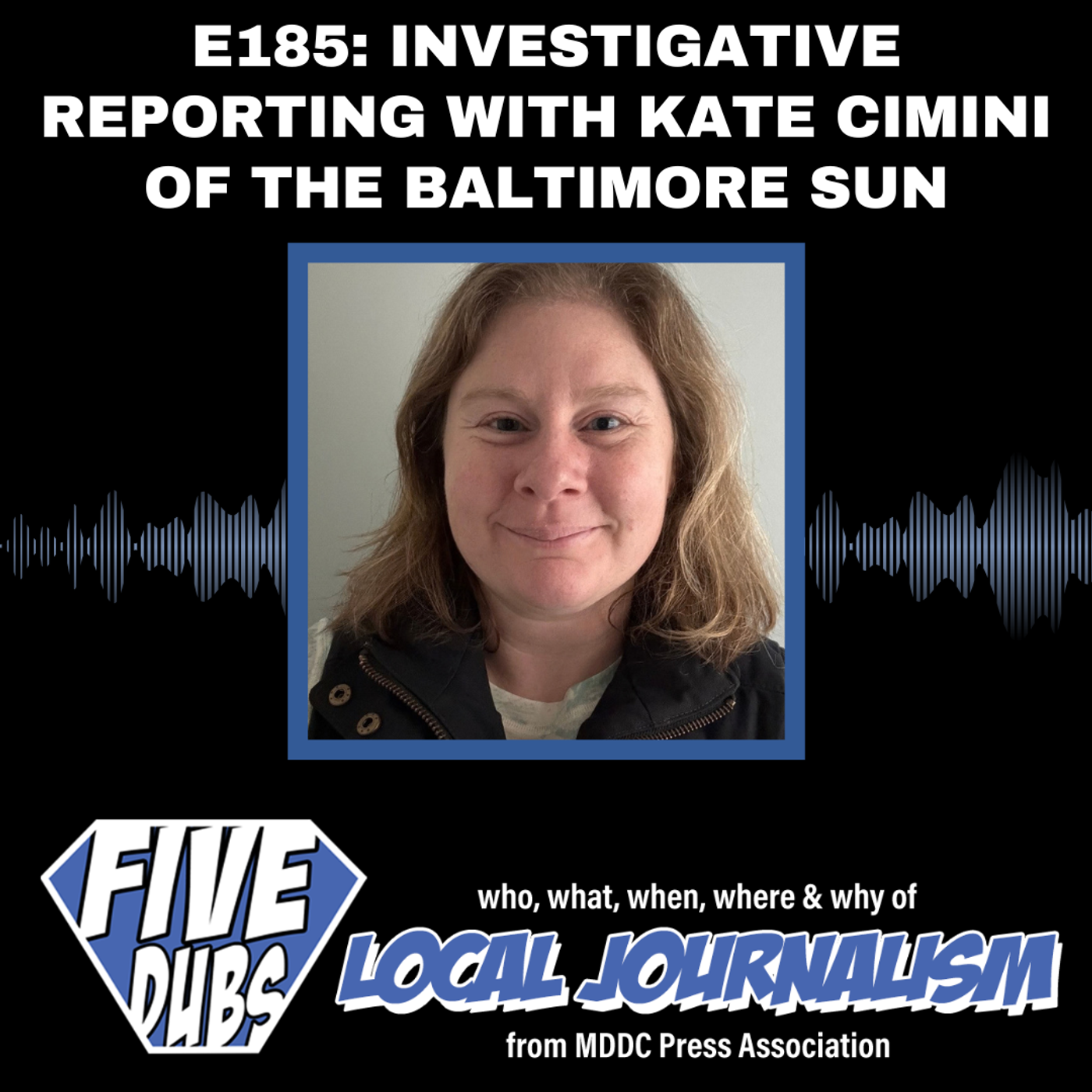
In this episode, Rebecca talks with Kate Cimini, investigations editor at The Baltimore Sun, about her award-winning investigative reporting and life as a journalist. Cimini's series on child welfare at Maryland's Free State Challenge Academy, a National Guard-run program for at-risk youth, won first place in the MDDC/AMARC Foundation contest this year. She walks through how a single news tip led her to uncover the story of Nathaniel, a teenage cadet assaulted in his sleep, and the reporting process that followed: sourcing records requests, tracking down cadets and parents, and building trust with sources who'd lived through trauma. They also discuss Cimini's path from public school teacher to journalist, how she balances the emotional weight of reporting on people's worst days, and what "service journalism" means in practice, from city council coverage to helping a dying activist raise funeral funds. Cimini closes by reflecting on what she hopes to bring to the Sun's long legacy of investigative work in Baltimore.
Rebecca Snyder: Hi everyone. We are here today with Kate Sminnie of the Baltimore Sun. She's the investigations editor. And another claim to fame is that she wrote a great series about a cadet beating in in Maryland that won the AMARC Foundation Prize in the MDDC contest this past year. So, Kate, we wanted to have you talk about investigations, life. this particular story and so on. So welcome to the programme. Kate: Thanks so much. I'm excited to be here. Rebecca Snyder: Yeah. Well, so let's start actually with your award-winning work. And just for those listening that don't know, MDDC partnered with the AMARC Foundation out of California to honor investigative work in Maryland, Delaware, and the District of Columbia with cash prizes, which is like catnip to every journalist out there, every person out there in the world. It's great to be acknowledged, but it's great to be monetarily acknowledged as well. And Kate had the first place award-winning reporting. So Kate, tell us about that series. Kate: man, so that that is actually still ongoing. it started in August of last year with a a news tip. and I started looking into just cadet welfare at Free State. Free State Challenge Academy is a it is the Maryland version of a national National Guard program. you know, largely funded through the Department of Defense. you know, I think it was up to 75% in some states, other states it was around 50%. and that program is largely aimed at at-risk youth. In fact, as a requirement of the program, you have to have dropped out of high school. and Rebecca Snyder: Mm. Kate: for some kids like Nathaniel who I connected with, they have such a difficult time succeeding in high school that if they drop out, If they decide they want to go back, the school doesn't necessarily have to take them back, even if it's a public school. Rebecca Snyder: When that means that's a really hardcore because public school has to take almost everyone. So that you're really talking very vulnerable, very disadvantaged children. Am I getting that right? Kate: Yes, basically if if they can you know, assess a child and guarantee that they're not going to be able to graduate by a certain time, they don't have to take them back. Rebecca Snyder: Okay. Kate: Yeah, they and that was surprising to me. I was a public school teacher. for the Rebecca Snyder: Mm-hmm. Kate: first chunk of my career. I actually you know, I I know that public schools are required to work with kids up to twenty one years of age. but that is largely, I believe somebody might need to fact check me on this, but I I if it's past eighteen, I think that's largely kids who have special needs and disabilities. Rebecca Snyder: Right, that would make sense. So it feels like there's this tranche of students or or young people that really don't have places to go and then are being diverted to places like Free State, which I just want to make sure that I understand. You had said earlier that in some states seventy five percent of the funding comes from the National Guard, but it's to a private institution. It's not a public institution, is it? Kate: So it is it is it's open to anybody who applies. It is a National Guard run camp. a it's it's under the umbrella of the Maryland mil Department of the Military. and it is publicly funded both through the state and through the feds. I if I'm remembering correctly, it's been maybe almost Rebecca Snyder: Okay. Kate: a year since I looked this up. So I'm sorry if I'm little rusty. If I remember correctly, in Maryland, the state funds it fifty percent and the feds fund it fifty percent. or they used to, as you know, the camp shut down in April. Rebecca Snyder: Right. So tell us more about Nathaniel and and what his experience was. Kate: so I connected with Nathaniel because his father wrote a Google review of the camp. And it was crazy. Rebecca Snyder: Get out, really. News tips come from everywhere. Kate: Yeah, they really do. So I had gotten a tip that there were some issues with child welfare at this camp, and this camps or the this particular camp served 15 to 18 year olds for entrance. You could be older when you graduated. and I think you actually had to be 15 and a half in order to apply. Rebecca Snyder: Mm-hmm. Kate: and and I gotten a tip that kids were being mistreated. And so I started looking into it. I started filing records requests, and you know, getting some stuff back on you know, written reports, annual written reports, kind of detailing you know, issues that the the students had. I had asked to go back to 2020. I believe they provided me with reports back to 2019. they're only required to keep reports for six years, and they just didn't have any existing before that. So it was very, you know, good of them to provide the extra. and we you know, I started looking around for people that I could connect with, people who'd gone through the camp themselves or parents of campers, because I was seeing a real mix of reviews online, basically. I was seeing some people say that they'd had a wonderful experience and some say it was terrible. And largely I did find that a good chunk of these kids really benefited from going to this camp. You know, they came from oftentimes vulnerable backgrounds. it's a camp where actually a judge can order you to go if they think that it's gonna keep you out of trouble. I didn't really connect with anybody who'd been ordered to go there. I'm not sure anyone's been sent there by a judge in several years. a a request that I sent in on that came back with nothing. but they, you know, I I also started looking everywhere I could, you know, like Facebook groups, news articles, and Google reviews. And Nathaniel's father had posted a review, including some photos that we ultimately used in the article. And I quoted his review, talking about the experience that Nathaniel, his son, had had at the camp at I believe he was sixteen at the time, maybe seventeen. basically Nathaniel not had a good time there. He he was enticed by the prospect that he could get his GED in a year and be done with high school before his friends. because he'd had a really hard time in public school. his parents had tried a bunch of stuff. you know, tutors and all sorts of all sorts of programs to help him succeed. And largely his mother, Sheena, said he would just kind of wander the halls. you know, his father, his parents were not together. and so he was going back and forth between his parents' house houses Rebecca Snyder: Mm-hmm. Kate: and you know, they were. both struggling with how to help him succeed. And so I guess a counselor at the school suggested he look into this. And he did. all three of them thought it was a great idea. And pretty much up until they brought Nathaniel there, Shana and Jason ended up telling me that basically at parent orientation, they were told, your kid is going to hate it here. They're going to lie in order to come home. they're gonna do anything, they're gonna say anything they can in order to come home. And you need to, yeah, and you need to be firm and ignore them. And Rebecca Snyder: Mm-hmm. Kate: this is actually this is a camp where the kids are supposed to be able to leave if they want. Like if they want to disenroll, they're supposed to be able to. that did not really seem to be the message that the people running the camp were sending. And so, Nathaniel did repeatedly ask to come home. I think they were allowed phone calls every couple of days or maybe once a week. Every phone call he was asking to come home, he'd write them letters asking to come home every day. Rebecca Snyder: that must be heartbreaking as a parent to to hear that, but feel like no, you have to stay. And Kate: That that's pretty much what Shana said. Yeah. And Rebecca Snyder: Mm-hmm. Kate: and she actually, you know, she she still really blames herself for not allowing him to come home before he got attacked. It's a tough situation. it's very difficult. so at any rate, about two weeks in, what Nathaniel told me, and what he told the doctor and what he told his parents, was that Kids had been running around in the middle of the night with I and like, you know, just kind of same group of kids over and over again. They'd gotten together and decided to, you know, be bad influences on one another. and they were running around with what he called lock socks. He wasn't sure if it was lock socks or rock socks, but it's a homemade blackjack. You know, you get like that padlock for your locker or something, and you stick it in a sock and you swing it around and you slam it into stuff, or in Nathaniel's case, his head. yeah. And so Rebecca Snyder: That's hard. Okay. Kate: yeah. so he he said it happened, he woke up to it. you know, he he's not super clear on the incident, he doesn't remember a ton. and so he, you know, he might have been woken up before that. There might have been some interaction, he might have just woken up to being hit. Hard to say. but ultimately you know, he was hit in the head with a homemade blackjack, had really significant swelling and bruising on this side of his head, and his head was shaved. Rebecca Snyder: Mm-hmm. Kate: because all of the kids are, you know, they're supposed to kind of dress like military cadets. It's a military camp. and it's very, very clear that he's just got this really big bruise and really you know, really angry. spot on his head in these photos. Rebecca Snyder: So that's so that's obvious, you know, you when you wake up the next day and granted sometimes, you know, I would imagine what happened at night, but it's it what did the administration or what did the the school do in that situation and and was there a history of these types of attacks? Kate: there wasn't a history of these types of attacks that's been recorded that I'm aware of. however, Nathaniel and a couple other cadets who were there at the time did speak to me. the other two did not want their names used. and told me that the guards at the camp were well aware, or the staff I shouldn't say guards, they were standing guard overnight typically. but they usually took a break around three AM for like a shift change. And that shift change usually lasted about 30 minutes, which was when these kids would get up and like make a ruckus. And and the all three of these cadets told me that this that the staff at the camp were well aware this was going on, and weren't that was why they were standing guard. but that there were still issues. And so the next day Nathaniel reported to the camp director, who left, I believe, in twenty-two. and then Keisha Webster took over, I think in 23 or 24. I can't quite remember there. but that camp director he he went to and told him that he'd been stung by a bee. I asked Nathaniel why he lied. He said because he thought if he told the truth, he wouldn't be allowed to go to the nurse. and he went to the nurse and she called. Nathaniel's mother, Rebecca Snyder: Mm-hmm. Kate: and apparently told Shayna, Nathaniel's mom, that she wasn't supposed to tell her this, but she needed to come take her son out of the camp and take him to an emergency medical center. they thought he might be bleeding into his brain. luckily he wasn't. Yeah. Rebecca Snyder: Yeah, that's so then after, you know, Sore y the his mom comes and picks picks him up and I would imagine she doesn't bring him back to the camp. And then like mom's everywhere, does she try and make all hell break loose to to say, you know, my child has been injured under your care, what's going on? So was there was it it covered up or what was the situation? Kate: You know, not not so much. they were just privately devastated. they did explore briefly a lawsuit but weren't really sure how to proceed. they're still thinking about it, although I'm I'm not sure, you know, how that can go, now that the camp has been shut down. Rebecca Snyder: Mm-hmm. Kate: but mostly they were just trying to figure out how to move forward. Nathaniel hasn't been necessarily diagnosed with PTSD or anything. but pretty much what he told me afterwards was that and I I think a big chunk of this kind of also came from Nathaniel not really wanting to engage with that camp again. but he had a really hard time sleeping at night. He still does. he was afraid to sleep. He'd just sit up all night until it was bright out and he could actually safely sleep. not surprising if you've been attacked in the middle of the night. and you know, he's he's suffered from some other maladies since as well. just, you know, struggling with some emotional regulation. you know, that's a very scary situation. And I think your brain does what it can to protect it. so, you know, it's it's been a I think it's been kind of a tough road. He's recently, when we interviewed him in October, He was, you know, feeling pretty hopeful, had gotten on a pretty solid path. He'd gotten a job at Target he was really interested in. He was working, stocking. and things were looking up for him for the first time in a while. So it was it was really nice to see that he'd kind of figured out a path. Rebecca Snyder: Well I'm glad that he has he started to figure out a path, but let's let's get back to sort of how you handle an investigation like this because so I want to understand sort of the news tips and then also how you pull together all those pieces. So in your role as investigations editor, do you have like a a a beat or an area where you're looking into juvenile justice, were you looking into kind of the the feeder programs for the National Guard? Like how did you or were you just freelancing and saying, Gosh, what what's out there in the world? What Google reviews are out there in the world? so how d how do you how do you source those news tips and when you start an investigation? Kate: So my role is interesting. My title is investigative editor, but I do a large chunk of reporting. I'm I'm really a deputy investigative Rebecca Snyder: Mm-hmm. Kate: editor. but my my title's a little funny. and so when that happened, I was transitioning more actually to the reporting side that particular month. And we sometimes just get Tips. We get people reaching out with you know, suggestions. I I can't remember if this was an email directly to me or if it was an email to our news tips email even. and I just started, you know, taking a look at it. but I read all of our news tips emails. we get a couple hundred a day. a lot of them are spam. But You know, I I read all of them just because a lot of times something will come out of it. Apologies. and Rebecca Snyder: the news to seem credible. I mean, because you're getting hundreds and you say most of them are spam. What what sort of awakens your senses? Kate: Well when I say most of them are spam, I mean truly most of them are from maybe the same same Rebecca Snyder: true, yeah. Kate: five people who just send us links to other news articles. and and then a big chunk of them are also actually just literal literal spam. you know, would you like to invest in my company? I am a Nigerian prince. Yeah. Yeah, yeah, Rebecca Snyder: That is literal spam. Okay. Kate: yeah. and then the ones that are written from an actual human signed with somebody's name from an email and give kind of a a concrete argument. I always take a a second look at those. and you know might write back, might try and learn a little bit more and you know, see what what else they have to say, maybe have a phone call. a lot of the time you know we we can't do every article that every tip that comes in, it can't they can't all turn into articles. We just I don't think anybody in the world has that kind of manpower. but you know, the ones that are the most pressing and could lead to the biggest change are the ones that tend to take priority there. Rebecca Snyder: And so when you're when you're first thinking of of investigative work, I mean obviously you're you're vetting a news tip. And then in in a situation like Nathaniel's where you know there's a lot of conflicting pieces, like what's your strategy for putting together investigations? Because you've you've been doing investigative work for the bulk of your reporting career. Totally want to get to the public school world, but in your reporting world, investigation is your bread and butter. So What's your how do you how do you keep all those threads going? Kate: Ooh, that's a great question. I tend to kind of keep a running list of what Rebecca Snyder: Mm-hmm. Kate: I'm looking into. Sometimes things fall off. and that's my biggest weakness. is Rebecca Snyder: Same, same. Kate: Yeah, I mean, sometimes it takes six months or eight months for a records request to come back and then you look back into it and you're like, boy, I have to redo all this old reporting to even remember what was going on. Rebecca Snyder: Mm. Kate: So some of the things I've started doing to kind of combat that is I do have my like general running list just with like a little a little summary of each story or like a kind of like the running headline that's in my head that makes sense to me but not necessarily anybody else. And then I also have been with some of the ones that are gonna take a lot more a lot longer of a push. I've I'm keeping like essentially a running diary of the reporting that I'm doing. I'll go out and I'll write, you know, I'll I'll interview a couple people and then I'll write a summary of the reporting that I did that day. any threads that kind of stuck out to me, any details that I thought were really unusual or important. or eye-catching, maybe like something that could be really that could connect with the reader later on. if ultimately it turns out to be relevant. and yeah, so far that has been really helpful. but I I've only been doing that for about a year, so I'll let you know next year maybe. Yeah. Rebecca Snyder: Right, check back in for sure. Because I I also in the in the for the non-journalists who are listening, I I think it's important to remember that this is one investigation that you're doing, but you may have others as well. So not only are you like braiding the threads of that one investigation, you're also trying to keep the other sort of segments that you have going on. straight in your head too. And this this seemed like a a particularly interesting or or delicate operation because you had to report with people who were traumatized, who were feeling intense shame and guilt. So do you have a what i what is that like and do you have strategies for navigating those situations? Kate: yeah. I for most of my career, I've mostly talked to people about like the worst day of their lives. that's not fun. It's not fun for you, it's not fun for them. and in order to make things go better for them, make them feel a little more in control of the narrative, the way they're gonna be presented, as well as just make sure that they don't spend hours, weeks, days regretting talking to me, regretting having their name out there. I have some pretty serious conversations with them up front and talk to them about, you know, how this can live online for a long time. Are they comfortable with that? It might be there 20 years later. You know, I don't really know how long the internet's gonna last. We've got it for now, but you know, I don't think in two thousand five we thought that you'd be able to find an article from two thousand five in twenty twenty-six. Rebecca Snyder: Right. Kate: and so you might say something that reads as funny then, but later people are like, like I now think X about you and that might not be true. Cause we're also, you know, we our thoughts and opinions change as we grow. and age And the version of you that's living online forever might not be who you are today. So we have that those conversations. We also talk about you know, how you know, if you have maybe a 17 year old now and you're talking to me about a sexual assault you suffered, you know, in 10 years, is your 17 year old gonna read that? And are you gonna be comfortable with that? So, Rebecca Snyder: Mm-hmm. Kate: You know, I I like to have those conversations up front. a lot of times, honestly, almost every single time people still say they really want to continue with it. And I think that's Rebecca Snyder: Mm-hmm. Kate: usually somebody who has that's usually the person who is comfortable talking to a journalist. Rebecca Snyder: Mm-hmm. Kate: and then we I I do what I can to provide s like stop measures for them. So with Nathaniel, even though he was 19 when I talked to him legally, he's an adult. you know, rules about how we refer to like, you know, children in the paper, you know, I if you're under 18, usually you have to have a parent present with you when I'm interviewing you or like your parents' permission, we refer to you by your first name, et cetera, et cetera. even though he was an adult, I really wanted to make sure he had somebody with him when I was interviewing him. In order to throw up roadblocks for him, which is not normally something I'd really want. But because it happened to him as a child, a lot of times you can kind of you know, like if you're thinking about something that happened to you when you were a kid, you can kind of default to some of your behaviors when you're a child. You might say things that you regret. You might you you might be more open than you should be, or that you would be as an adult. And so, You know, I I just to be responsible to him and to care for him, to help him care for himself. I asked to make sure that he had a parent present at that interview. and I let them know if there was anything they didn't want to answer, we would stop with that. a it's that's not normally something that I would do with an adult that I'm interviewing, but with somebody who suffered a trauma as a child, absolutely. Rebecca Snyder: So it w is this sort of that that sensitivity and and the way that you're approaching the that interviewing, has that evolved over time or was there a a point where you realize, gosh, I need to do it this way or this feels comfortable for me? Kate: probably both. I I started I started out as a public school teacher. I taught middle school and high school. and I I've always just been a little extra careful with like children who are sources. I don't often end up interviewing children who are sources. a lot of the times if I am, it's it's because they've been through something terrible. but when I first started doing reporting, I was still a teacher and I was freelancing and I did I cover I largely covered women's sports and I did a mix of reporting and editing, but I also did a mix of cause I was freelance, I was just, you know, I was trying to make some money. I also did a mix of you know, straight news and and editorial writing. Rebecca Snyder: Mm-hmm. Kate: And it was really interesting to me to see that a piece that I'd written six months earlier, which I now disagreed with, didn't, you know, a an editorial piece, to be clear. which I was like, you know what? Actually, like now that I have more knowledge, I've changed my opinion, people it it was interesting how my editorials changed what people were willing to say to me. Rebecca Snyder: interesting. How so? Kate: well like it it brought out new sources because Rebecca Snyder: Uh-huh. Kate: they read my stuff and like agreed with me. but it also shut down other sources because they were like, she just believes X. She's not gonna, you know, like she doesn't agree with me. I can't talk to her. and that I thought was super interesting. and and that's part of why I kind of really understand or really have this belief that like something that is true to you in 2005 isn't true to you or or isn't something you believe in 2025. Rebecca Snyder: Mm-hmm. Kate: and so you know, we are constantly evolving, you know, digital digital stories on the internet or not. so I, you know. Also, I've always had a real interest in ethics and I I would really go into stories trying to think about how I can do this the best way possible, but also how I can do right by this person so that they don't call me, you know, three weeks later and say, I need you to take that down. I wish you'd never put that out there. Rebecca Snyder: Mm-hmm. Kate: you know, it's it's because I I can't do that unless there's a very compelling reason, unless there's something wrong with the story, we are stuck. And I wanna be as sympathetic and helpful as possible. I feel like my job is to help people and not to not to put people who've already been victimized in a worse situation. Rebecca Snyder: So then it sounds like you you really are focused on making sure that whatever information they willingly provide is there for the long haul and they understand kind of the the risks and and the the implications of being like that readily online. Kate: Yeah. Rebecca Snyder: 'cause news media does Kate: Mm-hmm. Rebecca Snyder: have a larger platform than your usual, you know, Facebook post for sure. So there's going to be more attention. And then having and then you you have the core of the story because you have the personal the personal discussion and story from from your source. But in this instance, it felt like there was kind of a checkered, there wasn't it wasn't particularly no one was particularly right or wrong. It was just a spectrum within the camp. And so in an investigation, how do you how do you navigate that especially in the end written piece where people tend to be very reductive to say, those free stick camps can exist, but yet they did help a lot of other people. So how do you how do you navigate those nuances? Kate: I mean, I think just just by being very careful. I I I'm aware, I think we're all aware that that everything has shades of gray to it. there are instances where something that is really harmful to someone is great for somebody else. and I'm, you know, a like I I'm not even just, you know, a camp, but I was talking with somebody just the other day about ethical consumption under capitalism and how essentially you cannot do it and everything you enjoy at some point has caused somebody else some misery. And there's just, I mean, there's just shades of gray to absolutely everything. And I think we have to do our best to represent the shades of gray we can find, perceive, understand. I'm certainly missing some. You know, I'm I'm not gonna find all of them, but and I know that that everything I write, that, you know, maybe it helps Nathaniel, but ultimately the Free State camp was shut down. There's kids out there who are not gonna get to go to camp now and who aren't gonna benefit from it. There's people out there who are not going to get jobs with the camp as a staffer, there's a director who is out of a job. there's maintenance people who aren't gonna be servicing those facilities anymore. you know, a Ultimately I have to own everything I've written. Rebecca Snyder: Mm-hmm. Kate: and I think trying to present a fair and balanced picture of of reality is the best the best that I can is required of me. Rebecca Snyder: Yeah. So after the report c or the the reporting came out, what happened next with the camps? I mean, they were ultimately shut down, but what what did that look like? Kate: So I don't necessarily know that it happened because of my reporting. they didn't because they wouldn't say it. I asked repeatedly. what I know is so by the time I connected with Nathaniel, it had been shut down. It was closed down on August 10th of last year, I believe. right around there, 10th, 8th, 10th, 12th, something like that. and I and it was closed down because the they had issues with the facilities. The original camp that they were at that Nathaniel had been at too, they had a broken sewer line. They tried relocating the kids to an adjacent camp. but the facilities there were found inadequate by inspectors from the from the DOD. you know, they were lacking They were lacking safe s shower facilities, safe sleeping facilities. They didn't have cameras. They had no place for the nurse to store medication. you know, I they had no Wi-Fi, so nurses couldn't like upload any medical records from the kids that they were seeing. I think they lasted maybe six weeks at the other location before it was closed down. And they had been planning to reopen in January following repairs on the original site on Aberdeen Proving Ground, and that did not happen. I think they my guess is that they were told to kind of pause while the DOD figured some stuff out, or it's possible that the repairs were just taking longer than expected and ultimately were more expensive than anticipated. As a it seemed to according to the the DOD as a result of the the the war that is you know, we're still dealing with. they they needed more funding for the Iran War and were looking for ways to cut it. And they ultimately cut six programs, of which Free State was one. The other programs were Off the top of my head, I believe there was I know there was one in Hawaii that was like a very small program that really just had like a hairstyling aspect to it. Like you learned how to Rebecca Snyder: Interesting. Kate: Yeah, like it that was kind of the career aspect, like you learned how to become a barber. I had not heard of that one. Yeah. Rebecca Snyder: For another episode, we'll have to investigate that. but Kate: Yeah. Rebecca Snyder: go figure. Kate: Yeah. Yeah. and then there was one in ooh North or South Carolina. I'm so sorry. I should have double checked this one. but basically ultimately they shut it down because they were looking to move some funding around because the war in Iran has been very, very expensive. and my reporting may very well have helped with that, or it could have been purely a financial decision, it's not very clear. But regardless, I know that the royal family, Jason, Shana, and Nathaniel were all really thrilled that it was closed down because, you know, they just did not want what happened to Nathaniel to happen to anybody else. Rebecca Snyder: Sure, absolutely. And so when you're doing investigative series and reporting like that, oftentimes there are really, you know, seismic impacts or changes that come about that reporting. When you think back over your career, are there are there investigations or or reporting pieces that really jump out to you on on impact or things that have really touched your heart? Kate: the ones that the ones that I I think about most often are not necessarily the ones that had the greatest like impact in terms of number of folks. Rebecca Snyder: Mm-hmm. Kate: one that does stand out to me, I did in California. This was the first big investigation that I did with a colleague. I had been reporting on, and this one actually had pretty widespread impact. So that was nice. but I had been reporting on farm workers and the farm working community. I lived Rebecca Snyder: Mm-hmm. Kate: in Salinas, California. actually I lived next to Salinas, California, but I worked in Salinas, California. and we we had been reporting on farm workers. I had been reporting on farm workers the whole time I'd been there because it's It's the largest industry. Salinas is known as the salad bowl of the world. and it also is home to it's this really small town and it's home to like a hundred thousand folks, most of whom are daily farm workers. Rebecca Snyder: Mm-hmm. Kate: there's this one very small section of town called the Alis Al. It's something like 2.4 square miles and it's got something like 60,000 people living within its borders. and they are doubled and tripled up to the point where I mean one family I interviewed, there were there were nine folks living in a two-bedroom home. Rebecca Snyder: wow. Kate: Yeah. it's there's no extra housing because the land is so valuable that farmers Rebecca Snyder: Mm. Kate: don't want to sell it Because that's a one-time sale, they can make, Rebecca Snyder: Mm-hmm. Kate: you know, far more than that, like more than probably 10 times that value if they continue to farm it over the years. the soil's very rich and it's got a Mediterranean climate, it's perfect for growing. and so I'd been reporting on overcrowded housing and homelessness, and as a result, also farm workers. and I had just Right before the pandemic, I'd just done a fellowship, a health journalism fellowship through USC Annenberg on how viruses spread in overcrowded housing. And so when the pandemic Rebecca Snyder: Mm. Kate: hit, I was perfectly positioned to start covering that. and so we started, you know, I was doing a lot of COVID coverage in general, but also specifically COVID coverage related to farm workers and started a series looking at how that was being handled. For farm workers, how it was impacting them, whether they were actually being provided the PPE that farmers said they were. Rebecca Snyder: Mm-hmm. Kate: and I specifically had been reporting on H2A farm workers. And those are folks who are here on a visa, short-term visa, typically from Mexico, usually rural Mexico. Can be anywhere from six months to, I think up to three years. and You know, they come here, they typically stay in motels. can be it's supposed to be four to a room, it can be more than that at times. and you know, they're paid a daily rate. and they are, you know, provided two meals a day. but they're really here to work. they work six days week. It is a really difficult job. It's very physical. And really highly skilled, I would go out and like get trained in how to do the kind of picking and packing they were doing. And I could not do it to their standards. Just kept trying over and over again with different fruits and vegetables and never could do it. and so you know, I I worked with Jackie Botts, who later went to Reuters and now Jackie is freelancing with the guardian guardian, doing Rebecca Snyder: Uh-huh. Kate: amazing work. But we uncovered through reporting and investigative work and a bunch of public records requests that basically farm workers were not being given the protections that they were supposed to be. They were often forced to work alongside sick co-workers. and when they got sick, they you know, sometimes they would be housed kind of in this motel room situation, and like maybe given a meal a day, we found a situation where one man who had called a or I think he'd posted on their Facebook to a local TV station about the poor conditions he was enduring while sick in his motel room, ended up being fired and told to drive back to Mexico while sick. Yeah, I mean, like he stopped at gas stations, he interacted with border security. I mean, it it's hard to say who was getting sick from in from interacting with him, but it's possible somebody did. and so ultimately, that investigation resulted in some new state legislation regarding reporting of illnesses by farmers of the farm workers. So I I think one of those things that we found was that. They had not been reporting outbreaks to their local, their county health department. and and then we also got new legislation for or sorry, new requirements passed by Cal OSHA that were intended to help farm workers who were dealing with viruses as well. So that was that was pretty wonderful. Rebecca Snyder: Yeah, that's a big change. Big change. Kate: Yeah, that was cool. Yeah. Rebecca Snyder: And so what what you earlier you said that you had started out as a public school teacher. What made you decide to make the leap into journalism? No, you were freelancing, but Kate: I was not good at teaching. yeah. Yeah. Yeah. Yeah. Rebecca Snyder: It's good to acknowledge what where you could do better. Yeah. Kate: Yeah. No, I I I graduated from college in two thousand nine, straight into the financial crisis. there weren't many jobs at all. I wanted to be in journalism. I had a I even did a journalism internship at the time, in Spain. and Just couldn't find work here. Rebecca Snyder: Okay. Kate: so I my mother is a teacher. She said, Listen, I I we need a substitute teacher and then I know how to get you into teaching. You know, you can take these courses and this will help you get your certificate. And I really didn't know what to do and I was like, Great, making money sounds good. So Yeah. So that's my Rebecca Snyder: Absolutely. So what lessons what lessons do you take from the public school classroom into your journalism career? Kate: a lot. A lot. there's a lot of overlap. Probably so you know, ultimately w I went into teaching because like I I agreed to go into teaching really. because I loved school. Yeah. Rebecca Snyder: The power of moms. Kate: And good for her, she's still teaching. she's phenomenal. but because I love school and I thought that teaching it would be kind of like being in school. it was not I really enjoyed like learning stuff and then putting it together. And so essentially I enjoyed being a student and that's what I'm still doing. I'm a permanent student. Yeah. Rebecca Snyder: Yeah, I I think that's the glory of journalism is that you need to deep dive into something you have absolutely nothing to to do with and then spit it out in a coherent way and teach someone else about it, like pretty much that day. So Kate: Mm-hmm. Yes. Yes. So so that was that was a big that was a big lesson was was that one, teaching is not that, and two, if I want to keep doing that, maybe journalism is is the move. but also you know, something that was beaten into me my first year of teaching was don't put it in writing. And so, you know, it it it's always I I'm always super grateful when somebody has put it in writing. it's just a little gift when I can get that document. and you know, I think also maybe how to when you're teaching, it's a public service job. Rebecca Snyder: Mm-hmm. Kate: and so is journalism. you know, we're we're doing this work to help folks. and we may not always love the way those folks interact with us. but you know, you this is what we signed up for and we're still doing it. Rebecca Snyder: When you say that journalism helps folks, can you elaborate on that? Like what do you what do you see as as how it helps? Kate: I think there's kind of the classic, it you know, it helps to inform people and make sure that they know how to navigate stuff. you know, I for a while there was a real kick, real real kick within journalism, you know, like the service journalism aspect. Rebecca Snyder: Mm-hmm. Kate: and I think in the end, almost all journalism is service journalism, as long as you are are willing to kind of put in those put in the effort to do To clarify for folks how you got information and where that information came from and maybe how they can find that information themselves. And that can be literally like the city council reporter, right? You know, they every everything a city council reporter does is service journalism. if you brought in the definition. but I also I mean, you know, there's times you can get the laws changed. The story that I think about the most often and talk about the most often was I also did in California. I I connected with through another source, I connected with a woman who had been a lifelong anti-gang violence activist. so she'd worked for free pretty much her whole life, and she was dying Rebecca Snyder: Carlos. Kate: of stomach cancer and she had to fundraise for her own funeral, which was she knew was coming up in a few months. Rebecca Snyder: Mm-hmm. Kate: And they had not had any success getting people to donate. because silliness does not generally have like a ton of money across Rebecca Snyder: Mm-hmm. Kate: the spectrum. It's kind of concentrated in one area. and you know, she was so important of an anti-game violence activist in the 90s that Bill Clinton visited her in her home, like to thank her while he was president. and She needed about seven thousand dollars. that's pretty much how much your average funeral costs in California. And I think they'd gotten less than a thousand. And so I sat with her for a couple of months. I I came back every week, a couple of times a week sometimes, and just chatted with her and her daughter, Yolanda while she was dying. And you know, talked to her about her life, talked to her about what she was enduring. we did a video, we did an article. and as a result they were able to fundraise sorry, I'm getting a little teared up, fundraise enough for her funeral. Which was a very Rebecca Snyder: Yeah. Kate: nice funeral. Rebecca Snyder: That's wonderful. Kate: Yeah. Yeah, they did a great job. And and the she had become this activist because she she'd lost a son to a drive by shooting. He was not involved in gangs, but wrong place, wrong time. And all she wanted was to be buried next to him and the cemetery would Rebecca Snyder: Well yeah. Kate: not allow it because they'd closed that side of the cemetery. They had enough bodies there. They had too many bodies. and after my article ran, they opened it up and they let her be buried there. Rebecca Snyder: That's wonderful to have that that change so specific and so important to that one person, and then also be able to do some of those big seismic changes. But you know, because obviously that story really affected you, I wanted to know what you do to kind of lessen that burden for you. You're you're you care about the stories that you write, and so you're taking on that emotional labor too. So how do you how do you balance that? Or do you? I mean Okay, good to know. Mm-hmm. Kate: Yeah, I I try and have a really good life. You know, I have hobbies. I I run, I bike. I I I just I I just try and make sure that I also have a lot of joy in my life. Rebecca Snyder: Mm-hmm. Yeah. To get some of that balance that makes sense. and as we wind up, because you're at the sun now, I wanted to better understand you're relatively new at the sun, and in that investigative editor, deputy editor role. Tell me what you're hoping to achieve here in Baltimore. Kate: that is such a good question. wow. I'm not sure I've ever thought about this concretely, like like consciously, is probably the answer. I don't know. You have hopes. there's a history of really incredible journalism at the sun and in Baltimore in general. and you have hopes that you're gonna be able to add to that canon. But I you know, I have a good ego, but I'm not sure that my ego is big enough to say that I'm nearly as good as some of the reporters who've come before me. but you know, I'd I'd love it if I can contribute to that in some way and and help folks. 'cause that's that's the most important part of this is, you know, you wanna you wanna see your work make a difference for somebody and improve their life, or improve lives. That's that's probably the most important thing in general. although I also love it when I get to write something really pretty and turn a great phrase. Rebecca Snyder: Well, I can't wait to read all of it as we come up. And thank you so much for spending time with me, Kate. It was great to talk to you. Kate: You too. That was awesome. Thanks so much, Rebecca.