
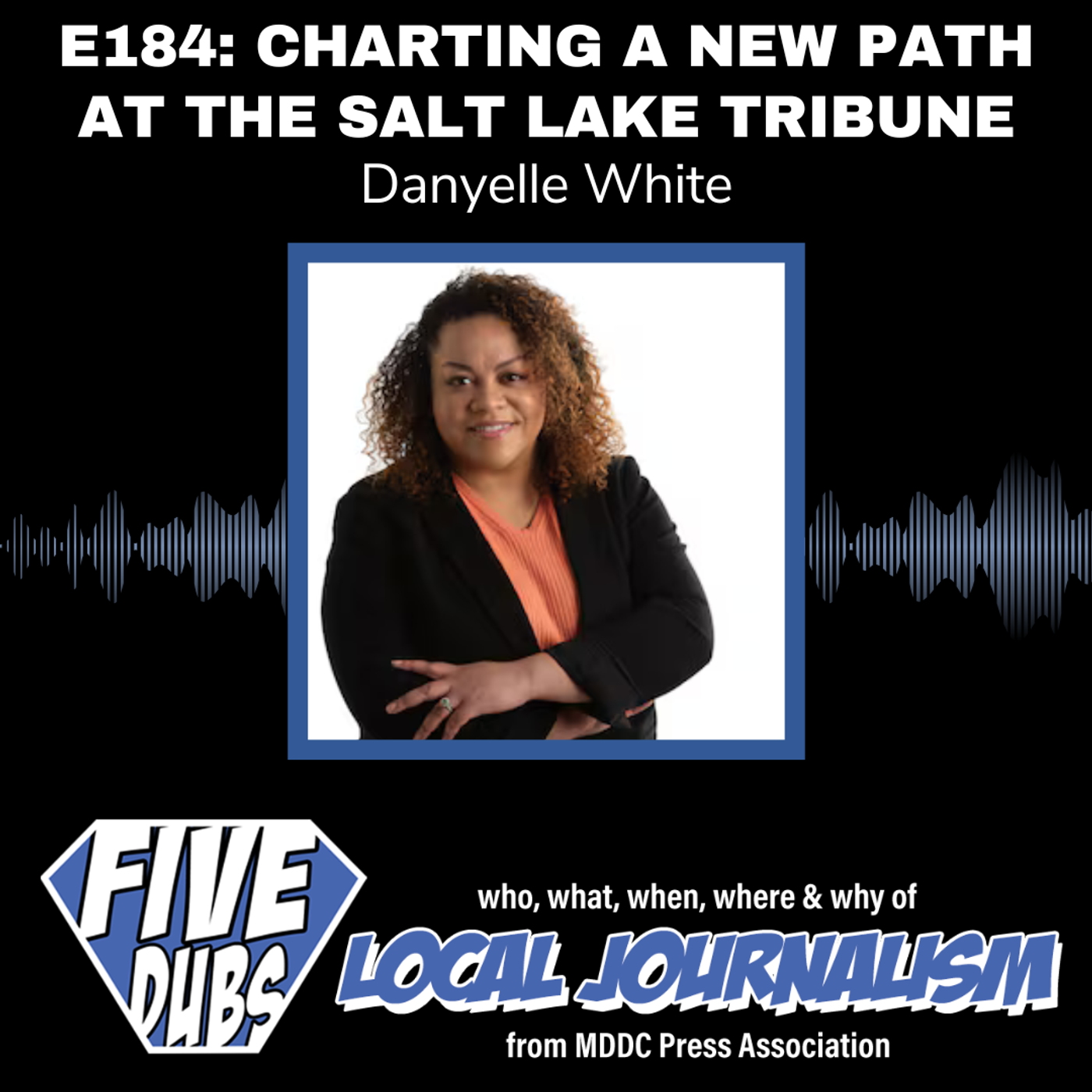
Five Dubs Podcast · MDDC Press Association
In this episode, Rebecca talks with Danyelle White, Chief of Content at The Salt Lake Tribune, about the newsroom’s journey through digital transformation and what it means to practice “conscious disruption.” White explains how identifying root problems, listening to audiences, and focusing on outcomes has helped the Tribune rethink its coverage, workflows, and relationship with readers. They discuss the Tribune’s shift from a transactional model toward becoming more essential to Utah communities, including its decision to remove its paywall and move toward membership. White also shares lessons from her time in technology, the importance of knowing what to stop doing, and how data, experimentation, and community engagement can help news organizations adapt without losing sight of their mission. Read API's article "A simple framework for deciding what to stop doing" as an introduction to the concept, and then "Make your stop doing list" to put the ideas into action. https://www.linkedin.com/in/danyellemwhite/ https://www.sltrib.com/
Rebecca Snyder: Welcome everyone. I am delighted to have Danielle White, who is the Chief of Content at the Salt Lake Tribune here in the studio with us. Danielle leads product marketing and audience teams along with community listening, opinion, and data analytics. She began at the Tribune way back in 2007 as a community reporter and worked her way around. She took a break to lead content marketing teams and technology, and then she returned to the Tribune in 2021. where she then turned around and led a digital first transformation. so we want to talk about this idea so welcome to the program first, Danielle. Danyelle White: Thank you, Rebecca. My pleasure to be here. Thank you for having me. Rebecca Snyder: And I got so excited because well, you talk a lot about conscious disruption and I wanted to first unpack what that term means. Danyelle White: Disruption? can it can be on the Rebecca Snyder: Well, the conscious disruption too. Danyelle White: the conscious disruption. Okay. I think the word the phrase conscious disruption means getting ahead of things before they happen to you, frankly, right? Rebecca Snyder: Yeah. Danyelle White: I think when we talk about disruption a lot, it's from external forces, it's circumstances, it's trends, it's reader habits or customer habits suddenly shifting. You know, I think AI is the disruption. du jour right now that people are trying to figure their their way around. And I think when you consciously disrupt yourself or consciously disrupt an industry, right, you are looking at how things are headed and you are looking at the trends and you are looking at the threats and you're looking at the opportunities, right? And you pick your spot and and you go for it. You play offense so that you're not kind of stuck playing defense on a back foot, right? And it's really hard to thrive and sometimes even survive when you're constantly having to play defense in that way. And so for us at the Tribune, we've been very mindful of, you know, the our worst nightmare is to be the executives of your that were like, the internet's a fad, it's gonna go away. And you know, like, Rebecca Snyder: Don't worry about Craigslist. Danyelle White: yeah, exactly. Like that is our worst nightmare is to to be those those folks. And so I think we are really conscious about, you know, paying attention to a lot of different signals. We're very data driven, but we also listen. You mentioned, you know, that I I lead our community engagement efforts and it's really important to us to have an understanding of what people need and and what they want, but sometimes what they say they want and then what they actually, you know, the behavior afterward. Sometimes there's a discrepancy, right? And so if you better understand their needs, I think you're gonna be in a better place. to deliver on what they need. Rebecca Snyder: So I I'm interested in that tension between going back to not wanting to to discount technology and new trends and listening to people's needs that they're not always upfront about. Like how do you stop yourself from jumping on every little bandwagon and going down the rabbit holes of people saying, I need this, but really they're saying that. That feels like a lot to balance. Danyelle White: It it can be. It definitely can be. We try to be responsive without being reactive. And I do think there's a bit of a difference there, right? As to responding to people's needs versus, you know, just reacting to whichever way the wind blows. And I think what that comes down to is being disciplined with your problem definition, how how you're understanding what the problem is. I I think that oftentimes, and and and this is true of any industry really, We we seek to solve a problem, but we don't pause to think if it's the right problem to solve or if it is a symptomatic problem, right? So especially if your tendency is to look for you know, how can I solve this with a workflow change? The problem that you're pr trying to solve is probably a symptomatic problem rather than the root problem. So can you take a moment, take a beat, peel back the layers of the onion and say, okay, what's causing this problem? Is it You know, this, this, this, or this. Okay, can I go a layer deeper? Can I go a layer deeper? Until basically the answer is no. And then once you're at that sort of root problem, and it's usually bigger than and harder to solve than whatever it is you were going to solve with a workflow problem, like, we'll just move deadlines up or we'll just Rebecca Snyder: Mm-hmm. Danyelle White: post more on Instagram, right? Rarely are those things transformational, right? They They can stop some bleeding sometimes. They can generate some excitement, like flash in the pan, but rarely are they going to be truly transformational to an organization or an industry. Rarely are they going to be consciously disruptive. So really the key is to understanding what your root problem is and figuring out how to go about solving that strategically. And evaluating the bang for the buck. Right. you know, I think a lot of in a a lot of journalism folks and also, you know, I I again I think this is industry wide, get a little caught up in resources, right? And Rebecca Snyder: Mm-hmm. Danyelle White: kind of ticking boxes around, you know, hours or how long something takes or this or that, or you know, productivity. And I think instead of looking at all of those tasks and and being very activity-based or even output-based, deliverable-based, we need to shift our mindset to being outcome-oriented. And when you do that, it becomes so much more clear to your point around, you know, how do you not take the bite at anything that seems appealing or is trending, right? If you can evaluate, okay, what are the outcomes that define my success for this, it becomes Rebecca Snyder: Mm-hmm. Danyelle White: a lot more clear where you should put your resources, where you should put your attention and time. and not get kind of caught up in the onesies, twosies. Rebecca Snyder: Yeah. Can you talk me through a time where, you know, you looked at the shiny workflow or the tasks and and had to discern and peel back those onions. how what did that look like in real time? Danyelle White: Yeah, I think we've had quite the journey, like you alluded to at the top, right? when the Tribune transitioned to a nonprofit, that was sort of what people talked about, right? is that we were the first to go from a legacy for profit to a nonprofit. And yes, that was a huge change. But the bigger shift behind the scenes was at that exact same time as we got out of a a JOA with our cross town rival paper. that required both papers essentially to go from seven days a week of print product to one day a week print product literally overnight January 1st, 2021. And you know, we were not ready internally to become a digital first shop. You know, we had been publishing online for years and years and years at that point, but our workflows and things were not oriented to best serve a digital audience. And so We we had a lot of mistakes and a lot of fumbles in those early days around, you know, timing, right? Like, we keep seeing these spikes at like 9 a.m. That's because that's when people got in and started publishing their stories. And so, you know, we were making a lot of erroneous assumptions around reader habits and what would drive them to a stronger, deeper, more engaged relationship with us just digitally. i it in those moments. So we tried, you know, timing was one of them. again to sort of the outputs deliverables. we tried doing more stories, you know, and and quicker hits and those sorts of things. And and in some ways that did work, right? Because it wasn't focusing we weren't having to do a huge long, you know, like pull it's or candidate story every day. but at some point, you know, garbage in, garbage out. is is ultimately where we where we landed in that the type of traffic you bring in sometimes is not the traffic that ultimately you want, right? And so we had to take a step back and say, okay, what do our readers need and want? We don't need to reach everybody. We don't necessarily even need to reach a national audience, but how can we best serve our community? So there were a lot of missteps that we had. made in this certainly in those early you know digital first days, that we've had to learn a lot and and test things and try things, and that's okay. Not everything has to be a a winner, but being comfortable and having a culture that is willing to experiment, that will is dedicated to learning from those failures, because failures can be very, very valuable if you learn from them quickly and correctly. And so that I would say that's the other kind of key part is is, you know, finding the real root of the problem, but also being comfortable with testing and failing and learning from those failures and adapting and moving forward instead of letting it kind of cripple you or that fear of failure make you, you know, not want to try or retreat into the old way of doing things, even though as you see in the landscape that things are evolving, you know. So I I would say those those two things work hand in hand. Rebecca Snyder: Well and and it feels like an iterative process and we'll get to culture in just a second, but I want to stay here in in sort of this defining defining the problem piece. Did you n did as you were peeling back the layers of the onion and sort of shifting in real time some of these questions that you were asking, did you always know you wanted the stronger, deeper, more engaged relationship with your audience? So was that your North Star or did you kind of arrive to that through this this peeling back process? Danyelle White: Say kind of both. I think where it it established itself is when we moved to nonprofit, and I think the question we were constantly asking ourselves is okay, what does it mean to be a nonprofit in in this landscape? And I think we had some great examples in the industry to look at, but we also kind of had to define that for ourselves in some some ways, and so that's where the experimentation kind of happened is. What do our readers want? It's really great that NPR readers are doing this, or you know, Cal Matters readers are doing that. but what do our readers want and need? and then yeah, our North Star was around b figuring out how to be essential to folks because it was becoming very clear from being a for-profit that that relationship had been established very transactionally, right? We will present information that you may or may not want and if you do want it, give us your money, you know, subscribe, and then you will have access to that information and others like it, right? And and we knew that we wanted more than that. And we knew that you know, the Tribune is 155 years old. It has been an institution in our area and throughout our state for a very long time. And it it means something to a lot of folks. And it means nothing to a lot of folks, right? And so how can we move more people over? How can we mean more to more people? And so we had, you know, we talked about what it meant to be essential i in those days, in those early days. I think we still we still do, but it's a little less explicit than having to say, you know, is this providing essential information? Is this something that people are gonna come back to tomorrow? Is this gonna make people subscribe to newsletters. Is this gonna make people vote? Is this gonna make people engage more deeply with their community? Right. And that to us is how we we wanted to participate in community as a nonprofit news organization. Rebecca Snyder: Mm-hmm. It feels like you've defined what being essential really means that, you know, you're you're spurring some action, you're building community, you're informing. But I want to go back to you had you had said earlier that the publication meant nothing to a lot of people. It meant a lot to some. And I feel like for journalists or for anyone who's really deeply committed to their organization, like that's such a stop short moment when you realize, my gosh, like. Half the popul they don't care. So how did you feel in that moment? And and as a journalist, I mean, news comes in all the time. What is what does that feel like and how did you react? Danyelle White: So this is where my break from journalism came in really handy because when you are sort of in the civilian world, the work world, like they don't care about your feelings, nothing is precious. All that matters is did it work or did it not work? And, you know, very categorically yay or nay, right? And so I got over that in the in the time that I was away from journalism. Where, you know, I got to be sort of the villain some days in my newsroom was having to be the bearer of that news, right? Is th those moments where like nobody read that. I know you spent three weeks on it, but fewer than a thousand people read that. And that means it wasn't. Mm-hmm. Mm-hmm. But yes. Rebecca Snyder: People should care about blah, blah, blah, but they're not. I think that's a really hard thing for people to know. Danyelle White: And there's the tendency to sort of blame the audience, you know, like we're amid a literacy crisis and algorithms and and all those things are true, right? And we can still control the framing of a story. We can still control, you know, the topic, how the entry point, who we are interviewing, and if that reflects our readers back to themselves, right? There it there are still a lot of things that are within our control. And that's sort of the battle the folks here. But one of the things that I think has been really effective is we do have a community engagement director who is amazing and has been doing this for many years, right? Getting out in the community. And when you watch a reporter go out and take like table at a like a festival or an event with him. And they have to hear, have you do you know the Salt Lake Tribune? No, what is that? you can't argue like you can argue with me about if that's true. You can argue with the data and the algorithms of, you know, and and that's why your story didn't didn't reach the people. But when you're face to face to someone who lives I don't know, 10 miles from where you live, and they've never heard of the Salt Lake Tribune. That's an eye-opening moment. And so where we can get folks out and involved in the community, I think is is a win. Then they also hear about real people's struggles, needs, frustrations, what they think is a story, because a lot of times what journalists think is a story or not a story on the flip side. you know, I don't know that. the average person necessarily would agree with. And so that has been part of our evolution as well, is is trying to get out of our own ego of, you know, we know best, we know what journalism is, we know what people want to read, and have a little bit more humility and and say, you know, what n what do you care about? And and do more listening. And that looks like a lot of different things, not just necessarily being out in the community. I think data is one way to listen, surveying is one way to listen, advisory boards. or focus groups or another way to listen, right? there's not just one way, but getting out of our own way a little bit has has helped significantly with our progress there. Rebecca Snyder: So how has your coverage changed in this journey to become stronger and and more deeply engaged with community? Like what are you covering now that you weren't covering like when you were there first time around as a community reporter in two thousand seven? Danyelle White: Mm-hmm. Yeah. Yeah. I think their approach has changed in a lot of ways, including what we don't report. Like, you know, crime has evolved. Like we barely cover crime unless it's, you know, a lot of people were injured or at risk. Like petty crime, we we we don't cover car crashes and those sorts of things. weather, right? Only if it's gonna You know, it's a huge storm or a system that's gonna impact a lot of people. and and a lot of what we considered like breaking news back in those days, we don't cover anymore. those things don't necessarily have the interest that they once did. Two, there's a lot of competition for those sorts of things. You know, you know, we have a a local news station here that covers that really well, but there's also, you know, ESPN for sports scores. We don't publish agate anymore, right? All sorts of things that give alerts, right? So, you know, if a celebrity passes away, right? That used to be a big deal. We would have to get on that even if it was wire immediately. You know, we we understand where there's competition and where that becomes not a good investment of our resources. And so the Tribune's bread and butter is accountability. And that is something that we we've been very proud of. And it's really important because again, the media landscape here, a lot of what is is here is owned either by you know conglomerates or the LDS church, right? And so being independent, we we kind of you know wave that banner of of you know covering politics through an accountability lens, higher education through an accountability lens. Environment has been something that we did not cover before. very much before moving to a nonprofit that we have seen huge demand for. and also like people thank us a lot. We have a webinar coming up next week that is about you know the Colorado River and you know it's such an important body for us but also states around us and and what we do with that. as a resource is going to affect generations to come. And so there's there's a lot of there's a lot of readers who look to us to have those hard conversations that the others might not. So I I would say an another play, you know, and how we do things, right? So we still have an opinion section. A lot of nonprofits don't have an opinion section for a variety of reasons. We do, but we evolved it to be voices. And the mission around that is we want to amplify voices that haven't necessarily been heard. We want people to write from an area of expertise. And that can be, you know, professional expertise, but that also can be lived experience and speaking Rebecca Snyder: Mm-hmm. Danyelle White: to that first person authority. And we have seen how much better that sort of content performs than the traditional op-ed commentary that's you know, waxing philosophical about, you know, this political event or you know, just the the state of society in general. Everybody has an opinion and that's one of the things social media has democratized, right? Is everybody has a platform to express that opinion. We don't necessarily feel like we have to support that in our pages. What we want to do is amplify the voices that help people better understand their neighbors and have a little bit more maybe compassion or at least insight into someone's experience that they don't share. That's where I think and and studies have shown that healing can begin when we're in such a divisive Rebecca Snyder: Mm-hmm. Danyelle White: society that those personal stories are what what convince people more than even hard data. And so we've pivoted our opinion section quite a bit since moving to a nonprofit. Rebecca Snyder: So a lot of the things that you've talked about, like accounta the accountability lens, the amplifying the voices who haven't been heard, that feels very kind of core values. And I don't do you have sort of stated core values that that are guiding you? I'm I'm kind of thinking like what you're through all this iterative processing, you Danyelle White: Mm-hmm. Rebecca Snyder: have a framework now, but what does that framework really look like? And then we can talk about culture. Danyelle White: Mm-hmm. Yeah. Yeah. I mean, we have we have our mission statement that you could read on the website, but like it's a it's a mission statement, right? I think our core values are really to try to serve all Utah's, right? And Rebecca Snyder: Mm-hmm. Danyelle White: that looks like a lot of different things, right? From a religion standpoint, which is huge here, to a political standpoint, to an environmental standpoint, which is big in Utah, right? but then like the lighter things culture, like Utah has a really interesting food scene and Rebecca Snyder: Mm-hmm. Danyelle White: a music underground music scene. And you know, our sports culture is pretty interesting as well. And how can we, you know, build community and help people feel equipped and empowered to be good members of that community? That's really the essence of what drives a lot of our decision making is how can we be the vehicle. To improve our communities. We know we can't do it directly. We have to either inspire or inform and educate folks to to participate more fully in their community and make that change. But that that's been sort Rebecca Snyder: Mm-hmm. Danyelle White: of the inspiration for a lot of our our changes and and our decision making internally on the day-to-day, but also, you know, our bigger, more strategic thoughts is how how do we better serve folks of the state? We've we've pushed. statewide, right? So we're called the Salt Lake Tribune, but we've always been a a statewide paper. We used to have bureaus. And then when we were owned by the hedge fund before we became a nonprofit, that all sort of retracted back to Salt Lake City, Salt Lake County, where the majority Rebecca Snyder: Mm-hmm. Mm-hmm. Danyelle White: of the population of Utah is, right? but since since the transition to nonprofit, we We've adopted, we were given and gifted by a family, the Moab Times Independent. Moab is huge. A lot of, you know, a lot of folks who don't even know much about Utah know about Moab. Rebecca Snyder: Mm-hmm. Danyelle White: so that was a few years ago. We launched last year, about 11 months ago. We're not quite to the year anniversary, the Southern Utah Tribune, because the southwest corner of the state around St. George has seen explosive growth and a lot of challenges with that growth, including. water and infrastructure. So how can we better serve them? And then we launched a newsletter almost two years ago up at the very top of the state in the Cache Valley area, which is has completely different interests and and problems and those sorts of things. So we've tried to take that really literally how do we better serve more Utah's in like coverage area. But also, you know, there's a lot of communities that we didn't cover or actually did harm to over our 155 years. And how do we start building relationships and building trust with those folks? Our community engagement director has launched a WhatsApp in Spanish, and that's steadily growing. It primarily is providing resources both from community partners or translated versions of our stories. And and you know, education is another place that Utah Rebecca Snyder: Mm-hmm. Danyelle White: is really seeing a lot of changes. So leaning in there, trying to listen to parents, but also, you know, students themselves. And and youth has been a really core, I would say, demographic for us over the past couple of years. I think we were a little bit ahead of the Instagram. trend and TikTok trend, we were on both of those platforms pretty early and have seen significant growth there. We've invested significantly in resources to make sure and sort of shift our understanding that yes, it would be great if people will click link on bio and come to our website and all of that good stuff and sign up for our newsletters. But really also it's okay if the only information people get is the, you know, the Instagram posts that they see from us and if that inspires them to vote or write a congressperson or go to an event or eat in another restaurant. there is something called the Tribune effect that restaurants have that when we cover them, they like sell out the next day or the next week or those sorts of things. And so we can have really large impact on a lot of different things in our area and and we have to take that responsibility seriously. Rebecca Snyder: Well and and I think the question I wanna ask is it feels like you've changed your definitions of success as well, because I think for a lot of traditional newsrooms it's okay, how can we drive subscriptions, how can we drive revenue in? And obviously revenue is important, but you've changed that model. And when you said, you know, you have the Tribune effect or you want someone to vote, those are very different than we want them to give us money. So it's probably wise right now to pause and ask you, what about this membership model that you have? Danyelle White: Yeah. Rebecca Snyder: and how has that how has that changed your outlook on how you approach your definitions of success? Danyelle White: Yeah, I think it's the other way around. How did what we Rebecca Snyder: Okay. Danyelle White: were doing evolve into us moving toward a membership model? So everything you said is true, right? Like our metrics for success are still very much, you know, we use median page views, for example, instead of average page views because it takes out the virality and outliers and and really shows us, hey, are we really reaching more people consistently? and we've seen That number grow more than we even hoped or dreamed over the pack past couple of years, in spite of you know, challenges with algorithms and Google specifically, you know, that I think a lot of folks have. And of course, revenue, like we we have to stay in business. We we understand that without support, we can't do any of this stuff. And so those are still very much metrics for success. But I think what changed. Is the understanding that that's a longer game or that has there are more complex factors at play that lead to those numbers than just sort of the this headline, this click, this ask, this donation, you know, this story leads to this subscription. That is true. And you have to build the trust first. They have to be aware of you first, right? And if they're never looking for you in the places that you are, you need to be in the places that they are, right? And and so I think our our view of the funnel has has taken it's a little bit of a longer funnel than we once envisioned it being, right? And so yeah, we we just a couple of months ago took down our paywall, which had been in effect for a very long time. and We did that after multiple years of planning and strategizing and testing. And we said, you know, I the the discourse around it, right, has been, it's the Tribune's big gamble. And I I guess it's a gamble as much as you know, getting out of bed and crossing the street every day is a gamble. But we we said internally and to our funders when they were like, you make two and a half million dollars off of subscriptions, you're really successful here. Why would you, if it's not broke, don't fix it, sort of thing. if we we we said to everybody, including ourselves, if we can't figure out a way to do this successfully, we're not gonna do it. We're not gonna risk a hundred fifty-five-year-old institution and it's and the livelihoods of those who work for it on a gamble. But it really came down to one again mission, right? miss mission and messaging, right? Which was we are a nonprofit now and What does that mean for us again? and there were a lot of people who kind of pushed back against the paywall and said, Well, you're a nonprofit now. Why do you still have a paywall? You're a nonprofit now, why Rebecca Snyder: Mm-hmm. Danyelle White: do you still have subscriptions? We never had a really great answer for that, other than the fact that when you transition business models, it's not like flipping a light switch. We still had a great amount of revenue tied up to this particular model. And we were adjusting. And there were a bunch of things that we had to do, you know, from an IRS standpoint, advertising, like Just a lot of very, frankly, boring and bureaucratic things that we had to take care of first before we could sort of shift to, you know, how we serve our journalism to Utons. So we did that. We did a test where we took a statistically significant amount of our subscribers a little over two years ago and we reached out to them and said, Hey, you don't have to pay us anymore. You still get complete access to everything that you were getting before. But you don't have to pay us, but we would like you to because we are a nonprofit. We are committed to serving you in in ways that other news outlets locally cannot. and we set a metric for like, you know, what's deadpool for us essentially. If it drops below that number, it's a signal that we cannot make this shift. Not only were we above that line, we were significantly above that line. We were pretty shocked with the response. And and we watched what happened with that cohort over over a year. And we learned a lot that has informed our membership stewardship strategy, our attention strategies, our onboarding, our win back strategies, right? Rebecca Snyder: Mm-hmm. Danyelle White: and so that was really informative, right, and and and interesting. The other thing that we did. is we talked about it openly, right? we announced at our gala that hey, we want to take down our paywall, but here's why we can't write the second. We have this runway to build, we need we need to hear from the community that this is what they want us to do and that they will support us. And again, we were overwhelmed and surprised to the level that people reacted so positively and supportively. So we were able to build that runway, that safety net to allow us to to make this transition. And then we made the transition a couple of months ago. And, you know, again, we had our metrics of, you know, what is what a success look like? We are well above those numbers. It's still early, you know. I'm not ready to take a complete victory lap yet. But you know, at every step we've been communicating transparently, you know, which I think is one of our values is transparency. you know, I think in this business, all news outlets should should strive to be very transparent. communicative about both our needs and how we want to serve folks and and then we tested and looked at data and sort of approached things systematically and slowly and you know people there were some people that were like you've been talking about this for years you're never gonna do it this is all just like fake and I could I can appreciate that and and the spirit in which that was delivered but you know we we had a responsibility to get this right. Rebecca Snyder: Yeah. I the stakes are high. It feels like that whole piece Danyelle White: Yeah. Rebecca Snyder: was just re-emphasizing the essential the th the essential piece of what you were trying to do and downgrading the transactional piece. Danyelle White: Exactly. Exactly. Rebecca Snyder: so I'm interested also in like what that felt like in the newsroom because when you know when you are a conscious disruptor, you're you're willing to challenge those systems, the habits, all those pieces. How do you within your newsroom and within your wider operation, how do you do that without making it seem like you're just descending into chaos? You added a lot of like with the Moab publication, you have different formats. You've got newsletters, you've got pieces, you've got more channels, like in some ways it feels like there's more pieces of the pie. So how do you make sure that people aren't exhausted by that change? Danyelle White: Yeah. I think there are folks in the newsroom who would say that we weren't successful at that point. You know, I I think there there are some folks who are exhausted by change. I mean, I we haven't none of that happened overnight, right? None of these things happened overnight. But again, I think as leaders, we also strive to be really transparent with folks in in our newsroom. And so we started talking about, you know, going to free very early internally. And there was a lot of enthusiasm around that because again, mission, right? And the paywall by a lot of specifically reporters was seen as an impediment to folks reading their story. and so, you know, there was buy-in internally from that. And we had to explain, okay, that's gonna mean we're gonna have to do some do our journalism a little bit differently. We're gonna have to cover things in a different way or cover things that we haven't covered before. We're gonna to stop doing some things that you know, aren't serving us or readers anymore. So just as important as, you know, I talked about raising the median page view, we had to raise the floor and we had to reduce the number of stories that were below that threshold. And that had just as much impact in, you know, our ability to reach people as all the other changes, right? and and and so that's one of the things that I, you know, I'm a I'm a coach in the media transformation challenge and I get to work with a lot of different leaders in the industry. And one of the things I'm constantly having to remind them is what you don't do is just as important as what you do do, right? Because our time and our resources are so precious in in this industry. We're all trying to do a lot with a little, and so you can't afford to do things that don't work. And you don't know that they don't work if you're not measuring them or defining success, et cetera, et cetera. Right. So we've put a lot of effort around what we have stopped doing and what we shouldn't do and analyzing what we shouldn't do. so that we can, again, to your point about exhaustion, right? You can't just keep putting things on people's plate without taking some things away. And in fact, I I actually recommend. taking the things away first, just psychologically. It's easier to to to be able to absorb the new stuff if you've already sort of made room for it mentally and literally. So that's been another huge key is what have we, what are we stopping to doing? And that and there's a a great exercise on American Press Institute website called Stop Doing. Highly re I I like send that out like candy to people. And it's always when they're like, bandwidth, right? Anytime you find yourself saying, like, we don't have enough bandwidth, I highly recommend doing a stopdoing exercise. You need to do it frequently, reevaluate frequently. If the answer is, you know, like why why am I doing this? If the answer is because we've always done it, you know, you need to evaluate that. And sometimes it doesn't mean stopping doing entirely. Sometimes it means doing it less frequently or in a more efficient way or less, you know, with less fanfare or something like that. Right. I remember we had someone or this was early, so like 2021. Someone literally was manually putting in analytics in a spreadsheet every day. Like yesterday's page Rebecca Snyder: Ouch. Danyelle White: views were this, our Facebook likes were this, like all the way down every single day. And I was like, Why are why why are you doing that? We have we have this platform and we have this, and we can, you know, and so sometimes we just we just get in a groove and we do something because we were taught to do it or that was we thought that was part of our responsibilities. But I had no idea that she was doing that every day. Right. Rebecca Snyder: it just takes five minutes. Don't worry. Danyelle White: Exactly. But that adds up, right? That all adds up. And so that five minutes could be better spent in a lot of different ways. So Rebecca Snyder: So and and for those listening along, we'll put the stop doing exercise link in the show notes so everyone Danyelle White: Yes. Rebecca Snyder: can can feel the glory of that and we'll we'll go into that in just a second. Danyelle White: Ha ha ha. Rebecca Snyder: But would you say that sort of the stopping part is the first step of some of this change? Like if a newsroom is saying, Okay, we want to make some transformational change, what would be the first thing you'd recommend that they do? Danyelle White: Start with the why and be very, very clear on the why. Because if the why is murky at all, because it's gonna be hard. Trans change, transformation is always, always hard. Even if you do it strategically, even if you do it in the bet like best way possible, right? it's still difficult. And and the why is what gets you through the other side. The why is what makes it worth it, right? The hard worth it. So I that that's the first place to start is getting a crystal clear why. and part of that, going back to what we were talking about at the top, is understanding the problem you're trying to solve and communicating the problem that you're trying to solve internally. we're seeing that Subscription fatigue is a thing, not just in our industry, but across the board. Netflix, you know, Amazon, all sorts of large outlets are starting to see declines in in subscriptions. we want to get ahead of that. So we're going to do XYZ, right? and then yes, the stopping doing, I I would say comes pretty early too. you know, we're gonna ask you to do some things differently, but first. We're going to see what we can take off our plate. We're going to evaluate what's no longer working. We're going to evaluate if there are platforms or other systems that, you know, could help us be more efficient in certain ways to take some things off your plate and then, yeah, introduce the strategic additions to, you know, whatever it is you're trying to transform. Rebecca Snyder: So that that process sounds fairly straightforward, but I wanted to go back to the defining the problem because y partly you wanted to reach out and be more relevant or more essential to all Utons. It is Utons, right? Danyelle White: Mm-hmm. Yep. Rebecca Snyder: just wanted to check myself. But we won't Danyelle White: Correct we'll turn it into Utahans, but ignore that, it's Utah's. Rebecca Snyder: go there. But I I it's sort of I'm curious about like who's in the room. So like I I think Reuters did a study maybe back in twenty twenty-five that like women are are although maybe f what forty percent of yeah, forty percent of journalists, they only make up twenty percent, twenty-seven percent of top editors. We know writ large news media is not is is it's wider than we want than than our representative populations. It's more middle class than our representative populations. And so when you are trying to accurately serve a really diverse space and your newsroom doesn't reflect that, I wanted to hear from you, like in defining the problem, do you have blinders or a different lens because of what your newsroom looks like? And I guess secondarily. How deeply do you involve all aspects of the newsroom in those discussions? Danyelle White: Yeah, I love that question. so we have been very open internally about we want the makeup of the Tribune to reflect the makeup of Utah. And every year we're doing it right now, or end of end of August, the deadline is always the Monday or the Tuesday after Labor Day. and then we always discuss it in a September staff meeting. We do a source audit, and that audit looks at four key demographics of and so source being the people we interview for our stories, the people who are who are mentioned in our stories. And and we look at gender, we look at age, we look at race, and we looked at a role. And role means are they an official? Are they an expert? And the role we really are trying to see an increase in is what we call affected. Meaning those Rebecca Snyder: Mm. Danyelle White: are the people who, those are the governed, not the governors, the governed, right? Those are the people impacted by the policy change or, you know, the ticket price increase or, you know, those sorts of things, right? because that reflects the reader. That that's meant to reflect the reader, right? and so I think, you know, every reporter has to do that, every editor has to make sure the reporter does that. And every, you know, we're very open about that. year over year of when we make progress and when we backslide and those sorts of things. And we talk a lot about that. So that's one one area that I feel like we keep a pretty laser focus on is is improving, you know, who who are we reflecting in our work. internally, you know, we unionized a couple of years ago. We signed our first contract last November and we had a mutual interest management and and and the guild in making more progress toward matching the makeup of of of you the you know the citizens of Utah. you know, there was the anti DEI backlash and so we have to be careful around you know, how we how we go about doing all of that sort of thing. But you know, I think Since I've arrived, I'm obviously am a black woman and in leadership, in in top leadership. And so this is an area that I I care deeply about. And Rebecca Snyder: Mm-hmm. Danyelle White: we have made significant progress toward our goal of of looking more like Utah here internally. when you're asking about women specifically, our CEO and executive editor, Lauren Gustis, is a woman. our head of revenue you know, development and advertising is Ciel Hunter and She is a woman. I am obviously the third member of our C suite. I'm a woman. and our deputy executive editor, Sheila McCann, also a woman, Pulitzer Prize winning woman. And so here internally, you know, I think we have a lot of female leadership and and female strength and a lot of interest in you know, making sure that we do right by as many people as we can. knowing that you know we're always going to piss some people off. We're in journalism, right? Like that's Rebecca Snyder: Right. Danyelle White: that's part of the job and that's gonna, you know, come with it. But can we want to be fair and represent and have trusted relationship with as many communities across the state. And again, communities look like a lot of different things, right? That can be age, that can be literal geography, you know, that can be race, culture, all sorts of different things, right? how do we better serve Utawns is at the end of the day what we're what we're trying to improve and and grow. Rebecca Snyder: Well, thank you for pulling up the averages of of women in the Danyelle White: Yeah. Rebecca Snyder: news in in top management. And it feels like you're going back to to a theme that you've had is that you're underpinning that idealism with data to say, okay, well, how can we measure that? How can we make sure that we're set? I wanted to so disruption, conscious disruption in that sort of arc of being mindful and thoughtfully thinking about the problem. The metrics, the goals. that also kind of applies to your own leadership journey in in in some ways. have you always been as savvy about disrupting your own life as you seem to have been in this journey here? What have you learned? Danyelle White: Ooh, that's a good question. probably not. I mean, you know, I was young like everybody else. And you know, I feel like I have the thing I would say that is my personal greatest strength if we're gonna go a job interview style is that I balance sort of the emotional gut intuition and like the hard logical facts, like that empathetic leader, but also like Here are your goals, you gotta meet them. Like I I I toe that line pretty well most of the time. and I do that for my like that's who I am. and I do that in my own mind a lot too, you know. And if I feel a strong emotion, I try to logic it. And if it's this if I get the same answer on both sides, it's probably right. and so yeah, I've I've I've I've made some what other people consider bold career choices. I don't feel like they were again risks at at that point. but I've definitely made decisions that other people have not necessarily understood or agreed with. And it's come from a place of I love to learn and evolve. Like I am I'm a person that is very comfortable with change, which again sometimes make me makes me the villain. But I'm I'm very comfortable with change and and I'm also really rooted in values. And so if there are certain values that are not being met or opportunities that I may had not have considered, but it makes sense for me. I'm never a person that's like, I can never come back or I can never progress beyond that. I I don't have a lot of fear in that way. I I trust my ability to figure out what's going on and adapt and find a way to succeed. I've had to do that in a lot of different circumstances both professionally and personally in my life. And so yeah, I think that is off of you know often reflected in in some of the decisions that we make collectively or the you know, the the things I pitch or propose in our senior leadership meetings do sometimes come from that place. Yeah. Rebecca Snyder: Yeah. Well and and I think one of the biggest and maybe not surprises, but sort of disconnects in your in your career path is that you took that ten year gap to work in technology and came back. so Danyelle White: Mm. Yeah. Yeah. Rebecca Snyder: what belief about journalism did you have to unlearn when you left, when you went to the tech that technology space? And Danyelle White: Mm-hmm. Mm-hmm. Rebecca Snyder: then what belief from the tech world did you have to unlearn when you came back? So sort of how did you unspool yourself from the career space you were in or the industry space you were in. Danyelle White: Yeah, when I left journalism, the Tribune was owned by a hedge fund and was being sucked dry for all it was worth, as has hedge funds want to do, right? And on a personal level, my mother had suddenly passed away and I had a little, you know, existential crisis around that because I had missed her last Christmas because I worked on Christmas Day. and and so the thing that I had to unlearn initially when I left journalism is that workaholism and that What I do defines who I am. Like I think there are certain professions more prone to that, you know, like my identity and my profession meld into one. I think, you know, medicine is is is one. I think journalism is another. And, you know, I can think of several others, but that was really difficult for me to unravel my identity. tie being tied to journalism. It was also really healthy, right? And especially as I was moving through that grief to understand that I am not defined by what I do for a living. I'm defined by how I define myself and the the actions I choose to make in every area of my life. And so that took a couple of years to actually unspool. And then what I learned in tech is how to build really high performing teams. And loved, loved that. that sort of mentality of, you know, fail fast, test and learn, that on a positive note brought both of those things back to to journalism. but I feel like, you know, there was a moment. So how I ended up back at the Tribune as a as a a board member actually reached out to me via LinkedIn and said, we need somebody with the street cred of a a former journalist has, but with the audience understanding of someone who's not been in the journalism world, would you come back? And I told my husband that night, I've never felt hell yes and hell no so strongly in that same moment. because I felt like on one hand, I kind of escaped the asylum and why would I ever go back? Like I Rebecca Snyder: Mm-hmm. Danyelle White: I I was really worried about myself retreating to that workaholism that didn't have any boundaries. just drove myself into the ground, let my relationships fall by the wayside. I was really worried about that. But the the the hell yes part came in the the tribune is doing something nobody else has done. And if I can be a part of that and create that blueprint that then maybe others can follow. Like that was really exciting to me. That challenge was really exciting to me. And so you know transitioned back, I think what was like the reverse culture shock and coming back was just sort of what is acceptable on a lot of different fronts, from a culture front to goals to everything in journalism would not cut it. Like there's just a different amount of rigor when your livelihood like when the dollar is the thing that's driving you, right? And I don't think that that's necessarily a hundred percent healthy either. and so coming back it was sort of finding that balance between, you know, pushing and still moving in that direction, but at a different with a different touch, I would say. Rebecca Snyder: Yeah. Well and and so historically, just to kind of put a little flesh around that, historically, you know, there's been such a separation between the revenue side and the editorial side. Is that sort of the is that why you think there's or do you think that that's part of why there's not as much rigor in to the numbers in journalism or or what what what kind of creates that less rigorous environment? Danyelle White: Yeah, I definitely think that's a huge part of it. And I think if you look historically, that was sort of the root of the problem is that that firewall essentially made it so it was like, I will write the things I want to write about and money is somebody else's problem. Like literally it's somebody else's job and I don't have to think about that. But I also think, you know, we didn't have data. We all the only data point that we really had was subscribers, right? And and of course the money. But so the paper got delivered to X amount of people every day and your story was on B one or whatever it was. And everybody sort of just got to assume that the people who re read all of the paper cover to cover every day. And there were There's some people who did that, but there were a lot of people who didn't. They just grabbed the sport sports section or the funnies or whatever, right? And and and so we didn't have that insight. So I do think the disruption of data has also been really harsh, right? Because on one hand it can be seen as, well, clicks can be inflated, you know, it can be gamified. I don't know what I'm really like. I know I'm doing good journalism. But if nobody is reading it, doesn't matter. And that's philosophical tension, I feel like, has been sort of a bigger piece of the puzzle than even the firewall. so I I manage what I kind of refer to as the bridge departments within our organization that serve both the revenue side and the editorial side. And so I'm constantly having to keep my brain in both. And and again, that transparency factor as as leadership, we are trying to kind of break down that wall in a responsible way so that people can understand the downstream effects of their work and their actions or inactions, right? if we're looking at the stopdoing and those sorts of things. And so I think that's been that's been key as well. Rebecca Snyder: Yeah. And it just strikes me that as you earlier you said that the tech side was more like money driven or revenue driven, but maybe it feels a little bit more numbers driven versus, Danyelle White: Mm-hmm. Rebecca Snyder: you know, here's here's our good. Would would that Danyelle White: Yeah. Rebecca Snyder: make sense to you? Danyelle White: Yeah. And I think in tech, so talking about the funnel earlier too, right? Tech has a very good understanding of the long play, right? And what behaviors make you more susceptible to doing what next, right? And so it's like at the very first moment you in are introduced to us or our product, we want to drive you to doing things that we know that if you interact with that feature. you are more likely to subscribe, or like if you're on a freemium model, you know, get an individual license or then a team license or then, you know, all the way down the road, right? And so it's much more incremental, whereas I think journalism, we kind of do the whole thing and then we send it out. And then you know, we don't break things down into parts and we don't have as long of a view of cause and effect and and the little micro causes and effects that that lead up to the big cause and effect that you want, whether that's subscriptions or donations or even just reading a story. I think tech is much more nuanced in that way. And journalism is a little bit blunt force in that in that way. Rebecca Snyder: glad you're you're in the bridge between those two. It feels like you have a lot to to offer on both sides. So final question. What personally are you stopping and starting now? Do you I'm I assume you do that exercise every once in a while. Danyelle White: Ooh, that's a good question. Mm-hmm. Mm-hmm. Yeah. So I've been in sort of paywall transition hell for the past few months, right? it's Rebecca Snyder: I'm sorry. Danyelle White: okay. I mean, anybody who's done a big tech transition, you know that there's a lot that goes into it. And then there's a lot of cleanup, right? There's you do the best that you can to prepare and think of all the things, but you're never gonna think of everything. And so there's some cleanup. So I'm I'm getting out of cleanup mode right now. I think the teams have it on the couple of things that are still outstanding. And I am actually taking on a little bit more of our like now we don't do sales for subscriptions. We're doing campaigns. And so I'm I'm just beginning to lean into campaign themes and all sorts of data and research involving successful campaigns. So looking forward to how that changes as well in the next couple of years for us. Rebecca Snyder: Well, I am excited to hear about it. Danielle, thank you so much for coming to talk to me. This was a really great conversation and I learned a lot. Danyelle White: Yeah. It's my absolute pleasure. It's been great. Thank you so much, Rebecca,