
Five Dubs Podcast · MDDC Press Association
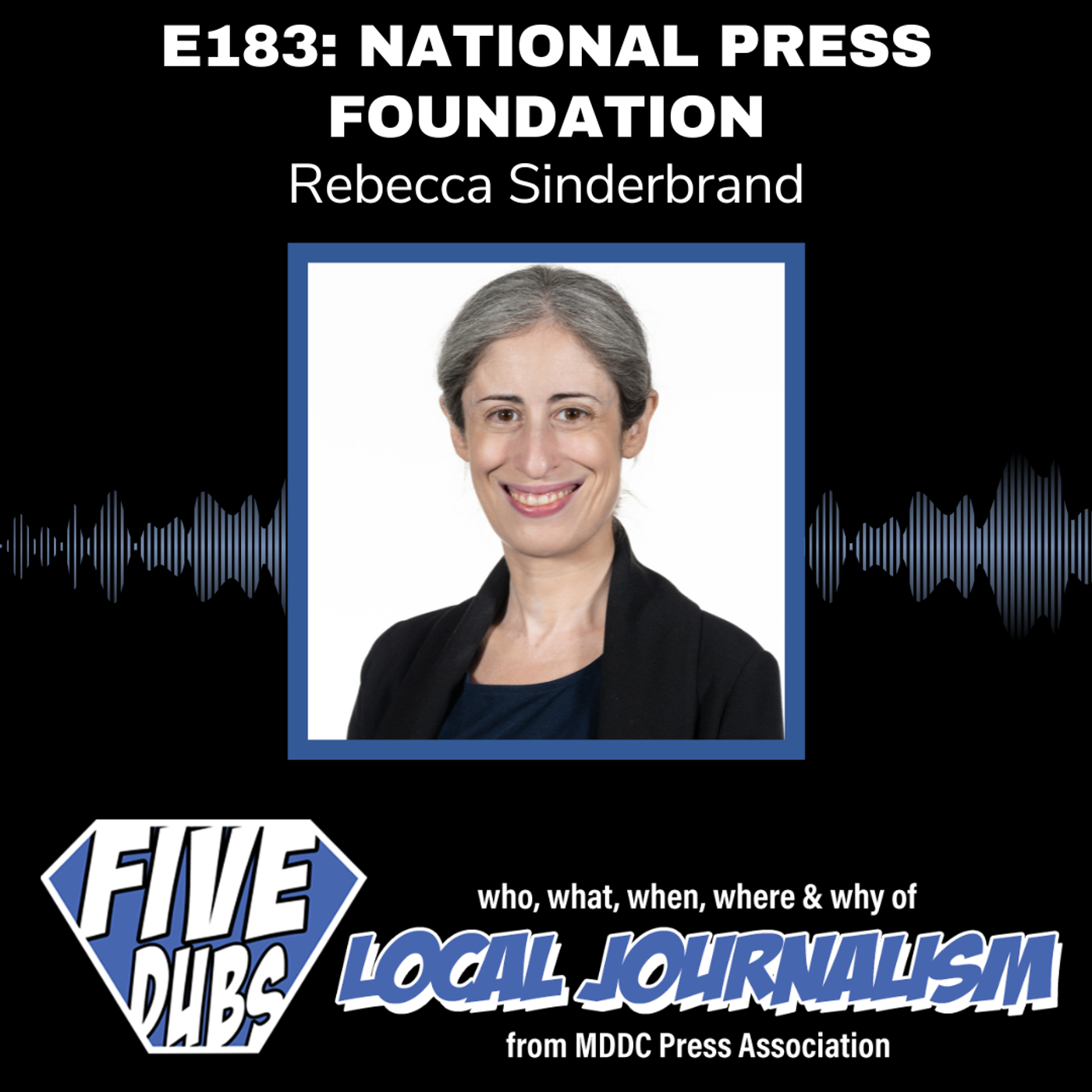
In this episode, Rebecca talks with Rebecca Sinderbrand, the newly named president of the National Press Foundation, about the foundation’s mission to support journalists through training, fellowships, mentorship, and professional development. Sinderbrand discusses how the organization helps working journalists strengthen their skills, build connections with experts and colleagues, and stay equipped to navigate an industry defined by constant change. They also explore the importance of investing in emerging and diverse newsroom leaders, building partnerships across the journalism ecosystem, and using new technologies—including AI—to enhance reporting rather than replace journalists. Sinderbrand shares her vision for the National Press Foundation and why supporting the people behind journalism is essential to the future of the profession.
Rebecca Snyder: Welcome everyone. I am delighted to have Rebecca Cinderbrand in the studio today. Welcome. Glad to see you. Rebecca Sinderbrand: Glad to see you. Thanks for having me. Rebecca Snyder: Well, and it's so exciting to have you because back at the very end of July you were announced as the new president of the National Press Foundation. And you've done so many different things, and it's in from the Associated Press to Newsweek, CNN, Politico, the Washington Post, and NBC News. And now you currently are at Georgetown University, which is your alma mater, I believe, and leading its Rebecca Sinderbrand: Thank you. Rebecca Snyder: journalism program. So With all that, I mean, you've got such a a wonderful track record in journalism. And you have said that it's important for you to lead the National Press Foundation to meet the moment, to help young to help journalists. So tell me what that means. Rebecca Sinderbrand: Sure. Well, and it thanks again for having me. I'm so thrilled to be having this conversation. and with someone who's so connected to where journalism is right now. I think, you know, it it there are so many people who are working to meet the moment in journalism, and I'm just thrilled to be part of this effort. and it's, you know, we you're talking about kind of this breadth of experience that I've had. This journey, I I feel like I'm I'm now have been on this. Journey through the profession and making the connections and picking up the experiences and the background to be able to sit in this chair and work with the incredible team and not just the incredible team, the incredible network. I mean, we're in this amazing ecosystem here in the DC area and beyond that in the local DMV area and across the country of journalists. Who not only care about the job they're doing, but care about the profession itself and preserving it and making sure that the journalists who are in it, it's all about the human infrastructure, have the tools that they need, have the resources that they need to continue to serve their very necessary function. and and we're heading into a moment when, you know, again, the past couple of decades, I would say if you have been a working journalist at any point in living memory and you're a working journalist right now, the one constant in your career has been change, radical change. change of the profit models, of of of what supports the journalism, of what pays the salaries, of who what makes sure that all you have all the tools, the technologies that you were using. you know, I I it it almost I the past couple of years I've spent in the classroom unpacking an experience with the next generation of journalists. And when I kind of describe the universe into which I graduated X number of decades ago, and the tools we were using, it it's as though I'm talking about, you know, the Pony Express era. They're just absolutely it's we've entered a completely different environment. So that's the one constant, the challenge, whether you're in the newsroom, whether you're in the classroom. or or or whether you're a a cheerleading from the sidelines, the one constant is making sure that journalism is even as it sticks to the the traditions and the values that define it and make it so essential, making sure that the journalists and the people who are currently in that moment and and working and to provide and continue that tradition have the tools and have the resources and have the infrastructure that they need to continue. to fill that function. And that's what I consider the core of our mission. It's, you know, the National Press Foundation, it's a half century old and thriving, and continuing to meet that moment and continuing to meet that moment with journalists who are already poised to have impact. So these are journalists who are on the beat. They're working hard. they're experts on their beats. they are people who are filling core functions on some of the most vital, vital areas for our country for our world, whether it's health policy, education, the workforce, whatever it may be, these are the people who are already in those seats, producing award-winning work, producing vital work, producing public service work, and we're helping to take good journalists and helping them raise their game. And that's been our mission. It's going to continue to be our mission. Rebecca Snyder: And it's such a timely mission because you're right, the only constant is change. And it sounds like from what and so I wanted to dig in a little bit to the the foundation's programming because you're providing infrastructure you providing support that may not still be there at an institutional, at a sort of local institutional level. So tell me, and for those who are listening that may not be as familiar, tell us what the foundation does on a practical level. Rebecca Sinderbrand: Sure. So the National Press Foundation was founded in 1975, really just started functioning in 1976. So it's exactly half a century old at this point. And it has a number of functions. So one of them and one of the core functions are these fellowships that are geared around very specific story areas, beats, core policy areas of coverage. And many of these are connected to local communities. national beats, international. and so these take place both in Washington, D.C., around the country. We're about to do one that's geared on coverage of local business that's going to be held in Chicago and around the world. We have international trainings that have taken place across the globe, one that we hold annually in Singapore as well. And this is geared to again journalists who already are working in the newsroom. These are people who, you know, again, as you say, newsrooms don't necessarily at this moment in time have the infrastructure to be providing the kind of you think about any professionally expert industry Doctors, lawyers, there's an element of continuing education, of making sure that you are read in all the latest techniques connected with the experts that you need, particularly for journalists, right? Connecting with the leaders in the field, the people who are the reliable sources of information. we do that for journalists. Beyond that, we also have some core programs that are continuing programs that happen annually, that have cohorts over the course of a year, and they are essential to our mission. So some of these would be this coming year, it will be the 40th anniversary of the Paul Miller Fellowship. And that's one that connects journalists who are actually in Washington with experts that they need throughout the city, throughout the the federal government infrastructure and the political infrastructure and really get launches them to be as effective as they can possibly be. There's also the which we consider to be incredibly central, the widening the pipeline program. this is Rebecca Snyder: Mm-hmm. Rebecca Sinderbrand: a newer program, but this is towards emerging diverse leaders within newsrooms, helping to provide them with the mentorship and the support and the training they need to become established, to stay central and to continue to rise in newsrooms and provide that essential leadership, diverse leadership moving forward. and so these are programs that again are geared towards this is not necessarily towards people who have just launched, but these are people who are poised for maximum impact, who are ready to be leaders on their beats, in their newsrooms and beyond. and that's where that we think that that kind of critical investment needs to continue to be made. Rebecca Snyder: Yeah. So I I'm interested so having the fellowships, the cohorts, the emerging leaders program, you're really looking to reshape a lot of how maybe the news industry sees itself, who's in who's in who's reporting who who are journalists and where people are going for information. So I wanted to start with the idea that you're kind of convening experts to shape either reporting strategies, so tell me what what strategies, what new sort of trends are you most excited about in reporting? Rebecca Sinderbrand: Well, it's really an extension of existing elements that are so core and fundamental to journalistic identity. So you think about connection and collaboration, right? So we don't you don't tend to have necessarily a lot of collaboration, you have a lot competition in journalism. this is about Rebecca Snyder: Right, the other safe. Rebecca Sinderbrand: kind of convening people to begin to think of each other as professional networks and assets and learn from each other. But also connecting them with experts in their fields. So you know the leading whether these are leading health journalists, leading health experts. Just to give an example, when we're talking about covering health, I was just looking down a rundown from one of our upcoming health fellowships. And it was again the people who you've seen their names quoted in news stories. If you are a local beat reporter. You may never have actually met them. You may never have actually been able to get them on the phone, sat in a room with them. This is your opportunity to do that. It's also your opportunity to connect and to really just dive into some of the next level, next gen techniques. And again, you know, when it comes to technology, you know, the way that journalists are using AI, we have a very careful policy, as do many newsrooms, around the use of those tools. But this has like this multiplier effect. It's again not. replacing journalists, but allowing journalists to do more than they perhaps could before. And in a way, you know, particularly at this time when you have cuts in newsrooms to essential functions and support, you know, researchers, data experts, visual experts, the people who supported some of these essential functions in newsrooms, and there are fewer of them, and you're being asked to do more with much less. And yet, we also have these new tools that are emerging and they're changing constantly. If we had this conversation six months ago or a year ago, we would be having a different conversation. And so there's this need for almost this constant updating of the skill set and the ways and the prompts and the tools that you can use to enhance your own reporting. And this is again, this is not a replacement for the human. It's just a way of supplementing, providing additional support. and this is a moment it allows you to step back, talk about best practices with some of the leaders in your field, figure out how it can apply to your work, what you're doing at the local level, speaking as a journalist who's attending one of these sessions, and then returning again, hopefully with new ideas, skills, networks, numbers in your Rolodex for additional reporting that enhance what you're already doing. and hopefully position you for the future. Rebecca Snyder: So and I know you haven't stepped foot into the job that's coming, but can you tell me about a time where that sort of happened how you would like in the best case scenario? Because your programs are national program, it's the national press foundation. And so you're you're dealing with a lot of local publications across the country. So do you have a time where where it worked how it was supposed to? Rebecca Sinderbrand: Well, I I I'll give an example of something along the similar lines towards a slightly different cohort and my my most recent role, which is at Georgetown University. So this past spring at Georgetown University, we have something called the capstone where our students who are getting ready, they they are All it's all over, but the shouting they have professional experience, academic experience, they're about to graduate into the real world. and we asked them to okay, take on a challenge that is original and ambitious and professional quality, as though you were in the newsroom right now. And so this past spring we took on a group project, and this group reporting project was indeed quite ambitious. It was, we want to take a look. At the ways in which, in terms of coverage and access and the experience, White House reporting had changed under the first year of the current administration. there'd been all kinds of changes to the way pools were assigned and and all all sorts of other kind of questions around how is White House journalism performed right now. And we would have all of these anecdotal conversations and piecemeal coverage, but what we wanted was data. We thought about this. Okay, so okay, think of yourselves as a reporting team, a lightly funded reporting team. You are pretend you're in a newsroom right now. How would we begin to conduct this project? What would we do? Right? Brainstorm this out. And so we were able to use tools to, for instance, create a a an app to scrape data. to download all of the pool assignments for the past year, both before and after the White House took over the assignment of the pool rotations, right? Scrape it, put it on a spreadsheet, begin to look for early trends. Now you still have to do quality control. You still have to make decisions about the story, you still have to create the public-facing summaries and products. but this is something that could have taken however many weeks, months to perform previously. And now it's something that could be done. That kind of, you know, that idea of thinking through what are the tools I need? What are the questions I need to ask myself to be able to create the technical tools that will turbocharge and and and and and turbocharge my reporting and and and compress the amount of time that is required for the initial element and then where do I go from there? This is a new process. And this is something that again is being repeated in newsrooms around the country, right? Where Rebecca Snyder: Mm-hmm. Rebecca Sinderbrand: reporters are having these tools available to them for the first time. They haven't necessarily traditionally been part of the job, and now they are. And you're thinking about it in new ways. And so the students were able to conduct this over the course of the semester and the results of their reporting were featured on NPR on all things considered. In part because, again. This is something that reporters around the country, including in the classroom, but beyond the classroom, are able to take advantage of this. But the thing that was as helpful to them as it would be helpful to a reporter with 20 years of experience is the opportunity to take a step back to talk about, okay, what are the core questions, the techniques, let's collaborate, let's work together, let's let's figure out how these tools work, right? And taking that step back. For a brief moment in order to have the maximum impact and create the most ambitious possible journalism. And so I think that that's something that, again, applies equally whether you're at the very beginning of your career or you're 20 years in. All of those are very helpful steps to take. Rebecca Snyder: Absolutely. Before we scamper on, what was the effect? What did they find? it Rebecca Sinderbrand: there so there were a number of conclusions. And the thing that was also so helpful was being able to say, here's what we found. We are not going to say we're not, we're not making it that there's been a lot of kind of charged conversation around access and transparency, the that conversation just generally. And we wanted to say what what we think is important, which is for journalists to have the access they need to the information. To that, they need to convey to the public. And this is why we think it's important. And here's how it was affected, right? We're not making it, these are no not judgment, these are just, and so we have a number of conclusions that I can, you know, I would the all things considered did a fantastic job of discussing these conclusions. but I will say it's certainly been affected. The experience of being a White House reporter has changed in multiple ways. Some of these ways increased access, some of these made the job functionally much more difficult. and I think the end result is you know, it it's a fundamentally different experience than it was two years ago. and and we're begin we're feeling the effects of it. And I think I will say where the asterisk is and where we were not able to, and we were very clear that we didn't have a bandwidth to complete that process. Is really analyzing in depth what the effect is on coverage because there's so so many factors that go into that. You can't say that any one single decision has the ultimate determinant, right? Like there's there's decisions on Rebecca Snyder: Right, it gets complex. Rebecca Sinderbrand: snapping, there's decisions on resources, there's audience consumption habits. So like we can't say necessarily this thing happened and therefore X happened and therefore Y was the result. We can say X happened and then Y happened. and then we will let additional research be done to determine whether X caused Y or was a contributing factor to Y. I know that's not a very that's not a very satisfying response, but the key with journalism and with academics is to be as precise as possible because we never want to overpromise or give a distorted picture of how confident we can be in conclusions. All we can say is around our data gathering methods and around our reporting, we have confidence. Rebecca Snyder: Mm-hmm. Rebecca Sinderbrand: And we let people kind of draw the conclusions based on what we have, based on what we feel confident relaying. So Rebecca Snyder: Well, and it also feels like that's that's very much the vibe of what you're doing at at the National Press Foundation, in that you're gathering the tools and the ability for journalists to do the research and not kind of just packaging it up and saying, Okay, this is how you do it. You're sort of saying this is these are things that these are avenues that you could you could use and this is how you could approach it. Am I getting that right or? Rebecca Sinderbrand: Right. Yes, absolutely. There's no the and this is the key with journalism, right? Our agenda is just presenting as close as possible with as much expertise as possible, as accurately as possible, a clearer picture of the world in which we live, allowing people to make their best judgments and to move forward with policies that impact people's lives based on As again as close as we can get an accurate portrayal of both things as they are, as they currently function, issues, challenges, bright spots, whatever those may be. You need expertise to accurately convey that information, and we're trying to support that, but that's the agenda, is just providing clarity to allow for more informed decision making, right? We're not making those decisions. We are the conduit for the necessary information that helps drive those decisions, whether it's in the voting booth, whether it's policymakers, those people can make the decisions. We are providing information. We're not looking to affect any outcome beyond hopefully it's a force for some sort of positive movement, whatever that movement may be, whatever the best judgment may be by the people who are making that those decisions. Rebecca Snyder: that that makes a lot of sense. And we'll get back to sort of the importance of journalism and what can only journalism do. But I wanted to turn back to some of the programs because earlier you said you had you're you're sort of convening experts on topic areas to talk to journalists so that they can have access to national experts that they may not have access to. And then you also have programs to develop emerging leaders and diverse leaders. And I'm just curious because I feel like there's an inherent tension. A lot of institutional national experts tend to be older white men, yet you're trying to foster the diversity that we all would prefer to see in that I think we would all prefer to see in journalism. and how do you how do you balance how do you balance those two aims, I guess? Rebecca Sinderbrand: Well, we're I mean, that that's what widening the pipeline is about. It's the it's the idea that, you know, in the past these opportunities have not been equally distributed. And the key values are making a concerted effort to be sure that we're investing in the entire human capital that exists out there. particularly again, as we talk about positioning an organization like the National Press Foundation, an industry like journalism for the future, that is a necessary element of that preservation. You can't begin to preserve what is worthwhile and important about journalism without making sure that you reflect the the entirety of the talent and the perspectives and and and all of the the the kind the the entirety of the industry itself. and so this is something that's been a challenge for so long. and this feels like you know our best way of investing. and it's something that we're very proud of. it's been an enormously successful program. and I, you know, Rachel Jones, who's really just been you know the the institutional kind of organizational mastermind guru behind this is just a force of nature and we're so fortunate to have her leading this effort. but it's reaching to every corner of the industry and it's been around at this point long enough that we're starting to see you know, cohorts like she had she was just at NABJ and connecting with multiple alumni of the program who Rebecca Snyder: Wonderful. Rebecca Sinderbrand: are winning awards and leading newsrooms and and you're already seeing kind of again these are individuals who are worth the investment regardless, obviously. but now we can kind of claim ownership and support them for the long term and see these investments pay out over time. You know, I I I will say this as a professor, you know, it's always kind of your your proud moment. You can't you can't necessarily say, you know, I'm responsible for this, right? When I see my students graduating into their fantastic, into their fantastic positions, but you do feel a sense of pride that you were able to recognize the talent and to support the talent and to provide the resources and some of the expertise and the connections and maybe something that has helped to sustain that success. Rebecca Snyder: Yeah. Rebecca Sinderbrand: And the key, I think, will be over the long term, also retention. Because it's not just launching people into these fantastic positions, but it's making sure that they are in the industry. You know, we have this problem now of this contracting number of opportunities industry-wide, right? So like the industry itself is much smaller than it was in terms of the number of opportunities when I launched my career, when you launched your career. Rebecca Snyder: Right. Rebecca Sinderbrand: and so some of those positions have disappeared. And there's a you know, this sense of okay. Can I grow my career long term? You know, not just a phase of my career, but looking ahead for the entire arc of a career long enough to lead a news organization, long enough to win a Pulitzer Prize, to have that impact, you know. And this is the key, right? So you can make that investment and someone can have a fantastic launch. but you want them to feel as though They can remain with that fantastic launch and to ride it out and to remain in the industry long enough to begin to mentor additional generations and new incoming reporters and to provide become their own incubators of talent in the long term. And that's our hope, is that eventually, you know, these are people who are coming back and leading these cohorts and providing that leadership for many years to come. Rebecca Snyder: And and when you came back to Georgetown, you know, making access to journalism was was a specific part of your your mission when you came there. What w are there things that you did at Georgetown that you think are applicable or that you want to replicate? Rebecca Sinderbrand: Very much. Yes. I mean these are different cohorts, obviously, right? they have the same essential mission, which is supporting a greater understanding of the way journalism works, helping people step back and develop their own processes and make their connections and get them launched and provide them with the resources and the assets that they need. So it's the same underlying mission, even though they're different cohorts. One of the essential elements, and I think this is true of almost any journalism program now, but certainly at Georgetown, and this is also true at the Press Foundation, I think most journalism nonprofits know, is the essential nature of partnerships, which is joining together with people who have and organizations that have similar missions, but perhaps provide a multiplier effect in terms of a greater network. expertise in areas, you have expertise in some areas, they have expertise in some areas, and by joining together, you become a much greater force and are able to have a much greater impact than you would be able to do individually. And I and I know that there are many in this industry, particularly in the journalism nonprofit space, who've been having this conversation around identity organizations and the ways in which, you know, what makes an organization essential. How can it most effectively conduct its mission and accomplish its mission. And I think that partnerships are a critical element of this. And so being you know, starting those conversations, making those connections, and then launching programs or coming together on programs where you have the same mission and complementary skill sets. so that's one element that I think is absolutely applicable. it is true at Georgetown and it did in multiple areas with multiple organizations both internally and externally. So it's both within the university, looking across departments and schools, thinking about, hey, interdisciplinary, you know, again, almost these beats, right? Rebecca Snyder: no. Rebecca Sinderbrand: Politics and policy, coverage of international affairs, health policy. So looking across the university and then looking beyond the university to newsrooms, nonprofits in Washington. And the same is true at the Press Foundation. And we're looking definitely to partner with fantastic nonprofits and others in this space who had the same mission, ideas, priorities that we do of supporting good journalists and making them better. Rebecca Snyder: So, you know, when I for the press association I always we're always looking for different partners because it is a force multiplier. but we also kind of recognize, okay, this is this is what we bring to the table. So for the press foundation, what makes you a unique, fabulous partner? Rebecca Sinderbrand: Right. So we have, first of all, a half century tradition and track record of having successfully conducted these fantastic fellowships at the highest levels that have really at this point literally thousands of alumni throughout the industry who have, you know, won awards, led newsrooms, had an impact both here and around the world. and so that's you know, again, this network and this track record This is a thing that we know how to do. and it's a thing that we're able to do, like, you know, whatever the mission in journalism there, and there are some fantastic nonprofits that are very more narrowly focused and having an incredible impact when it comes to, for instance, focusing on local journalism, supporting local journalism efforts or investigative journalism, health policy journalism, whatever it may be. And then when they're able to partner with an organization like the Press Foundation that ha that we know how to We know how to stand up a fellowship program that will convene and serve a fantastic cohort of the journalists who are best positioned to go back and have an impact in their communities. This is a thing we know how to do. So if we're able to join together in those missions, you know, people who have a more narrow focus and us with our expertise in this particular space of standing up Rebecca Snyder: Mm-hmm. Rebecca Sinderbrand: programs and supporting them and sustaining them. and also tapping into the human capital again. there are not many organizations at this point that have a half century of alumni to tap into. and that's just a fantastic asset, the human capital that we're able to draw on. and you see that every year, you know, with the dinner and and with the the kind of reunion events around Paul Miller and others where people come together because this experience meant something to them, meant something to their careers. I know speaking kind of, you know, from my career, and this is I I was never fortunate enough to participate. In a Press Foundation fellowship, but the fellowships I was fortunate enough to do, to participate in, to take a moment to pull back, to connect with other journalists, they meant so much to my career and really launched me on the path that got me to this space to be able to contribute where I'm contributing now. And then, you know, again, my my hope is again. with a foundation like the National Press Foundation. It's it it acts as kind of the essential element, I would hope, in these Rebecca Snyder: Mm-hmm. Rebecca Sinderbrand: partnerships of allowing organizations that have a mission to serve a specific policy, priority, what have you, to join with an organization that knows how to bring that to life and to make that happen and to convene those journalists and to support them on the in in the long run. So Rebecca Snyder: Yeah. Rebecca Sinderbrand: yeah, I'm I'm excited to jump into the space and start collaborating, both around this region, because obviously this is this is a fantastic region in which to collaborate with journalists. I mean, you know, you can't you you you you turn around and every third person is a fantastic reporter. who has something to contribute. But well beyond it, local journalism at this point when when we talk about policy journalism, talking about supporting statehouse journalists, supporting local journalists on the policy beats around the country, and investigative journalists on local beats around the country. this is the key for us in the long run that we're a national organization. This is not Rebecca Snyder: Mm-hmm. Rebecca Sinderbrand: The DC Press Foundation, it's the National Press Foundation. So that's the key for us. Rebecca Snyder: I d that makes a lot of sense and and understanding that your your alumni are spread throughout the country and talking also about the idea of retention in your emerging leaders program, what are how do you so you you don't have a lot of control over retention, I would imagine, because it's a shrinking world, sometimes. and how do you what concrete things are you doing to help improve that retention or foster those connections that are obviously so important to you in your alumni network. Rebecca Sinderbrand: This is the investment and the kind of best guess. And you know, we're looking for proof of concept here over the long term. So we're tracking how people are doing in the long term. But the idea is that if we provide this level of mentorship, career guidance, skills support, collaboration, the sense that you're in a cohort with others, even others who are not in your news organization, even others who are not in your same city. but but you're you're in a cohort, you are on a a team of of individuals who are rooting for you. both or who want to see you succeed, who believe you're worthy of investment, because every person who is selected as a as a participant in this program is someone who is both receiving and someone who we believe to be worthy of a Rebecca Snyder: Mm-hmm. Rebecca Sinderbrand: significant degree of investment. So the idea is that if you make that investment in terms of time, resources, connections, a skills supplementation, If you do that and you maintain that contact over time, that that is someone who is more likely to remain in the industry because they will feel that support, they will feel that network, they will feel as though people within the industry believe them to be worthy of investment, and that they have a future in this industry, as challenging as it may be, that there is a future path for them, and that people Rebecca Snyder: Mm-hmm. Rebecca Sinderbrand: believe that they are destined for future leadership, right? So the idea is that. If we provide that support, that over time that we will see it borne out in the retention statistics. And let you know, at this point, yes, it's still promising. The people who who in whom we've invested are still in this industry. The key will be we're going to keep watching over the long run. Our expectation, Rebecca Snyder: Mm-hmm. Rebecca Sinderbrand: our hope is that that continues to be the case, right? 10 years from now, 20 years from now, this program is still quite young. But that's our best guess. This is why we've made such a significant investment in this area, because that's our best assessment of the way in which to make affect that outcome. And we consider that to be a necessary outcome for the long-term health of the industry, is to have these fantastic humans in these positions of leadership. And we've made our investment to hopefully make that happen. And so we'll, you know, we'll keep checking and hope that it's borne out. Rebecca Snyder: Absolutely. Well, and and you were talking about sort of being removed from, you know, the day to day journalism because you've you've done academic research, you're now moving into this role. What do you what have you learned about journalism? What's how has your lens changed by stepping outside of the newsroom into these other experiences? what what do you see now that you couldn't see when you were inside? Rebecca Sinderbrand: Well, and I will say that I had this this moment, the moment I I I had always thought that I wanted to eventually kind of make the I've been doing some, you know, anyone who's an editor, to some Rebecca Snyder: Mm-hmm. Rebecca Sinderbrand: extent, there is a degree of mentorship and a degree of kind of instruction that attaches to kind of working with early career journalists. And so I had always had in the back of my mind that I wanted to eventually make The switch from the newsroom to the classroom in a more permanent way. But the moment this really kind of resonated with me and hit with me was during the extra the home stretch of the 2016 campaign. And I'm a deputy national political editor at the Washington Post, fantastic team, amazing team. And, you know, I I was invited to be a fellow at the Institute of Politics of Georgetown. I thought to myself, How can I possibly find two hours, three hours a week, more, what have you, to to to carve out to make this happen? And yeah, Rebecca Snyder: Because it's huge. Right. Rebecca Sinderbrand: and I and I and I found it to be such a worthwhile investment. It was the thing I most look forward to because it allowed me to take a step back and actually think in a very deliberate way, not just about what we were doing in the newsroom, but the why. and it and it was so rejuvenating and allowed me to reconnect with my love of the industry at at a moment you're working 80, 90 hours a week. you know, that the home stretch of a campaign season can be like. And it's my hope again, it's like, you know, that was something that that really kind of put me on this path. And they very much support each other because you really as a as a I I I almost think of this as my nicotine patch being part of first academia and now in the nonprofit space supporting journalism education because I'm still connected to speaking with, working with, supporting the same journalists that I did for my entire career. you know, it's again like I'm still connected to that space, but now in a way that allows me to provide that degree of support that I wanted to have when I was sitting in that chair and making those decisions. And these are these are really difficult, you know, it's it's a stressful job. and you know, you wanna have you wanna feel like there are people in your corner who understand that and are providing the the long-term support, right? So not just in the moment, on that treadmill and that breaking news treadmill, but thinking about in the long run. What allows me to connect with what I find fulfilling about this job? The reason I'm in this job in the first place, right? It's not to make money. There are plenty of ways to make a living that will compensate even much better. But there's a reason that people join this profession in particular. And part of it, you know, there are all kinds of motivations. But some elements of it is you really feel as though you are affecting good and you feel as though there's a degree of fulfillment that you derive from it. and having people who understand that and want to support that corner of it, who are not just invested, okay, did you win the news cycle? Did you beat the government show? How did you how viral did your story go? But the people who connect with, okay, what is it that you find most fulfilling? and how can we help to support that? I think that that's something that I'm I'm so fortunate to be able to to to provide some degree of support in that area. and the press foundation to be part of a team like this, such an amazing team that that is dedicated, that's the mission is to provide that support. and so I'm looking forward to doing that for for the years to come. Rebecca Snyder: Yeah. And it feels like really when when you talk about it, it strikes me that like you're holding space for people to take that deep breath and think, okay, how can I either make the connections that I need to make or how can I reflect on what I've done to find deeper meaning? Is that sort of where you were heading with that? Rebecca Sinderbrand: Absolutely. I mean, you know, you think about it's again connecting not just with the what I do, but the why and the how. because so much, you know, in the moment it's okay, what what do I need to do? Obviously, I need to get the story. Okay, but how am I doing it and why am I doing it that way? And then what is the impact? so you know, this is the I, you know, in many ways, the the journalism programs and they're they're in their own kind of moment of evolution, academic journalism programs at the university level, just as journalism nonprofits are in their own moment of evolution, right? Because the technology is changing, the career paths are changing. All of this is changing. And yet, you know, you think to yourself, okay, what is going to stay the same? Right? It's that continuity, that thread that connects you to, you know, a half century ago, all the president's men, the that kind of shoe leather, old school reporting, all the way into the future, hopefully 50 years from now. The idea, the same kind of unpacking the process. the way you think and make decisions, regardless of the technology. Like I I I'm very much, I always say this, it's, it's, it sounds traditionalist, but I think of it more as evergreen. You think of, you know, if I'd been thinking of a tech forward, you know, next gen technology focused approach when I was first entering the workforce, okay, I could have been the most experienced journalist in the world on MySpace. What would that have got me now? Rebecca Snyder: Right. It's always changing. Rebecca Sinderbrand: Not much. But instead, and there wasn't even a journalism program at Joe Shanna at that point, a formal journalism program. It was it's quite young. But what I did get from my education was what's the first question that I asked myself? When I go into a given situation, how do I begin to understand what I need to do, what I'm looking for, how to acquire it, and gain the confidence in that process? And that's something that's universal. And regardless of the technology, regardless of of what journalism looks like, and hopefully as a profession, it evolves to kind of again, you know, be sustaining in some version of its current kind of You know, we have newsrooms. The New York Times has a newsroom 100 years from now, who knows? but but but it's the same idea. It's journalists, no matter what method they're using, whatever what technology they're using, they ask themselves a set of questions that allows them to, whatever the situation, whatever the story, to begin to acquire knowledge, to have a degree of confidence in that knowledge that they've assembled. To turn that knowledge into a public-facing product that has utility and use to the news consumers in whatever format they're consuming it. This is the process that we want to support. And you know, I'm not saying we're agnostic, but we are to some degree a little bit agnostic about the method of delivery. I'm not gonna say, you know, I I have this romantic attachment to print, obviously, but if you know there's no longer a paper product, that doesn't mean journalism has died, right? Journalism survives. And it survives because the people who are producing it are using a version of this process with the same degree of information collection and the kind of the assessment and then the creation of a public-facing product. they're using and similar standards. And as long as that survives, that's the key for the future. And we're gonna try to support that. Rebecca Snyder: That sounds like a wonderful mission. and so the two things I wanted to end on. One, if people are interested in learning more about what the National Press Foundation is doing, where can they get more information? Rebecca Sinderbrand: Yes, so please connect with us. We're on multiple kind of social platforms, but you can also just go to our website generally and we announce we're rolling out over the course of the year, we announce additional, not just fellowships, but also awards. There are there's a long list of awards. We have our awards dinner that's coming up in February. We've just announced a the open call for awards in a long list of categories that recognize the best in journalism. And I encourage people to put their name in the mix and and if they feel as though they've done work that is should be highlighted and shared. That's part of our mission as well is highlighting the best in journalism and the best journalists and the work that they've done. So look at our website, the National Press website. You can find the National Press Foundation website. And again, we're a 501c3. connect with us, reach out to the staff, you know, myself, Jason Saragossa, Rachel Jones, all the fantastic leadership at the National Press Foundation. If you have any questions about what we or if you would like to partner with us and work together, if you're someone who shares this mission, you work for an organization or a newsroom or a nonprofit and you feel as though, you know what, I'd like to collaborate. I think that we can work together to create something. I'd like to hear from you and connect with you as well. So I'm looking forward to that. Rebecca Snyder: Wonderful. Great. And five years from now, under your leadership, what do you want the Press Foundation to look like? What would you like people to say about it? Rebecca Sinderbrand: I I would like to say, you know, we're we're about to head into I I know if it's it's it feels like both a long way away and it's actually also around the corner. We're heading into another election cycle. There are going to be a lot of conversations around policy, which is essentially what the future should look like. and and what works, what doesn't work, people are going to be looking for reliable information. And I think, and you know, this is part of our mission, expertise matters. It's something that we say, it's something, it's an idea that's, you know, oddly become a little a little up for debate in the past few years, but we believe that it matters. We believe that people who have really immersed themselves in a topic can be just Better position to share what they know with others who don't have the space or the time to kind of dive into the topic in that same way. And so what we're going to be looking to do is to connect reporters with the tools they need to explain. This environment as this national conversation takes place. And I hope that, you know, it in five years, the feeling will be that the investment we've made in this human capital has paid off in terms of a greater understanding. You know, it's not gonna say that it it's anything decisive, but it is contributing. In our own small way to the conversation and to the understanding and hopefully to the decisions, informing it just helping people to feel more confident in the decisions they're making and hopefully that improve their everyday lives. And so that that's my hope. And my also my hope also is that we have connected with the people who can best benefit, whether these are organizations, beat reporters, whoever it may be, who is positioned, who cares about journalism and who cares about the future of this profession. And so, you know, again, the idea is that we believe that these people and these organizations and these missions are worthy of investment. And hopefully we've made some some solid investments and had an impact in those career arcs and in those nonprofits and those programs and in those communities. So hopefully we've we've helped again make good journalists a bit better, as our mission Rebecca Snyder: Yeah. Rebecca Sinderbrand: statement says. Rebecca Snyder: I love that. So I feel like connecting people to to bring up their expertise to help the community learn more about itself and make the decisions that are important to them. So l I can't wait to see what you do and I'm sure we'll be in touch. There's lots of of great ways that we can work together and I'm looking forward to Rebecca Sinderbrand: Looking forward to continuing the conversation. Thank you so much for having me. This has been great. Rebecca Snyder: My pleasure.