
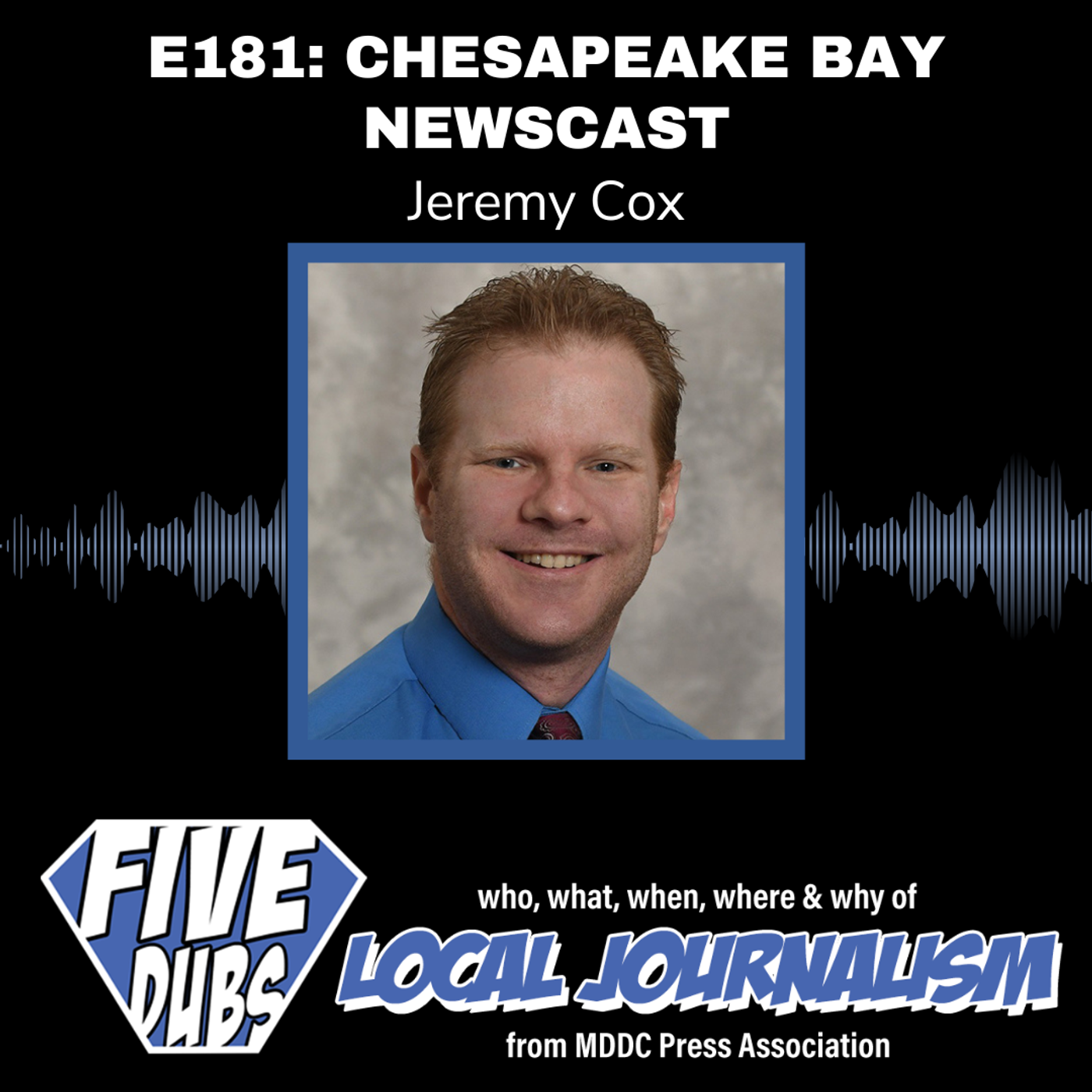
Five Dubs Podcast · MDDC Press Association
In this episode, Rebecca talks with Jeremy Cox, reporter for the Chesapeake Bay Journal, about the publication’s Bay Journal Newscast and its approach to reaching audiences through audio. Jeremy explains how the monthly podcast gives listeners a quick, conversational look at the most important environmental stories across the Chesapeake Bay watershed, while also standing on its own as a source of news. They also discuss the unique challenges of covering the Chesapeake Bay as an interconnected system rather than a traditional geographic beat, and how the Bay Journal uses its expertise to provide context and depth that can be difficult for general-interest newsrooms to offer. Jeremy shares how the publication is expanding its audio storytelling, adapting print reporting for different formats, and using podcasts and radio to bring its environmental journalism to new audiences.
Rebecca Snyder: Welcome. I am so excited to have Jeremy Cox, who is a reporter for the Chesapeake Bay Journal, in the studio today. Welcome, Jeremy. Jeremy Cox: Mm-hmm. Hey, good to be here. Good to see you. Rebecca Snyder: Yeah, no, it's great to see you. And it's also great to hear about the things that you're doing. And so you're a little bit on the other side of the the table this time because you're here to talk about your two podcasts that you that you run for the Chesapeake Bay Journal. one is Chesapeake Uncharted and then the other is the Bay Journal Newscast. So tell us a little bit, let's start with the newscast, because that's the one that just launched in June, correct? Jeremy Cox: Correct. So Yeah. Rebecca Snyder: All right. So tell us, tell us about it and why, why, why. Jeremy Cox: Yeah, so we started the newscast as kind of a way for people to get their their Bay environmental news in a different way. Not everybody is as we know, is is down necessarily with receiving you know, paper in their mailbox or even looking at pixels on a screen and and we thought, you know, this can be a way to To reach that audience and for those who maybe also get you know us in print or read us online to you know round out that coverage to give them something more than they otherwise would. And from a production perspective, we can get into it. the two podcasts that you mentioned are produced very differently, and this one is a lot less labor intensive, shall we say. So we can we can ensure that it it gets out in a more timely way to people. Rebecca Snyder: So when you there's two things that are just sparking for me right now. and the I want to understand sort of the the labor intensive aspect of it. and then I want to talk about covering the Chesapeake Bay as an infrastructure infrastructure system. because I think that's a really unique and interesting beat. But let's let's go down to the tactical stuff first and then we can get esoteric. Jeremy Cox: Right, right. from a production standpoint then the newscast is you use Riverside. That's a great we thought about using it and we may still use it one day, but we we happen to use Zoom. So if you've been on a Zoom call before, you can produce this podcast. And so we get three of us reporters or editors or whoever our title whatever our titles are, and we set some time aside. about takes about thirty minutes to have our conversation. We don't have a script per se. you know, we have our scripted opening and our scripted outro and sort of beat Rebecca Snyder: Mm-hmm. Jeremy Cox: you know, little beats that we hit. Okay, it's time for this segment and that segment. But so the r rest of it is pretty free flowing. And so that's obviously a lot easier than a scripted show where you have to sit down and spend hours Rebecca Snyder: Write the script. Jeremy Cox: Perhaps, yeah, writing out your your script. and I'm happy to talk about later w how we do that with Uncharted. But yeah, you sit down, you have your conversation, and then it's pretty much done. You know, from a production standpoint on the back side, it's just going through listening for the ums and the uhs and the parts where you had to start again and cleaning it up, adding your music and you're good to go pretty much. So very easy. you can usually I can usually edit it in, you know, twenty, thirty minutes. And that's me being slow with audition. I'm still transitioning from audacity to audition. So yeah, I'll Rebecca Snyder: All the A's very confusing sometimes. Jeremy Cox: have the word the the word audio in it. Rebecca Snyder: So when you are thinking about this conversation and you know I'm I'm a big fan of just the unscripted, authentic conversation because I think then you Jeremy Cox: Here we are. Rebecca Snyder: can get and here we are, like that's the way I like to do our podcast as well, because I think that it brings a really different aspect to the topic or or the person that you're hearing. And so you have So when you and and are you planning to do this on a weekly or monthly basis? I know it's still so new, you're probably figuring that out a little bit. but how do you decide? You know, you you guys are covering an awful lot. You've got a lot of different voices there. What bubbles up to kind of make it into that need to know dive? 'Cause in the big scheme of things, 30 minutes is not that long when people are nattering around. So how do you decide? Jeremy Cox: If if yeah, no, that thirty minutes definitely flies and we've we've tried to keep it around twenty five, twenty-six minutes. because Rebecca Snyder: Mm-hmm. Jeremy Cox: you're thinking, okay, how long is somebody's commute? That's kind of the thinking behind the length of time there. and it's a monthly since you asked. and I think that's kind of for us because we're on a monthly schedule with our publication, we come out ten times a year in print. So basically monthly. So that kind of made sense. from that standpoint. So each each one kind of looks ahead. We we generally come out around the I think it's the first of every month and it it's looking ahead to that next issue that's gonna land. From from Rebecca Snyder: Mm-hmm. Jeremy Cox: our standpoint, you know, we've just finished it, we've put it to bed, but you it's still in production from a you know from a paper standpoint. And so we we catch you but right before it's gonna hit the newsstands. And then Rebecca Snyder: Mm-hmm. Jeremy Cox: as far as, you know, what subjects we like to cover, hasn't been too hard lately because of, you know, events in our watershed like the big spill in the Potomac of the Potomac Interceptor. So that's been, you know, national news. Yeah. Rebecca Snyder: huge. Yeah. Jeremy Cox: but you know, it's a pretty quick conversation. We kind of put our heads together, you know, a week or so before we talk. What's the big story you're working on this month? and then we go, yep, that's number one. And what's and then we want if we have our Pennsylvania reporter, they're gonna talk about Pennsylvania. You know, if Lauren Lauren's always gonna be on, she's our co-host, Lauren Heinz Acosta. So she's gonna talk about Virginia. I'm gonna usually talk about Maryland. So then it's just making sure that we're kinda covering our geographies. You know, if you're in Virginia, Pennsylvania, Maryland, maybe even DC, we're gonna cover you know, at least three of those areas. Sometimes Delaware. Rebecca Snyder: Mm-hmm. Jeremy Cox: So yeah. Right. We got Rebecca Snyder: Delaware's a big part of the watershed too, for sure. And so Jeremy Cox: at D D C after all. Rebecca Snyder: Yeah, exactly. So Jeremy Cox: Yeah. Rebecca Snyder: I wanted I'm just curious because I for I think for some people who aren't really familiar with the Chesapeake Bay Journal, the way you're approaching this topic is really, in some ways, radically different than than sort of a traditional legacy publication that would have, you know, that is really kind of bordered around geography. So you'd be like a Maryland paper. I think it's really unusual because you have coverage throughout the entire watershed. And for some of our listeners, including me. It's been a while since I've taken environmental science. So refresh us. Like where does the watershed begin and and tell us about the magic of the Chesapeake Bay and how it relates to your coverage area. Jeremy Cox: Yeah. Magic. Right. Well, so geography still plays a role, right? And as you said, we are based around a watershed, which which is different from most publications, right? Where you say, okay, we're this state or this tri-county area or whatever. and so the watershed is sixty-four thousand square miles. And so the watershed is basically defined as, you know, wherever a raindrop hits in this area. You know, it could conceivably find its way to the Chesapeake Bay, you know, as opposed to the Mississippi River basin or the Ohio or Delaware Bay or something like that. So it generally follows from, you know, n top to bottom. Cooperstown, New York is the headwaters Rebecca Snyder: Mm-hmm. Jeremy Cox: and kind of a big, huge blob going down to the eastern side of West Virginia, down through Virginia and not quite the south side there, cutting over around the Appomattox River, over to the James River to the mouth right there at Virginia Beach, right there. Rebecca Snyder: Mm-hmm. Jeremy Cox: And then on the east side, pretty much all of Maryland except that very northeastern northeast part, and running down pretty much the center line more or less of the Del Marva Peninsula. And if you want to get nerdy for a minute, I mean that's the watershed, Rebecca Snyder: I do. Jeremy Cox: but there's also the air shed where air blows Rebecca Snyder: Mm-hmm. Jeremy Cox: and you know, the stuff that's in that air can make its way to the Chesapeake Bay. And that actually goes up into Canada a little bit, over to Michigan. but we we're not gonna do that anytime soon. we've we've covered it a little bit when it came to the lawsuits about you know, Maryland suing western state, you know, states to our west about Rebecca Snyder: Mm-hmm. Jeremy Cox: polluted power plants, but yeah, generally we we don't cover the airshed the way we cover the watershed. So sorry. Rebecca Snyder: But I'm glad there's another frontier out there. I mean, you could always, always do it. Well, and it just I Jeremy Cox: Yes, we we grow. we're coming to away. Rebecca Snyder: So actually, Jeremy, my first dumb question of of the day, like, does every raindrop in the world somehow go to some watershed? There's probably not a a raindrop that falls that doesn't like drift somewhere. So that's kind of a topographical, really interesting piece to think about where where things flow. So When you're covering, you know, you're cover Cooperstown probably doesn't necessarily see itself intrinsically as part of the Chesapeake Bay watershed. Jeremy Cox: Yeah. Right. Rebecca Snyder: you know, certainly in when you're close enough to the water to get to it easily, like of course you think, like I live in Baltimore and all of the the storm drains are like drains to the Chesapeake Bay. So it's really at the forefront. But when you're covering such a large geographic area. How do you kind of contend with the idea that people don't see themselves as part of that system that you're covering? Like does that matter? Jeremy Cox: Right, you know, I mean newspapers historically set themselves up in geographies because people in the Baltimore area thought of themselves as, you know, Baltimorean or Baltimore adjacent, even though they Rebecca Snyder: Mm-hmm. Jeremy Cox: lived in York, Pennsylvania or you know or Carroll County or something like that. so you you definitely put your finger on something there. How do you take this, you know, area with eighteen million people in it And say, okay, we're all revolving around this waterway that may not, you know, be something that you see on a day-to-day basis. You may not even see it for years. And so that's why we all we often use the term watershed. We're we're very careful to say the Chesame Bay watershed or the region or the Mid Atlantic, even, because there is some waterway in your backyard if you're you know getting our publication. there's some creek, a ditch, whatever that does, you know, interact with your life that you care about. that through you know, the the wonders and magic of hydrology has a connection, surface connection or you know, groundwater connection to water bodies that do feed into the Chesapeake Bay. So, you know, the Susquehanna River goes all the way up. There's two different prongs of it. And it does loop in, you know, southern New York there with Binghamton and with Cooperstown, as I said. And so yeah, they may not feel a connection in their day to day lives to the estuary itself, but we're Rebecca Snyder: Mm-hmm. Jeremy Cox: constantly that's why we report on not just the bay, but here we are reporting from you know the wilds of Pennsylvania or western Maryland. and this is I we are always we have kind of this trick well you gotta throw the bay in there somewhere, right? If or explain geographically, okay, you know, Antietam Creek, which flows into the Potomac River, which is one of the major tributaries of the bay. And sometimes you ha you have to go like five or six steps and you maybe don't list them all, but you you jump, okay, well, it flows into other waterways. But we're we're always trying to okay. Rebecca Snyder: Then he a Daisy cleanup. Jeremy Cox: Yeah, exactly. So you're kinda always reminding readers, Okay, look, this is why this area is connected, why you should care, you know, hundreds of miles away. Rebecca Snyder: Right. Well, and I wanted to go back to that idea of of how you you cover that. So I don't know if you've read the local news network report out of the University of Maryland, news people need. but I was happened to be at their their little launch summit maybe two weeks ago and and heard sort of the the w way to make news more relevant to audiences. And I think they've done some really interesting things with human-centered design surveying to understand how people interact with the news that's in their lives. And one of the big things was that people need to understand sort of the the infrastructure and hidden forces that are shaping their lives. So like the systems. So and I think traditional journalism is looking at, we're going to do state politics or we're going to do crime or we're going to do the environment. But not looking at the criminal justice system, or not looking at you know, the federal government or or the municipal government or religion as a beat, or and I think that you all are sort of just in the way that you've developed, are taking that kind of systems approach with the way that you approach the watershed. And so I know that. I wanted to understand a little bit more about how the Chesapeake Bay Journal kind of sees itself and what your mission is in terms of of your reporting and and how you manage to do all of those things. Because reporting on a system is really big. It's not easy and you're doing it with a a really small staff. So let's peer back behind the curtain. Jeremy Cox: No, I I love what that what you're saying with that report. I I can't wait to read it myself. and I'm a little bit in academia myself. I'm I'm an adjunct communications professor, so at Salisbury University here in Maryland. Rebecca Snyder: Mm-hmm. Jeremy Cox: So I get an it enables me to to think in some ways, you know, I'm that maybe a typical reporter doesn't, you know, because we often we're missing that link often between the scholarly world and the applied world of journalism. So I'm excited to hear that Rebecca Snyder: Gas. Jeremy Cox: they have something that really speaks directly to what we're doing. but as far as the Bay Journal goes, right, I think the I love and I hate this term we we often throw around, we call it slow journalism. So Rebecca Snyder: Mm. Jeremy Cox: we we're not gonna be able to cover. I mean and this breaks my heart as a, you know, a tried and true daily, you know born and bred reporter, you know, I want to be first. I want to break that news. And since we're a monthly, yeah, I mean we have a website and we we do break news from time to time, but it's not our bread and butter. And it can't be, right? We just don't have the staff for it. Still means my Rebecca Snyder: Mm-hmm. Jeremy Cox: heart does break when I'm like, you know, I wish I could have gotten to that. but you just have to tell yourself that's not that's not our you know MO. Our MO is I think you put your finger on it, telling the story of a system of you know clarifying and elucidating this mystery of how the environment works and how humans interact with that environment and that can take on you know many different you know, avenues from state government, you know, all those traditional beat reports, right? State government, federal government, even to traditional, you know, features cut type coverage down to like sport fishing and that sort of thing. What are they seeing and experiencing? And so you're almost writing business stories about the commercial, you know, seafood Rebecca Snyder: Mm-hmm. Jeremy Cox: industry and that sort of thing. And so all the things that your journalism professor taught you, like you know, write stories, don't write articles. That definitely, you know, is what we're trying to do. B you know, and that daily coverage is great. It's absolutely vital. I'm here for it. But you know, you often end up writing about the latest turn of the screw. So you have, you know, four to five, six, you know, fresh paragraphs and then all the stuff you wrote last week below that. And Rebecca Snyder: Mm-hmm. Jeremy Cox: I I find I don't get to r you know, rehash Hardly ever because I'm writing about something new and different or it's been so long since I covered it that, you know, I only have one paragraph that's basically restating and it's all new and it's new to me. And if it's new to me, it's new to the reader there. So I I think that's what's exciting about us is you know, you really are learning something new all the time. You know, might have sort of the basic outlines, but the You have a new lens on it with every story. Rebecca Snyder: Right. Well it is it's constantly shifting. And so the when you're and I think the way that you've approached your your podcasts, and let's just make sure everybody who's listening knows that they can go to bayjournal.com, and then you can look at podcasts and there's the newscast and then the the uncharted, Chespeak Uncharted. When you're though I I feel like these are both They're different kind of storytelling, you know, newscast is is that top line like here's what you need to know. Are you kind of trying to drive people to the print or to the to the website or or is it really are you trying to make it truly a standalone that if people just want to interact with the podcast, they have enough to to be actionable in their life? Jeremy Cox: Yep. Yes and yes. So we we go at it as if like this is the only thing that you may hear about this, you may never see us in print. So I absolutely we want it absolutely we want it to stand on its own. but we say, you know, in our podcast certainly, hey, you know, if you want to hear more or you wanna sorry, not here, but if you wanna learn more about this, more, you know, that we can get to in this five minutes, certainly bayjournal dot com or find, you know, sign up for a subscription so you get that print edition. So yeah, I'd say we're trying to do both there. if you just want to listen to the podcast, great. Or if you want to find out more, we want to make sure you have the you know, you're hearing, okay, this is what the next step is. Rebecca Snyder: Right. And then the Chesapeake Uncharted, that seems like it's and I've only listened to an episode or two there, but it feels like you're really kind of going deeper and and kind of filling out maybe like the story that mm you went with, maybe you're filling in the color around it and and really giving others an opportunity to kind of highlight what's important to them. Jeremy Cox: Yeah. Rebecca Snyder: Am I getting that right? Jeremy Cox: Yeah. So it's it's it's tougher to wrap your head around it because each season is a little different and Rebecca Snyder: Remember. Jeremy Cox: not just in how they're reported, but the summer there's one season that's all interviews, for example. So they're they're quite different. I think what's different about Uncharted though historically has been that has been very much audio first. You know, those stories came about Because the that season or that particular episode was reported really with audio in mind. Whereas Newscast is us sitting around talking about what we've been doing for the print product, for the web product. and so still storytelling, still the environment there, but that's kind of you know coming from this direction at it. And so Uncharted is It's still around. We haven't come out with a season. We do one generally one a year, but Rebecca Snyder: Mm-hmm. Jeremy Cox: it's evolving now just because of the you know, again, workflow issues. Like now we are on a separate track producing little radio feature stories that can be plugged right into NPR type news. Rebecca Snyder: I see. Mm-hmm. Jeremy Cox: Yeah. So we've just started that. We're about three or four in now. And so again, it parallels what we do on the the print side and the digital side, which is we make our content available. And if you're in the news business, in case you didn't know, we have the Bay Journal News Service, which is sort of like the associated press, but it's our content about the Bay. And anybody is welcome to run it as long as they, you know, just give us proper attribution, you know, byline, all that. and photographs as well, by the way. So same thing, same idea, but now with audio. And we're we've you know reached out to and you know forged relationships with NPR, local NPR stations and other you know local news that happen to go out across the radio. And so now we've we were collecting these little story packages and generally these are done in parallel in my reporting process, and Lauren is producing these as well. in tandem with a print article. So I go out and I've got my recorder and basically your reporter becomes your notebook. And what's great Rebecca Snyder: Mm-hmm. Jeremy Cox: with technology now is the AI can go and give you the transcript and yay, that saves you a step. Because Rebecca Snyder: yay transcripts. Love Jeremy Cox: for that, you know, boy, to have to go through I mean you've I'm sure have done it, you know, had to go through and listen to your your audio and all the time it takes. It just wouldn't be possible without it. So that's great. And then so then you produce your print story, you produce your radio story, you edit them all up. And so now what Uncharted is going to be is once we get sort of about twenty-five minutes, thirty minutes of content, we'll group those together and it'll be, you know, here's what we've been producing, and you know, kind of like this American life Rebecca Snyder: Mm-hmm. Jeremy Cox: where it's here's a different, you know, five minute story and they're all put together. all about Rebecca Snyder: Yeah, sort of like snapshots. Jeremy Cox: yeah, all about the bay. but we want to make sure that, you know, yes, people are hearing our this content, this radio content, you know, out in the world, maybe when they're driving in their particular location, but we wanted to make sure that people could find in one place if you know, you didn't have to live in Virginia beach and be listening to W H R O in order to hear this report. You know, now I know you can through the magic of the internet you can hunt for it if you wanted or See it in your your socials or whatever, but here's one place. And so Uncharted's gonna be that place for that. Rebecca Snyder: I like that. And I I mean it makes sense to kind of put it all in one aggregated place because it's all your content. so Jeremy Cox: Yeah. Yeah, it and real quick it it definitely it's not like brand new to Uncharted because the first couple seasons and really the most recent, the fourth season, were that kind of, you know, magazine style. Okay, you know, you're going on me g you know, at my elbow on a reporting trip. So it it's it will you know, you want to make sure you're not making a hard left or hard right here. So I think it still fits with the DNA of that particular b brand. Rebecca Snyder: Right. Well and yeah, I mean you're you're kind of cultivating just different these are snapshot stories as opposed to like when you did Agnes, like that was a season all about a specific incident and then you went in different directions. Jeremy Cox: Yep. Right. Right. Rebecca Snyder: I'm curious though, because you know, you've you've done print for a long time. how different it is like when you're switching gears to write for print and then repackage that story for audio and then talk about maybe that story in in the podcast. Are there what what different approaches do you take for different mediums? Jeremy Cox: Yeah. That's a constant conversation you need to have with yourself. you know, a lot of people from you know, I it it seems like it's very daunting, but then you hear, okay, a lot of people in radio came from print and okay, they've they've trailblazed that path. It it is possible. So if you're listening to this right now, here's yet more living proof. You can do it. you can edit, you can tell these stories, you can capture audio. It's not as Yeah. Legit the worst part, right? but Rebecca Snyder: You just have to get over hearing your voice which I think is the hardest thing. Yeah. Jeremy Cox: I think the if I just kind of boil it down to one nugget, it's that when you're telling a radio style piece versus a print piece, you know, the print, you have your little, let's say your feature, you've got your two, three, four graphs, and then your nut graph, and okay, you know, we n then you go from there. Whereas radio you have your anchor intro, and that's sort of the sort of usually your summary lead almost. You know, you're kind of giving up most of your your gold coins up front. Okay, this is what this is about. But then you're set you when you dive into the package itself then and it cuts to you in the field or whatever, or your you know, whatever it is, your nut graph then is at the end. And so, you know, you're going on this journey, you're following, you know, you're you're withholding a lot, and you know, it's not that second graph, okay, I I quit gotta, you know, put this in your face or else you're gonna leave. You know, there's a Rebecca Snyder: Mm-hmm. Jeremy Cox: little bit of an expectation there that the listener is going to you've got them, okay, they're gonna stick with you now. It's not as hard as reading, you're just listening. And so then it just becomes a matter of keep engaging them with interesting details and you know ear catching sounds and pulling them through until you do get this payoff at at toward the end that is your nut graph. this is why all this mattered and it's all tying together nicely. So I think that was kind of the hard the hardest part for me was just to relax and let the story tell itself, not impose you know, the print style onto something that r it doesn't work that way. Rebecca Snyder: Right. No, and that makes perfect sense because in the news in in a in a print newspaper you wanna like okay, you wanna tell what it's about and then if they wanna continue to move on and read through, they can get more detail. But you are kind of pulling people along and I think for For listeners when you're working in an auditory space, they're more willing to walk with you, especially Jeremy Cox: Mm-hmm. Rebecca Snyder: if you have sort of inventive or interesting audio. So, you know, you can you cannot kind of make a silk purse out of a sales ear when you're working in print with your with your with your interviews, but how do you how do you make or how do you encourage or or unlock people's quotes like when you're directly quoting them in audio. Like how d do you have any special tricks for, you know, how you make that that those interviews come alive? Jeremy Cox: Yeah. I think it's the same as much as I like to talk about how they're different animals, I think the same quotes that jump out to you in audio are the ones that will jump out to you in print as well, usually. and I know this because I'll write one script or the other first. I still have figured out like, is it smarter to do it this way or the other? I'm still experimenting, but it does seem to be like if I'm using a quote over here in the print side, pretty good chance, you know space notwithstanding that I'm gonna use it on the other side as well. And I I think the the only thing that's different is like if a if a quote sounds a little bad, it doesn't really matter, you know, in print. You can fix it, you know, cut out a certain part of it or whatever. But if it's, you know, you got some bad background noise or they stumble it up a little bit, then You know, it's harder to use in audio, obviously. You only get that one shot. And so if you hear that good quote, sometimes you ha and you know you you're listening in your ears and you go, gosh, this is just that just isn't gonna work there. You need to make sure in the moment, okay, let's go back and hit that again. Can you explain to me again, you know, what what this is Rebecca Snyder: Mm-hmm. Jeremy Cox: about so that you do get it in real time? 'Cause just like photography, once you go home, you're not getting any more material from the field. So you gotta make sure that you get it there. so that's probably the biggest difference as far as quotes go. Rebecca Snyder: Right. No, are you you're taking photos as well. Like you're you're the triple threat these days, right? Jeremy Cox: Yeah, sometimes we do video. W as part of all this, we're like, okay, you know, maybe video we can kinda tap the brakes on that a little bit. so there's a little bit of give, but you know, if it calls for it, we we certainly have that in our back pocket. For example, the the Potomac Interceptor sewage break, you know, I did a little one minute video for that. So a little bit more quick hits, taking advantage of those YouTube shorts and Hopefully the algorithms Rebecca Snyder: Mm-hmm. Jeremy Cox: and all that will appreciate that. But yeah, so when I'm out in the field, I try not to do too much, but you know, there's always gotta be a print story, right? That's the the bread and butter, of course. but then okay, does it make sense to do audio? You know, some stories lend themselves to it and and others don't. And Rebecca Snyder: Mm-hmm. Jeremy Cox: yeah, so if it if it does seem to lend itself, you know, I'm out in the field with somebody. there's a process that's going on that I can document, something surprising happening, and of course sound, you know, lively, engaging, interesting sound, then, you know, that that's when you can say, okay, I'm gonna reach across. And again, it's not the the hardest thing in the world. You know, your your Zoom report and this is Zoom the recorder version. It's weird that it's the same name as the app that we use, but the Zoom recorder, that's Rebecca Snyder: right, yes. I always forget about yep. Jeremy Cox: basically, you know, to eighty bucks or something like that, a hundred bucks, probably now with inflation, a hundred twenty. But anyway, one of those is great and you know, get the right kind of mic for it, or just use the mic that comes with it, and you're good to go. And it's really, you know, y if you think audio first when you're out doing the reporting again because you can't go back and, you know, recapture sound, that's probably the way to do it. And the print stuff will be in there. You know, I I think the main Rebecca Snyder: Mm-hmm. Jeremy Cox: difference is sometimes for print, you know, there's details, right? Audio, you kinda get this top twenty, thirty percent of the story and print dives into that last, you know, seventy to eighty percent. And so you gotta make sure to ask those print type questions to winnow out those details that you'll need. But other than that, the reporting is pretty much the same. Rebecca Snyder: Mm. That actually that's good to know because I feel that all those lines blurring and and different stories not maybe require, but are are better suited for different mediums. And so the more facile people can be in crossing those those divides, I think the stronger the storytelling can be. and you're in this really unique position because you're also an adjunct at Salisbury. So I'm you have like you get to be all these pearls of wisdom just flowing out of your mouth all the time. Jeremy Cox: Right. Yeah. Rebecca Snyder: So and and because you've seen this this business change a lot, what what would you tell younger Jeremy? Like what would you call what would you tell college age Jer Jeremy about this business? Jeremy Cox: Yeah, don't be afraid of technology and tech and the changes in technology. you know, I think going you know, growing up in this business when you know when I entered it, newspapers had websites, they would update them maybe at you know the stroke of midnight every day, you know, the old days of Rebecca Snyder: Mm-hmm. Jeremy Cox: drag and drop, if you will. and You know, I was always like, well, I kind of understand like theoretically that it's important to know things beyond just how to use your word processing program. But like I think for too long I was kind of afraid of adapting or you know, adopting a different storytelling method that involved a different technology. Just because, you Rebecca Snyder: Mm. Jeremy Cox: know, you look at the learning curve and it's like, my gosh. I mean, not only do I need to figure out all these, you know, bleeps and bloops and what this button does and how not to screw it up and not sound like a complete amateur, but also like, yes, it's a different storytelling. I've been doing it this way. Can an old dog learn new tricks and all this sort of thing? And it's like, just get over yourself and you know, try it, watch some YouTube videos. take some classes you know there was a a a great one that I took asymmetric a I guess asymmetrically is the word I it was on demand we'll say and really helped me asynchronous Rebecca Snyder: Asynchronous is I think what the kids said. Jeremy Cox: my goodness see that's why that's why we pay you the big bucks asynchronously I took it and it really helped me kind of jump the line you know I didn't you know so if you have the opportunity if if if it costs a few bucks, it'll be money well spent to take a class in okay, how do you, you know, use editing software or do digital storytelling or, you know, v tell a a radio story, that kind of thing. Because I think we all storytelling is storytelling and I tell that to my students because we do a a lot of different things in this intro to mass media class, mass media writing, you know, from writing tweets to writing, you know scripts for teleplays and everything in between. And I'm like, at the end of the day, people the human mind is wired, hardwired for good stories. the same way it's wired to caffeine or other types of drugs. We want that good hit of a good story. It's satisfying and it really it doesn't matter if you're telling it in print or over radio or some, you know, online storytelling application. At the end of the day, you're you're giving people you know, what they want and what they need honestly. They wanna learn about the world around them and they wanna learn about it in an engaging, exciting and, you know, poignant way. Rebecca Snyder: Yeah. No, and I I think you're totally right that, you know, content is is always king, especially, you know, we do a lot with local news in in the press association, of course, in this podcast. but local news is all about the stories that are there. It's just, you know, news equals stories. And the format kind of can fall away because you're gonna reach different people in different situations and different times. And if you don't have information kind of prepared in the format in which they're ready to meet you, then Jeremy Cox: Mm-hmm. Rebecca Snyder: you're missing, then you're both missing out. so I think that's that's sage advice for the young Jeremy. Are your students picking that up or are they still kind of really nervous about how they appear in the world? Or about like being perceived in the world? Jeremy Cox: Yeah, you think, Gen Z, they're digital natives, right? And it's it's funny, not all of them act that way when it comes to the the journalism, right? And I think it it comes because, well, you major in journalism because or communications because you know, engineering wasn't your thing or math wasn't your thing, and and so you Rebecca Snyder: Mm-hmm. Jeremy Cox: bring something in that's adjacent to engineering and math, okay, now you're gonna need to work this you know, expensive camera equipment or learn this fancy editing software and it's well now I'm not so sure about that. I was just doing this writing thing and now you're telling me to do this. and so that that's always the the the leap is, okay, it's gonna be fine. It's all storytelling. All we're doing here is we're putting it into a different box. That's it. So getting them over that hump is yeah, don't y you're definitely mistaken if you think, the kids will figure it out. Some will, but more more need a helping hand and encouragement than you would, you know, just assume. Rebecca Snyder: Yeah. And I would imagine your experience is really helpful there because you had to do some soul searching and and sort of like what what am I doing here? What do I want to do? Jeremy Cox: Eak. Yeah. Rebecca Snyder: So I wanted to to go back like what when you're sort of meeting readers or or listeners where they are, what do you want them to take away from Bay Journal stories? Jeremy Cox: Yeah, I think we we always have our our our mission at the forefront, right? We're, you know, independent, you know, nonprofit. We're very much about, you know, while we do get grant money and some of it comes from the federal government, of not reporting, you know, with any strings attached. So the big thing is let's give people 'cause there's a lot of noise out there coming from public relations. from, you know, the government itself and from, you know, news that's honestly I mean, I know people are working hard. I'm a daily I was a daily reporter and had to cover, you know, two to three stories a day. And, you know, you see stuff that just doesn't have the depth, s or or maybe is not exactly factually nailed down the right way. And so it's really a breath of fresh air and refreshing to see something that you know, if I can talk us up for a second, that has that Rebecca Snyder: Please do. Jeremy Cox: yeah. that their reporters are actually bringing their own expert expertise, right? Because the beats Rebecca Snyder: Mm-hmm. Jeremy Cox: the days of the beat reporting, as newsrooms have shrunk, beat reporting has unfortunately started falling by the wayside, right? Everyone's had to become a jack of all trades, master of none. And so here we are, this is all we do. And so, you know, this is you know Carl Blinkenship's five thousandth story about nutrients in this particular pe Chesapeake Bay watershed. Carl's our founder, going back thirty years ago, you know, an incredible wealth of knowledge. You know, people Rebecca Snyder: Mm-hmm. Yeah. Jeremy Cox: in the Bay program and scientists come to him with questions. You know, he is a a subject expert. and so You know, I'm not there yet. and that was another thing that I would tell younger Jeremy is, you know, put the anxiety away 'cause when we would have these staff meetings and I'm the new guy, like, how do they know everything and know everybody and how will I ever get there? And I've five, six years now, seven years now, and I'm like, Okay, I'm at least seeing a glimmer now, okay. It is possible to get there, but just be patient and keep doing you know your stories and it will get there. But yeah I think that's what makes us special and why this the slow news is you know it doesn't sound like it would be a great you know intuitively because right where it's a fast-paced world and how's this gonna work? You know how you gonna monetize that but I think our niche is filling in those gaps for you know for communities, right? gaps in Rebecca Snyder: Mm-hmm. Jeremy Cox: terms of like there's not as many reporters and not as many publications, so that's why we make our, you know, content available. But also gaps, even if you have reporters there, are they able to to tell the stories as deeply as we can, you know, with as the context, you know, the that encyclopedic knowledge. some can, but increasingly, you know, many are unable to given just the constraints of, you know, modern newsrooms, if you have a physical newsroom even. So I Rebecca Snyder: Right. Jeremy Cox: think that's our place is telling those environmental stories the way no one else can. Rebecca Snyder: No, I love that. And as we as we wind on, I want to hear your favorite story. You know, you've been at the Bay Journal now like six, seven years. you've been it's been a while. gosh, yes. So a little six seven on that. And what's your favorite Jeremy Cox: And have a six year old who does it who Rebecca Snyder: story? Jeremy Cox: Yeah. I'll go back, you know, recently just because it was you know, oddly, most of us reporters get seasick very easily. So I'm gonna throw Rebecca Snyder: Yeah. Jeremy Cox: Carl under the bus, Ad Cra the late the great Ad Crable shout out, he would get, you know, motion sickness. and and and I do as well. So like it's always an adventure when you're going out to someplace and the worst is just when you're bobbing along like a cork in the water. And that's precisely what you do if you're fishing for sharks, apparently. Rebecca Snyder: Good to know. Jeremy Cox: So yeah, la this was actually my first radio story and I went out there and like, okay, I'm gonna do this, I'm gonna wear the patch behind my ear and all that. And so I go out with these scientists from Vim's, Virginia Institute of Marine Science, and they're, you know, catching sharks to be able to tag them and learn about them, and right there at the mouth of the bay, pretty much. And I mean, it hits me within like 20 minutes. I mean, I'm in the cockpit of the boat with no air on my face, and I'm like, this is not great. And so basically we're out there for 12 hours, and the entire 12 hours is just one of the top five, you know, physically most, you know, miserable times of my life. And but I'm st I'm, you know, okay, we gotta do the journalism. So I would go in these like five minute spurts every half an hour. Okay, I'm gonna interview you. Okay, that's about all I can do. And this these poor, lovely people that I'm with, these researchers who do this every day are like, yeah, we feel ya, you know. it happens to the best of us and they're being very nice about it. And I'm just so but just being able to you know having done it, gotten back to land, kissed the ground, and gotten a a pretty solid piece out of it, you know, despite all I had to go through for it. I mean it was a beautiful day and it really waters couldn't been quieter, but what I did learn was and if this happens to you, it doesn't matter what how much dramamine you take. If you're already tired to start the day, I'd gotten up at two AM to drive down there. If you're already tired and fatigued, it's it ain't gonna help. Rebecca Snyder: I love that story of fortitude and stick to itiveness. I mean, not that you have a choice when you're out on the water for twelve hours Jeremy Cox: Yeah. Rebecca Snyder: and the scientists are not going to turn around for some baby journalist who can't stay Jeremy Cox: Yep. Rebecca Snyder: upright. They're just going to be like, puke over the side, it'll be fine. But I love that you were able to like take that and then apply it, still get the story, still Jeremy Cox: Right. Rebecca Snyder: get it done and and wake up the next day and do it again. That's a that's like the resilience of journalism right there. Jeremy Cox: Yeah, yeah, you know, I mean it's I'm sure there are bigger stories out there, but you know, we we we gotta keep proving us to ourselves every day why we get up and that's one of those story stories that does it for you, you know. That that's that's why we got into the business right there. Rebecca Snyder: Well, truer words never spoken. Jeremy, thank you so much for coming to talk to me. If anybody still needs the URL, it's bayjournal dot com and the podcast is newscast, which is under the podcast tab on the website. And I can't wait to hear more about what what you're doing. So thank you so much for coming to talk to me. Jeremy Cox: Yeah, you're welcome. This was great.