
Five Dubs Podcast · MDDC Press Association
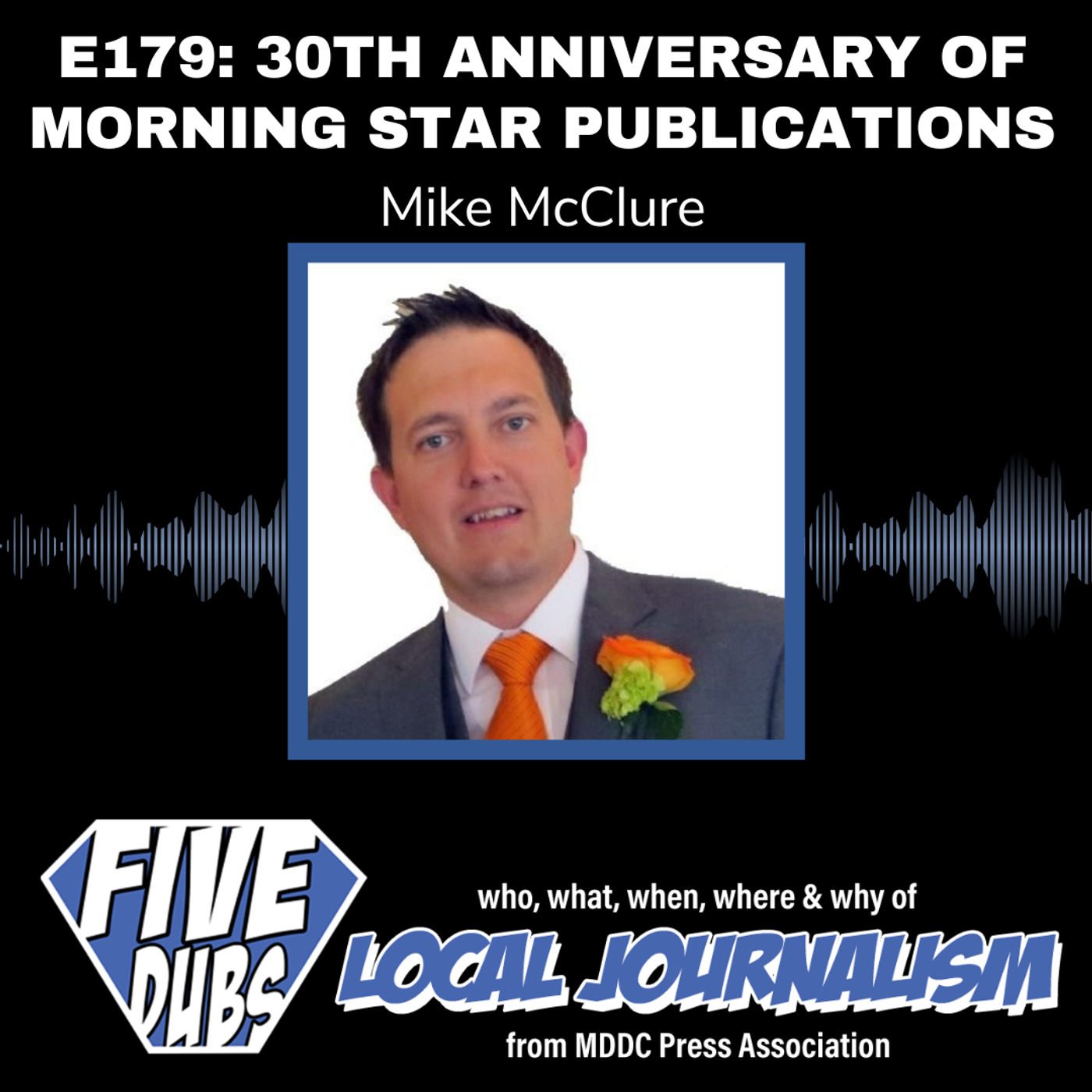
In this episode, Rebecca talks with Mike McClure, publisher and owner of Morningstar Publications, about the 30th anniversary of the Seaford Star and Laurel Star. Mike reflects on the publications’ three decades of hyper-local coverage in Western Sussex County and the importance of being present at the town meetings, school events, sports, festivals, and community gatherings that matter most to local readers. They discuss how Morningstar Publications has adapted to changes in technology, advertising, and the news industry while maintaining its focus on local reporting. Mike also shares his journey from radio and sports broadcasting to owning the newspapers, his decision to purchase the publications to ensure the community would continue to have a local newspaper, and the role of community members, freelance writers, and local businesses in keeping the papers connected to the communities they serve.
Rebecca Snyder: Hi everyone. I am delighted to have Mike McClure, who's the publisher and owner of Morningstar Publications, which is the Seaford Star and the Laurel Star here in the studio. Welcome, Mike. Thank you, Rebecca. I appreciate it. Well, and I appreciate you coming out because you're taking time out from the 30th anniversary celebrations that are going on for the Seaford and Laurel star. So congratulations on on a three decade run. Thank you. I've been with the with Morningstar for twenty-four of the thirty years. wow. And our founders Brian and Carol Richardson started it nine nineteen ninety-six. The Seaford Star started in April, Laurel Star started in August, and then we started a a business publication after that, business report. Mm-hmm. So tell us a little bit about the Seaford Star and the Laurel Star. You're in Delaware, not in the beach area. so tell us a little bit about how those publications kind of knit into the community. Well, we're basically between the two papers, we're the newspapers of record for Western Sussex County. So Seaford Star goes from right at the border between Kent and Sussex at Greenwood and goes down through. Bridgeville, Seaford, and Blades. And then the Laurel Star picks up in Laurel, Bethel, and Delmar. And then the two publications go we go a little bit into Maryland and we've started to go into east into Georgetown and and Millsborough a little because those areas don't have papers. Right, right. So tell me a little bit about kind of your approach because those are really hyper local. They're small towns that don't have sort of an individual paper and and so how do you how do you approach coverage what do you what do you do with the publications well we're I mean every it's it's all local. I mean our focus is local we'll I mean we'll occasionally have some state news that that obviously applies to this area as well. But I mean we're at the town council meetings, the school board meetings, the the high school sports and little league I mean we cover as much as we can with I mean, we're pretty much all freelance writers. I'm the only right now I'm the only full time writer in addition to everything else. And but yeah, we all the towns I mentioned, we we cover their town council meetings or school board meetings. I mean ever we we also rely on readers to provide us with some stuff. I mean we can't get everywhere. So we just ask to send us some pictures or a little write up and and you know we'll run in the paper for them. But I mean we we are 100% local. That's that's our main focus is just getting to those things that's that are important that that people can't always get to, but they want to know what's going on in their towns and in their area. Sure. Tell me a little bit about that interplay between your your audience or your community that's that's providing some of that content and and how you kind of approach that. Do you have people that I know you rely on on certain individuals in the community, but What what types of things are they how are you using those those community members? Well, a lot of the times, you know, there's a lot of organizations like VFWs and Chambers of Commerce and stuff and and you know, they want to be in their local papers. So they they'll provide, you know, press releases and pictures and they'll they always let us know when there's something going on. If we can get someone out there, we we definitely get out to as much as we can, but Yeah, we're we're really dependent on our readers to kind of keep us because we cover so many different areas, we rely on them to keep us up to date on what's going on because we don't always know. And sometimes we won't know here directly from the organization, but a reader will say, Hey, did you know that the VFW is having a car show or or whatever? So yeah, we are very reliant on our readers and and community members to to keep us in the know. Because there's only so much we can know about and and find out on our own. Although, you know, all of our writers and staff members live in the area. So we we we kinda we keep it's our area, so we keep keep in touch and we know what's going on too. Well, and I think that's I in being embedded in the community like that, that you're kind of the first call for community members who want to get the word out about an event or or want to make sure others in the in the community know. I think that's That's a real position of trust that you have. that you're you're one of the sort of first the first bulwarks that they go to. since you've been there for twenty-four years, that that is a lifetime. and and almost for the f the full run of the the publication, how have things changed? What was it like when you when you first started? And and you know, obviously in that span in those decades, a lot has changed within the industry, within technology, within how people approach their community. So talk to me a little bit about the progression of the publications. a lot has changed since I've been at the paper and and when I got started a couple years before at another paper. I mean, I used to take pictures, you know, with a film camera and have to go to one hour photo at Walmart and sit in the parking lot and wait for the pictures to be developed and then go and see if you know any of them actually came out. versus having a digital camera where you can take a picture, look at it, and see right away whether you have a picture or not. So there's that. There's the I didn't when I first got in the industry, I wasn't doing the layout of the pages as I am now. But I mean back then you did paste up and and I remember when I first started here at the star, we'd get the paper done Tuesday night, print it all out and have to drive it up to Dover to the printing press to to get it printed. Versus now we We do it all digitally and and just send it, you know, email it or send it up to the printer and and don't have to deal with drive them up there. So there's a lot of things that most things technology's been better. There's been a few things. I mean, we're competing with social media now. I mean, didn't back back then you didn't have social media, but we know that our mo we know that our stuff is factual. We can't always say the same about social media. Mm. So it sounds like your sort of the focus and the content has stayed really very similar and has been very consistent over that time. And really it's sort of the outside the wrapper basically. The technology and some of the processes have have changed. But at at heart, you're still providing hyperlocal content to small communities. Am I getting that right? It's yeah, it's it's the same. I mean, it's the same basic product. I mean We've had to deal with like a a lot of newspapers have had to deal with, you know, circulation shrinking a little bit and advertising coming down a little bit. But we've we've held our own because we offer something that, you know, other media in the area don't offer we're we are actually at the ball games and at the town council meetings. So, you know, they hear it firsthand from someone who is actually there and sitting in the seat kind of representing all the readers that can make it to the meeting. Well, and I know one of your particular passions really is high school sports and local sports. and you're you're like this triple threat because you're the photographer, you're the writer, you're the layout person as well. and so what's your approach and and why why are local sports and and high school sports so important to you? Well, I mean, s I I've grown up in sports. I mean, it's been I've had the pleasure of being able to work in sports my whole career, one way or the other in in radio or or newspaper or whatever. So I mean that's I grew up in a kind of a sports town in Pennsylvania. My dad was highly into sports. He had a sports center that sold sports equipment. So I mean, that's been my life. But being able to do high school sports, I mean This area of Western Sussex is nuts about their their high school sports. I mean, they're very supportive of the local athletes and the and the local teams. I mean, it it's said about my hometown with Del Mar that they roll up the sidewalks when Del Mar football is playing at night on Friday nights because the community just this community just loves their sports. So I mean it we I love doing it, but it we're also serve serving people that that want it. They want to read about their kids. They want to read about their neighbors' kids, their grandkids. So we're able to do it because there's a demand for it in this area. And it it seems like there's less and less sports coverage elsewhere. So you know we we kind of serve a demand that's definitely in this area, there's a big demand for it. So we do we do like during high school season we'll do seven or eight pages of sports. and we'll have three pages that are different. Between Laurel and Seifers. So that's actually like 10 or 11 pages of sports a week. And then we we do each fall, winter, and spring, each season we do a sports high school sports book. And there's we get tons of advertising and people pick it up everywhere. You know, it's it's inserted in the paper, but they also we also put it out in the schools and the in the communities. So people love their sports. We also do when a team wins a state championship, we'll do a special section for them. And we've had over the years, we've had pretty much every high school that we cover has won something. Mm-hmm. that's exciting. And so now I actually I want to go back to when when Brian and Carol first started the publication. What need were they trying to fill? Because I don't, and check me on this, I don't think that there's competitor publications. Like you, there's there's no one else who's covering what you're covering. Was that always the case? Or no, at the time there was. Bru Brian actually came from what was the Seaford? leader and state register. when they changed hands, he actually brought at least half the staff with him and and they started the the Seaford well, Seaford Star in April and Laurel Star in in August. But I mean they I think they just felt like they could do a better job than the company coming in of of of covering the community. And eventually that that paper left and you know went away and and yeah, ever since then we've been the only pub papers in the area. Mm-hmm. And so when you came on twenty four years ago, what drew you to the publication? And you were in radio previously, correct? Mike remembering that? Yeah. I I went to school at Salisbury University and stayed in the area. My my parents always had a a summer place down here in in Delaware. So we were familiar with the school in the area. So after I graduated, I worked my senior year at at Salisbury, I worked at Like two different radio stations and the school radio station. Got a job at those stations and worked midnight shift doing DJing and then during the day weekends I could do got to do sports. Did you get to pick your own music and your own your own your own programming? Not really. Okay. I wasn't sure. It was it was slow music middle of the night. So I had to struggle just to stay awake. I always feel like the the overnight DJ is the toughest shift ever. So so I I did radio. I actually worked for a minor league baseball team in Lynchburg for a year. And when I came back to the area, I I I was doing some part-time radio, but I couldn't find a full-time job and and I didn't want to leave the area again. I needed to stay in the area. So I took a part-time position at what used to be the Sussex County, which was the Georgetown Millsboro paper. Mm-hmm. And I I did that for about a year, and then it led to A full time position and I've been been doing it ever since. Mm-hmm. Well and and so you've been a faithful staffer at at Morningstar for a number of years, but then a couple years ago, maybe four years ago, you purchased the publication. Is it did I get the the timing right? how long have you owned have you owned it? This is my fifth year. Your fifth year, okay. several years before that, The owner Bryant Richardson got elected as state senator. Right. When he became state senator, I took over the day-to-day operations at as publisher. his wife Carol, who also was co-founder, she stayed in the office and and did the bookkeeping and that kind of stuff and kind of co managed it with me. And when sh when she was ready to retire, then then we, you know, had a discussion and I ended up buying a buying the paper from him. So now what made you decide to to purchase the paper? Because some would say, gosh, that's you know, that's that's a struggle. This is not the easiest way to make a living for sure. so what kind of drew you what what kept you there all those years and then prompted you to purchase? Well, I mean, what prompt prompted me to purchase was I wanted to keep my job for one thing. I wanted to keep doing what I was doing it and I wanted to make sure that this area still had a a local newspaper because there's no guarantee when you know you sell to a larger organization, there's no guarantee that that publication is gonna stay, or if it's gonna if it stays, it's gonna stay the same as as what it was. It could be a shell of what it used to be, which you know, I wanted to make sure that. That our community still had a local newspaper because I feel like I feel like communities need to have their own publication. Yeah, absolutely. And so that kind of deep commitment to the community. I know that shows up in in your sports coverage, but what other ways do you feel like you're really committed to the community? We we give back in in a lot of ways. I mean, we have a toys for top box in our office. every year we usually in the past we've done fundraisers for local little leagues. I one year I did a series of stories on organizations that give back to the community. And then we and then we did a fundraiser and and donated supplies to each of the the organizations that we featured. that's so cool. And I know it just seems like and I I interact with your content a lot during the MDDC contest season. And I think you're a you're a multi-year winner of News Organization of the Year in your in your category, in your division. So congratulations on that. but it feels like you do a lot of promotional campaigns and and sort of really your VFW work, your you know, the Fourth of July things that you do, really kind of flavor your coverage and and reflect what is important to sort of the the kitchen table idea of of community that it's not you're reporting on things that people are doing and and events that really matter to to people in your community. At least that's what it looks like from the outside. Is that kind of by design or or how do you how do you decide what to cover? Well, a lot of the special publications are just a continuation of what Brian and Carol did. You know, I mean, we added some things over the years and took away some things that weren't working, but I mean a lot of what we're we're doing is what Brian and Carol started with. So I mean, we've always done a a Memorial Day section. We've always done a Veterans Day section to honor, you know, the military. I started breast cancer awareness. Section which has grown over the years. There used to be a we do different programs for events. There used to be what was called Live for Chocolate, which was a fundraiser for the local hospital, which they're not doing anymore, but we used to be heavily involved in that and used to give back to that. we do All the a lot of the the festivals in the area will do some type of a section or a book or a page you know promoting those things. We most recently started the Winds and Wheels Festival, which is a event over at the airport in Georgetown through the Georgetown Chamber of Commerce. And we started we picked up their official program book last year and we're gonna be continuing that this year. that's exciting. So now what kind of you have the business report and so tell me a little bit about the business climate in in your areas and sort of what's what's trending and and what's important in terms of of because you know, to be able to support the business report, there have to be a fair number of industries and and businesses. So how is that going? Well, the business report started out as a newsprint publication, but many years ago it became a glossy magazine and it it used to cover just Kent and Sussex in Delaware and we kind of merged it with our Salisbury publication we had. So now it covers Waikami Cook Maryland as well. Okay. So each each it comes out every month and each month we have a theme we'll do like a health and wellness or senior living or something like that. Different we have agriculture or education. So we have different themes that businesses and organizations can They get a story about themselves to go along with their advertisement. And then and then every month we also have we sell a cover package where they get a business will get the picture on the cover and then center spread story and pictures and then a an ad that they can use later on in the publication. So so we you know we rely very heavily on on local businesses in those three counties to to support the cover and the the themes and then and then we have just the normal like business news and and we run health news and education every month. We we have columns from a marketing person as well as a finance person each month. So we we try to hit as hit all the bases with our cover coverage in the business report. Mm-hmm. No, that makes perfect sense. And so we know it's your 30th anniversary this year. So what are you doing to celebrate 30 years? Well About a month or so ago we did a after hours with one of our local chambers, the Western Sussex Chamber of Commerce. So that we got a pretty good turnout from that. We held it at our office. later this month we're gonna be doing a special publication, you know, for our thirtieth anniversary. So we're getting I'm getting all my writers and some former writers and and contributors to to write something up, you know, a column or or story or something. And then we'll asking some of the local businesses and and organizations to support that so we can have a nice publication for our to celebrate the thirtieth. So in thinking that sounds like a wonderful series of celebrations. I'm wondering in your you know in your history with the the publication, what was the favorite thing that you covered? Did you does anything jump out at you that you were like, wow, I'm so grateful I got to to be a part of that or that was so fun. We've covered so many things. I mean, with my sports background, I've I've had the opportunity to cover several state championships in in multiple sports. So I mean it it's always fun to see the loc local athletes compete for a state championship and win one and and we've had some very successful state championships. I mean, I just enjoy like I I enjoy going out to the local festivals. We've had a couple that ran for a long time and recently stopped. We used to have a Fourth of July festival in Laurel. We used to have Riverfest in Seaford, but we still have Apple Scrapple and Bridge Apple Scrapple Festival in Bridgeville. We have a Afram festival in in Seaford, the Winds and Wheels in Georgetown. So there's we have a strawberry festival in in Laurel and Delmar has Day in the Park and Heritage Day. So I like going out that's that's where I get to Between the festivals and the ball games is where I get to see people, you know, see people in the community and talk to them and get their feedback. Because unless something really bad happens, I'll I'll get a phone call or email. But otherwise it's it's at those events that I get the the immediate feedback from people. So I want to go back. Actually, there's two things that that strike me in in what you said. Number one, I need to know more about the Apple Scrapple Festival, because that seems just an interesting mix of ingredients in the world. So what's what's with that? Well, Birgeville has a a scrapple plant called Rapa. And then they also have Adams that does does fruit and apples. So That's kind of their two pro products that they're known for. So they do a and they even do a I think they still they used to do a scrapple toss where they'd put scrapple in a bag and see how far you can throw it. That does sound like a fun event for sure. And then just in hearing what you do, how do you fit it all in? Because you're out in the community almost, you know, between the number of sports that you cover. and the festivals that you go to and they're both weekly publications. How how do you manage to fit, you know, 10 pounds of potatoes in a five pound sack? That's a lot going on. Well, I mean, I rely I rely greatly on my freelance writers. I mean, we've got about eight or nine right now, I think, that, you know, that they'll cover I I I don't do it all myself. I've I've got some I've got two other writers that cover sports for me. I've got people that have their certain beats or certain towns that they cover. So I don't really I don't cover a lot of news. I'll occasionally I'll cover a a school board meeting that I just have to listen to recording on online to cover it. but yeah, I mean we're we get out to a lot of we do get out to a lot of things, but it it's certainly not just me. It it's because of of the writers that we have and we also have contributors that that write columns. We have a doctor that writes a Health column, we have gardener that does occasional gardening column. We have a pastor that writes a monthly church column, we have a lawyer that does a lawyer column once a law column once a month. So we have a lot of people for the editorial side of things, and then I've got the best staff in the world as far as organizing everything else, as far as laying doing the ads and you know, proofreading and and billing and all that kind of stuff. We we have a pretty small staff. I think there's about eight, eight or nine of us in the office, but we get a lot we get a lot done with the small staff. Well, I feel like you have a really consistent staff. Have many of them been with you for for the duration? Maybe not all 24 years of your tenure, but have they been around for a while? We just had the last one that was there since the beginning retired a year or so ago. But most of the other ones are Have been with us at least five or ten years. Wow. I've been there the longest. I have one staff member, Carolyn O'Neill, who was my first editor at the when I was at the Sussex County. And now she really retired from her other position and and came in and she's working part-time and she's actually one of my proofreaders. that's great. And then how do you find your contributors? How do you do you sort of I not there's not often the pastoral column and you know the gardening column. Do you seek those those individuals out or are they coming to you to kind of pitch what they want to cover? They usually find us. Yeah. I don't know that I don't know that any of the of the ones that we have, the columns or or the writers were ones that I specifically sought out. I mean a couple of times we've put in ads for freelance writers. Mm-hmm. Because you can never have too many freelance writers, but a lot of the columnists just either when I was there when Bryant was there, you know, came to us and said, Hey, I want to write this. And we said, okay. Yeah. that's so cool. So now what are you doing to kind of set yourself up for the next 30 years? There's, you know, again, a lot of change in the industry, a lot of change, I would imagine, are your communities changing a little bit? Are you starting to see more activity or they what's what does the outlook look like for your geographic areas well there there is some growth seaford's seeing a lot of growth especially with new businesses coming in laurel's so slowly growing they have some new businesses and and some growth Delmar is seeing some more housing Bridgeville has has grown with they have the heritage shores Golf club that came in years ago with metal involved. So we yeah, we've seen a lot of growth in the area. I mean, obviously we have to we have to evolve and and appeal to younger people. I I feel like younger people do see our publications because we have a newspapers and education program where we put the papers in the schools. So Mm-hmm. If the kids' pictures are in the paper, they're finding out about it because that is true. Yes. When I talk to them, they they certainly know who I am and know who the what know about the papers. So we are reaching them that way, but I mean we do need to reach them digitally. We have an e publication, we've got about maybe fifty subscribers. Most people, most of our readers that we have right now want a print publication. They want it in their hands. And and I'm the same way. I I've got I subscribe to a lot of different papers in the area and most of them are print publications. Right. Yeah. No, there's the serendipity aspect of print, and you're sort of I it's nice to be able to have that tangible piece. So then what's next for the Seaford and Laurel Star publications? You're the you're celebrating this monumental anniversary because thirty years is is really impressive. so what would you like to see come out of the next thirty years? Well, I mean, like I said, we we definitely need to we're updating our website. We have the e publication. I would say if we do any other future publications, it probably would be probably e publication first and then if we need to do some print, we could do some print. But I mean we definitely have to roll with the times in the next in the next thirty years. I had mentioned that we we do a little bit of coverage into Millsboro and and Georgetown because I mean, like I said, I started out at the publication that covered them and they and that publication was around for a hundred years, but it's it's no longer around. So those those areas really don't have coverage. So we do a section once a month, the the first week of each month on Millsboro and Georgetown, and then we put we take out extra copies to the libraries and town halls and stuff and and We've gotten some good feedback. So between doing that and also doing the Wings and Wheels book that we partner with the Georgetown Chamber on, we'll probably, I mean, if we can, we'll we'll probably do more in those areas. Maybe maybe someday do a a weekly paper in those areas if we if we have the support from the area. Sure. And so it sounds like content is still obviously critical and and the changes that you're seeing are really How you can deepen relationships in new communities and then maybe keep up technologically to to meet changing needs in terms of how people want to receive the content. Is that am I getting that right? I yeah, I don't I mean, there's a lot of talk about digital and social media and that, but I don't see that the need has has changed any. It's just how you get the the information to them. People still want to know what's going on in their community, and there still is not really. very good alternatives to to publications like ours and really a lot of the independent newspapers like Cape Gazette and Coastal Point, which are we're kind of partners with them because we're all independently owned. So we we kind of stick up for each other and help each other out. So yeah, yeah, w eventually it may go to just digital someday, but what what's goes into the publications I I don't think is going to change because people still want to know. what's going on in their communities and and we serve that we serve that purpose. Yeah, no, I I totally agree because no one else is going to provide that hyperlocal content all in one place. You know, I think when when you think about where people would need to pull, you know, if they want to know what's happening in various town councils, that's a lot of little tiny websites that they that they have to go to to pool it all together. And The original reporting you do, I think really just knits your community together. So congratulations on 30 amazing years. Can't wait to see what you do in the future. So thank you for coming to talk to me. Thank you, Rebecca. I appreciate it. Appreciate it.