
Five Dubs Podcast · MDDC Press Association
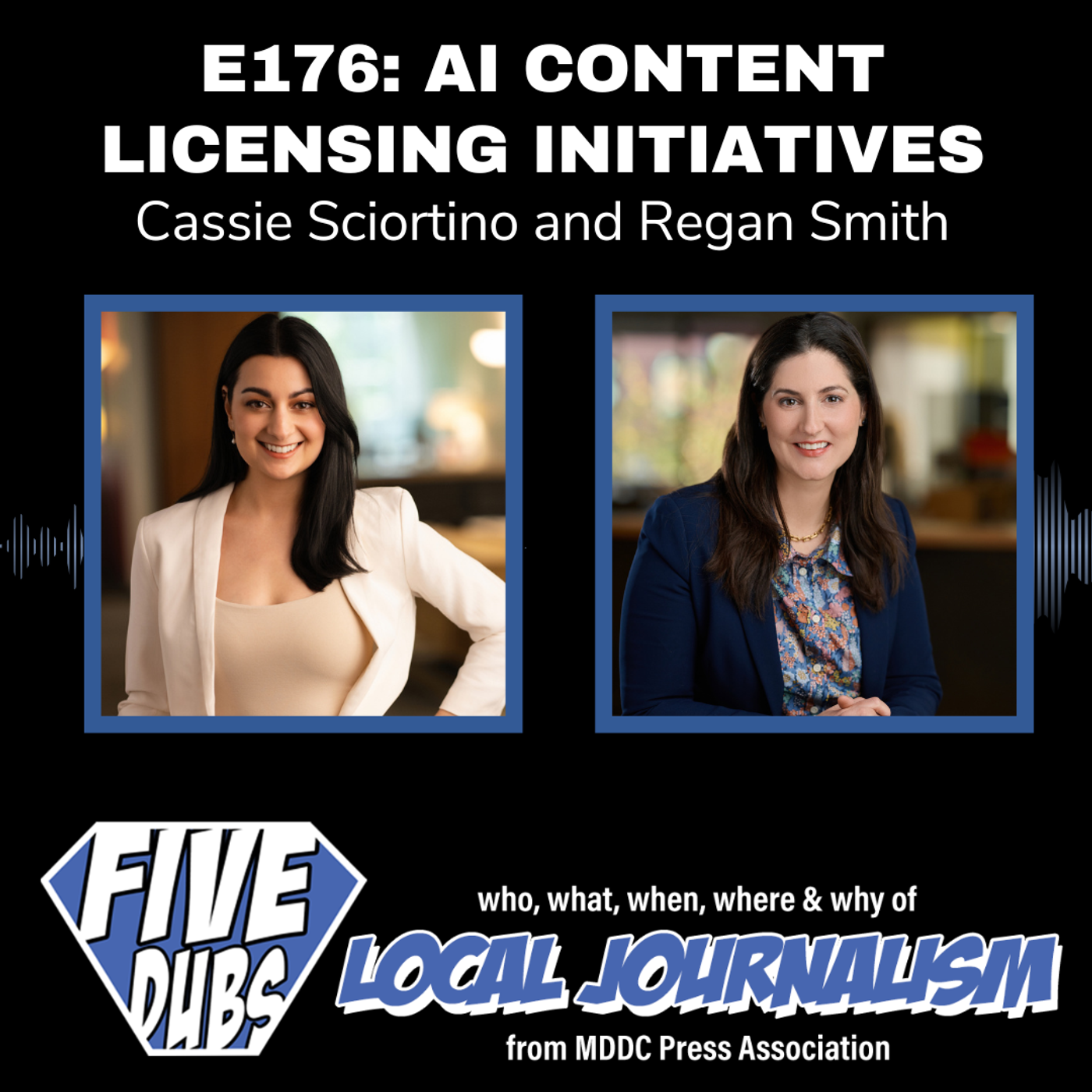
In this episode, Rebecca talks with Cassie Sciortino, director of legal, and Regan Smith, senior vice president and general counsel at the News Media Alliance, about how AI is reshaping the news industry and the organization's efforts to help publishers protect and monetize their content. They discuss the legal and policy challenges surrounding AI training, copyright, and transparency, while explaining why licensing agreements are emerging as a practical way for publishers to work with responsible AI companies rather than against them. The conversation explores News Media Alliance's new opt-in AI licensing initiatives, including partnerships with ProRata AI and Bria AI, and how these agreements create new revenue opportunities while preserving publishers' control over their intellectual property. Cassie and Regan also share practical advice for publishers navigating the rapidly evolving AI landscape—from managing copyrights and content rights to evaluating AI vendors and preparing for future licensing opportunities—while emphasizing that sustainable partnerships, transparency, and strong legal protections will be key to the future of journalism in the AI era.
Rebecca Snyder: Welcome. I am delighted to be in the studio today with Cassie Schiartino and Regan Smith of News Media Alliance. So welcome to the program, friends. Cassie Sciortino: Thank Regan Anne Smith: Thank you. Rebecca Snyder: Cassie is the director of legal for News Media Alliance and Regan is the senior vice president in general counsel. So I wanted to, I'm really excited that you're here today because we wanted to talk about how AI is reshaping the news media industry and what News Media Alliance is doing to help publishers contend with some of those at times what feels an overwhelming tide that's ripping away content. out of publishers control and sort of using it to train large language models that are not benefiting news media. So a fun chunky issue to jump into. But let's take a step back and first talk about a little bit about News Media Alliance and what that organization does and how it relates to different publishers. And Regan, you want to jump in on that? Regan Anne Smith: Yeah. So News Media Alliance or NMA, we represent newspapers, magazines and digital publishers in the US market internationally. We have over 2000 members sort of ranging from 90 % of the newspaper market, from large companies to small local journalism, community journalism or digital only properties. Rebecca Snyder: Thank Regan Anne Smith: And we really represent them on the full range of issues, including privacy, First Amendment, competition issues, subscription, digital operation issues, and as you mentioned, AI, which is really a top of mind issues, I think, for publishers everywhere. Rebecca Snyder: Absolutely. And, you know, from the Press Association standpoint, I work on local and state issues, and it's been a blessing to have News Media Alliance really taking on those large-scale issues. Like, in all honesty, there's not much that Maryland, Delaware, or the district are going to do to, like, shape and change how the world is interacting with AI. And so having an organization that kind of speaks Cassie Sciortino: you Rebecca Snyder: nationally and work on the federal level has been especially beneficial. So thank you for being the friends that you are, for sure. Regan Anne Smith: Thank you for that. And we will also take those props back to our advocacy team. So we're on the legal team too, so we might represent in court or educational regulatory issues. And then a lot of NMA is really focused on engaging with governments. Rebecca Snyder: Yeah, absolutely. So let's I know you all have worked deeply in the AI, in the AI space, filing some being party to different lawsuits and and working through sort of the AI issues. Could you kind of just briefly lay out what what NMA has been doing in that space? And then we'll get right into the licensing program and why that was important. Regan Anne Smith: Yeah, and maybe I'll just provide an overview there to AI is just a transformative and disruptive moment for everybody publishing certainly, not least when we're having this conversation. I know even before I was at NMA, there was an articulation of AI principles, which I think then became adopted globally to start to think around what sustainable use of publisher content would look like. We wrote a white paper in 2023 that did a forensic investigation into the most popular AI training data sets and chat CPT and Google's Gemini that found that news publisher content was up to 100 times overweighted in the training set. So you take a big training set and they clean it out and they just keep the quality content. And surprise, surprise, that ends up being news content because it's well written, it's fact checked. It's informative and it speaks in a way that people like to speak. And so it has a lot of value into producing the underlying models, let alone we started, think it's, know, the landscape keeps moving very rapidly, but we still have some of the older problems with us. That way paper looked at memorization, retention in the model, because if you've memorized something, it's hard to say that the AI is just learning like a human being. And we also articulated some of the copyright interests in that. So we've engaged regulatorily with the Copyright Office, with other agencies and places in Washington, D.C. to sort of explain how things are working and to advocate for publisher rights. Our advocacy team, government affairs team, as I mentioned, educates both at state and federal level and legislatures pushing for AI bot transparency. And we've led a lot of educational engagements, which I think Cassie will talk about a little bit later today. And finally, we helped organize the first ever joint litigation by news publishers, at least that we're aware of, which is a litigation called Advanced Local versus Coherent. It's currently pending in the Southern District of New York. And we fully defeated a motion to dismiss a few months ago. And it is looking at the sort of taking and just like verbatim output, a ton of examples of just reprinting news content without any permission, in some cases hallucinating and hurting the brand. And of course, we are active in the courts and amicus briefs or in other ways to support our other publisher members who are engaging in their own mitigations. Rebecca Snyder: And so, you know, thinking about what News Media Alliance is doing in this space, you know, you're protecting really the intellectual property rights. You're protecting the copyright. You're looking at transparency. And you're mitigating or you're working through the wholesale theft of content really as it's absorbed into those language models. And so for those who are not particularly facile with the courts, except to know that they always, the wheels of justice are slow, like super slow in many cases. And so that motion to dismiss just means, denying the motion to dismiss is just basically saying there's something here, it's not a victory yet, but there's something to really delve into. And so in my perception, in the midst of all these other actions that you're taking to support publishers, Regan Anne Smith: you Rebecca Snyder: in keeping ownership and control over their content. One of the ways that I think has been really innovative that you've looked at doing that is doing an AI licensing program. And so that's not a, you know, take it all. It's in the absence of regulatory action, because that has not really happened yet. In the absence of legal determination, which is all still pending, it feels like somebody has to step into the breach and figure out, okay, what can we do? And so that's sort of where I'm thinking your licensing, your AI licensing germ of an idea came from, but tell us how this program started and what it's doing in that context. Regan Anne Smith: Yeah, and I think you put your finger on really sort of the heart of what we're trying to do because we're not anti-AI at all, right? I mean, this is a transformative, disruptive technology and we want to make it work sustainable for news publishers. I think one of the reasons why the court cases, you know, there's over a hundred different court cases, they're testing different use cases, different fact patterns. And so it's not going to be like an on-off switch. one and done resolution in the courts because different companies are operating in different ways. And we want to encourage AI developers taking contents to have a permissive partnership based way to work with publishers, right? So say, you know, a consumer might be afraid that a chat bot is going to hallucinate or not give you something reliable, or they want to be able to check the primary source. That partnership can help a developer build that. more easily and engage more constructively and build that trust that I think a lot of journalism providers offer trust through their mastheads because they stand for quality and they stand for editorial processes on this. you know, while we don't want to support those who have sort of seen this as like a rush and, you know, move fast and break things moment without regard to the laws, we have a lot of existing laws. And we think that the marketplace is going to provide many of the solutions that get us to sustainable and good. So since we know press content is so valuable, know archives, frontline content. today's AI model has not been trained on tomorrow's news or even yesterday's news. There's a whole opportunity to start to work together. as search engines turn into answer engines, you know, that changes some of the calculus under intellectual property rights, whether you're driving the reader to the original source and providing sort of a lookup tool, or whether you're doing something that feels more like syndication or summaries or abridgement, we have a whole, you know, existing, you know, toolbox for that. And we think our licensing program fits right into that toolbox. So, Rebecca Snyder: Mm-hmm. Regan Anne Smith: I think it's not really a surprise that press publishers were some of the first to embrace AI licensing. The Associated Press announced their deal with OpenAI in, I think, July 2023, really one of the first deals in the AI world. That is kind of a long time ago, right? We're already in 2026. Since then, there's been over 100 deals that have been publicly reported, and surely more that were not publicly reported. And when we looked at this, knowing that plurality and diversity of news and magazine and digital publishers and the public benefit that we get as readers and having a lot of different choices, we wanted to sustain and support that diversity. It became obvious this would become very important to scale. Now we see even up to the president himself speaking about that. And we wanted to show that the scaling is possible. for licensees and lancers. So, you know, coming from a licensing background, is advantageous to reduce transaction costs. It's sort of pro-competitive to connect buyers and sellers together and do it in an efficient way. And sort of looking through, also wanted to minimize some of the friction and administration. Rebecca Snyder: Mm-hmm. Regan Anne Smith: administrative costs that can come sometimes if you don't set up your licensing system effectively. So we did a lot of discussion and analysis and looked at options that were working and other like mass digital licensing and set up our AI licensing program. Rebecca Snyder: Well, and to me, it makes so much sense because, you know, rather than have every publisher sort of stand on their own and try and work a licensing agreement there, if you have kind of a master agreement that, you know, News Media Alliance, who's really deep on these issues is saying, yep, this is a license that's appropriate. You can use this. sort of like the Creative Commons license for, for for AI licensing in some ways. It's a master agreement that people understand and you can always adjust, but this gives people a pretty complete starting point that they could just take as is. And so is that how, when you created that licensing program, how did that impact the licensing market? Because you had said earlier that there are hundreds of You know, publishers doing this, there's lots and lots of AI companies that are trying to capture this. How is that received? You know, was that a breath of fresh air for everyone or did you have some challenges in getting it to be adopted? Regan Anne Smith: I think it was received pretty well. So we are offering a voluntary opt-in license for people to participate in. Everything is non-exclusive. People are still free to make their own deals. And I would say one thing that is different, and Kessie can sort of dive into some of the specifics on what we have done, is we're not necessarily saying like this is the AI license because it depends, right? What does the person want to do with that? If they want to use news content to create a summary. and they want to link out and it's going to drive traffic, that might be a little different than if you're doing something that feels a little more cannibalistic. You know, might want to pay more for that. And so we kind of looked at benchmarks and have been tailoring agreements to the specific actor. Now, in time, know, standards may start to develop, but I think that is a good way to approach this sort of emerging time. And so it's really providing a way to to reach a lot of publishers at once while preserving, you some people may have different types of content, they might want to do, you know, a different type of deal. But we looked at, for example, how independent music or independent music publishing is licensed in the streaming age. And we sort of said, well, that works pretty well there where, you know, a lot of companies may want to come together because it just is better than having everyone try to negotiate individually. They can use this option if they want to. And I think our efforts have been well received. Rebecca Snyder: Well, and Cassie, I want to get to you to talk about the two opt-in AI licenses that you've created, but I wanted to just ask about corollaries that you see in the marketplace, because when we first started talking, I was thinking, gosh, in some ways this feels a lot like the deals that you make with LexisNexis, or like there is a precedent and a history on that and how music sharing software is also compensated. So those would be two areas. other sort of inspirations or marketplaces that are using this kind of setup. Regan Anne Smith: Yeah, I mean, think some of this is like old line and new bottles, right? We have been licensing in the digital age for a long time. We looked at how graphic arts and visual arts were working. mean, a marketplace where you're sort of like, you know, everyone's raising their hand and saying, pick me or pick me is one way. We did another way where we can, you know, bring a bunch of content together. We looked at pools, you know, pooling options such as Copyright Clearance Center and those other collecting societies and you know, our existing legal structure is sort of set up to facilitate efficient transactions. And so we thought, well, gosh, we should really take advantage of this for those people who want to participate and license some of their content to a responsible AI actor. And so I think there's different ways to set this up. But by having an opt-in license, by doing this for our members, you know, we don't have you know, there's no administrative fee, we're not making any money on this. And so I think that is, was also really important to us to do, to set up an option that is very light and does not come with like heavy infrastructure or technology costs because we weren't, you know, we weren't seeing the justification for that, you know, at least for some of the deal opportunities out there. Rebecca Snyder: Yeah. All right. So Cassie, I want to turn to you and ask you about the two opt-in license programs that you decided on. So that was Bria and Prorata. Can you talk a little bit about what they are and how they're different from one another? Cassie Sciortino: Yeah, absolutely. And again, to what Reagan was saying before, are a bunch of different rights that can be licensed and different uses that they can be licensed for. And so these two opt-in licenses that NMA is currently offering, because we're still going. We're going to have more, too. But the two that we are currently making available are for what's called Retrieval Augmented Generation Use, or RAT use, which really just means calling on content in real time to enhance an answer. Regan Anne Smith: Thank Cassie Sciortino: given in response to a user query. And so our first license that's available is with Prorata AI. And if you don't know who Prorata is, they're a generative AI company. And they've developed a specialized attribution technology and also an answer engine that's called GIST AI, which is really just an AI search engine, right? Again, giving answers in response to user queries. And then their attribution comes into play. by determining for each answer what publisher content was essential in creating and crafting that answer. And then those publisher sources and that attribution is shown in the answer itself. And the attribution is ultimately then used to distribute the revenue proportionally back to the publishers. And so Harada is just search engine. It lives on a standalone platform, but mostly publishers are using it now in the distributed form, which is a widget that they put on their individual websites. And the idea there is to keep their website users on their sites and like engage user retention and engagement as, you know, having the search engine right there instead of having to go out to a different website. And so under our agreement, participating publishers would license their content to Parada for rag use and Rebecca Snyder: Mm-hmm. Cassie Sciortino: to be used in the answers. And then Prorata will pay publishers on a 50-50 rev share basis. And we are excited to be partnering with Prorata. have, know Reagan might touch into sort of their like, pedigree later, but they are a responsible AI company who we feel we're excited to be partnering with. And then our second license that we more recently launched is with Bria AI. And so this again, is for a rag use. So in neither of these is there a training rate, no training, no syndication or full refund rate. It's just for that rag use. And so with Bria, similarly publishers would be licensing their content to Bria to be used to like round AI outputs, again, which is really needs to enhance answers. And Bria has a patented attribution technology that will be used to determine again, what publishers content was used in the given answer. And under this agreement, Bria will be paying 50 % of all revenues to publishers, again, determined using their attribution technology. Bria has successfully deployed their image-based foundation for two years now, including a partnership that they have with Getty Images. And so we're excited to be partnering with Bria as well here in applying and extending this rag and attribution infrastructure to text. So that is a lot of info, but more of like a high level of our two current license agreements that we have available right Rebecca Snyder: Well, and I can see how in sort of in short kind of using it as an answer bank really is beneficial because you're making if the publisher puts that widget on their website, it makes their content stickier. And it also really shows the benefit of of that of their archive without having to tag everything, because it can get very complicated when you're dealing with the the way back archive defines stuff. that people really are interested when they want to see the depth. images are always a huge piece. So then what I'm getting, and I just want to check in, Bria is more for images and Prorato is more for text, or did I miss a connection there? Cassie Sciortino: So to clarify, our agreement with is for text content only, at least for now. Bria doesn't have a similar foundation model for text, but they've been really successful in their image-based foundation model that they've been deploying for two years. so in thinking about our responsible AI actors and those who we think are right to build these agreements with, we see Bria as a great partner there and looking forward to seeing it flourish in this tech space, which is under art. Rebecca Snyder: And so, and I want to get into sort of how you choose your licensing partners in just a second, but I want to stay with the publisher side. So I want to just make the point and clarify, give the opportunity to clarify that the sort of the fight against training and pooling content wholesale is still ongoing. These are licensing tools that can help publishers and protect publishers. but they don't really address the training piece. Am I getting that right? Cassie Sciortino: Our two agreements that we offer now are just for that rag use. So they don't have a trading rate, but not to say that we wouldn't, you know, explore it later, potentially. Rebecca Snyder: But it's still developing and honestly, think the case law is not, you that's not settled yet. So why give away something that you may not, you know, that may be a different space later. And so I did, so thank you for that. That was helpful to help me understand where things are going. And then one last thing between Bria and Prorata, are they kind of shaped at different sizes of publications or? Regan Anne Smith: you Rebecca Snyder: different types of publishers or is it really just sort of they're both kind of equally appropriate for any context? Cassie Sciortino: I wouldn't say that they're distinguished by what size of publisher they would take in. We have ranges of publishers participating in both. But I think one thing that I would note too is that Peretta has that distributed widget that I was talking about that a lot of publishers use that Peretta deploys itself. And then Bria has its grounding system product being sub-licensed by its enterprise customers. And so they could be deployed in. different ways, the base of it is the same with that answer and query grounding system, but not distinguish on what type of content. Rebecca Snyder: Yeah, thank you. That's super helpful. And so earlier you all were talking about reputable licensing partners or appropriate people who act right. So I wanted to dive a little bit deeper into that because there are so many AI companies out there. How do you choose who's going to be a good partner for you? Because there's so many. So what did you base that choice on? And Regan, did you want to take that? Regan Anne Smith: Yeah, I mean, look, we're certainly in dialogue, as Cassie mentioned, with a number of actors. We're open to variety. We want to build a sustainable market for news publishers, bottom line. so we are, I think, we are talking to a lot of different companies. And what we're looking for, I guess, in a deal is what I would say. is one that is valuing publisher content in a sustainable and appropriate manner. We kind of know what benchmarks were before and can sort of look at what uses are now. Now the fact that ProRata and Bria both have attribution engines, they both are committed in a way to paying out in a usage-based revenue share model. think those were attractive aspects of that. ProRata was started by Bill Gross of Idealab, which had a lot of connections and working with publishers and they had a trust level with that. So that certainly helped, but we don't think there's a one size fits all solution. And we hope to advance the types of agreements we can get into in a way. And we understand this is a quickly moving marketplace and there's a lot of companies. getting their arms around what rights they need to acquire and how to scale their partnerships. And we want to be part of that solution. Rebecca Snyder: So it feels like this is a really dynamic space and that you have these two partners thus far and they're useful for different purposes in some ways, but you're totally open and looking to increase that number because I guess in many respects, the more partnership opportunities you have or the more licensing options that you have, the more people could be covered and then you have all these great options basically. Regan Anne Smith: Yeah, that's exactly right. both, you know, Prorata and Bre are relatively small companies. I think it's sort of a misconception that licensing will hurt the AI companies or like only the largest can afford to pay because we started with two of the smaller companies and that's part of how they're differentiating themselves. And I think that's really to their credit. Rebecca Snyder: Yeah, absolutely. And so we talked now a little bit about the partner, the licensing AI companies, but there's a huge diversity in your membership. You have large, small, everything in between. And so, you know, it strikes me that for a small publisher, just having someone do the footwork with sharp legal minds is worth its weight in gold. But how else do you feel like These content agreements are helping small publishers because, granted, there's many more small newsrooms out there in the world than there are large conglomerates, even if the revenues or numbers don't always line up in the same way. Regan Anne Smith: No, absolutely. I think, you know, smaller publishers are really the lifeblood of our press. We have members of all sizes and we want to support, you know, wherever our members are coming at. But certainly we knew that this was something that needs to be accessible for small and medium sized publishers, for independent publishers. And we're a proponent of using aggregation to unlock the market for them. I mean, we want people to be able to focus on running their business and have the opportunity to trust you know market standard, you know reliable type of agreements that are that are created with Publishers sort of in mind so, you know, there might be you know, just standard things like Are you going to get paid monthly or quarterly or will people be distributing through RSS or who knows, you know? And we wanted to make sure that any agreement would have achievable delivery obligations or for a small publisher specifically because we understand that... the benefit of reducing transaction costs and making this something that works for everybody in efficiency needs to keep sort of publishers at the heart of this. And again, we looked at. other models that were out there and saw this working pretty successfully in the pre-generative AI context and thought, well, you know, let's try to work on this here and make sure that the infrastructure is working. And then also I think that taking note administrative fee was also important to us because a lot of the revenue for AI might start out and be relatively small and we don't want someone to be giving away like a chunk to. a representative or someone that is cutting in right at the beginning when you're trying to grow something more nascent that will hopefully over time become a reliable revenue stream. Rebecca Snyder: Absolutely. I, you know, it also strikes me that because you've consciously developed this without a large technological burden, you know, small publishers do struggle with, you know, their website, their, you know, all the pieces, a lot of it is, you know, just done by duct tape and a can-do attitude. And so how does that, do you find that when you're working with smaller publishers that, lack of technological facility. Is that a detritus? Like how does that interplay with the licensing? Regan Anne Smith: Well, I think that might be a good segue for us to let Cassie talk about how we are working with technical vendors. But I think on licensing specifically, we want to make sure that we don't push in a solution that not everybody needs. So I was talking to one startup the other day, and I think they were trying to do the right thing. And they're saying, I've got this way to, and they're building a whole data normalization structure. And they said they would help. small publishers for this. And then they were going to talk to, for example, Amazon and license to Amazon. Well, Amazon is Amazon. They've got their own way of structuring data. So someone is going to have to pay for that effort. Maybe that will make Amazon not want to overpay for that piece of it. They didn't really need bills out for them. Or maybe that has to cut into the publisher side of things. So we tried to be very deliberate and realize that as long as publishers understand what rights they have to give, which we can talk about that as well, all of these companies are digital businesses and getting access to the content is not the difficulty that we're seeing on the AI side of things. Making it, bringing it under agreements, that's the trickier part and that's more of a sort of business. Rebecca Snyder: Yeah, that makes sense. so when your news media lines is doing so many things, and I feel like is this partnering program, this is the first time you guys have ventured into this type of space, but you do so many other things. And so first, let's fact check me. Is this the first time that you've kind of entered into developing wholesale agreements across the board or do you do that already? Regan Anne Smith: So I want to say that there was maybe a couple of decades ago sort of like a predecessor thing as far as syndication. So I don't want to say ever, ever, but I definitely, you know, I think in recent time, yes, and it just felt like the industry was in such transformation that I know our CEO wanted to really be helping lead in the solutioning of this. Rebecca Snyder: And so can you put this program and this kind of new innovation, you may have done it, you may have been forward thinking decades ago and done a similar thing, but how does this sit in context with the other things that News Media Alliance is doing? I mean, I think it makes a lot of sense, but it's a little bit of a stretch for what you customarily do. So put it in context with the other activities for me. Regan Anne Smith: Yeah, I mean, I will just say I don't think it's that much of a stretch to get into licensing. We did sort of think through and look when we mentioned how other licensing to come out. A lot of times it did come out of. trade association work and other content sectors. mean, the Motion Picture Licensing Corporation is an example of that. So we were trying to see what would naturally make sense. And obviously we're being very, you know, understand what lanes we can be in and what the rules of the road are. But it felt like there was a demand from our members and we're here to represent our members on this. Rebecca Snyder: Well, that makes so much sense because you are deep in the space and you understand sort of all the the how it permeates through so many different types of products and markets and having a central spot to say, OK, we understand where this is coming from. Here are kind of recommended vendors or vendors that can help do specific topics really does feel very practical on on a lot of different levels. So. to me it feels like you're working on not only the licensing piece, but securing, you know, the copyright and the sort of long-term things, the licensing and the helpful pieces, but then also on a very practical level, which many publishers are super interested in now, like how can they use AI to help their business? And so it's not, as you, I think we started off saying, there is, AI contains multitudes. And it's not a totally evil thing. It's not a totally good thing. And there's always a mix, and people need to sift through it. And it sounds like, and that's very much in keeping with News Media Alliance in general in terms of the issue areas that you work in. At least it seems to me. That makes sense. Is there any, now the other. We started off when we summarized what NMA sort of does out in the world. AI is sort of one pocket of work that is a pocket of issue areas that you work on. How does AI kind of interact with your other issue areas? Do you want to talk a little bit about that? Regan Anne Smith: I mean, one thing I can say is we do a lot of regulatory engagement. So for example, the Copyright Office asked how AI licensing was going and being able to articulate what the marketplace was doing, what the marketplace was capable of doing, why voluntary licensing might be really well suited when you have these new technologies. You know, I think it's helpful to explain to policymakers because their job is not in private. industry. And so really helping connect and advance the business interests to regulators, I think, helps us all be better informed. And so one of the things we spoke about is how private deals can be structured in a way that they can always be restructured. That can allow both innovation and creativity, production of new content to evolve. And then I think the other piece, we are looking at what's happening in the courts. And I think it's important from a copyright perspective to be able to show that a vibrant market is doable and it's possible. out of these 100 litigations that are just on copyright, they're all going to look at the question of fair use. And one of the fair use factors, factor four, is the effect on the market. Now the Supreme Court has twice said this is the most important factor. And you can look at Rebecca Snyder: Hmm. Regan Anne Smith: markets that are traditional, reasonable, or likely to be developed. I think in this case, AI is not just on the horizon. It's already here in terms of AI licensing. But being able to explain to a court why it was possible to license is really instrumental to the fair use analysis. And we saw in one of the earlier decisions, the Cadre versus Medi-Case. The court said, hey, I heard that Meta tried to license and didn't get a call back. Well, we don't want that to be a situation for press publishers. We genuinely want to find ways to structure good partnerships and to help anyone have a variety of tools in their toolboxes to get to that point of partnership, if that's what makes sense on both sides. And so partially, when we're doing this, we're also able to explain to the courts, hey, take a look at the marketplace that is emerging, because we know that this overall market is something that you have to consider in your fair use determination. Rebecca Snyder: Well, and it looks like that way you are demonstrating in a very clear way that yes, you're willing to be a part of it. It's not just that you want to help create solutions that work. And I also feel like the regulatory process is often overlooked, but that's really where the rubber meets the road. That is such a critical part. There's so much focus on legislation, which is also important. It's after the bill is passed. That's when the real work begins. Regan Anne Smith: Yes, and I will say our people who engage deeply with legislatures, they are very focused on scraping transparency and accountability because we can talk about licensing and all of this solutioning partially. Publishers need to have control over what bots and whatnot they let on their website and understand who is trying to get access. So that's a huge priority of focus for NMA. And I think that being able to have that transparency is going to be a key driver of the licensing markets as well. Rebecca Snyder: Oh, absolutely. And all of that, I do see a lot of legislation kind of bubbling up around that. That's the first, the first step, even though I feel like many publishers are aching to kind of keep control of their content and be compensated for their content. The legislative process is not to that point yet. They're really just at the let's have transparency in what's being used at this point. And so do you think, because I'm thinking that small and medium publishers are probably the ones that are getting more, that will have more of the need for this right now. What do you think they should be focusing on? If you were a small publisher, what would you, and you had Cassie and Regan on either shoulder, what would you, what should they focus on? Regan Anne Smith: Well, would hope they would take a good look at the AI licensing program and other things you could do to get ready. to participate is take a look at your rights management. Make sure you understand what rights you own and you have the rights to license your content management system. If you have older contracts or acquisitions, do your internal housekeeping. Cassie mentioned the vendor showcase. There's a number of defensive considerations. Many publishers have elected to block a bot scraping that is not helpful. to their business model. So that's something you can consider, you know, in identifying what content you have. And I think I'm always a proponent of register your copyrights. That's another thing we're very active on. We have set up a copyright registration webinars and tutorials for people. And that's a helpful way to show that, you know, your content has value. You have copyright protection whether or not you register, but that helps you enforce your rights in court. Rebecca Snyder: staking that claim, understanding the agreements you already have in place, and then looking for new products and models that can help bolster what you're doing just as the prep stage, or even in conjunction with doing an AI licensing agreement that sounds like all really good tips for the small publisher. And so as we wind up, I always like to ask what's next. You're so much in this space and there's so much that's ongoing. What are your, I mean, aside from saving news media from news media publishers from the ravages of AI, what's your short and long term goals in this space? Regan Anne Smith: right. hope people will grow and participate in these opportunities and we hope to have many more. We're optimists at heart, but we're also keenly aware of the explosion on agentic AI and some of these resellers and others. We always have one eye on what is happening in the courts. It's better when we can go in partnership, but we're also going to stay vigilant because we know we're not right there yet with everybody. Rebecca Snyder: Absolutely. Well, thank you so much for coming to talk to me. It's been really helpful to understand this landscape a little bit better and how it and sort of the practical steps that publishers can do to protect their content, gain revenue from their content and really take advantage of AI. So I appreciate you coming out and I'm sure that we'll talk again as things develop. So thanks so much. Regan Anne Smith: Thank you so much for the opportunity.