
Five Dubs Podcast · MDDC Press Association
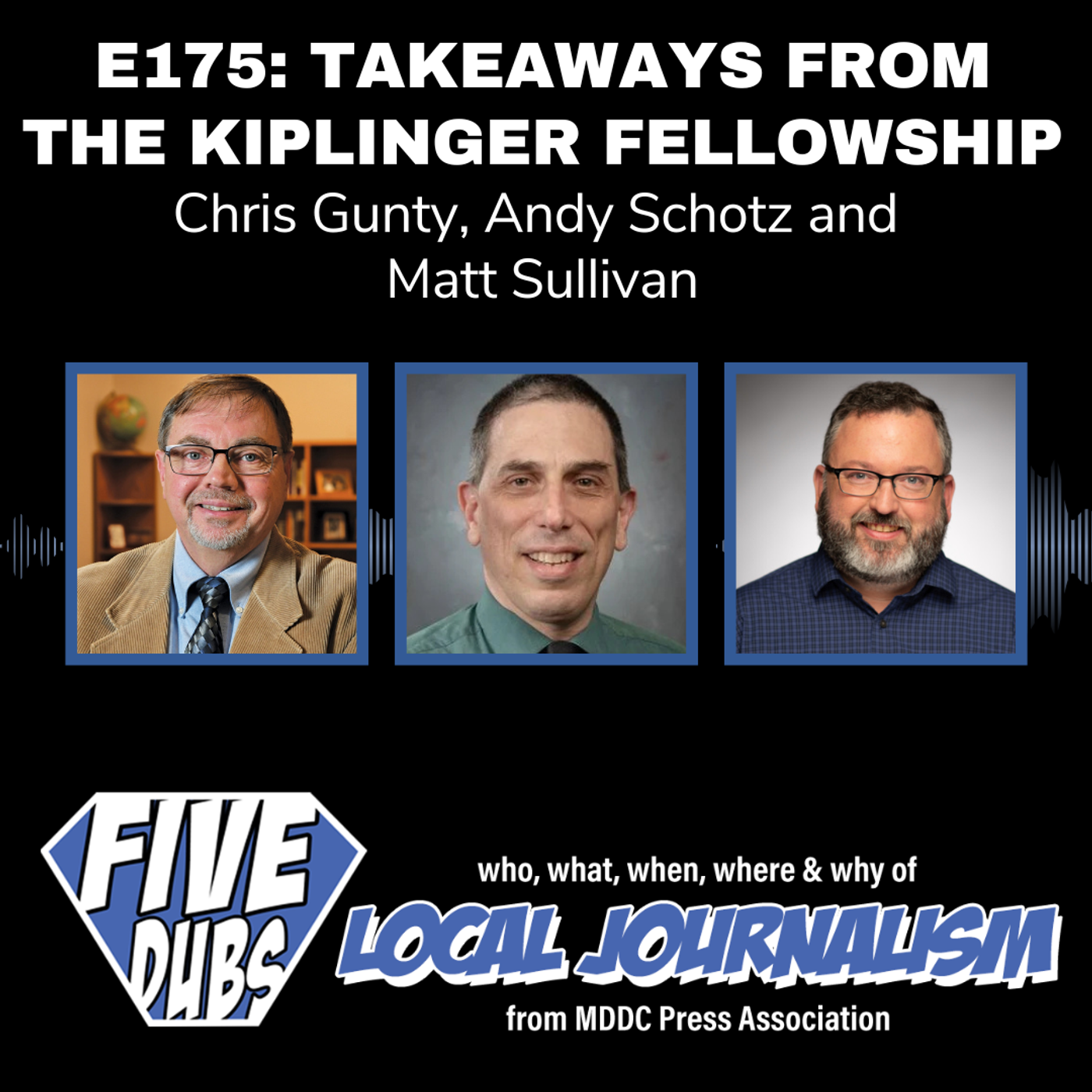
In this episode, Rebecca talks with Chris Gunty of the Catholic Review, Andy Schotz of The Frederick News-Post, and Matt Sullivan of Spotlight Delaware about the insights they brought home from the Kiplinger Fellowship's Saving Local News: A Practical Guide. They reflect on the value of stepping away from the day-to-day demands of the newsroom to exchange ideas with journalists from across the country and explore practical strategies for strengthening local news. The conversation covers everything from business model planning and audience engagement to AI-powered tools, event calendars, newsletter optimization, and sustainable revenue strategies. They also discuss the importance of collaboration across news organizations, experimenting with new ideas, and focusing on journalism that is relentlessly useful to readers. The episode offers a candid look at how local news leaders are adapting to industry challenges while sharing practical lessons that can be applied in newsrooms of all sizes.
Rebecca Snyder: Welcome everyone. I am so excited to have in the studio today Chris Gunty from Catholic Review, Andy Schatz from the Frederick News Post, and Matt Sullivan from Spotlight Delaware, who are going to share all the tips, tricks, and learnings that you received in the great state of Ohio during the Kiplinger Fellowship meeting, which was just last month. So welcome to the program. Matt: Thank you. Andy Schotz: Thank you. Christopher Gunty: Thanks for having us. Rebecca Snyder: Yeah. Yeah, no, it's it is terrific. And I so I want to start first off by helping us understand what the Kiplinger Fellowship is. And ⁓ Chris, I think it was your idea to convene us all for ⁓ for this podcast episode. So why don't you start? Christopher Gunty: So the Kiplinger Fellowship is a program that is sponsored by the Kiplinger Foundation. ⁓ this year the fellowship theme was saving local news, practical matters. So it was very much targeted to practical ideas for saving local news. ⁓ I was selected as one of the fellows. ⁓ my wife, who is the managing editor of the Arlington Catholic Herald in Arlington, was selected as well. We knew that our friend Andy was selected, so we carpooled with him over there. And then we ran into Matt when we were there and and I remarked, isn't it great that there are three news organization of the year winners who were also represented as Kiplinger fellows? So that was kind of cool to encounter ⁓ Matt and Andy from ⁓ D D C there. Rebecca Snyder: ⁓ I love that through line. And I think that also shows that, you know, as news organizations, you're really trying out ⁓ different different ways of being and approaching the work. And it's it's obviously ⁓ it's it's obviously ⁓ doing good things. So, Matt, as our Delaware person, tell us what you were, not that it relates to Delaware, but tell us what you were hoping to achieve from your time in the fellowship. And you had sort of an interesting spot because you've been to a A number of these types of programs. Matt: Yeah, my my first career when I was with Gannette, ⁓ I get sent here and there, all the kind of places when I when we had money for training, and that was a common thing in the newspaper industry. and it's not as much anymore. But I I thought this was one of the great week of the kinds of things I've gone to. This kind of small group where you're able to talk to people, actually c have a conversation, then see the people later and follow up on it. ⁓ was really ⁓ useful. And a lot of people in this moment, I think. w answer what I was doing there. There there's a lot of experimentation happening in media across you know, i we say I mean we're in nonprofit media at Spotlight Delaware, but even that has five or six different flavors or approaches around the country that people are working on. So it's really interesting to hear how other people are approaching basically the same problems from very different ways around Rebecca Snyder: Mm-hmm. And I think it's so interesting if you look at the the three ⁓ groups that we have represented on the call, you have the Frederick News Post, sort of a traditional mid-sized daily in a in a smaller city. You have the Catholic Review, which is very focused as a dio ⁓ as a publication of the the Diocese of of Baltimore, and then the nonprofit news online only site ⁓ from Spotlight Delaware. And so do you think that and Andy, I don't know if you you can speak to this, but is like what does having that diversity of different focus areas do for a program like Kiplinger where you're you where you're talking about new and different practical solutions? Andy Schotz: Well it was it was interesting in a Necessarily small. We had 30, some 35-ish people, ⁓ but it really did a great job in offering a cross-section in print, online, size, profit, non-profit, ⁓ geographic area, focus of what you do, even international. We had a couple of people from overseas with us and ⁓ One of the best parts of the week, which was a really smart thing to do, is not just hope that people can talk to each other as you fill the time between events or as you pass in the hall or anything like that. There was a focused portion as we wrapped up the week where we sat and talked and it started out a little stilted, like who wants to go first? But then once it did, it really flowed pretty well. And I that was one of the best exchanges of ideas. Rebecca Snyder: So what kind of new ideas did you come come up with? I mean, I it's catnip to me to talk about the practical solutions facing news media because I think sometimes we get into those traps of like talking about truth and democracy and journalism with a capital J, and all those things are really important. But all the news organizations that I've encountered have kind of similar issues in terms of revenue generation, audience engagement. you know, and actually securing the news and information gathering. So what were what were your favorite takeaways from from the time? Christopher Gunty: You I think one of the things we had was ⁓ a workshop with ⁓ Mackenzie Warren from ⁓ Madele University ⁓ local news initiative and he ⁓ asked us to do a a business model plan for something in our newsroom. ⁓ and they were ⁓ we split into two groups for this. So there was a you know a group of fifteen in one room and then ⁓ we switched for the next session. But ⁓ each of us had very different things that we were pushing. Rebecca Snyder: Mm. Christopher Gunty: ⁓ I chose to focus on one of our products, which right now is not a revenue generator for us. It's called CR for kids. It's a a little ⁓ black and white thing that is that we send by PDF to the parishes so they can print and kids can color and do the puzzles while they're in mass and they learn a little bit about the saints. I'm like and we'd been talking a little bit in the newsroom about how do we make that better? How do we enhance that? ⁓ what kinds of things? In ninety minutes I came up with a business model plan for that and brought it back to the newsroom and said, let's start working on this. And we have already had three meetings about it. We've already started working on it. So this is something that we're gonna implement very quickly. If if n I got nothing else out of the week, I got that. And and I did get a lot out of the rest of the week. But that's a great start for us to start looking at how do we practically apply the lessons that we learn. to make this thing so that we can do a big launch this fall with a a new new branding, new marketing, additional expansion of the product into different platforms. And we've done all that in two weeks. Rebecca Snyder: That's amazing. So I and I'm curious because you know, you're a savvy, like you know your numbers, you're an innovative person. Like, what was it about that framework? Was it just like sometimes it's the time and attention that you really haven't ever carved out 90 minutes to think something through before? But like what about that experience made ⁓ made you be able to pick up all the pieces of the kids product and and put it together in a different way? 'Cause I feel like you know a business model, right? Like Christopher Gunty: Well th well yeah, but this was you know, it divided things into nine boxes and said you should be able to fill in all nine boxes on this. And that includes a value proposition. It includes where your cost centers are, where your revenue centers are, who your market is, who the who are the people you need to cooperate with to make this work. And so it was just to focus on, okay, I can do that and and it's all on one sheet. Rebecca Snyder: Mm-hmm. Well, and I love that because you can almost apply something like that to any product that you have or any process that you have to to really discern and clarify. And, you know, Matt, I saw you nodding your head. I have the benefit of seeing the video, ⁓ here. And so I saw you nodding your head when when I was talking about just carving out and holding space for things. So was that sort of what Christopher Gunty: Exactly. Rebecca Snyder: Is that sort of your big challenge in some ways? Because you're in a really small newsroom that's a startup as well. I forgot to mention that. Matt: I it's everyone's challenge. It's a challenge in a small newsroom of a startup. I don't think it's any different for Chris or for Andy. ⁓ none of us have any time to think about anything on a regular basis. And so having a week to sit and actually think about the business away from things is a great recipe for coming up with new ideas. And and Chris, if you ever already plan to like syndicate that to Wilmington District, ⁓ Diocese, I think you should ⁓ add that to your business plan because I bet you get some money out of them. Christopher Gunty: That'd be great. Matt: But ⁓ but yeah, no, I I I I've ⁓ I came out of the ⁓ Rebuild Local News, who I know you guys know. I know Marilyn has been well involved with. ⁓ Susan Patterson Plank was there to present on different models around the country. And this is a long form thing. And though it sort of I think grew out of the nonprofit news movement, it's you know, work that's gonna affect ⁓ potentially impact everybody, ⁓ regardless of whether you're a nonprofit or Rebecca Snyder: Mm-hmm. Matt: for profit, ⁓ depending on how it's set up in different states. It was really interesting to see how different states are approaching it and and as as somebody who is and this is not maybe the common opinion, but I I'm not sure long term nonprofit news works without some form of state investment. and this is the baby steps towards something closer to what Europe looks like. ⁓ is probably the only way local news in the long term becomes something that is financially stable, I think. Rebecca Snyder: Mm, mm-hmm. Matt: And so seeing these early steps and and being able to like think about how they might work in Delaware and other places was really great to step back and look. Rebecca Snyder: Yeah. Well, and I I do think getting that perspective, you know, you have all those thirty different news organizations there, but getting that sort of national perspective to say, okay, what what's working in different states? What ⁓ where can we move forward and what other models might be is ⁓ you know, it sometimes feels like the challenges facing local news can be really, really big. And they're not ⁓ you know, they're not necessarily ⁓ it as one organization it can feel very isolating. And so I think having that perspective of, ⁓ this is something that they're trying over in this area and here's what another group is trying here, because you're right, there is no model that's working. And I don't think there's been a lot of research necessarily on what business models are actively actually working in the US because nobody wants to open their books. So here I and Rightfully so. But how does that sort of that financial interplay? You had mentioned earlier that you're not sure that nonprofit news will survive without state intervention or or local news in general. What ⁓ why do you think that? What's what's going on for you? Matt: Well, I think it's a long term business model. I think we're we're okay right now and in case anyone my staff's watching it, we're fully solvent and doing fine. ⁓ but ⁓ but i local news as we knew it in the second half of the twentieth century was funded through an ancillary business of classifieds that is never coming back and didn't necessarily wasn't part of the actual product as news. It wasn't it was a different thing that was making money. attached to the thing that people want to like local news, ⁓ we're not gonna find a golden goose like that again. an unless we want to go back to an early twentieth century model where all of our news was heavily ⁓ opinionated based on the opinions of the person who owned the press, ⁓ where the ethics of ⁓ modern journalism weren't really part of the game and you were basically just selling news to people who want to hear what you were saying, I don't know there's a way to do that without finding a a a a another source of revenue that can replace that long term. ⁓ on a local basis. National's different. ⁓ but local, you know, when you're trying to cover news of like Andy's Town or Delaware or anywhere else like that, i it's just going to be very it the the challenges are going to be very ongoing for years. Rebecca Snyder: Mm-hmm. Yeah. Well and and so I wonder ⁓ go ahead. Sorry, Chris. Christopher Gunty: And Rebecca, I wanna I wanna give a shout out to you. One of the things that that was brought up in the ⁓ workshop about revenue models was talking about the bill that we got passed in Maryland to ⁓ support to to require that state agencies advertising half of it had to go to local community news outlets, which and you specifically, Rebecca, were praised for pushing that over the goal line and getting it done. And then last week Governor Moore vetoed it. So ⁓ so I mean that that whole pretense premise there of this is one of the ways that people can model on on this, and then it fell apart. But specifically, that was praised as an option to get the kind of support that Matt is talking about to say you get at least some state government contributing something by buying ads that have value. Rebecca Snyder: Devastating. Right. And and I think also and we are we are down, but we are not out on that advertising set aside. You know, the news media if is nothing if not persistent. ⁓ and any failure's not an option, so we're gonna continue to work through that. ⁓ but I think telling the story of what news media can offer is is something that we haven't always as as news organizations done a good job. Christopher Gunty: Yes, we are. Rebecca Snyder: On I think there's a lot of misconceptions specifically around that legislation about what advertising in local news organizations actually means. Because it's not just a print ad, it's not just a banner ad ⁓ behind a paywall on a website. You know, like our news media organizations have a whole host of advertising options and work as as basically full service agencies. And so I wanted to kind of ⁓ Thanks for foreshadowing that, Chris, because I wanted to turn to Andy because the Frederick News Post is a powerhouse of like innovative revenue strategies from events to special publications to, you know, ⁓ contests. Like you're doing so and I know your newsroom, you're not, you're not revenue, but ⁓ I think that the news post really has an innovative mindset and a failure is not an option mindset. So I wanted to know sort of what this fellowship meant. to your organization. Andy Schotz: Well, I'm gonna I'm gonna shift gear ⁓ gears and focus a little bit because ⁓ if you look at the title, Saving Local News, Colonel A Practical Guide, ⁓ Knight Kimplinger, the benefactor of this program, had made it clear to the executive director that it couldn't just stop at saving local news. It was not meant to be everybody gather and commiserate and figure out Rebecca Snyder: Mm-hmm. Andy Schotz: What can we do? Woe is me. A practical guide meant that you had to leave with ⁓ I'd say more ground level discussion and actual useful specific ideas. And the the fellowship combined both of those ideas to some degree. ⁓ we had one session where somebody from the Knight Foundation talked about ⁓ programs that they fund, but it's not individual newsrooms, which really excluded everybody there at the granular level, but maybe at the collective level we could benefit. But it wasn't something that we could immediately say, okay, let's go find night funding. But other other ideas explored ⁓ more conceptual and philosophical approaches like Chris described a business model or kind of a thought exercise and how can you reach people where they need to be and what they need. And it was not something that you necessarily would execute in your newsroom when you're done, but it made you think about what you do and how you do it. But then some of the more specific ideas, as I mentioned, the idea exchange and ⁓ one session where a a newsroom that had been formed by a somebody who lost their job and and decided to cover the community on their own. ⁓ talked about calendar ⁓ platforms, which was really right up our wheelhouse because we're about to change our calendar platform and she was using the same one. So those were the types of things I think were more transferable in the short term to come back and say, like, let's do this thing. So I think it was a really good mix at concept and practice. Matt: Are you going to use one of the calendars they they demonstrated? Andy Schotz: Well we're we're already sorry about that we're already in the midst of that we're in the learning or or training stage of that same platform. No, ⁓ actually I'm sorry. Somebody else who spoke up was City Spark. She's Yodel, but somebody else was City Spark, and that's what we're planning to switch to. Matt: Of Yodel? ⁓ the other one. City Spark. Yeah. They're exciting. Rebecca Snyder: Well, and you know, one of the things I think is really helpful about having that group in is understanding what platforms and programs are out there because there's so many options. So just knowing like, okay, Cit Spark is something that that others are using and they're having success and they look like me, ⁓ is I think really beneficial. And so did you feel a little bit more secure knowing that there were some proven and tested platforms out there? And what are what are ones we should know about while we're here? Andy Schotz: Well, that's a Citi Spark is the one that we know of, and and one of our sister papers is in it. We did our training session. ⁓ I don't know how it compares to Yodel. They might just be two things doing the same type of work. Yeah. ⁓ but then it led to a discussion of not necessarily how to use this platform or the other, but what it means to be thinking holistically, I guess, about calendars as a way to draw on the community and Rebecca Snyder: Uh-huh. Andy Schotz: kind of own the space of if people want to know what's happening, they turn to us. And ⁓ both of those platforms I think really do a nice job of not making it easy to enter an event, but drawing in events from the community. And then in our case, they'll we'll be able to share them with several papers at the same time. And so we'll all be bolstering our our calendars so that they go beyond our natural geographic region and make it more of a community source at a regional level. Matt: I think it's I think it's the first AI thing I've seen where it's like you're on board with this part of the content process. that has been a hard way to integrate. This seems like it makes sense. And I remember when I was at the news journal, I started the news journal 2004, we had three full-time and a couple part-time people who were running the the calendar. And there's just no way in the modern sphere. Rebecca Snyder: That's super cool. Mm-hmm. Matt: We can afford that many FTEs to work on a calendar. ⁓ there's n there is no solution for this anymore. So that's a good place for AI to step in. And it looks like it's a good use. Rebecca Snyder: Well and I'm curious also it so I think ⁓ figuring out where AI can slot in that it's not gonna ⁓ you know distract from the human centered element of writing and producing and and news judgment and I think calendars are great space for that, but like also this idea of that the news or news media is information that people can use. So it's not always just, you know It's not always news stories, it's not always analysis, but sometimes it's okay, how can we pull in data and and provide it to people? How can we bring in calendar things that aren't, you know, journalistic necessarily, but critical to how a community knits itself together. And I feel like all three of you have done a really good job of kind of conceptualizing who your community is and trying to provide information that helps that community. I'd love to hear a little bit more about, you know. really just that concept because I think that's going beyond what a lot of people would think about here's what news media does. Christopher Gunty: Yeah, I guess. Andy Schotz: Well, let me I'll give you I'll give you a simple example of of that, ⁓ just focusing on the calendar part of it. When we were not focused on it as much, maybe a year or two ago. I mean, we still have a robust calendar, but one specific part of it that we've adapted is on our page two. And that was always conceived as like a nation brief type of area. But as you think about How can you make this a local product and a and of use to your readers as much as you can? None of that news was distinctive to us. It wasn't even our own staff generated news. And so we got rid of that format and decided to put our calendar events, our daily calendar, just a snippet of it a day or two at a time, ⁓ grabbing from a more robust ⁓ several pages that we run in our poll out section every Thursday. But we thought, well, why not? give people events listings every day. So that's something that has become very popular and really helps us ground ourselves in the community as opposed to just how do we fill a page. Rebecca Snyder: Mm-hmm. Christopher Gunty: Yeah, and Andy's got a great point about that. A lot of it is about perception. ⁓ so when I started the newspaper in Phoenix, we had wor Nation and World briefs on page two and local briefs on on the inside back page. And we were getting complaints that the that there was way too much national and local national and world news in the newspaper. We simply switched those two pages, did not change the the amount of content we were doing. We switched those two pain pages and And the complaint stopped. ⁓ and so that I think goes to a a question a point that ⁓ Yanni Greenbaum from American Press Institute made during his workshop about that it's really about relevance. How is this news relevant to our readers right now, today, for what they need today? And he had us do an exercise that was, you know, you had to come up with a last mile delivery model ⁓ for something that that needed to be done right now. ⁓ and so Rebecca Snyder: ⁓ Christopher Gunty: ⁓ that was the kind of thing of saying, How is this relevant? That helped us. Rebecca Snyder: Mm-hmm. Matt: think I'm not on the I'm not on the news side anymore, but when I was I used to be known for saying that I we our product had to be relentlessly useful was my phrase on it. And everything we had to be looking at is this useful to the readers? Is it are we solving problems for them? Rebecca Snyder: Mm. Matt: And even as we come out with new products now, ⁓ we're launching an arts and culture vertical at the end of the year, ⁓ as part of what we do. And we were thinking about when the newsletter should go out. And we picked four PM on Thursday because on the theory of people start thinking about their weekends on Thursday night and people are done with work at four PM and want something to distract them. So we're very much like trying to fit into where people's lives are and and what Rebecca Snyder: Right. Matt: What is the moment of their week when they're like, Hey, what's play with the movies this weekend? Or what you know, what vessels are this weekend? It's four o'clock on Thursday. And so that's when we're gonna deliver the newsletter to them. So we're we're very much trying to use that kind of, you know, human built like modeling as we launched a Rebecca Snyder: Well, and I feel like that's where data analysis and and some of those those AI pieces, you know, on a very basic level, like MailChimp tells you, ⁓ this is the time people open stuff. But really kind of thinking about the arc of what people are doing and looking at those data analytics, especially on the website, that can be so incredibly helpful because you're not just shooting in the dark. So, you know, I would love to talk to you a little bit more about the idea of how you are using data or things that you learned during during the fellowship about how to how to guide those decisions. Cause we can flail out in the world ⁓ and just say, ⁓ I think this is a good idea and the loudest voice sort of wins. But what are what are you hearing about how to use data and and those analytics to make decisions? Or it didn't really resonate, it's okay too. Andy Schotz: Yeah. Matt: I'm trying to think we didn't do much data specific discussions. I we we we certainly didn't have a whole lot of tech people there. So I I wan I wanna like the audience like people, the the those kind of folks weren't they weren't the filling the room. ⁓ I I I I know with Spotlight, I think just being a startup, we're very ⁓ action oriented. You know, let let's try it and then if it doesn't work, we'll do something different. ⁓ but the trick of Andy Schotz: No. Rebecca Snyder: Okay. Right, right, right. Mm-hmm. Matt: it does it not work is looking at the data and getting a sense of of what's working. We do we started doing a lot of A B testing and our audience member is in a belief of a theory of continuous testing. So we just got done a two-week test on subject ⁓ subject lines. Whether two stories in a subject or one story in a subject makes a difference. And then she'll be stopping that and like trying something with emojis. ⁓ and that kind of stuff. So we're constantly trying to see how we can refine Rebecca Snyder: Mm-hmm. Matt: down to, you know, that kind of a level to know how many people can get opening the newsletter, et cetera, et cetera. Rebecca Snyder: Yeah. And I think having that like clarity on what you're trying to test and what you're trying to solve for is really helpful. ⁓ and then you just make the next best decision, iterate and keep moving. I wanted I wanted to take a step back and I know we're gonna have to wind up ⁓ fairly soon just because of timing issues, but how did you how did you know about this program and what's the the for people who are listening to say, I think that would be really cool, how do they get involved? Christopher Gunty: I got an email from Kevin Smith, who is the executive director of the program, ⁓ and ⁓ hmm, this sounds like something that would be worthwhile for me ⁓ and for my publication. ⁓ let's give it a shot and was thrilled to know that that you know ended up getting selected. ⁓ Had to a biography, had to submit, you know, some basic info. ⁓ they had like nine or ten content categories they th they thought about, you know, presenting on. ⁓ You know, I said which of these might be helpful and I kind of went through them and it was like nine out of ten, you know, would be helpful to us. ⁓ so but I think the other thing to do is to that it's not the only fellowship out there, it's not the only thing out there. So ⁓ you know, subscribe to a lot of journalism newsletters that will mention these kinds of things and ⁓ and then apply for what you can. The other thing to note is that next year's theme for Kiplinger will be different than this year. So it'll be something else that might appeal to to different people. Rebecca Snyder: And and API does a similar kind of content arc. Last year it was ⁓ I think ⁓ it was it was audience engagement or or like connecting with communities. And this year it's more like youth and journalism. And so a lot of the different organizations really are ⁓ l focusing deeply on content. So and I feel like this the application comes out in the fall because this was a May, ⁓ a May event. So we'll have to and through MDDC Friday planner, we also try and showcase opportunities like that if we hear about them early enough so that members can find out what's going on. ⁓ is there any follow-up or are there things that ⁓ that as between the three of you, of course you have the benefit of knowing each other already and kind of staying in touch, but is there planned follow-up or or the way the cohort can work together? Andy Schotz: Well, there's there was ⁓ I think two things. One is that one of the exercises, the one that Chris described about the last mile project was ⁓ something that we broke into groups and came up with. And then we were supposed to hold each other accountable by taking the name of the partner next to you and their email and then watching to see if they carried out their idea and bugging them if they didn't. I don't know how much that will follow through, but Christopher Gunty: Okay. Andy Schotz: ⁓ the second thing was ⁓ a Snapchat group and I never had used Snapchat. What's up? I'm sorry. A WhatsApp group and I never had used it and I logged on and I don't know if I'll use it, but I think we will try to stay in touch. Rebecca Snyder: Mm. Christopher Gunty: What's that? Matt: We have each other's emails. We can we can we can also do it the old fashioned way if we need to. Rebecca Snyder: ⁓ okay. Go old school. Now, do you think that the three of you because and you knew each other I think you knew each other before you went into this program or maybe collegially? No. Andy Schotz: No I knew Chris. Christopher Gunty: Yeah. I I knew Andy I knew Andy but I hadn't met Matt. Matt: No. Rebecca Snyder: Okay. So Matt with the dark horse in this one. Because actually, shout out, both Chris and Andy sit on the MDDC board. So ⁓ they've known each other for a long time. ⁓ and we have Jake Owens from from Spotlight. So you're y'all are represented. ⁓ but are there I I think being in the same region and in the same press association, even if you have really different ⁓ sort of business models and focus on your work. Are there ways that you think you all can work together or keep in touch to kind of keep the energy of of this fellowship alive? Christopher Gunty: I think so. I you know, part of the the thing is that we are competing in different spaces, so we're not really competing against each other. And that I think bodes well for anything, ⁓ any kind of cooperation. Matt: I think we sh I think we have to even like our our issues are similar given our geography in terms of that kind of stuff. But also I I have this is my second career in journalism. I left for 10 years between 2012 and 2015. And one ⁓ 2025. And what ⁓ I find coming back is that there just isn't as many opportunities to talk to other journalists as there used to be. There's a few of us around. ⁓ a lot of times you go to an event, there's only one person there to cover something, you don't have that group of people in the back. Rebecca Snyder: Mm-hmm. Mm-hmm. Matt: I think more intentionality about sharing ideas between ⁓ publications is something that just would benefit all of us ongoingly. and and the fact that we're geographically we don't have to drive to Ohio to do it, ⁓ does suggest that there should we should figure out some way to continue that kind of work here. Rebecca Snyder: Mm-hmm. Right. Andy Schotz: Rebecca, I think that we did a good job of getting, you know, kind of mining each other for ideas while we were there. And I I'm not sure how much that will continue, but ⁓ I I wrote something for a a newsletter that I'm in a group I'm part of, and I'll just mention a few of them because they were interesting. Literacy Day Lessons for Children's at a far at a farmer's market, ⁓ a series of profiles about people in the community. average people who you might not know, but you write about them and then hold a celebration event where they are treated like stars. Pop-up. Yeah, yeah, he had great ideas. an election night party for the public to wait results. They just show up at your building and everybody watches together. And then the last one that I included, which is from Chris, I believe, the ⁓ workshop on how people can take the best pictures with their smartphones. And so that's a really neat idea, practical Matt: Hmm. That's the guy from Argentina. His ideas were very good. Rebecca Snyder: Mm. Christopher Gunty: Yes. Rebecca Snyder: ⁓ Andy Schotz: way to connect with your community, not necessarily in a straight news sense, but offering the expertise you have and letting them know, you know, how they c how you can help them, even if it's not in the exact way that everybody thinks of. Rebecca Snyder: Mm-hmm. Well, those are all great ideas. And so I invite each of you to come back when you're implementing Chris when you implement your ⁓ your new redesign for the kids pages. ⁓ and and when Andy and Matt, you implement the things that you you took away, I want to hear about them so we can come and and talk about them on an upcoming episode. But this was terrific and I really appreciate your time today in in coming to talk to me about this. ⁓ and if people are interested in the Kiplinger Fellows program. That's out of Uha Ohio ⁓ University and it's the Script School of Journalism. So if you just Google Kiplinger fellows, ⁓ you can hear who was ⁓ who was involved this year and look for news about how to apply for next year. So thank you all so much. Matt: Thank you. Christopher Gunty: Good. Thank you, Rebecca. Andy Schotz: Thank you.