
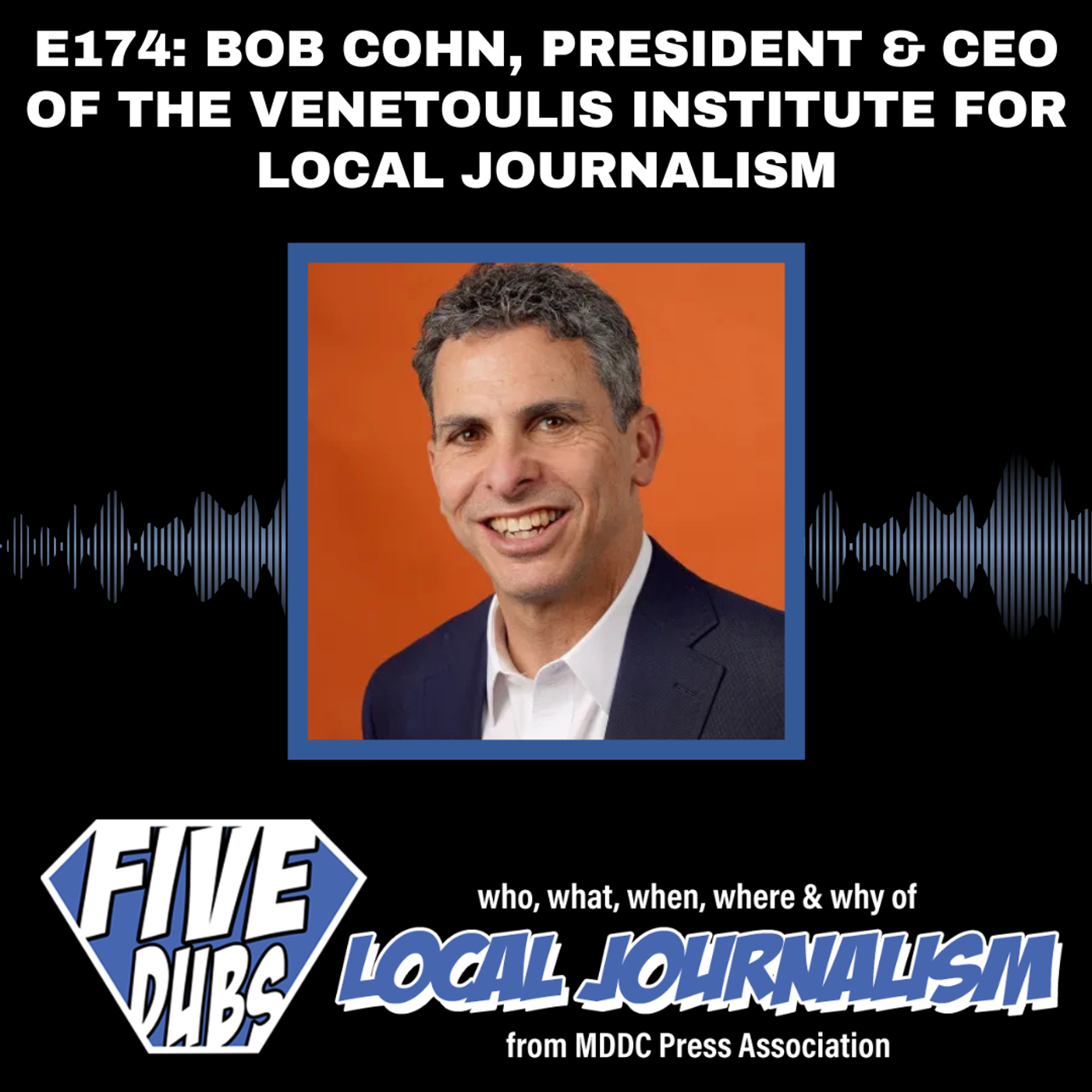
Five Dubs Podcast · MDDC Press Association
In this episode, Rebecca talks with Bob Cohn, president and CEO of The Venetoulis Institute for Local Journalism, about the organization's rapid growth and its vision for strengthening local news. Bob discusses the Institute's recent acquisition of the assets of the Pittsburgh Post-Gazette, how the move fits into its long-term mission, and what the organization has learned from expanding The Baltimore Banner into new communities across Maryland. They explore the business model behind the Institute's approach to sustainable local journalism, including the role of subscriptions, advertising, philanthropy, and community engagement. Bob also shares how the organization balances startup innovation with the legacy of established news organizations, the importance of building a strong newsroom culture, and why investing in local journalism is essential to serving communities and ensuring a sustainable future for the industry.
Rebecca Snyder: Welcome everyone. I am delighted to have in our studio today Bob Cohn, ⁓ who is the CEO of Locally, you know him as the CEO of the Banner, but sort of the stealth one is he's also the CEO of the Venetoulus Institute for Local Journalism. So welcome to the program, Bob. Bob: Rebecca, thanks for having me. Rebecca Snyder: Well, and you are very welcome. And I appreciate that you've made the time to come and talk to me because you're now what six weeks into sort of the major news. I mean, you've had a lot of major news events with the Pulitzer Finalists this this year and and all those good things. But most recently, the Venetoulus Institute purchased the assets of the Pittsburgh Post Gazette. And so you took ownership of those assets, not all the contracts and all the drama, but the actual operation ⁓ may 4th. And so we're recording this right before July 4th. So I wanted to check in with you and see, you know, how it relates, how it's going in Pittsburgh, how it relates to the work of the banner, which has also expanded quite a bit. So we've got lots to talk about. Yeah. So how are things going? You know, when when you purchase an a a new operation or an asset, there's a there's a lot of Bob: Excellent. I'm looking forward to it. Rebecca Snyder: learning that happens. And so what are you what are you finding out? Was it what you expected when you guys jumped into that that pool? Bob: Yeah, well it all happened very quickly, you know. ⁓ the the the owners of the Post Gazette announced in January that they were gonna shut down the newspaper after two hundred and forty years. ⁓ the you know, the leading news organization of in western Pennsylvania in two hundred and forty years old. So We kind of expressed interest later that month and it moved very quickly ⁓ when we ended up signing an agreement in April. So very fast and then took over on May 4th. So what we expected is hard to know. We didn't have time to expect anything. ⁓ but ⁓ you know it is an excellent brand. It's it's ⁓ got a lot of ⁓ history. Rebecca Snyder: I Bob: and brand equity in ⁓ Pittsburgh and the surrounding areas. It's won Pulitzer Prizes and done excellent work. And ⁓ you know, we're ⁓ coming in to learn about Pennsylvania, to learn about that market, to bring what we've learned in Maryland ⁓ there, ⁓ and then ⁓ see if we can ⁓ kind of operate both properties now, both the banner and the Postgazette under this joint ownership and and grow them both so they can be important ⁓ sources of trusted local news in their communities. Rebecca Snyder: Right. And so actually I guess ⁓ let's take a step back and sort of talk about how this acquisition fits into like the overall umbrella and idea of what the Venezuelas Institute for local journalism, I think that's an important piece, what they're trying to do. ⁓ and so tell us a little bit about the overarching plan. Bob: Well, you know, the mission at Venetoulus is is really two parts. The the first is to bring quality, trusted journalism to communities that need it most, ⁓ and ⁓ help people navigate their lives and hold their ⁓ powerful officials accountable and institutions accountable. But but the the the second is really to be addressing the crisis in local news that's as we see nationwide. ⁓ with so many newspapers shutting down or being purchased by hedge funds that are kind of hollowing them out, ⁓ or or disinvesting in in the future of local news and and to to do our small part to try to counteract ⁓ what we see there. And really, that was an experiment that we began here in Maryland, starting in Baltimore City and then the counties surrounding Baltimore. And as we grew elsewhere in Maryland, and we can talk about the Maryland growth ⁓ all along from the very beginning, Stuart Bainum, who who founded the banner in 2022, ⁓ always said from the beginning that we would try to create ⁓ a model that we believed ⁓ could work. Rebecca Snyder: Mm-hmm. Bob: ⁓ nationwide and then to ⁓ to bring it elsewhere if the occasion arose. Rebecca Snyder: Well, and I feel like the pace of expansion and growth for the banner, I mean, it let's we'll talk about Maryland ⁓ I guess a little bit more in depth. But in in it it doesn't feel like, you know, a four-year-old company is like, yes, let's go and make sh and and acquire other properties in other states. So when you were, you know, sort of on the brink of doing that, w and there were other offers for for the Pittsburgh Post Gazette, what made you all feel like you were the right purchaser at the right time. Bob: Yeah. Well, first I wanna ⁓ double click on what you said. ⁓ last week we celebrated our fourth anniversary. So we are a startup ⁓ here here in Maryland. ⁓ but ⁓ what made us think that that we we could ⁓ do something Rebecca Snyder: Mm-hmm. Bob: ⁓ helpful in in Pittsburgh was the fact that that our model, which is this, we can talk about it, but this mix of subscriptions and advertising and philanthropy, ⁓ combined with some ⁓ some cost discipline and just absolute commitment to the community, that that could work elsewhere and not just in Maryland. And that was always the goal from the beginning. ⁓ and Pittsburgh ⁓ it wasn't so much that we were we looked around And said we have to go to Pittsburgh, but Pittsburgh presented itself as an opportunity at a time when we were thinking, there's some evidence that our model is going to be working in Maryland. And we should, consistent with the founder's note that Stewart wrote back in June of 2022, we should be thinking about where else we might take it ⁓ for the good of trying to spread the word on local journalism. Rebecca Snyder: Yeah. No, and and that makes perfect sense. I mean, if you have a business model that you're and granted, the I d I think the jury's still out on like there's not a silver bullet of of revenue models for news media at this point. So it's really very freestyle and you're drawing from a lot of different aspects. ⁓ and when you look at at the Pittsburgh property, I mean fundamentally they they ran into their the issues with healthcare costs and and some of the the costs associated with ⁓ with the ⁓ union suit that that was resolved in twenty twenty five. And so when you look at that organization, I mean they had the Pulitzer for the Squirrel Hill Tree of Life ⁓ shooting, ⁓ they have I mean Pittsburgh is a really interesting city in terms of like sense of place and locale and a lot of dedication to their local news outlets. And the Pittsburgh Post Gazette is kind of, you know, there's other news media as there always is, but they're definitely the like they are the paper of record with a long career. So like history. So when you kind of look at It it makes sense to me and and obviously it made sense to you guys as well to do it, but that that had a lot of really good fundamentals to be the next acquisition because you didn't you didn't inherit the debts. You only took the assets. So it's kind of clean slate at that point. Is that am I getting that right? Bob: Yeah, and and you're right. They they've been through some pain in recent years, ⁓ but that doesn't ⁓ tarnish the overall strength of the brand, ⁓ its place in the community. I've learned just in the two months that we've we've owned it and in the in the month or two running up to it, just ⁓ how strongly the brand resonates, how much belief people have in it. They stuck with it even during difficult strike years and then about ninety days where the message was they're shutting down. ⁓ between their message on January seventh and the announcement on April sixteenth that we would purchase ⁓ was a period where ⁓ it was known that they were shutting down and that ⁓ was a hard time. And so ⁓ the asset purchase allows us to start from scratch with the with the strength of the brand and and and the customer base, the advertising base and the subscriber base, ⁓ but to kind of right size things ⁓ and and get a fresh start at the same time. Rebecca Snyder: Yeah. And so ⁓ it's i I think it's such a juxtaposition that you have this really new startup, digital only, and then you have the, you know, predating the ⁓ the the Constitution kind of publication that's still in print, doing like really long past. And you've been in the newspaper industry or the news media industry for a long time. So what are you like, how are you handling that juxtaposition or is it Is is it really just format and wrapping or are there fundamental differences when you're coming from those two cultures? Cause it's a startup culture and an entrenched culture. Like how's that how's that working in your head? Bob: Well, I mean, for starters, ⁓ the banner ⁓ is not a print ⁓ operation. So ⁓ the Post Gazette ⁓ print is an important part. ⁓ they they have ⁓ the newspaper comes out twice a week and it's an important part of ⁓ the identity of the Post Gazette. It's a driver of readership and it's a driver of revenue. So ⁓ all of us at the banner have worked in print, or nearly all of us, I suspect maybe some of the very younger ones have not. ⁓ Rebecca Snyder: Right. Bob: So we have print in our blood, but the banner is not a ⁓ doesn't have a print cadence. So absorbing that into the culture is ⁓ new and you know it's familiar to many of us, ⁓ but it's still new for Venetoulus to have a print operation. ⁓ and you know, we we all talk about, you know, we're startup and and legacy. You know, the banner quickly becomes a legacy too. If a legacy happens, there's so much new to learn and it things are changing so much that the fact that the postgazette's been around for 240 years and the banner for four doesn't really make ⁓ the banner any more immune to having to learn new things than the postgazette is because the world's changing so so quickly ⁓ and and and so profoundly all the time. ⁓ so but but you know, there's there are some differences. Rebecca Snyder: So tell me more about those differences. Like how are you how are you working through them? Because I do love that, you know, sort of that idea of continuous revelation. You know, everything is changing like this time last year. We weren't really dealing with AI as deeply as we are now. And that, you know, cuts across all sorts of things. ⁓ but when you're you're ⁓ like that difference and diversity of thought is also really powerful. So like I'm sure that the banner is teaching the Pittsburgh Post Gazette things, but like how do those differences then come back and inform what you're doing here locally? Or do they? Bob: Yeah, in both cases, we're learning. Yeah, they're there. I mean, it's only been two months, but we can already see ways in which ⁓ Pittsburgh is doing different things and new things and better, better ways of doing things than the banner is, and vice versa. So we think we have a a pretty strong ⁓ subscription model ⁓ that we can help ⁓ goose subscriptions in Pittsburgh. They have a very strong advertising ⁓ function and and ⁓ we can learn. from some of what they're doing there. We have a strong social video component at the banner. and ⁓ bringing some of that social ⁓ energy ⁓ to the postgazette is gonna be helpful. ⁓ and and the post Gazette has is so deeply embedded in the community ⁓ that that's ⁓ we can look at those roots and figure out how we can better plant down the roots ⁓ for the banner in Maryland. Rebecca Snyder: Mm-hmm. That makes sense. ⁓ and I wanna so I just want to point of clarification really, ⁓ just so that that I'm set on this. Those are all kind of back office or I guess operational functions as opposed to editorial functions. And so I just want to clarify those newsrooms are not merged, you know, like you still have the Pittsburgh Post Gazette editor and editorial staff and Audrey and her team at the banner. And I so I just could you clarify for everyone so that we're not misleading anyone about like how they're interacting. Bob: Totally. Yeah, it's a great question. So the Venetoulus Institute operates both properties ⁓ and ⁓ areas that are kind of geographic specific and driven, like the newsroom or the advertising function or the events teams, those are very much separate. ⁓ so there's a separate editor in both locations, and there's a separate ⁓ advertising leader, ⁓ and and anything that is unique. to ⁓ location ⁓ we're doing as separate ⁓ operations. There are a lot of back office operations as you indicate, ⁓ whether it's ⁓ finance or product or engineering or HR. or or some growth marketing ⁓ where you can centralize that and and build a much stronger central service. And that's what we're trying to do. It helps us absorb fixed costs so that we can drive both properties to ⁓ sustainability more quickly, get both to profitability. And then because we're a 501c3, the minute we can ⁓ make a dollar, it all goes back into the journalism. So very Rebecca Snyder: Mm-hmm. Bob: specific ⁓ geography-based ⁓ entities like the newsroom in particular and advertising, and then some that that ⁓ would kind of roll up to central services. Rebecca Snyder: Now you all have ⁓ the banner has some really cool events. You know, I'm just thinking of Innovate Her. You've done sort of your Maryland legislative look, your Impact Maryland things. Are there ⁓ like what events are you excited about, maybe learning from Pittsburgh about? Are there there ways that you think you can bring them back and forth? Bob: Yeah, they have a really kind of active ⁓ they have something called Best Bites, which is an like an active food event or series of food events that we've talked a lot about doing at the banner and just haven't haven't done it. And so we think we can learn a lot from that and and try to do some of those around around around Maryland. and ⁓ I think that some of our Rebecca Snyder: ⁓ Bob: events like Impact Maryland, the kind of the the the kind of more ⁓ TED style events ⁓ could could work well in Pittsburgh. So there's some opportunity for ⁓ a lot of best practice ⁓ back and forth trading ⁓ that we see benefits ⁓ for both properties. Rebecca Snyder: Mm-hmm. Yeah. ⁓ and so actually going back to some of your shared services, and I it's it's premature, but are you thinking that, you know, you'll have like maybe circulation marketing in one place? Or like are you ⁓ whenever there's whenever in the industry or any any industry people talk about well, we're gonna share services, there's that immediate frigion of fear. Like, is that gonna be centralized in my town or is it going to be centralized over there? Or are you thinking like are you thinking less of like geographic locations and more like people doing the work that happen to be wherever they are? Does that make sense? Bob: A little more a little more of the latter. It's not ⁓ I mean I think you know kind of post-COVID we live in a more fluid world about ⁓ about geography. So ⁓ we a lot of the ⁓ the the leadership of the banner, some of those folks in the C suite will will move over to operating ⁓ Rebecca Snyder: Mm-hmm. Bob: their function across both properties, except of course advertising and and and events and especially the newsroom. ⁓ but they have teams in both locations. Yeah. Rebecca Snyder: Mm-hmm. ⁓ that makes sense. Yeah. And I mean, Pittsburgh is only four hours away. It's not like it's you know, it's not like it's San Francisco and I mean, I guess you have to get over the Steelers thing. But you already are dealing with that with the commanders when you go into Montgomery and Prince George's County. So Bob: Yeah. Well, we're just about to we haven't we haven't had a commander season. we did a little bit of overlap when we went into Montgomery, ⁓ but we weren't really covering the commanders then. We are now covering DC sports, which we can talk about in our expansion down there. So suddenly we have ⁓ three NFL teams, ⁓ two of which are sworn ⁓ rivals. ⁓ Rebecca Snyder: Mm-hmm. Is that gonna rip the organization apart? Bob: Kind of went into Pittsburgh making jokes about it and realized it was really no laughing manner to Steelers fans. So I'll have to be a little more careful. Rebecca Snyder: Yes. Always watch your back, I suppose. Well, and and ⁓ so I wanted to ask when you guys went into Montgomery County and Prince George's, you did so much research. I remember talking to Zuri about sort of the lead up to ⁓ to that ⁓ the expansion and and the ⁓ then the bureau. And so I wanted to understand kind of that philosophy of how you get to know Bob: Right. Rebecca Snyder: a new space before you go in in there and how you can kind of apply those lessons to this new space also in a new to you space in Pittsburgh. Like I just think it's masterful the way the kind of the listening sessions that that you did that weren't necessarily related to here's news media readers, but more learning about the community. So could you talk to us a little bit about how you do that and why you did it in that way? Bob: Right. So we did ⁓ we we did that in Montgomery before we launched last September. We're in the middle of doing that right now with Prince George's. We only we only launched there in May, so two months ago. ⁓ and we're about ⁓ I think we've done about four or five listening sessions across Prince George's County in the last ⁓ few weeks and going into the summer. And the we did a little bit of quantitative ⁓ research ⁓ and a little bit of qualitative along with that, and now the the listening sessions ⁓ Rebecca Snyder: Mm-hmm. Bob: To really make sure we understood what members of the community want and need from local media. The big difference in Pittsburgh is we have a hundred people who work in Pittsburgh as part of Enatoolis right now. So we are not going in fresh. A few of us are going in fresh, but we have ⁓ a team that is extremely ⁓ you know well. ⁓ integrated and and wise about the market there. ⁓ so ⁓ it it's ⁓ the difference really between the banner ⁓ moving to a new region and Venetoulus purchasing ⁓ another asset and ⁓ you know we did ⁓ the previous owner did terminate all employees and then we hired from scratch, ⁓ because that's what an asset purchase is. But in hiring from scratch, we availed ourselves of the tremendous talent from what at that moment was about to be the old postgazette. ⁓ and there was a tr fantastic talent pool. So ⁓ the challenge of learning the community is ⁓ much lower ⁓ because our leaders on the ground there know the community very, very well. Rebecca Snyder: Yeah. So ⁓ I'm curious, you know, I I believe that ⁓ Pittsburgh Post Gazette had about a hundred staffers or a hundred newsroom staffers. How many of them came over into the new organization? Bob: Yeah, this so we invited all members of the newsroom to ⁓ raise their hand and indicate interest in coming over ⁓ to the new post gazette. And about 90, ⁓ not about 90, exactly 90 indicated interest, and we hired 59 of them, so ⁓ two-thirds ⁓ came over. and ⁓ all of them, everyone we made an offer to accepted. ⁓ and you know, it would have been nice. to ⁓ have more like 80 or 90 or even have a hundred people in the newsroom. ⁓ the truth is that the post gazette has been losing money for a long, long time. And our goal is to stabilize the operation financially and then grow it ⁓ once we can can turn it around a little bit, which is consistent with the way we did what we did in Baltimore. We started the banner with 35 people in the newsroom and now ⁓ just starting ⁓ just finishing our fourth year. We have a hundred people in the newsroom. So we we will build out the Post Gazette, ⁓ but we needed to ⁓ get to a a place where where we could ⁓ align the size of the newsroom with the financial realities of the organization. Rebecca Snyder: 100% you gotta put your own oxygen mask on before you can before you can scale up and breathe. ⁓ so ⁓ that fif those those fifty-nine head count, that's the space that you wanna be in now. It's not like you had fifty-nine, but you wanna be at seventy by, you know, by September or something like that. Is that am I getting that right? Bob: Yeah, we're not growing instantly. ⁓ but I'll be surprised if we don't grow in the, you know, I don't anticipate a lot of growth in this calendar year, put it that way. So we're not we're not at sixty getting to seventy. We're we're at this number ⁓ while we get our sea legs and while we ⁓ recover from Rebecca Snyder: Got it. Okay, so you have what you need. Bob: the the shutdown. I mean they lost some advertising revenue. We lost some advertising revenue ⁓ as part of the expectation that things were shutting down. So all that will will bounce back and is already showing a very, very positive momentum. ⁓ and then we will ⁓ look to for for growth. Rebecca Snyder: Yeah. No, and that makes sense. I just wasn't sure if, you know, you were at your your desire right now. ⁓ and so I wanted to when when we talk about the Venetoulus Institute and and this permeates through the banners, well, like the values that you really bring to the organization ⁓ and and where you think your model is you focus your model is talent infrastructure and then culture. And so we talked a little bit about infrastructure. You know, you've you've right sized for what you need. You took you have the assets, you took the talent that that was appropriate. But talk to me about culture because right now I sort of feel like you have all these different pieces and all these essentially like new entities that you're trying to and culture is such a difficult thing to translate and to and and to make permeate a workplace. So how are you tell me more about the culture that you want to have ⁓ that that you've really tried to institute at the banner how you're bringing that into Montgomery and Prince George's and DC sports while we're at it. And then you're also trying to you know, make that happen in Pittsburgh. So how do you how do you do all that? Bob: Well, first you're you're right that culture is critical. We believe it's ⁓ among the most important components of what's working at the banner. And and by that I include Montgomery and Prince George's and and everywhere we've gone ⁓ in in the state. and ⁓ we we are very much committed to bringing that culture to Pittsburgh, some of which is already in place, and we talk about it a lot. We talk about it at town halls. We talk about it in one-on-ones with leaders. ⁓ it's it's on the wall, it's painted on the wall of the of the banner headquarters. ⁓ although we're doing a little work in that space now, so we had to ⁓ pull some things down, but ⁓ partly because we're expanding ⁓ a little bit in in in ⁓ in Baltimore as well. Did I say Pittsburgh in Baltimore as well? ⁓ but you know, whether it's it's it's ⁓ Collaboration, urgency, respect, commitment to the community. these are ⁓ you know data-driven or data-informed decision making. ⁓ these are all part of the culture. And ⁓ you know, the the mutual respect and the working together ⁓ And and the breaking down of walls and silos is critical to what's worked for the banner in Baltimore ⁓ and now elsewhere in Maryland. And that's an important part of what w we would bring to Pittsburgh in our. Rebecca Snyder: And so like how are you on a really tactical level, how are you translating that into an organization that's had some like recent trauma because not only you have the fear around the sale, because there was probably a good, you know, ninety days. Th there was a couple there was a period where nobody knew what was happening. So that's destabilizing and scary. And then you had the drama and trauma of the union fight and and the lawsuit. So like what are they and then you have bright and sunny, earnest people from Baltimore coming in and being like we want rainbows and kittens with urgency and transparency and respect. How are you translating that in because like that's that's a hard thing to do, I think. Bob: Yeah, but a lot of those ⁓ traumatic ⁓ moments that you're talking about are are in the past. They happened ⁓ you know, the the the strike ended eight months ago and the fear of the shutdown, I mean that obviously was extremely traumatic, but the minute ⁓ we announce we're coming in, fear of shutdown evaporates because we're now we're now not shutting down. Rebecca Snyder: Mm-hmm. Bob: ⁓ and as for the positive values that we're that we believe in and are trying to inculcate, there's two ways to do it. I think one is to stand up and talk about them, and the other is to model them every day, just to do them. Part of the cultural values is just this is how we operate. Now let's start working together and and just let that kind of ⁓ come through through osmosis and and through demonstration of how we all work together. Rebecca Snyder: Mm-hmm. So like that consistency and just sort of walking your talk is is how you've been doing that. And then as you're building up new newsrooms, and I guess Prince George's is now like your newest newsroom that you're building up, are a a lot of that I I would imagine you're bringing in the right people, the right talent to sort of do what you want. But ⁓ tell us a little bit about what you're seeing as you as you build out new newsrooms. Bob: Yeah. Absolutely. Well, what we're seeing in, you know, so so when we launched in in in 2022, ⁓ it was ⁓ the Baltimore banner to serve Baltimore and very quickly within the first year, the surrounding counties around Baltimore, so Anna Rundle and Howard and Baltimore County. ⁓ but if if you look at the founding the founder's note that that Stuart wrote ⁓ at the time we launched, even before we launched, ⁓ there were two parts. There was To be to serve the people of Maryland, so to get beyond Baltimore, but also, ⁓ this is from the note, to build a sustainable business model for local news that can be replicated in communities across all 50 states. So even then, this little punk of a startup was talking about something much more grandi grand or grandiose. ⁓ so when it came to sticking within Maryland, a year ago. ⁓ really before the the Washington Post was going through ⁓ its most recent and and more ⁓ convulsive troubles, ⁓ we looked at Montgomery County, the the largest county in the state, most populous county in the state, the wealthiest county in the state, ⁓ and ⁓ a complete news desert, really, or or nearly ⁓ complete. ⁓ when we went in to do our our market research there, there was a hunger for for trusted local news, ⁓ or more of it at least. I won't say there was none, but more of it. ⁓ so and so we went in and we ⁓ you know we hired six six reporters and brought an experienced editor from the Baltimore operation down to run it and brought in a couple of people to do ad sales. ⁓ I will say that since we launched last September and ⁓ now in the early summer, More than half of our net growth and subscriptions in those eight or nine months has been from Montgomery County. ⁓ it's ⁓ it's it's been a bet that has really paid off. The the in our voter guide, the number one driver of Reader interest, as demonstrated by page views ⁓ and subscriber starts, was Montgomery County over Baltimore City and Baltimore County. So ⁓ and Prince George's was very close behind. So betting that the banner could ⁓ expand ⁓ into neighboring counties, even if those counties were DC facing and not Baltimore facing, ⁓ was was a bit of a gamble that seems to be paying off. Rebecca Snyder: Mm-hmm. Bob: And really, we wouldn't have done Prince George's if we hadn't seen the evidence of Montgomery working. ⁓ and we jumped into Prince George's a little sooner than we might have. But you know, the post announced ⁓ back in February that they were cutting 40% of the newsroom. ⁓ and that announcement coupled with the Early signs of of progress in Montgomery County gave us the confidence to put some ⁓ reporter boots on the ground in Prince George's and to start covering ⁓ DC sports teams, the the commanders, the nationals, the capitals, not so much to serve Washington readers, although we're happy if they want to read, but to serve our Maryland audience. ⁓ two point one million of people who live in Prince George's and Montgomery and are much more likely to be commanders and nationals fans than they are Ravens and Orioles fans. Rebecca Snyder: Mm-hmm. Right, right. So I mean, in we talk a little bit about infrastructure and you're I mean you're still a startup. You're getting to be a legacy startup, don't get me wrong. There's there's things you're learning and changing, but it it strikes me that you have been really strategic and smart about seeing an opportunity and then jumping on it. But that also I mean you don't have a huge influx of people back there saying, ⁓ yeah, I've got time on my hands, you know. find me another property to run. So like how do you balance that ⁓ sort of still being a lean infrastructure with all these places you're trying to go and making sure the the mission is is succeeding because that feels like dancing on the head of a pin to me, but you're doing it. Bob: Well, I think that in hindsight, I I don't think we had any ⁓ intention of doing ⁓ the the the DC counties, the DC facing counties in Maryland and another operation as big as as the as the banner in another state all at the same time. You know, opportunity opportunity knocks when it knocks. And and the mark I think of a strong organization is not necessarily the plan for it. Rebecca Snyder: Right. That would not be on anybody's bingo card, but here you are. Bob: But to be ready for it when it comes. ⁓ when Pittsburgh cropped up, we could have said, well, that's a great opportunity. Too bad it's not two years later when we are in a stronger position and have learned more and have a deeper bench and ⁓ can properly do this. Well, it was available then. ⁓ and and and the opportunity in Prince George's and Montgomery presented itself when incumbent players moved out. ⁓ and and so ⁓ I think it wasn't it was not a pl I I think there was a long term plan to try to make it work in Baltimore and if we can to ⁓ replicate it elsewhere. That's about as far as it went. I don't think we intended to do it on such a compressed timetable. ⁓ but as I say, when you know when it knocks it knocks. And ⁓ so we we had kind of a flat out first half of the year. ⁓ Rebecca Snyder: Mm-hmm. Bob: And I ⁓ would like to think that we're gonna absorb some of this ⁓ before we do anything else crazy. Rebecca Snyder: Well, let's hope, but you never know where opportunity comes from. But has there been and I guess I'm I I'm really maybe asking, like, what about your infrastructure allows you to scale so easily? You have some very talented people there, but is it because you've just recently set up all those systems that you're fresh on like here's how we could shift them and change them? It feels very flexible, like your organization is flexible in that way? But am I like I'm an outsider, so I don't really know that. ⁓ so what's allowing you in in that idea of infrastructure to be able to take on these new projects successfully? Bob: Yeah. I think you hit on the two things. One is is leadership and the other is is infrastructure. On the leadership side, we built we really have built a leadership team ⁓ in terms of their ⁓ experience ⁓ and and capacity ⁓ that ⁓ was is ready, was ready to expand portfolios. ⁓ we had kind of a a C suite team that ⁓ to say We're gonna we're gonna add another entity of the same size as the banner. ⁓ and we're gonna and we're gonna backfill with some mid-level people to make your teams ⁓ stronger. That was not out of the question the way might have been at year two versus at year four. So and and I I think that the leadership ⁓ made it. made that plausible. But the other, as you point out, is just getting everybody, and by everybody, I really mean ⁓ not obviously the banner properties elsewhere in Maryland is easy, but but but the Pittsburgh property over time onto a common infrastructure ⁓ with the with the banner. So product and technology and and ⁓ ad tech and marketing tech could be on one platform. ⁓ because you ⁓ you know, we when we just built and launched ⁓ a new app for the for the banner. started going out to one percent, two percent, five percent, you know, the way Apple rolls it out ⁓ here ⁓ in in late June. And we'll be able to take the work, which was three or four months of work and a not insignificant ⁓ devotion ⁓ dedication of resources and use that ⁓ in in Pittsburgh when we can get off the legacy ⁓ CMS that Pittsburgh's been on and is really not adequate to to the needs of the post Gazette. So getting on common infrastructure and and by that I really just mean ⁓ tech platforms ⁓ is critical. Rebecca Snyder: Mm-hmm. Mm-hmm. No, and and that makes sense. And sometimes I feel like legacy publications have like they have to carry their legacy along. So you have all of the systems that have been built over that are really entrenched. You have, you know, this is how your archives have been evolving and whatnot. And and it is, it's difficult sometimes to make change in that way because It's not like you can just say, From here on out, we're starting fresh and we don't care about any we don't care about the last two hundred and forty years. And so that does create challenges for sure. But it sounds like you're you're working through them. Bob: Well yeah, and challenges on the one hand, but but it's ⁓ it it it's a blessing to have those that that that history, all that content, all those photo archives, all those you know, ⁓ the coverage of everything, you know, going back to you know, the signing of the of the Declaration of Independence. Actually, no, they weren't there for the of the constitution, seventeen eighty six. So ⁓ that they missed it by by a hair. ⁓ Rebecca Snyder: All that content. Yeah. Justice Mitch. Bob: Yeah, exactly. ⁓ so ⁓ I mean we're talking about the photo archives right now. That is tremendous. And and yeah. Rebecca Snyder: But well, and I was just actually I was at a conference ⁓ the other week about archivists who are now I think getting more and more intrigued by the ⁓ by working with news publication archives and catalog especially as as there are news media properties that are that are closing and then what happens to those archives and understanding how ⁓ how people are working to have those physical archives is really important. So are you I are the Pittsburgh Post Gazette, they're not moving offices or anything. Like what's happening to their archives? 'Cause that's that's probably like a huge physical space that that takes up. Bob: Well, so we are even prior to ⁓ prior to the purchase, they had new office space ⁓ for lease. ⁓ and we we ⁓ took over that lease. ⁓ independent of the purchase, we also took over that lease. So we'll be moving into new space ⁓ in the early fall, and we're building it out now, and it'll be I think space ⁓ every bit is good or or frankly better, but don't tell Rebecca Snyder: Okay. Bob: my my Baltimore ⁓ team this as what we have ⁓ the Inner Harbor here ⁓ in in Baltimore. And ⁓ you know part of the culture is getting people to come in the office. We have a three day a week ⁓ policy. ⁓ Pittsburgh is in between locations right now because they knew they were set to move. And then there was a shutdown and and so they're in kind of inferior space temporarily. So ⁓ the culture improves and we're able to to get people ⁓ in together, collaborating together in a space that that just ⁓ feels like like conducive to to doing great work. Rebecca Snyder: Mm-hmm. No, I think that's really important. Because actually, you know, MBDC of course runs a an internship program. We're really excited to have one of one of our interns at the banner this summer. ⁓ Marika is ⁓ I hear doing very well. But when I think about people coming into this industry, if you don't have the institutional knowledge and like you learn so much about being in a newsroom and I think sometimes we're we're losing that and journalists want to be together for the most part. They're they really like to learn from one another. So having a space that's really set up to do that is is important for sure. Bob: Hundred percent. Yeah. It's I mean it's it's essential to to building a culture and also to transmitting culture and just to have young people learn. I mean, all of us learned ⁓ you know, I spent my twenties around just tremendous, tremendously talented journalists in their thirties and forties and fifties and sixties, and I just learned so much from them. Rebecca Snyder: Yeah. Sligger's a little guy in the back that tells you how to do all the stuff that you you really have no idea about. and so I guess in that that idea of like paying it forward or or being available for others to learn from you you have said that that's important as ⁓ maybe not part of the core mission, but you're trying to make this the revenue model that you've settled on sort of accessible and applicable in different different areas. So let's again in that interest of clarity, tell me what the revenue model is that you guys are operating under. Because I think sometimes people think, ⁓ nonprofit, it's it's all philanthropy. Or but then they're like, well, there's a paywall and ⁓ there's there's these things. So tell us w about the revenue model. Bob: Yeah, I think and I think the model is is, I won't say unique, but pretty unusual, because we have some decidedly, you know, nineteenth century ⁓ planks like advertising and subscriptions. And those are important. ⁓ and then we have events, which is a relatively small percent, and I'll give you the breakdown in a moment, ⁓ but ⁓ but still kind of ⁓ kind of newfangled. Events have kind of come up in the last 10 or 20 years ⁓ under the Umbrella of publications that are doing that as as part of their business. And then because we're a 501c3, we we can take philanthropic ⁓ donations. And that that combination of philanthropy with, say, subscriptions and advertising is unusual. There have been, as you know, hundreds ⁓ of ⁓ hundreds and hundreds of nonprofits that have cropped up across the country. ⁓ nonprofit news organizations, very, very few of them also have a subscription function. and that makes us unusual. And ⁓ it's it also is what is is working for us. ⁓ and we The first thing that happened when we when Venetoolis took over the Post Gazette is the Postgazette became a 501c3 as part of Venetoolis. And now we can raise ⁓ philanthropic dollars to support the Post Gazette. ⁓ this year at the banner will be almost half our revenue will be subscription revenue. And we have we now, as of today, have 85,000 paid subscribers. ⁓ and then about Rebecca Snyder: Uh-huh. Bob: 30% will be a combination of advertising and events. And 20%, a little more, 20 or 21, 22, is philanthropy. ⁓ and you know, that's that's a you know, last year's revenue number ⁓ because it we've already been reported to our board and it's in being the 990, was $18 million in revenue. Rebecca Snyder: Mm-hmm. Bob: And we've grown in the two previous years 39% and 34% in consecutive years. If we have similar growth this year, we'll be well into the into the 20 million, ⁓ which is essential because we spend more than that in order to run the operation that we have. So ⁓ this mix of those kind of four legs of the stool is what we think is is the business model that we ⁓ believe can propel. The banner and Venetoulus and therefore ⁓ the postgazette forward. Rebecca Snyder: I I want to talk about community because for me, like the through line in what you're talking about is, you know, the a lot of times the philanthropic or those individual donations, people ⁓ want it to be a part of something. And then the advertising is its own community because they're sharing information about local news. And you're not, you know, when we say advertising, yes, I'm sure you have some programmatic like flowing through. But a lot like I see your people out on the street, like you are selling to individual local businesses. And then the subscriptions again are people who are invested in their local community. So tell me a little bit about you know, is that a through line that you see and how they all kind of and events of course people are coming in and and in community there. So like i is that concept a a container that can hold all those things ⁓ and make sense of it? Bob: Yeah, I mean community is a thread that runs through the whole the whole organization. When I when I my shorthand that we're doing, you know, the the mission is to do trusted trusted local news. ⁓ you know, community is it just embedded in that. And everything that we do, I mean, you know, the the the newsroom playbook really is audience focused, do things that will serve audiences, digital first. Community embedded, that we are out there in the community doing our reporting and ⁓ focused on impact. So I think audience first, dig audience focused, digital first, embedded in the community and and dedicated to doing impact journalism. ⁓ and ⁓ you know, when you're doing local and not national news, the community is if you're not focused on the community and you're not living in the community and doing and seeing the people who read your content and listen and watch it out at the market and the soccer games, then ⁓ you're not doing it right and you're not gonna succeed. Rebecca Snyder: Mm-hmm. Yeah. No, I think that that is really powerful. And so knowing ⁓ we've had such a a wide expanse of conversation, I don't want to keep you forever, but I want to know what's next. What what kind of as we wind down, what closing thoughts do you have and what's next for Venezuela and the banner? Bob: Well, I I you know, I I think what's next is to make sure that that the the couple of big bites we've taken in recent months, ⁓ we can ⁓ God to continue the metaphor, digest that was a horrible way to start that ⁓ start that sentence. Is is is that we that that we get it right, right? And and we don't take our eye, ⁓ it's it's critical in Rebecca Snyder: You gotta swallow Bob: ⁓ focusing first on the on the kind of the the DC facing counties, but also in Pittsburgh, that we not take our eye off the ball of our core franchise, which is ⁓ you know the Baltimore region. ⁓ that is where our ⁓ You know, if you add up Baltimore City and Baltimore County, that's 50% of our subscriber base. and and it's certainly a big part of our philanthropic base. So I do believe that that, and I when I say our, I mean the banner part, not obviously the denominator gets twice as big when you add in Pittsburgh. ⁓ but if you just think about Maryland, ⁓ And and so ⁓ and we haven't ⁓ the you know the the the Baltimore newsroom has not we haven't borrowed from Baltimore to run Montgomery or Prince George's. We've supplemented the the newsroom ⁓ as opposed to stealing journalists from from the Baltimore region to fill out ⁓ space down in prince george's and montgomy because we're committed to making sure that we that we cover the baltimore region as well or better and ideally we get better and better every day. So I think ⁓ you know the the the focus now is to ⁓ continue to improve our execution in Prince George's and in Montgomery counties and to ⁓ integrate ⁓ Rebecca Snyder: Mm-hmm. Bob: ⁓ Pittsburgh where it makes sense and to learn ⁓ the the Pittsburgh market and the team ⁓ the part that that remains separate and embed ourselves in that community too and bring what we think has worked in Maryland ⁓ to to Western Pennsylvania ⁓ and and ⁓ improve the financial situation and the and the journalism ⁓ in Pittsburgh. Rebecca Snyder: Can't wait to hear more about it. You'll come back and talk to me at some point ⁓ when more of these things come to pass and as as you sort of gain those lessons learned. Really appreciate your time today. It's been a great conversation and thank you so much. Bob: Yeah. Thank you, Rebecca. I've enjoyed the conversation.