
find your cause · Joseph Smalzer
Carmen James Randolph is the founding president and CEO of the Women's Foundation of the South (WFS), a New Orleans public foundation that builds the health, wealth, and power of women, girls, and gender expansive people across 13 Southern states. Carmen has spent more than three decades in nonprofits and philanthropy, starting with literacy and education work with children in Washington, DC, then at the Meyer Foundation, and from 2014 to 2021 as Vice President for Programs at the Greater New Orleans Foundation. WFS opened in 2021 with $1.3 million, raised first from about 85 donors in philanthropy, and within 30 days its home state was hit by Hurricane Ida. Its first grants were $5,000 awards that nonprofit leaders could spend on their own rest and leadership, and that model now runs in six state cohorts. In this episode Carmen explains why women and girls of color in the South receive $2.15 per person in philanthropic funding, how WFS tracks a 50 to 60% gain in leaders' reported impact, the $15 million AMANDLA Fund designed with grassroots leaders, and a planned fund for maternal and infant health in states where mothers in labor are flown out of their communities to give birth. Timestamps: [00:50] Who is Carmen James Randolph? [01:18] What is the mission of Women's Foundation of the South? [01:39] Why did Carmen give three decades to philanthropy? [08:14] Is your vision big enough? [09:17] Why do Southern women of color get only $2.15? [11:37] How did WFS open its doors with $1.3 million? [14:19] What can $300,000 do for burned out leaders? [16:38] Why did leaders score 11 out of 30 on self-care? [18:42] Why fund the leader first? [24:49] How does WFS measure its impact? [26:49] How do nonprofits work under today's political pressure? [33:08] Why watch Southern state houses? [34:59] What is the $15 million AMANDLA Fund? [37:04] Where will WFS be in five years? [38:12] What happens when there's no birthing center nearby? [42:52] Why did the state cut a program that saved babies? [44:31] How can you support WFS? [45:33] How will your end of year gift be doubled? Guest Links: Website: https://womensfoundationsouth.org LinkedIn (Carmen James Randolph): https://www.linkedin.com/in/carmen-james-randolph-8821106 LinkedIn (Women’s Foundation of the South): https://www.linkedin.com/company/womens-foundation-of-the-south/ Facebook: https://www.facebook.com/womensfdnsouth Instagram: https://www.instagram.com/womensfdnsouth/ YouTube: https://www.youtube.com/@womensfoundationofthesouth2487 Bluesky: https://bsky.app/profile/womensfdnsouth.bsky.social GTZP Links: Website: http://www.gtzp.org LinkedIn: https://www.linkedin.com/company/greaterthanzeropercent/ Apple Podcasts: https://podcasts.apple.com/us/podcast/find-your-cause/id1528910691 Spotify: https://open.spotify.com/show/2ZeAnlQ YouTube: https://www.youtube.com/@gtzp
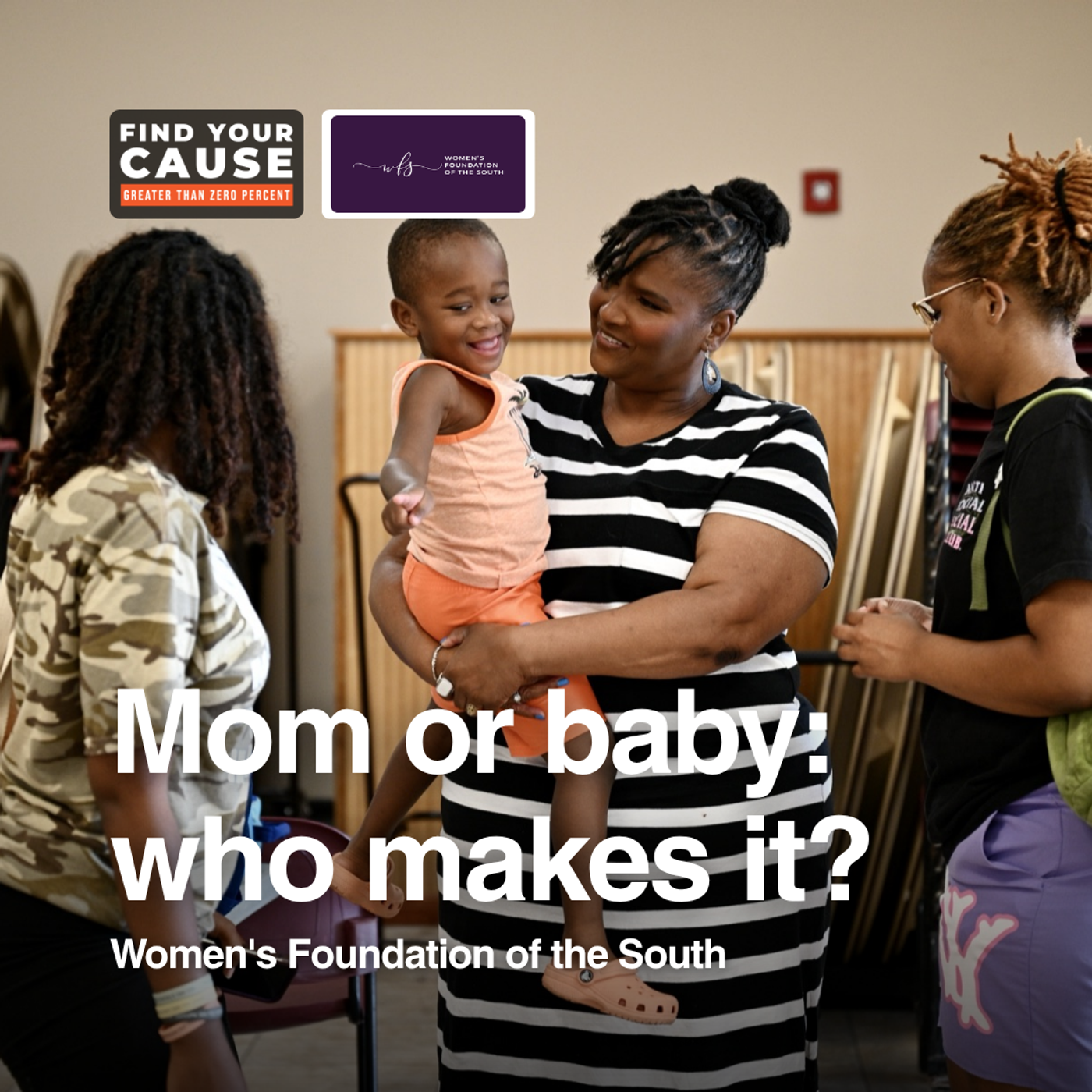
speaker-0: And what I'm told is that the question is, who makes it? Does mom make it? Does baby make it? And in some cases, it's not both. If you have a high risk pregnancy and you are in labor and there's no birthing facility within an hour or 90 minutes of your home, what happens is they medevac the mom. From her home to take her to the nearest place where she could have birthing services. speaker-1: Alrighty, so thanks everyone for tuning into this episode of Find Your Cause. On this Tuesday, we have Carmen James Randolph, who is the founding president and CEO of Women's Foundation of the South. Carmen, thank you so much for your time today. speaker-0: Thank you for having me, Joseph. speaker-1: Yeah. I almost said Friday because normally we do these on Friday. So I'm like, God, it's actually a Tuesday. So it's crazy. So usual, we like to start with the mission of the organizations and foundations that we're interviewing. So what is the mission of women's foundation of the self? speaker-0: The Women's Foundation of the South is dedicated to the prosperity of women, girls and gender expansive people in the South. And our mission is to build their health, wealth and power. speaker-1: So we're gonna get into all those details, but before we do, why you? Why is this something that you've invested a large part of your life and passions into? speaker-0: Joseph, I've worked in the nonprofit sector and in philanthropy most of my career. So started as a baby, but I have spent the larger part of more than three decades in the nonprofit sector and in the philanthropic sector. And I would say as a young woman entering the field, my desire always was to make a larger impact. I had learned firsthand working in nonprofits with children in the inner city in Washington DC, just how injustice shows up and what that looks like in terms of education, educational opportunities in a real way with kids in literacy, with parents who are struggling to make ends meet. and who absolutely want the best for their children and are struggling to see that path forward. So I worked in communities and had the opportunity to build relationships with children, with families, with moms. And always I found myself not that those individual relationships were not important to me, but how do I make yet a bigger impact. And my first foray into working in traditional philanthropy was with the Meyer Foundation in Washington, DC. And I would say when people think of philanthropy, typically there's a model of charity that people think of. They think of just giving dollars and the giving and the grant making happening because it makes someone feel good and it because it will do good in the community. And I feel and have experienced and lived philanthropy being so much more than charity. And I've had the opportunity to work in philanthropic environments where philanthropy was seen as a catalyst. It was used as a catalyst for everything from economic development Creating an arts corridor in a community and totally changing what that that corridor looks like and feels like and who has the opportunity to live there and thrive there, to being an impetus for making lasting change in terms of education reform or other areas of system reform. I came to the South to the Greater New Orleans Foundation. In 2014. And since being in New Orleans, and I came here with the same kind of passion to use philanthropy as a catalyst, as a tool for change. And it was at a time when New Orleans was still rebuilding after Katrina. We were approaching our 10th anniversary of Hurricane Katrina. A lot of the built environment was coming back. But the hugest question that was on the table was one of equity. It's like how do we build the human capital and and invest in the people so that the people benefit from a rebuilt community? And I would say from that moment to even where we are now, that the biggest challenges still remain. How people realize The tremendous benefit from the revitalization and the livelihood, how their lives are anchored and supported in this community. But while here, or since being here, I've always had a passion for kids, I've always had a passion for moms, and I've come to understand how on the policy front and just in reality. How there were so many issues that pertained to women, to families, to girls that were on that were not being talked about, that were not on anyone's philanthropic priority. For instance, we didn't have a fund at the Community Foundation dedicated solely to women and girls. People are comfortable talking about poverty and alleviating poverty, but when you really start to dig beneath the surface and talk about strategies that are specific strategies that help the very people who you're who are impacted by poverty raise from that situation, then you have to get a little bit more granular and talk about okay, what strategies work in black and brown communities or in indigenous communities. And that always I have found to be a place of friction where people were sometimes not willing to go there. But I see it as necessary if you're truly interested in changing systems. You have to change them and meet the people who are closest to the ground, closest to the problems, and from my vantage point, closest to the solutions and engaging them in the process. So I would say That understanding that maternal mortality was so incredibly high here, infant mortality also incredibly high, and yet it was not a philanthropic priority area. And remember, I was experienced and used to philanthropy being used as a catalyst to make real change, to make an impact. I saw that as a window, as a need to make change. And as I started talking to my colleagues in philanthropy about what the needs were in Louisiana, they're like, Carmen, that's not just a Louisiana issue. That's true here in Arkansas. That's true here in North Carolina. That's true here in South Carolina. And so the question of one of my mentors here in New Orleans, Lynette Gilbert, she asks, is your vision big enough? That came to me like, okay, Clearly, we're not thinking big enough. The need is beyond Louisiana. And what if we pushed out and looked at creating something for the South? It doesn't mean that there are not women's funds in other states, but what it does mean is that there isn't a regional organization that is dedicated to serving women, girls, and gender expansive people. who are elevating the issues, who are not scared to talk about the impact on black and brown and LGBTQ communities, and who can leverage dollars nationally, even internationally, to benefit the South as a region. We're very clear that we need more investment. The MIS Foundation does a report called the Pocket Change Report that looks at all of philanthropy and the investment in women and girls, and then the investment in women and girls of color. And of the $16 plus billion dollars that's invested annually, about $16 in some change goes to women and girls. And that sixteen dollars in some change per woman and girl. When you look at how much goes or supports women and girls of color, that number drops to five dollars and thirty six cents. And then when you look at how much of that investment for women and girls of color happens in the South, that number plummets to two dollars and fifteen cents. So we're talking about organizations that are Doing the most to hold up the sky, to fight for justice, to provide diapers, to address food security, to fight for housing security and affordable housing, workers' rights, voting rights, climate justice, or doing mentoring and support for girls. And on average their budgets are so incredibly small. And I personally see the work that they're doing as anchoring democracy in the South. This is democracy in action and it's led by women leaders who have the know-how but do not have the investment. speaker-1: Amazing. Looking historically at Women's Foundation of the South and the fundraising process, but more so the deployment of those funds, what were some of the early on people or communities or other organizations or injustices that y'all's organization started with and evolved to over time? And why? Initially. speaker-0: If you can believe it, we just celebrated our fifth anniversary. So five years ago in 20 speaker-1: Five years. speaker-0: Thank you. I feel like we are in kindergarten. We're doing it. We're moving up. But we opened our doors five years ago in the state of Louisiana. And I must say there was a tremendous amount of planning and support and engagement that. Happened among women throughout the field of philanthropy. We had about 85 donors who helped leverage the first $100,000 that we've raised to stand this organization up. They gave up their own treasure. Their organizations also matched their gifts, and they also asked allies and friends to donate to us. That activity. help leverage another one point two million in institutional dollars. So we opened our doors with one point three million and there was this beautiful kitchen cabinet of diverse women, white, Muslim, trans, black, brown, and young, who were planning everything from the mission, vision, and values of the organization to what would the operations plan be for the first year? What would the strategic plan look like for the first three years of the organization's development? So when we opened our doors, honestly, Joseph, we hit the ground running. We hit the ground ready to go. And within 30 days of opening our doors, our home state of Louisiana was hit by Hurricane Ida. And it was just devastating. And if I can take you back to 2021, we were still fully in COVID. This is pre vaccine. And we knew that these same leaders, these same organizations that our strategic plan had us doing listening tours and talking sessions. I'm sure you've heard that term, that because it's typical what foundations might do to learn from them and help determine what our focus areas would be. We're like, okay, These organizations have been in response mode. They've been in disaster response mode because COVID was in fact a disaster for months now. We know that they're weary and now they are in the midst of disaster support. And I had received a grant that had a mandatory regranting budget of two hundred and eighty-five thousand dollars. Now I'm gonna just be real. I was accustomed to managing portfolios of several million dollars. So that was my mindset. So it's like, okay, what can we do that's meaningful with less than $300,000 a year? And we thought really hard and what we came up with was we need to pour into these leaders who are responding, who are active in disaster, who are helping families And and who need support themselves because we know they're on the edge of burnout or they are burned out. So our first entree to supporting leaders, we looked at organizations that were across these three pillars of health and well-being, economic security and wealth, and then power building. And we looked at organizations that were working across these three areas. And we selected a portfolio of about twenty-nine organizations who were working within those three pillar areas. And we gave them grants to support their leadership and restoration. They were small grants, five hundred thousand dollars. I'm sorry, I said I just say five hundred thousand, five thousand dollars that they got to spend however they felt it was needed. They got to determine what best supported their restoration and their leadership. And we brought them together for a retreat. And we brought them together with other women leaders in their state. And the purpose of the retreat truly was them not just to rest, but to learn how to prioritize themselves in the midst of all the work that they're doing and to take what. we call a purposeful pause. And after that retreat experience that really looked at how they would incorporate this into their work, the application was very different for the funds. It took just minutes to do and it included a self-care assessment. Are you hydrating? Are you eating nutritious foods? Have you taken a vacation? Are you spending time with friends, family, and loved ones? Are you sleeping? Now I say you can't dream if you don't sleep. speaker-1: So speaker-0: Ask these women to answer these self-care questions and with a high of thirty points possible on the self care assessment, we found that these leaders on average were scoring about eleven. speaker-1: It's probably not a good score. speaker-0: No, not a good score at all. So part of their journey with us was can you choose one of these indicators and let's see where we're gonna strive for improvement and along with this grant that you get to tailor and use for your benefit. If you use it strictly for personal reasons, it's taxable. But if you use it because the grant went to the organization, so In one case a leader's mother was about to transition and the organization just didn't have the funds to just pay her to spend that time that she needed with her mother. But these dollars enabled her to take leave and be paid and be there through the transition with her mother. So there were all kinds of things that the organizations and the leaders chose for use of those funds. And it was such a powerful experience for the organizations, for the leaders to have to be trusted in this way. To like, there's no questions. We know you're doing the work. We have vetted you. We know that you are achieving incredible results. And now it's our time to support and hold you because you're holding your community. speaker-1: Is the logic that investing in investing meaning deploying capital in the individuals will long term have a more positive impact than deploying that capital to the actual organization's operations and like whatever value that operation of the organization brought to the community they're serving? speaker-0: We deploy the funds to the organization. They get to determine what support of the leadership looks like. We have some organizations that are co-led. We have some organizations that where an executive said or a nonprofit EG says, Hey, I really need to be the nonprofit EG. I don't need to be the janitor. I don't need to be the chief fundraiser. I don't need to be all these things. If I can have support that helps my infrastructure and gives me what about support for an executive assistant, then I can do what I need to be to do and be my best. But they get to determine that. So this is support that they get to basically customize and curate according to their needs. And what we have found investing initially, this is just the initial investment. We don't seek to make this the only way that we invest in nonprofits because, like I said, I gave you those horrible statistics in the very beginning. We recognize that they need general operating support. They need capital, but we have to capitalize fully to be able to deploy those kinds of dollars, right? So we've decided because those that investment turned out to be just pivotal in the leader's experience, the pivotal in helping a leader who was literally burned out and on the verge of burnout to find renewed energy to stay and create more supports for their leadership to Creating more practices in their organizations. We had leaders who turned around and created well-being stipends, who changed policies so that employees had paid leave and used paid leave. So really has changed the organization and in some cases has had impact on how those organizations have worked in community. For instance, one woman shared with us that She had done their organization was dedicated to helping survivors of domestic violence. And she said she realized through the retreat process and the grant that the thing that she was most missing was therapy for her own trauma. So she used those funds to support her own therapy. And through that process, she's like, okay, we are deploying our program through the lens of trauma and not the lens of victory. Why don't we look at how we do our work with a focus more on healing and a focus on victory? What does that look like? So it changed their practice for her to deal with her own trauma. So I just say that so that became our entry into Louisiana. And since then, we have built six state cohorts. Louisiana was our first. We determined that this was the way that we would enter other states. And honestly, it creates a very respectful and engaging path for a foundation to enter a community. And we bring these leaders together so that they can learn from one another and that we in turn. We learn from them, but what we center is their exchange and learning from each other. So they have that experience within their state cohort, but then we have now developed a program where we bring them together virtually on a monthly basis. So they get to exchange with other leaders who are doing reproductive justice work or birth work or working on affordable housing or working on voting rights or what have you. Working on civic mobilization, they're getting to exchange with leaders, Georgia and Texas and Mississippi and Arkansas and Alabama and Louisiana and Mississippi. They're now having this exchange across states. So that's how we started and that's where we are at this time. Now six state cohorts. speaker-1: I feel like there's something to be said, and I feel like it's hard to measure, of the whole idea of not reinventing the wheel and what can be accelerated by bringing in this case leaders that are all supporting the certain components of of focus that they have, whether it's women's rights or whether it's housing, et cetera, like bringing together like-minded folks that are working towards the same goal and how much further they could get towards solving whatever that focus or passion or injustices that they're working on compared to if they had not brought themselves together. And is I feel like it's hard to measure that of say you have five different people from five different states working towards the same goal, all the barriers that one could remove or share that they've overcame to the other so that when that happens, they have the tools to overcome whatever barriers that they're trying to get. And I asked that question of measurement, because with foundations, I know different foundations have different, I don't know, I don't want to say auditing for the negative sense, but how are you guys currently tracking that deployed capital and maybe what are some of the impacts that it's driving? speaker-0: Well, I think one of the ways that we are tracking the capital that we have deployed and the impact that it's having is strictly like through the impact on leaders. So if you just look at just our focus on leadership development and leadership support, how has deploying capital in this way that's based in trust that is user friendly in the sense that we are not making these nonprofits climb a huge impossible hurdle to be supported. So for us to deploy capital in this way, we look at the impact on their leadership because we evaluate what's changed on for their for them as a leader, on their organization. And on the way that their organization serves the community. And what we have found through this process with each state co cohort. Now we haven't evaluated Alabama as of yet, but with each cohort, we have seen gains of 50 to 60 percent in how leaders are describing the increase and the impact on their own leadership and in how they are personally improving. and in terms of their organization and their community. So that is for us a significant starting point to understand that this way of making an investment by centering first the leader and the leadership, however that organization describes the leadership, it's critical to looking at the overall health of the organization. So we also do capacity building support. We ask these organizations, what do you need in terms of capacity? So that's why they come together on a monthly basis. And that monthly experience is informed by the nonprofits themselves. So we've brought resources and experts to come talk with them and do work around leadership succession planning. on building culture within your organization very intentionally and what does that mean on fundraising, on just in terms of if you can imagine five years ago Roe v. Wade was intact, affirmative action was intact, and there wasn't an attack on DEI, of which now women is a negative word, let alone people of color or low income or any of these other things that are true realities in community. So I had nonprofits come on. Can we just have a conversation around with other health providers about how do we message about our work when vaccination is so important for our community? It's flu season. And since we're funded by this entity, now we can't encourage people to be vaccinated for flu or COVID. How do we message about our work? What's working for you when you're doing this? And let's look at, okay, let me try that. We've had every conversations like that to what do you do if ICE approaches your organization and demands all the W9s of people who you've worked with? And an entity say, let's look at knowing our rights. And how we protect our communities, how we protect our staff, how we look at what our rights are if we are faced with that moment. So as a regional philanthropic entity with partners with grantmakers concerned with immigrants and refugees, ABT, which looks at the health of black communities and others. We pull on these resources and we make these resources available to our nonprofit partners and really look at how we can help them. Hold the line. I wish I could say stabilize, I wish I could say grow, but in this moment for many of our organizations, holding the line is the victory. speaker-1: Yeah. I think it's really interesting how you are looking at deploying funding in some of the funding deployments you've shared of focusing on the leaders of the organizations first. Because in the example you shared of the person who worked with communities that have been impacted by trauma, you wouldn't even think about that leader likely making sure that they have the resources available to support them through their trauma. And if you potentially hadn't offered that option of having that funding deployed to support that, maybe that leader is no longer gonna be want to operate their nonprofit because that went unresolved or unsupported. That's an example of an initial measurement of if you focus on having these discussions of like what do you need as a leader to help accelerate your organization, think about you as an individual as a part of that thought process that kind of came about in that example. And you guys could have potentially just saved an organization from stopping operating because that was not a question asked. And then you already answered the second part of my question that I had of you don't know what you don't know as a nonprofit leader. Before I'm asked, where do I think capital could be deployed to have the biggest value add to my organization or to me as an individual? I think having resources come in and share ideas and having that capacity building conversation and hearing from other leaders. And then making a decision of okay, based on that, now I think this is an area of fundraising that I have a gap on or of XYZ areas. I think that's a very unique way to to look at deploying capital that's not as common as I have heard. I think the reason why it's not as common is it's a lot harder to track the impact and to document the impact because I'm sure some organizations and nonprofits you've worked with are like they know for every dollar we raise, we For example, every thousand dollars builds a well. So exactly where that money's going, exactly the impact, and it supports a community of five thousand in this third world part of the world. So it's easy to say like where that money is exactly going and the impact it's driving versus some things that are a little bit more harder to track and that way harder to maybe get approval for deploying that funding in certain areas. So a kind of thought process that you have of thinking about the leader. Yeah. speaker-0: And I would say to that end, these organizations are doing incredible work. I remember there was one leader who was talking about their work and they just had a huge win that they achieved in terms of policy. And she said, had I not had the support from WFS to take a purposeful pause, I wouldn't had the opportunity to step back. And think and dream of a different solution to move forward. Because when you're constantly in the work and if you are working from a place of crisis all the time, how can you see other possibilities if you are not taking that step back that we all have to take as leaders to be able to get another vantage point? The other point that I would make is this, as I said, this is just our entry. This is just the way that we've started. We've only been around for five years. So, in addition to the support that we've given directly to leaders and the capacity building support, we also do research where we aggregate data from the South in a series that we call Shift the South. So we aggregate data and research and policy. And we highlight nonprofits that are working on policy wins or blocking negative policies in the South. And we want to draw attention to why the that quote from W.E.B. Du Bois, As the South goes, There goes the nation, why it's important for everyone to pay attention to what's happening in state houses in the South. Because Quite frankly, negative policies have a tendency to proliferate or harmful policies, things that actually do harm to families. So we look at what the lift is that nonprofits are doing. We track the wins that they are achieving. And we just went through an eight-month process to bring nonprofit leaders together to design. A fund that would address, as they have defined it, the conditions to building power on the ground in the South. So we fully understand that women anchor the ground game in the South. We're not interested in raising small amounts of money to support the ground game, because we asked the question: what could they do if we 10Xed their work? What could we do if we 10Xed The ground game in this moment. And they have co-designed this fund to say what it is that they would need and what the conditions are to build power on the ground. To me, it's quite profound. And so we're hoping we're launching this fund. It's called Amanla. The Amanla fund, our goal is to raise $15 million over the next five years and to deploy. at least two to three million a year in community over the next five years. And our thinking here in our nonprofits push, they said, okay, because we initially said a $10 million fund and they said that's not enough. And we agreed that $15 million would be the floor to support this work. Because you have women leaders who are leading movements in the South on every front. Whether you're talking about labor, voting, civic mobilization, economic justice, climate, you have women leaders who are behind this work and they need what's missing is the investment in their success. So that is a fund that we are in the process of launching, and I'm happy to provide anyone more information. on that fund and what its priorities will be. But we see that as a lovely complement to our Shift the South work because we do a legislative recap every year that basically tells the story of what happened. Right now we're focusing on seven states. What happened in the state legislatures in seven states? What were the wins? What were the blows and what were the mixed results? for women and families in those seven states. So all of that is the mix of how we invest. speaker-1: Amazing. And I feel like you partly answered this with the fund that you guys are building. But five years from now, when you look back, what do you hope to have achieved at that point? So in the next five years. speaker-0: In the next five years, a few things. One, we built this to be a foundation that made impact. And I hope in five years we have attracted other like-minded aligned donors who are looking to make impact that they can see, that they can touch, that they can understand in the South. So there is an incredible opportunity, I think, to join us and to decide what kind of future will we underwrite with wealth, with resources in the South. Just to give you an idea, the next fund that we're looking to launch is a fund that focuses on maternal and infant health. I mentioned that maternal mortality is so high. in the South and we believe that health, I'm sorry, that health is the starting point for wealth and for power. So we're looking to start this fund and we understand that with hospital closures throughout the South, in some states there are women and families that do not have prenatal care, access to prenatal care. And access to birthing services in more than two-thirds of the state. That's the case in Alabama. Can you imagine? So driving to get prenatal care can be a 60-minute drive to at least get access to prenatal care or birthing care services. So imagine in a state like Arkansas, which has one of the highest rates of maternal mortality in the country. If you have a high risk pregnancy and you are in labor and there's no birthing facility within an hour or ninety minutes of your home, what happens is they medevac the mom from her home to take her to the nearest place where she could have birthing services. And what I'm told is that the question is who makes it? Does mom make it? Does baby make it? And in some cases, it's not both. It's one or the other might make it. That doesn't have to be. And we can look at the opportunity of investing in creating safe birthing centers in community. There's old wisdom that brought babies here safely, and between midwives, doulas, and doctors, to me it almost makes sense. It'll make more sense to Medevac a doctor in to a birthing center for a high risk pregnancy delivery or challenge than sending a mom out of her community. But I think and I just bring that forward to say that there is opportunity for us to make real changes. And to look at investments and changing systems and changing realities for women and families in an incredibly impactful way. So five years from now, I hope I have a circle of new friends. I hope that we are still linked arms with our old friends who helped us launch. But we have this broader circle of new friends who care about what happens in the South. who understand the power of the collective to make real change and impact, and for us to see considerable changes and drops in how many women are surviving pregnancy and birth in the first year. We should not be a country in the development world with conditions on par To some third world countries for how women are faring in birth and childbirth in the first year. That is just unacceptable. And we can make those changes and we can make it happen. So that's just one example. But we have a goal of at least being a hundred million dollar endowed foundation with at least fifty million of that going towards endowment. So if we can accomplish that with a new circle of friends who are interested in helping us build, because these are generational challenges that really need generational investment. And I see many ways that philanthropy can operate and be catalytic. I say often now we start in our investments by providing this infrastructure of care. Caring for the leader, caring for the work of the organization. And what would it mean if from this infrastructure of care we also hold space for nonprofits? We hold sacred, trusted space for them to come together and grapple with these tough issues that they're grappling with. But then the sweet part, if we can really invest in a way that makes their work sustainable, that makes it so that a leader like Mary Schulteis, I'm naming her because I just love her and I love all of our leaders, but this woman, her organization, was singularly credited with lowering infant mortality in the largest parish in Louisiana by more than fifty percent. So Over thirteen point something percent down to six point five percent. So you get infant mortality down to just a little over six percent. From my vantage point, that's a win, and we're saying, okay, we can eradicate it. No baby has to die in twenty twenty six. And the state responded by celebrating her and then pulling the funding. Great job. And then determining it wasn't needed. And Mary is so dedicated to her families, to the work. She's continuing to operate a one point three million dollar program, which is five hundred thousand dollars a year, and trying to do it at the same level of service, providing supports for moms, for young fathers and babies. And I don't think that should be, I don't think that should be Because we have real lives at stake and I think we have the real power to make change if we work together. speaker-1: Amazing. Two final quick questions I have for you. People that are listening and wanting to get engaged or learn more, what's the process? speaker-0: First, please visit our website, ww.women's foundation south dot org, and we can take donations and there's many ways that people can donate and support us from monthly donors to donations of stock or DAF donations. We are open to all levels of investment. You can the name of our staff person Harmony at Women's Foundation South, you can reach out to her if you have a specific way that you would like to donate. But on our website, also you can sign up for our newsletter. We do try to project this regional picture of the South, and our newsletter is an excellent way of getting informed. And we invite you to join us in this movement. speaker-1: Amazing. And then is there anything we missed so you want to leave us with before we wrap up? speaker-0: I would just say we are headed towards Thanksgiving, if you can believe it. So we are headed towards this season of gratitude and this season of giving. And this is a time for people to think about their end-of-year contributions, not only for WFS, but for those nonprofits in your community that are doing incredible work. If you are the holder of a donor advice fund. Now's the time to put it to action because the need is incredibly great. It's incredibly great in the South and throughout our nation. Food security, for instance, is an issue that we have nonprofits that don't work in food security now operating food banks because of the need and for the hunger in their communities. So now is just a very important time to give. And there are incredible tax benefits. So if you have questions about where you need to be in terms of your tax deductible gifts, and the exciting thing for us is that any gift over at five hundred dollars and more would be matched dollar for dollar by an anonymous donor. So I just hope that in this season of giving and thanks, people recognize the needs that are in their community and get involved. speaker-1: Well, Carmen, thank you so much for your time on this Tuesday. We're honored to hear and share your story and the work you're doing. And people that are listening will also share all the links in the show notes below. So if you want to learn more about Women's Foundation of the South, follow the links and feel free to reach out to Carmen with any other questions you have. Otherwise, thank you again so much for your time, Carmen, and best of luck into this holiday season. speaker-0: Thank you, Joseph. Thank you for having me.