
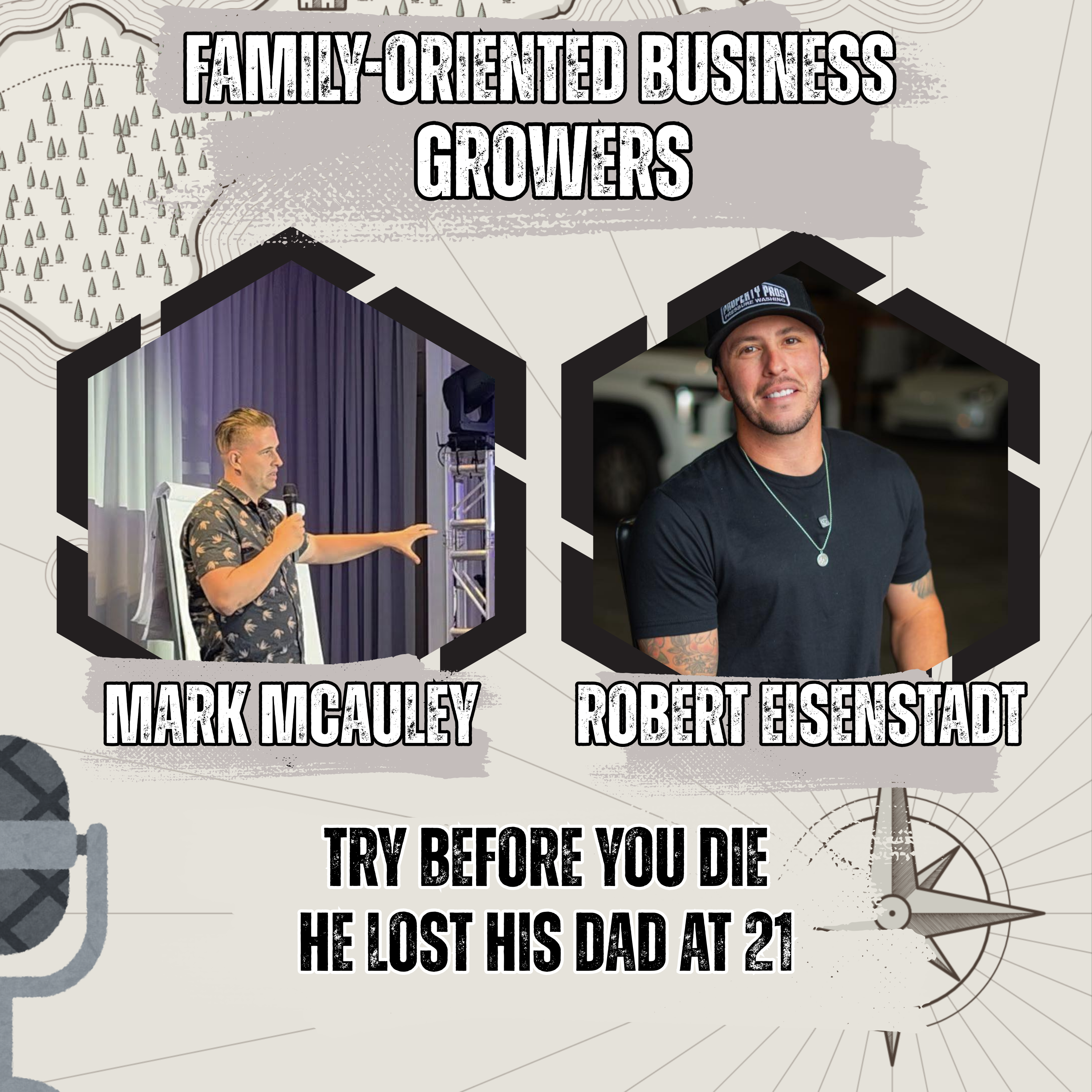
Family-Oriented Business Growers · Mark McAuley
Robert Eisenstadt runs a very successful pressure washing business as well as the Commercial Pressure Washing community group (with resources and recently their first live event, link at the end) - but he wouldn't have built it to what it is now if his wife hadn't noticed that the remodeling & carpet cleaning side of their business was losing them about $20,000 per month! And he wouldn't have even graduated to that problem if he was never spurred to start his business in the first place. How did that happen? When Robert was 21 his father died and Robert was unable to get the time off that he wanted to handle things with his family. He promised himself that he would never again let someone else be in charge of his time like that. Join us on our conversation as we talk about how Robert is now hyper-intentional with his family, what he has learned from his business' growth and his relationship to mortality & legacy. Join the Parents Growing Cleaning Businesses group & get your free "Save 5 Hours Per Week" Time Audit via www.warplan.au Check out the Sarah Blakely clip referenced in the interview here: https://video.wixstatic.com/video/0aac73_e876b7c301b048628da04e066dca28ad/1080p/mp4/file.mp4 Get in touch with Robert here: https://www.facebook.com/robert.eisenstadt And lastly, join the Commercial Pressure Washing Group here: https://www.facebook.com/groups/999291775282305/
Mark McAuley: Hey, hey, welcome to all of you bandits and chilies. Today's guest has just run his first live industry event, commercial pressure washing live, which for a kickoff event pretty well. had 85 people show up all from organic traffic, advertising at all. Very first event, which must be ⁓ really epic itself. ⁓ He also property pros, which has kind of like. two or three different, we'll get into the specifics, you know, sort of pressure washing, Christmas lighting and air conditioning. So to tell us more about that and to lay the scene out, Robert, how are you? Robert Eisenstadt: I'm doing good, man. I appreciate you having me. I'm looking forward to this. I see a lot of your podcasts and see you crushing it. So I appreciate you ⁓ asking me to jump on here. Mark McAuley: No, I appreciate you being here. I appreciate you being here. Just really quickly, I got to the end of that intro and I was like, I have no idea how to say your last name. Robert Eisenstadt: Yeah, most people don't. It's Eisenstadt. Mark McAuley: Great, okay, fantastic. So now we know who you are. us a little bit more about, ⁓ like, set the scene ⁓ the business journey so far and like kind of just paint the picture of like what ⁓ Property Pros was and is and all that kind of stuff. Robert Eisenstadt: Yeah, when I was 21 years old, my dad died ⁓ ⁓ ⁓ heart attack. ⁓ was working at a Ford dealership. Long story short, they basically told me I couldn't take the time off that I needed ⁓ handle his estate, like his funeral, he was upside down on the house, all kind of stuff. And so I basically told ⁓ myself I would never let anybody ever be in control of my time again. ⁓ I wanted to start a business, and it's funny, because you do this, right? So I actually started a carpet cleaning business. nothing about marketing, had a horrible name. Hired my friend, guaranteed him a paycheck of 800 bucks a week. Went broke. Had to him go and started knocking on doors, so we started doing carpet cleaning. We added on services. Started doing rent-readies for management companies. And then one day a buddy of mine called me and said, hey, we just fired our pressure washing contractor. Do you want the contract? I said yes. So we added pressure washing. to find out, the Handyman Company had grew pretty big. We had like 15 trucks on the road. We were doing a lot. ⁓ I was losing $20,000 a month. I had no idea because I wasn't paying attention to my numbers. My wife went through my books and sat me down and said, hey, you need to figure this shit out. You're losing ton of money. Mark McAuley: That is a great question if I don't say so myself. Can't wait to hear the answer in like 14 seconds from now. Just wanted to jump in and let you know about the free time audit designed specifically to save five hours per week for parents running cleaning businesses. It takes about two minutes to complete and you get your time saving results straight away. To get your free time audit, join our Facebook group via warplan.au, link in the description. Now, what was that cliffhanger question again? Robert Eisenstadt: So we got rid of the carpet cleaning, rid of the handymanic construction side of things, focused on just pressure washing, and basically went from 70,000 to seven figures within three years. Mark McAuley: Yeah, wow. Okay, a lot. ⁓ a lot to unpack all those threads. So first of all, really sorry to hear about your and that whole situation at the time where you, ⁓ I this was the catalyst for you getting into the business and everything, but just not having that ⁓ life to be able to be there for your family in that way, ⁓ that been really difficult. Robert Eisenstadt: Yeah, ⁓ know what man, definitely taught me that everything happens for a reason, cause you're right dude, I wouldn't have my businesses, I wouldn't have my ⁓ I wouldn't have my family, like everything happened ⁓ it was supposed to happen. It took me a long time to be able to realize that and I appreciate you saying that, but definitely at peace with it man, you know? I I miss my dad, I gotta... I don't know if you can see this, but I got his portrait tattooed on my arm and wear his ashes around my neck every day and ⁓ with me so, but ⁓ that never happened, it wouldn't be where I'm at, so I gotta be at peace with it. ⁓ Mark McAuley: Thank you. Yeah, yeah. So on the business side of things, the services that you'd out with and that transition of like the numbers are not making sense, the math isn't math-ing, how did kind of end up from... Because you're running ⁓ a set services now that are completely different to what you started with. ⁓ Robert Eisenstadt: Yeah. Mark McAuley: and how did you end up here where you are? And do you think it has anything to with the services themselves or is just that's kind of been the evolution of it and you now know enough to make these services work? Robert Eisenstadt: Well, I mean, think it was really just a thing of paying attention to what we were dealing with, right? Like, and let me paint the picture for you. For example, we were cleaning carpets inside of residential homes. We were doing bathroom remodels and kitchen remodels inside of residential homes. And then we had this $70,000 worth of commercial pressure washing contracts. And I was losing all the money was in the carpet cleaning and the remodels, right? And plus it was a huge headache. dealing with a lot of these homeowners. Like for example, we'd go remodel a shower. Somebody like the homeowner would pick out the tile. We'd put all the tile up and then they'd be like, I don't like this tile. And it's like, you picked it out. know, I don't know what to tell you. So it was a crazy thing. So after I found out that I was losing a bunch of money, I looked at the pressure washing and I was like, okay, we're profitable on pressure washing. Like, let's just stick to this. ⁓ was really a numbers thing on why we made the transition. And it just made the most sense. And it was one of the best decisions I've ever made. Mark McAuley: Mmm. Yeah, yeah, and I love it. And guess just to of drill into that point, all of those businesses can work and the model could be fixed on any of those. But I guess at the time, because this is an interesting thing that can happen because it's weird to think, like even though we know, like cognitively we know, it is weird to think that you can be busy working, running the business and either have one that is just leeching and not... ⁓ profitable at all, just like piggybacking on the success of the others. Or even an entire business that is not profitable and yet you keep running. Like it sort of seems like that shouldn't be possible. So for people that ⁓ be like, ⁓ might be the reality in their business right now and they don't even know it, what would you say to them in terms of how to go about identifying that and how to even, like what numbers do they need to be looking at? Robert Eisenstadt: Yeah, mean, dive into your profit and loss statement, right? Like, are you spending your money? I know if, well, you Nick, right? So, well, actually, I don't know if it was Nick or if it was Josh, but, you know, mission critical expense audit. Have you ever done something like that? Mark McAuley: Yeah, yeah. Just for the benefit of the tape, Nick Demarck and Joshua Latimer. Yep, carry on. Robert Eisenstadt: Yeah, sorry. Nick DeMarc ⁓ Joshua Latimer, great, amazing people. But anyways, ⁓ Critical Expense Audit ⁓ basically going through ⁓ single expense that you have ⁓ looking at what your mission is, right? Like ⁓ your mission is to grow and scale a business ⁓ you maybe it's so you can have some kind of financial freedom for your family, whatever that mission is for you, going through every single expense and It's a simple yes or no. Is this mission critical or is it not? Right? Like do I have to have this expense? And I still do that to this day because it's like engraved into my head. Like literally yesterday I was doing this and I found a $10 a month subscription. What was it for? It was for, oh, it was for Uber, Uber something. And I was like, I don't need this. And it was like, oh, you saved $140 over the past like, Mark McAuley: Hmm. Robert Eisenstadt: Four years, I'm like, no I didn't because I'm spending $10 a month on this platform that I don't need, right? And so, defining the expenses on what is mission critical and what's not is super important. And just realizing where your money's going and what's the most profitable, right? So dive into your profit and loss statement. I like to look at our profit and loss by a percentage of income and then we run job cost analysis sheets and all that stuff which. I'm assuming you, I think you know all about, right? Mark McAuley: Yeah, yeah. So another thing just to kind of like, if we zoom back to that point, because it was your wife that flagged the financial issues for you. At that stage, did you have, what was your relationship like with your numbers? ⁓ you have trepidations that even looking at the numbers, it sounds like you weren't like very on top of them, but like, were you kind of like worried to look at what the reality of the situation was? Robert Eisenstadt: Yeah. No. ⁓ non-existent. had a bookkeeper that I thought was doing a good job for me and they weren't. My wife didn't know how to look at a profit and loss statement so she literally went through every single credit card statement, every single invoice that we had, like she did it like the super old school way, right? ⁓ we figured that out, obviously we found a different bookkeeper. She's amazing. She creates budgets for us. ⁓ I mean, at end of the day, was a constant game of robbing Peter to pay Paul, right? So like, Mark McAuley: Yeah. Mm. Robert Eisenstadt: A lot of our jobs were net 30, they still are, but a lot of our jobs are net 30. So we would get, we would put a bunch of expenses on the credit card. We would do a job. We would get paid 30 days later from whatever job it would be. We would use those funds to pay off the credit card. And then we would go run that credit card again to get more materials for the next job. And it was just this constant game of like getting paid to pay the credit card off and then do more work. Right? So. From then to now, now I look at my P &L probably three or four times a week. have numerous budgets that we look at. I have ⁓ seasonality and maybe ⁓ Nick you create some of that stuff too. ⁓ So you know exactly what I'm talking about ⁓ as as our budgets and our revenue goals, capacity goals, all this stuff, right? Mark McAuley: Yeah, yeah. Yeah, so... Yeah, Nick DeMarc, he's very much like his superpower is basically the numbers being the numbers guy and his voice lives rent free in my head when because I know I know what his first would be around any any decision in the business, right? It's just this default blanket statement ⁓ test and measure. And that's basically his approach to everything. Because it's like, don't know whether this is the right decision to make. You don't know whether this service ⁓ is or whether this advertising method is worthwhile whatever. You've just got to do it. You've got ⁓ to track you're doing, test it out, it, iterate, all that sort of stuff. But that was really, from my time ⁓ working with him, that was the main thing that I think that he just drilled into my head was just that phrase, test and measure. ⁓ Yeah, yeah. And what you don't measure, becomes this sort nebulous problem. You don't have any way of separating, even the services thing, If you don't ⁓ know what's for the carpet cleaning side versus the handyman side versus the pressure washing side, and it's all just Robert Eisenstadt: Yeah, what you measure you can improve. Mark McAuley: numbers, the business could be, you know, profitable, but it's actually only one of those services that's making it profitable. And the other two are just like piggybacking or whatever. that's ⁓ yeah. Robert Eisenstadt: If I knew back then what I know now, I definitely could have fixed those services and made them profitable, right? But I don't regret my decision to switch to just the pressure washing. Again, we had this conversation before, I truly believe everything happens for a reason. It happened how it was supposed to happen. I didn't have mentors or coaches or anything like that back then. I was kind of just... Mark McAuley: Mmm. Robert Eisenstadt: in the pure entrepreneurial way, building the plane as I'm flying it. You know what I mean? I was just trying stuff and seeing what stuck. Mark McAuley: Yeah, that's it. And you do the best you can with the information that you have and the level that you're at and whatever and make it work. curious to get your thoughts on because something that I've this myself well and as a mistake. ⁓ And I a lot of people in industry groups all the time talking about this of adding different services. So you've started out multiple services. You've cut some services. And then you've added different services. What is the main thing that you think about now what you know now as to whether or not adding a service or getting into a different service is the right move? Robert Eisenstadt: well, now coming from a point of vertical integration on how I can serve my existing clientele. Right? So like, for example, the Christmas lights, we do a lot of work with HOAs. ⁓ I ⁓ that single Christmas, ⁓ most the neighborhoods decorate their neighborhood entrances. Right? Why wouldn't I make that a reason for me to be able to serve them in that, in that manner? Mark McAuley: Mmm. Robert Eisenstadt: Right. So. Mark McAuley: Mm-hmm. Just to challenge you on that a little bit, right? Because this is like threading the needle here. Because you could also say, well, all of those HOAs, they might, by the same logic, you could be like, I should be doing lawn care, I should be doing gutter cleaning, I should, you know, there's like 50 other services that you could look at as an opportunity. So how do you distinguish between, okay, yeah, Christmas lights, yes, lawn care, no. Robert Eisenstadt: Yeah, please. Well, the thing that got me into Christmas lights was really just an industry of Anna went to the huge convention and a buddy of mine was we were sitting there talking and he was like man I made an extra few hundred grand this year in a couple months Doing Christmas lights and I was like fuck it. Let me try it And that's the god-honest truth, right? Like that's literally how that went But we do have plans to open several more companies over the next ten years to vertically integrate more Mark McAuley: ⁓ Yeah. Robert Eisenstadt: We just opened up the air conditioning and heating company to service more of our industrial and commercial clients, gas stations, grocery stores, industrial complexes, retail shopping centers, and kind get that maintenance going for them. But you're absolutely mean, can landscaping, restoration, painting, drywall, a million services that I could add. Pool service, right, for community pools, the list goes on and on. have an idea on the that I want to provide that sound interesting and fun to me. ⁓ And are just kind of the ones that I'm going for, I guess. I think life is a big game and we're just trying to get to the next level. Mark McAuley: Yeah, love it. Okay. So I'm listening to this through the ears of someone who, I'm trying to prevent them from making a mistake. And I know like for me, I did this ⁓ when it basically just me on the tools and I see lot of other people do this where they look at ⁓ the app, that opportunity of like, okay, I'm already in this person's house. I'm, cleaning this. could that on and then I can do. Robert Eisenstadt: Okay. Mark McAuley: you know, four different services for potentially for every client, right? So therefore makes sense. and one of the big problems with that is that if you then, if you start out with that as you, you can probably do an amazing job because like you really care about your business, you're invested in it. You're going to like do all of the, ⁓ the, training and everything for each of those things. But now you've added all this equipment and then when you want to train someone, they now need to be proficient in every one of these things. And you're probably going to have at least one of those services, which like barely gets done ever. And so that's like something they need to remember like three months apart from the last time they did it and all of that. So it adds a lot of complication and friction. maybe as you answer this, maybe like kind of define what you mean when you say vertical integration, and then also like, how you kind of preventing ⁓ that What's the difference between that scenario that I've just painted and how you're now approaching adding a service. What's the difference between that scenario that I've just painted and how you're now approaching adding a service. Robert Eisenstadt: Yeah. So you're talking about being a jack of all trades and a master of none. Right. And so difference is, is I started, I wanted to be a jack of all trades and a master of none. Right. But when I was able to dial back, I became a master at my craft and dialed in everything. Right. Like I knew everything about, about how to clean. Mark McAuley: Yeah, essentially. Robert Eisenstadt: I started to learn how to run a business. started to focus on all of the things that I needed on my one core service, right? ⁓ ⁓ a lot easier for me to add other services because I have so much experience and knowledge under my belt, right? Like my business now is completely systemized. I could leave for ⁓ amount of months and it will continue to run and grow, right? ⁓ just like you. And it's a difference of me starting out and not knowing. Mark McAuley: Mm. Yeah. Robert Eisenstadt: versus me already going through the trial and error of doing all of these things, trying to add all these services, right? Like I've built the proof, right? So I built the proof of taking a business, implementing systems and scaling the company to where now ⁓ can take those same systems and implement them into another business, right? Like I know the steps that I need to take. Mark McAuley: Mm. Mm. Yup. Robert Eisenstadt: because I've already taken them. Now, you talked a lot about mistakes. We might have a completely different mindset behind mistakes, which is completely okay. I think failing is one of the best things that people can do. Mark McAuley: I just, actually literally just yesterday I got some new shirts made and I don't know if this is going to come up on the camera very well, but it's ⁓ success and failure like mirrored because like basically the, the, the freedom to fail is the substrate of success. So yeah, a hundred percent. Yeah. Robert Eisenstadt: Yeah. I love that. Yeah, well, Will Smith says it a lot. I don't know if you ever heard him say it, but he says fail often and fail forward. ⁓ You know, everything that's good in my life has come from some kind of failure. Right, like it's like that old saying of kid has to fall off the wall to learn the lesson. Mark McAuley: Mmm. Yeah. Mm-hmm. ⁓ Yeah. So I guess, I guess where I was coming from is more like, it's not that you should be afraid. it's not that you should be seeking to never make a mistake or to never fail. but also you don't want to fail unnecessarily. Like, ⁓ you've benefited a lot from coaching and mentoring. to me, it's like, if someone's listening to this episode, they're gonna, there should be way for them to take something out of this and go, okay, that's going to prevent me making this mistake. Cause I can learn instead. from Mark's mistake or from Robert's mistake. now I don't need to make that same one. That path's been trod before me. So that's kind of the approach I'm taking with it. But yeah, 100%. ⁓ Robert Eisenstadt: Yeah, I mean, like I said, master your craft, stick with your one service. try to branch out. Don't be the yes guy. Don't, don't ⁓ on more than you can chew ⁓ ⁓ the one thing. And once you master the one thing to a point to where you can literally write it down of everything that needs to be done and delegate it to somebody else. Then you can ⁓ to think about focusing on something else. ⁓ is not, ⁓ is not addition. It's, it's, it's subtraction. It's elimination, right? Mark McAuley: Yeah, yeah. ⁓ Mm. Robert Eisenstadt: So like for where I am or you are or a lot of people that I know are, it's not about adding more, it's about getting rid of, right? But for the people that might be listening, that might not make a lot of sense at the moment, right? Because they're like, well, I need to add more services. I need to make more money. I need to do this. Yeah, sure. But you need to in everything that you're doing now so you can then eliminate and delegate. Mark McAuley: Yeah, yeah. Yeah. ⁓ Robert Eisenstadt: Right? Because once you have somebody else that's focusing on the systems that you've built, then you can start to add other services. Mark McAuley: Yeah. So this is reminding me of, Tommy Melo says you've got to nail it before you scale it. ⁓ so that, that idea of, as it pertains to doing multiple services, I'm, curious as to what you guys do at the moment in your team, but like for, for an individual person starting out and doing like a bunch of services and then training someone that's, that's going be really overwhelming, especially when you're figuring out the systems and everything goes along with it. Do you, for technicians, Do you have roles that are doing multiple services or are they mainly like kind of sticking in their lane? I assume with the Christmas lights that it'd have to be because that's very seasonal. yeah, are the technicians doing multiple things or are they like very much this is the service that I do and that's all I touch? Robert Eisenstadt: Commercial pressure washing and exterior window cleaning. Mark McAuley: Yeah. Yeah, that's it. just had to Google this because I was trying to remember who it was. ⁓ think of her name. ⁓ Sarah ⁓ ⁓ the founder of Spanx. I don't know if you've heard of her. ⁓ a self-made billionaire. I believe mainly from that business. But one of the things ⁓ I her say in an interview one time, which like really just touches on all this, was that her dad, when they were kids, Robert Eisenstadt: That's it. Sounds familiar. Mark McAuley: he would always, at the dinner table, he would ask them, what's something that you failed at today? if they didn't have a good answer, he wasn't browbeating them, but he was basically, ⁓ it just that the culture in their household was like, that's not good enough if you didn't fail at something today, because it meant that you weren't trying. And she just talking about how that ⁓ really impacted her with failure and relationship with success and that that freedom to fail. I just think that is super powerful. I think that's only for like the statement itself, but also specifically for like the how we're framing those conversations with our kids and like the culture that we're fostering at home around around that kind of thing. Like when they when they stuff up when they go out and ⁓ a mistake, what what's their relationship with failure because of how we react to it. I just think that's really cool. Have you heard that before? Robert Eisenstadt: No, I haven't, but I'm definitely gonna look it up after this. Mark McAuley: Yeah, yeah, check it out. I think it was like some podcast that she did or possibly even like a keynote speech or something. Yeah, that's it's really cool. Anyway, that's that's a rabbit hole. And you know, I'm just like, Googling in the middle because I was like, I can't remember her name. I always forget. What was that? Sorry. Robert Eisenstadt: No, it's good. I appreciate you saying that. I said I appreciate you bringing that up because I'm going to look it up as soon as we're done here. Mark McAuley: Yeah, yeah. I'll pop a link for it actually in the show notes when the episode's done too. So if you're listening, it'll be in the description. Okay, so with that business journey, and you've said a couple of times everything happens for a reason, but what have been the defining moments that have your business to where it is today? Like what have been things along the way where you've really, there's been a fork in the road. ⁓ Robert Eisenstadt: Perfect. Mark McAuley: And something's happened this way or that way and it's really shaped how you've gotten to where you are now. Robert Eisenstadt: coaching. mean, it's ⁓ ⁓ dude like Finding somebody... look, ⁓ I have gotten to where I am? Probably. It would have taken a lot longer though. Finding somebody that done the exact thing that you are wanting to do is And ⁓ like the way that I coach people, I like say that I become a partner in their business without them giving me any equity of their company. Right? Like, I mean, I've helped people build out their products and services. I've helped them with bids. I helped them with cold outreach. Like I literally become a partner in their business without getting any equity. But the problem was for me was finding somebody else that could do that for me. Mark McAuley: Yeah. Robert Eisenstadt: And so once I was able to find somebody who genuinely cared and really wanted to help me, it changed everything. And so... Mark McAuley: So who did you, did you work mainly with one coach? Did you have a couple that have helped you along the way? ⁓ Robert Eisenstadt: Yeah, there's a few and not only coaches mentors to you know I think that those words kind of get tossed around a little bit too much you know somebody that you could just call on for advice I have a ton of mentors man You know Brandon Vaughn Joshua Latimer Carlos Gonzalez Craig Harrison Matt Clark Nick DeMarc There's a there's a ton of a man And all of these people have been in my corner when I have an issue, hey, what should I do about this? They help me. And it's been one of the most pivotal things that has been so transformational throughout my life to be able to have that kind of network where you can call somebody ⁓ trust in the fact that they are going to give me the best possible advice that they know of ⁓ help me get through whatever ⁓ I'm at. Mark McAuley: Yeah. Yeah. Yeah. Yeah. Robert Eisenstadt: And obviously it's grown, like that network has grown immensely now, right? And so some the events that I have attended, you know, I've created amazing relationships there. Another part of the reason why I decided to make my own. But honestly, it's just seeking the education and the mentorship has been. It's so life-changing, Mark McAuley: Mm. Mm. Robert Eisenstadt: Especially for me because you know my father died when I was 21. I don't have somebody that Could go to for life advice all the time, you ⁓ Mark McAuley: Yeah, yeah. No, that's, that's, super powerful on that extra level as well, because you in a good mentoring relationship or in a good coaching relationship, there is kind of that sort of fatherly dynamic, if we can call it that, in the sense that it's, it's not someone who's there to be your friend 100 % of the time either. Like there's gonna be that bit of pushback and that bit of calling you out and all that kind of stuff as well. I for me, hugely, hugely impactful of, because like you you can do it yourself ⁓ and you can that you shouldn't touch the hot stove ⁓ by touching it. Like even right now, I've been looking at, ⁓ so our oldest, ⁓ Felix, he's five. Robert Eisenstadt: Right. Mark McAuley: And so we're probably like a little bit kind of off this, doing like some down versions of this, but I've got my eyes on taking him to do like a ⁓ like like like abseiling rock climbing thing. And there's a place not too far from us that like runs tours and that kind of stuff. And when you think of something like that, someone had go first. Someone had to be the first person to do that and to climb a rock face ⁓ and whatever. Robert Eisenstadt: Yeah. Mark McAuley: But with or without equipment, I'm not just going to go and do that. I'm going to go and join someone's thing that knows exactly what they're doing and how they're doing it so that they can show us. And so it's going to be easy. And I have full confidence when doing that, that I'm going to go with them. It's going to be like the appropriate level difficulty. We're going to have the right equipment. We're all to have a great day and a successful journey, and we're going to make it back alive. I have full confidence in all of those things. If I was just to go out there myself, if I was to just buy some equipment and try and figure it out, my confidence in all of those things would be pretty low. I don't know, I'm not sure if we're coming back. I'm just sure if we're coming back today. So it's that, it's that for your business of like, this is someone who's done it before, who knows the path and who can guide you on like, okay, yeah, you don't want to take this, you know, right now you can reach that point. Robert Eisenstadt: Yeah. Mark McAuley: But if you go that way, you're gonna run out of handholds and footholds, that kind of thing. Robert Eisenstadt: Yep, it's definitely an important thing, man. I I both sides, I would say. ⁓ I to ⁓ play fire sometimes. I ⁓ like try. It depends on what the situation is, right? I like to try things, random things, like whole rock climbing thing, I would probably just try. Be like, ⁓ maybe this isn't for me. Let me find somebody who's done this before. Mark McAuley: Thank you. Yeah, yeah. Robert Eisenstadt: And that's how it typically ends up working out anyways. know, like most of the time, in business, people ⁓ trying to get business going or increase sales or whatever it might be. know, they're trying all these different marketing techniques and it's just not working. And then they look for help. At least that's what I have seen from my perspective. Mark McAuley: Mm. Mm. Yeah, and like just to compare those two things, like one of them sounds a lot more fun than the other. Like if you, if you go out to try and rock climb on your own, you're probably going to stay within a risk tolerance where you, you probably not actually going to die. You're probably going to do what you think that you can, but you're not going to get as far as you would otherwise. And then, you know, at the end of the day, you're going to come home, you're to have a nice day in nature and seeing some sites, know, smell some fresh air, all that sort of stuff. Um, when you do that in your business, it's like, Oh yeah, I just wasted. Robert Eisenstadt: Hahaha Yeah. Correct. Mark McAuley: $3,000 on Google ads because I didn't know how to set it up properly or whatever it is. It's like that that's not that's not a fun adventure. Like so yeah, I think when you said you balance the two I completely agree except I don't think it's so much a balance. I think it's just ⁓ me. It's that entrepreneurial drive where I'm at for like just towards risk where it's like, yeah, I'm going to do the kind of reckless thing and like that's just that's just a part of who I am. Like I am going to do some stupid things. Robert Eisenstadt: Right. Mark McAuley: regardless, just try and stop me. But also, I know that it's probably smarter to just listen to someone who's already done the thing. So let's go back to the commercial pressure washing live event that you just did. That was in February, was it? Yeah, awesome. Awesome. So all right, so tell me about it. How was the event? What were like the biggest moments of the event? What did you learn? How did Robert Eisenstadt: Yeah, February 26th and 27th. Mark McAuley: What was the lead up to that? tell me everything. Robert Eisenstadt: Yeah, so again, I've spent last, let's seven years flying around the country attending all these events and I just tried to pay attention to what was missing and I wanted to bring everything that was missing, right? ⁓ Some the events that I've attended have been amazing. Some of the ⁓ events I've attended have been like, okay, and some of them have just sucked. So I paid attention to all of those things. I wanted to find a good venue. I wanted to make sure that the attendees had good food we nailed all of those. As far as the lead up, I think we only advertised it for like three months. All organically, we didn't run any paid ads or anything like that. It was just posting in Facebook groups and it was... ⁓ Mark McAuley: Your ads were hilarious, by the way. They were really good. right now, if you're listening to this, you haven't seen this, go back into Robert's Facebook feed and just like find what he was posting in January about this stuff. It was, was some great hooks in there. It was very funny. Yeah. ⁓ Robert Eisenstadt: doing handstands on chairs and falling and yeah, a bunch of dumb different stuff, but we were just having fun with it, you know what I mean? Like we were just enjoying ourselves and it worked, I guess. But we just, ⁓ wanted to create a space where people that wanna grow their commercial side of their business can come and network and we can teach them a few things. And it was a huge risk financially. Mark McAuley: Yeah. Yeah. Robert Eisenstadt: It was very scary. I learned a lot about throwing an event. Everybody always said, man, throwing an event's a lot of work. I was like, eh, it's not gonna be that bad. It was a lot of work for sure. A lot of stress with, you because the thing that people don't understand is like, just for a room block, for example, right? If you wanna throw an event and you want to get a room block at a hotel, if you don't fill those rooms, you're responsible for those rooms. So that's like super scary. Mark McAuley: Mmm. Yeah. Robert Eisenstadt: you know, plus the venue cost ⁓ is super expensive. ⁓ It just a really scary thing to do. But at end of the day, I just had to at least try and we succeeded. Everybody that ⁓ came to event, even people like, do know who Craig Harrison is? Mark McAuley: No, I didn't get it. Robert Eisenstadt: He owns a Front 9 Restoration. huge in the power washing industry. He's been going to events for 20 years. He said it was the best event that he's ever been to. Mark McAuley: Yeah. Wow, that's super impressive for the first event because of, this wasn't even gonna be my next question, but it is now, is I like this has to almost be the case where ⁓ you've it, it's the first time you did it, would have, what we're talking about, you make a bunch of mistakes, there'd be so many things that you'd be looking at for, I assume you're gonna do this again next year. Yeah. Robert Eisenstadt: ⁓ yeah. Mark McAuley: what are the big takeaways that you're taking into next year that you're going to go, okay, I'm going to do this and it's going to make it so much better. Robert Eisenstadt: Man, there's a couple small things, but honestly, nothing super crazy. We're gonna change up the speaker lineup a little bit. We're gonna try and give them a little bit more of some networking time, because they really enjoyed the networking. We have some exciting stuff as far as the speaking, and then one of the other things that we're wanting to implement, I almost don't even wanna say this, because it's not a guaranteed thing yet, but. We're trying to get some hands-on training as well. Even though this event was really geared more towards the business side of things, people still really love the ⁓ hands-on training. So one of the things that we're hoping to do is to go to a commercial property that we have already serviced. We'll walk through, we'll do like a mock-up proposal, what we would look like or what we would look for when bidding this property, how we would bid this property. and then maybe later that night come back with everybody and actually service that property. I think that would be a huge value add, but you know, I had my own clients come to this event as sit on a panel, something that's never been done before, you know, and it was a huge value. Mark McAuley: Yeah. Yeah, that's awesome. Yeah. Yeah, well, I mean, you heard it here first, guys. So next year, there's going to be a tactical walkthrough, quoting and hands on training guaranteed at the CPW live event. That's definitely happening now. He said that I was kidding. That's that sounds really awesome there. And again, it sounds like you've just absolutely smashed the event if for running it for the first time and getting kind of feedback and just just having that. That's that's really cool. Robert Eisenstadt: We're definitely gonna need a bigger room this year or next year. Mark McAuley: Yeah, yeah. Well, ⁓ great problems to have you graduated to the next level of problem. And then that's probably going to present its whole own, you know, because now it'll be the first time you're running it at that scale or whatever. Right. So ⁓ the background to like CPW live, right? What's the non live version? ⁓ What's what's the community looking like for that? What are the what resources are available for people in that space that you're running? Robert Eisenstadt: Yeah. Yeah, so we have the commercial pressure washing contractors Facebook group. And it's just a free group free Facebook group people can join you have to own a pressure washing business to be in there. That's one of the things that I'm a little bit of a stickler about you have to own a cleaning business at least to be in there. We don't really let people come in there and advertise their their products or anything like that. It's it's an information group. There's Just under a thousand people in there. I deny a lot of people, you know, because there's so many people getting in there that are trying to do like Facebook ads for people, ⁓ ads for people, and it's just, it's not that group, right? And so ⁓ very like niche focused. You go in there, I go live in there like almost every day just talking about different stuff, LinkedIn, ⁓ cold just random free stuff all the time. Mark McAuley: Yeah. Robert Eisenstadt: And then I did create a mastermind which will have already be out and running by the time that this airs. it's basically a six month program. ⁓ then at the end of the six months, everybody's gonna fly out to my warehouse in Las Vegas. We're be doing some pretty in-depth ⁓ strategic throughout that. But if anybody's looking for any kind of resources, you can definitely go on Facebook and just type in commercial pressure washing contractors and ⁓ ⁓ that Mark McAuley: Yeah, awesome. I'll pop a link in the description again for that. So that's super easy. Just out of curiosity on the group level, do you have like a bunch of people helping you out with moderation in that? I know ⁓ like a group is, it is bit of a ⁓ challenge of it and sure that it's just like the right kind of content, right kind of people, that people are not spamming or even stuff that's happening in the background with like unsolicited DMs and that sort of stuff. But yeah, you're doing it like yourself. Do you have any issues with that? Robert Eisenstadt: No, not at all. That's the other thing too is like everybody in that group is super cool, super helpful. Nobody like, dude, it's funny. I'll post on some of these other Facebook groups and people would just like start talking shit and just like bad mouthing for no reason. I've never seen that happen in my group. And if it does happen from people that join, I'll just kick them out. Mark McAuley: fantastic. Yeah. Yeah. Yep. Well, I mean, that's that's why it doesn't happen, right? Because like what it does, they they get cut. And so only the people that behave themselves remain. Yeah, no, love it. Robert Eisenstadt: If you're not there to help or get help, get out. Mark McAuley: Yeah. Yeah. No, 100%. Yeah, that's it. That's it. Yeah, no, it's, it is, it's super valuable to have those space because like you'll see this in lots of different industry groups and like the, Facebook group that I run is, I call it an industry group. It's like parents running cleaning businesses. ⁓ Robert Eisenstadt: I mean, it's very simple. Mark McAuley: it's not like it's not the place for questions like, know, ⁓ like which chemical show you the what brand of this or whatever. It's more about like the working on the business side of things and or balancing that with like family and that kind of stuff, right? But even that like, ⁓ say Robert Eisenstadt: Yeah. Same thing. Mark McAuley: Yeah, that's it. And it's like, you have a purpose behind a group, just like curating it to run with ⁓ that it just inherently means that like, okay, we have to cut off some conversations, we have to cut off some like, ⁓ there's to be like a relevant posts and all that kind of stuff. But like over time, yeah. The reason delving into this is just really to encourage the person who's listening to this, it's a good fit to make them understand that, hey, like go ⁓ and join group, right? ⁓ Robert Eisenstadt: Yeah. Mark McAuley: Alright, now let's just switch to a totally different thing because there's something really cool that your family does that I wanted to delve into. You guys are, you're a family of five, yeah? Yeah. Quickly, what's the age ranges of your kids? Robert Eisenstadt: Yes. Yeah, so three beautiful kids. ⁓ my daughter actually turns nine tomorrow. ⁓ Yeah, well, actually, I guess today for you. ⁓ You're living in my daughter's birthday right now. Yeah, my daughter turns nine tomorrow. My son is two. My is eight months And ⁓ yeah, we're in the trenches of it. Mark McAuley: Okay, all right. Yep. Yeah, yeah, because I'm living in the future, so you know, happy birthday. Yeah, full on, full on. So I assume it's the other four of you then. you're you're you're wifing yourself and the younger two kids that all have the remainder of your birthdays in July. Is that right? Okay. Robert Eisenstadt: Yeah, yeah. So my wife is July 17th. My youngest daughter is July 23rd. My son is the 27th and I'm the 28th. Mark McAuley: Right, so rather than just having this like back to back, you know, of birthdays, you kind of combine that into one fiesta event. Talk us through, first of all, what that is and then what has, what that's made really special for your family. Robert Eisenstadt: I mean, I think really it's just about... toys are dumb, they're a waste of money. Birthday parties are kind of cool, especially for like, you know, young ages. But what are some of the most fond memories that, you know, we have as children and it's going on these trips and having these experiences. So ⁓ made the decision that instead of having even myself, my wife and, ⁓ know, and Aspen and why don't we just take a trip every year? Let's just take one big trip. to celebrate all of our birthdays and it'll be our big trip of the year. We go on little trips probably almost once a month, right? Like we'll go to Disneyland, whatever, but you know, I think we're going on a cruise this year I would just much rather create those core memories, these real experiences of, ⁓ when I turned ⁓ we went to the Caribbean. When I turned five, we went to Hawaii. When I turned six, we went to Europe. You know what I mean? Like, and just be able to document all that and let them remember that. And I just think it's much more beneficial than throwing a little birthday party of kids that you're never, know I mean? ⁓ you turned, ⁓ you remember anybody from your fourth birthday party? Right. But you probably remember, and I don't know how much you've traveled, but I'm sure you remember some kind of extravagant vacations that you've gone on. Mark McAuley: Yeah, I can remember, not even extravagant. It doesn't have to be extravagant, but ⁓ I remember like trips we would have been taking when I was four. ⁓ And 100 % the same that of it's doing things over having things, experiences. The benefit of an experience too in my mind is that over time, if you have a thing, Robert Eisenstadt: Any! Mark McAuley: it typically becomes less valuable to you. especially take kids toys, right? It's like, it's, it's a super exciting, you know, dinosaur or whatever. And then over time it depreciates and it's just another plastic thing hanging around. But the experience you go and do a thing and over time, the memory of that thing becomes even more valuable and nostalgic and, and just, you know, everything associated with that. And you get more and more appreciation for that. Robert Eisenstadt: Yeah. Mark McAuley: as you grow older, like there's, trips that ⁓ we took as a family when I was a kid that like, now I look back on through totally different eyes as a father. And I look at it and I go, man, like, now understand at in part, what was involved like for my parents when we did that, or like my dad would take me camping, like just like us two, like one-on-one. And you know, it, Robert Eisenstadt: Yeah. Mark McAuley: at the time as a kid, it's just like, is great. We're having a blast, we're having a lot of fun. And then as an adult, it's like, right. So like there was all this work that had to be done. And I was a useless kid. He doing all of the work to facilitate this, right? And so it gives you that extra appreciation of what went into that. then you realize like, wow, like on another level you couldn't have understood before, like, ⁓ wow, he really loved me because he did all of that for me, right? ⁓ Robert Eisenstadt: Yeah. Mark McAuley: I, yeah, that and a million other reasons I am a hundred percent experiences above possessions. but what are the, like back to your like annual trips that are like the birthday for everyone except like excluding that, you know, one, daughter in the family. ⁓ what, are some things that you try to do to just like bring intentionality to that, like beyond just going for a trip? Like, is there anything that you, you do to just be like really intentional? Robert Eisenstadt: Yeah. Well, being a business owner, it's really hard to shut off. And sure you ⁓ might able to understand that, but I'm, I look at myself as I work 24 seven. My brain always on. And when I ⁓ on a trip this, ⁓ I shut off I shut off from social media. I shut off from work. I won't take any phone I won't answer any emails. I won't do anything. I'm extremely intentional with my time and my presence. am more during that time than I literally can ever be. Right? We at home as much as we can, but at the end of the day, I'm still getting phone calls or emails or, you know, I have things running in the back of my mind, but ⁓ it's like switch hits me ⁓ when we go on vacation together. Mark McAuley: Yeah. Yeah. Robert Eisenstadt: I'm off. ⁓ call me, don't text me. ⁓ ⁓ on fire, put it out. I don't care. ⁓ Mark McAuley: Yeah. Yeah, yeah. Call the fire brigade Yeah, love it. was actually having a conversation with a client yesterday about this and it me like what she was experiencing right now reminded me of about 18 months ago as a family, we took a trip where we just went completely like off grid. Like we had no phone service. ⁓ So we were just Robert Eisenstadt: Yeah. Mark McAuley: off social media, off from the business and all of that. And at the time we were feeling really burnt out and we felt like we needed the trip, but we also for the same reason felt like we couldn't take the trip. what was really interesting and the reason I bring this up is that when we came back, we were not behind. We were actually in front, like almost straight away. And when I was talking to this client about this yesterday, ⁓ I kind of just had this realization that it's the same thing like what we were talking about earlier of like when you're running a business, if your business is running at a loss, the harder you work at it, the faster you loss, right? You're just, if it's trajectory is down and you add more work, it's like you're just losing money faster and burning out. so if your bandwidth and everything is running at a loss, not necessarily that's the case for you ahead of going on these trips, but just the value of like switching off. When you come back and you have that You're now refreshed and you're operating it again from a perspective of bandwidth and presence and intentionality and just energy and all of that kind of the non tangibles. You end up not being behind even though you took the time off, which I just think is so important to like remember ⁓ the next time where it's like, man, like I don't know if we can take this trip or I don't know if we can do that thing or whatever. Have you ever experienced that? Do you feel that way? Like when you come back? Robert Eisenstadt: ⁓ yeah, dude. So, and I was gonna, like, before you even asked the question, I was already, like, getting ready to talk about this, but ⁓ the first time this ever happened to me, I remember vividly, I was, this was before I had kids and before I was married to my wife. I was still with my wife, but it was before I was married. I was so stressed out in business. I remember sitting on a parking garage roof and I was crying and I was on the phone with my buddy who lived in Costa Rica. Mark McAuley: after the July 6th. Robert Eisenstadt: And this was not that long ago, this was during COVID. I had my oldest daughter, but didn't have the two younger ones, right? And so oldest is an ex of mine, just to preface that. So she was ⁓ able to go to mother's house. Anyways, I'm sitting on the phone on this parking garage and I'm like, dude, ⁓ I'm so miserable. I'm so out. I hate my life. I hate business. Like I just, don't even know what to do. And he was like, why don't you just come here? And I'm like, dude, I can't. And he asked me, said, let me ask you a question. Do you think that if you come here for a week, you're gonna lose everything? Like, you're just gonna lose everything. Everything is just gonna burn to the ground. I was like, no. He was like, okay, then shut up, book a plane ticket and come here. And I was like, you wanna know what, dude? I home. It's like of those pictures that you'll never let go of. My wife. Mark McAuley: Mm. Hmm. Yeah. Robert Eisenstadt: girlfriend at the time, my wife, was laying in our bed and I walked in. She worked for another company at the time. walked in. I said, hey, I'm to Costa Rica. I need know whether you are coming or not, but I need to know right now. She's like, well, I have a job. ⁓ I can't, I can't just up and leave. And I'm like, you need to call your boss right now and you need to ask if you want to come. If not, no worries, but I'm leaving. Mark McAuley: R.A.T. Robert Eisenstadt: so she called her boss. said, Hey, I get it. Everybody needs a break every now and then. No worries. Go enjoy. Have fun. The next morning at 7am, we were on a flight to Costa Rica, had no idea what we were getting into. I all of the social media off my phone. I shut, I turned my phone into airplane mode, told my office manager here, handle everything. Don't call me. Don't text me. And that ⁓ trip. was so life-changing for me because I was able to look at not just my business but my life from like a bird's eye view, like an outside perspective. it was ⁓ of those things that when you can get away, you can start to see and ⁓ about things a lot clearer, if makes sense. And so I... Mark McAuley: you Yeah. Robert Eisenstadt: I went on that trip, man, and came back and everything was just better. My mindset was better, my vision was better, my passion was there, I closer to God. ⁓ these things just became better. ⁓ talked earlier about pivotal moments, that was a pivotal moment. ⁓ felt like I couldn't go because my business was crumbling, I felt like my life was crumbling. ⁓ And typically, I know you've probably heard this before, but the magic that you're looking for is in the work that you're avoiding. And so I a risk, I left, I went, and everything was just better. Mark McAuley: Yeah. Yeah, yeah, no, I love it. My favorite quote, I actually don't think I've heard that one before, but my favorite quote is basically the same thing. It's a Joseph Campbell quote that the treasure you seek is in the cave you're most afraid to enter. And yeah, 100%. What's really interesting about that is I feel like it almost, I'm sure that you had a great time in Costa Rica, right? But I feel like it almost doesn't matter. The actual, the actual, tangible elements of whatever it was their individual form probably didn't add up to the life-changing event. But just like the space, the distance, the perspective, the breathing room, right? Is that? ⁓ Yeah. Robert Eisenstadt: ⁓ yeah. Yeah, it was just being able to actually shut off. Mark McAuley: Yeah, which again, like just to someone like listening to this, you know, this is going to kind of like a permission slip because if we try and rationalize that when you're in when you're in that state, it doesn't necessarily make 100 % sense that this is what you need to go and take a break and like, where do I go? What am I going to do? Do I need to like, do I need to like brainstorm? Do I need to? It's like, just just give yourself the time and the space and you'll figure it out. And if it feels like you can't, maybe that's the signal that you should. So yeah. Robert Eisenstadt: I don't think that the... Idea of what we should do is always the right idea Mark, let's say you catch on fire right now. What's your first instinct gonna be? I would say most people's instincts are going to be to run. Mark McAuley: Yep. Yep. Robert Eisenstadt: Right? Like, yeah, scream and run. But if we were taught in school, stop, drop, and roll, right? Mark McAuley: ⁓ Yep. Robert Eisenstadt: It's kind of like the same thing, like your life is on fire. I don't think you need to run. You need to stop, and roll. You need to stop what you're doing and calm down and assess the situation, right? So like, Mark McAuley: Yeah, go and find some water in the form of a Costa Rican beach. Roll around in that. Robert Eisenstadt: If somebody Yeah. You know, I'm going to Costa Rica. Sometimes you just got to shut. Dude, I mean, think about the way the world is right now. We are so indulged in and dopamine hits and all this other stuff. And it's like, sometimes you got to get ⁓ of all of the outside noise. know, Joe Rogan talks a lot about ⁓ do live in unique times. We live in some of the most unique times in human history. We are able to. Mark McAuley: Mm. Robert Eisenstadt: control all of the content that we consume the podcast that we listen to the music that we listen to the TV shows that we watch the podcast that we watch like this one, right like we can control the the intake that we are getting but at the same time are we controlling the amount of time that we are spending with just ourselves? Mark McAuley: Yeah. Yeah. Robert Eisenstadt: Right? And so honestly, if you feel like your business is burning down and your life is burning down, ⁓ getting rid of all of the outside noise is probably the best thing that you can do. Mark McAuley: Yeah, yeah. there's there's so many things to that. ⁓ In ⁓ that just did recently with Joshua Latimer, he talked about ⁓ I call this the spiral staircase, infinite spiral staircase, but it's ⁓ that your, it's thoughts, ⁓ beliefs, feelings, actions, Robert Eisenstadt: Hahaha! Mark McAuley: each one carries on to the next. then the reason it's a spiral staircase is because the results that impact your thoughts. Like, you get the feedback from the thing that happened. And so when you curate what you're thinking about by the things that you're intaking, like right now, ⁓ of people are stressed about the war and the fuel situation and whatever. And it's all this stuff that is completely outside of your control, which ⁓ just serves to stress you out. Robert Eisenstadt: Yep. Mark McAuley: when you could be focusing on like the things that are within your control and okay, like what can I do like right now? Like what's something that I can be, because that's having an outlet a stressor where you can actually do a thing. One of the, this is like a rabbit hole within a rabbit hole, but one of the things that contributes to whether an event is going to be traumatic for someone or not is whether they were actually able to act on their fight or flight response. So if you have someone that's in a car accident and they're pinned and they're trapped there and their response is flight, but they can't move, they are almost certainly going to be highly traumatized from that event. Whereas somebody else that was in a similar comparable situation, like maybe there was like some kind of a house fire or whatever, and they were able to take action and that flight response and do something about it They may not be traumatized by that. It might be like a really terrible thing that happened But they may not have that same level of trauma because they could do something about it So we when you say like we can curate what we're taking in We can curate what we focus on like what we choose to focus on which then allows us like as that goes down the chain to action it allows us to do something about the things that we're thinking about so I know that that's like kind of a lot, I just I feel like that is ⁓ so important The other thing with what you said is the information now, and I'm sure Joe Rogan would talk about this a lot too, that because of the amount of information, we're so connected to all of these external factors like that, that sphere of external stuff has gotten way bigger, way bigger than it ever was. Because now something happens in Russia or Ukraine or Iran or wherever, and you hear about it like straight away. If you're tuned into it, it's like the updates are going to come out within seconds. ⁓ You can take all of that on at a scale that our brains are just not equipped to cope with. Yeah, I know that's like a whole like riff and tangent and whatever, but I just feel like that's like super important because like managing your own like stress and mental health and all of that and what you're thinking about is so huge. Robert Eisenstadt: Oh yeah, I don't focus on any of that. I don't watch the news. Like I have no idea what's going on with the war right now. I just don't. I focus on my life and what's directly involved in my life. You you talked about the whole fight or flight thing. I think a lot of that really comes from like, man, we can go down such a big rabbit hole right now. A lot of it comes from like confidence. Mark McAuley: Yeah. I'm here for the rabbit holes, like, you know, go on, go on, chase that rabbit. Robert Eisenstadt: Yeah, yeah, like a lot of it comes from like confidence and it's like where does confidence come from? It's like showing up for yourself Yeah, right. So like, you know, it's it's kind of funny that we oftentimes when we tell somebody else we're gonna do something that We do it but when we tell ourselves we're gonna do something we often give ourselves way too much leeway, right? Like we'll say hey, I'll be there at eight o'clock. I'll meet you there. You're there at eight o'clock Mark McAuley: Self-trust doing the thing you said you're gonna do. you Robert Eisenstadt: you know, ⁓ I'm gonna start hitting the gym. And then it's like, well, I don't need to go today. would you show up for other people and not yourself? Mark McAuley: Yeah, for sure, for sure. So one other question that I wanted to ask you, and this is kind of broad, but because ⁓ you your dad when you were ⁓ relatively like 21, and now you've got your own kids running your business, all the things, how has that impacted your view on your Just your role within your own life, your role as a husband, your role as a father and your perspective on things. Robert Eisenstadt: That's a tough question to answer, for numerous reasons. But... ⁓ I think as parents we always want to do everything that we can for our children that we were never able to get. always want to show up in ways that you feel your parents never ⁓ up for you in some kind of ways. The problem is my dad had a huge heart, he was a great person. Mark McAuley: Mm. Robert Eisenstadt: and a lot of that has instilled in me, right? Like I know I'm a great father. I know that I love my kids so unconditionally. The hard part about that whole situation, I think, is that become very... What's the word I'm looking for? I've become okay with death. Mark McAuley: Mm. Robert Eisenstadt: And so, like, I know that I'm going to die. And it hurts knowing that my kids will probably have to go through something similar of what I did. Mark McAuley: Mm. Robert Eisenstadt: I don't see myself living to be super old. Mark McAuley: you Robert Eisenstadt: But it's really just about a legacy. What is ⁓ legacy? ⁓ happens after you die? What do people say about you? You've been to a funeral, right? Mark McAuley: Thank Mm. Yeah. Robert Eisenstadt: Have you ever thought about this? Have you ever been to a funeral where somebody gets up to the podium and they start talking about the person? Mark McAuley: Yeah. Robert Eisenstadt: Have you ever thought about when you died, what they would say about you? Mark McAuley: Yeah, probably not as in-depth as I should, to be honest, but yeah. Robert Eisenstadt: So I remember going to a funeral and watching person after person after person step up to this podium and speak about this person. And it just me into this hole of if I were to die today, what would people say about me? What would my kids say about me? What would my, like, ⁓ did I leave for them? What kind of ⁓ and kind of, you know, or... possibilities that I instill into my kids' heads. Like, what did I leave behind for my family to believe and have and think about? And so, you know, lot of times people think I'm crazy because I do crazy things, randomly day decide to throw an industry event and risk tens of thousands of dollars trying to do this thing, right? But at the end of the day, I know what I was left with when my father died. I was left with a broken heart ⁓ ⁓ massive empty space, but I was also left with amazing powerful traits. can't guarantee my kids anything, but the only that I really feel like I can do is be the best person that I can be and try and instill the same values ⁓ that believe, also let them be who they want to be. Mark McAuley: Yeah, yeah. Yeah, I feel like that sounds like it just brings a lot of intentionality to and perspective of intentionality to like, who am I and what am I doing and all that kind of thing. I recently ⁓ heard this someone and I thought this was like a really great way to kind of take that into a very like microcosm, like little practical way to that. Robert Eisenstadt: You know? Mark McAuley: in a relationship is just to go into interactions with people, whether it's a new person that you're just meeting for the first time or relationship with your kids or whatever, but just to decide in advance how you would want to make the other person feel. like, if, if, than like the full funeral eulogy, like if, if, if someone was to describe like right now, like, Oh, I just had this conversation, like even this podcast, like, Oh, how would you describe like Robert, like his energy, like what would you say about him? And they come up with a few, whatever, and then like maybe from a hundred people, you'd have like these three words that really stood out as the top three. Well, if you reround the tape and we did this again and you came in with a totally different intention and you were like, no, I really want to focus. Like I want them to take away this, you point. Like I want people to really feel just uplifted from my conversation or my presence or whatever it might be. Just making that decision in advance. I think that's a really good like kind of practical way to just bring that into the day to day. But yeah, I'm glad that you've been able to find really positive meaning out of that tragedy. And, you know, I hope that you're wrong. I hope you live a very long and fulfilling life. Not that you said it wasn't going to be fulfilling, but you implied it wasn't going to be as long. So anyway. ⁓ Any any final thoughts you'd like to wrap up with or just to like tie a bow and everything? Robert Eisenstadt: Tomorrow's not promised, Everybody has a different perspective on this, but it's a harsh reality. There's thousands and thousands and thousands of people that woke up this morning, brushed their teeth, and left the house with plans tonight, and they're not gonna be able to make it to those plans tonight. That's a very harsh reality. So at the end of the day, There's thousands and thousands and thousands of people that woke up this morning, brushed their teeth, and left the house with plans tonight, and they're not gonna be able to make it to those plans tonight. That's a very harsh reality. So at the end of the day, Mark McAuley: Yeah. Yeah. Yeah. Yeah. Robert Eisenstadt: If there's something that you want to try, why wouldn't you try? Right? Like, you have no idea what is in your future. I think that's a good lesson that I've learned through of the harder times in my life, but there's no point in not trying. If there's something that you want to try, why wouldn't you try? Right? Like, you have no idea what is in your future. I think that's a good lesson that I've learned through of the harder times in my life, but there's no point in not trying. Mark McAuley: Mm. Mm. Robert Eisenstadt: you know who Ed Mylight is? Mark McAuley: No. Robert Eisenstadt: In my opinion, and his opinion too, guess, because I got this from him. But when he said it, made so much sense. If you to hell, the worst thing that could happen to you ⁓ is you a version of yourself that you could have became. Mark McAuley: Mm. Mm. Robert Eisenstadt: if you would have just tried. Mark McAuley: Yeah. Yeah. Robert Eisenstadt: Like, bad would that suck? Mark McAuley: Yeah. Yeah. To know that that's, was, that was yours. That was you. That was the potential that was within you. ⁓ What, one of the, what, one of the things that ⁓ my ⁓ coach Richmond din says, this is kind of his like his mantra ⁓ for one like if he's doing like a cold plunge, for example, you know how like in a cold plunge, you're kind of just like going to your head. It's just like, you know, this is, ⁓ he's like on repeat the phrase. Robert Eisenstadt: Meeting if you would have just tried. Yeah. Mark McAuley: All I need is within me now. it's a really good line because like you just said, like that potential, it's the pain that description is because it's not a different person. It's like this person that had this outcome, like this optimized version of yourself, that is you. And it's just difference, the gap you and that version of yourself. you have everything that you need within you to reach that now. But yeah, like the pain of seeing what could have been. Robert Eisenstadt: Yeah, imperfect action will trump inaction seven days of the week and I know you've heard that before but ⁓ Just try whatever for anybody who's watching this whether it's in your business in your home life If there's something you want to do just try it Mark McAuley: Yeah. Yeah, love it. And I mean, hey, the best that happens is that you just decide randomly on a whim to run an industry event and it's a raving success. I to catch you there at next year's one. which is to be even better. ⁓ I've heard the grapevine it's going to be much better. ⁓ Robert Eisenstadt: What's worst that happens? Love to have you. Yeah, it's gonna be good, man. Yeah, I really appreciate it. Looking forward to having you out there next year, and I appreciate you having me on the podcast, Mark McAuley: Yeah, no, it's been awesome. It's been awesome. All right. Thanks very much. Enjoy the rest of your day. Robert Eisenstadt: Appreciate it, buddy. Mark McAuley: All right, catch ya. Robert Eisenstadt: See ya.