
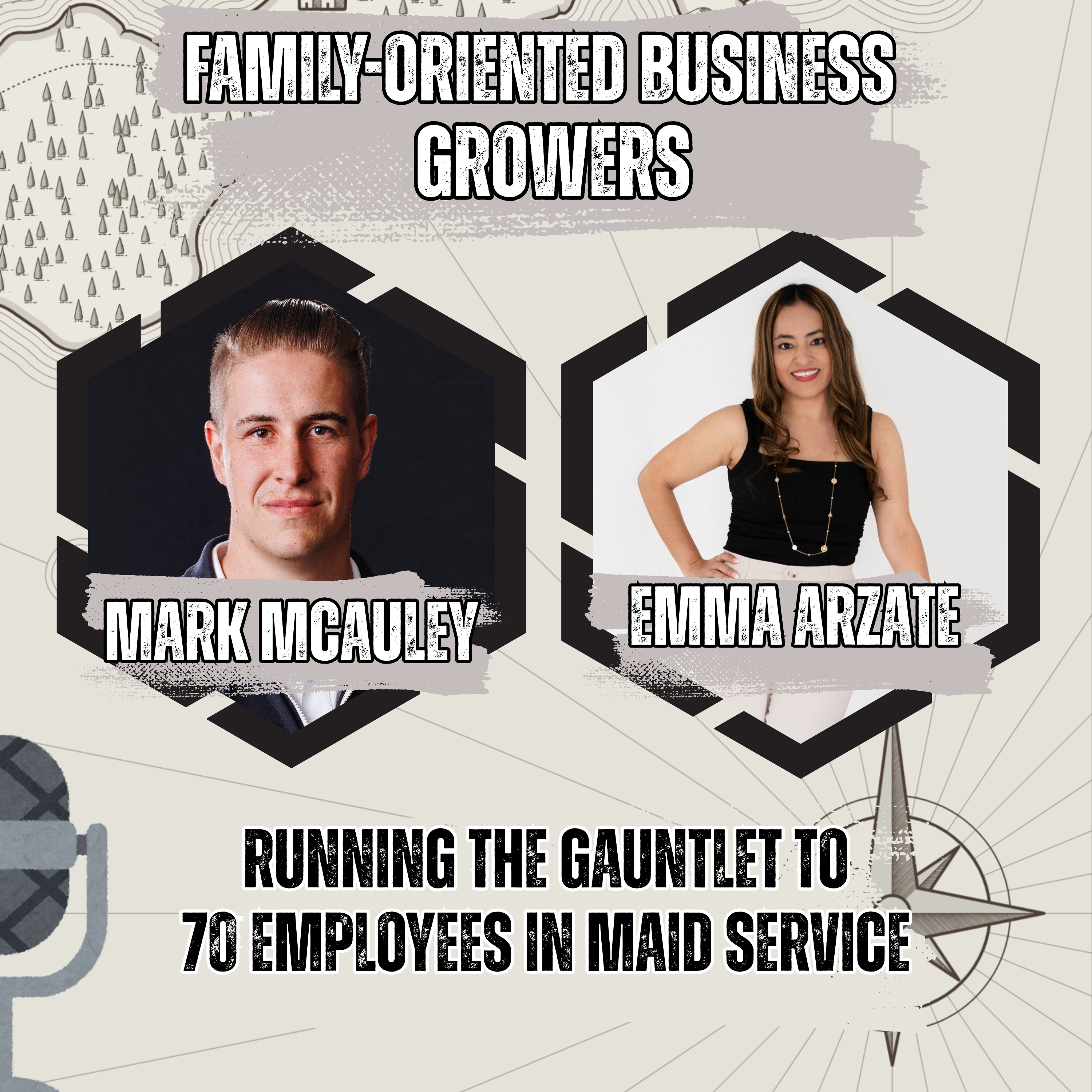
Family-Oriented Business Growers · Mark McAuley
Emma Arzate shares her journey of starting a maid service business to "help her mom" which has since grown to 70 employees! Along that journey, her mother got cancer, Emma had twins that were born 13 weeks prematurely and all of the "normal" stuff that comes along with growing a family & a business. Listen as she shares how she achieved time freedom through intentional growth and mindset shifts. She emphasizes the importance of surrounding oneself with the right people and seeking coaching for business success and work-life balance. The conversation covers the power of proximity, the development of automation software, the importance of implementing knowledge, and the value of coaching and accountability. Emma Arzate shares insights on business growth, learning, and the significance of investing in oneself. Join the Parents Growing Cleaning Businesses Facebook group & Get your FREE Save 5 Hours Per Week Time Audit via www.warplan.au Takeaways Intentionality in business and mindset shifts are crucial for achieving growth and time freedom. Surrounding oneself with the right people and seeking coaching can lead to significant business success and work-life balance. Power of proximity Importance of implementing knowledge Value of coaching and accountability Investing in oneself Chapters 00:00 The Journey Begins 02:13 From Side Job to Full-Time Business 04:05 Challenges and Growth 10:30 The Impact of Coaching 13:10 Work-Life Balance and Mindset 23:14 Surrounding Oneself with the Right People 28:30 The Power of Proximity 30:14 Development of Automation Software 36:16 Implementing Knowledge and Coaching
Emma Arzate: for me it was like, okay, my English wasn't my first language. I grew up very, very poor. mean, family of six, in a one bedroom, one bathroom apartment. it was very hard. sometimes, I'm not saying it's the case for everybody that came from very humble beginnings, but since I just started thinking as you grow up, this is the way it's gonna be for me. There's no other way. I don't deserve more, there's no way I can achieve more. But as I started investing in myself, reading a lot, and surrounding myself with people that believed in me more than I even believed in myself, which one of them was my mom when she had the dream, like, we can do it Emma. I was like, wait, if others are believing I can do it, why don't I start believing and stop doubting myself so much? Now Mark McAuley: Hey, hey, welcome to all of you bandits and chilies. I'm here today with Emma Azate and she runs a maid service with over 70 employees. She's also dabbling into the software space. She's previously done some coaching and consulting. She's one with irons and many fires, a bit of a visionary, bit of shiny object syndrome probably, but very well channeled into what she's doing. So thank you very much for coming on and sharing your time with us. Emma, how are you? Emma Arzate: Mark, thank you. Thank you for having me and I appreciate your great description there. A little bit of everything. Mark McAuley: Well, I hope it was great, but perhaps you could expand on it a little bit more and give us some background and context and set the scene on some of that that I just sort of said and the background in the business and everything that you've got going on. Emma Arzate: Yeah, so started the main service business over 16 years ago. And it was more like my mom had a dream and I was kind of the person that helped her see how we can take this off. And that became a real thing. So we've been doing that for 16 years. I run it with my brother who's a co-owner of the business. yeah, and then eventually as I invested in myself, I started doing a lot of things the right way. and then I started to get more time freedom, which I was able to tap into other businesses, which you just described. Mark McAuley: Yeah, yeah. It's funny how we do that, right? We get the time freedom and it's like, all right, I've got this I've got this extra time now I'm going to spend it. Here's another business I can spend that on. Yeah. Emma Arzate: Yeah. Mark McAuley: So you started out with you and your mum. Who was the driving force in getting it started? Emma Arzate: Well, I can say she had the inspiration and I was in college. I did not know what I was doing. I didn't know what I exactly doing live. And then she just said, you know what, I wanted to launch a cleaning business. She had been cleaning houses on her own. So I could you help me? I mean, I was young. I didn't really know what I was doing. And I was like, yeah, sure. Let's figure it out. I registered the business and I try to do things, you know, by the book. And then it just kind of we did it like that for about three years. I had a full-time job going to college and I had my oldest son. So you know I just started that's kind of the way it started. Mark McAuley: Yeah, yeah. So yeah, you basically sort of stopped off at the cleaning station for a season in your life and you just never left. It's like, is, yeah, Emma Arzate: and have a nice night. Mark McAuley: I'll just do this whilst I'm in college and then all of a sudden, 16 years later, here you are. Emma Arzate: Yeah. Mark McAuley: So I think your son would have been about two at the time. Is that right? Yeah. Emma Arzate: Yeah, he was almost two. So right now he's going to graduate high school and go to college this fall. But yeah, he was around two years old, probably a little, like a year and half or so. I, that's right. Mark McAuley: So you were just, it was very much kind of like a side job thing that you were doing whilst juggling all those other things, college, raising him and everything else. And it was just like kind of in support of that and in support of your mom. And that was the level of intentionality Emma Arzate: Yeah Mark McAuley: you entered with. Is that right? Emma Arzate: Yeah, I don't think I had enough intention. I was like, I'm gonna support my mom. She's got a dream of launching a business. Then it became where it was time for him to start preschool. And I was like, okay, well, I'm gonna have to juggle that. My husband had a full-time job. And I was like, okay, well, I'm gonna just kinda quit my full-time job and go full-time in this business because I was noticing that it was paying my mom's bills, not so much my bills. But it Mark McAuley: you Emma Arzate: was paying my mom, okay, well, this could be a living. this for a living and that's kind of how it took off and then I did it for about three years alone you could say because my mom was in the field then my brother was in the military in the army and he finishes time comes back home and says, I need a part-time child so I can go to school. So I was like, well, look, guess what? My books are a mess. I don't know what I'm doing with the books. I need some structure. I was good with the sales and the marketing clients and stuff. I don't want to say I was good with the marketing because I didn't know when I was doing that back then. Again, this was like 16 years ago, so we're going to be 17 years in business next month. And then he brought all that experience and structure from the military. That's when I feel like it started to feel more real. Mark McAuley: Yeah, yeah, you alluded to before like doing it the wrong way before you learn how to do it the right way. So I suppose Emma Arzate: Yeah. Mark McAuley: this might have been a part of that. But was there another moment where that really shifted? because obviously there's a huge difference between, yeah, it's like it's me and my mom and then all my brothers, you know, he's come in and now you have over 70 staff. Like what happened? Emma Arzate: So I would say one of the things is my mom, she was diagnosed with cancer about, let's see, let me do the math. I would say about five, six years in the business. So she had to physically retire from the business, right? She had to physically retire from the business. she went through, she's fine now. She's been a cancer survivor for almost 11 years now. And... You know, at that time, you know, her body, you know, wasn't normal. It hasn't been back to normal because she went through chemo, through surgery, through radiation, all that ugly stuff that people that go through cancer go through. so we're like, okay, there was times in the business where I was like, I don't want to do this anymore. You know, it's a lot of work. You know, I was learning and grinding through the whole thing and I didn't know what I was doing. Right. Remember, this was before I started learning and getting help coaching and things. like that. So, but I just did it because I was like, well, my mom, you know, she can't get a full-time job physically. I just need to continue. Right. So that's when I another opportunity came up where I'm like, okay, this needs to be my real career. All right. I had more dependency from my mom being in the, you know, depending on the business now. So yeah, she was the inspiration and Mark McAuley: Yeah, yeah, well. Emma Arzate: she was a continuation. And then I just learned to love it. Mark McAuley: Yeah, yeah, I'm glad that that she has come through that and is doing well now. That the time period when she was going through all of her treatments and everything. How did that overlap with like when you started to get coaching for the business? Because the reason I ask is that it sounds like that would have been obviously a lot harder of a strain on everything. And if you're continuing to work not knowing what you don't know. That just kind of equates to working harder and harder and harder rather than, you know, working a bit smarter by being told what you didn't know and shown a better way of doing things. So how long were you in that really like hard just head down and grind sort of phase before you got help for the business? Emma Arzate: It was five years actually, five years of... And it was so... She went through the cancer and, you know, whatever it was that I needed to do, I was doing it, right, with my brother. And we're just like, okay, we have to make it work. There's no other way. And then I was wearing all the hats. I'm sure you can relate to that. At one Mark McAuley: Yeah. Emma Arzate: point in your business, you were doing that. So I was wearing all the hats and then all of sudden... I was pregnant, I got pregnant of my twins. They were very much planned, but what wasn't planned was that they were born 13 weeks early, so they were born at 27 weeks. And remember, at that time, that was 2018, so was about nine years in the business. You know, at that time, I was wearing all the hats. I was doing sales, scheduling, most of the things. I mean, my brother was doing hiring and payroll and stuff, but everything else on the phone stuff, it was me. And then, so I had to step away from the business six months. because they were in the hospital three months and you know, I had to take care of them. I was in the hospital one month before they were born. Then I was, they were in the hospital three months. It was, went through a hard, hard stage in life with them. And at that point when I came back, you know, about six, seven months later, we said, you know, there's gotta be a better way, right? Because we went through a lot of harsh, I was able to step away because my brother was able to support. But it was very hard. At that point we said there's gotta be a better way or we might just have to give up on this business. Because I came back and things were still messy, right? The business was able to survive, it just, what we realized is how weak the business, how much dependency the business had in me, right? Or in my brother. So it's like, know? So that's kind of another stage where it's like, you know what, it's time to get help. Mark McAuley: Yeah, yeah, wow. I mean, you were just running the gauntlet of life there, like twins, 13 weeks, prem. I can't even imagine that would have been like so stressful. Yeah, again, glad that they're all right as well. But like Emma Arzate: Yeah. Mark McAuley: throwing that into the mix of all of the things that go into running. I was gonna say running a small family business, but at that stage, it doesn't even feel like it necessarily like, because you're not having like the really structured systems to run. It feels more like it's running you in Emma Arzate: Yeah. Mark McAuley: that phase. That's kind of what I'm hearing. All right, so then after that, what coaching did you get? Did you start off with like courses, podcasts? Did you get like straight into coaching? Where did you go? and what were the biggest things that practically actually changed for you? What was like the first thing where someone pointed out or it was pointed out to you like, hey, this thing like that, you should fix that. Emma Arzate: Yeah. man. So I was online trying to figure out, what am I going to do? You know, who do I learn from? There was a lot of options. There's way more options now, but back then there was still a lot of options. I'm talking 2019, seven years ago. And you know, I found this, was like a, a training and I, I'm, you know, I fly a couple hours to the training and I'm at the training and Somebody mentions, you know, my coach. thought she wasn't my coach yet. She's like, somebody mentions, you know, there's this coach. She knows what she's doing in your industry. You should totally hire her, right? So Debbie Sardone, right? And we hired her and she taught us systems, how to pay, all the whole thing. And it just changed everything for me, for us. Mark McAuley: Yeah, yeah, yeah. Just to try and zoom in on like one thing, like with systems, for example, what was like something that was really broken in your business that maybe you weren't even aware it was broken. was just like, this is just, that's just how that clunky wheel sounds. And then, and then when the system came in, it's like, okay, that's, that's how one of those is supposed to work. Emma Arzate: Yeah, man, there's a couple things, but I would say the main thing is how to attract and hire the people that actually want to work for you. to get Mark McAuley: Yeah. Emma Arzate: them to pay them enough, well enough, how to charge enough to hire the right people that actually want to work for you. So that's one of the things that changed completely is how to pay them well so that we can attract the right people. Mark McAuley: Yeah, yeah, that's... Yeah, I'm sure that like there are people listening right now who are just like, wow, yes, that's, that would be a huge shift because if you can't reliably, predictably hire the next great employee, like you can't scale, you're, you're capped at the team that you have. And then if you don't know, or don't even really believe that you can find another good employee out there somewhere that they kind of don't exist. then yeah, that's going to be a really solid ceiling on your growth. So then bringing it from then up until like just to kind of complete the story in subsense up until now, what's changed in your business from that point until now that you've implemented systems, grown and scaled, where are things at today? Emma Arzate: So, you know, implementing the right way of paying people so that you can attract them and you can retain them has been the... the biggest thing, right? mean, although we're cleaning houses at the end of the day, we're in the people business, right? That's what my, you know, some of my coaches say, you're in the people business. You're not really in the cleaning business. So what does that mean? That means that if you have the right people that you can not only lead, but inspire to follow you, then, you know, then you'll have a successful company that, you know, the people show up and actually want to be there. They enjoy what they do and they want to see us continue to grow. So right now, fast forward to now, I'm so much easier when I say this, but I mean, I have a business that I love that is way more profitable and that I can step away, actually me and my brother can step away for a couple months and the business will still be growing, right? And that's just because we attract the right people, we keep the right people, we promote the right people. Mark McAuley: Yeah, no, that's huge. I mean, you say it like, sounds easy and nice now, but like we've just heard the backstory, we know it's just congratulations on getting it to where you are. Emma Arzate: Thank you. Mark McAuley: One of the things that I sort of learned from our experience was that we were growing the business with the vision of the time freedom, the geographic freedom that we wanted from it. But the real value of that freedom is felt in darkness. It's not the cocktails on the beach, it's when that sort of family stuff happens. And like now, the way that your business is set up where you or your brother can step away, it's gonna do its thing without you, you could be gone for months at a time. If there was something else that came up within your family where you needed to put your focus and attention on that, you have the resources and the freedom to just fully do that, to give it your full attention and to be able to be where you need to be at the time. And that is, that's so huge. And that's a real privilege and freedom that you kind of don't appreciate until the moment where it happens and you either have it or you don't. So hopefully, hopefully you don't need to use the freedom that way, but it's really important that the business is there to support that. So with going back to like your journey, you've also done some coaching in the past. What are some patterns and problems that you've seen either from your younger self or that you've seen with other people that you kind of wish that you could just fix for people? Like, hey, if you just had this belief, if you just understood this one thing, this would make a really big shift for you. Emma Arzate: Yeah. man, there's so many things that come to mind. mean, one for me is mindset. Mindset is a big thing. you, if you learn to change your mindset, right? And what that means to me is understanding that if you want it, you'll find the way, right? You'll find the way and don't try to do it alone. I tried to do it alone for 10 years, meaning that I was like, okay, there's good. Eventually I got it. Like there is a way, there is a shortcut. If you hire somebody that has Either live through what you want to live, right? Grown in a company or have a business where it's not only, it's not even about how big the company is. It's more about does that person have a business that you're like, maybe has a time freedom, right? Maybe has the revenue, maybe has a, whatever it is that you envision Mark McAuley: Thank Emma Arzate: for yourself that you're able to learn from that person that's, it's there, it's where you want to be, right? So that would be one thing is don't try to do it alone. try to get help faster so that you can get the shortcuts that already exist out there. And then the other thing as well for me that is try to... And I know that people say this a lot, work life balance, work life balance, right? But for a couple years, I felt like, okay, I need to work hard, hard, hard, and eventually I'm gonna slow down and I'm gonna be able to dedicate more time to my family and things like that. But I learned that not really, if you don't slow down, life is going to slow you down. And for me, that's Mark McAuley: you Emma Arzate: what, right before the whole situation with my twins, I was just going really fast, working as hard as, pregnant I was like I love what I do and just do whatever I can and but then you know life slowed me down and said no it's time to slow down right so that's I think that was that was a big lesson for me so what I do now is it's like I'm not gonna work hard hard hard and then slow down why do that instead try to find the way where I'm there for for my business but I'm there for my family first Because you could have a successful business, if you don't have the family that you can enjoy the success of the business with, then what's the point? Mark McAuley: Yeah, yeah, it is very much like a kind of have your cake and eat it too sort of scenario because if the goal of the business is to drive towards some version of freedom and family and whatever that looks like for you, the destination, like we shouldn't, the journey rather should not like sacrifice the destination on the way. Like we don't want to be like, okay, well, until we get there, we're not doing any fun family stuff. I'm not Emma Arzate: Thank Mark McAuley: going to be present at home. So when you say like work-life balance, can you describe what that means to you? Like how would you describe a healthy work-life balance or even the concept? Emma Arzate: Yeah, so for me like stab it looks different for everybody right so for me It's like what are your non-negotiables when it comes to like family that you're not going to sacrifice, right? So for me is like I don't sacrifice my mornings with my kids, right? I make sure I'm there for them to for the morning rush Breakfast good morning kind of thing and then after school not miss a game because I have to go and schedule a customer I have to know like, know, I mean just be there and be present and then there's other ways like If I travel, most of the time I have my husband tag along or my kids or both so it doesn't feel so much like work, right? So if I have to take a day off, like I have to this week because they have a fun day at school, I take it off, right? So it's like, what are the non-negotiables? And then also, okay, now as a business owner, you have time freedom, right? That's the whole reason why you started a business anyways. So what are you gonna do that makes you feel like, yeah, I do control my time? I don't have to work 60 hours a week because I used to work that much. And it was because, okay, well, I don't have to, but I was doing it anyway. So it's like, what are the non-negotiable? What are the boundaries that I'm gonna set? And what moments I don't wanna miss no matter what, because that is the whole point of having a business where I have time freedom. So that's pretty much what to me work-life balance means, is being present at the moments that matter to me the most and for my kids as well. Mark McAuley: Yeah, love it, love it. We were talking a bit beforehand and a word that you brought up, which I think really fits in well here is just that intentionality. And I think that that fits really well both sides because it's the intentionality with the family of, I'm going to be there for this. I'm going to be mentally present. I'm, you know, I'm switched off from work. we're, we're at the dinner table. This is like a family focused time, whatever it is. Right. But also on the other side and kind of back to like doing things like working smarter, not harder and the coaching and all of that. that allows you to be more intentional with your time in the business to get better results from the time that you're actually spending so that Emma Arzate: Yeah. Mark McAuley: it doesn't have to like seep out and take up all of this extra time because you're working on the right things, you're getting the things that matter done and then being able to sort of move forward. Now I wanted to come back to the mindset thing a little bit and I kind of wanted to play devil's advocate on this just because it's so... When you say like, if you want it enough, then you'll find a way. it's like, I think it's the James Clear quote that a big enough why will surpass any how or like something like that. Like basically you have to figure out the why and then the how follows, right? Creativity follows commitment, all that kind of stuff. And it's really easy to say that, but someone listening, I'm kind of like hearing their voice in my ear saying, yeah, but like, I do want it, like I really want it. I'm working my knuckles to the bone, Emma. Like I want it so bad. And it's just, not working for me. So like, how does that help me? You know? So, so could you like sharpen that a little bit and refine that? Like how does that mindset piece really fit in to them getting the thing that they want? Emma Arzate: Yeah. my goodness, it's such a very interesting topic because it goes into so many things, beliefs and things from your background, where you come from. First, it's like... First understanding like why do you want to do what you do? Right? What's the goal? What's your vision? Right? Because if you don't have it then where are you going? Right? Then you get stuck in like the grinding I'm gonna just work hard hard hard, but then for what right? So having your why and having it and very clear to okay This is my why and this you know I'm going to achieve it even if you don't know the how Because a lot of times we don't know the how we just know that we want it right? But if you want it bad enough right and you and you work for for you can't. Now you say, okay, okay, I work hard, I work 60 hours a week. Okay, but are you intentional like you were talking about earlier? Are you doing things the easiest way or the only way because you have tunnel vision because that's the way that you started your business and you think this is the only way? Or are you being open-minded and being like, you know what, I may need some help getting me there faster, right? That's why I'm a big believer in coaching. I I've been coaching for being coached, Even as I was coaching other people for the past five and a half, six years, I've been over six years with a coach, one, two, three at a time. the reason why is because I know there's a better way and because at every level in business, I'm gonna need different type of advice, different type. And sometimes you just want somebody that gets you, right? Somebody that understands you. So one of the things as well is as you start... getting help, you start surrounding yourself with people that they have dreams and beliefs that perhaps the people around you, whether it's family members, friends, they don't have aspirations or maybe they just don't, they don't know what they don't know. So you just kinda get pulled back a little, you know? So, I mean, one of the favorite quotes that I love is, are the five people you surround yourself with, right? And that helps a lot with mindset. And one thing without getting too deep also, is understanding like what it why is it what limited beliefs are holding you back Right? So for me it was like, okay, my English wasn't my first language. I grew up very, very poor. mean, family of six, in a one bedroom, one bathroom apartment. You know, I'm not gonna make you cry, Mark, so I'm not gonna tell you the whole story. But it was very hard. sometimes, I'm not saying it's the case for everybody that came from very humble beginnings, but since I just started thinking as you grow up, this is the way it's gonna be for me. There's no other way. I don't deserve more, there's no way I can achieve more. But as I started investing in myself, reading a lot, and surrounding myself with people that believed in me more than I even believed in myself, which one of them was my mom when she had the dream, like, we can do it Emma. I was like, wait, if others are believing I can do it, why don't I start believing and stop doubting myself so much? Now I'm not saying that I don't have limited to beliefs. I think it's something that a lot of people deal with day to day. But I want to say that that's really what helped me. Mark McAuley: Yeah, love it. Your mom sounds amazing. I just I Emma Arzate: on YouTube. Mark McAuley: love that. Because obviously she was in that picture too. Like she was in your humble beginnings. She was like even more deeply entrenched in that from her background, probably, right? So Emma Arzate: yeah. Yeah. Mark McAuley: but then she's she's like sort of cheerleading you in that as well, which is really cool. There's sort of two things that I want to zoom in on. The first one is like the five people that you surround yourself with proximity as power, all of that. That is so true and I feel like I've only recently actually realized how true it is and it ties into the second thing that I wanted to like thread the needle on here that you were saying about, how did you put it, that's basically like the limiting beliefs, you didn't describe it exactly this way but like when you have like that way that things have been in the past, the background, you get used to things being a certain way and What's really cool about this, just like to go down a nerdy rabbit hole for a moment, is that your central nervous system, your subconscious brain, it doesn't speak English or Spanish or whatever other languages that you have under your belt. It speaks the language of symbols and directions. And so when you make those changes, like if you've been in this particular environment for a really long time, that's how it calibrates to what is normal. And Emma Arzate: Mm-hmm. Mark McAuley: that's where those limiting beliefs sort of sit because it's like, well, yeah, but we can't, we can't do that other thing because that's outside of what's normal. That's outside of our standard. Then when you rub shoulders with five people that are ahead of you in a particular domain, you know, whether it's business or health and fitness or whatever. That is what helps your system to recalibrate and to raise your standards just by osmosis. You don't actually have to do anything else. If you did nothing else but just hung around people that were a few steps ahead of you in whatever direction you wanted to walk, you're going to start naturally matching that pace because your system is calibrating to all of that. That's just some thoughts to like thread pieces together. And I'm sure that's going to elicit additional things from you as well, Emma. So if you want to like just like take that from there, I'm just like hitting the ball straight back over the net. Emma Arzate: Yeah, that is so good because I think a lot of people don't realize that, right? How much of an impact that has in your business and your life in general, right? Because you could not own a business and still feel that... Like, what am I doing? Like, I'm not good enough and you know, I'm never gonna be this. I'm never gonna buy my first house or whatever that case is, right? So I think that it has a lot to do with it and that's why I feel like if you're always getting, know, investing in yourself, learning, it's gonna be almost like come with the fact that you're gonna be surrounding yourself with people that are either coaching you or that they're being coached next to you and the peers that are gonna understand, right? the pains and what success looks like when you own a business is very painful, right? It's very rewarding as well. I would do it all over again, right? But I do think that one of my closest friends are actually colleagues that I met in coaching programs, right? And I met you in a coaching program too. So it's like, that's how you meet people that get you and that understand you and that celebrate when Mark McAuley: I'm Emma Arzate: there is success, right? Because not everybody that... Mark McAuley: Yeah. Emma Arzate: could around you could celebrate you if they don't really understand what you even do, right? Mark McAuley: Yeah, yeah, 100%. 100%. And the when I was just saying, like, I feel like I've only recently started to understand the real like, the real power of proximity is one key part of that is actually just physically getting in the room with other people. Because I've had a lot more like sort of digital relationships with people I've done a lot of my coaching has been like the that I've been in like programs and stuff has been based from the US. And so I I've done a lot of it online and all that sort of stuff. And you do get the benefit of that. I'm in a Zoom room with these people and talking about their same struggles and all that sort of stuff. But when you step off the digital landscape and into a physical room with people, and then you see these people that it's like, wow, like that person over there, they're doing this insane thing. they are making. millions of dollars a year doing this really weird niche thing that like I don't even understand how you make one dollar a year doing that. But they're absolutely crushing it. And also, they're a real flesh and blood person. And, you know, they've got like a bit of like parsley in their teeth. And like, they're flawed. They're like, they're just they're just normal person, you know. And that that really like kind of helps to for me to like sort of like that calibration of like, oh, wow, okay, like, this is, this is just a thing. This is just what normal people are doing. So coming into the software side of things, everything that you've got going on there, tell us a bit about that. Like, what are you building that? Who is it for? What does it do? How did that start? Even how did you get into? Emma Arzate: So as I mentioned earlier, I run the business with my brother. And as we were growing, we had had some growing pains. We met a good friend of ours named Celso and Jessica. They own a maid service as well. And we met them at actually at an event, just like you were saying, how you get to meet people and that's how it kind of started. And, you know, they had a solution to some of our pains as we were growing. Right. And they said, you know, you know, you could build an automation for that. You know, there's like, OK, really? So anyways, that's how it started, because As you grow, I mean when we were at 20 cleaners to get to 30 was another level of skills that you need, right? When you get to 30 and so forth, 30, 40, 40, and 50. And we decided that we were doing too many things manual. That was working. We had five, 10 cleaners. It was not going to work when you have 40, 50 cleaners. You know, right now we're a little over 60. But so we build automations and as we build them, our colleagues would be like, okay, so what are you doing again for your lead nurture or your employee onboarding? Oh, well this, this and that. And they were like, can you build it for us? So that's kind how it started. You we said, you know what, this could be a thing, right? People are Mark McAuley: you Emma Arzate: willing to pay for our time. Especially because colleagues, business owners understand that any time you spend somewhere else, it's away from your business, from your dreams, from your time freedom. So they're like, I'm willing to pay for your time, just do it. So that's kind of how it started. And it's taken off very well. because this didn't exist in industry, there wasn't enough automations. You were hired in a marketing agency and they would kind of give you a cookie cutter emails that you would be sending to your cold leads, to your hot leads, to your past clients, Mark McAuley: Please put this on. Emma Arzate: to your council clients, and we're like, why don't we build six journeys, depending where they're at in the buying process? Because prospects, they need different type Mark McAuley: Thanks. Emma Arzate: of messaging depending where they're at, right? Mark McAuley: Yeah. Emma Arzate: That became a thing. Now we tell people like, you want to be the blockbuster in your industry or the Netflix? And everybody's just like, well, I to be the Netflix. And we're like, well, animations would Mark McAuley: Thank you. Emma Arzate: be the Netflix way. Mark McAuley: Yeah, yeah, love it. So I was almost going to go down the blockbuster Netflix like rabbit hole and that whole story, but Emma Arzate: you Mark McAuley: Just back to the, that you said in there about like the different levels and the automations that like are really important at a specific level. I feel like that is a good point to underscore because the reverse happens when, especially when someone is just like working at stuff and doing kind of whatever and whatever feels right without Emma Arzate: Yeah. Mark McAuley: maybe mentorship where. you start solving problems that are not at your level. You're like, solving the problem that you need to solve when you have like 30 plus employees. And it's just, it's just you and your mom, you know, like Emma Arzate: Yeah. Mark McAuley: building out this thing. It's like, this is going to be fantastic. But you need to make maybe the brute force version of that. The non-automated version is correct for the stage that you're at until, you know, you're, you're ready for that later. Not that that's like bad. If you, if you have it at a software package and it's all built out. maybe that still works, but there's still time that needs to be put into deploying in the business and just focusing on the things at the stage that you're at. How do you find that that works with your clients, with the software? Do you kind of have to give a bit of guidance on, for where you're at, don't worry about this stuff. I know that there's these cool features, just focus on this, though. Emma Arzate: all Mark McAuley: That is a great question if I don't say so myself. Can't wait to hear the answer in like 14 seconds from now. Just wanted to jump in and let you know about the free time audit designed specifically to save five hours per week for parents running cleaning businesses. It takes about two minutes to complete and you get your time saving results straight away. To get your free time audit, join our Facebook group via warplan.au, link in the description. Now, what was that cliffhanger question again? kind of have to give a bit of guidance on, for where you're at, don't worry about this stuff. I know that there's these cool features, just focus on this, though. Emma Arzate: all the time. I mean, we just, were a vendor at this event recently and I had to do that. I had to tell them, like, look, right now you need, so we, know, we are two core products is lead nurturers, right? And then employee onboarding to onboard the cleaners that you're hiring. So what the first case scenario is lead nurturers and they don't, they're not having, they're not getting enough leads. And I'm like, you need to get enough leads. You focus on that first, right? Attracting Mark McAuley: Yeah. Emma Arzate: new leads so that you can then afford to spend money. in this investment, which is an investment, And then if, in the other case, our other core product employee onboarding, we've had people that are like, well, I just have two cleaners. Okay, how many are you, how many cleaners are you hiring a month? I'm hiring a cleaner every two, three months. I was like. Let's work on getting your hiring ad better, your interview process better, and all those kind of things that you need, pay well and things like that. And then you can grow enough to where you're going to be hiring two, three cleaners a month. That's where you need an automation. So I'm a big believer Mark McAuley: Yeah. Emma Arzate: as you, like, I've turned people away all the time. I'm like, you don't need this right now. You need this. You need to fix this. You need to fix that. So that you're at a stage where you're growing and you can work on your business. Because an automation is more like working on your business versus in your business and in your business could be mini little $10 tasks that you know and there's nothing wrong with doing them Mark McAuley: So. Emma Arzate: we all started that way but as you grow you're gonna have to just level up right but don't level up too quickly because then Mark McAuley: Yeah. Emma Arzate: you know you're gonna be in trouble Mark McAuley: Yeah, it's the way that you've described that is painting this image for me of someone that's like set up this full like timed automated sprinkler system and like this whole horticultural setup and whatever. But they have like one tomato plant. And Emma Arzate: Bye! Mark McAuley: it's like, this is great. Like this will work really well. Like this is going to provide the nutrient but like you don't have that problem yet. have to upgrade your problems to the point where the system that supports all of that is relevant. Emma Arzate: Yep. Mark McAuley: Yeah, love it. So just kind of like coming back to the coaching that you've done in the past and like the patterns that you've seen and tying that into what you're doing now with the software and everything. What do you think is the main thing that gets people stuck or unstuck? Like for someone like this, I feel like kind of ties into what you were saying before about like being visionary and it's easy to just see like the cool shiny software and do that thing when maybe that's Emma Arzate: You are. Mark McAuley: not the level that you're at. What do you think causes people to get caught up in maybe the wrong thing and what can help them to bump out of that? Emma Arzate: Man, I mean, there's a couple things. The biggest thing is... People not making time to work on the important things, only at the urgent things, right? Urgent things is like, okay, you know, I have a complaint, I need to fix it right away, right? So that's urgent, that needs to be taken care of, right? Important things that I feel like a lot of times, and I did it too, I wouldn't block time for this. Working important things like, you know, how do I make my hiring process better? How do I go and I, you know, hire a coach, and I work with the coach, and then I... block time to implement some of the things the coach taught me, right? So those are important things that are gonna move you forward. But a lot of times we get focused on the urgent, urgent, and we don't spend any time, focus time, deep work, to implement some of the things that we learn, or to actually spend some time learning, right? Because there's usually a better way of doing things. So I think that there's two types of business owners. One is the one that It's learning all the time and it's great, but it's not implementing much. And then the other one that's learning and then implementing as much as they can, right? I mean, and there's no right or wrong way. I think it just depends on your growth, how fast you want to grow, right? Mark McAuley: Yeah, yeah, I think it's it's sort of like information like obesity to a point where if you're just Emma Arzate: Yeah. Mark McAuley: consuming and you're never exercising it, then you've just Emma Arzate: Yeah. Mark McAuley: got this like calorie surplus of all this cool stuff that you know, but it's not actually benefiting your business because you haven't actioned it. And that I think that can be like really overwhelming, probably now more than ever, because there's just so much information and like, you know, online. podcasts, know, guilty as charged, Facebook groups, courses, all that sort of stuff. And then AI, like you can just say, Hey, here's the thing. And it spits out this tailored information to you instantly to the point where we kind of become desensitized to it. And we're like really training ourselves to just skim information rather than actually take from that. Okay. This is the thing that I really need to do and actioning it, like transferring Emma Arzate: Thank you. Mark McAuley: it from like knowledge to action. So For you, how have you managed to kind of keep that in check? Because like you're not immune to that problem. How have you sort of balanced or decided what things you are actually going to act on and setting the time aside to do that whilst you're still like consuming information, you're still learning, how are you balancing that like implementation versus information? Emma Arzate: I think accountability makes all the difference. mean, if you have a coach that holds you accountable, that's where they say, well, why do you need a coach now if there's information everywhere, chat to BTU or AI could just tell you, Well, who's going to hold you accountable? Typically, a coach will. Or a peer group, right? Where there's peers that you're going to be meeting every week and there's going to be accountability, right? Obviously, goal setting is a big one as well. If you have a partner like I do, have non-negotiable weekly meetings where we look at if we're on track or off track, if not, what's the cost of that, right? So I think that's a big one. Mark McAuley: Yeah, being, pardon me, being accountable to yourself is also like really, really important, but that's like, that's something that whatever level that you're at, you have to work at it, like working out of the gym too, to get to the next level. Accountability groups, I think are really helpful, but the pitfall there is that if you're in a group of people who all need accountability, and they're also the ones providing the accountability and you're sort of there to help each other out but none of you have that sort of next level of accountability or no one's really in charge of that accountability or accountable for the accountability then it's kind of like you're all it's just like the blind leading the vision impaired to some degree. What would you say, because you've mentioned this a couple of times about like, you know, get a coach, right? That'll solve your problems. Emma Arzate: times about like that or I'm sure that'll still be a problem. Mark McAuley: What would you say to the person listening who's like, yeah, like, I'd love to get a coach. I mean, that sounds amazing, but I don't have the time right now. I kind of fought it right now. All of those sort of standard objections. Emma Arzate: And I'm not coaching anybody so I'm saying this as a peer-to-peer thing to whoever is listening who's a business owner I would say because of that is that you need a coach because you don't have the time you don't have the money it's it's why you need a coach right because I think that you know you're right I like I'm in a couple It's like a mastermind accountability with a few colleagues and we're friends and typically we're just talking. We're just kind of like celebrating each other, complaining or venting. I'm going to say complaining, it's venting. But there's no, leading it. So Mark McAuley: And we'll you in a Emma Arzate: you know what mean? Versus like I've been in a group before and I've had my coaching group before where I'm leading them. I'm guiding them. Like this is what we're doing this week. This is what we're working on next week and et cetera. Right? So yeah, if you're going to have an accountability group, make sure that it's somebody it's guiding it typically it's a coach or if it's one-to-one but I would say if you don't have the time the way I feel that I look at my learning whether it's I'm reading a book whether it's I'm getting coach where I'm taking a training a course whatever it is it's an investment it's not a cost it's an investment that's going to multiply if I implement because knowledge is power but implemented knowledge is powerful right so Mark McAuley: Mm-hmm. Yeah. Emma Arzate: And if I'm willing to invest in myself to be better, be a better leader, then I have the confidence that my clients and my employees are going to be invested in what I'm to offer to them. Right? So it's like, you know, I've had people that like, they're like, am I, know, can you, can you tell me, you know, why do think I should get a coach? And I'm like, well, can you tell me why not? Do you want to grow? Mark McAuley: Yeah. Emma Arzate: Right? Can you tell me what do you do to grow? And I'm like, learning, right? reading it's amazing the only thing it's if you read a lot of books and you don't implement any of it right so I think the biggest thing would be like how do you get yourself to the next level if you can't do it alone there's always a better way and sometimes it's finding that better way Mark McAuley: Yeah, yeah. And, you know, like I am a coach, so this is not as unbiased as what Emma just said. But first of all, jump into, there's a link in the description for the free Facebook group. I drop a lot of free value in there. If you reach out, I will give you a lot of free help before we like talk about anything to do with like paid coaching. So if you genuinely feel like you can't afford something like let's just have a conversation about it and sort something out. But, but also Like just taking the example of like reading a book, the book is really, it's going to have like really good information in there, but it's generalized. The difference Emma Arzate: Yep. Mark McAuley: between that and coaching is that when you get a good coach that has walked the path that you're trying to walk and they can see the blind Emma Arzate: Mm-hmm. Mark McAuley: spots in your specific situation. They could even reference back to the same book, but they're just telling you, Hey, you need to focus on chapter eight before you focus on chapter four. Like this thing needs to happen in this order. And The other thing that you just said Amitru is like, you know, if you can't get there on your own, I think that most people, depends on the size of their goal as to whether they can get there on their own or not, but they can probably make some progress. They can get some headway at the very least on where they're going. They might be able to get all the way there. The difference is speed. And that's Emma Arzate: down. Mark McAuley: something that I've really experienced from coaching is it's just like, yeah, if I was trying to figure this out myself, like I've just saved myself years of pain and suffering. Like what you were talking about before, like the, can't remember how many years in total it was like between sort of like five and eight years. Emma Arzate: So yeah, that's I was gonna say and you know, I was in business 10 years, right? Mark McAuley: Yeah. Emma Arzate: And the last six years I've been able to multiply my times five. And the business I had was Mark McAuley: Yeah. Emma Arzate: a decent size. It wasn't super small, but you know, we had you know about 15 cleaners 10 cleaners, right? We were able to multiply it by five in five six in you know in six years so And what you know one thing I swelled that there's a reason why? Mark McAuley: Yeah. Emma Arzate: Advice is not free and one of the things my my coach says is people that pay pay attention Right. Mark McAuley: Yeah. Emma Arzate: How many times have you I've given free advice all the time and I come Mark McAuley: Hmm. Emma Arzate: back to the same person and it's not because I'm over there just hey You want my advice? No, it's just the conversations flow, you know? And then I talk to the person and then I see him the next month or so and I'm like, so what? I just haven't had the time. Well, you know what mean? They have nothing to lose when it's free advice. There's no scaling. Mark McAuley: Yeah. There's no skin in the game. Yeah. The other one I've had on that recently, which I really like is that transformation happens at transaction. Yeah. And I felt Emma Arzate: Yeah, that's a good one. Mark McAuley: that to be literally true. Like when you, when you make the purchase, like the moment that the money leaves your account for some big uncomfortable purchase, which is a bet on yourself instantly, you show up different. It's just like, Emma Arzate: Yeah, there's a commitment in. Mark McAuley: Yeah, I'm committed and I've just entered into this program where I've just bought this thing. Like I am the person who, whatever, I'm the person who takes this bet on myself. And the other one, you'll probably like this too. This is like an urban dictionary word, which is ask whole. So it's somebody who asks for advice, but never takes it, right? So don't Emma Arzate: Ha ha ha ha ha. Mark McAuley: be an ask whole. if you're gonna get it, whether it's free or not, like you get advice, like do the thing, because if you had the problem enough to ask the question, then take the advice provided that it's, yeah, don't take just any advice, but if it's qualified advice coming from somebody that you would swap places with in that zone of your life, Emma Arzate: there. Mark McAuley: then yeah. All right, so any final sort of thoughts to tie a bow on everything? Again, thanks so much for your time, Emma. It's been great, but just words of encouragement or things that would be helpful, something maybe that you wish that you had heard earlier in your journey. Emma Arzate: I mean, I would say that believe in yourself, right? Believe in your dreams. Have a vision. Have the why. Even if it's not perfect, even if it changes, don't... Dawn is better than perfect. Don't feel like, Just because this is my goal for next year for five years from now does not mean that you can't change it But not having anything, know, then there's it's just a dream, right? It's not really a goal So especially if there's no date to when do you want to accomplish that and then don't be afraid of investing in yourself like At the end of the day, like you said earlier, if you don't bet on yourself, how do you expect others to, like your employees, the people you want to hire to work for you? And then just be careful. There's a lot of information out there. I would say try to learn from people, like you said, that you would switch places in business with. They've walked the path that you want to be. They're only a chapter, like Josh said, as a chapter, a few chapters ahead from, and that's the case. When I talk to people, it's like, look, I'm only a chapter two ahead of you. If you put your mindset, if you implement, if you work smarter, not harder, it's possible for you. I'm like, I am not smarter. I tell people that I'm not smarter than you. I just spoke to my friend and she was like, don't say that. But I told him, I'm a college dropout. I didn't finish college. She's like, stop saying that. And I was like, what's wrong? Like, you know what I mean? And I consider myself very successful. And it's not by accident. And it's not because I was born smart. It's not because I was born rich. It's not because I'm lucky. None of that. It's just because I found a better way and I've invested in myself and invested in shortcuts. Because like you said, shortcuts buy you speed. Mark McAuley: Yeah, that's it. Love it. There was one thing in there I wanted to underline and I've forgotten what it was now. No, no, it's great. It's great. great. Emma Arzate: I just thought so fast that I don't even... Mark McAuley: Just, you what? I can't remember what it is. I'm going to edit that out. I'm just going to thank you for what you said. There was something in there. was like, that was really good, but I'll just edit that. Thank you. Thank you so much for all that, Emma. It's been amazing to have you on and to share your journey. yeah, wish you all with everything in the future and all that you're doing with the software. Emma Arzate: Thank you, Mark. I appreciate the invitation, especially coming to somebody like you. So really appreciate it. Mark McAuley: Beautiful. Thank you.