
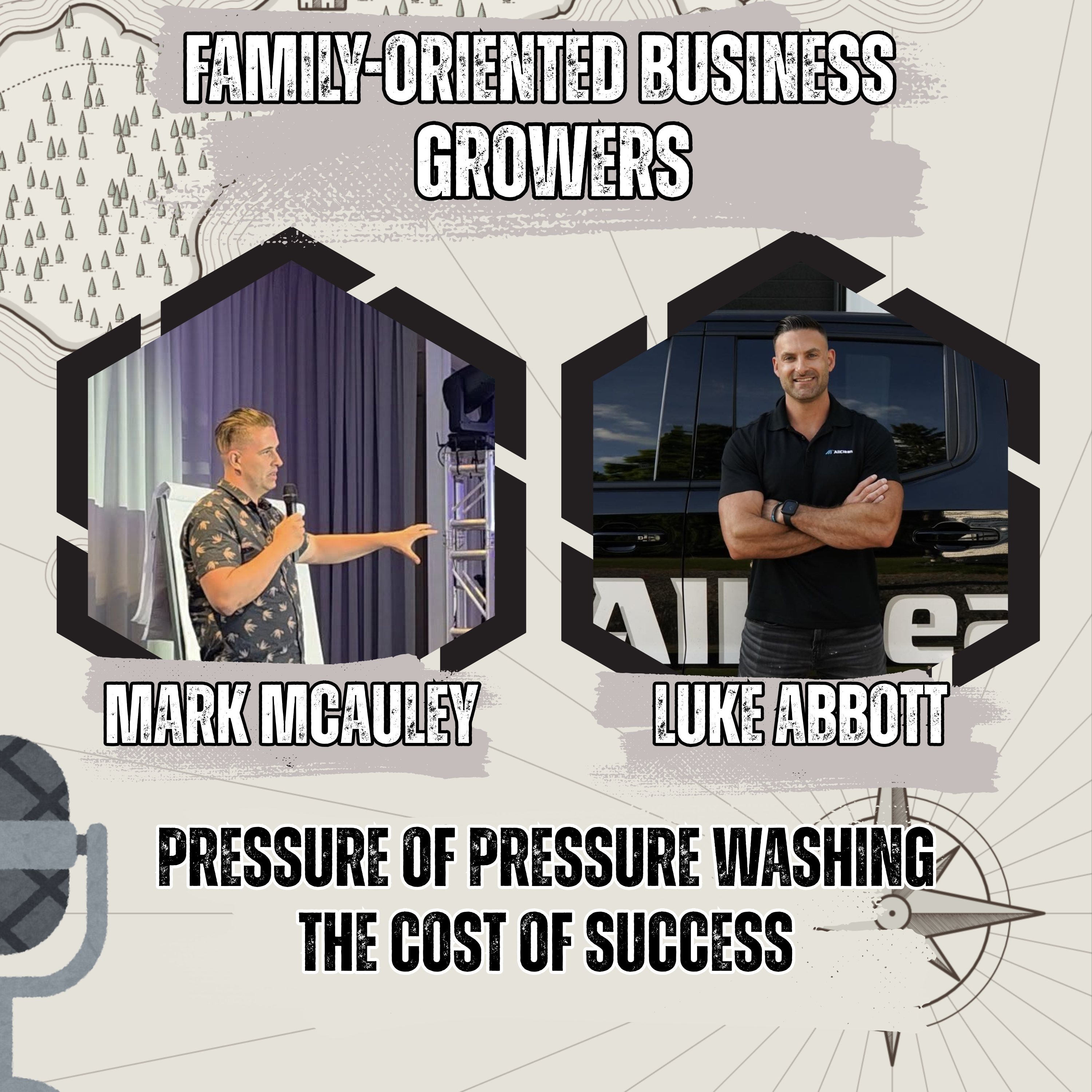
Family-Oriented Business Growers · Mark McAuley
Luke Abbott runs All Clean Power Wash, a multi 7 figure business that serves his family & community. But it wasn't always that way. Luke started with nothing and worked really hard until finally he unlocked an EXTREMELY hard season of his life that acted as the catalyst for his success. He was essentially an absent father for a period of time when his kids were little because his business had taken over his life. He had to fight his way out and through. In this episode, Luke shares the lessons that he learnt along the way, what he wishes he knew earlier and the things that are working the best in his business right now. Join the free Facebook group for Parents Running Cleaning Businesses via www.warplan.au (and get your free "Save 5 Hours Per Week" Time Audit) Connect with Luke here: https://www.facebook.com/luke.abbott.77
Mark McAuley: Hey hey, welcome to all of you bandits and chillies. We've got with us here today Luke Abbott from All Clean Powerwash he started from nothing, arguably we could say less than nothing, ⁓ has built his business to doing ⁓ multiple seven figures right now. So hi Luke, how are you and thanks for being here. LUKE ABBOTT: I appreciate you having me, Mark. like I was telling you earlier, this is the first time I've had a podcast with somebody outside of the state, so it's exciting. ⁓ Mark McAuley: Yeah, well like I said, I'm glad to have you and like to be doing this from the States but I've ⁓ to get there as well. haven't been to visit yet so that's on the list for this year. LUKE ABBOTT: We gotta get you over here, man. Mark McAuley: Yeah, yeah, it'll be great. It'll be great. So set the stage for us. Tell us about this from starting from nothing, what that meant for you and where your business is today. What's that journey been like? LUKE ABBOTT: Journey has been kind of surreal and back how fast it has gone. So ⁓ you say nothing, ⁓ I had something, right? I had a beautiful life. I had two amazing children, but I ⁓ was as a garbage man before I started in business. And you when I was this position, I never knew I was going to be an entrepreneur. I never knew that I was going to be owning a company called All Clean Power Wash, leading 28 people at the peak of our season and working our way in some multi-seven figures with two locations coming up this season. If you had told me that back in 2016, I would have just, I wouldn't even have the mindset or the bandwidth to even think of that type of capacity. So yeah, looking back, man, I, Something, I always felt like something was missing inside me when I was picking garbage or I was working the other position I had before that. And what happened was was a major situation in my life at the time that ⁓ me ⁓ either fight or lay down and die. And that was when ⁓ accountant called me. She had told me that I owed the IRS 15 grand. That was back in 2017. And when I heard that news, I was on vacation with my wife and children. My daughter was three years old. My son was seven months. And my wife was, you I didn't tell her the entire time we were down there too. I got this call like two days into the vacation. Didn't tell her one thing, but I was sick to my stomach the entire trip until I got home. And then when I got home, I finally sat her down and told her. So that was ultimately what pushed me to starting this business was, was the IRS. Mark McAuley: That is a great question if I don't say so myself. Can't wait to hear the answer in like 14 seconds from now. Just wanted to jump in and let you know about the free time audit designed specifically to save five hours per week for parents running cleaning businesses. It takes about two minutes to complete and you get your time saving results straight away. To get your free time audit, join our Facebook group via warplan.au, link in the description. Now, what was that cliffhanger question again? LUKE ABBOTT: that I owed money. Mark McAuley: So yeah, shout out to the IRS. ⁓ But seriously, it was a catalyst by giving that feeling of hitting rock bottom and ⁓ then being enough. What do they say? the of staying the same, it became greater than the pain to change. So what happened from there? How did you then? LUKE ABBOTT: Yeah. Thank you. Mark McAuley: because you said you didn't really know anything about what you were doing. How did you your business and ⁓ did the growth start to happen for you? LUKE ABBOTT: Yeah, so obviously like when I got that call and I got home from vacation, I went back to picking garbage and single day I was stressed. was like, I have to figure out how to pay this money back. So it the pressure washer sitting in my garage one day. I just looked at it ⁓ because I pressure washed in my house. I cleaned my concrete, I cleaned my garage, my house, whatever. ⁓ And I doing it. ⁓ So I at it one day and I said, I wonder if I can leverage this piece of equipment. to make some money. Then I called my wife's friend over. She had a marketing degree, had no clue what marketing even was back then. I couldn't even have given you an example of what it was. So she came over, built me a flyer. I got on Facebook. I started using all these free resources to start putting my name out there. I was going by Luke Abbott Pressure Washing back then. I didn't have insurance. I didn't have a DBA yet, but I had a pressure washer and I had the will to succeed and try. So started rolling in and was, you know, one or two jobs a week turned into three or four jobs a week to five to seven to 10. And it just kept multiplying from there. And ⁓ I, I finally to realize what my purpose and what I was designed for. It was that call that pushed me to find out who I truly was. It was the best mistake I could have ever made was cashing out my 401k and having the IRS down my back was the best thing that could have ever happened to me. So yeah, in a nutshell, that's how things kind of started spiraling with the business. Mark McAuley: Yeah, love it. So dig into that a little bit more because like, who are you? What is the identity that that revealed to you? LUKE ABBOTT: So who I am now is I'm a man of service. I know a lot more about myself than I did back then. That was probably nine, 10 years ago when I was picking garbage and I felt empty. I now know what my core values are. I know what my mission is and my mission is to serve people. And that's my family, my coworkers, my in a nutshell. I'm a man. I'm a healthy man, I'm authentic, and I'm all about achievement. And these are all the things that came to surface myself after getting into business and graduating inside this organization. Mark McAuley: So yeah, that's really interesting because I feel like something that keeps a lot of people stuck at whatever level that they're at is it's about beliefs, what we believe ⁓ and what meaning give to things. So the belief that you've sort of stated in that identity is essentially that your ⁓ success, ⁓ has this ripple out effect where your success benefits you and then your family and your employees, your clients, your community, right? And if you see that, which is true by the way, unless you're out there scamming people, that's true for everyone listening as well. If your business is doing what it should be, that's the ripple effect that you have and you're not helping anyone by playing small. Like if that's a positive ripple effect, throw a bigger rock, make larger ripples. So. belief allows to expand because if you think that you're scamming people, if you think that your success and your growth has a negative impact on someone else or that like the employees that you bring on are really minions ⁓ that enslaved in your evil corporation, ⁓ then probably not going to do those things because of... the that you also probably hold the belief that you're a good person and then this equates you to being a bad person. So is that something that you have had since the beginning is that something that you've grown into where you came to realize along the journey that hey actually when do this good things LUKE ABBOTT: I have always been somebody who took care of other people before myself. I grew up with amazing, you know, grandparents, parents who ⁓ grew up in a restaurant business and ⁓ watched my grandparents and my parents take care of people. And all I've done my entire life. if you, Mark, if you called me and you're like, hey man, I got move this weekend. I really, you I don't have a friend to help out. I'll be like, tell me the address. I'm there. Cause I truly believe that it's. Mark McAuley: Just keep in mind the address is in Australia, but yeah. LUKE ABBOTT: I give you a play ticket, I will be there and I will help you. But that's just how, it's how I've lived my entire life is, know, doing the right thing, good things come back to you. It's as simple as that. And you live your life with that authentic being of service attitude and you apply it to everything, this is what's happened to my life ⁓ in business. And I've able to, ⁓ Mark McAuley: Sounds like a plan. LUKE ABBOTT: bring great people on. And going back to what you said about these evil business owners running evil corporations, that will get exposed very quickly. And you will have constant turnover. usually you'll crash and burn. But we've been ⁓ lucky and so successful that when I bring people in, I truly just, I'll take care of them. Like they're my family, ⁓ like my customers. and you'll get a much better return from your people by doing so. ⁓ in a nutshell. Mark McAuley: Yeah, yeah. Yeah, so, so my point about the evil business owners thing is like, obviously that that can exist. But my point is that a lot of times people running a good business think when they start to apply it to this kind of thing, and they think about their growth and success, they seem to think that it's this evil enterprise or that it's like that they treat it that way and it holds them back. ⁓ you ⁓ back on the journey that you've had? and identify any shifts in your beliefs that you've had or that you thought at one point you came to realize was not true and then that served you better. ⁓ from when you to now, have any of your beliefs ⁓ around what you're and your business, have your beliefs shifted. LUKE ABBOTT: Well the first thing that comes to mind was when first started in business I was pricing lower and When I completed a job quicker or thought I priced the job too high, ⁓ used to think about it and I used to have an emotional attachment to it. But I did have a belief shift that when you're building an organization and you're bringing great people on and you're constantly reinvesting back into your business, that when you charge more, you can do better things with it. you can actually take care of your customers better when you charge more. You can take care of your employees better when you charge more. You can have better systems in place when you charge more. So that was a big shift for me. In knowing that I am a good person at the end of the day, and I am running a good organization, that now I don't, it doesn't bother me that I charge more. I want to charge more because I know it's going to the right buckets. It's not going in my pockets. It's going to the entire organization and the people we're taking care of outside of the organization. Cause we do a lot of give backs too to the community and people in need. So yeah, that was a big belief in mind shift mindset shift that happened throughout the process of the business growing. Mark McAuley: Mmm. Yeah, yeah, for sure. And ⁓ yeah, another one that I think would resonate with a lot of people is ⁓ whole rat's nest of beliefs pricing and what we make that mean. Now, earlier, you mentioned the word capacity ⁓ and ⁓ you, that the 2016 version of yourself, said, LUKE ABBOTT: Mm-hmm. Mark McAuley: would not even be able to fathom the capacity of what you're currently doing. what does that mean to you? Because I think that's a really interesting way to put it. LUKE ABBOTT: It just boils down to the fact of inexperience being somewhere you've never been. You don't know what you don't know. And even, you know, from 2017, when I started to 2018, I learned something from 2018 to 19. I learned something 1920, 2021 every year. You know, as a business owner, you should be learning and growing in increasing your capacity. as your business grows, I call it the graduation levels inside of your business, truly what it comes down to. Yeah, it's just knowing what the future holds, ⁓ but willing to accept the failure and the mistakes and the learning moments ⁓ in yourself out there, listening to podcasts, reading books, ⁓ putting in rooms with people that you've never. been around really uncomfortable situations. I'm a huge advocate for that. I have put myself since I started this business in rooms of people on stages, on podcasts in front of my camera. you just, I'm constantly putting myself in those uncomfortable positions because that's where growth happens too. Mark McAuley: Yeah, yeah. That ties in with something you've mentioned ⁓ we started recording as well, which I wanted to come back to, which was you said that your ⁓ to fail was that's really served you well in your business. So there's kind a couple of parts to that. ⁓ First of why do you think a lot of people might not have that same willingness to fail that you do? ⁓ And how has served you well? LUKE ABBOTT: Yeah, everybody has like a risk tolerance level. I got in business, I an adrenaline junkie. ⁓ I ⁓ like motocross bikes, ⁓ crotch I was that guy hanging stand up wheelies 100 miles per hour down the road. You know, I got into a bad way of alcohol and cocaine use throughout my ⁓ 20s. ⁓ like, I pulled through some stuff before I got business. when it came to business, when it came to spending money on a certain thing that might get me from A to B, ⁓ it no problem to me. It was like, all right, let's spend it. ⁓ Or seems like a great hire, let's hire. This looks like a great software, let's try it. I couldn't things fast enough because that was my personality. I loved speed, I loved adrenaline. And the business gives me that. Now, not everybody's built like that. There's other people who are a little bit more calculated, little bit more safe. And it's that they can't take risk. Sometimes they get, certain people get kind of caught in this stranglehold of, I don't know what way I need to go. And then they stay stuck. They don't pick a direction at all. And that's the worst thing you can do. Mark McAuley: Yeah, yeah. LUKE ABBOTT: Risk tolerance level. Everybody has their own risk tolerance level. Mark McAuley: Yeah, yeah, I love what you said about like, love speed, because Joshua Latimer that ⁓ money loves speed as well. ⁓ Right? ⁓ that willingness to ⁓ just make decisions ⁓ leads you to the ⁓ even if takes you like five wrong decisions to get to the right one, you're still going to get to the right one faster because you would just like going through the process quicker. Yeah, so that LUKE ABBOTT: Yeah. Yeah. Mark McAuley: to fail kind implies like bit of, I guess, trusting your gut ⁓ and in with that decision, thinking it's the best one right now in the moment, but then kind of just being like willing to see how that plays out, see what happens. Is that a fair ⁓ comment? LUKE ABBOTT: 100 % fair comment. yeah, I've had major strong gut feelings like this is the right move to make. ⁓ had feelings where I don't know if this is the right move to make. And I've had moments where my team makes decisions and I don't know if it's the right move to make, but you have to trust the process. ⁓ and, know, are ways to mitigate risk, you know, ⁓ Mark McAuley: Yeah. LUKE ABBOTT: Risk truly is the main reason, of the main reasons, how we have been able to get where we are as an organization. Mark McAuley: Yeah, 100%. I mean, that's why the that's the being a business owner involves an outsized risk in pursuit of an outsized reward. That's like the whole thing. Yeah. LUKE ABBOTT: is, ⁓ if you keep making the same mistake over two, three times over, that is not the correct risk. If you make the mistake once and you learn from it, move on. But when make the same mistake over, that is insanity. Mark McAuley: You Yeah, yeah, love it, love it. So, okay, that willingness to fail, you just expanded that onto allowing your team to make decisions. Let's tie that back into capacity. Is that something that was really hard for you initially and that you had to kind of grow into to allow, like kind of to delegate that risk process? Like you have your own high risk tolerance and then all of a sudden it's like, but now they're the ones making a decision and a call. Was a bit of a process for you? LUKE ABBOTT: Yes. you honestly, it too tough of a process for me because the people bring into this organization are most times a lot of people I start building relationships with outside when I'm like communicating with people and I bring in because I trust them for one, you know, I bring them into my team. part of my family and I have to them to make decisions. Like I don't want to run, you know, ⁓ Mark McAuley: Yeah. LUKE ABBOTT: dictatorship here. ⁓ do make the final say, but I don't always want to have to make the final say on the little micro situations that are constantly happening every day in business. What would say to a business owner out there is if you are relying on your team and you're hiring people and you're vetting these people and you trust these people to come into your walls, you need to trust them to make some decisions. Mark McAuley: Yeah. LUKE ABBOTT: And then if they don't make the right decision and it doesn't pan out in right way, then you sit, you have a conversation about it and you talk about it and you coach them up and you figure out the next pathway. should never be like, you know, if you're allowing your team to make a decision to, you can't necessarily take it out on them if it doesn't go right. Right. So. ⁓ Mark McAuley: Yeah, yeah, 100%. Because they need to have that freedom to fail in order to make the decision in the first place. Like if they think, if I make this decision and it goes sideways, I'm going to lose my job, they're just not going to make the decision. And then it's going to come back to you you're going to have to be there on all the micro decisions throughout the day because they don't feel empowered to make a decision. So. said before started recording that your I asked you like what your superpower was and you said recruitment and which I think ties in really well with this. So maybe talk through ⁓ what your process looks like and how you come to be the leader that you are. LUKE ABBOTT: Yeah, I mean, before I even got in business, loved camaraderie. loved, you know, when I was ⁓ ⁓ senior year of high school, I was the guy throwing parties at my dad's house when he went away on to ⁓ girlfriend's house on Friday nights. So I loved having people around me, good people around me, and then showing them a good time and putting out on show. So when came to business, ⁓ that's I'm doing. I mean, I'm just being myself. I'm bringing great people in everywhere I go, I'm constantly talking to people. There was at one point I was, I had a membership to three different gyms because the gyms are where I find a lot of great technicians. ⁓ season, I just pulled two more out of the gym that I've been going to the last couple of years. And all by using my and talking to these people. Mark McAuley: Yeah. LUKE ABBOTT: And the first office manager I brought in that helped, that truly helped grow us into the seven figures, met her at the bank. She was my bank teller when I ever, when I went in and did deposits. So I see a certain spark in somebody, or if I see potential in somebody, I am so consistent and persistent with them that it's almost, they have to say yes to me at some point. ⁓ And can't. Mark McAuley: Yeah. LUKE ABBOTT: I don't mean to say that in a cocky way, but I'll give you an example. There's this kid that just came on board with us. This season he's starting. A year and a half ago, he told me no, that he pursuing other things. But I saved his name in my phone as his name, Clean Mark. Anytime I have a question mark next to somebody, I constantly follow up with them throughout the year. Hey, how's it going, man? Did you find that thing you were looking at? you know, whatever. So this last time, a month ago, I sent him a text. said, listen, man, I have three spots left this season for wash technicians. And I'd really love to you on board. What do you say we give it a shot this year? Got him. So that is just who I am, man. Like all day, every day, I'm constantly watching people. I'm talking to people. I'm getting phone numbers. Mark McAuley: Yep. LUKE ABBOTT: keep it in my phone, keep it in the back of my mind, I love it. And it's the same thing, you know, I obviously worked ⁓ in my own organization. ⁓ was doing the same thing with customers, but now I'm just doing it with internal employees. Mark McAuley: Yeah, yeah, love it. I want to come and hit the gym with you because most people don't want to talk to anyone in the gym, right? Like it's like most people, like, you just get in, you keep yourself, you do your thing, go, and you're out here buying like three different gym memberships so that you can go and talk to people that are at different gyms. But it's super effective because like when you think about it, people at gyms, right, they are self-motivated, they're driven. LUKE ABBOTT: Yeah. Yeah. Yeah. Mark McAuley: And there's certain mindsets that go along with that. And you can see a lot of that on display just ⁓ the fact that they're there and then by how they're showing up when they're there. So yeah, that's going to be way more informative than ⁓ job interview is. I'm curious, do you have anything in place for recruitment outside of yourself? Because that really sounds like it's all tethered to you. you at any point run job ads and get people in otherwise, or is it just like you're just headhunting constantly? LUKE ABBOTT: Yeah. Yeah, so like what I'm really headhunting for technicians is this business, heartbeat is the technicians. Like you're only as strong as your technicians are inside of service business. We can have all the admin we want, but if we don't have great technicians out there performing revenue every single day at a high volume, then how do you keep the positions fulfilled, right? So when it came to the admin positions, Mark McAuley: Yeah. Yeah. LUKE ABBOTT: Yeah, there's quite a few of them that I did bring in, know, like our production manager, I met him at gymnastics that my daughter goes to. GM, he's a GM for a hotel. Like he's got a lot of experience in like the corporate world. So he brought a lot of his knowledge over and implemented systems and structure in our production department. But you know, I have used Indeed. You know, when it comes to our dispatcher, Mark McAuley: you LUKE ABBOTT: our sales representatives, like we've used Indeed for some ads, media for some ads, and then the team has assisted on the interview and the onboarding process with that too. So it's not just ⁓ me, but I would say 80 to 90 % of it is definitely me driving the driving force. Mark McAuley: Yeah, yeah, yeah. can only imagine, maybe you can paint a bit of a picture on what this looks like on the other side of that because that process ⁓ I to say it's unique and it feels like it shouldn't be. It feels like that should be like the kind of default thing that people do even before indeed, but it feels like it's unique, especially at your scale, that that's what's happening, like just kind of across the board. And because it based on headhunting, some spark that you've seen in someone that has prompted you to have that conversation and to then follow up with them and whatever, when you're bringing these people onto your team, does that create in your team that is ⁓ unique? LUKE ABBOTT: It's so unique because a lot of these guys have, they just have a lot of the same kind of characteristics, the same kind of outside hobbies. You know, they're hunters, they work out, they start young families. So when you bring this dynamic into these walls and you protect that, and you have just nothing but great people around you, people that aren't doing drugs, they're not staying out all night. They're not coming to work, you know, half-assed, no energy. is what I am, that's what I'm protecting big time. Because we have had some come in here that we've let kind of come in and gave them a shot. And ⁓ what is ⁓ they start with a spark and then you see that kind of fizzle out and then you start seeing it way down on the senior or master. Mark McAuley: Hmm. LUKE ABBOTT: in the truck with them. And that is something that I will not allow. And as soon as that happens, they're out the door so fast. And then it creates a lot of respect, you know, inside this organization. the A players know that we are watching them, it is so huge. Mark McAuley: Yeah. Yeah. The the culture of your business really impacts ⁓ what is allowed stand like culture and standards kind of go hand in glove. And if you have who's like below standard coming into the business that they're like, basically going to be filtered out as a culture fit. Like it's going to be like they're a culture misfit. It's not going to But on the flip side, if you were if you were to allow it to stand, if you're allowed to allow them to stay when they're being a drain on everyone else, then that's going to start festering its own sort of side culture where like this not use too graphic language and we're talking about people here, but like it's kind of like an infection, right? Where now other people are going to say, well, hey, if Joe can get away with that, why am I working so hard over here if this is tolerated? So yeah, what about like moving on from ⁓ more into leadership? Like once the people are on your team. LUKE ABBOTT: Okay. Mark McAuley: What are you doing with them in that space that might be a little bit different to what people are typically thinking of with leadership? LUKE ABBOTT: Well, like a great leader to me, in my opinion, is bringing the energy and the coachability, the accountability, someone that can be there that they can look to as a strong advocate for the brand and who's willing to lead at the helm. ⁓ And ⁓ am and I will, and I did it ⁓ with my thus far and still going. It's. I never knew or looked into what leadership really was. Leadership is a very like vast, you know, kind of in opinion. And there's lot of qualities that make up a great leader. And, you know, a few of them are some that I just recited, but, you know, there's so many times where Mark McAuley: Hmm. LUKE ABBOTT: People think being a great leader is knowing everything and I, Hunter, and I will be the first one to tell you, like, I don't know everything. And they, the team also, I will tell them I don't know everything, but trusting my team and then, you know, knowing and seeing that I am allowing myself to be vulnerable with them is huge. It shows them that I am a real person at end of the day. And I'm not like a tyrant at the front of the ship waving a wand. Mark McAuley: Yeah. LUKE ABBOTT: saying this has to be, know, I hope that explains everything but. ⁓ Mark McAuley: Yeah, yeah, yeah, for sure, for sure. What about like conflict resolution, that kind of stuff, like ⁓ conversations that you've just mentioned about like employees that you did have to let go, ⁓ people chances, assessing whether to give them another chance that ⁓ that kind of more difficult stuff, can you talk us through how you, maybe how handle it, but even below that, what your, how you approach yeah. LUKE ABBOTT: ⁓ Yeah, I guess it depends on the situation, right? know, ⁓ give you two examples. So like if we have employees, you know, constantly calling into work or they're showing up a little late, like there's a step process, right? For like dings, you know, and there's, there's, there's records being had and three strikes, you're out type of deal or three strikes and you go onto a pit plan. So that's one way we go about it. The other way is, ⁓ If a technician kind of screws up in the field, it's pulled in for a meeting, you know, and we have a field service supervisor in place that will have this meeting. and if it's like, depends on the severity. If it's ⁓ that was ⁓ and it was a major catastrophe, then I will sit in on it too. along with my production manager and the field service supervisor, but usually if coachable, we'll coach it. If not, they will be coached out the door. that coaching out the door always ends up being that the values aren't aligning with the organization. Mark McAuley: Yeah. LUKE ABBOTT: And if it's just something that they need extra work on, like, you know, as far as like the work goes and working a little bit better, their attention to detail, we'll work with them on that, right? There's a plan in place to help them get up to speed. But then if they just can't get up to speed, maybe this isn't the right career for them to at the end of the day. So it just depends on the situation at hand, how we go about approaching it. Mark McAuley: Yeah, no, love it. And then maybe the flip side of that is when you have someone coming in on like a technician role and you're ⁓ working with them over time and then looking to get them into a, like say lead technician role or some other position to hire internally, what's approach to how you're coaching people through that in kind of leadership and development? LUKE ABBOTT: Yeah, so like three years ago, we didn't have any type of ladder in place for, know, when I had interviews with people and I kind of preached our mission, you know, that was it. Like, hey, you're coming in as a junior tech and then you can make ⁓ senior tech. And that was it. So I was thinking to myself one day, I'm like, this doesn't make sense. Mark McAuley: Yep. LUKE ABBOTT: because we have two man trucks and one man trucks. So what happened was, is I created a step program, an apprenticeship program. ⁓ also when we had just juniors and seniors, we had no form of grading. We had no form of how do we let this person go if they're messing up, right? Like that was a hard conversation when let's say a senior tech was saying a new guy wasn't cutting it after 60 days. It was like, all right, well. you know you kind of suck so we gotta let you go. it was a little bit more formal than that. But that's why we created this whole apprenticeship program and the whole ladder system. now we have an apprentice. Mark McAuley: now you can define what kind of suck means. ⁓ have metrics, have data. You suck exactly this amount. ⁓ LUKE ABBOTT: It makes the conversation way easier. Yeah. Yeah. So we have a very open conversation when people come in the door now. It's like, hey, you're starting out as an apprentice. You're on probation for 90 days. And while you're on probation, you're being graded every single week and month. You can graduate early if you're phenomenal, right, like 30 days. But again, we have this grading process now. So by the time 60 days comes, or 90 days and are not doing so great, it's an easy conversation to have when you have all of the records their probation, right? So, ⁓ you and then when they make, you know, let's say they graduate, they're going from apprentice to junior technician, so their pay wage goes up and they now have access to the bonus program that we have. And then after a year of service, you can make it to a senior, which is another bump in pay. ⁓ you're working on larger projects and then another year after that as master technician. So goes by the year and we figured after three years of service with us, you know, you're going to be very well experienced. You're working on large commercial projects. The next level after that is field service supervisor. Mark McAuley: Yeah, yeah, yeah, I love it. One of the things I like to say is that in order to great employees, you have to define great employees. so just to kind of scale back the ⁓ that you've got. for like the simplest version of that to someone who's maybe just starting out. they've got like a couple of employees that are looking to hire their first employee. It's really what you've got going on there is just really an advanced version of having the conversation of expectations in advance and saying, is what the job is, this is what we expect. this is what success looks like, this is what doesn't cut it. so then later when you're revisiting it on any issues, you're just referring to the conversation that was already open. ⁓ But that all starts with like defining what that even looks like. And a lot of people when starting out don't even get that step in place. And so then it becomes, yeah, ⁓ really to ⁓ have any of conversations around it. ⁓ If you were to... LUKE ABBOTT: Yes. Yes. Mark McAuley: Go back and let's just say that you had a couple of minutes or something to talk to. You can pick a time, whether it's the 2017 or the 2019 version of Luke, but you ought go back and just give some advice. What would come to mind? LUKE ABBOTT: Oh my god. Oh man, so the 2017 Luke was working by himself. The 2019 Luke had one employee, but also working a full-time job and running the business. Oh boy. Mark McAuley: Hahaha LUKE ABBOTT: Nice. That is a loaded question, man. You really threw this on You know, probably myself in rooms and putting out there more sooner. putting myself in uncomfortable situations sooner because I really didn't start pushing myself until like the year 21, 22, where I really started going to events out of state and putting myself in front of the camera and all that. But again, it's very hard to look back and say that that's what I should have done because I was so, Mark, I was so freaking busy, man. My wife at one point was like, you have to pick one or the other. Mark McAuley: Yeah. LUKE ABBOTT: I can't do this forever because I was not physically or mentally home at all. So I was burning the candle at both ends literally to build this thing. And that brings up a great like kind of topic is like living your life out of balance. Everybody talks about it, like living your life out of balance. And some people might think they are, but dude, I know what living your life out of balance really means. Mark McAuley: Yeah. Mm-hm, yeah. Yeah. Yeah. LUKE ABBOTT: can cause a lot of havoc on your married life, your children's lives. that's why I worked so hard those first few years is because I knew it lay off eventually. Mark McAuley: Hmm. Yeah, yeah, that's interesting that you say that's why because I think that's the struggle that a lot of people have, like the reason that their life is out of balance or that their business is not serving their family but instead they're serving their business. The reason that is often... ⁓ because they're trying to do the right thing by their family, but they're like sacrificing their family to do it for that season, right? And in your case, whilst it sounds like ⁓ was a period of time where it was like, okay, this is getting out of hand, it has paid off. But ⁓ what the difference between those two pictures look like for you? Like your experience of when the business was not serving your family and instead you were in servitude to the business. Now the business is serving your family. What's the difference between those and how that looks in terms of how you're able to show up for your family? And what was the biggest single thing that made the difference that actually helped you to make that shift? LUKE ABBOTT: So from 2017 to 2019, I was very heavily involved with doing the work and still working my full-time job. So my days consisted of me getting up at five in the morning. I had to start leaving to my day job at 530 and I started picking garbage by 6 a.m. Did that till 2 30 in the afternoon. And then if I had a job after work or an estimate, that's what I was doing. So. For the first couple summers, I was living that cycle of working all day. was usually missing dinner with the family, and I was sometimes missing bedtime. And I repeated that cycle for three years like that. when I was home on the weekends, or home during the nights, I was researching, or I was texting with customers. I was never... For the first couple summers, I was living that cycle of working all day. was usually missing dinner with the family, and I was sometimes missing bedtime. And I repeated that cycle for three years like that. when I was home on the weekends, or home during the nights, I was researching, or I was texting with customers. I was never... Mark McAuley: Mm-hmm. Mm-hmm. LUKE ABBOTT: ever mentally home with my family. ever mentally home with my family. ⁓ Sorry, this always gets me. look back at pictures when my kids are little and I think like, it finally worth it but. Sorry, this always gets me. look back at pictures when my kids are little and I think like, it finally worth it but. Mark McAuley: Thank Thank LUKE ABBOTT: I missed a lot. ⁓ Especially in the summers when my wife would take the kids to the park ice cream or like, I see those pictures and I get emotional immediately. I still think about it. I missed a lot. ⁓ Especially in the summers when my wife would take the kids to the park ice cream or like, I see those pictures and I get emotional immediately. I still think about it. Mark McAuley: Mmm. Mmm. Yeah, yeah, for sure. ⁓ LUKE ABBOTT: So in 2019 my wife finally said like, gotta pick one. It was because she was doing it all, man. She was working as a nurse. And then when she went home, she had the kids. They were little. she was cooking dinners and taking care of all their needs and taking care of the home while I was out running around building this thing. And I looked at her that night and I said, well, I'm not giving up pressure washing, so forget about that. And I said it like very like in a snarky way. And then, you know, she wasn't wrong for telling me that. Like she was burnt out too. We were both burnt out. So I told her, I will make it work. I promise. Like I promised you one day it's going to pay off. said that very distinctly. So what I did was, is I worked harder. I worked harder at figuring out ways to remove myself out of the business. that 2019, my first hired Jonathan was so crucial. Mark McAuley: Mm. LUKE ABBOTT: I tell people this all the time, your first hire is so, so crucial that they have the same mission and values and ⁓ to be And I just trusted Jonathan so hardcore that he was able to go out while I was working my day job. And then when I got out of work, I was doing a little bit of sales. And then I just, I just kept domino effecting, adding in great technicians. And then I finally brought in an office manager and that was the huge pivot right there. That, office manager, because now I wasn't taking phone calls. She was taking all the calls, selling over the phone. Mark McAuley: Mm. Thank LUKE ABBOTT: handling the admin side of the business while I was out solely just selling and managing the operations with the technicians. So then from point on, ⁓ that's I really started to look at, this is becoming a real thing. And this doable. And my beliefs started really gaining confidence that I can do this. So. Mark McAuley: you Yeah. LUKE ABBOTT: I just kept bringing in great people and figuring out ways to delegate and remove myself from that task that either A, I don't like doing or B, I wasn't doing it and I knew it needed to be done. So I just kept doing that at every single level to the point where I am now. I work probably like 20 to 30 hours a week and it's kind of built out strategically throughout my day. but I'm never missing events. I'm never missing dinners when we're having them. I can go pick up my kids out of school when I want. It's just, I have this, they call it freedom, but I have a schedule that works for me now. That's what it is. So that's what life looks like now compared to then. Mark McAuley: Mm. Yeah. Yeah. Yeah. Yeah. Yeah. Yeah. Thanks very much for sharing that, And that struggle is ⁓ really real, time that you don't get back. But at the same time, a lot of people get caught in this ⁓ and then... that you're in that 2017 to 2019 like stage, sort of like, it's hopes and dreams, but you don't actually know how it's gonna work out. And so to get through that and to, yeah, that's a really huge deal. In the course of that, what have you found has helped you to context switch? So like, for example, if you've got stuff going on at work, and you're trying to come home and take the work hat off and put the dad hat on or the husband hat on or whatever it is. LUKE ABBOTT: Yeah. Mark McAuley: helps you? Do you have any like or rituals around that or that you're like telling yourself that helps you to just like step into being husband, that role? helps you? Do you have any like or rituals around that or that you're like telling yourself that helps you to just like step into being husband, that role? LUKE ABBOTT: You know, when I'm home, I'm definitely much more mentally present than I ever was, I still don't ever fully turn off business because I truly like this is my hobby too at the same time. Like I love business. I love figuring out strategy. Now when I'm home, it's just being very self aware of where my phone is, put it down and just Mark McAuley: Yeah. LUKE ABBOTT: focusing on what's in front of me at home. You know, and I'm also not like, I would probably say that when I was doing sales, that was like of the hardest things ⁓ to shut my mind off at home because when I'm delegating task off and that department off of me was huge, even though I loved it so much. The high the sale, I love it in the chase, That was truly, most times what was keeping me mentally not home was when I was talking to like five to 10 different customers or the phone or trying to cut deals through text messages. That was like probably the biggest shift for is completely getting rid of the sales department off of my plate so that I be mentally present at home. Now it's just few and far when I'm ⁓ home. Mark McAuley: Hmm LUKE ABBOTT: My operations manager will call me about something that he's thinking about wanting to implement. We'll talk about it and then boom, we're done. then I'm back focused at home. Yeah. It's just being self-aware and prioritizing, you know, the, the, the tasks. Mark McAuley: Yeah, yeah. Yeah, for sure, for sure. wife has called me out on this a few times as well, where one of the struggles I had, ⁓ kind of to that in terms of the context, which was when a message would come through from the team in our group or in anything similar to that, I would feel the need to jump in straight away and solve it. in my head, it's like, they need to feel supported. And there was this time in particular where was something I couldn't do anything about. And, but I was, I was like straight on to reply with like something just like the essence of support, even though I wasn't actually going to be able to fix the problem. And she said to me, she's like, what are you going to do? Like, just leave it. They'll sort it out. It'll be fine. You don't need to be involved in that right now. And, and she was You know, it's like, yeah. And if I, if I that, LUKE ABBOTT: Yeah. Mark McAuley: identity level thing and that belief level thing around I need to be the one to appear to solve this problem, even when I'm not going to be the one to solve the problem, I want to like appear like I'm the one that's solving this problem. not actually helping anyone. And it's just it's allowing that like ⁓ work to creep in unnecessarily and just push past an extra boundary where it's like, one wasn't actually called for it didn't actually need to be taking up that bandwidth in that time. So LUKE ABBOTT: Thank Mm-hmm. that's just part of you wanting to help too, right? You wanna help your team. ⁓ Not knowing that you could be kind of handicapping them a little bit by not allowing them to make decisions. Mark McAuley: Yeah. Yeah. Yeah, exactly, exactly. A lot of the time, the reason for something is also the reason against something. Like that, we want to help. And so ⁓ one towards that is quick respond to the message. And the other path is, well, don't. Just let them sort it out. Just trust the process, like you were saying earlier. LUKE ABBOTT: Yeah. I've definitely had, ⁓ we use WhatsApp to communicate in different departments in our organization and there's definitely been conversations this year where my production manager, my office manager, and my operations manager will be talking about something they're trying to figure out I will literally say I'm curious to see what you guys figure out and just leave it at that. Mark McAuley: Yeah. Yeah. Yeah. Yeah. Yeah, that's a great line. I reckon if you use that line enough, it will become a huge part of your internal business personal branding, where they'll just be like, yeah, you know, they'll be doing quiet satire on the side. Luke will be curious to see, which is great, right? Because it's an empowering statement. LUKE ABBOTT: So challenging them. Yeah. Yeah. Yeah. Yeah, man. Mark McAuley: Any thoughts from your end of ⁓ what would like to leave another business owner that might be struggling in a couple of chapters behind where you are? Something that might give them a bit of hope, some food for ⁓ a lesson that you've anything that. LUKE ABBOTT: Oh boy, a lot of lessons learned. You know, it always goes back to... ⁓ being willing to take risk, being willing to fail and learn from those moments, but also like keep going and not quitting. There's probably been a thousand times where the normal person would have quit. 2023, the winter of 2023 going into 2024 was the hardest winter I have ever experienced where I felt actual stress. what happened was, is we ran out of money. You know, we have nine months where I'm located to really capitalize on revenue. And then we have three months of non-revenue producing months. So when you're really growing as fast as we are and reinvesting back in the business and keeping people on, it sucks a lot of cashflow. So at the time, I was Mark McAuley: Mm. LUKE ABBOTT: Reaching out to banks. got denied by like three of them for an increase on our line of credit that season. Mark McAuley: Mm. LUKE ABBOTT: And what I will say to anybody out there listening is don't ever take your first no, your second no, your third no, or your fourth. Always keep going for yes, because we finally got a yes. We got an increase. It saved us. We're more profitable now. We made adjustments following that year. started watching our numbers, started having monthly P &L meetings, built budgets the next two seasons, and we are healthier now. and we're prospering. So that is one thing I would say is when you feel like you're your end, you're not. You still have, you can always figure out a new strategy or a way to make it happen. That is one quote that I have on our walls is just it happen. ⁓ It's as simple as that, taking action and making it happen. Don't settle on the first note. That's what I'll leave that. Mark McAuley: you Yeah, love it, love it. Thanks very much for your time, Luke. It's been awesome. LUKE ABBOTT: I appreciate it, Mark. You're the man. This was great.