
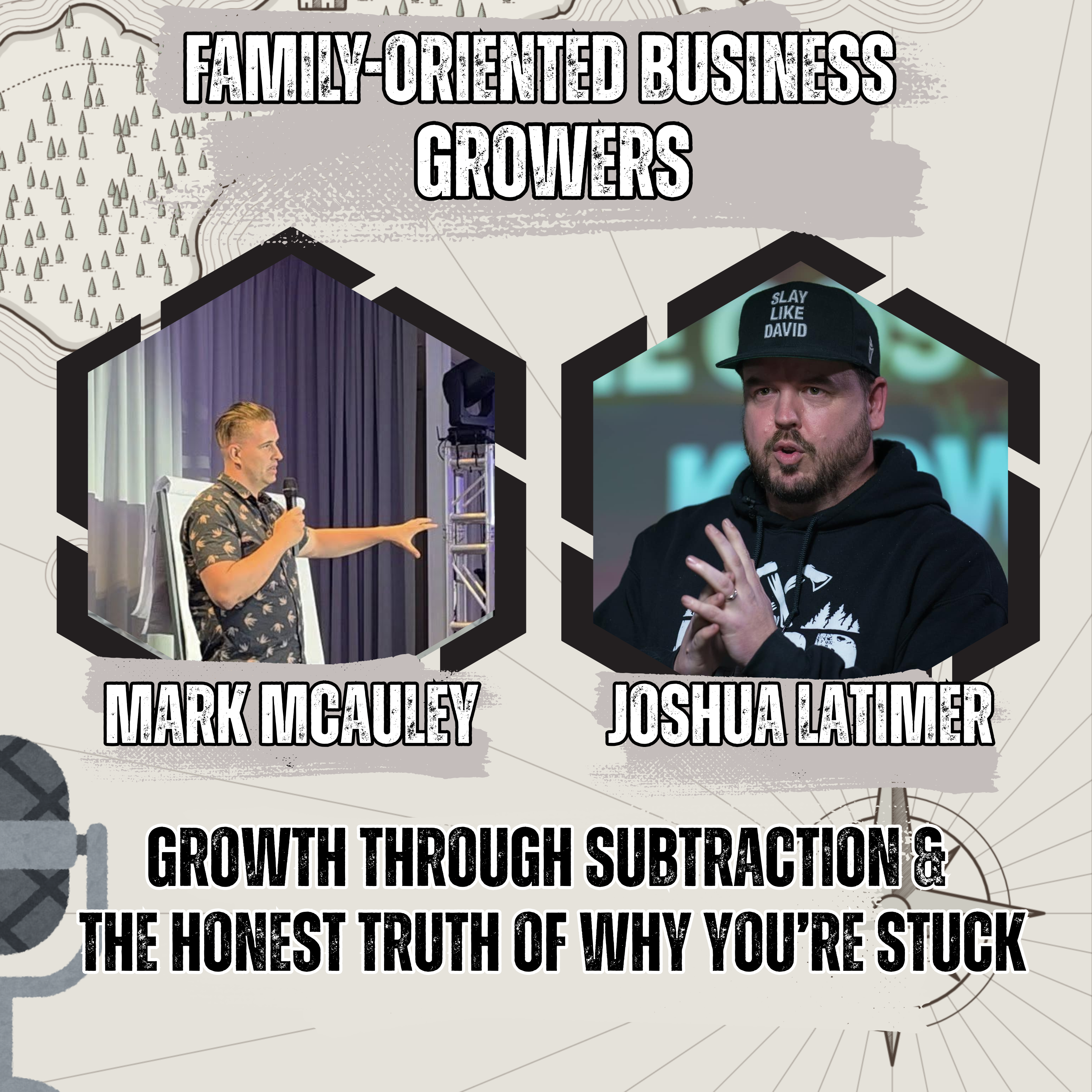
Family-Oriented Business Growers · Mark McAuley
Joshua Latimer, the founder of WarPlan, Send Jim & in another life able to deliver a pizza in a reasonable amount of time. In this episode he drops non-stop gold about growth through subtraction, F.O.P.O, identity ranges that are keeping you stuck AND the hard truth behind all of that that is REALLY keeping you stuck. Listen to this one more than once and don't forget to give it a great review! Join the free group for Parents Running Cleaning Businesses at www.warplan.au Check out what Josh is up to with WarPlan at www.warplan.com
Mark McAuley: Hey, hey, welcome to all of you bandits and chilies. We have a very special episode today with man who probably does need an introduction, but like to me needs no introduction. And so I haven't really prepared one, but really what's going on here is that he has been conned. He's been scammed. He's been hoodwinked into jumping my podcast and giving me free coaching. So, you know, the, the, ⁓ the is up. Joshua Latimer: You Mark McAuley: How do you feel you've been caught out? How are you Joshua Latimer? Joshua Latimer: I'm doing better than I deserve. That's what Dave Ramsey always says. So we'll stick with that. Mark McAuley: Yeah, it's a good line. It's a good line. So since I didn't really give you an introduction, I'm going to leave that mainly to you. Can you set the stage on like ⁓ story so far of everything that's happened leading up to today? You know, no pressure, but of who you are, what's going on in like your businesses and yeah, just it from that. Joshua Latimer: Sure, I'll give you two different introductions. One is like the way I would introduce myself if I met a new person. My name's Josh. I've been married for 24 years this summer to my high school sweetheart. I have five kids, built and sold four companies. Loved small business, small business ownership. Most proud of being married to my high school sweetheart and being a dad. The really cool internet-y... thing is probably the built and sold for companies spoken 100 stages had a million downloads of his podcast, you know, generated $40 million on the internet selling all kinds of stuff from software to education and coaching and events. And I've done a lot of stuff. But the bottom line is, is started out as a pizza delivery driver, married young, ⁓ went through a lot of pain and suffering to learn stuff still have a lot to learn. And I like to help ⁓ business owners, especially good hearted ones. Mark McAuley: Yeah, love it. See, this is why I leave the introductions to you. That was much better than whatever I was gonna come up with, so I'm glad I went with the hoodwinked introduction. Joshua Latimer: Thank It's hard to like compress like decades of suffering, pain, lessons, trials, tribulations into like a soundbite. ⁓ you know, one thing about the internet is like nothing is as it seems. And so you see all these people and they have these fancy like credentials and stuff. And it's really not ⁓ It's like true-ish at best. ⁓ know, most people, even that all of us look up to are like painfully average it. nine out of 10 things. Usually people are really good at this one narrow thing or they're extraordinary at this one thing, but they might be terrible at cooking hamburgers on the grill and they're boring in their life. So nobody is as awesome as you think they are. I love the quote, never meet your heroes, but I think you should meet people you look up to because it will edify yourself when you realize that they're not that great. And it's not like they're up here and you're down here. It's like, oh, I'm exactly the same except I need more volume in this area or I need to pivot these two things, you know? And the delta between like big results and little results, it's not as big of a deal as the internet wants you to believe. Mark McAuley: Yeah, 100%. Like when you say true-ish, it's kind of like, it's a generalization, right? Like this is, we've got, it's the same thing as that introduction, right? You've just had to compress decades into a 30 second intro and there's true things in there, but like, obviously it's not the full picture because that would take decades. ⁓ Joshua Latimer: Yeah, I'm not gonna say all the bad parts. I can't say all my painful, woeful inadequacies. I don't say that part. I just say the cool parts. Mark McAuley: Yeah, no, if you're gonna leave things on the cutting room floor, that's what it's gonna be. Yeah, I recently joined a really cool program and they had their end year event in December. And being the room with crazy people like that, it was very much like experience that you just described of, ⁓ I was like you bumping shoulders with these people because there was a lot of dancing going on and realizing that, like, Joshua Latimer: Right. Mark McAuley: They're almost, they're almost human, right? Like they're doing these crazy things, but it's like, oh yeah, like you. Yeah. Joshua Latimer: Wait a second. They're not magical superheroes. They're just people but they take disproportionate months of action and they have more confidence than me like it's a couple little things usually Mark McAuley: Your dance moves were almost as bad as mine. Yeah, yeah, that's it. ⁓ the spirit of trying to condense ⁓ worth of experience a short soundbite, you've worked thousands of family businesses, specifically in the service space. What are the main things that you see that get people stuck? And ⁓ what do think the problem is? Joshua Latimer: Here's one thing that's interesting. people that start a local business will call it, not always, but ⁓ they're running away from something when they start their business, not running towards something. So what does that mean? Well, what it means is they're quitting a boss that they didn't like, or they're saying they worked a job and they said, I can do it better on my own. And so they're kind of like escaping the pain of being an employee rather than saying, OK, I want to build this thing. I have this grand vision for my life. And what happens is they usually do pretty well up into the point where they've more or less replaced their previous income. so what happens is, in terms of being stuck, they're really not stuck. until they hit their identity range. I call it an identity range. I live and there's kind of a high number and a low number in terms of like income. And you're like, this is what's correct for who I think that I am. And none of this is conscious, right? It's like subconscious. But if you're a make $10,000 a month person in your job, you'll start your business and relatively quickly kind of get to that level. And then that's where it gets stuck. There's lots of mistakes people make. scale their lifestyle too fast with their business and then they're always stressed out and they can't really afford to ⁓ in growth. There's stuff like that. But the big stuff is always mindset related, limiting beliefs, false beliefs. And ⁓ I was really young, I thought all that was like nonsense, the Tony Robbins stuff. But more experience I've gotten, the more people I've worked with, not only is it true, it's like immutably, irrefutably the problem for almost every person that's stuck in any capacity. It's fear, it's overwhelm, it's procrastination, it's overthinking, it's perfectionism, it's religious programming, it's how their parents taught them about money, it's all that stuff that kind of puts the brakes on it. A lot of people, when they're trying to get unstuck, they're like putting their foot in the gas. but their subconscious putting foot on the brake at the same time. And that's why it feels like dirt, dirt, dirt, dirt, dirt, whole time you're going. like, what is wrong with me? And people sabotage themselves so that they stay in that ⁓ range that they think is correct. That's why getting in rooms with other people like you just described. is a game changer. Because what happens is the goal isn't even to make more money. The goal is to change what you think is the correct amount of money for who you believe that you are. In other words, how do we raise the whole range? Right? I don't know if that sounds weird. I'll let you kind of jump in here, but that's the goal. so proximity is power and belief is transferable inside these rooms. And so when you're around big thinking people, Mark McAuley: Hmm. Joshua Latimer: and you're around people who think it's normal to have more than enough, little by little, it'll start to bleed into you and then you'll feel more comfortable raising your range and then your business will grow again. Mark McAuley: Yeah, love it. That doesn't sound weird to me at all. one ⁓ in there which I thought was like kind of a microcosm of the other, which is like when you have the income range, that like earning range, and then you were saying about like the lifestyle creep, I feel like that's like a microcosm of the same thing. the spending is also a range. It's like, and maybe it's spending to keep the amount of money I have saved within its range. So that sort of stuff is happening. ⁓ Joshua Latimer: Yeah, it should be. Mark McAuley: What's that expression? It's it's turtles all the way down, something like that. Like old theory of like how the earth was like, you know, resting on the back of a turtle or whatever. And it's like, what happens below that? it's it's turtles all the way down, right? Part the question that I asked though, ⁓ if does sound weird to someone ⁓ is what they think the problem is, right? Because if the problem is identity ranges, how does that manifest itself? Joshua Latimer: Yeah. They think the problem is, yeah. They think there's a couple big ones. They think the problem is they need more leads. They think the problem is that they need better leads. They think the problem is that Gen X, Gen Zers don't wanna work hard, right? They think things like that. So ⁓ they're doing is they're always looking externally. So ⁓ concentrate this. They think the problem is external when the real problem is internal. That's like the simplest way to put it. They think the problem's over there instead of the problem being in here. And even making that shift is huge. this thing called heuristics. All humans have heuristics. A heuristic is like a rule of thumb. ⁓ something, you know, if you're walking down the sidewalk. and you see a person wearing a ski mask walking towards you, your nervous system will change, even though technically you don't know for sure that they're gonna rob you, right? But it's a rule of thumb. Guy in ski mask walking speedily towards me, let's go ahead and not cognitively process this. Let's just assume the guy's gonna stab me and rob me. ⁓ a heuristic, and we have a lot of negative heuristics. A good heuristic for a business owner would be to just blame yourself for everything. And it's not logically true because there are external problems that happen, but it's just a better rule of thumb. So if your employees are bad, then you just say, ⁓ what did I do wrong? How can I fix this? If your leads aren't big enough, be like, well, I'm not good at marketing. you do that, you'll level up way faster. Mark McAuley: Yeah, I heard a really good quote yesterday actually which was, I'm gonna butcher this, but it was basically like, person who blames others has a long way to go, the person who blames ⁓ has almost arrived, and the person who blames no one is there. Something like that, right? Yeah, yeah. But like, just to thread the needle on that because it's like, okay, ⁓ Joshua Latimer: ⁓ That's good, I like that. Mark McAuley: Josh, what you're telling me is that it's not an out there problem, but like, I still need leads though, right? Like I, a bit of an out there problem. Like the GenX employee, like I do need to fix that. like. Joshua Latimer: Well, do you? Do you need leads? Do they? They think they do. I mean, if I was working with someone directly, the very first step is seeking clarity on what that person thinks that they want. few people even know what they want. You know, Mark, like, they either know what they don't want, like, I'll say, what do you want? And they're like, well, I don't want to struggle anymore. Cool, got it. That's not a thing that you want. That's a thing that you don't want. ⁓ you know, what do you want? Well, I just, ⁓ don't want. Mark McAuley: Mm. Joshua Latimer: to feel stressed out all the time or, I don't want my wife to nag me anymore. And they have all these negatives or what they have is they have what I call placeholder goal. I'm like, what do you want? this, Mark. What do like eight out of 10 small business owners say that their goal is with their home service company? Mark McAuley: Probably a million dollars. Yeah. Joshua Latimer: You nailed it. And I knew that you'd say that because that's what people do. So like everyone thinks that's what they're supposed to want. So then they just convince themselves that that's what they want. And the problem is, is once they realize what's required to achieve it, they just kind of don't do it. So they pretend like that's totally what they're trying to do, but they're kind of not really doing it. And the reason why is because that's not actually even the thing that they want. lot of people don't care. mean, where's the rule book that says you're supposed to have a seven figure business? ⁓ you're supposed to have an artisan business that you can work part time that funds a ministry and maybe the ministry thing is what lights you up and creates a fire in your belly. See, just knowing that and identifying it will give you the fuel to do all the hard annoying stuff you got to do to get that outcome. But ⁓ the million dollar business doesn't actually create energy in you, ⁓ it's not the thing that motivates you and lights you on fire, ⁓ not actually going to do what's required because It's hard. You have to do a bunch of stuff you don't want to do repeatedly over time. Like you get stabbed in the back, you get stabbed in the front, like bad things will happen, you'll waste money. That's normal. So step one, get clear on what you actually want. Then can determine if you need more leads or not. A lot of small businesses really don't. In a lot of cases, you can double the size of a company without even getting more leads. And if we can't double the size of the company, it's not particularly difficult in most cases to double or triple the size of their personal take-home profit also without getting more leads. It depends, right? It's situational. the leads really isn't the problem usually for the most people. They don't make enough money per customer. They're not profitable enough. They have shame around charging higher prices. They have fear. And so even if they get more leads, it doesn't help like they think. And I'll give you an example. So. I have a software company that does really cool direct mail stuff called Send Jim. And that business, I spent a million dollars to like build it and it was making no money. And so I gave a bunch of my last few dollars to Russell Brunson and he helped me fix my business. And it was so funny, I was on a Zoom call similar to this and he looked at everything and he's like, Josh, you ⁓ a watermelon for a dollar. and then you fill up the back of your truck with all these $1 watermelons, but then you go to the market and you sell them for 50 cents. Do you see the problem? I'm like, yeah, I see the problem. He said, Josh, you think the way to fix this problem is to have two trucks full of $1 watermelons, right? like, all does is accelerate the destruction, right? I heard quote that said two guys are at a bar and one of the guys asked the other ⁓ guy. So Jim, how'd you go broke? And Jim said, gradually and then suddenly, right? Which I think is hilarious. So my point is, like leads are required for growth and scale, you know, at some point, but the unit economics of your customer should need to be correct or else the lead isn't really doing that much if you're not profitable enough. Mark McAuley: Yeah. Yeah, yeah, for sure. It's like if there's a friction point and a problem around the jobs that we already have, anything that we do to expand that is like gonna bring in more of the same thing. And if that's a money model issue or whatever it is, like it's just gonna be copied and paste the same stuff. ⁓ I another like ⁓ side on that would be like sort of the push-pull effect of the marketing and the kinds of customers that you're getting, like if you're attracting really just, you know, if you're attracting Karens and getting a lot of pushback around little issue, it's like maybe there's something else sort of upstream that needs to be fixed first in the messaging and the pricing and ⁓ of that, ⁓ rather than let's just get 50 more Karens Like that's worse than a second truck of watermelons. Joshua Latimer: Yeah. Yeah, Golden says there's three types of customers you have freeple people the people want everything for free They value nothing and then you have cheaple people or they want a deal, you know They're like the Groupon customer. I don't know what they do in Australia with like Groupon and stuff, but it's it's those are the first two but the third one is a preple people premium value people people so freeple cheaple preple it's like a tongue twister, but Yeah, I mean how we get them is how we got to keep them So like if you build a book of business off of free people and cheaple people, can't really do a lot with that book of business because ⁓ going to leave if you change the rules. And so to your point, yeah, we need to attract different types. of customers. you're a girl in high school who has low self-esteem and has daddy issues, it's pretty common that maybe you want the attention of boys. And so the way to do that is to wear a mini skirt and wear makeup and stuff. And it's like, will that work? Yeah, sure. You'll get the attention of boys, but at what cost? Because how you get them is how you got to keep them. ⁓ so you better not gain 20 pounds. You better ⁓ wear makeup. We want to build a book of business of customers that we don't resent. ⁓ people build a whole business full of customers that they hate and it's a miserable horrible feeling. Mark McAuley: Yeah. Yeah, just like one other thing, which I think is a perfect parallel with that example is you better not start having some self-esteem, Like better not start that the high school girl, right? You better not start thinking for yourself. You better not start having self-esteem. better not like ⁓ people ⁓ with the of Karen customers. If people are to walking all over them and sort of. Joshua Latimer: You better not. Right, exactly. Yeah. Mark McAuley: calling the shots and setting the tone of how things should be run in their business. And then all of a sudden the business owner is like, actually, you know what? It's kind of my business and I'd like to set up some rules and some boundaries and I'd like to do things this way. All of a sudden it's like, well, I mean, who do you think you are? Right? Yeah. Joshua Latimer: Because you're reframing them too hard. You know, there's a certain frame that's been set. It's like they're up here, you're down here, you're a subservient little slave to their every whim & And when you try to break that frame and be like, no, I'm a high level, top shelf, white glove, premium service professional that deserves to be respected. And my technicians and my crew deserve to be paid market rate wages for above market norms service. They're like, ⁓ think so, right? It's like, it doesn't work very good. Yeah. Mark McAuley: Yeah, yeah. Okay, so the theme of identifying the why, like that's like what you sort of were highlighting in that identity piece, identifying the why is really critical, figuring out what it is you actually want. And then there's the hard things that you've got to do. And that you often say about like, there's like the sort of hustle and grind. See, hustle and grind can be kind of like either a trap or call it a season, but it's like a season in purpose to something, but you say there's ⁓ to get and you've already won. So assuming that someone is clear on their goal and their why, how can people differentiate between what is necessary to hit their goal versus what is just like wasted effort, wasted hustle and grind? Joshua Latimer: How can they differentiate between wasted effort? Like basically, what's the difference between busyness and productivity? Could be like another way to word that. Is that in the right? I don't know. mean, it'd have to be analyzed case by case. I can tell you like common things that people do. I Mark McAuley: Yeah, we can run with that. Yep. But give it some heuristics, what are the rules of thumb? Joshua Latimer: How do we start this conversation out? Most people what I call it, like it's a sophisticated form of procrastination. And here's the thing, people already know what to do. They just don't do it. ⁓ I'm overweight Mark, because I don't understand macros, body mass index. Calories like I know that I shouldn't eat birthday cake for breakfast, but I just if it's there I probably will eat it for breakfast. It's a behavior problem not an information problem So your question is like, you know what what's the correct information on how to you be succeed and not waste your hustle and grind and In a way, it's like most people maybe not everything but lots of things that they already should be doing but they're just not doing it including me, right? So if we're honest with ourself This sophisticated procrastination is when we keep ourselves busy doing things that look like it's moving the needle, even though deep down we know that it's not. And perfectionism is an example of this. Or you build a system in your business and you have five different versions of it, because you always got to perfect it a little more. Or you build a spreadsheet or a KPI or whatever, and you're in your CRM and you're doing your follow-up sequences. There's like a million things we can way waste a lot of time on. And what's happening is we're avoiding the one or two needle moving things that we don't want to do that we know we need to do. That's really the problem. And usually it revolves around sales and marketing. People don't like to be noisy. They don't want to bother people. They don't like to make known the fact that they exist. And so they just kind of hide, stay busy so they don't feel like they're. doing nothing and just hope that people call them back and things like that. if I bought one of the listeners to this podcast business, like the very first thing we would do is just call everyone that's ever give them money ever. Like we would literally just call on the phone, every person in the history of the and talk to them. We would do that first. Most business owners never even talk to their customers ever. It's like they're scared of them. I mean, these are the people that know, like, and trust you. And if I give you a half a million dollars to buy a little tiny company, you know, how do I make my half a million dollars back really fast? Well, I'd probably make half of it back just by using this thing and having a couple of people hit the phones, right? And so there's so much opportunity with obvious things that we're scared to do. The better question is, how do we do things that we're scared to do? Right? a better question. Because if you could start doing the things that have previously been scaring you, Mark McAuley: Yeah. Joshua Latimer: crazy good stuff would happen in your business almost immediately. Mark McAuley: Yeah, I was going to ask a worse question instead. I was going to say, is there like some kind of an app for that, that like, that allows you to use your phone to like call people? ⁓ Joshua Latimer: Yeah, I'm always like, this isn't just for doom scrolling and fear into your brain, like on TikTok, like you can actually type numbers in it and then like humans will answer it and you can talk to them. It's crazy. Mark McAuley: Yeah, I mean, when you put it like that, does sound terrifying. Yeah. So kind of tying that to what you were saying before about like the one foot on the accelerator, one foot on the brake. So I'm interested to get your thoughts on this because at the root of that, the motivation behind both feet is probably the same. Right. So I don't know if that's enough of a question for me to ask it or Joshua Latimer: Yeah. What do you mean? Mark McAuley: Okay, alright, so like the thing that is you where you're like, I'm gonna do this to go forward and the thing that's saying, hold on, slow down, I'm gonna do this to slow down, stay back, to not whatever, ⁓ put the on. If you like into those, they probably ⁓ converge with a motivation and maybe the motivation is like, ⁓ I love my for example, right? And so, in one iteration that's like, well, I'm going to grow this business. And in the other iteration, it's like, well, hold on, this is scary and risky and dangerous and like we need safety. So does that make sense? Joshua Latimer: Yeah, I understand what you're saying. I'm not 100 % sure if I agree with that. But it's not crazy. For example, my perspective would be, I love my family, therefore I should create abundance. But there's not a scenario of, reason you're hitting the brake and not doing the create abundance, I don't think would also be because you love your family. It's because there's a greater driver. I don't want to look stupid. Mark McAuley: Okay. Joshua Latimer: You know, most people aren't scared of failure. They're scared of looking stupid while they try. You've heard that, right? And I think that's powerful. And I know. It's like, you know, don't know if you ⁓ release the of these podcasts, but just imagine a stick figure and here's how life works. Okay. There's like steps. There's thoughts at the top of your head, right? Thoughts, if you don't... manage them, become beliefs automatically, which is step two. So we have thoughts that turn into beliefs. Beliefs control the way that we feel, which is step three. The way that we feel dictates the actions we take or don't take with our hands. And the actions we take or don't take with our hands control, number five, the results. So you have thoughts, beliefs, feelings, actions, results, right? And so... Sometimes it's useful to reverse engineer. It's like, if you love your family and you're like, okay, I want to create abundance for them, but then you don't do it, what we have to do is start with, here's the result, Then we go a layer below that. Well, what was the action? ⁓ Then we have to go a layer below that. What was the feeling that caused us to do the action of nothing? Well, the feeling was... FOPO, is a back of napkin way to remember this that I kind of coined, right? It's like fear, overwhelm, procrastination, overthinking. These are all different. But let's say that you're just overwhelmed. Okay, so the feeling of overwhelm is what stopped me from doing it. Then we have to go out later behind that, which is what is the belief that's causing this feeling, right? ⁓ if you figure that out, things can change. Now, this isn't easy stuff to do. It takes real thought. Most people don't actually think, Mark. They just respond to stimulus. Like they're literally a groundhog's day in real life. Like they're a hamster on a wheel. Even entrepreneurs have a business. We more or less do the same thing every day, more or less, for years on end, right? I love Myron Goldin one time said, Mark McAuley: Mm. Joshua Latimer: You know, people think they have 40 years experience driving a forklift, but that isn't true. No one has 40 years experience driving a forklift because it don't take that long to learn how to drive one. You have two weeks worth of experience repeated over 40 years. And so business owners are doing that, right? They got the basics, they got their income up to where they can technically survive, even though they claim they want more. They never do what's required to get more. And then they sit in that pocket for 10 years or for 15 years. I want to give my wife that vacation I promised her. ⁓ Mark McAuley: Mm. Joshua Latimer: But external, you know, the inflation is really out of control and these people don't want to work and we're just externalizing because we want to avoid thinking thoughts like this because it's triggering and it's scary and it goes back to your childhood and it goes back to things that aren't true. It's existential. I mean, it's a terrifying thought to say, what if I believe lies and it's ruining my life? What if I believe things that I think are true, but they're just not true? I mean, there's a concept in consulting known as growth through subtraction. think the last thing most people need is more stuff on their to-do list. What we need to do is delete the lies. Growth through subtractions means how can you double the size of your business or the result that you're getting or triplet or 10x it? How do you get a big result by deleting a lie? Mark McAuley: Thank Joshua Latimer: And it goes back to those five steps, thoughts, beliefs, feelings, actions, results. Now, we can take action using willpower, even though we feel scared, but we can't do it in perpetuity. It's not a long-term strategy. We have to change the way that we feel to be able to effortlessly take the action. Another good myronism is people need to stop trying so hard to succeed. Instead, they need to let themselves succeed. Mark McAuley: Mm. Joshua Latimer: And this is what he's talking about when he says that, right? It's like, what lie do I believe that's ruining my life? Start there. Mark McAuley: Yeah, yeah. I think just to make that like practical, I think probably one of the biggest ones around that or like a really common one would be what you were saying before about people not wanting to be seen, not wanting to make known their business, which I wanted to like underline that because that's basically how you define marketing. Like marketing is to make known and so marketing, sales and marketing can kind of be maybe like a swear word for some people in their brain that's like ⁓ dirty words, dirty words, but make it known. Joshua Latimer: Yeah. Mark McAuley: and just to just like let people know hey like this is like we have a business over here and we do a thing that can feel like a bit of a helpful reframe lower barrier to entry so what what else can they then do if they like let's say they identify that and they go okay this is my issue I have I have trouble being seen I'm worried that people are going to say mean things about me what what is the the next evolution of trying to like break that down or to shift that belief. Joshua Latimer: Well, people might not like this, but it's the truth, so deal with it. A lot of poverty, not all, but lots. A lot of these businesses that are stuck, that are blaming everybody, it has to do with arrogance. These people are prideful, okay? So I'll give you an example. When you are like, oh no, what if I get a negative comment? You're making everything about yourself. Depression is at an all-time high these days, partially because people psychoanalyze themselves as a part-time job. Who am I? What was my thing? What trauma did I, what microaggression happened to me when I was seven? We're self-obsessed. The way to get rich is to be others-obsessed. When you view sales and marketing as... You know, well, I don't know, that's dirty, that's evil. No, you're prideful and you're not willing to look silly in an effort to serve the people that your business is called to serve. You you could argue that it's your moral obligation to be very loud to market your business if you actually gave a crap about the people you claim you're trying to help. if you provide horrible service, yeah, don't market, that's unethical. If you provide... great, not perfect, but great service. If you do the right thing when no one's looking, if you show up on time and do the right thing, you are like should be on a rescue mission to save these homeowners from all the unscrupulous, dirty, dealing businesses that you're competing with. But they're out there being loud and hurting people and you're being quiet because you're selfish. It's arrogant. It's prideful. It's you focused. You know, the number one fear of adults probably where you are too, but in the U.S. is public speaking. And the reason people are so scared of public speaking is because they're self-obsessed. What if the public speaking had nothing to do with you? What if public speaking was about delivering a message that could plant a seed, that could grow a tree, that could change someone else's life? And if this sounds cheesy to you, you just don't get it. is about service of other people. It's our moral obligation to do the best we can for those that we can. We're not forcing them to buy anything, but we have to make known ⁓ possibilities. And I think a lot of business owners at the end of the day are very narcissistic. They think that poverty is piety, that wealth is wickedness, and them playing small somehow elevates them to some higher level of righteousness. All of it's a lie. All of it's a facade. They are selfish, scared, small thinking people. If you cared about your family and the thing you promised your wife, you would do the thing that scares you. If you cared about giving to your church and building an orphanage, you would sell more stuff to people. Selling is service. But I don't have any opinions, so don't ask me. Mark McAuley: it. Yeah, okay, so I'm gonna just like translate that to the other ear because like I think that the way that you explained that is really really good for like one type of person but then maybe for someone else that that's like hitting a little bit hard it's maybe viewing it as if failure if the ⁓ possibility of like the freedom to fail which gives you the freedom to succeed, the thing that is at risk there of being hurt most is your ego. I recently heard someone describe this as you can make friends with the worst case scenario and when you do that you'll probably realize that the thing that's at risk is just, ⁓ really just your ego at the end of the day when it comes down to it. Like you're probably not going to wind up homeless and without food and all of the things, right? That can happen. Like in Australia, it's pretty difficult to starve to death, right? You have to like basically deliberately go out of your way to make that happen. So there are probably like some safety nets in place and some things, but you just wouldn't enjoy having to make use of the safety net. It's like, oh, like I'm gonna have to move back in with my parents. I'm like 35 years old. That's okay. an ego thing. It's not an ideal scenario, but like the thing that's really gonna get hurt there, like you're gonna be okay, but it's the is what's gonna take the hit. What are thoughts on that reframe? Anything you wanna like sharpen on that? Joshua Latimer: Yeah, I think that's another way to say the same thing. not that people are intentionally choosing to be this evil bad person, but ⁓ one the truth to these people. So look, this is the truth. Think about it. It might change your life, and you might not like it. But it's true and you not wanting to go on stage or to market or to run the Facebook ad or to, you know, take some sort of perceived risk is just you protecting you. It's all about you, you, you, you, you. Think about the jobs you're going to create, the lives that you could change, the wealth you could accumulate. There's more than enough for everyone to have more than enough. There is no economic pie. You succeeding does not make someone not succeed. It's more like a garden. There's an economic garden. And when you succeed, it's like planting a seed in the ground, right? And it sprouts a tree that has more apple. on it. You I love the quote, you can count the number of seeds in an apple, but you can't count the number of apples in a seed. Every extra dollar you have that you can be generous with, that you can serve your family with, that you can shortcut some things for your kids, set them up, educate them, give them, like all of this epicness is waiting for you if you would just stop being self-obsessed. Mark McAuley: Yeah, love it. Whilst we're talking about the apples, let's do the other thing about how people are basically... You know what I'm talking about. You don't know what I'm talking about, right? Yes, yeah. Joshua Latimer: ⁓ people are apple trees? ⁓ yeah, yeah, yeah. Well, I have a theory that humans are just like apple trees, except we have attitudes. And what I mean is, is ⁓ can plant an apple tree in really poor conditions and it's in dry soil and the sun beats down on it every day. And maybe the thing barely survives. ⁓ in its entire lifespan, it might produce three apples and then it dies. And what's interesting is another apple tree planted in really good soil. They're in community, kind of like an entrepreneur being in community, getting the right information, you know, has support of their spouse, they're in momentum as a family. I mean, that's a lot easier to make apples in that scenario. The second apple tree might make 10,000 apples before it dies, but both apple trees reached 100 % of their potential. Both of them get an A plus on the report card. are like that except we have attitudes. So we just decide, don't want to produce apples today. I don't feel like producing. The apples aren't for you. The apples aren't about you. We need to produce. We're designed to create. We were made to make stuff and created to create stuff. ⁓ we sit around and we play small and we hide and we get old and then we die. ⁓ didn't really achieve anything. ⁓ self-soothe ourself, we pretend like it's because of ⁓ government policy or the employee that screwed me. ⁓ But if we're really honest, we know that that's just nonsense. Those things, those bad things that happen to us are real. Setbacks are real. Mistakes are real. But those are contributing factors to success, not determining factors of success. Getting a flat tire on your way to a job interview, imagine you're going to your first job interview and you get a flat tire. That happened. That's real. And then you're late and you don't get the job. But then imagine you're just like, That's it. Didn't work out for me. You just like wander the streets, know, panhandling for 50 years and how dumb that would be. Right. It's like, yeah, that happened. But there's a lesson in it. You know, you either either either win or learn. That's it. Mark McAuley: Yeah. What I think is interesting about this, for, I've talking to a few people that are like really new their business, just like starting out. And what I've noticed is that they tend to, because of uncertainty, like ⁓ I'm starting cleaning business. It basically feels illegal. Like everything I'm doing and just, like, should I even be in your house right now? Like, ⁓ am I, am I to mop the floor this way? Whatever it is, right? Joshua Latimer: Alright. Mark McAuley: And because of that uncertainty, they basically anyone, but like especially their customers, they let them speak into their mind and they believe what they say when they say things like, the price is too high. or you should do it this way instead of that way. And so they're essentially taking business advice from a very biased source, which is this customer who really, I mean, if they had their way, their preference would be to pay you less. But it's not even necessarily, they don't have to be a bad faith actor, it's just that that's what they're hearing, right? And they're allowing that to speak into their mind. Whereas what you're saying here, right? The power of this is that it's the truth, but you have to, like, first of all you have to take a step like listening to a podcast like this to hear something like that and go actually yeah like I'm gonna sit with that does that make sense yeah maybe I'm gonna maybe I'm gonna choose to believe this the thing that Bob told me when when I gave him that quote so think that's like a really important part of it it's just like it's the of proximity but even just by like what we're feeding our minds ⁓ in terms who we're letting speak into our life Joshua Latimer: I mean let's talk about the word confidence. So the reason the customer has so much influence that moment is because of a lack of confidence, right? Confidence comes from the root word confide. And I think you may have heard me. teach this before, this is a Myron Golden thing, but the word confide, if we break it apart into the suffix and the prefix, is con and then fide, C-O-N-F-I-D-E. Long story short, it means with trust or in other words, to trust yourself. The word confidence means to trust yourself. Well, how do we do that? How do we trust ourself? I mean, we're the only people that have heard every lie we've ever told our whole lives, am I right? Can I get a witness, right? So it's like we have a lot more reason to not trust ourself than we have to trust ourself and that's a problem. So then when you get an unsolicited piece of advice that you did not ask for from an unqualified source, you're still like, man, I don't know, maybe I should listen to it. opinion feels just as possibly valid as your gut instinct because you don't trust yourself. ⁓ Again, not to beat a dead horse, it has to do with the amount of volume of action you take. Confidence comes through repetition. comes through volume. Think it like this. Confidence is the derivative of evidence, right? So like if you want to be confident selling, you have to sell 1,000 times. or 100 times, right? You're gonna be more confident on the 100th than you were on the 20th, right? And it just keeps stacking, right? If you wanna be confident cleaning, you have to clean stuff. And so what happens is people aren't willing to just keep going even though there is uncertainty. Tony Robbins talks a lot about like uncertainty with entrepreneurship because... That's the prescription. When you start a business, you're choosing to live in more uncertainty than you've ever lived in your life, right? And it's super uncomfortable. But it's good. It's good for you. It grows you. It's that time under tension is what creates you who you are. And think of it like this. Let me ask you, Mark. Are you the same exact person today that you were 24 months ago? Mark McAuley: Not at all. Joshua Latimer: Not even close, right? Not even close. Because there's you working on your business, but at the same time, your business is working on you. The customer's opinion that turns out to be dumb, thank you customer that I learned. Because again, you win or you learn, right? The trick is to like, just do it faster, compress time, compound it faster. Enjoy the fact that it's not perfect. know, another thing that kind of segues into this is people have a hard time making decisions when they're new in business. Sometimes they've been in business 20 years, they can't make decisions. And the reason why is they're trying to make a perfect decision. A perfect decision doesn't exist. a multiverse, there's infinite possibilities. You're not going to make a perfect decision. You just want to make lots of decisions. Because the more total decisions you make, the better at making decisions you'll be. It's like a spreadsheet in your mind and you're like, oh, this one was a good one, this one was a good one, here's 27 bad ones, here's three more good ones. And we need more data in the table to like reference so the next decision is more likely to be good. And so trying to make a perfect decision, maybe you make three perfect decisions in a year, your business isn't really moving that fast. you're better off making 200 imperfect decisions with only 25 % of them being good because now you have a bigger body of work to reference as you continue making decisions. Does that make sense? Mark McAuley: Yeah, yeah, like clarity is a byproduct of motion. And when you make that wrong decision, you get a brand new shiny piece of information that helps you realize why it was the wrong decision. Like I didn't know this before because if I did, I wouldn't have made this decision. But now, now I know. Joshua Latimer: and the only way you ever really know it was by doing it wrong. Because you can know what not to do intellectually or by reading a book. It's not the same thing as knowing what not to do by touching a hot stove. You tell your kid not to touch it, they kind of get it. They're like, yeah, I probably shouldn't do that. Once they touch the hot stove, their level of knowing goes to whole other level. And the same thing is true in business. Mark McAuley: Yeah, because the first time all they really heard was, touch the hot stove. And they're just like, yeah, it's like, I know I shouldn't do this. I know that I'm pretty sure that I run this like, yeah, ⁓ sure if I've run this like radio ads campaign, I'm just gonna throw my money away. like, I coming back to it. I ⁓ think need leads ⁓ Maybe gonna do that. Joshua Latimer: Yeah, basically. That's actually true. Focus, focus, focus, yeah. Mark McAuley: Surprisingly, for like the last five minutes, I've been waiting for this expression to come out and we've been like dancing all like all around the edges of the phrase, massive imperfect action, right? So that's something that you talk about a lot and that like kind of just bow ties everything that we were just talking about, but with what we're talking about before that, the sort of hustle and grind, that whole thing, how would you, heuristic, as a rule of thumb, how would you help people to define what the massive, in massive imperfect action should look like? Joshua Latimer: Well, it's subjective, right? I mean, what's a massive amount of weight to lift? I don't know, show me your skinny arms and we'll figure it out together, you know? So it's like, you have to have some sort of baseline. There's some level of action you're taking right now and we want to do more than that. And so it's completely up by each subjective person. I'll give you an example. So there's a lady, I'm writing a book right now on FRAP. teaching the FRAP formula and we're spreading all over the world and it's gonna be amazing like how epic it is especially when they like when you attain mastery of it and you really understand it and there's this lady and she needs to raise her prices like 20 % and even doing that probably isn't enough but she feels so bad and she has customers from seven years ago but she's losing money and she'll go out of business if she doesn't fix it. And logically, she knows that that's true, right? The math isn't mathing, but she just can't do it. And so for her, massive imperfect action is raising her prices 1%, which is what I had her do. I'm like, OK, you're having a nervous breakdown. Pump the brakes. Calm down. Let's raise it 1 % and then in seven days, let's see if anything horrible happened. And she kind of laughed, but it actually really helped her because she did it and nothing changed. ⁓ she did that week, she literally added a percent to it. And then the next week we raised it by one more percent. And we just kept doing that. So for her, based on her situation, maybe that was massive imperfect action. Basically, it's another way of saying, you know, do it scares you or Joseph Campbell has a famous quote I think it's him that the thing you desire most is inside the cave No, the thing you desire is inside the cave you fear to enter most I think I butchered it but like the thing scared of contains The thing that you want right the thing that you want so massive imperfect action on a family side If you're not spending any time with your kids It's like spend an hour with them today say no to something else to say yes to that. That would be massive imperfect action Mark McAuley: Yeah. Joshua Latimer: For someone that is in momentum, you know, maybe it means making 3,000 Facebook ads. You I have one of my private clients that I help with FRAP. He's paid me $225,000 to help with FRAP, which sounds insane, but his business has went from 4.8 million to over 9 million in a couple years. And it's so funny because he, He just bought a helicopter because of FRAP actually. That's why was in Florida. He was flying me around in a helicopter. insane. But the thing is, is for him, he was a big direct mail person and he spent hundreds of thousands on mail. Well, to grow even faster, we needed another acquisition channel. So he did Facebook ads. Well, most small companies, if they're on Facebook ads, will have like three... to five like ad creatives. Like they'll come up with three ads, turn them on and be like, that didn't work, right? No, no, no. Like they have a misunderstanding of what's required to get disproportionate huge results. Rick made 3000 individual ads just in the year 2025 for a local business. Now he's in three different cities and it's a big company, like an eight figure company now, but for him, Massive Imperfect Action meant going from like, you know, 500 ads to 3000 ads. For someone that's never done it at all, it might be going from zero ads to the three ads. And then once you're at three ads, it's going to 30 ads, right? I just saw an Alex Hormozi clip this morning, and he said version one of him making content was a guy would come to his office every 90 days, ask him 100 questions with 100 hooks. He would sit there for eight hours and answer them all. The guy would leave, and that was his content for the whole three months. And then once he was used to that, it's like, how do we ramp it up? Now he does like 700 pieces of content a week or some insane number. that answers your question. Mark McAuley: Yeah, for sure. I like the gym analogy too of like, feel hard, it should stretch you because that's, it's part of the growth is gonna be from the massive imperfect action but then the other part of it is like the work that it's doing on you. Yeah, about ⁓ question I had like in my head for this like free coaching session that I've swindled you into was how you call yourself out on things? So if you notice that you're focusing on the wrong thing or taking too long to make a decision, do you have some kind of self system for like a reset button that you push? Joshua Latimer: Hmm. I mean, to give you a real answer, I don't have something in place for that right now, other than my wife, right? best way to do it is to be in accountability with people. by creates a lot of value. Let's say someone had to pay $10,000 to be in an accountability group. And in this accountability group, they don't even talk about business tactics. They don't even talk about business strategy. They don't even become friends. Let's say that this group, the only thing that it does is attach some sort of positive pressure to you doing the thing that you said you were going to do, or course correcting when you're off. Just that by itself is worth an immeasurable amount, depending on how big your business is. So accountability, proximity to the right people. You know, being candid and open with your spouse, humility to be open to new ideas, continuing be coachable, those sound like ⁓ good or like a good answer to that question. But usually, way you know the course correct is through pain. That's usually how you figure out that you did the dumb thing. If you're really, really wise, you'll figure it out before the pain, right? Or you'll learn from other people's pain. You can observe other people's pain and not do it. A wise man has many counselors, but typically you just run into the brick wall. And the good news is, is it's not that big of a deal to run into the brick wall. Failure's not final. Failure's not fatal. It doesn't matter. I said you win or you learn. Mark McAuley: Yeah. Joshua Latimer: We're scared of something that doesn't have any teeth. You're gonna pass out a flyer and no one calls you. It has no teeth, who cares? What we're gonna figure out is was it the timing I put it out? Was it the hook or headline? Did I not have a good offer? Do it again, immediately. But fundamentally change one of those elements. Hey, I did it this time and two people called me. Okay, well do it again and maybe four people call you. Maybe you can never get passed four. Okay, can I afford to distribute this and does it make sense with my average check? You can build a system but it requires some iterative failure to work. Mark McAuley: I feel the teeth from ⁓ what we it mean. like that example like I put out a flyer and no one called me, we might make that mean rejection. ⁓ Joshua Latimer: Well, they think flyer failed means I failed. It does, because in the West, I'm assuming where you are, but people introduce themselves, they say, I am a plumber. am an electrician. ⁓ hi, Josh, what do you do? ⁓ am a lawyer. In a lot of other parts of the world, they say, I do plumbing. I do lawyering. Is that right? ⁓ Mark McAuley: Yeah. Yeah. Yeah. Joshua Latimer: Meaning like small business owners get their identity, like their actual identity, conflated into the business, which is insane. It doesn't make sense at all. So if your business makes a mistake, it's like an existential threat to your existence, right? If my business fails, that means I failed, right? And nothing could be further from the truth. Your business is like a, it's like a soapbox car. Do they do soapbox derbies in Australia where they rate, the boy scouts make the little wood car and put wheels on it and roll it? Mark McAuley: ⁓ yeah, like possibly, I don't really think I've seen one, no, but like I've seen, you know, 80s movies, Sandlot Kids, kind of stuff. Joshua Latimer: It's called pinewood dirt. Yeah. So like, it's like your business is like this little thing and you're building on it and tweaking it and trying to make it aerodynamic and you're painting it fire engine red. But then you're like, man, I want to change it to green. It's a thing that is external to you, designed to carry you to the thing that you don't know that you want. See the problem. So like your business is just a vehicle to drive to this thing that you want. which is why it's such a mess when people don't actually know what they want because they're just driving around doing stuff. It's like being in a boat with no rudder just flying around and you're like, why am I dealing with this hurricane again? Well, you can deal with the hurricane when tropical island is just on the horizon, right? And you can push through and you can do the ropes and you can, ⁓ so get clear on what you want. Do massive imperfect action. Keep tinkering with the car. Do it faster. ⁓ problem isn't that people don't take any risk. They do. The problem is that they wait six months in between each time they do it. And so the problem is this lagging gap where they finally pull themselves together, get the courage to try again, and then they get beat up again or they learn, and it's so slow. Most people are like, well, I don't believe in get rich quick schemes. Okay, me either, whatever. But I don't want to build a life on a get rich slow scheme on purpose. Just because we don't want to do a scammy get rich quick scheme doesn't mean we should be like a turtle with our business. guy that runs Send Jim, my software company, he's the CEO of that company. On side, he wanted to start a home service business so he could better understand it, because all of our customers were. And I remember at the time, five years ago, when he was going to do it, he's like, yeah, me and my brother, we're going to do this garage floor company. I'm like, okay, they do two million a year. And he's built it on the side while working a full-time job, more than full-time job. And he just took massive action with no gaps in between stuff. And they lost money and made mistakes and hired people and fired people. All the normal things happen to everybody. They just compressed it into like four and a half years to hit a couple hundred thousand a month, which is pretty cool. You can make that take 20 years if you want to, but why? Mark McAuley: Yeah. But one thing with him, right, he's not saying, I am a garage floor installer or whatever, right? And he's, yeah, and he's like in another business, not to say that you have to be in another business or doing another thing. And it's not the focal point, but like, he's just from that description, I can tell that he's going to be very, his emotional relationship to that business is going to be hugely different to the average family run. ⁓ Joshua Latimer: You didn't know anything about me. hugely different. Mark McAuley: that's built this thing and it's their baby. And ⁓ when anyone says a mean thing, they give them a bad review and they tether it to themselves and they feel that sense of rejection. And it reminds them of like when their mom was late to pick them up from school when they were seven or whatever. Right. ⁓ making it mean all of these other things, which when we ⁓ it sounds ridiculous. It's like that's absurd. But like that's what we're doing all the time. And we don't we don't question it until something like this prompts us Joshua Latimer: Yeah. ⁓ it's real. It's actually good as an apple. Mark McAuley: to go, you actually like, that is kind of, maybe it doesn't have to mean that. Maybe I could make it mean something different and then maybe it would be easier for me to my self-worth from the outcome of this ⁓ thing. Joshua Latimer: 100 % agree. And to be clear, what I'm suggesting people do is detach themselves from the business like that. That's good advice. Your business is your business and you are you. You are not your business, your business is not you. It's a separate thing. It's a vehicle, it's a tool, it's all it is. It's a vehicle to drive you to something. And how long do you want it to take to get your vehicle road worthy? You know, you want to just sit in the garage and you're just constantly tinkering on it because every time a piece of rust falls off, you feel like you're a loser or something. It's like, get the rust off, put the new paint on. Like I'm not a car guy, but it's like, get the thing done and get the thing going, you know, so can do what you were meant to do. Most people are meant for all kinds of awesome stuff. Like I actually, I'm one of the weirdos that really believes people have a mission and a mandate, a purpose, a destiny that's really real. They were made to do specific things that only they could do, but they get there because of faux pas and because of all the stuff we've been talking about for the last hour. Mark McAuley: Yeah, yeah. Yeah, I think that that from the business and viewing it as separate from you ⁓ is helpful in another way too, which is that if you view it as a separate entity, like I think you guys call it an LLC, here we call it like a proprietary limited company. that's like legally a separate entity and if you view your business as being this actual separate entity from you and then you consider if that entity was a person and it was treating you that way as a person like would you allow anyone else other than your business to treat you this way like what what boundaries would you be setting in place right so it's like on the one hand the rejection is not like personal to me and then on the other hand also it's like hey stop interrupting dinner with my family like that's not that's not like what this relationship is Joshua Latimer: That's a good one. Yeah. Yeah, we would fire our business if it was an employee. Yeah. That's cool. Yeah, personify your business and then score it on how abusive it is to you. Yeah. Mark McAuley: Yeah. Yeah, and then get some relationship counseling around that. Joshua Latimer: I love it man, it's been good. Mark McAuley: Alright, love it. So any any final closing thoughts and with of the amazing things that you're doing at the moment if like where do want people to go if they're looking for more information they're looking to to jump into like a FRAP program or anything like that. Joshua Latimer: We are a decentralized coaching company we've been figuring out what that means for two and a half years, three years maybe. And we think that small groups by people who are slightly ahead of you is ⁓ much more than reading another generic book or buying a course from Grant Cardone. I think business owners very fatigued. ⁓ at the Liars and Charlatans on the internet. And there's all these people, know, buy my course on sales and I'll show you how to be a closer. And they have to talk to their wife? No way, I'll have you close them. There's just all this noise. And then there's marketing agencies. Hey. just pay us $2,000 a month on a retainer and we'll do it. They promise you the world they deliver nothing. You buy a course, it sits on the shelf, right? Like people are over it. And I don't know if it's the same down under, but I think it is. You have you noticed there's five times more of this stuff than there was five years ago? There's 10 times more. So what we do is we help regular people start a part-time mentorship business our software and our frameworks. And don't know if you know this Mark, like into what we're doing in 2026 is we're launching what are called FRAP chapters. And it's a way for you essentially start a local. in-person mastermind group with other businesses that don't compete with you and you are the teacher leader facilitator of the group and you're walking them through FRAP. FRAP is a way to make a lot more money using creativity. It's an acronym for Frequency Referrals Average Ticket and Pricing and you can make an extra $100,000 on the side part-time running one of these FRAP chapters. You don't have to be a guru. That's what we do. So if any of that's interesting to anybody, more than welcome to to go to warplan.com which is our website. If you're just a business owner that needs help in oxygen, then give Mark all of your money because that's what he will help you do. you want to help others, know all of it. ⁓ don't have that much. ⁓ don't have that much. Like they need to give you all of it so you can make them way more. You know, never underestimate the power of making a bet on yourself. You know. Mark McAuley: Maybe not all of it, like, you know, might, you're like, just most of it, just most of it. Joshua Latimer: Never underestimate the power. Like when I joined, the first group I joined was $25,000 and this was over 10 years ago. That could have been a million dollars to us. But our business completely transformed. The ironic thing is it's not because I got this one exact tactic. It was just a collective upgrade in belief. Never underestimate the power. Like when I joined, the first group I joined was $25,000 and this was over 10 years ago. That could have been a million dollars to us. But our business completely transformed. The ironic thing is it's not because I got this one exact tactic. It was just a collective upgrade in belief. by being around people that thought bigger, that thought different. You know, I was able to meet all these crazy people in that group, like Myron Golden. I've known him for like eight years now. Alex Hormozi was in that group in the beginning. And when you're just around people being who they are, but they think bigger, and they have a little different perspective, ⁓ my God, just really, really cool things can happen. by being around people that thought bigger, that thought different. You know, I was able to meet all these crazy people in that group, like Myron Golden. I've known him for like eight years now. Alex Hormozi was in that group in the beginning. And when you're just around people being who they are, but they think bigger, and they have a little different perspective, ⁓ my God, just really, really cool things can happen. Mark McAuley: Love it, love it. Thank you very much for your time and for allowing yourself to be hoodwinked. It's been a pleasure. Joshua Latimer: It was absolutely the best hoodwinking I've ever been a part of. So thank you, Mark. Mark McAuley: It's great review, I'll have to get that put on a shirt. Joshua Latimer: Awesome. Thanks, man.