
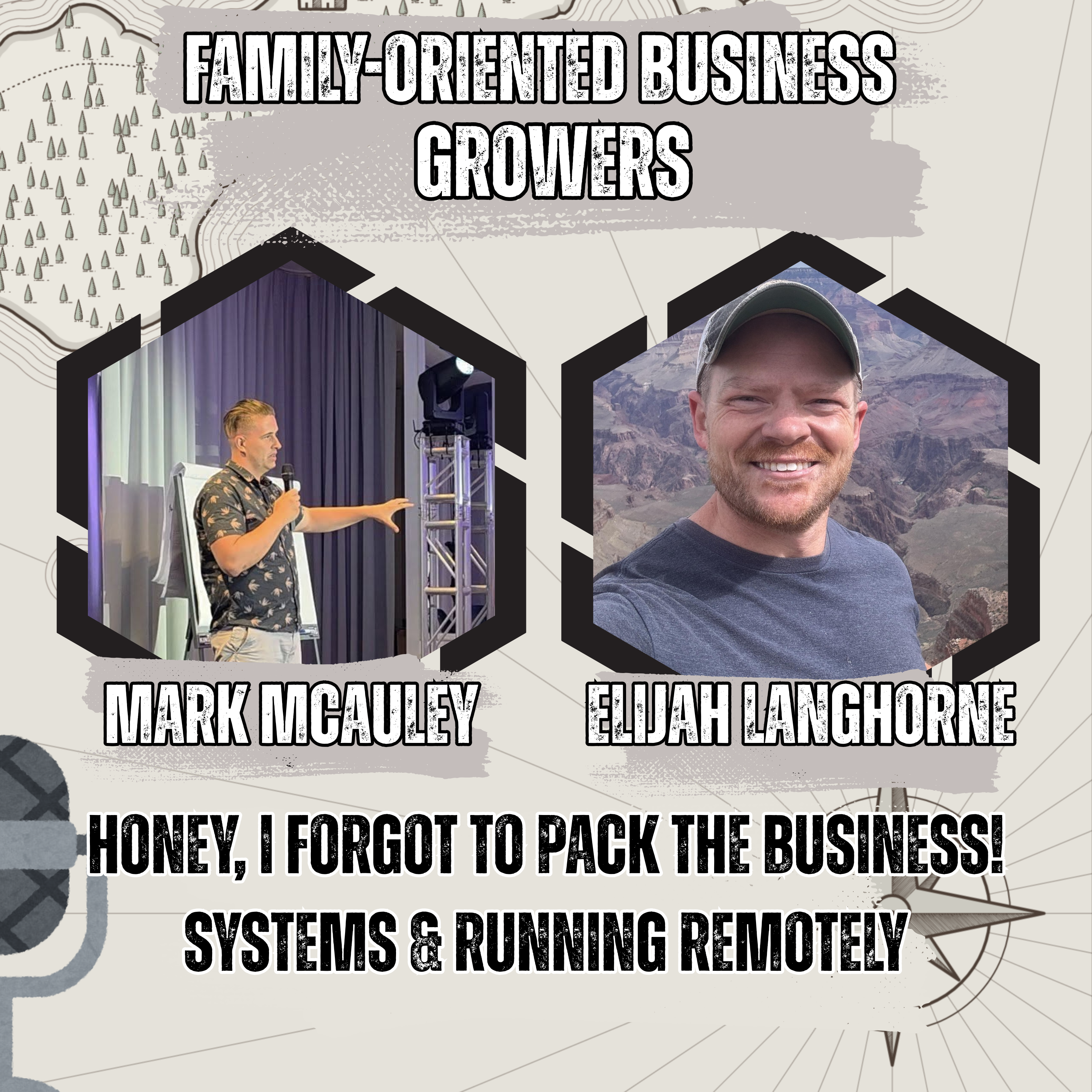
Family-Oriented Business Growers · Mark McAuley
Things were going well in Elijah Langhorne's electrical contracting business. His days were free & easy... Until he met a woman who would change it all! In their decision to marry, Elijah would move states and the business would not move with him. Join us as we discuss how Elijah made the transition to running his business remotely & which systems were key in his ability to do so. From opposite sides of the globe, Elijah Langhorne & Mark McAuley have each built successful service based businesses that are run remotely. Whether this is your goal or you are just looking to effectively delegate and get off the tools, the steps are largely the same. Enjoy this conversation and jump into our Facebook group for Parents Running Cleaning Businesses via www.warplan.au where you can ask questions on how to apply this to your specific situation and also get your free "Save 5 Hours Per Week" Time Audit. Get in touch with Mark via https://api.leadconnectorhq.com/widget/bookings/time-for-you-to-win Get in touch with Elijah via [email protected]
Mark McAuley: Hey hey, welcome to all of you bandits and chillies. Today's guest was building and running his electrical contracting business. And things were going really well and he building momentum. And then, and then a woman came into the picture and changed all of his life choices and his priorities. And so he decided to do what any responsible business owner would do and set up his business in such a way that he could run it remotely and have it self-manage so that he was able to move and get married and do all of the things. So tell us all about that Elijah Langhorn of Langhorn Electrical and Contracting. Elijah Langhorne: Absolutely. Thanks, Mark. I appreciate the opportunity to be here. It was really interesting to get my perspective ⁓ my business. I started out ⁓ a lot of people, just chasing revenue and chasing dollars. And ⁓ I was doing good work for good people, but I knew that there was something ⁓ something else that I was kind of being called to. And I met my soon to be wife and I realized what I was supposed to be doing. So re-roll it back a little bit, I started out in contracting ⁓ before I joined the military. And then when I separated from that, I came back and built a business doing what most people do, just trying to work harder than everyone else. And ⁓ worked it didn't. hit a few seasons where I had to rebuild. financially, operationally, even personally. And that's when I started noticing that things were starting to shift on the inside. I realized that it wasn't a problem of effort. It was a problem of structure for the business. And that's what kind of led me down this path of trying to make my business healthier, not just larger. Because if you don't have the right systems in place, scale scales chaos. And I realized that was I was doing the same thing over and over again and I needed better systems in place. ⁓ I started down that path of being more intentional in the way that I structured and ran my business, I started seeing that so much opened up in margin, not just with revenue. Revenue ⁓ through the roof. But what I really wanted in my life wasn't just more money. I wanted the time to pursue the things that actually made me me. Mark McAuley: That is a great question if I don't say so myself. Can't wait to hear the answer in like 14 seconds from now. Just wanted to jump in and let you know about the free time audit designed specifically to save five hours per week for parents running cleaning businesses. It takes about two minutes to complete and you get your time saving results straight away. To get your free time audit, join our Facebook group via warplan.au, link in the description. Now, what was that cliffhanger question again? Elijah Langhorne: And I stopped defining myself by, I'm Elijah. I'm a contractor. do all this stuff. Suddenly I went from being the technician to the architect. now I could design my business to support the lifestyle that I wanted to live and ultimately facilitate me to move from one state to another, to buy the house that I never thought that I could afford as a young man and have the life that I have now with my wife. ⁓ And a great thing. Mark McAuley: Yeah, fantastic, fantastic. So the scaling and I can't remember exactly how you phrased it, but essentially, like, it's like a pressure test, right? If you're building and scaling and things are not actually improved fundamentally in like the systems of the business and the supporting structure, it's just going to put more and more pressure on everything and specifically on you. So do you think that that was the catalyst for you? Elijah Langhorne: Hmm. Mark McAuley: to make the decision or to change that, of switch the identity hat between being the technician to the architect, or was there something else that kind of took you in that direction or helped you to see that vision? Elijah Langhorne: There was something else. There was something external. And ⁓ many business owners and founders that I talk to and that I work with now, they have business ⁓ because love what they do. The problem ⁓ when you good at baking pies, everyone tells you to open a bakery. And the two different skill sets. I was a systems guy in the military. Attention to detail was a huge thing. when I went back to contracting, I was doing work that I love to do ⁓ I was good at it. ⁓ that's what brought in, it was basically word of mouth was all of my lead gen and having my calendar booked out. Went from working by myself to having four trucks on the road and we were doing great, but I had nothing to show for it. ⁓ And was trying to figure out why is this so bloody hard? Mark McAuley: Mm. Elijah Langhorne: And, you know, I'm educated. have a degree in organizational leadership. have an MBA. Yet even with all of the book smarts, ⁓ system was struggling on paper. I remember the first year that we broke half a million dollars in revenue. And were some months where I was actually having to use my VA ⁓ pension to help cover some of the bills. And I was like, where is this money going? And I just. Mark McAuley: Hmm. Elijah Langhorne: decided to stop and quit trying to muscle my way through it like a brute. And it was kind of divine providence that at that time I came across someone who would eventually become my business mentor. And they just told me, Elijah, you have the heart for what you're doing, but you don't have the systems in place. It's like you're on a bike and you're pedaling on the smallest gear and you're just not shifting. If you would just press this lever, You get more leverage and you could go farther faster. I started shifting gears and everything changed. And then that kind of ignited the passion of, know, how much time and stress could I have shed had known these things on the front end. And that's kind of what has led me to now trying to talk with people like you share the message of like you, can do what your passion is, but you can operate with wisdom and understanding and do it better than just. Mark McAuley: Hmm. Elijah Langhorne: as that technician mindset. Mark McAuley: Yeah, yeah, I love it. It's like the the pie shop thing feels like a direct reference to the E-Myth, right? And running a bakery has surprisingly little to do with baking bread or making pies. I feel like that's even more pronounced with like something ⁓ like qualified trade, like electrical, because the the importance of getting that right is so it's so important. The importance is important. But at the same time, that has little to do with the actual successfulness of the business model and everything there. within what were some things that you were blind to even just a couple years ago that you can really see clearly now? Elijah Langhorne: Yeah, I used to think ⁓ ⁓ ⁓ problems. And I know that revenue actually hides ⁓ problems. I blind to was the math of the entire system. this comes down frequency referrals, average ticket, and pricing. I would celebrate big ⁓ but I had no underneath it. And now I look at a business and immediately ask, is this predictable or is this luck dressed up as success? ⁓ Massive difference between the two. Mark McAuley: Mm. Yeah, I love that distinction of revenue solving versus revenue hiding problems because a blind spot, that's like a really great example because those two things feel the same. If you can't see the problem and you assume it's solved, right? It's like, fantastic, great. Revenue to the rescue again. So what were of the things that helped you to learn those lessons? Because we were talking a little bit before and you'd mentioned that ⁓ Elijah Langhorne: Yes. Mark McAuley: ⁓ It was really the seasons of in which you learnt the most. So what were some of the things that helped you learn those lessons? Elijah Langhorne: Let's ⁓ doing things the hard way. They say that life is the worst teacher because it gives you the test before it teaches the lesson. But one of the great things that we can do is we can buy the of ⁓ other people. ⁓ what I by that is when ⁓ you have strength mind to recognize that you're struggling in an area, you have the ability to pause and say, okay, who else has struggled through this and gotten a win? And you turn around and you look at where they failed because we can't relive everyone's life and learn everything ourselves for the first time. How long did it take Edison to do all of his iterations of inventing the light bulb before he finally got it to work and created a working light bulb? We don't have to spend years of our lives to create a working light bulb now. We just go by the light bulb. And for me, It was realizing that when I have a hard lesson, I can turn around and find a mentor to help give me an answer. An of that, one of the hardest lessons was realizing that I was not running a business. I was feeding a machine that required me to show up every day or it broke. And I remember hitting a switch where we had work coming in, but cash was tight, couldn't figure out why. And it turns out that I was underpricing over delivering and not structuring anything at all for margin. that was one of those touch the stove moments where, because you can always be told, don't touch the stove, don't touch the stove, but it's the burned hand that teaches the lesson of fire the best. When I had that epiphany, forced me to stop thinking like a technician and start thinking like an owner. Mark McAuley: Yeah, yeah, that's it. So even even sometimes where we buy other people's mistakes, sometimes we still insist on making our own and just touching the stove. But then ⁓ you do that, you do have a completely different level of understanding of why you shouldn't touch the stove, right? So I think I'm curious to get your thoughts on this, because I think that's something I see with people. ⁓ The problems that you're describing are very ⁓ like Elijah Langhorne: Yeah. Yep. Mark McAuley: Very common, hear this sort of thing a lot. And think that one of the things that people struggle with is that they let unqualified opinions speak into their life and their mind and their business. And they don't really have like a, you don't what you don't know. So sometimes they might hear some business advice over here and they read this thing online and they saw this video ⁓ and then customer told them this thing and they're not necessarily like parsing that information in such a way that they're actually like able to hear what's good advice. Like which person told them not to touch the stove and which person was telling them to put the fork in the toaster, right? What do you think about that and ⁓ how do you think that you can kind of that problem with the things that you don't know? Like how do you know which advice to listen to? Elijah Langhorne: That is a ⁓ great question. doesn't always have a clear answer, ⁓ being aware that that is kind one of the central questions in our day and age, we're in an environment, an era now, where there's so much information that's available just with a few clicks on your phone. You don't even have to type anymore. You just ask ChatGPT, hey, give me an answer. The is everyone's using ChatGPT. And with so many sources, I see a lot of people that they're scrolling through social media. They don't even realize they're not looking at people. They're looking at some avatar that's spitting out information. And because so many people are hungry for information right now, that has become the product. Actually, we are the product and everyone is trying to fight for our time and attention. So people go online, they go looking for questions, ⁓ answers to problems that they're dealing with. And there are a thousand and one sources that want to sell them their proprietary method and framework for solving this one thing. An example of that is, you know, being a business owner, I'm constantly bombarded by all of these different ad agencies saying, we can get you leads, we can get you generator installs, we can get you clients. And just wonder like, ⁓ are, is all of your work geared towards acquiring Contractors when like a there's a disconnect between what they're saying that they can do and what I actually see them doing So for whatever answer ⁓ may be looking for online, whoever is trying to give you Unsolicited advice. I would always look for Fruit ⁓ then root and what I mean by that is when they're saying ⁓ do this and you'll get all these great results I Would want to go back and look at what? What's the route that's feeding their claims? it actually successful in their business? If selling this miracle solution, but you never did it, or if you're coming from one failed enterprise after another, well, I'm not really going to trust you with my money to make my business work better when it didn't work for you. ⁓ So you coming from a position of strength and authority? What are you qualified to actually say? On the qualified point, Again, I had graduate degree. I'm actually going for a doctoral degree right now. But I'll be the first one to tell you that those degrees don't mean anything. I care about real world practical experience. Did it work for you? When I am needing an done, I don't want the surgeon who four ⁓ five-star Google reviews. I want the surgeon that has 4,000 three and a half star reviews because he's got the proof that supports his position. So always go back and look at who's actually saying it. Look and try to do your due diligence and figure out where are they coming from? What credentials do they have? And do they have the actual proof from their life of what they're saying? Mark McAuley: Yeah, love it. My favorite line on that is don't take advice from someone that you wouldn't trade places with. And importance of that too is that that can be cross domain. So you might take business advice from this person, but not family advice. And then you might take health and fitness advice from this person, like, do not listen to what they have to say about business and finance or whatever it might be. Right. ⁓ Elijah Langhorne: Yeah, absolutely. ⁓ yeah. Yeah. Yeah. Mark McAuley: go back to ⁓ you were setting up to get your business ⁓ in position where you were able to move away from it and running it remotely. What was the changes that you made? ⁓ So saw that that was going to be the goal ⁓ and what wanted to do now. What were the things that you started to change to make that achievable? go back to ⁓ you were setting up to get your business ⁓ in position where you were able to move away from it and running it remotely. What was the changes that you made? ⁓ So saw that that was going to be the goal ⁓ and what wanted to do now. What were the things that you started to change to make that achievable? Elijah Langhorne: That's a great question. It's a very practical question. That's a great question. It's a very practical question. So I looked at essentially a system that I did own a business. I owned a job with ⁓ Because if I wasn't there, it stopped or it broke, and in a very catastrophic, spectacular way. ⁓ what I started doing was looking for ways to look try to label the things that required my presence on a daily basis. I was too in demand as a key component in every system of the company because what I started out as a one-man show, I just scaled it and the chaos scaled along with it. So what I started doing was just identifying the different frameworks I needed for each stage of the business all the way up to where we were at. And I started just building out systems. there's so much, you know, we say, ⁓ build an SOP, build a system. It'll fix all your problems. It's not quite that simple. Because company culture comes into play looking at who you already have on the books that you've hired. Does fixing your company culture and building systems involve firing people? Do you have the wrong people in place entirely? Because I've seen some businesses that were fairly large. but they were very, very unhealthy. And it took coming in and doing some radical amputation and paring it down just to make it be something that would be sustainable. But I looked at the basic systems of your office work, your field work, your sales work, sub-branches like HR, things like that, getting them tacked onto the right people, getting actual job descriptions down for who had... what responsibilities and who could they call if they had a question on it, and trying to get the processes out of my head onto paper. And that was the biggest thing, was not having me as the first line of a question being answered. There was always a source that they could go to. knew this is my true north guiding principle for the way the company runs, and this is where I go to get answers. And then empowering the employees I had. to follow through on their decisions and not come in and micromanage all of it. Mark McAuley: Yeah. Yeah, so I feel like that's really the struggle of the skill of delegation. And I think that the first thing is, and I don't know, like this was true for me, like I never really thought of delegation as a skill. It was just like, ⁓ like that's where you get someone else to do a thing for you. Like where's the skill in that, right? But struggle, like what you've just described is that when you're doing everything yourself and then you try and take your hands off it, kind of, you still end up like you're touching it. Like someone else is doing the thing, but you're touching it and then you're touching it over here. Elijah Langhorne: Alright. Mark McAuley: and you've got a leg on this thing. And all of these things have these contact points with you. what can you speak to that a little bit of ⁓ what might have looked like to you before and what that looks like to you now? Because it's one thing to have the system in place, but it's another thing to actually empower someone else ⁓ to that system. Elijah Langhorne: Yeah, I'm going to go a different direction on that than what you might hear a lot of gurus say when it comes to delegation, because I don't consider myself a guru in any way. For me, delegation first starts with identity. I had the identity ⁓ of was the man that made everything work. ⁓ And developed, I ⁓ had lot of self-worth and value tied to the fact that I could answer any question and I could do virtually any task. as grew, ⁓ a of my worth as an owner was, that's Elijah. It's the of saying, Mark, that's the guy with ⁓ the cleaning business. ⁓ he's super successful. Do you know how many clients he picked up last week? My ⁓ identity was tied being a part of everything. And it was hard for me to hire because I wanted someone that would be as good as I was ⁓ the task. And of course, in my mind, no one ⁓ really up to the level that I wanted them to be. So ⁓ it was even hard to make a hire that I could delegate to. And then once I did make a hire, then I was always like trying to be part of the process because like if I was needed, then I was more important. learned very quickly that you don't find people that are necessarily 100 % qualified for your task. ⁓ find them at 60 or 70 % and ⁓ hire them there and then you train them up to the level that you need to be at for your company with all the proficiencies that you require. But you have to empower them to do the work that you've hired them to do because that's where they're getting their value and their self-worth from. ⁓ one wants to come in and constantly be looked over the shoulder and micro touches and directions, you've got to empower them and give them self-worth by doing a great job for your customers. it's work on the owner's part to say, am not better or I not ⁓ more important I was called 37 times before lunch. So when it came to the delegation, I had to have the right people. Mark McAuley: Mmm Elijah Langhorne: and it's my responsibility to ensure they're properly trained, equipped, and empowered. But once I give them that framework, then I have to take my mind off of that task, otherwise why am I paying them to do it? And I have to apply my resources towards the thing that an owner should be doing. If I'm not driving client acquisition, if I'm not working higher level tasks that my office manager and my techs can't do, then I'm failing the company. It was an identity shift for me. Like I had to delegate because suddenly I had a whole new job, a whole new horizon I was looking at for the things that I needed to do as an owner and a founder. Mark McAuley: That is so good. this, like the whole time that you were talking, I was just like hearing the, the, part of, um, the interview I did with Joshua Latimer. don't know if you've heard that one, but there was this, this part of it where he just, it was like a real like takedown of ego. And it was fascinating because like in everything that you're saying right here, there's that identity component, which is a really big part of it, but also. our ego can be really sneaky and shifty and disguise itself as humility and virtue when it's actually arrogance and pride. And so we think that ⁓ contacted 37 times about this thing is we're kind of secondary gain from that. Like that's actually a problem, but where it's ⁓ sort of our ego and we feel good about the fact that we were a part of the process. Elijah Langhorne: Yes. Mark McAuley: but we're also not getting out of our own way. then other that it kind of ⁓ as it pertains to that identity piece, the way that the ego kind of slips in there and pretends to be humility is it's like, you are the or you are the whatever role hat that you're used to having on. And we associate that Elijah Langhorne: Yes, absolutely. Mark McAuley: with being a more humble position than say, you know, the CEO or the big wig or the manager or whatever else you want to call it that you need to be doing in the business. But by not getting out of the way and by still touching that role and still like doing the things that you've tried to delegate, you're not empowering the other person. You're not. stepping into the thing that would actually help the business and you're essentially keeping yourself and the business smaller and helping less people like on the team and outside of the team for the sake of how it is challenging your own sense of identity and self-worth which is ego it's ego at the source of that but like it's so it's so cleverly disguised that it's hard to see that and I just think that that's a really like powerful way to look at it with that whole identity piece as well What are your thoughts on that? Just kind of feeding that straight back to you, Elijah. Elijah Langhorne: Yeah. Mark, I completely agree with you. One of my favorite sayings is there's ditch ⁓ on both sides of the road. And you've seen people that are like, ⁓ worthless. I'm no good. Nobody would me. Those are the guys that stay in the only sole proprietor. They never grow. They never because they don't see the value in themselves. On the other side of that, One of my favorite sayings is there's ditch ⁓ on both sides of the road. And you've seen people that are like, ⁓ worthless. I'm no good. Nobody would me. Those are the guys that stay in the only sole proprietor. They never grow. They never because they don't see the value in themselves. On the other side of that, Mark McAuley: Mmm. Mmm. Elijah Langhorne: You have the absolute narcissistic people who think that they are God's gift to the world. Both of those people are on the same continuum of You have the absolute narcissistic people who think that they are God's gift to the world. Both of those people are on the same continuum of pride. you know, I mean, you could have self-deprecating humor. You can be relatable. But when you don't value your time, one else is going to value it. And if you don't value your time, no one will pay you what it's worth. So you can fall into the ditch of being, you know, so small-minded thinking that you have nothing to offer. Mark McAuley: Hmm Elijah Langhorne: And you're basically just a low value person and you can fall on the ditch on the other side of being so full of yourself, whether it be that narcissistic over the top. You're just super greedy just for money's sake. Or may not really be operating a successful company like you were talking about and describing. ⁓ You have to be the center of everything and everything has to orbit around you. And both of that, it's the exact same trap that owners fall into instead of walking down the center of that road, valuing who you are, your skillsets, your abilities, charging appropriately for it, empowering other people to do what they should be doing in their roles, basically staying in your lane. Now, I completely agree with you, Mark McAuley: Yeah, yeah. And I think Josh also kind of prescribed the antidote to that, which is basically to make it about other people. And just in conjunction with what you're saying there, it's like, if you think about what is actually the most benefit to the most people or the most benefit to the people that you are most responsible for, right? So like your family, your employees, and you view that as the lens through which you're trying to make these decisions around like, you know, should I be, is this my role? Should I be touching that? Do I need to delegate this? Do I need to stop doing that? Whatever it is. That's when we take ourselves, our out of it to see what we should be doing or what the best move is. ⁓ And then, and then we can set that aside and just like follow the path of, okay, this is like, this is what the business needs of me right now. This is the why, this is what we're driving towards. regardless of how I feel about it, regardless of the secondary gain that I might be getting from, being involved in that process or whatever it is, I'm just like sticking on the path and, trying to avoid the ditch on that side. love, I love that analogy. what, ⁓ so, so when were, Again, setting up to move, running remotely, getting, ⁓ described this before the call as you a ⁓ self-licking cream. ⁓ Love It's fantastic description. So in that process, what are the key functional parts? Because I think that this is a really important thing, whether someone wants to run their business remotely or not, the things that are required Elijah Langhorne: Yeah, self-licking ice cream cone, yeah. Mark McAuley: to do what we were just talking about of getting yourself out of some of these processes are the same. It's just that if you're going to physically not be there, you really need to actually do the thing and not yourself in the process because you can't be involved in that process on a daily or weekly basis. So what do you think were the core key moving parts in the business that you had to really effectively calibrate on that self-licking ice cream cone? Elijah Langhorne: Yeah, absolutely. ⁓ was to build something that produced results without depending on me being everywhere at once ⁓ particularly geographically there. And ⁓ what I love about that is it didn't just be specifically niche down to a contractor. It really applies for anyone trying to get more leverage and freedom in their life. For me, ⁓ I to get the visibility on some very key shortfalls and gaps in my business. And that's the areas you're talking about. For me, it was lack of systems. And just because it lives in your head doesn't it's a system. It's ⁓ not minimum viable system. It's one of the KPIs that I try to highlight when I'm working with business owners now, that if ⁓ a minimum viable system is something that can operate apart from you, and if it's just in your head, then... that doesn't suffice. So for me, it was a lack of systems. It was also not having visibility on my numbers. You've heard it said a lot of different places, but math is the path. If you don't know what your numbers are, you are just shooting in the dark for everything that you're doing. For that's why I could have over half a million dollars in revenue and still effectively be broke at the end of the day. ⁓ The last thing for me, it was no Mark McAuley: Mm. Elijah Langhorne: not having any real strategy for increasing value per customer. ⁓ you don't know your if you don't have systems in place and you don't have a way to actually get true value out of each customer, you could have a million customers. But if you're only making a dollar off of each of it, you're going to hit your ceiling for your time ⁓ capacity and not going to make money out So I would say it was those three things, systems, numbers, and value per customer. Mark McAuley: Yeah, love it. I think that really feeds into clarity, which feeds into confidence as well, because like, ⁓ when, when people, and I've done this as well, struggle around the pricing ⁓ their services, it, if you don't understand your numbers, you don't actually know what the, the real operational of the business actually are. You can be stressing out about putting out this quote and charging this price because it sounds like a big number. But then when you actually dig down into the numbers and you realize, actually, I'm not making any, like, this is, this is breakeven. And so I need to raise my prices by this much. And then if I raise my prices by, you know, let's just say it's $30 an hour or something. And the person then wants to haggle me down $20 an hour, just as an example, it's like, well, I now understand that that's not this huge number that we're talking about. That's like two thirds of the profit. gone right there. So like when you have that clarity, it brings that confidence to it. I want to come back to what you're saying about systems though, because this is like, for me, this was such a nebulous concept when I was like really starting to try and understand what I was doing. And I was listening to podcasts and I was, I was reading books and they would talk about systems. I would think, these like crazy complicated things. I didn't really know what it meant and I didn't know what I was doing and it got to a point where I was like maybe I'm too afraid to ask at this point like I'm gonna try know what a system is and ⁓ it too late to ask? ⁓ when you say that getting the right systems in place in your business was such a critical thing in setting it so that the ⁓ self-licking ice cone is operational, can you give an example like a really practical tangible example to illustrate what that means in practice. Elijah Langhorne: Yes. the simplest way ⁓ give an example of a system in practice. Before I really dove into all of this, I was of laissez faire with the way that I ran things. I'm not saying that I wasn't structured, but most of my came from just effort. effort, it just, wasn't sustainable because I was constantly having to pour out Energy in the form of effort to get a result. So structure versus effort When I started developing Systems to kind of hang my business off of I was building a structure and So the structure is like the skeleton and the systems are the muscles that hang off of it that make the different body parts function and move I needed to have a very practical system for how did I handle new client intake? So in the grand scheme of things, you're trying to meet people, you're trying to ⁓ they have a problem that I can solve? If I can solve it, what would it cost to solve it? Go through all the particulars, work up the contract, shake the hand, do the work, collect the money. That whole life cycle, that down. These are bucketed terms. ⁓ You always got to like break it down into smaller chunks. So out of my whole system for handling a customer, I had to develop a system for client intake. This was not finding the leads. This was not qualifying the leads. This was what happens when a lead raises their hand and says, I'm interested in having something done. So for me, what that looked like, I actually had to write out an SOP that my office manager Mark McAuley: Mm. Elijah Langhorne: would be able to follow that depending on if the lead was from Facebook, whether it was a phone call, whether it was email, there were certain questions that they had to ask. They had to ask, obviously, general information of name, phone number, email address, ⁓ service nature of the problem. But it goes deeper than that because I want to know were you referred by someone else ⁓ so can turn around and give that person a shout out so I can turn around and pay a referral commission. so I can find out what of my lead gen is actually working. I was missing all of that data, I didn't know if my ads were converting or not, because I never captured this, because I didn't have a system in place for it. So for client intake, it was capture all of their information, the specific information I wanted, and then all the extra questions, and then build it into a form, and then up channel that to the appropriate person to be able to reach out. during intake, they would schedule. the estimate timeframe. If we had to go out and look in person, depending on the nature of the job, some things they could just email in or text in pictures and we could look at it ahead of time and give them a quote kind of remote. So we needed the entire system in place for that because pre-system, I would have a phone call come in and then I would get a text message about, so and so needs a such and such done. And I'm like, well, I'm in Dorita right now, so where are they at? And then they wouldn't have the service address. And then by the time I'd find the service address, I'd have realized it's 45 minutes away, and it's already early afternoon. So it was just so bogged down. It worked, but it was super clunky. Once the system was in place, I suddenly got a detailed, actionable brief. This person at this location needs this work done. Here's pictures of it. Mark McAuley: Thank Elijah Langhorne: I could either shoot an automatic text response like we'll get to them on Friday, here's a price, or I could kick it to an electrician or someone else to give a quote for or have them go out and look. But once the system was nailed down, it made everything else that orbited around it function that much faster and smoother. I hope that kind of answered your question on that. Mark McAuley: Yeah, yeah. Yeah, it does. Look, I'm listening through it this through the ears of me not knowing what a system was. ⁓ And like, my goodness, this sounds so overwhelming. It sounds like a lot. it is. ⁓ ⁓ but is important. But at the same time, Brandon Vaughan describes it as you already have all of systems in your business. Like they all already exist. they're just not optimized. So like if you never, if you never contract your past customers, you have a zero touch follow-up system, right? ⁓ So system is essentially what happens in your business. So that's why it's already there. It's like, well, it's already happening or it's already not happening, but the system is like what's going on. ⁓ I feel like one like part of ⁓ system that you were describing that I would like zoom in on ⁓ that referral piece. Like if we find that this customer during the customer intake has come in, ⁓ Elijah Langhorne: Yeah. Yes. Yes. Mark McAuley: from a referral, then that essentially triggers this other thing. Okay, now we need to follow this system where we thank the person that referred them. Maybe there's like a referral program, they're an affiliate, like kickback commission, whatever that looks like. But like that's sort of how like the piece is built together. I like the analogy you used of the skeleton ⁓ and then like the muscle and you've got like the tendons and ligaments and whatever. It's like this thing here happens and so then, you know, this pulls and then the thumb closes and now like the person was thanked for the referral and all that kind of stuff. obviously all of those pieces can be built over time. Like again, everything's there or not there in its current state, but it can be built and you can make it more intentional over time. back to you extricating yourself from the business, you kind of described earlier that the path for that was figuring out what you're still touching. And the solution to that was developing the systems so that you could stop being the person touching it. Like someone else had a thing to follow, there was a process, it was delegated, it's now this is part of this role, that's this person's role. When you were in that process, did you... Elijah Langhorne: Yes. Mark McAuley: have to make a specific hire to take on a whole section of roles that you were filling or were you able to delegate it to existing roles in the business and just sort of extricate yourself out from what was already there. Elijah Langhorne: It was a measure of both. My most critical hire was getting an office manager that I actually trusted to represent the company. And it was a huge move for me to cut off myself from the cell phone. At the time, we were using Google Voice as our work line. I'd be standing at one job. on the phone about another job they're waiting for me on the third place to get to. the biggest hire was peeling off. when you look at the ⁓ stages of growth, there's like five stages of business growth, you start out as the guy in the truck. And you are guy that you do everything. Picture the work truck with clipboards and the half-eaten hamburger and all the stuff on the dash. And there's just stuff everywhere because You are the business. ⁓ you step up to the next layer of that, you become the administration manager while you have people going out and doing the work. And where a lot of people are at. They have maybe some people underneath them. They're working. They're doing good stuff. ⁓ But stuck heavy in that admin role. And when you are tied to that, you're ⁓ not tied. You're anchored to it. My most critical hire was getting someone that I could actually train on my admin work so that, and I even empowered them with some tools so they could handle some basic level estimates. I built Excel sheets where they could just turn around and answer the questions off the intake form, plug it into the dropdown sheets, and it would give them the cost. So they could actually answer some of these things over the phone when they're in that initial conversation with an interested buyer. Having someone that could take the administrative workload of you because You go from being the guy in the trenches doing the work and your body is tired to then you're the admin guru and then your brain is tired and you have no bandwidth to think or do anything. Getting that load taken off of me allowed me to really see all the other areas that I could expand into and grow in. So the office hire was the biggest thing. Beyond that, I saw where I was not fully trusting some of the people I had to live up to their capacity. I wasn't empowering them to be more than just my roofing contractor or just the guy that I called when I needed sheetrock finished and things like that. Once I had more cognitive horsepower available, I was able to see, I can get this guy to do this. I can have this guy do that. And we started adding things on, incentivizing them to do this extra work, gamifying the entire process. Now the techs get to kind of compete against each other and we just started taking off. Mark McAuley: Yeah, Back to the admin thing, because that just reminded me of the feeling of just directly before outsourcing admin and then after that was up and running, was such a huge shift because it's a different kind of burnout. tying that into what we talking about earlier with the whole ego thing, this is one I think that's a really big part of that, is Admin work is so intimate within the business. like it's touching all these customer touch points. like, it's kind of all the, you know, from inquiries to complaints to, and it impacts every other part of the business. It's kind of the glue that's between like customer and the team and all that sort of stuff. And ⁓ and think when we're doing a role, we tend to think that we're the best at it. And like you said before, you're trying to try to hire someone else to as good at it as you are. And really, ⁓ should be trying to find someone who's better at it than we are. But I feel like getting off the phones in particular for me really illustrates this point because even if you are the best, you can't be the best at everything because you on the phones, whilst you're at one job trying to get to another one and then you're talking to this customer and you're trying to set something up and then you haven't like actually sent them through the email that you said you would because then the phone rang again and you were talking to another person. It's like even if you're the absolute best person on the phones, you can't do that. whilst being the best person on the tools and whilst being the best person giving the quotes and all of those things. So it really is sort of shortchanging all the elements of the business. And this the struggle of this, I think, is that when you start out as a one man band and then you're trying to grow it, initially you have to wear all the hats, you have to wear all the instruments and you're marching to the sound of your own drum. And then as you take that often and delegate it, can still feel tethered to the identity as well, like we were talking about before. you have, I'm curious about that, like identity shift, did you have much of a struggle around viewing yourself as a ⁓ different of that puzzle or just like how you viewed yourself in relation to the business? What were those transitions like for you? Elijah Langhorne: They were significant, honestly, at first, because again, so much of my identity was tied to the work that I did, the quality of the work that I did, the fact that I was so respected in my community. The fact that I wasn't by far, I was not the largest contractor. But I... I took a lot of pride in the fact that I'd never had to advertise for all the work that I had. It was all based off of referral because everyone just genuinely liked us that much. me, letting go, it was one thing to kind let go of some of the field work because it's very tangible. I see the work that someone's doing. I know their work ethic and quality, so I can trust that. But when it came to letting go of the administration, You know, I felt like ⁓ guys out in the field doing the work where the hands, ⁓ admin was the head. And I was like, I'm supposed to be the head. Like, this is something that I'm supposed to be running and I'm responsible for. And, you know, it was like, don't know if you've ever ice skated, but it's, your body ⁓ knows how to when you walk. It's different though, walking ⁓ on ⁓ ground versus on a very long suspension bridge because there's less stability. You get on ice skates and then it's hard to let go of that rail because suddenly you're trying to balance in a way that you've never done before. And for me, letting go of my ⁓ level of work was having to learn how to balance all over again of what role do I actually have in the business. Because again, if I thought this was my job and someone else is doing it, well, what do I do now? Mark McAuley: Hmm. Mm. Elijah Langhorne: ⁓ But I was having to evolve into a higher level of business owner. It's interesting, most owners treat their admin work like overhead, but actually what determines how much revenue your business can actually handle. And Mark, you said earlier about how really you find people that are better at it ⁓ than we Ultimately, that's what started seeing is like... wow, I thought I was doing a good job, but now that I have found a person, gotten them trained on my flavor of company culture, they're doing a better job at this than I ever could. And honestly, I don't really like talking on the phone. text if I have to, but I don't like just being that. And ⁓ hired some people that were really good at it. And I was so grateful that I trusted them because now I see that I could have never gotten to the point that I'm at now had I not. taken that leap of faith and empowered them to go and do this because they're better at it than I am. Mark McAuley: Yeah, love it. I really like the ice skates illustration because feels like that it's really destabilizing to step away from something and then on the one hand you're still holding on to the thing that you were doing because that's what's familiar and ⁓ grounding it's like ⁓ well I know this and I'm still like I'm touching all the emails and the inquiries whatever because I know how to be useful over here and on the other hand it's figuring out how to do the new thing and how to get in motion and rhythm of the new thing is actually gonna move the business forward. ⁓ other thing I think about the one man band situation and then like that evolving the full orchestra as you start to delegate this stuff off is that if you think of a really massive company, huge corporation, they have the efficiency of scale. And so a lot of the roles that we do, like, well, every role that we do when it's a one man show, but even when you delegate that out, like, it's actually at scale. This person that you've brought in as an admin, like that would be like five different roles. ⁓ have, ⁓ have one person that was like, you know, for the phones and you'd have one person that was, ⁓ handling the, you know, the invoicing and whatever, right? But we lump it all together and it's just like, oh, it's a bit of this, it's a bit of that, it's a of that. And it makes it really hard for anyone to specialize in it. And I think that that efficiency of scale is a really big thing because when you get that, even just that little bit larger where you can start to split roles a little bit and shift, it allows every person that you put into that role to have a better opportunity to thrive because they have less things in total that they're focused on. that's something that I think was probably a blind spot for me because I sort of, that conversation like trying to find people who are better at it than you, that felt impossible because it's like as a one man show. you are so invested in the business that it is pretty much impossible to find someone better than you because you're doing everything at such a to the best of your ability because it's your livelihood and you really care about this thing. But that actually gets easier as you scale because you're able to really narrow the focus of what that person is. so you just need to this this person needs to be the best person at the phones and this person needs to be the best person at, you know, installs or Elijah Langhorne: Yes. Mark McAuley: customer service, whatever it is that their thing is. Yeah. Have you felt that shift over time within the roles in your business of the expectations that you previously had on roles versus now with your team, what you're actually expecting, requiring, and defining roles to be? Elijah Langhorne: Yeah, absolutely. Because admin is what makes growth sustainable. Without it, your growth just turns into stress. I think it was on a Alex Hormozi video where he was talking about how ⁓ used the buckets concept. ⁓ And that one man ⁓ show business is just in a bucket. the bucket the business. Inside of it are all these different separate components. There's actually doing the work, whatever service you're providing, then there's all the paperwork side of it. There's all these different skills are in that bucket. when you pull one thing out like ⁓ well really that admin is its own bucket in and of itself. And like you described, you've got, you know, ⁓ do you answer the phone? There's a vast difference between answering on the first ring and the fifth ring. Do you answer with, you know, it's a great day at ForgePoint, you know. how can we help you today versus hello. don't know how many times I've called a contractor and like seven rings into it, they answer with a hello. Not really the person that I want to trust with ⁓ a sensitive important project. So your admin bucket, you've got the people that answer the phone, the people that manage ⁓ your employee paperwork and payroll, ⁓ who all of your estimating and stuff. And even ⁓ all those things as you scale, they turn into their own buckets. and each of these buckets needs systems. So you can zoom in as deeply as you really want to in any of these areas and continually refine it and sharpen that edge. And like you were talking about the larger businesses, the people that are truly dominating their space, it's not because they're the only ones that have invented fire. You can go out and buy that anywhere. The thing is they have invented the system that lets them deliver with a level of excellence that their competitors can't match. Mark McAuley: Yeah, yeah. moving forward, what is your vision for the business now? Like what's the next ⁓ evolution looks like for you? Elijah Langhorne: for contracting company, what I would really like to do is just the ⁓ area we're in. Because when I started out, I was growing larger and larger and larger by doing more stuff. And ⁓ heard saying, you can be a jack of all trades, but a master of none. What I have started doing is listening more to my clients ⁓ and ⁓ hearing their genuine voice of what do they really want from us. there's a bunch of people that they call with random jobs, but that's not really what is true to the, what is becoming the character and nature of our company. So instead of growing larger, I'm actually kind of restricting it and dialing some things down. So what I want for ⁓ Electrical and Contracting is just to be the premier standby generator dealer in my region. ⁓ We don't need to do every service for every customer. I want to do one thing with excellence. Because if I can over deliver on quality for this one thing, then I can meet more people's need because there's not really high quality vendors for this service where I'm at. And it also just gives me more fulfillment because I'm not chasing revenue size of the company for my validation. I'm treating my customers like my family and I want to serve them with excellence. I want to do great work and I feel that we can be a better service to our community just by doing this one thing with excellence. So I'm trying to really dive deep on how can I be the best generator installer in my state really. Mark McAuley: Yeah, love it. I think as well that that reduces a lot of friction, like as as you try to be the best at one thing, those job roles and everything that we're just talking about, that gets like ⁓ clearer for each set part of the process. Like when there's an inquiry, it's either in our wheelhouse or it's not. And if it is, we're going to know that really, really well, because this is all we do all day, every day. ⁓ then with the technicians, like this is this is what we do. It's it's not like 50 different things. And I haven't done one of those in a while. Elijah Langhorne: Hmm. Mark McAuley: It's this one very specific thing that is just the bread and butter, day in, day out, our speciality, what we focus on. And so then there's a lot less friction as it relates to quality issues, as it relates to training, all that sort of stuff. do you think the main gaps that you need to bridge are as you pursue that vision? ⁓ Like where you are now to like focusing on that one thing and really dominating and being the best at that one thing. Elijah Langhorne: the gaps that I really need to close in that area are developing my referral networks with the who used to be my competition. ⁓ referrals aren't random. Your referrals are a byproduct of repeatable experience. If you can't predict your referral, you just haven't built a system for it yet. So what I'm looking at doing is how do I ⁓ rebrand company from being a a general contractor to just doing this thing and then bringing in all of the other ⁓ that I know that do good work and then suddenly have them be part of my funnel because now we're not in direct, we're not diametrically opposed with what we do. Now I'm a partner with them because they're not going to do generators as well as I can. And if I just do the generators, suddenly they will refer all of their generator customers to me. And then I have people that I trust to be able to send this other work out to. So in essence, by dilating down and focusing on one thing, I suddenly am able to grow by an order of magnitude because I can partner with all of these other people now and they become part of my network. Mark McAuley: Yeah, I love that line. Referrals are not random. wasn't whether I was going to trace this rabbit or not, but when ⁓ did decide or realize that? Because you were saying before about how you took lot of pride in getting all of your work basically from word of mouth, not needing to advertise all that sort of stuff. And that's like a really common thing. ⁓ You'll hear a lot of businesses say that. When ⁓ did you... decide to get or realize that you even could get really intentional about referrals rather than them just being something that kind of happened to you as just whatever. Elijah Langhorne: So I used to think that referrals just meant that I was doing a good job. now I know ⁓ mean that I built something that was worth talking about and I made it ⁓ easy talk about. ⁓ So gets into the choreography of your business. You should be seeding your from the very first interaction. It's actually part of my client intake form where we talk about how we are a veteran-owned Mark McAuley: you Elijah Langhorne: small family operated business that we rely heavily on word of mouth because we would rather work with our neighbors and our friends than just drawing random people. So we're constantly seeding the fact that we are looking for referrals that we highly prize a five-star review because it means that you're actually willing to stand up and say, these guys did good work for me. So we built it into our choreography. started preceding the customer. from before they even sign an estimate, they know that we operate off of referrals, that we fight for our reviews because we want to have a good reputation. So we build it into the whole customer lifecycle. By the time we are high fives and shaking hands at the end of a job, the customer has already been seated about four or five times with the fact that we operate off of reviews. We operate off ⁓ referrals. And that way, when it comes time to ⁓ They've already heard it a couple of times and they're at the point. And I tell my guys this all the time that at the end of a job, I don't want people to give me money. want them to want ⁓ give me money. And there's a vast difference in that. And when you actually want to pay the contractor at the end of the job, you're more inclined to also turn around and scan a QR code, give them a five-star review, and also refer all of your friends to it. And then beyond that, we have other incentivized programs in play. where you can actually get cash rebates, you can get extra maintenance, things like that, if you refer a job and someone buys a generator or something like that. So there's so many different ways you can be intentional about structuring that system. And again, you take luck out of the equation and you ⁓ dominate it just with volume of quality work. Mark McAuley: Yeah, love it, love Now, ⁓ haven't actually really talked about or touched on it. ⁓ danced around it a little bit, but you're also, is ForgePoint, was that right? Yeah, which is your consulting business. Let's talk about that for a moment. Who ⁓ you serving with What does that look like? Give a little of the background ⁓ story on that. Elijah Langhorne: Yes. Yes. Yeah. So I, my mind was just absolutely blown when I started working with my business mentor, started learning about these systems, started realizing that there's so much stuff that I was doing the hard way and I could actually codify it and make a framework that not only helped me and all of my employees, but I realized that ⁓ so other people were asking me for help with their as well. And ⁓ I turned around and got certified in the FRAP framework. It's frequency referral, average ticket and pricing. There's a whole, almost like a cult following around this because we have yet to find a business that this will not blow up. It's like pouring jet fuel in your gas tank. If you look at comparison of ⁓ versus getting in a car for going from one level of business to another, when you put FRAP into a business, it's like you're getting in a jet. Mark McAuley: Hmm. Elijah Langhorne: And you just go so much farther, much faster. And it was where my passion was at. Also kind of correlated with the timeline of me expecting to marry a very cute teacher from Texas ⁓ and possibly It was kind of a God thing because everything just lined up at the right time where my mentor is like, you know, we, we can certify you to teach this because you're answering. A lot of questions on these calls and I can tell that this is where your heart's at. Like what, what do you really want to do? you ask business owners nowadays, like what do you want from your business? And they're like, ⁓ I want to be a million dollar ⁓ want five trucks on the road. I want this. want that. Cool. Why? Like why do you really want to be a million dollar business? And when you start dialing, digging ⁓ and that answer in the things that most people say they want. Mark McAuley: Mm. Elijah Langhorne: aren't really what they want. Again, going back to that fruit versus root, the million dollar business is fruit. The root is they want to be established and ⁓ never want to have another debt collector column. They want their wife to trust them with the finances again. They want to prove ⁓ their parents that they can make it on their own or maybe they want to provide for their aging parents. So I asking all these deep, meaningful questions and I realized that my Mark McAuley: Mm. Elijah Langhorne: my passion was working with other entrepreneurs. I love the contracting work. It's fun, I don't want to keep doing that in my entire life. It's not sustainable either. And I made jobs for good people. The business is doing its own thing. And I saw the door coming open for ⁓ to move to Houston, Texas and doing ⁓ business and consulting. So I founded ForgePoint Consulting. kind of the behind that is forge you were shaping ⁓ metal. ⁓ there's big difference between untempered metal that will not hold its edge. It's malleable. It's brittle. It break. It's just not useful. But when metal has been ⁓ forged, suddenly it hold an edge. It could become a tool. It could be useful. It can drive purpose and actually benefit the people that are using it and the people that are around it. And I saw my business as being untempered and unforged beforehand because revenue, all of it was going out the door. I could not be a blessing to my family. I could not support my community through the donations that I do now. There's all this stuff that was in my heart that I couldn't do because my business wasn't forged and created to be successful. So now ⁓ help business owners stop being the hardest working employee in their own company. And we do that by building clarity, control, and cash flow into their business. Because most founders, they don't have an effort problem. They have a leverage problem. So we come in and we fix the math through the pricing, average ticket referrals, frequency. And then we build a structure around that that lets the business grow without the constant hustle. Mark McAuley: Yeah, love it. Love it. this again, like picking which rabbit to chase. There's this one thing which ⁓ kind of just stood out to me as you're describing that, but that sort of placeholder goal that people have of like, because you're right, like people, they don't really know what or why. then when, when think it, they to put a placeholder, they either tend to... Elijah Langhorne: Yeah. Mark McAuley: say what they don't want or they pick the thing that's like I think like a million dollars I'm supposed to want that right that'll do but just you were saying that it occurred to me that like one of the reasons that we know that's not the thing is because people were saying that you know five or ten years ago and a million dollars changes like you know inflation and stuff it's like that million dollars is not the same as this million dollars so why do you still want that like it's not it's not even the same thing don't you want like one point you know four, three, seven million dollars now. yeah, just digging into that, why I'm getting clarity on that is like super important. I love the forge imagery as well. I mean, I was thinking more, like you were talking about like the metal holding an edge. I was just thinking even of like a useless lump of ⁓ unprocessed mineral, ⁓ you ⁓ from ground and then taking it to the point of, because that's, Elijah Langhorne: Yeah. Mark McAuley: of what it can feel like when you start. just this idea and it's what you described before of just like kind of brute forcing it. If we're using like the sword analogy, if you took a lump of metal into battle, like yeah you can probably do some damage with that, but ⁓ it's a well crafted weapon. It's not really fit for purpose and ⁓ yeah I love the imagery around that. I will ⁓ some details from you and pop in ⁓ link in the show notes of how people can get in touch with you. Any final closing thoughts or anything just to tie a bow on all this, ⁓ Elijah Langhorne: I think if I had any closing comments for your audience, if they're listening to you, they're already moving in the right direction. You do not have to be a guru. ⁓ You not have to know a guru. You just have to have a heart ⁓ that seeking after wisdom, and you need to know what questions to ask. Going back to ⁓ my education, the undergrad taught me how to solve problems. The graduate degree taught me how to ask the questions that qualified the problems to solve. And now that I'm doing the doctoral work, it's all about what questions should we even be asking. So just by your audience being here now, they're already doing that top level doctoral work of saying, what questions should I even be asking? Because so many tools are available. So many things could meet your individual need. you've got to know your why. You've got to know what gets you up in the morning. what drives you to excellence and to do your job. Asking those questions and then figuring out how do I apply it to my business with systems, things like that. If they're hunting after those answers, it's not a matter of if they're going to be successful and get a breakthrough, I think it's just a matter of when. Mark McAuley: Yeah, love it. I think that's such a powerful imagery to go in with that as well, because it's like the questions, different questions is going to prompt you to pick up a different tool. So if you ⁓ the tool, but you've also selected the right one because you are asking, asking better questions or asking more questions to figure out like, what's the why? What's going to be the best tool to actually actually get there and solve it? ⁓ Thank you so much for your time. It's been it's been amazing ⁓ with you and Elijah Langhorne: Yes. Yeah, absolutely. Mark McAuley: Yeah, just thanks very much for coming on. Elijah Langhorne: always a pleasure, Mark. Thank you so much for having me. I really appreciate it.