
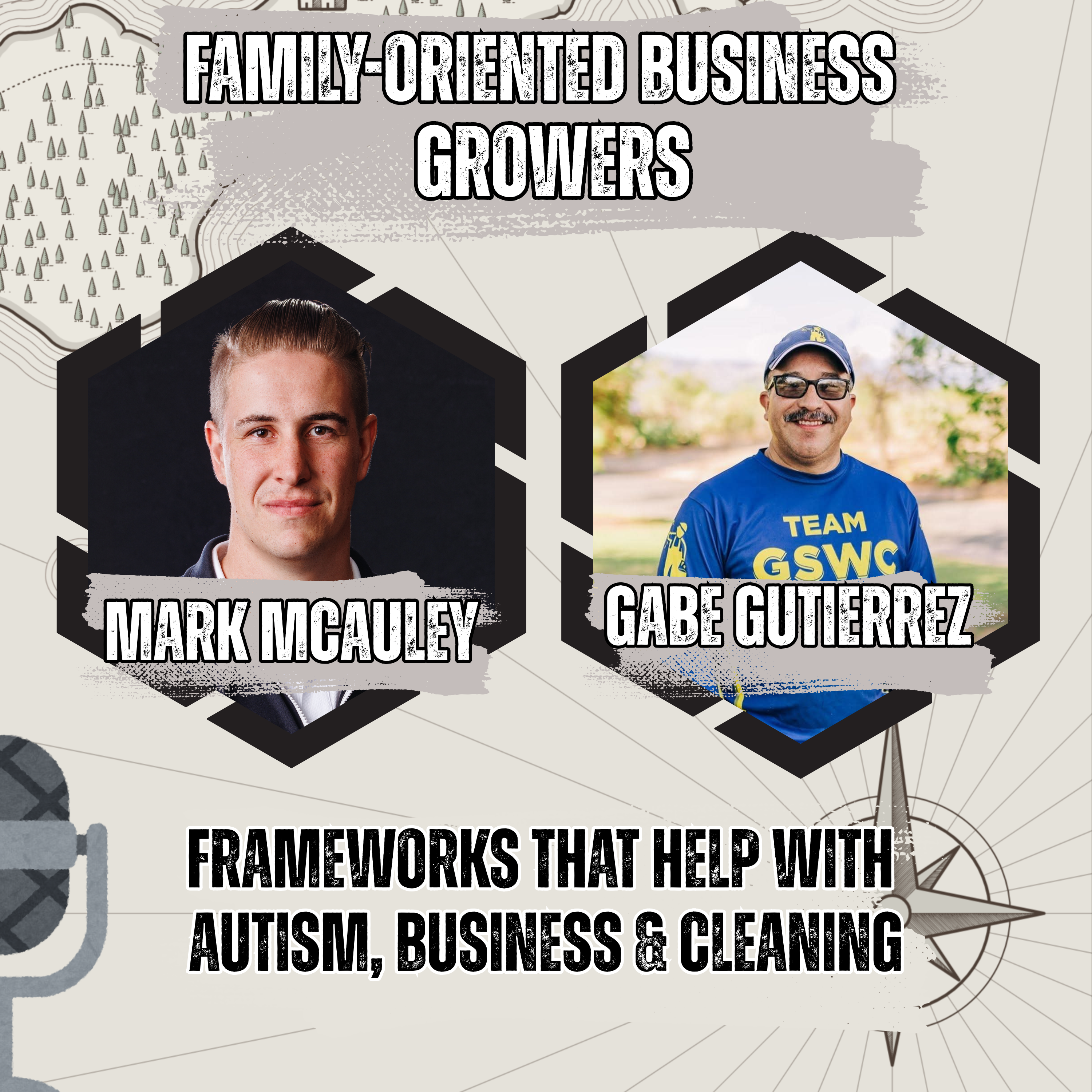
Family-Oriented Business Growers · Mark McAuley
This episode covers the ABCs of Autism, Business & Cleaning with Gabe Gutierrez & Mark McAuley. Gabe is the founder of SqueegeeU which is an educational resource for both the technical and business aspects of window cleaning as well as it's own podcast. Gabe learnt things the hard way and has a passion for saving others the time & struggle of doing the same. This comes up across each of the 3 title areas of this episode as we discuss what he learned & how he adapted to his daughter's autism diagnosis, how he began to learn the answers to questions he didn't know to ask when growing his business and the parallels of poor technique with a squeegee to poor systems in the business. Despite some technical difficulties, this was a great conversation - join us! To join the Parents Growing Cleaning Businesses Facebook group & get your FREE Save 5 Hours Per Week Time Audit visit www.warplan.au To get in touch with Gabe visit www.squeegeeu.com
Gabriel J Gutierrez: me tell you, there is nothing more painful than wanting to hug your daughter and you know you can't because it hurts her, right? And like you have to fight every single bit of your urge. Like she gets scared or like she would get scared or she would be hurting. What do do as a parent? You grab them and hug them, right? I can't do that. That would make it worse. That like, it scares Mark McAuley: Hey, hey, welcome to all of you bandits and chilies. Today's guest started his window cleaning business about 26 years ago and has since developed Squeegee U for window cleaning training, both technical and business. Welcome Gabriel Gutierrez. How are you? Gabriel J Gutierrez: Hey, good. you doing, Mark? Nice to talk with you. Mark McAuley: Yeah, I'm doing very well. Yeah, at time of recording, I jumped on your podcast a couple of days ago. We had a really good chat and here we are doing the reverse and I get to learn a little bit more about you, which I'm excited to do. So maybe just paint a little bit of a picture, you know, if you could just like condense the last 26 years or more into, you know, yeah, yeah, piece of cake. Gabriel J Gutierrez: Sure. 26 years, two minutes, got it. Well, you know, I came into window cleaning like a lot of window cleaners. I knew of somebody who did it. My wife and I had been talking about starting our own business somehow. You know, we were both, I was working at the bank. She was working as a receptionist and we were just like, man, we've got something better than this. So we found, we knew a friend who had his own business. He was a window cleaner. I really wasn't looking to become a window cleaner. I just wanted to pick his brain about starting a business and what that's involved. I hadn't really decided what I wanted to do. And he was just like, why don't you become a window cleaner? Here, I'll give you some accounts. I'll give you some equipment. I'll do training, blah, blah, blah. And it kind of scared me. So I backed off at first. And I said, no, no, I don't think I'm really do that. So I went back and told my wife about our conversation. And she says, well, how much was he selling the accounts for? And I said, I don't know. It's like, well, how much equipment were you gonna get? I was like, I don't know. He's like, well, before you say no, why you get some more information and see if this might actually work. So I called him back, we met up, he brought all the equipment. He gave me about an hour's training and lo and behold, by that I had a route. I had a small storefront route. I had a bunch of little, you know, $15, $25 jobs, but it came out to about $600 a month in work. So as far as getting started in a new business, I mean, you really can't beat that. He sold it to me for $600, included the equipment I needed. I just figured, well, worst case scenario, if I don't like it, I'll sell it somebody else for 600 bucks, know, have them take over the routes. So yeah, it was probably a good six months before I realized that this was something I could do. I had a lot of frustrations in those six months, but. And by that time I got to the point where I could see myself. So little by little grew it. I was still working at the bank as I got more window clean accounts. I was cutting back my hours at the bank and then I got to about 19 hours a week and that was the minimum you could work to stay an employee. So I had to make a choice. Do I make the jump? And I did. And then of course, at that time, then all the jobs went away, right? So we struggled for about two years after that and to finally get a solid enough customer base where we could actually live off of it. Then we had our daughter in 2009 and when that happened, recognized that I was just, I was running like a gig business. You know, I really wasn't putting any work into it. I wasn't advertising. I wasn't trying to grow the business at all. was just all literal word of mouth. If someone wanted it and they called and they took the time to call me, I'd do the job. And once I realized how expensive it is having a kid, I realized it had to become something more than what I was doing. So that's when I actually started trying to grow, ran into a lot of problems, know, did well, didn't do well. And then in about 2017, I found the IWCA, which is International Window Cleaners Association. And I went to a couple of conventions. I started making connections with people who have become longtime mentors to me, still friends to this day. These individuals who took me under their wing gave me awesome advice stuff that I just wouldn't have heard from anybody else except for window cleaners who had gone through what I've gone through. And by that time, yeah, now I actually had my business was starting to make money and it was no longer this albatross around my neck that was kind of keeping me down, you know? And so I just finally got to where I can now give back to the community. And so I became a board member of the IWCA. And I've done a lot of things in the industry as far as we started a group called Into the Flow Group, which recently, you know, it's a group that's designed for education, safety and philanthropy. so like we just raised $15,000 for a window cleaner had fallen off of a ladder to help cover his medical bills. We do those fundraisers maybe twice a year, but the Facebook group itself is just meant to be a place where anybody can come ask a question. There's no stupid questions. You're not going to get trolls coming on you. You're not going to get drilled. We delete those comments if we see anything like that. We want people to feel comfortable to ask the questions that they need to know, regardless of where they're at in their window cleaning journey. And that way they can get the help that they need. So, but yeah, that's pretty much my story in the industry. And now I started squeegee you, like you mentioned, and hoping to continue that passion of teaching other people. how to clean windows and how to avoid the mistakes that I made so many years ago. Mark McAuley: Yeah, thanks very much for sharing all of that. The $15,000 raised as a community effort is really just amazing. And it's such a powerful thing to have. There's little online community hubs that are able to do that kind of a thing. And I think that speaks to the connection of the group as well to really be able to do that, which is just fantastic. Gabriel J Gutierrez: And I should just say too, it's the tribute to the vendors as well. like for instance, Mark McAuley: Hmm. Gabriel J Gutierrez: WCR, they have a window cleaner relief fund. They donated $5,000 right off the bat. The IWCA Mark McAuley: Yeah. Yeah. Gabriel J Gutierrez: has a charity wing called the IWCLF. They donated $4,000 right off the bat. And then like ABC window cleaning, they donate like a $1,500 water fed system. We have people donating poles. had even business owners saying, hey, I've got this brush. that I don't use anymore but it's brand new. I never use it, it's brand new. I'll offer that up in the auction. And so all of those people from the big vendors who gave a lot of money to the smaller guys who were just, hey, got, can you auction this for 50 bucks? Let's try and raise 50 bucks Mark McAuley: Yeah. Gabriel J Gutierrez: for this. That's just awesome and I love, we've been able to do about seven or eight of these since we've been in Into the Flow and each time it's just really neat to see everybody come together for that. Mark McAuley: Yeah, no, that is fantastic. it's, I think that that's a really good way to sort of thread the needle between like what people want to do and also just making it practical for them to do it because maybe someone's like, Gabriel J Gutierrez: Mm-hmm. Yes. Mark McAuley: you know, like, I'd love to, I'd love to give something but I don't, you know, but then when you put it even in an auction sort of set up like that, it's like, actually, you know, I did, I did make a mistake and I purchased that piece of equipment, which I'm never using. Yeah, Gabriel J Gutierrez: Yeah, right. Mark McAuley: just going way back. to your story actually of coming across the opportunity for the shopfront window round actually kind of reminded me of the inverse of like Jack and the Beanstalk in which you've gone back to your wife and she's like, well, did you ask about the beans? Like how much were the beans? And then, yeah, like, I mean, they sound like Gabriel J Gutierrez: Right. Did you buy the beans? Did you actually see the beans? Yeah. Mark McAuley: they're like magic beans. don't know. We Gabriel J Gutierrez: You Mark McAuley: should learn more. But then when you bought the Magic Beads, buying the shopfront window round, I feel like this is a common question that a lot of people would have because one of the strong things that we had in our business, more or less from the get-go, was some shopfront window runs that were just a really solid foothold. It didn't matter if it was rain, hail, or shine. Gabriel J Gutierrez: Mm-hmm. Right. Mark McAuley: we had these consistent jobs that we would just go and do, even if it was like literally just like pelting rain at the glass. I'd be cleaning them because you were on the schedule and this was my income. And it, it doesn't matter because it's like, it's still going to look, if I cleaned it whilst it was raining or if I cleaned it and it rained the day after, it doesn't matter. And I'm going to be there next week or another week anyway. Gabriel J Gutierrez: Right. Mark McAuley: And it's just about the maintenance. it really like kept that cashflow year round, Gabriel J Gutierrez: Yes. Mark McAuley: but For someone to start a shop run is really difficult, especially if you don't buy into one. So from your experience and working with people, what have you seen with that? Like, do you think that it's worth it for someone to try and start a shop run from scratch or do they really need to buy in to make that work? Gabriel J Gutierrez: Yeah, I think you have to buy into one honestly. It worked out for me because it was just a small route, right? It's $600 a month. That's not much, but it was perfect because I had a full time job already. So I was already Mark McAuley: Hmm. Gabriel J Gutierrez: working and I had a day off and I could do all of that in one day. So I could, you know, make an extra, you know, was 150 bucks that week just by doing the windows and then, you know, going on to my regular job. And then as I started picking up other little jobs around that area. That's when I started kind of growing it and then would cut, cut off a day of work. So now it's only three days at the bank, two days doing windows. And so I got to grow that route gradually as opposed to trying to Mark McAuley: Hmm. Gabriel J Gutierrez: right away come in, I need to get, pick up five accounts this week. Otherwise I'm going to starve, you know, I didn't have that pressure. I could just do the job. You know, I went to the next, you know, the, the shop on this side of the shop on that side. Talk to the owners, hey, let me do a little demonstration. I'll just show you how nice your windows could look if you just hired me. I'd clean one window and then say, hey, know, give me a call. Here's my card. And I just, little by little, I was able to kind of, kind of strengthen that route and kind of fill in holes where maybe I had a little bit of a too long of a drive than I should have. And so I was able to kind of find jobs along that route. so by the time I, it took me about two years. I had a pretty decent route for a single owner operator. You know, Mark McAuley: Yeah. Gabriel J Gutierrez: the downside is that it's, and I learned this a little later, is there is a cost, opportunity cost to that because the routes of course Mark McAuley: Hmm. Gabriel J Gutierrez: are less profit than like a residential job. So I had. so many routes that I only had about two days, you know, once I'm, this is once I'm doing Windows by myself or on Mark McAuley: Mm. Gabriel J Gutierrez: its own, I only had really two days for residential, which is the moneymaker. You know, I made more money in those two days than I did the three days that I was doing route work. And as a, you're, when you're not a business minded person, you're just thinking I need work. You don't really think about what kind of work am I getting for, you know? And so saying no is not really in your vocabulary. And you have to learn that it's okay to say no to certain Mark McAuley: Mm. Gabriel J Gutierrez: jobs if they aren't the right jobs. that took me Mark McAuley: Yeah. Gabriel J Gutierrez: way longer than it should have to learn for sure. Because you're always, you when you are a single owner operator and that mortgage getting paid depends on that check coming in, you're afraid to say no to jobs that are a sure thing, like a lower wage or, I mean, lower profit commercial job that you know you're going to have every month to the keeping Mark McAuley: Hmm. Gabriel J Gutierrez: it open in the event that a residential calls and you just don't know if the residential is going to call. So that's that's that Mark McAuley: Yeah. Gabriel J Gutierrez: fine balance that really took a long time for me to find to feel confident enough to say no to those jobs because someone's going to call. I don't know who I just know they're going to call. Mark McAuley: Yeah, yeah, picking the right jobs, saying no to the wrong ones really reduces a lot of friction as well. Just back to the route side of it, like I think obviously the big advantage is that consistency around another big advantage is it's a great place to put someone on train. Like what Gabriel J Gutierrez: That's it. Yeah. Mark McAuley: you were just saying about that capacity when you get, I assume this is probably literally what happened for you, but like when you Gabriel J Gutierrez: Mm-hmm. Mark McAuley: get someone on and it's easy to sort of train them to do that successfully for shopfronts that it is Gabriel J Gutierrez: Yes. Mark McAuley: for houses. They can take that over quicker, which then in that equation, whilst you're still on the tools is going to free you up to do more houses and they can like Gabriel J Gutierrez: That's it. Mark McAuley: hone their skills in an environment that doesn't have tracks. It doesn't have screens. It doesn't have Gabriel J Gutierrez: Yes. Mark McAuley: pets and kids and homeowners watching it really closely. Yeah. Yeah. Let me just, let me just set up my lawn chair and binoculars to, Gabriel J Gutierrez: It doesn't have customers staring at you, you know. Mark McAuley: you know, other window cleaners here. so there's, there's a lot of advantages that way. the struggle I think with that model is that you have, if you view it as a sales exercise, like you're going to this one job Gabriel J Gutierrez: Mm-hmm. Mark McAuley: that you have, and then you're trying to sell the 10 jobs around it. Gabriel J Gutierrez: Yes. Mark McAuley: It's really, it's not that much easier to sell those jobs that it is to sell a residential job and the residential Gabriel J Gutierrez: 100%. Mark McAuley: job might be worth. $500 or $1,000 or whatever right off of that. And this job might be worth 25 bucks. And it might be Gabriel J Gutierrez: Yeah, exactly. That's it. Mark McAuley: worth 25 bucks every month or every two weeks or whatever. But even over the course of the year, that's still not that much. And Gabriel J Gutierrez: And I think it really depends on the areas. Well, I know some window cleaners in the United States, they live off of those routes, but they Mark McAuley: Yeah. Gabriel J Gutierrez: are one of just a few window cleaners. So they have that that weight to say, hey, this is how much I charge. You don't like it. Go to the other guy. And if the other guy is Mark McAuley: Yeah. Gabriel J Gutierrez: terrible, well, now you're the best option and they're willing to pay it. So they're able to kind of pack those. Mark McAuley: or if the other guy's great, but his rates are also like good, you know, so yeah. Gabriel J Gutierrez: Yes, yes. So, so. With me in my area, we've got about a million people in Tucson and the surrounding areas. And we've got like 150 window cleaners. Not all Mark McAuley: Yeah. Yeah. Gabriel J Gutierrez: are registered, not all are licensed or legal really. But we have ton of window cleaners and they all want that Mark McAuley: Mm. Gabriel J Gutierrez: route work. for now where I'm at in the business, it doesn't make sense to go after those. If Mark McAuley: Yeah. Gabriel J Gutierrez: we get called for a bid, it's a decent size commercial job, we'll go bid it, but we bid it to make the same money that we would on a residential job. And so we Mark McAuley: Yeah. Gabriel J Gutierrez: only close on maybe 15 to 20 % of those. Those, the ones we close on are typically the people who are tired of the 50 other window cleaners they've tried and they don't show up or they do a horrible job or they're rude to their staff or whatever. And now they're like, okay, we're going to, we're willing to pay some money to have a quality company come in. And that's usually by the time, you know, we come into play, that's, that's what they've gone through. So we just picked up two bank, it was a bank, a credit union, two buildings. I had cleaned them years ago and I raised my rates and they dropped me, which I was fine with. I figured that's what was gonna happen. And I happened to know the window cleaners who had done it before me and the last one was a really good friend of mine and he ended up not wanting to do it anymore. They called us, we just got the bid on that. But of course, you know, it's probably about four times as much as I charged the last time. But, yeah, it all came around, right? So you just have to kind of know what your Mark McAuley: Yeah, yep, that's it. Gabriel J Gutierrez: worth is, you know, and, and when you've got an established company or business in an area, you just have to make sure you know what you're worth and stick to your guns on that. Mark McAuley: Yeah, yeah. And whether it's route work or whether it's residential or larger commercial or anything, really it's your points of difference and it's the customer relationship that you build that is going to defend against somebody else coming in and undercutting and all that sort of stuff. And that just looks a little bit different between residential and say a shopfront. Another thing with the shopfronts that it makes it just a bit trickier is that you're dealing with layers of decision makers. Like if you go to get a shopfront job, you might be talking to somebody Gabriel J Gutierrez: Yes. Mark McAuley: who's just running retail, but then like they're not the manager. And then you talk to the manager, but they're not the area manager who it needs to go back to head office Gabriel J Gutierrez: Right. Mark McAuley: to be approved for this, you know, so you're to run into a lot of that, which means that for every, you know, say for a residential job, which might be, you know, 500 bucks compared to $500 worth of shop jobs divided by how many individual shops that is, you're going to have like, you know, a dozen or more decision makers to Gabriel J Gutierrez: Yes. Mark McAuley: get that $500. And then the admin and like the, you know, invoicing and everything, it's broken down into these little chunks. So there is a lot of that, but it can be really, really powerful as a solid foothold, the seasonality, a lot of those things. Yeah. Gabriel J Gutierrez: Yes. I just want to say real quick, just I've literally turned down jobs, like fired customers because of the invoicing headaches, because you got to use their portal and you got to fill out just right Mark McAuley: Yeah. Gabriel J Gutierrez: and you got to get signatures and then you got to get the invoice number and Mark McAuley: Yeah Gabriel J Gutierrez: then the PO number. And I say, you know what? I'm done. Find someone else. We're doing more work in the office than we actually did when we were Mark McAuley: Yep. Gabriel J Gutierrez: on site cleaning that window. Yeah. Mark McAuley: Yeah, 100%. We had one that they wanted us to do the job, send the invoice, and then collect the payment the next time around, which doesn't sound that bad on the face of it, but that process would just break down. And then the technician would speak to a different person the next time they were in the shop. And then every time they'd be on the phone to someone, they'd be checking the system to make sure that they're not paying an invoice that's already been paid. And Gabriel J Gutierrez: Yeah. Mark McAuley: it's like, what are we doing? This is a $30 job. And every single time it's just this huge admin headache for them and for us. Gabriel J Gutierrez: care. Mark McAuley: we're just like, you either need to just pay us this way or like find someone else because it's just not worth it. Yeah. A hundred percent. Gabriel J Gutierrez: All right. Mark McAuley: So, so going forward from there, let's just like fast forward until, was it 2009 that your daughter was born? Gabriel J Gutierrez: Yeah. Mark McAuley: So. That obviously changes your perspective on a lot of things. And one of the things that you mentioned was that you realized how much it cost to have a kid. And I actually think that's a really interesting analogy too with the business. Because raising prices and pricing correctly is a whole thing. And one of... my mentors, shout out to Joshua Latimer, one of the things that he says that's really like instilled in my brain is that you need to price for tomorrow's business. So if you are looking to grow your business to the next level, that next level has additional expenses. If you're now Gabriel J Gutierrez: Yeah. Mark McAuley: building a business that has an admin layer or an ops manager or whatever, like that money is going to have to come. And if you want to get there from where you are, you should be factoring that in now so that you're building the runway to have those things. And I think the same could be could be said, right, with, we've got we've got a baby on the way. Maybe maybe we need to look at our economics and all that sort of stuff. Now, in reality, for both of us, that's not necessarily the way it works. You kind of get to the problem and do like, Gabriel J Gutierrez: Right. Mark McAuley: wait, hold on. Where's the money? But so on the business front and then on the like just the the worldview shift. kind of what happens at that point within your journey. That is a great question if I don't say so myself. Can't wait to hear the answer in like 14 seconds from now. Just wanted to jump in and let you know about the free time audit designed specifically to save five hours per week for parents running cleaning businesses. It takes about two minutes to complete and you get your time saving results straight away. To get your free time audit, join our Facebook group via warplan.au, link in the description. Now, what was that cliffhanger question again? the business front and then on the like just the the worldview shift. kind of what happens at that point within your journey. Gabriel J Gutierrez: Yeah, it was, it's like I said about 2017 is kind of when I finally got the guidance I needed. So you're talking eight years of floundering of just, know, cause I Mark McAuley: Mmm. Mmm. Gabriel J Gutierrez: hired. So I had the work, I just didn't want to hire. Now I recognize, hey, if I'm going to make the money I need to make, I need to have multiple employees. I need to have two or three employees. So I hired first right away. Cause you know, now I'm in, I'm in go mode, right? I'm dad, I got to provide, you know, my wife wants to stay home with the, with the baby. And I wanted to give that to her. That's the one thing she had asked when we got married is like, if we have kids, I really want to be a stay at home mom. That's really important to me. I want to raise my baby. I don't want to put it with sitters again. It was not like anything bad about that, or if anybody has to do that, but that was just her, her wish. And I said, I'm going to give that. I promised her so I'm in that mode so I hired someone right away had no idea how to hire anybody he just said I can do windows hey great come on you know join me and we had this situation where it was during the busy season so it was great he had work I had work and then he says hey I want to you know it's okay if I go back home to Mexico for to a family for Christmas and New Year's Sure, that's great man. Take two weeks off. Enjoy your family come back in January and we'll get started again. All right January 4th came which is when he was supposed to come No show, no call, no answering, no nothing. And he had my truck. He had one of my trucks. Mark McAuley: I'm Gabriel J Gutierrez: So I was like, okay, well maybe he's sick, you know. Well it turns out he just had an issue with alcoholism. He went on a bender during that whole time and he was just in the wind. So I didn't hear from him until the middle of January, like later part of January. Mark McAuley: man. Gabriel J Gutierrez: So about two weeks he was gone. had just no, And he shows up all, you know, head turned down. I'm feeling horrible and and I just I talked with them and of course I listened to him I I'm not gonna you know I I know alcoholism is something that's a challenge for a lot of people But I just told him I said look man. I can't hire you back. I can't you did this once I can't trust that you're you know you're not gonna do it again. I like you I like you as a person. I wish you well I hope Mark McAuley: Mm. Mm. Gabriel J Gutierrez: that you've battled this and get and get control of it, so it doesn't hurt your your chances You know but I can't so he asked me if he could buy the truck because he liked the truck so he ended up buying it from me because I'm like Well, I'm not hiring forget that I'm just do it myself so I went about another Maybe year and a half to two years working by myself as a single owner operator, and I just was just Pushed i'm going into the ground man. I'm just working until six seven o'clock at night i'm Calling people at eight nine o'clock to schedule for you the week and I just I was just running myself ragged and I just it wasn't going to work I had to figure out another way. So that's when I started like well, there's obviously business people are successful so I need to learn how to be a business person because i'm not a business person and like I mentioned I started attending the iwca conventions. I took the classes There are just so many things I learned. from just these really basic classes that I just had no like I took a profit it was a person who had Was kind of ran his business off of the profit first model, know the book that that's there and I took that Mark McAuley: Yes. Gabriel J Gutierrez: class and it just was so Mind-blowing I bought the book read the book. I just realized how much stuff I was doing wrong I was throwing everything back into the business, but there was nothing that was it wasn't providing anything to the business, you know And I was just kind of like throwing band-aids at it. So I need there was Structural things I needed to fix I needed to fix systems and it is install systems And I needed to have things in place so that the business could actually be not just in my brain But just a thing different from me and then I again I meant I met some mentors some people who would just listen to me and give me advice and tell me what they did I I I I love giving advice, but I get frustrated when people don't take it because I always Mark McAuley: Mmm. Gabriel J Gutierrez: take advice when it comes from someone who I respect and I trust, you When I'm asking for it, I always apply it. So it frustrates me when I see people who will ask me and then just like disregard it. I'm like, all right, well, you asked me. I gave you some stuff that would really help you. But if you're to blow it out, you know, then thank you for wasting my time. You know, I don't say that to them. That's what I'm thinking. But I took it all, man. I was just a sponge. And the growth I had from 2017 to about 2019, 2020 was just, I couldn't have done it without people who were generous Mark McAuley: Thank Gabriel J Gutierrez: with their time and their knowledge to help me. So that's what I wanted to do was to help others too, for sure. Mark McAuley: Yeah, yeah, yeah. All right. I want to taste like three rabbits from this section. Okay, so. So the first one Gabriel J Gutierrez: Alright, alright. Mark McAuley: is, there's actually an urban dictionary term for this, which I think that you'll love. It's called an ask whole. It's somebody who asks for advice, but never takes it right. So, know, don't be an ask whole. Gabriel J Gutierrez: That's it. Yes. And there are a lot of them in the window cleaning industry. Mark McAuley: that the second one going back is actually, let's go way, way back that January, right? you had an employee and a truck that was MIA for like 10 days to two weeks that you just, longer than you expected that you just knew nothing about. Gabriel J Gutierrez: Mm-hmm. Yeah. Mark McAuley: And I feel like listeners hearing that will have inserted their own story in there somewhere, but we all kind Gabriel J Gutierrez: Yeah. Mark McAuley: of know, right, that that sounds like a funny little anecdote story now of like, oh, can you believe it? know, yeah, right. Gabriel J Gutierrez: It was not back then. Mark McAuley: but at the time, Right, the feeling of that and then like, I don't know what your wife thought about it, I don't even know, did you tell her what was going on or were you just kind of like, yeah. Gabriel J Gutierrez: yeah, no, I mean she knew what was going on because I'm sitting there and he didn't show up for work again today. He didn't, you know, I had scheduled work for two people and I'm doing Mark McAuley: Yeah. Gabriel J Gutierrez: it all myself. So I'm like working till six, seven o'clock at night, just trying to get that work done. Try to keep, you know, keep my promise. Cause again, I'm booked out now because I, so it's like, I, if I don't get, Mark McAuley: Yeah, yeah, exactly. Yeah. Gabriel J Gutierrez: if I have to move that, I don't have anywhere to move those jobs to or I'm, we're going to have to work on Sundays, you know? and, I didn't want to have to do that. Mark McAuley: man. And what year was that? Was this just directly after your daughter was born? Gabriel J Gutierrez: That was 20, yeah, it was like 2009, 2010, somewhere in there. I think it was a 2009 Mark McAuley: Yeah, okay, so yes, I've used... Gabriel J Gutierrez: to 2010 transition is when that happened. Mark McAuley: Yeah, so she's essentially at home with a baby or a very, very young child. And Gabriel J Gutierrez: She's... Yes. Mark McAuley: yeah, like I think when he did come back, he was probably lucky that he got to talk to you and not your wife. Let's be real. Gabriel J Gutierrez: That is probably true. That's been true for most of our business. Mark McAuley: But yeah, so that feeling, like when those experiences happen, it feels... Gabriel J Gutierrez: Mm-hmm. Mark McAuley: So massive. And I think that this is a really good thing to remember is because if someone listening to this is in the middle of one of those situations right now, I use the analogy of it's like the stone in the shoe. It feels so much bigger than it is when you take your shoe off and you finally tip this thing out and it falls out and you're like, where's the rest of it? I Gabriel J Gutierrez: Mm-hmm. Mm-hmm. Right. Mark McAuley: was picturing this huge jagged thing just stabbing into the sole of my foot. And it's actually like this tiny little minuscule whatever. over time when we look back at it it's like yeah that's not so big but at the at the time when the pain is really real it's it's a huge thing. The other part of that that I wanted to touch on was just like how you you hired you didn't know what you didn't know and the tricky thing about that is that you don't even know that you need to reach out for help if you are completely Gabriel J Gutierrez: Yes. Mark McAuley: unaware of the problems that you even need to solve. and it's sort of the way that you told that story reminded me of like the classic, you know, if you think, if you think it's expensive to get the job done, right, you should see how expensive it is to hire the cheap guy. Right. I saw one of those Gabriel J Gutierrez: Yeah, for sure. Mark McAuley: posts yesterday, on a pressure washing group and it was just like Gabriel J Gutierrez: yeah. Mark McAuley: the pressure washing lines in like a brand new, pathway and that someone's come Gabriel J Gutierrez: Yeah. Mark McAuley: through and they've just destroyed it basically. Right. but that's kind of the same in the business. Gabriel J Gutierrez: And the dead plants along the line there too. Mark McAuley: Right. Gabriel J Gutierrez: Yep. Yep. Mark McAuley: Yeah. So, so in your case, you said you were floundering for like an additional like eight or nine years, then Gabriel J Gutierrez: Mm-hmm. Mark McAuley: you would have been if you'd reached out for help earlier and got that mentorship that eventually turned things around. Gabriel J Gutierrez: Yes. Mark McAuley: So it was like, when you think of that as a cost, it's like, maybe the mentorship was going to cost a few bucks or whatever, but eight or nine years. And then the time, the struggle, the money that you would have been making if you got the mentorship Gabriel J Gutierrez: Yes. Mark McAuley: at the beginning of that hit or nine years, as opposed to at the end of it. It's huge. So the cost of quote-unquote hiring the cheap guy in that equation went yeah, go Gabriel J Gutierrez: Yeah, and I do want to clarify. mean, obviously the business did well enough that I didn't quit, right? And that I didn't just ditch it and Mark McAuley: Hmm. Gabriel J Gutierrez: go do something else. So Mark McAuley: Yeah. Gabriel J Gutierrez: I just, I know that had I had proper guidance at that time, I would have made so much more money that time. You know, Mark McAuley: Yeah. Gabriel J Gutierrez: I would have taken advantage of things that I just didn't even know existed or didn't think it was that big of a deal. And so, though I survived it, Mark McAuley: . Gabriel J Gutierrez: and I think that in itself gave a lesson to myself and to my company, But had I had someone to kind of help me navigate it or, just know how to make decisions that, know, with the business in mind, I made decisions from my gut, from my heart. I gave a little more to the employees, like considerations and allowed them to kind of mess up more than I probably should have. Like now, now I would never tolerate, but back then I let things go Mark McAuley: Mm. Gabriel J Gutierrez: away too long because I didn't, I felt bad for them or I didn't want, you know, I'm thinking of their family. thinking, you know, which all of that is valid. But you know, bottom line is you have to protect your business. You know, and that's what I tell people now. Yeah. Mark McAuley: Yeah, it all flows outwards from there and you just like now you just have more context on that. It's not like you care less about their family, you just have more context around what it means when you tolerate this Gabriel J Gutierrez: Yes. Of course. Yes. Mark McAuley: or that specific thing. Yeah, so, ugh, there's so many things. I guess when you... When you got that mentorship, right? And things start to change for your business. Actually, actually, hold on. Sorry. Let's, let's go back one step. Cause something you just said then made me think of this, right? The danger of, um, a comfortable life and the business, as you said, it was not so bad that it was not like you were not making any money. was not like, um, you guys couldn't eat, right? Gabriel J Gutierrez: Right. Mark McAuley: But that's kind of, that's sort of where we get stuck because if it's a six Gabriel J Gutierrez: Yes. Mark McAuley: out of 10, we can tolerate that. And then it's Gabriel J Gutierrez: Yes. Mark McAuley: when things get really hard and it drops to being like a two out of 10 and we're like, oh my goodness, we've got to fix this. That then becomes the catalyst for us to do something about it that turns it into a nine out of 10. so, but yeah. Gabriel J Gutierrez: Yeah. Yes. And I think just real quick, just what Josh, what Josh had to say was so true because had I been pricing myself for the future, Mark McAuley: Mm. Gabriel J Gutierrez: that would have helped fix so many problems. But I wasn't, I was pricing it to what I was making that way in my mind. And I tell a lot of people this too. My mind was the market price for what I did at that time. And I was not accurate. had zero, Mark McAuley: Yeah. Yeah. Gabriel J Gutierrez: I had zero. data to back that up that my own idea Mark McAuley: Mmm. Gabriel J Gutierrez: of what was market price when other window cleaners were charging almost double what I was charging but I just didn't know right so Mark McAuley: Yeah, that's, that's so true, right? Because we, we believe what we think. Like Gabriel J Gutierrez: Mm-hmm. Mark McAuley: we think that, well, I thought a thought. they're like, I'm a pretty reliable source. It's like, not if you don't know though, right? Don't trust everything you think. And that, Gabriel J Gutierrez: And if you don't know, that's right. Mark McAuley: that thing of what Josh said about, you know, you need to price for tomorrow's business, to, price as you'll need to, as you grow into that stage, that is a really good example of the kind of advice that you can only get from a mentor. Gabriel J Gutierrez: Yes. Mark McAuley: Because like you can hear that on a podcast and you can apply it to a thing. But, somebody who hasn't gone through the next stage of whatever it is that you're trying to do in any aspect of your life, can't give you that kind of zoomed out future perspective advice, because that's not the sort of thing that you just think of when you're in the weeds, you're doing all the jobs, you're doing the admin, you're, hiring, you're training, you're going home, you're changing nappies, you're tired, you don't have bandwidth, you're not thinking, Hmm, I wonder what it's going to look like when I bring on that other role that I haven't even figured out yet and how much I'm going to have to pay for that and maybe I should be pricing that into it. Like that's just not the kind of thought that can occur without some sort of mentoring influence. So I think Gabriel J Gutierrez: Yes. Mark McAuley: that just like sort of speaks to the overall value of that. So when things then shifted for you, like what was it that shifted specifically in the business and what did that look like? Gabriel J Gutierrez: Well, one was thinking of the business as an asset. You know, I had always thought of me as the business. I mean, my business name is Gabe Spotless Window Cleaning. So I always was a part of the business. And once I started viewing it as an asset or a tool, well, if you have a tool, you can tinker with the tool, right? You can do things with it and you can manipulate it to accomplish what you want and you can hack it or you can buy new tools or you can add other attachments to that tool. And now it becomes more valuable to you. that's once I had that mental shift of seeing the business as separate from me. but as something that I could manipulate to make what I needed out to get what I needed out of it. That changed my whole mindset. You know, I'm very, I was raised to be a very stand up person and if you put your name on this, then you should be proud of it and blah, blah. And I shouldn't say blah, blah. That's very important. But when I started... Taking myself out of the business me, you know, it's removing my personal self as the business then What I stopped doing was giving more of myself to the business than it needed right and you start seeing that hey There's a cost to that there's a when you emotionally invest in your company that to that degree You you get a wear and tear on your body both mentally and physically That you don't get if you view it as as an asset or you view it as a tool, you know So just like you wouldn't go fit, you know, if your if your car is going a little slower up a hill You don't get out and push the car You just let the car do it then if you need to take it in to get fixed you take it in to get fixed But that's what I was literally, you know, figuratively doing was pushing my business myself Instead of saying, wait a second, why is this business not working the way it is? Let me tinker with it. Let me figure out what I'm doing. Let me talk to a mechanic, someone who's been in business longer than me and is where I want to be, and ask them, what are they doing? How are they doing to solve this problem? I'll just give you one. I talked to one guy, and one of things he says is, why are you running Two Man Cruise? And I was like, well, that'll help us to get more jobs done. He goes, no, they're more efficient if you have one man crews. And I said, yeah, but I don't have that many trucks. He goes, you will make more to cover the cost of that truck than if you keep them in one truck. So I did, I implemented it. I moved to everyone, one man crews. Obviously if it's a bigger job, we just have two people go, two trucks go and handle the job. But once I went to one man crews, I mean, I think that my profits went up about 30%. It just was amazing. just something I it was it's very counterintuitive to someone who's not a business person But he's like, yeah, you know, look there they're there they can do the job according to theirs how they like to do it They're they're not being distracted by someone asking them things. Hey, where's this? Where's that? Are you gonna take your break? Are you gonna do this? They don't they're not second-guessing. Hey, did you do this room ready? No, you know all of that takes time all of that is inefficiencies Yeah, to use, oh, this is real quick, to use the automobile analogy. If we're too emotionally invested, those one star reviews, the feedback that may be negative, it hurts us, we can't take it as data. If we're driving a car and someone pulls up to us and says, hey, your taillights out. You don't get offended. What are you talking about? My tail lights out. How dare you? How dare you tell me this? You just say, it is. thank you so much. I'm going to make sure I get that light bulb changed out, right? And you go on and you don't let it affect you personally. So when you get those one star reviews, if the business is separate from you, if it's a tool, if it's an asset, then you can take that information, say, OK. They had this bad experience. Was this a case of this is just a one-off and this person is kind of grouchy or is this an error in our systems? Is this some type of issue that we can just do a couple tweaks and no one will ever have that issue again? You know, you can look at it as data as opposed to being offended by it and it just gutting you like you said, because I've had those too. They're like, Oh, what did I do? And I'm calling them up. Is there anything we can do to change this? you please, you know, you know, no, it's data. Take it, if you earned it, then you earned it, and just make the changes that you need with the data. Yeah, for sure. No, I mean, it was a huge effect. Well, first, it was a relief. So just to put it in context, our daughter, she was diagnosed as autistic, I think about seven years ago. It's I don't know. It hasn't been that long ago. It's been four years ago, four years ago. She was 14, 13, 14. Yeah, Yeah, three or four years ago, she was diagnosed. And but prior to that. You know as a child she was nor I mean from our appearance that she was normal Loved to do little kid things loved to dress up as a princess went to Disneyland had a great time looking back there were things that Let that we should have seen as signs had we understood what autism was I had no clue of what autism was none zero I heard it you hear autism you think of Rain Man, right? You think of Dustin Hoffman and Tom Cruise's Rain Man, and that's what you that's what everybody thoughts That's kind of for years that was kind of the stigma so a lot of people didn't want to be diagnosed as autistic because of that stigma you were afraid of being lumped into a group or I've heard people say no I don't want to get tested because then I'm gonna use it as a crutch is that's an excuse for me actually in a certain way and I you know I always respect anybody who's dealing with their own personal health if they have that right to not get a diagnosis. Just from our vantage point once we understood what our daughter was dealing with It was like a total paradigm shift of our parenting. know, I was raised by, had two, you two parents loved me. My dad was from military, very disciplined, very, you do things a certain way. If you don't, you get punished. There's a punishment for every, every bad decision. There's a reward for every good decision, you know, and that's, it was very cut and dry and I grew up with that mindset. So obviously I parented just like my dad, you know, it was just very natural. That's what I knew. That's what worked for me. So I parented with my daughter that way. But what we were finding out was she was diagnosed with ADHD early on but nothing worked nothing worked and it was just like we just felt like we were in this constant cycle of Her getting bullied Being by teachers. I mean we here's our daughter who we knew I mean her biggest fear is upsetting an authority figure, right? And then yet teachers were telling us, your daughter is willfully disobedient. And that just, just, you know, obviously, you know, all parents are going to be overprotective over their kids, but it just made no logical sense to me. You know, I grew up with a father who, if we were acting up, he would defend the teacher. And that's, that was always my attitude. I always kind of came in there with the T the teacher has the best interests of the child at heart. If they're saying this, there's a reason. Let's try and find out what the reason is. And this, this whole experience with my daughter changed that all. realized that no, as a parent, you have to be an advocate for your child and you can't take for grand that the teacher has the best interests of your child at heart. Most of them do, I believe they do, even if they're not educated on what autism is or what other learning disabilities are. But they have a general idea. But I found out there's a lot of teachers, I shouldn't say a lot, there's a significant enough amount of teachers who are just there to collect a paycheck. And any child who has something that takes more effort to teach them, they really don't want to deal with. And as a result, the worst part, went to just such a dark place and I won't share details just out of her privacy but we literally as parents were like okay well I guess our daughter is just not going to get an education because we are not putting her through what she just went through that school year Thankfully my wife and doing research found a small little private school just down the street from us It's 10 minutes away from our house. They cater to kids that are newer nor diverse So ADHD autism a lot of other, you know disabilities and stuff like that and It has just been night and day as soon as well. It took her about a year because she still had so many trauma, so much PTSD from her old schooling that took her about a year to learn to trust the teachers. But once she learned to trust them, I mean, she just blossomed. It felt like we got her daughter back again. You know, she just blossomed and now she's, you know, she's able to learn. She's getting good grades. She loves school. She, she loves that. But a lot of it is with the, the understanding that autistic people generally speaking, because they say it's a spectrum so people have different the different areas are different for them so one of the things that I learned that helped me a lot was when they would say spectrum I always saw it like a like a slide up right they're a little autistic they're a lot autistic but that's not what spectrum means it's more like one of those audio boards those sound boards you know where they've got one gear up one gear down one so there's a bunch of different symptoms of autism. Some of them have a lot of one, some of them have a little, some of them and everyone's different. But some that are consistent are for instance stimuli. So they're very sensitive to being overstimulated and they have sensory issues. just I'll give you this is something that helped paint the picture for me of what our daughter was going through. So she's in middle school. She's, and this is the counselor who's helping us. Once she got her diagnosis, she says, okay, put yourself in this position. Loud noises hurt you. So anytime a loud noise comes, it's like this piercing pain in your ears and in your head. So you get to school, you're on the playground playing with your friend, having a good time. And this bell rings that just jars your head. Now you've got to run down a hallway where there's a bunch of kids, all of them talking, all of them bumping into each other. You're trying to get through this crowd. You get into the classroom, you sit at your desk. What happens? Another loud bell rings in your head. This pain comes in your head. It takes you five, 10 minutes to kind of get settled from that. The teacher's already 10 minutes into teaching a lesson. You miss the whole first part of that lesson that is going to help you to understand the rest of the class. So now you sit in the classroom. not understanding what's happening because you missed the important part that does the foundation for the rest of the class. So what do you do? Well, now you do something else. So you might, if you like drawing, you might start to draw because that's, at least you're doing something that can help help you from feeling bad. Well, now the teacher sees you drawing and gets mad at you and, and, you know, maybe even scolds you in front of the class and embarrasses you. And now you're really in your hole. And so what autistic and ADHD kids do is they call it, it's called masking. They put on a mask. They want to look like everybody else. So even if their whole world inside of them is just being destroyed, to everybody else, they've learned to look a certain way so that nobody knows that. So our daughter was masking all of those years and it just took such an emotional and physical toll on her because everyone was telling her she was a bad kid. and everyone was telling her she was dumb and she wasn't trying and she just exert herself and in the meantime she's got this sensory battle going on at school you know so we take her to this new school who understands all that they keep them in the one class they don't move they don't change classes when the teachers change the teachers rotate around instead of the students They have 15 minutes breaks between classes. They can go to have a sensory closet, which has like LED lights and soft blankets they can sit down on, really soothing music. instead of the kids going from class to class, they stay in one class and the teachers rotate on that in the grades, which is really, really awesome because what it does is it gives the kids their own... desk, is very important to them to have their own little place that they can store things and keep things and make their own. Then also they have a sensory room. like there's a 15 minute break between the classrooms and those in those breaks they can go into a closet it's called a sensory closet so they've got like LED lights and they've got just like a little sound machine to kind of you know have things that are relaxing and just kind of get them calm down from all the sensory issues of being in the classroom and then they're they're ready to go on to the next class and you know all of that type of thing is just really really a blessing because you're not going to find that in public schooling you know obviously can't it's not because they don't want to it's just the the funding isn't there so us finding that school was such a big turnaround to help her have the structure and a place where she could feel safe To be able to express how she feels, you know and to learn without being criticized To have to to deal with her sensory issues without being made to feel like she was personally a failure for having them You know, that was really awesome. The second thing that made a big difference was We received counseling too and we had to relearn how to be a parent. So like me personally, I'm a very huggy person. I grew up in, I'm Hispanic, so we go to a family party, right? The rule was you get there, you cannot play until you hug every single person in that room and you cannot leave until you say you hug every single person in room by until I'm by. That was just the rule. And I'm a very huggy person. So my daughter, because of her sensory issues, she doesn't like hugs. She'll tolerate one, but she doesn't like them. So I had to stop hugging her, which is really hard for me. I reserve it for very special occasions. And even then she's just kind of like, you know, leans over and lets me hug her. The other hard thing too was eye contact. She doesn't like eye contact. She gets really nervous with eye contact. And part of it is because a lot of autistic people have difficulty reading faces. So... they're spending too much time trying to read someone's face that if they see your eyes it makes them feel self-conscious because now you know, did I do something wrong? Did I misread it? Are they angry? Are they not angry? You know, they don't know any of that. So they prefer often to look away when you're talking to them so they can focus on your words rather than try to read your face. And I was taught that to show respect, you look at your parent in the eye, right? You look at the person who's talking to you in the eye, you pay attention, you stay focused. And then when, you know, then they know that you're showing them the proper respect and you're paying attention, but it's just the opposite with an autistic person. So I had relearn how to parent and I also had to relearn how to accept her love for me because since she wouldn't hug me that's had to learn how to other ways, right? And she wouldn't look me in the eye when she talked to me. So like just as an adaption for an example, one of our favorite things we do is we go to, well, we call them the swap meet. I know what you call them over there. You know, like just place where it's like big old piece of land. Everybody's got booths and tables and you're selling, they're selling their junk basically. But we love to go to the swap meet. She loves finding treasure. She loves looking amongst things and finding something of value. And so she can do her searching, looking at other things, and then we can actually talk and have a conversation, you know? Mark McAuley: Yeah. Gabriel J Gutierrez: And us just spending time together is that love. That's our hug, is us just doing something together. I'm looking for my tools, she's looking for her little treats, and we just walk and talk, you know? So I've had to relearn how to... communicate with her almost like learning a whole other language that just because she doesn't want to hug me and just because she doesn't want to look me in the eye it doesn't mean that she doesn't love me and that she doesn't respect me I just have to meet her where she's at Mark McAuley: Yeah. Gabriel J Gutierrez: and that's that's the discipline you know that's that's what's hard because on one hand I have to prepare her for the world that's not going to be so understanding about this but Mark McAuley: Mm. Mm. Gabriel J Gutierrez: at the same time am I pushing her too much where I'm causing her pain right So it's like you have to find that balance. I making her uncomfortable in a way that she needs to be to learn? Or am I making her exposing her to something that's causing her pain unnecessarily? And I'm not autistic, so I don't know where those are. So that's a constant battle I have as a parent, especially one that was brought up very disciplinarian as a disciplinarian. I want her to be prepared for the world. but I don't want to cause her unnecessary pain. So all of that is kind of the jumble of what we've had to relearn in like the last four years. Mark McAuley: Yeah. Gabriel J Gutierrez: It's just been a lot, but I'm really appreciative that there's so much more information about autism now and that the spectrum of it, know, or the specter of it is a better word, of it isn't as bad as it used to be. You know, now people are a lot more understanding of it. There's a lot more areas that have consideration for sensory issues, you know, and there's a lot more tools like she has these little things called loops that go into her ear. It helps to muffle a lot of the background noise, which for a lot of autistic people, that's really hard. Background noise is just as loud as the person talking to you. So Mark McAuley: Yeah. Yeah. Gabriel J Gutierrez: for them, it helps them to block it out. And now they can actually go to an area where there's a lot of people like a grocery store or a school or, you know, Costco or whatever and Mark McAuley: or a swap mate. Gabriel J Gutierrez: not be over with the sensory issues or a swap meet so you know there's Mark McAuley: Yeah. Hey, Dave, just. Gabriel J Gutierrez: there's a lot more things available Mark McAuley: so thanks, Gabe, for going into detail on that, what that journey's been and the changes in understanding. There's at least two really good metaphors that you use that I think are really powerful on that. The second one was the audio board thing, right? And... We're actually, we're dealing with some tech issues and audio issues on this podcast right now. But when you think of it that way, it's like, if this is the default settings that are applied to this audio board, if you were running, if you were like a sound technician and you were trying to like set up for a band, like they change everything. But if you have these default settings that are a certain way, and the only way that you could change how the band Gabriel J Gutierrez: Mm-hmm. Mark McAuley: sounded. was to make changes on the other end. okay, like, well, maybe we can move this further away from the microphones. Maybe like this needs to be quieter. This needs to be louder. This, whatever. We're gonna change like the acoustics of the building to accommodate the soundboard. That's kind of like what's happening Gabriel J Gutierrez: Yes. Mark McAuley: with your daughter or with your family to best accommodate. So I think that's like a really powerful one. And the other thing you said was in the, about a year into the new school, once she'd really found her feet. that she was able to just blossom, right? And I think this is a good way to sort of thread the needle between this part of the conversation and the business part of the conversation, because once you understand who or what you're dealing with, and in this with like having the autism as a framework to understand, It's allowed you to see some of those needs through a different lens and then put her in an environment where she can flourish. And the same thing I think is really true in our businesses and in our family life and whatever. Like we have these things going on and when we better understand that, hey, this is actually, this is the kind of business that I'm running or these are the kinds of Gabriel J Gutierrez: Mm-hmm. Mark McAuley: people I'm dealing with in my family. Like, you know, something like that where it's like, my, I hadn't realized for the first 14 years that this was the way that it is for my daughter. So Gabriel J Gutierrez: Yes. Mark McAuley: I think that that's a really powerful sort of thought of what are we doing in our business that maybe we're trying to fertilize the business with the wrong thing. Maybe we're trying to give the business too much sun or whatever. And there's other areas to focus on. And the other thing, because I had this thought literally yesterday. I sometimes wear earbuds and I try not to like, I listen to things whilst I'm doing things, right? But I try not to do that when like my family's around when the kids are around. But when I do, Gabriel J Gutierrez: Yes. Mark McAuley: like yesterday I was doing some stuff around the house and then my wife and the kids came home and so I paused what I was listening to, but I still had the earbuds Gabriel J Gutierrez: Yes. Mark McAuley: in and I noticed I was getting frustrated with the noise Gabriel J Gutierrez: Yeah. Yeah. Mark McAuley: very quickly. because having them in changes how you're hearing it, right? And so as a result of that, I was like not interacting with, you know, those, that audio sensory data in the same way that I normally would. And, and it just, had that moment where I was like, this is, Gabriel J Gutierrez: Right. Mark McAuley: this would be like what that's like for somebody with sensory issues. Like you have this sort of baseline all the time thing where it's just, it, it, like, I can't distinguish enough of like what someone's saying, whether they're talking to me, all that kind of stuff. And was just really frustrating, know, like kids, don't come out like we have, we have three, five and under, they don't come home quietly. It's not like one, everyone waits so that one person talks at a time. Um, but it just gave me a little microcosm insight into like, Oh, like I can, I can see what that's like. I can't really fully understand. Like for example, the, what you said about like the pain, like the loud noise is being like a pain response, but all of that stuff is so valuable and helpful to get like the insights on. And I think again, just to follow up with you on a question to kind of thread the needle, like that framework that that's given to you, what parallels do you see with that and the frameworks that you learned when you really, you know, turn things, I was gonna say turn things around, not even that, just where you really like started to take your business to the next level and you started to see success. Like there was frameworks for that too, right? So what are the parallels Gabriel J Gutierrez: Yeah. Mark McAuley: and see? Gabriel J Gutierrez: Well, I think kind of what we talked about earlier really plays into this is I work really hard to not invest myself into my business, not to take it so personal. Let me tell you, there is nothing more painful than wanting to hug your daughter and you know you can't because it hurts her, right? And like you have to fight every single bit of your urge. Like she gets scared or like she would get scared or she would be hurting. What do do as a parent? You grab them and hug them, right? I can't do that. That would make it worse. That like, it scares her. If Mark McAuley: Yeah. Gabriel J Gutierrez: you grab her when she's not expecting it, she goes like this. I mean, it would make a bad situation worse. So you have to stop. and think, what can I do now to Mark McAuley: Yeah. Gabriel J Gutierrez: actually be a positive force in my daughter's life at this moment, right? And I think with business, that's the same thing. If you react emotionally, if you react instinctually without really looking at data and really without looking at what's the actual result of my actions, you hurt your business. You do. And so you have to separate yourself and Mark McAuley: Yeah. Gabriel J Gutierrez: again, not take things personally. If you get a bad review or if you get a call from a customer who's upset, you know, I, I, my, my office is always telling, telling me, know, Gabe, you are the ultimate schmoozer. And it's not that I'm a schmoozer. It's that I listen without getting offended. So if they say, you know, your workers came in and they did this and I don't know how you can run a company like this and blah, blah, blah. I just have the ability to let, them see what they're going to say. and say, okay, so if I get in the straight, the problem is they came in, they didn't wear shoes. They were being louder than they should have. Is that what's happening? Yeah, that's what happened. You know, I am so sorry. That is not according to our standards. I will have a meeting with them and I'll talk with them. I'm going to make sure that all of our employees understand this happened and to just refresh them on our standards that way we can address this issue. And thank you for bringing that to my attention. Thank you for helping me to know this because we hadn't had this pop up in a while. I mean it shows me as an owner I need to give this attention, you know, and then they're happy because they Told they told me how they felt they Mark McAuley: Yeah. Gabriel J Gutierrez: feel like action is being taken from it And now I can provide something valuable to my team to help them to know, this happened. You probably weren't the one who did it you probably will never do it, but just be aware. This is something that, that fell through the cracks and we want to make sure we don't let this happen again, you know? And then I'm happy because the customer is happy. added something to the business that, made it stronger and I'm, I'm done. In the past, I would have been so offended. might've argued with the person. I might've told them they're wrong. I would have stood up for my employees, you know? Mark McAuley: Yeah. Gabriel J Gutierrez: and then you lose that opportunity. That's it, that's it. So you just have to think, Mark McAuley: You might have tried to give your business a hug when that's not what it needed. Yeah. Gabriel J Gutierrez: okay, maybe this is what my instincts say to do. Is it really what my business needs? Is this really gonna help the situation? And so that's kind of the biggest takeaway for me, at least that I've learned, is to... remove yourself emotionally from that and not to take things personally instead look at what am I being told here what information am I given that I can actually use to help my business so that that's one thing for sure Mark McAuley: Yeah. Yeah. All right. So let's let's zoom forward to the squeegee you side of things and just get a little bit more detail on that. Like who, who is the ideal person or groups of people that squeegee you is for? What do they find there? What what are the resources look like? What are the different options? Like just talk, talk Gabriel J Gutierrez: Sure. Mark McAuley: through that. How what's the what's the value in squeegee you? What does it present? Gabriel J Gutierrez: Yeah, so squeegee you was formed out of my desire to give new window cleaners a platform that I did not have. So as I told my origin story, right, I had a guy sell me some some route, give me some equipment. Didn't even know what the names of the I knew a squeegee was but I didn't know anything I literally didn't know anything else. I just knew it was a bucket I knew as a scrubber. It was a pole and I used dawn dish soap right in my water That's all I literally knew I thought for the longest time because he gave me two squeegees He gave me an Etter a brass 18 inch and an 8 inch I thought that's the only size squeegees came in for like three or four years like I didn't realize You could have different sizes of squeegees. I just didn't know you know so I went through all that I learned as I as I kind and I'd like work with another window cleaner like as a subcontractor on job And I'd be watching them like a hawk like I saw what they did right there. wow I bet you that'll help fix my problem over here, and then I would start practicing it and and I'm a very analytical person anyway so I'm always trying to figure out how things work and So over time because I'm so analytical by time I start hiring which was about nine years later I kind of had a little toolbox of things that I had taught myself To kind of help me to fix problems that I was having right, but I mean, you know You shouldn't have to take you know, five six seven years to fix problems. So sweet you is designed to it's a fundamental foundational training program where I teach people how to fan, not just like, Hey, this is how you fan. do this, you do this, you do this and you're done. Yay. I break it down to small little steps and they don't actually fan the window until a full day of training, you know, until they actually start fanning where we teach about following Mark McAuley: Hmm. Gabriel J Gutierrez: the frame. We teach about pivoting, what kind of angles you want to have. We teach about pressure and, and how to hold the squeegee properly. you know, we just kind of little by little, as we learn, they add it on and then they go further on the window. So by the end of that, that first module one, they're actually fanning and they're fanning like a professional, not like someone who just looked at YouTube and is trying to figure out on their own. They're fanning like a professional. And that's what I have. I have videos of that on squeegee you have some of my students and it's their first time fanny and just how happy they are. Right. And they're going from zero experience to in a day. They're actually fanny. Now, of course, you know, learning how to fan is, is it's just like anything it's reps. So I'm just teaching them how to get there. It's to them to continue following through on those lessons and that's where the videos come in handy they have them they can have access to them on their phone if they feel like they're struggling on something like maybe they're streaking or they weren't streaking a couple days ago they can go into one of my videos look watch it get the reminders and then try it and adapt it in the field and then they can go on so the video portions are meant to be kind of an on the job aid as people are going through their work that if they feel like they're Mark McAuley: Hmm. Gabriel J Gutierrez: losing some of their fundamental parts of fanning and causing them to have some mistakes. They can kind of do a refresher. It also can be used by employers as you hire someone new. You can put them through the Squeegee program and get, like I said, a foundational training. I'm not teaching rocket science. I'm not teaching fancy fanning skills or tricks or anything like that. It's very fundamental and it's meant to be efficient. It's meant to reduce mistakes and it's meant to kind of give them a leg up on their competitors from the beginning because they're gonna, they're not gonna learn the bad ways to do it and then Mark McAuley: Mm. Gabriel J Gutierrez: have to unlearn it later. They're gonna learn the fundamentals and then they can divide, know, cause we all have our own fanning styles, but if they can have that foundation, now they can go forward learning with that foundation and avoid some of the mistakes that a lot of people make. Mark McAuley: think to someone, especially someone who's like looking to hire for the first time, but even if you've done it a few times, you just have a bit more context for this. if you can do it really well, that doesn't mean that you Gabriel J Gutierrez: That's it. That's it. Mark McAuley: can teach it really well. Like I, I wish I wish I had had your videos, right? And just like bought that as a training program and just put new employees through that as a foundational thing from our very first hire because what I learned in Gabriel J Gutierrez: Mm-hmm. Mark McAuley: trying to teach people like I've gotten pretty good at it now, but initially it was just Gabriel J Gutierrez: That's it. Yes. Mark McAuley: like I'm trying to communicate maybe too many steps ahead. I'm like not Gabriel J Gutierrez: That's it. Mark McAuley: going back to the basics and it's like what why aren't you getting this? It's like they're literally not holding the squeegee correctly and something like that something so basic where you just Gabriel J Gutierrez: That's it. Yes. Mark McAuley: instinctively you go and you grab it and you know you just like wave it around like magic Gabriel J Gutierrez: You Mark McAuley: wizardry on the glass and then it's like wait what just happened and then they're they're like you know holding it really weirdly and wrong it's like it's like trying to put Gabriel J Gutierrez: Yes. That's it. Mark McAuley: a a pen in the hand of a child right and just get that grip like you don't think about it now you just grab a pen but they they you know they they grab the pen Gabriel J Gutierrez: Yes. Mark McAuley: like with a fist and it's like if you if you're holding Gabriel J Gutierrez: Mine too. Mark McAuley: it like that your handwriting is always going to be terrible. Like you're not really going to be able to, you know, my handwriting is terrible anyway, it doesn't matter. Gabriel J Gutierrez: Yeah. It's. Mark McAuley: so so yeah, I think that's a huge, hack to just just invest in that time and training of those foundational things and having a framework to put someone through. Gabriel J Gutierrez: Yes. So much of window cleaning is just muscle memory, like you said. So if you've done it something, you know, a thousand, 10,000 times, you forget what you had to learn in the beginning to get to that point. And so, uh, like you said, you can have a really good window cleaner, but they may not be a good teacher. So what I'm doing is I'm correcting the co some of the common mistakes that people make so that once they have those down, now they can, they can learn the other kind of more trickier stuff on their own. or develop their own styles or develop their own kind of way that they do it, but they're not gonna make the mistakes, right? And get frustrated or I had one guy that he literally fan and then wipe because there was one area on that window he always left a mark on, but rather than figuring out why he left that mark, he just automatically wiped it. That was just it. That was his style. Mark McAuley: Yeah. Gabriel J Gutierrez: Every single way he do, do, do, do, Do do do do white because he knew there was a mark there and so I stopped Mark McAuley: Yeah. Gabriel J Gutierrez: him I said whoa And so we I helped him break it down and figure out what why are you leaving that mark? What are you doing in your in your method? That's leaving it because I don't leave the mark. So there's something we can adapt here You know, and we finally got him where he wasn't doing that at least not all the time But that's that's the type of mentality is people are trying to survive So if they have a bad habit They Mark McAuley: Yeah. Gabriel J Gutierrez: just try to muscle through the bad But if you can just learn Mark McAuley: Yeah. Gabriel J Gutierrez: the fundamentals from the beginning, it just makes the rest of that technical part so much easier. And then you can go back, then you can focus on the business part. But you can't focus on the business if you don't, I can't deliver a proper product, right? Mark McAuley: Yeah, yeah, like just going back to the pen holding analogy, if you're holding it in the fist and then you get your 10,000 hours of reps in doing something foundational wrong like that, but yeah, you're just going to end up with that sort of a thing where you're learning the corrections, but that's not going to be the quickest, easiest way. Even more seriously, that's going to start to lead to things like RSIs or just... Gabriel J Gutierrez: Yes. Mark McAuley: just not Gabriel J Gutierrez: Yes. Mark McAuley: being able to work as hard for as long because the work is harder when you're not doing it the correct way. know, putting unnecessary strain on your wrist and shoulders by trying to do too many things that you could have made it simpler. Yeah. Gabriel J Gutierrez: Yeah, your carpal tunnel. Yeah, one of the common things that I correct is just the pressure that people put on the glass. and I show them how little pressure I'm putting when I'm fanning and they're like, you don't have to press on it because they're used to kind of pushing. said, no, you know, when I first started, I pressed hard because that's what I felt needed to be done. And I got carpal tunnel and I had to learn how to fan on my left hand for six months because I had to let this heal. But as I went on, I learned, wait a second, I don't need to push that much pressure on there, you know, and there's just a way, as long as you have the right handle and the appropriate amount of pressure, you're not putting the wear into hair on your hand. after that, mean, I've gone, you know, it was probably another 16 years without having any Mark McAuley: Mm. Gabriel J Gutierrez: issues with my arms because I learned how to do it appropriate and ergonomically, you know, how to hold it. So it's just those little things that Mark McAuley: Mm. Gabriel J Gutierrez: as a professional, when you've been doing it, you know, five, 10 years, you don't ever think about, I break those little steps down to help them to get there. So that's, that's where we're at. Mark McAuley: Yeah. Yeah, I think another one just to drive the economics kind of home is when to switch from a poll to holding the squeegee, right? I went when people as first learning that Gabriel J Gutierrez: Mm-hmm. Yeah. Mark McAuley: that that doesn't come naturally. And they're like, they're trying to learn two different things. It's like, I was doing it by hand and now I've got it on a pole. But then now that it's on the pole, I don't want to take it off the pole. And so they end up sort of contorting themselves and pretzeling themselves into this. these uncomfortable positions because they're not used to where that transition should be. just giving like this, I'm not saying this is like there's only one way to skin a cat, but the guideline I give them is basically like shoulder height. Like once you're below shoulder height, just like take it off the, take it off the pole. If you, you had to start with it, like just work your way down to that point and then you're good. But like once you're starting to work below Gabriel J Gutierrez: Yes. Mark McAuley: this point, then you know, pushing yourself back and you're, it's just, it's making. more of your body have to move in more different ways. It's not very efficient and you're likely, again, like you're doing this eight hours a day, every day, it's not insignificant. in terms of like that has a flow on effect to other areas of the business, like in terms of churn for employees, people just literally burning out or Gabriel J Gutierrez: Mm-hmm. Mark McAuley: physically being incapable of the work because they've started to get shoulder issues or back issues or wrist issues or whatever. That then has a flow Gabriel J Gutierrez: Yes. Mark McAuley: on effect because now to then your whole business is doing the same thing. Your whole business is now contorting because now we need to hire more and we need to train more and we need to do all of these other things because we're out of position because we're not training correctly the first time and being able to keep people for longer. So yeah. Gabriel J Gutierrez: Yes, I get that a lot when I train water fed because you know if you're using a water fed pole a lot There's a way to do it where you're not putting so much work on your shoulders and your back. I there's always going to be some because you're obviously holding a pole. No matter how light that is, it's high, know, it's there's the winds, there's all kinds of stuff, but there's ways that you can do it ergonomically where you're the pressure is maybe on your waist or it's on your leg or it's while you're cleaning, it's up against the building and you can minimize that. And I can't tell you how many times I talk, I I'm teaching people and they're, got their pole and they're literally like this, you know, and I'm like, what are you doing? Mark McAuley: Yeah. Gabriel J Gutierrez: your shoulder is going to be burnt out in know half an hour but they don't Mark McAuley: Yeah. Gabriel J Gutierrez: understand they've never learned another way and so all of that stuff like you said it just that's not only just reducing wear and tear on yourself which is important because you are an asset to the company as a worker if you're still working as a single owner operator or maybe you're just in the field and you have a couple employees but you know because your business relies on you but just exactly what you said it will have some unforeseen effects and you're going to burn out yourself and you're going to burn out your employees. And that just adds more expense to the overall cost of running your company. Mark McAuley: Yeah, yeah. Love it. Love it on all the levels. Just to tie a bow on anything, any closing thoughts, Gabe? I'll put links in the description as well for like where people can contact you and for squeegee you and all that sort of stuff. But yeah, any closing thoughts? Gabriel J Gutierrez: No, I, know, squeegee you is definitely as what they would say a passion project for me. I love teaching people. love making connections. But even if I don't get someone as a client. You know like with the squeegee you podcast we always have people on sometimes. It's about technical stuff sometimes. It's about business stuff But it's always going to be something that adds value to your company So that's something that I encourage people to watch this for free and we do give we have giveaways And we're hopefully going to be having some sponsors soon, and they'll be having giveaways So we really want to make it worth that but if you feel that you want to invest some money into your business whether it's by Subscribing to the videos I shouldn't say it's because you do have access to once you buy the videos you have lifetime access to them but we have consulting services so like I mentioned if you've got just a project and you need someone to kind of bounce you know off of we have several different people who are at different stages of businesses that can help you meet your goals from growth and you know scaling to getting started to something we have one guy who is a window cleaner but he's also a tax professional he has he runs a tax office so he can help you get your entity all in order and get all your taxes done and and make sure that you're doing what you need to do on that end if you if you're someone like me who hates taxes but we have people available to help You know you whatever you might be in your business and then with the technical training I'm available man. travel I can help get your division started or if you yourself Maybe been doing it five or six months and you realize you're lacking in skills I can help you to become efficient and I can come and meet you work with you with your crew You know on-site and help you get stuff. In fact one guy hired me to help him finish a project I went down to Florida went to Orlando and Worked with his crew trained, but then I made sure that job was done because it was a deadline. I two days to get it done. I worked with his crew and of course you know I was the most experienced one there but you we got the job done and I got to train his employees so he had kind of a double bonus on that. So yeah you know I helped him with bidding, I helped him with planning, knowing what tools to have, equipment, all that advice that's all comes under our consultant program and you know that's what I love to do is just kind of be an asset to other companies like that. Mark McAuley: Yeah, love it. And just as a final note on that, like when you have that image in your head of Gabe flying out and training your crew, helping to finish a large project with your crew as a part of the training and all of that kind of thing, think about the significance of that cost. And then think about the, the, the, the stripped back version where you get the videos and you can just have somebody Gabriel J Gutierrez: Yes. Mark McAuley: who has a proven training system teach somebody on your team, how to squeegee rather than you like, burning yourself out and not really teaching them the right way and getting frustrated with them and all that kind of thing. So definitely check that out. I think it's well worth it. And thanks very much for your time and for coming on, Gabe. Gabriel J Gutierrez: Thank you so much. It's been really nice getting to know you. Both you coming on my podcast and not on yours. You're really the type of person I like to connect with someone who loves to teach others, wants to be, help us to be all to be profitable. But more importantly, we get a thrill out of helping others and that's really cool. So thank you so much for having me on and letting me part of your network. Mark McAuley: Yeah, we'll have to do it again sometime. Thank you very much. Gabriel J Gutierrez: Yep, sounds good. Anytime.