
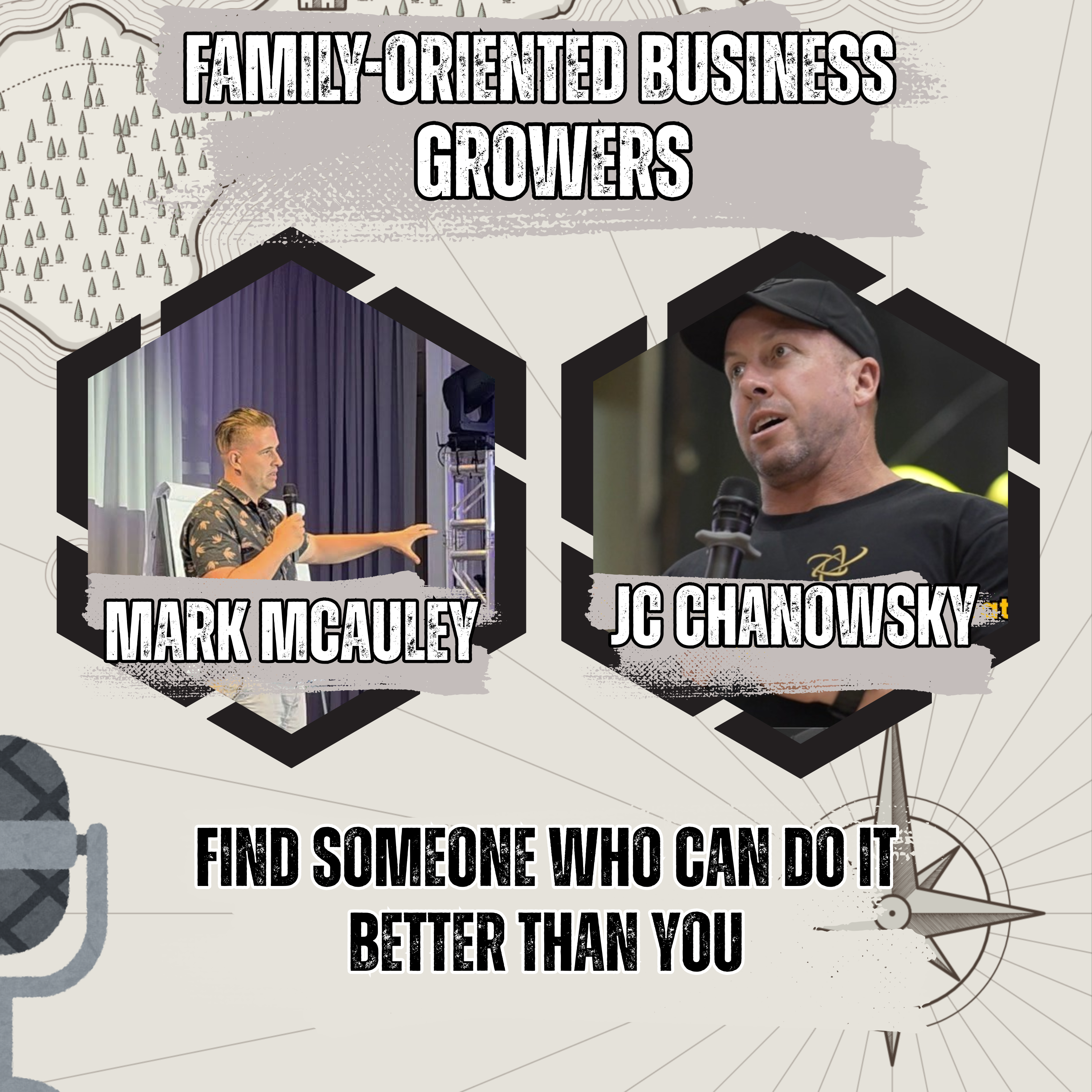
Family-Oriented Business Growers · Mark McAuley
Have you ever thought "no one else can do this the way I can?" JC Chanowsky used to believe that and it was the moment when that belief shifted that EVERYTHING changed in his business. He has now mastered the art of outsourcing and militantly sticks to his own zone of Unique Genius. Not only has this allowed his businesses to thrive, but it also makes it a lot more fun for him in the day to day because he is working as much as possible on things that really light him up. JC runs a pressure washing company as well as a Christmas lights company & he helps his wife Angela with their Strategic Partner business Unique Genius. Join the free group for Parents Running Cleaning Businesses via www.warplan.au Connect with JC via unique-genius.com http://facebook.com/JCChanowsky
Mark McAuley: Hey, hey, welcome to all of you bandits and chilies. Today's guest runs multi-million dollar businesses, including ⁓ Cape Fear ProWash, Patriot Illumination, and Unique Genius. We have with us today, JC Chanowsky. JC, how are you? JC Chanowsky: I'm doing good. doing good. I like that intro. You got to tell me a little bit more exactly what that meant, but it's a pleasure to be here. I know it's been kind of dynamic trying to get us connect, but we're here. So let's have some fun. Mark McAuley: I'm very glad to have you here and the dynamic of trying to get connected, think just really speaks to where you're at. We can maybe talk about that in a minute, but ⁓ I've enjoyed the process of getting you on here and I'm glad to have you. terms of the introduction, I think like our kids are younger than your kids, right? So this is a bluey reference, bandits and chilies. That's what that is. yeah. ⁓ maybe start there on the getting connected thing because one of the things that... JC Chanowsky: Okay. Mark McAuley: in one the ways that I want to be like you when I grow up is I'd like really outsource all of my executive function to other people to deal with. And I've ⁓ I've that to fairly limited degree. But like yours is is great. So we connected a bit on Messenger. Your VA jumped in to with some of the logistics of that as well. And then also you have like house manager too to help on like house front so that's aspirational for me like that's like the next thing that I ⁓ want sort out is is getting that side of things handled so that my wife and I can focus in our zone of unique genius ⁓ pardon pun but what what has the impact ⁓ for you being able to outsource a lot of that executive function JC Chanowsky: Yeah, I mean, you know, let's start with the manager first because that one was, because Angela. Now she's had house managers in the past prior, in her younger life. ⁓ And she told me all the great benefits of it. I kind of laughed about it. I wasn't against it. so, you know, we put a ⁓ post out on and just put it out to share it to a couple of Facebook community groups. And we had one in and it was okay. ⁓ And she was a bit and more chatty than worky. And as my wife is a stay-at-home entrepreneur, she works from home, you she needs to be focused on working, not chatting. So that wasn't a good fit. And Angela's like, this can't work. I need to have somebody that's here to work. And then if I have time to talk, we can. It's nothing against them. It's just that I have a job and they have a job to do. So once we found that one person, we found a retired... the wife of a retired Marine, she's local she kind of did this kind of service before in California, we're in North Carolina and it's been great. know, the biggest... Concern with this type of job is trust because we're not there over watching them and there's a lot of times that Angela are traveling and we need somebody in the house to have the house ready when we get back this person that we found. I mean, I have literally left money in the the ⁓ dresser in the in the laundry, you know, whatever it is jewelry around the house and there's never an issue where we come home like, ⁓ my God, where did it go? It's like ⁓ money is folded and said on top of the washer. The jewelry is still where it is. And when we come home like the house is spotless to the way we we expect it and just been a great asset to my wife and I that, know, nobody, well, I won't say nobody. Most people don't like folding clothes. They don't like doing dishes. They don't want to clean, you know, especially when you work eight, 10, 12 hour days, the last thing you want to do is go home and do more work, more chores that doesn't have an impact on your business. So for us to be done with the work day and to be able to focus on whatever we want to do, have a conversation, probably talk about some more work. That's been a great, investment and I like using the word expense because it's been investment in our lives that we can focus on what we really want to focus on and not the things that don't drive the needle to have a bigger impact in our lives. Mark McAuley: Yeah, love it, love it. So maybe just ⁓ the uninitiated, because I'm relatively new to this concept of a house manager, right? So what is the difference between, a housekeeper versus a house manager? JC Chanowsky: Yeah, a little bit more dynamic. Angela, I love Amazon ⁓ ⁓ we would have a lot of stuff come in. And then when we want to return it, it would sit by the door. And then 90 days later, we couldn't return it no more. that was like one really key thing that we wanted to add in there was be able to ⁓ any type of deliveries or exchanges. Because you know, we would get the stuff, not use it and then sit there and then just go in the junk pile and probably get donated. So we're losing money. So and my does order a lot of Amazon. Like it's it's it's a lot. It's funny, but it's a lot. And they're not working for a company. So, you know, the pay is going to be significantly different. Usually when you hire a company, you're paying, you're typically paying like 75 bucks an hour. I'm ballparking that, but it's up there in that range. Probably. when we started with her, I think we started at $25 an hour. She might be a little bit more now and on our hours and our time. Like, Hey, these are the days and hours that we want you to be there. ⁓ by the way, we're traveling next week. We want you to have the house cleaned and then come the next day to do all our laundry for us. So. know, garage organization, closet organization, clothes organization, taking clothes to donations. It's a lot more than just going to scrub toilets and clean showers. Mark McAuley: Yeah, yeah, 100%. So it's a lot of that sort of executive function kind of stuff. It's funny you mentioned the parcel return. I bought a pair of shoes online. needed some new, like ⁓ really needed some new runners. ⁓ I have ⁓ in my runners. And I bought these shoes already having holes in my runners and they came and they were a size too small. and they sat there for the best part of a month before I sent them back. I'm still waiting for them to come and I'm getting around and I'm like heading to the gym and I've got like these holes in my shoes. ⁓ my goodness, need to, I already left it too long because of executive function to order them in the first place and then having to reorder them. It's just like, ⁓ you know, that sort of stuff. it's like, ⁓ I said, that's why I want to be like you when I grow up. ⁓ JC Chanowsky: It really sounds silly too and if anybody's listening like that's ridiculous like why can't you return your own stuff and it's not that we can't do it. It's just we don't want to do it because we want to focus on doing other things. And, you know, for us, we're really home bodies. Like we don't ever really leave the house unless we're traveling or like kids. So for us to get out and then go to a place that we don't want to visit in the first place, you know, what else can we offload ⁓ really just start getting rid of those? I like to say the 10 hour task in your life and your business so you can start focusing on the things that really make you happy. Mark McAuley: Yeah, 100%. And it's like, mean, in your case, right, you're running multiple multimillion dollar businesses. So wherever you can close off tabs in your brain that you don't have to think about returning a pair of shoes or booking accommodation for a trip that you're taking or something like that, it frees you up to do the stuff that is not the $10 an hour task, right? JC Chanowsky: Yeah. Right. Mark McAuley: And actually Alex Formosi had a really good video about the sort of seven tiers. I can't remember all of them, but it was basically the seven tiers of things that you can outsource. it starts off with maybe like... cleaning and like household chores. And then like by the seventh one, it's like basically, you know, not flying commercial, but like having a private jet, right? So gets like more and more expensive to buy back your time as you scale. And but it was aside from like at that level, like at the lower level, it's very practical to everybody. And just yeah, anyway, that's like that's an aside, but it's a really good video and should definitely be checked out. this all kind of ties into ⁓ JC Chanowsky: Yeah. Mark McAuley: unique genius but like before we get there let's just wind back can you set the set set the stage for us set the scene of the story is so far how ⁓ how businesses started how they grew and then what led to ⁓ where are now and and what even the picture of today looks like like what's going on ⁓ in businesses today JC Chanowsky: Yeah, so I joined the Navy in 2004 and went overseas to Guam, which is not too far north of you and never made it down to you, unfortunately. But, you know, I did five years in Navy. I did security and then I got stationed in New York, upstate New York, in near Albany. And it kind of like just ended my career. It was like guarding a frigging water shack. There was nothing there. It was really boring, not exciting, not really what I signed up for. So said, you know what, I'm done. So I got out in 2009. and I didn't want to go work for anybody and I was 29 at the time year yeah 29 years old time so my dad was a carpenter by trade for his whole life I didn't really want to do that I started looking into landscaping. really enjoyed doing mowing. I did some side jobs like that growing up and in the Navy. did some side ⁓ side hustles with that too. But then I realized everybody in North Carolina had a landscaping business. So then this is way before Facebook. I was on these forums where you actually had to go to websites and like typing groups and get information. They talked about pressure washing. So found pressure washing, started pressure washing in 2009. KFIR ProWash, quickly realized, well, the recession hit in America and nobody was spending money. So that was a bad time to start a business. I wasn't privy to all this and wasn't really paying attention, but I still did it anyway. Ended up going back in the Navy full-time, deployed overseas to ⁓ came back home, moved back to New York because my wife was from there at the time, or my ex-wife was from there at the time. At our second child at that point in 2012, 2014 we came back to North Carolina. I went back in the Navy down here, working full time at our local base. Still running the pressure washing business part time. 16, I learned about Christmas lights, so started Patriot Illumination in 2016. And then 2019 was really like the catalyst for growth. Um, but also a tremendous change in my life. 2019, the beginning of the year, I left my ex-wife. Um, I went all into my business and really started working on my business instead of in my business. And that's where we saw some tremendous growth. I got a business coach. I went to some like business development, uh, like, networking workshops and things like that and really just like learning how to be a business owner and not just an employee. So we went from just myself to I think seven employees that year. And then 2019 were around 250,000 then grew to 500 then to a million. I think we got up to like 1.5, 1.6 with a combined of those two in 2023. Um, and then 2023 was actually when I met Angela, we were both speaking at an event in Vegas. Um, she was speaking about her book. She wrote a book. I was speaking about Christmas lights and, um, We didn't know that when we met it was fate and we never left each other's side. She was living in Nebraska, I was living in North Carolina. had this crazy relationship where like every other week we were traveling, going someplace together, whether it was a business event or just traveling for fun. I mean, we traveled a lot. in six months and then she finally said, hey, why don't I just go move in with you in July of 2023? She did and then started really like going in on business together with Unique Genius and KFIR ProWash and Patriot Illumination. 2024, December, we got married and that brings us to here. So right now. You know our shift and focus really is on unique genius because we know that business owners need that service more than pressure washing or Christmas lights. So we can have a bigger impact on small business owners like myself, yourself and others out there with the use of working with unique genius. You know we help business owners scale affordably with elite virtual teams based in the Philippines. have an incredible team out there that's over 200 ⁓ individuals right now ⁓ ⁓ Right now we're just on a mission to help business owners a greater impact in their lives to be able to focus on their family. That's really big to us, his family, so that really ties into our ⁓ values together. yeah, that's kind of a nutshell right there. I know it's a lot. Mark McAuley: Yeah, it is a lot. I want to reverse back to I forget what year it was you said when you first got a business coach. So what was the 2019? So what was the catalyst for you signing for the for business coach for the first time? ⁓ And was the impact and shift that that had like not just in terms of you then grew to having like seven employees that year or whatever, but like ⁓ the mindset shift? What changed for you? JC Chanowsky: 19. Yeah, it was actually, you know, somebody had been following for a while. Pat Clark is his name. He's not too far from me. Five years, five hours away, similar lifestyle, kind of grew up poor, you know, grinding to get the business going, family, just a great human. And he, did the things that I wanted to do. And I just kept following them. And one day it was in January of 2019. messaged him and said, Hey Pat, you have time to talk. He really didn't know me, so I didn't expect him to say yes. And he said, yeah, let's get on a phone call. And like 30 minutes later, he had, I wouldn't say the word convinced, but he talked me into signing up for conquer, which is coaching group ⁓ way back when. And, yeah, you know what, Josh and, and to go to sales boost, which was like the very next month. So did both. I immediately, I hung up, I signed up for Conquer. He was my coach and I went to sales boost and it really just changed mindset forever. It was like, you know, nobody can do as better as me. I need to answer the phone. I need to be on every single job. If, know, if I'm not watching over them, it's not going to get done. And it was the wrong mindset. And it's very normal for small business owners to have that. I have that conversation all the time with so many people. And once you can get that out of your brain, that's really what they did. Like if I don't listen to Pat, then I'm an idiot because Pat did the things that I want to do. So Pat tells me to do something and I say, that's not going to work. Well, then why would I join and sign up with Pat? Like, why am I just going to burn money away? Mark McAuley: Yeah, why did you pay him all this money to not listen to what he said? JC Chanowsky: Right. that financial investment, again, I like to use the word expenses, investment in myself, in my business, you know, made it burn a little more if I didn't listen, if I didn't execute, if I didn't follow through. So if Pat said something, I did it. If else said something that was doing what I want to do, I did it. And I ⁓ didn't I I went all in on our brand. I went in all my people, you know, and I never, can't say I grew my company to where it is today. alone. Like I did it with tremendous team members along the way that believed in my vision for the company and believed in what we're doing ⁓ were able to get us where we are today. So, you know, over the years we've had some tremendous culture. We've had good culture along the way. And then there's times of periods where we were at bad culture, but always constantly learning, trying to fix and, and, and, you know, make things better. And the one thing that really set us apart and why so many people loved working for us is that it was never an employee. You're never a number for us. I don't care if you're seasonal full time. I like to consider you guys family. I bring my wife there. I bring my kids there. I don't care if they brought their kids there, their pets there. I want, you know, a safe work environment for people to feel open, to have a conversation without fear of getting fired if you messed up. You know, whatever it is, I just want people to know that like. If you're with us, we're with you. Mark McAuley: Yeah, love it, love So yeah, I was in Conquer well. I mainly worked with Nick DeMark ⁓ yeah, I didn't actually really, I sort of knew of Pat, but I didn't really know him, but I was recently introduced to Pat Clark and ⁓ he'll be coming on doing an episode on the podcast as well. had a chat with him and ⁓ yeah, he's very down to ⁓ but at the same time, ⁓ successful at what he does. ⁓ JC Chanowsky: Okay, yeah. Yeah, Nick's awesome. ⁓ cool. Yes. Mark McAuley: ⁓ yeah, cool. I love seeing all the connections and where it all fits in. ⁓ fast then from that experience and because unique and you can maybe a little bit more about exactly what you do, but it's all about, I would it's all about you having solved a problem. for yourself or you and Angela having solved problems for yourselves that you see a lot of value in to solve that problem for other people. So maybe just talk a little bit about what's gone into it from like experientially for you guys of how came to be kind of like a passion project and what problems Unique Genius actually solves. JC Chanowsky: Yeah, absolutely. So Angela started Unique Genius six years ago. She was working with another company had a lot of ⁓ in the Philippines. And she's been an entrepreneur since she was very young ⁓ and just saw the need to be able to help other home service businesses. So she kind of branched off and started doing her own thing. And when met Angela in 2023, ⁓ I already a couple of EAs that I worked with. I've had some good ones. I've had some bad ones. I've had everything in between. And You know, I was like, you know, babe, you got something really good going on. Like, why don't you just explode this business? You know, so many people need your services right now. And she was really intentional on building a strong foundation, the Philippines, so that the culture there, you know, being 7,000 miles away, they felt like they're right here with us. So she was very intentional with building the business slow with the right leadership so that as she grew it, pillars were in place to support all the growth. So along the way we've been to the Philippines twice. We'll be back there this July. We go out there for like a huge mastermind. If you will, we bring everybody into one Island. Uh, last year we had 140 this year. We'll probably have about 300 and we're bringing our clients from the U S a bunch of them are flying over there to go meet their VAs. Uh, which is pretty fun. And I use the word VA, but we like to use the word strategic partner. Oftentimes when you get VA's virtual assistants or task doers kind of low level good people don't I'm not downplaying that we like strategic partners who were forward-thinking that are always like ready to work and thinking ahead of you not waiting for you to say You know, this is what I need you to do today It's more like with Miko, know Miko reach out to you On behalf of me because I was failing to do what I need to do So he was being proactive not waiting for me to say hey Miko go figure this out And as far as like tasks and roles, you know, I like to anybody a strategic partner can do anything in your business that doesn't physically involve touching things. Um, so bookkeeping, social media, posting CSR, inbound calls, outbound calls, cold calling, uh, outreach, uh, bookkeeping, um, And then my favorite, which is Miko, um, he's my right hand is a executive partner, which is for usually for business owners. It's like their main go to, to manage their life. You met, managed my calendar. He managed my inbox. He managed my emails. If I got stuff, I got paid. I'm like here, Miko go fix this. If I break something, he's fixing it for me. Um, but like to wake up every single day and not have to go immediately to my email. because I know he's got it or if I'm, guess only on the calendar in our 730 or eight o'clock meeting, he's like, JC, this is what you got. You know, it's just great having that right hand. I don't want to say man, but like just the extra hand, like they're holding you to carry along the way. So you don't have to think about it. You just show up and do what you have to do. Mark McAuley: Yeah, yeah, no, 100%. Yeah, had that experience with ⁓ VA, that with the appropriate sort of training and mentality and over time building that relationship where she understands my thinking on things. One of the things that I found, I'm curious to get your input on this, like culturally with Philippines. it is a little bit more by default, kind of a, that role there kind of becoming into a typically expecting it to be a very handholdy role and a very task doing role. And they may not feel as though they have permission to sort of step beyond that and color outside of the lines. So one of the things that has really helped myself with our VA has been kind of just like. setting those expectations and saying, I want you to make decisions to back yourself. You know what I think about this. Or if she asks a question, of like putting it back on her and saying, what do you think I'm gonna say? Yeah, that's it. You know the answer, you have the confidence. And if you make a mistake, if you stuff it up, I'm not going to... you I'm not going to like just fire you for that or like whatever the bad things that you're imagining are going to happen, like that's not what's going to happen, right? And so just kind of giving that permission to be able to do a lot of those extra things. So I think that's like one important part of that additional sort of strategic partner or proactivity that you're referring to. else do you think really plays into that? JC Chanowsky: Yeah, and know, it comes down to you either want help or you don't want help. And need to empower them. You can't just say, you know, I want you to do this, but I want to watch every step of the way or, you know. once you're done with it, let me verify it to make sure now in the beginning. Yes, I absolutely think that that needs to happen because you want to make sure they, you know, especially if they're sending off emails. Now I'm not going to have them send an email to the president and to say, go send it off blindly, but you know, some basic emails, responses, you know, any of our software companies that we work with, like MECO is dealing with them and he's in there saying, Hey, this is MECO, JCCA or partner. ⁓ So You need to empower them to do these things and start slow. Don't just vomit on them. Say, I want you to figure this all out. That's where they fail. You're like, this doesn't work. This is stupid. Like I joke all the time. They're humans. They're not in the matrix. You can't just say, I want you to run Java code and figure out how do my books and do this. And they're going to download it like they're in the matrix. I know all this all of sudden. No, like they're humans. They know what they know. They're not experts in everything, but the things that they're experts in, you need to trust them and empower them to be able to go do these things for you so that you can focus on doing what really lights you up and you can work on your unique genius. Like, I don't want to look at my emails. I don't want to look at my messenger. There's a lot of things I just don't want to do because it gives me no joy. It's not that this is not important to me. It's just not moving my needle of happiness in life. So if I can delegate those and really focus on what is going to make us successful in our businesses and in our families, then I'm going to have a much bigger impact focused on those things instead of getting distracted every 10 minutes. You know, like I got do not disturb on my phone. And if anybody calls me, it goes straight to voicemail. It's not that I don't want to talk to you. It's just I don't need distractions throughout the day. I'll get back to you when I can. I'll respond to the message. when I have time, but if I constantly allow all these distractions to stop me from that momentum throughout the day, then it's like, well, I'm going, I'm going, I'm going, and then, oh, now I gotta go backtrack. Now where was I? Let me get that momentum again. So, you know, by delegating these tasks, whether it's an internal team or an external, know, strategic partner, you know, you're empowering your team to be successful, which empowers you to do the things you wanna do. Mark McAuley: Yeah, yeah. I just want to underline one point there, which is that if someone's listening to this and they're thinking, know, I'm not sure if I'm ready to walk the road slash run the gauntlet of hiring a VA or anything of that nature or whatever. There was one key actionable thing that you can do in like five minutes just then, the JC said, which was to set up the notifications on your phone in a way that is intentional for you so that you ⁓ running The the task the action or whatever rather than it demanding of you throughout the day whenever it demands that it's it's relevant so setting to do not disturb or having like particular apps or particular people or whatever that are allowed to contact you or not and then blocking off a time of the day for responding to the rest of the stuff a super five minute ⁓ one kind of forever hack that is very ⁓ very good at closing off a lot of tabs in your brain and opening up a lot of bandwidth and it doesn't cost you anything to do. So just wanted to underscore that point. the ⁓ of ⁓ of genius, right? What you were just talking about then kind of made me think of doing an energy audit. I don't remember who taught me this. I feel like it might've been Joshua Latimer. I'm not sure, but this is something I teach with my clients is to go through and can do like a time audit as well. And like what you were saying before about like a dollar amount audit, but also an energy audit because you, and this could be all in the same thing depending on how you want to set it up. But essentially like ⁓ tasks do you do that feel really fulfilling and give you energy versus what do you find like the most JC Chanowsky: Mm. Yes. Mark McAuley: draining thing ever to do and you just wish you could never touch it again, right? So when you do that, that's essentially going to direct you towards the zone of genius and the things that you actually like what JC said that light you up and focusing on what you're good at and anything that lights you up, you're probably inherently going to be better at it because you enjoy doing it. So with all of that in mind, the concept of unique genius and supporting that, what is the impact when someone has things in place that allow them to focus on and only on, or almost exclusively on their area of unique genius. What's the impact for them? JC Chanowsky: Yeah, it's funny that you said that the energy audit and know, Dan Martell talks about buy back your time. then Angela, I just spoke at DDD con last week in Salt Lake city. And that was the exact line that she did was your energy audit. She was like, you can buy back your time, but you can't buy your energy is so important with that. So going through and just to kind of get into that like just list down everything you do today and be like very real and authentic about it like my calendar is Color-coded and if there's colors in there I don't want to see like if it's purple or green like that's not a color I want my calendar So how can I delegate that to somebody else to go do those things if I see yellow? I mean some traveling I'm really excited if I see purple. It's my kids, you know blue is gonna be fitness and things like that. So, you know live by your calendar And then your life will get easier because then you can really control how much time you're delegating to things that you want to be doing and what you don't want to be doing I mean in the past. I've literally had gym in there in the morning dinner date nights things like that like it sounds silly, but Most of us don't realize how much we're doing that doesn't move the needle and it could be four minutes here three minutes here Send an email, you know ten minutes on social media You know all those little things in our life that are just holding us back from really moving that needle So I challenge you if you're like, ⁓ you know, that's not me. I got everything dialed in. Well, I challenge you to go through the week, go through the day and just start going through things like. ⁓ yeah, I had a meeting for five minutes with this person that did nothing for me. Okay, great. How can we not have that meeting next time? Who can we delegate that meeting to next time? And if you don't have that person yet, well then great. We want to work towards that. Like who can we hire to fill in to start doing those things? Strategic partner is usually the most affordable and fastest to get there, but it's not for everybody. And we understand that. So we want to be very transparent that like, you know, having a strategic partner isn't for everybody. That's okay. Like I have somebody in my office I love, but I also love my strategic partner because most of the times they're like way ahead of our office staff. Like they're already thinking like way ahead of them. Now my current office staff, she's phenomenal. So I won't say that about her, you know, so being able to really focus on your energy, like me, social media. I love social media. love posting. I love doing funny stuff. I love engaging with people. I love getting people laughing. I post the stupidest things all the time and I post some serious stuff and I also post the stuff that like most people don't want to talk about which is when like I am depressed down business is bad because I want people to understand like you are not alone. Like Mark I'm sure you've had some good days, but I'm sure you've had some really bad days where you're like, is it just me? Am I the only one failing at this? So by being able to do that and talk about that, I'm able to get people, and this is what Josh Latimer says, they feel like they're on lonely Island. Like it's just me over here. And if I can relate with those people and say, you are not alone. I can't tell you how many people have come to me private. They won't share or comment. They won't like the post, but they'll private message me and hey, thank you. That's the post I needed today. I thought I was the only one going through this depression. I thought I was the only one failing. So I get out there and do that, but I have fun doing it. Like my big thing is having fun. I'm a funpreneur. I like to do that. When I'm having fun, my energy is high. When I'm not having fun and doing the task that I don't want to do, I never want to be on the phone with a client. Not that I don't like my clients, I just, doesn't give me the energy. you know, there's so figuring out what lights you up. And real quick to that too, like. Business owners when they start business, they are the task doers of everything. They got all the hats, right? They just keep stacking them once HR it's admin is training at sales. It's CSR. Sometimes you got to swap them back and forth but Is every task? Lighting you up is every task giving you energy and as soon as you say no Great, you need to delegate that and get rid of it as fast you can just because you own a business doesn't mean you're good at sales. There's a good chance you're horrible at sales and that's okay. Just because you own a business doesn't mean you're great at admin. I suck at admin. I don't want to do admin. It drains my energy. So just do that energy audit on yourself throughout that day, the week, the month. And what does drain your energy? How can I delegate that? if you don't have employees right now and you think you can't afford it, well, I think you can't afford to not have them because you're doing things wrong. You're probably not doing enough of it and you're not getting the lead flow or the follow through on the customers to drive the business to be able to start hiring that person. you know, I like to tell people, I'm not saying go bet everything on black right now, but bet on yourself. And if you believe in yourself and you follow through and do the right things and get the right people in place, really good things will happen to you and it'll give you the time to focus on you and your family. Mark McAuley: You Yeah, love it. I think another tiny actionable step right there is for the person who's thinking, I don't know if I'm ready to hire someone and how I'm gonna do all of that. Even before that, like when you bring someone on, they're gonna need to be trained. So if you are doing the tasks right now that you hate doing and you identify like this is my to delegate list, as you're doing them. start thinking about how you would train, how you would delegate so that you're one step closer in that direction so that when you're at that level and in the process of that you can feel free to reach out to me, maybe reach out to JC as well about like to go about that effectively for like preparing to delegate to a VA or someone else. The thing that you said there which I thought was like a mindset slash narrative shift, a of people like their business is hard and then they feel like if they want to grow their business that equals more hard, right? So you were just saying about being a fun printer and ⁓ things that light you up and all that kind of stuff is that growing your business ⁓ is definition going to be fun for you because you're focusing on the things that you enjoy. And so that be a narrative shift that to grow your business can be fun and it can be easy as well if you let it. And I think that's like a really important thing to sort of think on as well of like, okay, well, what if, what would it look like if it was fun? What would it look like if it was easy? What would it look like if I wasn't just like banging my head against the wall? And how would I stop that? What are the tasks that are making it feel that way? Kind of the reverse question to what I just asked before, like, what you found for yourself and or what have you seen for others? in how it affects someone not working in their zone of genius, like how that contributes specifically to business not serving their family in the way that they intended it to. JC Chanowsky: Yeah, I mean, you become a victim to your business and now you're an employee. You're not a business owner. And I've seen it from guys that I've known started the business right around the same time that I have. And they're just still struggling. They're constantly struggling to hire. They're constantly struggling to grow their business. Most of the time it's they're in their heads and they just can't get out of their heads. But you know, if the phone's not ringing, if the sales aren't coming through, then are you really providing for yourself, for your family, for your business? And the answer is no, because you're gonna be stressed, you're gonna be down, you're not gonna be the same father, you're not gonna be the same husband, you're gonna be irritable likely, you're gonna be working late days, long nights, missing some holidays, birthdays, whatever it is to get whatever opportunity you can. know, often times they think like, I can't afford to not do this, I don't wanna hire people because they can't do it, I don't wanna pay the money because I can do it better, but you know, I'll never look back and say, damn, I I missed more birthdays. I wish I missed more time with my kids. And was 2017-ish, I think it was, and we out on the boat. This was like a Tuesday afternoon. And it was during school. I don't know why the kids didn't have school, but anyway, I had to go to work at like one o'clock. So we had to leave. We had to leave beach at one o'clock so I can go to work. And my kid said to me, Dad, you work too much. And that broke me. Like, what am I really doing? Like I thought by working 60, 70, 80 hours a week, depending on the season and providing and giving them everything they wanted. So I thought the things that they, I thought wanted, like they would have the good life, but all they really wanted was time with dad. And I can't get that time back. can't get, you know, the eight, nine, 10, 11 year old versions of my daughter's back. Like they're 13 and 15 now. you know, just think about the future and think about your kids and stop thinking about yourself because I was being very selfish and I thought I knew what they wanted. I thought I knew what everybody wanted, but I was giving everybody what I think they needed, not what they actually wanted. So. It's really important to have those conversations. And if you don't have a family yet, then fine, have fun, do the things you want. But if you do have a family yet, you know, do your kids want more money in the bank or do they want more time with you? Because tomorrow's never guaranteed. And that's one thing I really live our life on is like, I live life like there's no tomorrow. So I don't want to regret if I get into an accident or something ever happens, like, ⁓ I wish I did this better or I wish I took more time to go do this or I wish we traveled more. Mark McAuley: what I find interesting about that is that's all very like very powerful and very true It's kind of a of a cliche though, right? Like ⁓ you know the time matters more and the kids don't care about the money and whatever like I'm sure that you That the version of you that was ⁓ that mistake if we'll call it that and struggling with that at the time had heard someone else ⁓ that so what do think that that hadn't clicked before then if that makes sense? JC Chanowsky: I was just being selfish and I was, young, stubborn and yeah, I just, wasn't being true to myself or my family. And I just felt by having all the glamorous things, the cool cars, the boat, the vacations, like that was the way I can, I don't want to say buy love for my kids, but gift my kids love. Which I will say like, had an effect on my relationship with my kids now because I wasn't paying them the time. I wasn't affectionate with them. I was just giving them cool things and thinking that was the way that I can get their love when again, they just wanted to hang out with dad. They just wanted to go to the park. They just wanted to watch a movie. They didn't care about the toys and trips. Now, they them, but you know, I was was... telling them what they I thought they needed not what they wanted. Mark McAuley: Yeah, yeah, because I feel like I've made that same mistake too. Even just acutely, like I feel like that kind of thing can crop up on a random Wednesday, you know, where it's just like, I'm too focused on ⁓ this thing I'm making my work mean something that it doesn't mean today. Or my kid has for my time and attention and it's like... well, why is that not more important in this moment? Like maybe it is, you So I feel like that kind of thing can crop up. And what I have found personally to be like the antidote to that just really gratitude. It's gratitude for what it is that you have today in this moment and the stage where they're at. ⁓ you know, our kids are five, four and 21 months ⁓ and kids are a bit older. Like you say, can't like wind the clock back, but it's like, okay, like what's the experience like right now? And what can I do to show my gratitude for like where we're at today? And inherently we're still gonna make like a bunch of mistakes and look back on them and go, yeah, like I probably, that was maybe not the right move on that random Wednesday. But yeah, that's just my two cents on that. JC Chanowsky: Yeah, my one real quick, like one thing that somebody taught me was like, you know, how many times have your kids come up to you and say, dad, dad, can you do this? Me? You're like, no, not now. I'll do it later. Like, you know, that's their moment. That's the moment they want to be with you. I give it's not any pressing that you can just say, I'll give you two minutes right now. Like that's going to light the world up. That's all they want. There's one of your attention for two minutes. It could be 30 seconds, but I was too busy at the moment to not even give them 30 seconds. So I got real better at. Mark McAuley: Hmm. Yeah. Yeah. Yeah. JC Chanowsky: not saying not now and just putting everything down, go and do whatever it was and then coming back and doing things. It made their day so much better. Mark McAuley: Yeah, yeah, I, that reminds me of like two specific little examples, both involving our middle daughter, Addie. She, one time she came into my office and it was like that exact thing of like, you can I have a moment? And I thought about saying no and I said yes. And I was like, yep, let's do the thing. And literally what she wanted would have taken less than a minute. It took less than a minute. JC Chanowsky: Yeah. Yeah. Mark McAuley: It was just the tiny little thing. It interrupted my day less than if I had notifications on like we were talking about earlier. Like I could have just got a random message on WhatsApp that would have interrupted my day more than that. And ⁓ completely lit her up. And another one with her was, we ⁓ were like, you know, some daddy daughter time and we're out in the car. I think, dropped Felix off I don't know where he was going, but it was just us. ⁓ We're already out in town and I asked her like, okay, where do you want to go? What do you want to do? Thinking like we could go to any number of these cool playgrounds or whatever. Whatever we're to do. And she wanted to go to the playground that is like opposite our house and it literally has one swing. It's like one of those like round swings on like the single point that kind of, you know, and that's the only piece of equipment. And she's called it like, you know, the playground with what the one swing I'm like, that's, that's what she wants to do. Right. Okay. That's where we're going. We're already out. We could go to what I think is a cooler playground, but in this moment right now, that's what she wants to do. So sometimes it's like, it's a really simple thing and we build it up in our head and we think, it's going to be this big thing, this huge production to go and spend time with them. And I don't have time for that right now, but maybe we're not even like thinking about what it is that it could be just like something really small, really simple. The other question I really wanted to ask you was ⁓ are some key beliefs that you hold that you think that other people would benefit from adopting? JC Chanowsky: or life? Mark McAuley: whatever like that conjures in your mind. JC Chanowsky: Yeah, I think the one big thing that really had a tremendous impact on the growth of my company was like empowering your team and, um, just letting them, it's, it's okay to fail. I tell everybody all the time, like it's okay to fail. As long as nobody's going to get hurt, we can always learn from something. And I used to be that, you know, scratch happened or something broke, throwing stuff and cursing and yelling. And at the end of the day, like I didn't feel better about myself. The team was scared. They didn't want to be around me. They didn't want to tell me anything. Um, and you know, I, I make mistakes all the time. My daughter made a mistake, uh, yesterday that I found out and I, and I started yelling at her and I'm like, while I'm yelling at her, I'm like, I make mistakes all the time. My daughter made a mistake, uh, yesterday that I found out and I, and I started yelling at her and I'm like, while I'm yelling at her, I'm like, J.C. you're such an idiot because you did the same as that thing when you were her age. So why are you getting mad at her? Nobody got hurt. Well, they kind of went to the hospital. It was fine. It wasn't bad. But you know, once I started empowering my team to do things and had the freedom to make mistakes, like that's when growth really happened because they weren't afraid. They weren't afraid to ask questions. They weren't afraid to go and do something on their own. They weren't afraid to make suggestions on how we could do better. I always tell her, I don't know everything. So if you know a way we can do something better, faster, J.C. you're such an idiot because you did the same as that thing when you were her age. So why are you getting mad at her? Nobody got hurt. Well, they kind of went to the hospital. It was fine. It wasn't bad. But you know, once I started empowering my team to do things and had the freedom to make mistakes, like that's when growth really happened because they weren't afraid. They weren't afraid to ask questions. They weren't afraid to go and do something on their own. They weren't afraid to make suggestions on how we could do better. I always tell her, I don't know everything. So if you know a way we can do something better, faster, safer, affordably, let's do it. Let's try it. If it doesn't work, then great. We tried it at least, but if we don't know, then we don't try and we can't, you know, ⁓ our company. So giving people a safe space to work freely and to feel comfortable to come to you safer, affordably, let's do it. Let's try it. If it doesn't work, then great. We tried it at least, but if we don't know, then we don't try and we can't, you know, ⁓ our company. So giving people a safe space to work freely and to feel comfortable to come to you if make a mistake, because there's nothing worse than an employee going out and doing something and damaging the property or ⁓ a vehicle, whatever it is, and they don't tell you. And then customer is calling you and say, Hey, JC was out here and he damaged my property and I got it on video. You know, hey JC, what'd do? Oh, yeah, I didn't think it was a big deal. So I didn't want to tell anybody about it No, it's not what I want. Like I don't care if it's like hey, I killed a blade of grass like alright, cool Let's see how we can fix this or a flower You know, whatever it is like I'd rather them come to me and tell me that something went wrong than a customer coming This way we can go to the client say hey while we're in the job site something happens I mean I had two guys driving a vehicle there were What were they? 20 and 21 years old. They were driving a brand new vehicle, $117,000 vehicle, all in with everything. And two very expensive pieces of equipment fell off the back of the truck. They're driving on the freeway. By the time they turned around, I don't know how it happened, somebody drove, picked it up and hauled off with them. I I think they were about $1,600 for the two of them. When they came back, I'm like, what happened guys? They're like, I don't know. We're driving. It fell off. I'm like, all right, well, cool. How can we prevent this from not happening again? They're like, wait, you're not mad at us. I'm like, no, mean, mistakes happen. I'm not happy that we lost $1,600 equipment, but like shit happens. Like, so let's fix it, learn from it and make sure doesn't happen again. And that really empowered them to, to feel safe, to come to me if anything else ever happened again. And everybody in the, in the work environment knew that too. So. know, empowering your team to win, but also that if they do fail, that it's not a punishment, it's a learning opportunity. Mark McAuley: Yeah, think if I was to try and summarize that as like what the belief was before to the shift after it's it's probably like I and the best person to do everything essentially versus not ⁓ can find other people who can do it better than me and in conjunction with that like you know ⁓ I make mistakes like I would never have made that mistake and then flipping that around and realizing like you know I yeah I that could have easily been me like I could have made that mistake or maybe maybe I wouldn't make that now but maybe I would have made that mistake when I was 21 right ⁓ that kind of thing so yeah it's it's of a JC Chanowsky: Absolutely. Mark McAuley: humility shift I feel in that like that's like what that belief there is embedded in and that narrative Yeah, awesome. So with unique genius ⁓ and of that if people are interested in that, how can they contact you? How can they reach out? What's the process like? JC Chanowsky: Yeah, they can go the website, ⁓ www.unique-genius.com. can find me on social media. If it's on Facebook, it's Jared Chanowsky. I think Instagram is too, or might be J.C. Chanowsky or my wife, Angela Chanowsky. You know, we're just, we're here to have fun. We want to see people be successful. I haven't done everything right the first time, maybe not in the second time, probably not the third time always, but you know, along the way we found great mentors in our life to teach us and coach us along the way. And that's what we want to do for others. Like we want to set people up for success ⁓ grow their business. You know, we have some people that come to us and say, Hey, I only want one strategic partner. And we have some people say, I need five right now. so there's no like, Point of your business where it's the right decision you could be just starting and and I say this all the time If I ever ever start a business again, the first thing I ever do is hire an admin Immediately right out the gate, you know, if I couldn't afford it I know that if I invest in them like it's gonna allow me opportunities to grow my business way faster Because I don't want to be working 12-hour days and trying to send off estimates at night and do all those things and then forgetting So put in that key person in place to help you grow. But yeah, unique-genius.com unique-genius.com social media Facebook, easiest way to find us. Mark McAuley: Yeah, I'll check some links in the description as well. Yeah, thanks, thanks, heaps for coming on. It's been a great conversation and I really appreciate having you. JC Chanowsky: Yeah, that was great. Thank you.