
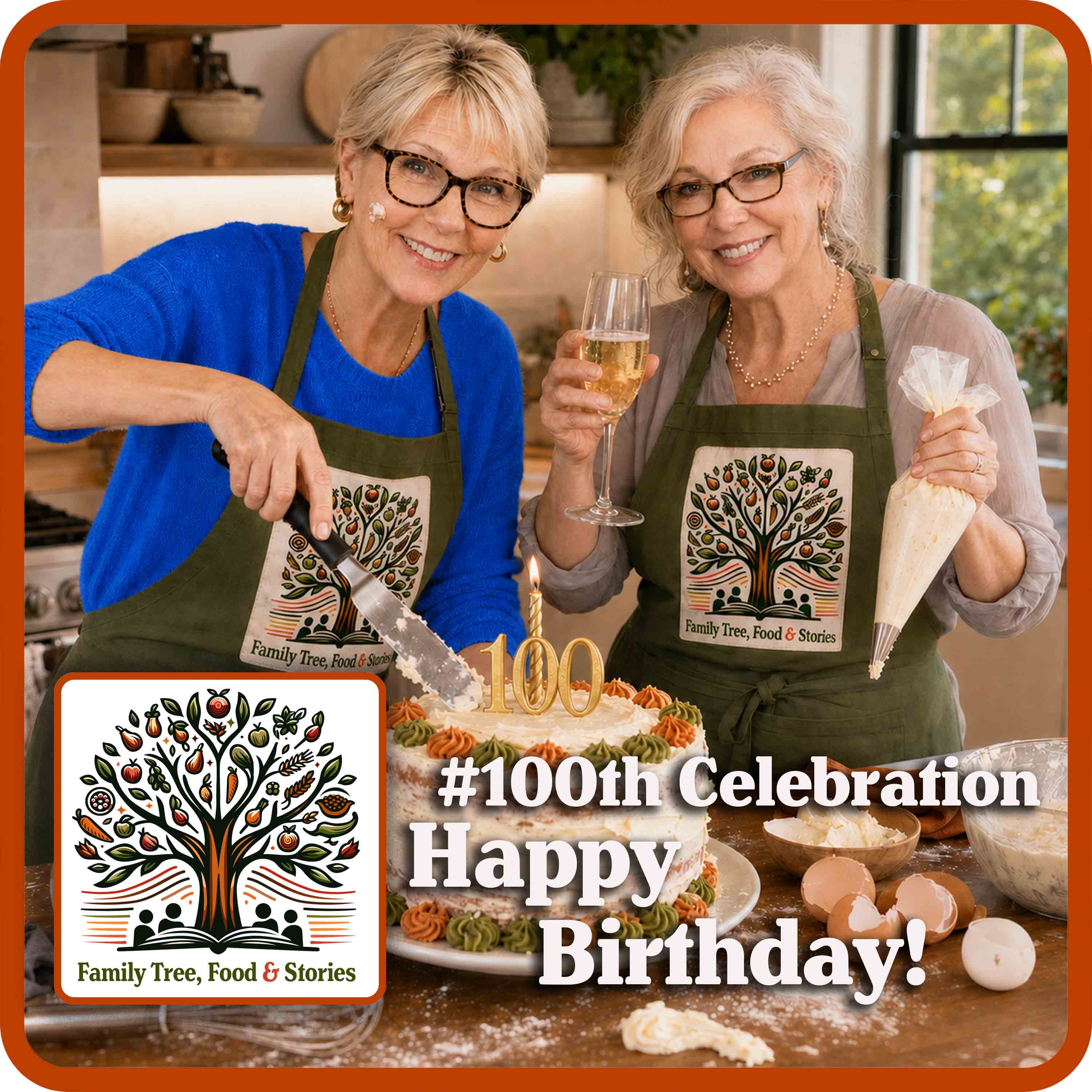
Family Food Stories · Nancy May & Sylvia France
Birthday candles aren't Greek. They're German, and they were meant to scare off demons. Plus: the $50M fight over the Happy Birthday song. Who won? Birthday candles didn't start with the ancient Greeks and a moon goddess, although many believe that. That's honestly pure "forklore" as we call it, with no historical record. The real origin is 18th-century Germany's Kinderfest, where families lit one candle for each year of a child's life, plus an extra "Lebenslicht" (light of life), and kept them burning all day to protect their kids from harm. In this 100th-episode celebration of Family Food Stories, Nancy May and Sylvia France trace how that German ritual became the modern American birthday cake, why "Happy Birthday to You" was privately copyrighted for 80 years until a 2015 lawsuit revealed the company never actually owned the lyrics. Then dive into why a 1950s marketing psychologist convinced Betty Crocker to make instant cake mix harder to bake instead of easier. Along the way, they cover how other cultures mark a birthday, Korean seaweed soup, Chinese longevity noodles and peach buns, and why so many of those traditions honor the mother instead of the person turning a year older. This is a real milestone Family Food Stories episode built around a simple idea: the cake was never really about the cake. 5 Key Lessons Learned 1. Birthday candles are German. The real story is connected to the German Kinderfest, first recorded in 1746, where a candle for each year plus one extra "to grow on" was meant to guard a child from evil spirits until sunset. 2. "Happy Birthday to You" was under private copyright until 2015. Two kindergarten teachers in 1893 Louisville wrote it as a "good morning" song, not a birthday song. A publisher later claimed roughly $2 million a year in licensing fees. Then a 2015 lawsuit proved the company never owned the words, and Warner/Chappell settled for $14 million. Sadly, the teachers never got a dime. 3. The modern birthday cake is an industrial invention, not an ancient one. Sugar and white flour were once luxury goods reserved for the wealthy. Mass production dropped prices, making the frosted birthday cake a middle-class staple. The tradition most families think of is barely a century old. 4. The "crack a fresh egg" instruction on cake mix wasn't about better cake. In the 1950s, Betty Crocker's fully powdered mix sold poorly, so a psychologist found that home bakers felt guilty. Why? Because it didn't feel like they'd made anything. Switching to a fresh egg and requiring one restored the feeling of effort, and sales took off, even though food historians note the fresh egg also just tasted better. 5. Not every culture celebrates the birthday person. In Korea, the tradition is seaweed soup — because on the day you were born, you eat what your mother ate, honoring her instead of you. Vietnam and China carry versions of the same instinct. It reframes the entire holiday: the day was never really about the person turning a...
0:05Nancy May: Hey everybody, I'm Nancy May and this is Family Food Stories
0:08where every dish has a little bit of history and every kitchen, yes, has a
0:12secret, and we know you've got one too
0:16Sylvia France: Oh, it's probably in the back of the refrigerator somewhere.
0:19Nancy May: Molding.
0:20Sylvia France: No, no, no, no, no.
0:22it's fermenting.
0:23It doesn't mold I'm Sylvia Franz, and this is episode 100
0:28Nancy May: 100.
0:29Can you believe it?
0:30But before we start, our 100th episode ask, would you go to
0:35Podcast.FamilyTreeFoodStories and share this episode with
0:39somebody that you care about?
0:40Because it can be your gift to them, and it's our gift from us to you, too.
0:45I wanna open this show with a question that I've never even