
Failure Is Freedom · https://www.martinessig.com
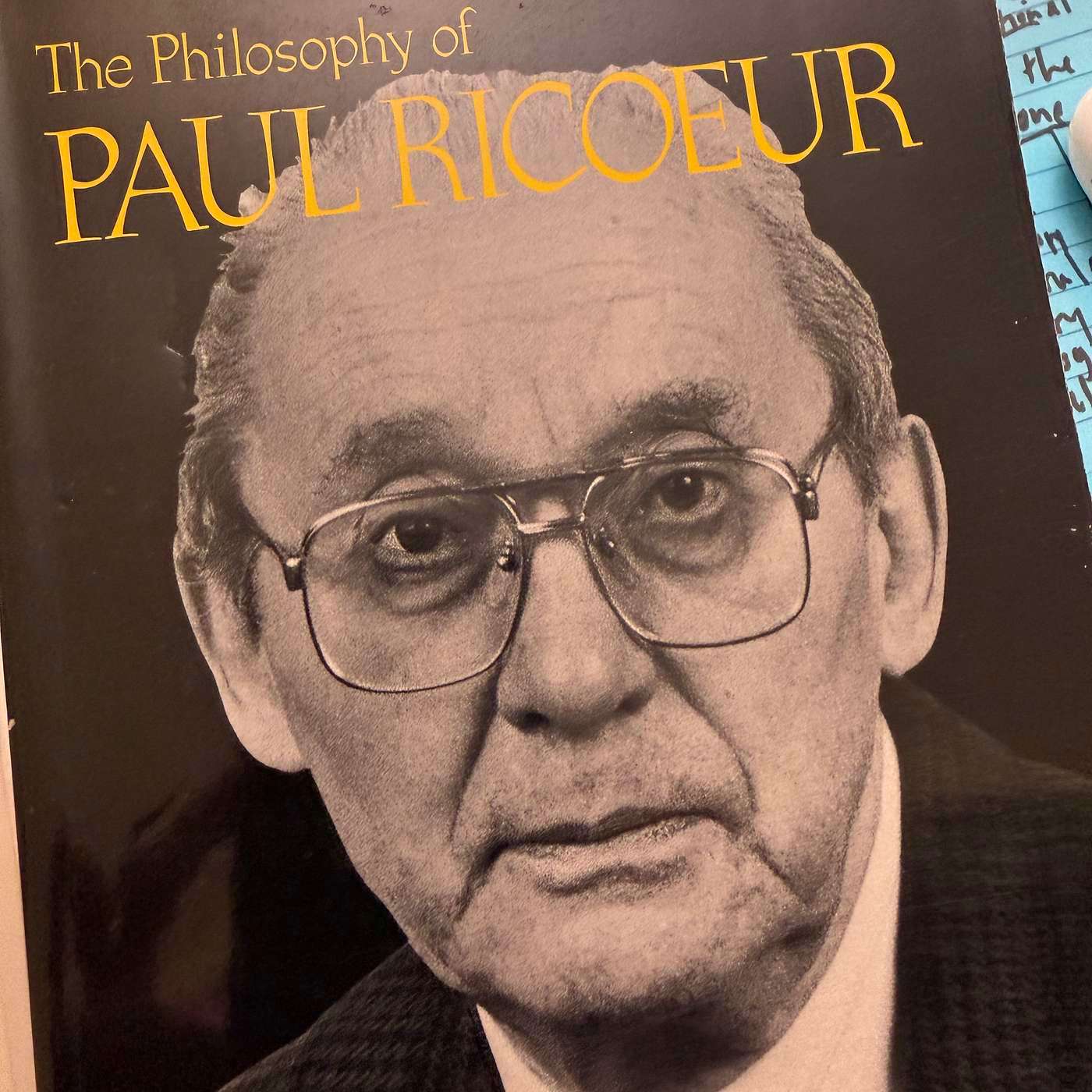
It may be helpful to map some Peircean semiotic concepts onto Ricoeur’s hermeneutics to see how they illuminate each other. Ricoeur doesn’t use Peirce in this way himself, but he certainly used much of the semiotic work that built upon CS Peirce’s initial contributions to the field. Peirce adumbrates three types of signs: the icon, which relates the sign to the signifier via resemblance, the index via material causality, and the symbol via convention, each of which contains various degrees of freedom relative to the degrees of determination of each’s Peircean “Interpretant.” Peirce formulated the relation of the sign to its signified as a triad that included what he called the “Interpretant,” which was the intermediation of semantic meaning within the semiotic relation of seeing one thing (the signified) in terms of another (the sign). The sign did not directly present the signified in an unmediated way but through a concept, which for Peirce was the Interpretant in the intention of the interpreter. Paul Ricoeur also formulated semantic meaning in terms of the relative degrees of freedom given to the intention of the interpretant, which for Ricouer was the hermeneutic circle of interpretation itself. The signifier determines its signified incompletely, which leaves room for possible interpretations in the gap between them. The irreducible ambiguity of this gap is generative because new semantics and new concepts can be formed in the clash of interpretations within the conceptual mediation of the intention of the interpretant, which mirrors Ricoeur’s depiction of a metaphor as a clash of meanings that poetically renewed and increased being within the degrees of freedom given by the virtuality of the imagination. The more distantiated the relation between the signifier and its signified, which was the relative level of abstraction of the interpretant, the more degrees of freedom contained in the possibility space actuated by the relation. Even semantic possibility spaces that seemed mostly determined, such as the indexical relation of cause and effect, can be reopened to reinterpretation, or reimagination, through the clash of possible interpretations given by the interpretant of the metaphor. One of Ricoeur’s favorite examples is GM Hopkins’ metaphorical predication, “The mind contains mountains,” which clearly contains sublime degrees of freedom for the poetic imaginations of a community of interpreters. For Ricoeur, as for Giles Deleuze, imaginal virtuality was actual and as ontologically real as a physically actualized possibility space, just as a conceptual realization in this actual possibility space was as ontologically real as a physical realization. Finally, CS Peirce’s “Hypostatic Abstract” has many illuminating overlaps with Ricoeur’s notion of semantic realization in the poetic imagination to be covered in the next episode. https://www.martinessig.com I mix the mixtapes that I post here but..., Baddass vibes mixed by James Reeves of...
0:16SPEAKER_01Welcome back to Failure is Freedom.
0:18SPEAKER_02Today we're going to be thinking about the thought of Paul Riccour via the thought of Charles Sanders Pierce, which is a useful mapping, maybe only for me, but I think it will be for others as well, because I tend to understand everything through Pierce when I'm thinking about semiotics.
0:39SPEAKER_02So just to kind of map out where we are again, we're talking about a shift from phenomenology, in particular Husserlian phenomenology, to the hermeneutic techniques of Paul Record.
0:55SPEAKER_02One way to think about this shift is that what Husserl was seeking after was what he called an idetic reduction, so that you reduce all your presuppositions for whatever observation you're undertaking, so that whatever the object of your observation is, it can show itself from itself, so that it can appear from its own ground, so to speak, and not appear according to the projections of your intentions or according to your ideas or concepts or theories about things.
1:34SPEAKER_02In science, this is called the theory ladeness problem of observation or the observer effect.
1:42SPEAKER_02These are all things where we get in the way of our own observation so that we're kind of just seeing a projection of our own uh intention, of our own self uh onto some you know screen, um, but we're not seeing, you know, something that is truly other than ourselves.
2:01SPEAKER_02We're not uh in actual dialogue with uh the other.
2:05SPEAKER_02We are simply in um dialogue with ourselves, so to speak.
2:10SPEAKER_02Kant was really the first one to break this down in terms of the distinction between uh phenomena, which are a projection of our a priori intuitive uh categories, so that the world that we see is organized according to the perceptual categories by which we have to see it.
2:33SPEAKER_02So uh even our most basic percepts are not like the raw numeral things in themselves, as Kant would put it, uh, but rather they are mediated through the uh perceptual apparatuses uh of our sensory um organs, our sensory systems, bodily sensory systems, according to the categories necessary for any sort of perception.
2:59SPEAKER_02So not just particular to our perceptual bodies, but to any possible perception, so that you need to have a category of quantity, a category of quality, a category of relation, and a category of modality uh in any possible perceptual uh apparatus, which would sort of bar access to whatever it was uh that was before our perceiving it.
3:27SPEAKER_02Um, so that you kind of have to start, at least for us, for the first person observer, which is our only access to whatever there is, uh, with a percept uh joined to another percept uh via a category or via a rule like quantity.
3:43SPEAKER_02And the most important of all the categories is relationality, because we have to see the world as having causes and effects, because that is how we see uh related events, related objects.
3:57SPEAKER_02And as Kant is showing, we can't see anything without a sense of how relations disclose uh what there is.
4:07SPEAKER_02Uh without putting into relation, without relatedness, there is no perception, and nothing can uh appear on the phenomenological screen of first person subjectivity.