
Evolutionary Insights by Anthropology.net · Anthropology.net
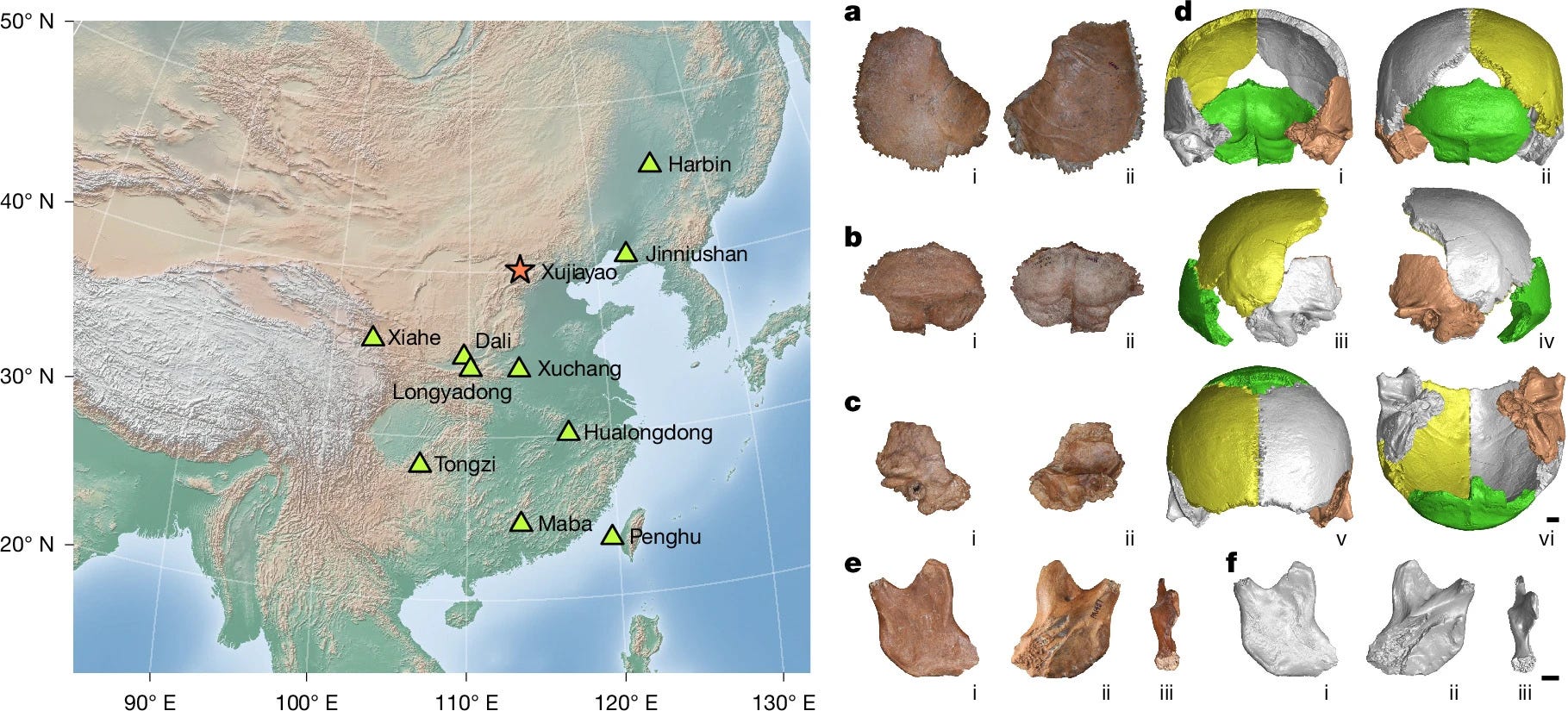
At position 996 of a collagen chain called COL1A2, the protein extracted from a right parietal bone from Xujiayao, a Middle Pleistocene site in the Nihewan Basin of northern China, carries lysine in 57 distinct peptides and arginine in one. The second Xujiayao specimen sampled, a mandibular ramus, gives 61 lysine-bearing peptides against a single arginine one. Every Denisovan with protein or genome data carries lysine at that position, while Neanderthals and modern humans carry arginine, and those two bones are the main reason the Xujiayao hominins are now being called Denisovan. Since the fossils came out of the ground between 1976 and 1979, Xujiayao has been filed as Homo sapiens neanderthalensis, as early H. sapiens, as archaic H. sapiens, and, to avoid the argument, as archaic Homo. Most recently it became the holotype of Homo juluensis, a species proposed partly on the 1,700 ml endocranial capacity of the Xujiayao 6 cranium (Wu et al., Journal of Human Evolution, 2022). If you follow East Asian Middle Pleistocene hominins, you probably carry a picture of Dali, Jinniushan and Hualongdong as archaic humans with unsettled names, and of Denisovans as a lineage known from a genome plus a few molecularly confirmed jaws and one cranium. The paper appeared in Nature on 21 October 2026. Song Xing, Zhongyou Wu, Qingfeng Shao and Junyi Ge are the equal-contribution first authors, and Qiaomei Fu of the Institute of Vertebrate Paleontology and Paleoanthropology in Beijing is the corresponding author. The team sampled two of the 20 Xujiayao cranial, mandibular and dental fossils, recovered 18 endogenous ancient proteins, and concluded that the assemblage belongs to a late Middle Pleistocene East Asian Denisovan population. They then compared skull and jaw anatomy across East Asian archaic Homo and argued that most of those fossils, Dali, Jinniushan and Hualongdong included, are Denisovan as well, and that the size gap behind H. juluensis is variation within one population. This post is about how much of that sweeping reclassification two bones and one amino acid can carry. How do researchers know the proteins are ancient? The sampling was minimal. The team CT-scanned both specimens first (37.56 μm resolution), then drilled a small hole in each in a dedicated clean room, shielding the surrounding bone with aluminium foil. They dissolved the powder, split the proteins into fractions, and digested them with trypsin, an enzyme that cuts proteins into short peptides. A mass spectrometer then reads the mass of each peptide fragment, which allows the amino acid sequence to be inferred. The runs were done in two independent laboratories, one at Capital Medical University and one at Fudan University, and the data were searched with two software packages, PEAKS Online and MaxQuant. Extraction blanks were processed alongside the samples, and a modern camel bone served as a positive control. The hard part with any ancient protein is separating the real thing from...
0:00SPEAKER_00Imagine a museum drawer.
0:01SPEAKER_00Like, really picture it.
0:04SPEAKER_00Maybe it's heavy industrial steel or,
0:06SPEAKER_00you know,
0:07SPEAKER_00old polished wood just sitting in this vast,
0:10SPEAKER_00incredibly quiet, climate-controlled archive in Beijing.
0:13SPEAKER_01Oh yeah, the kind of place where you can hear a pin drop.
0:16SPEAKER_00Exactly.
0:17SPEAKER_00And inside that specific drawer is a collection of fossilized human bones.
0:23SPEAKER_00Things that were dug up out of the dirt back in the 1970s.
0:25SPEAKER_00Right, over 50 years
0:26SPEAKER_01ago now.
0:28SPEAKER_00Yeah.
0:28SPEAKER_00And for decades, they have just been sitting there in the dark.
0:33SPEAKER_00But they haven't been resting peacefully because for half a century,