
Evolutionary Insights by Anthropology.net · Anthropology.net
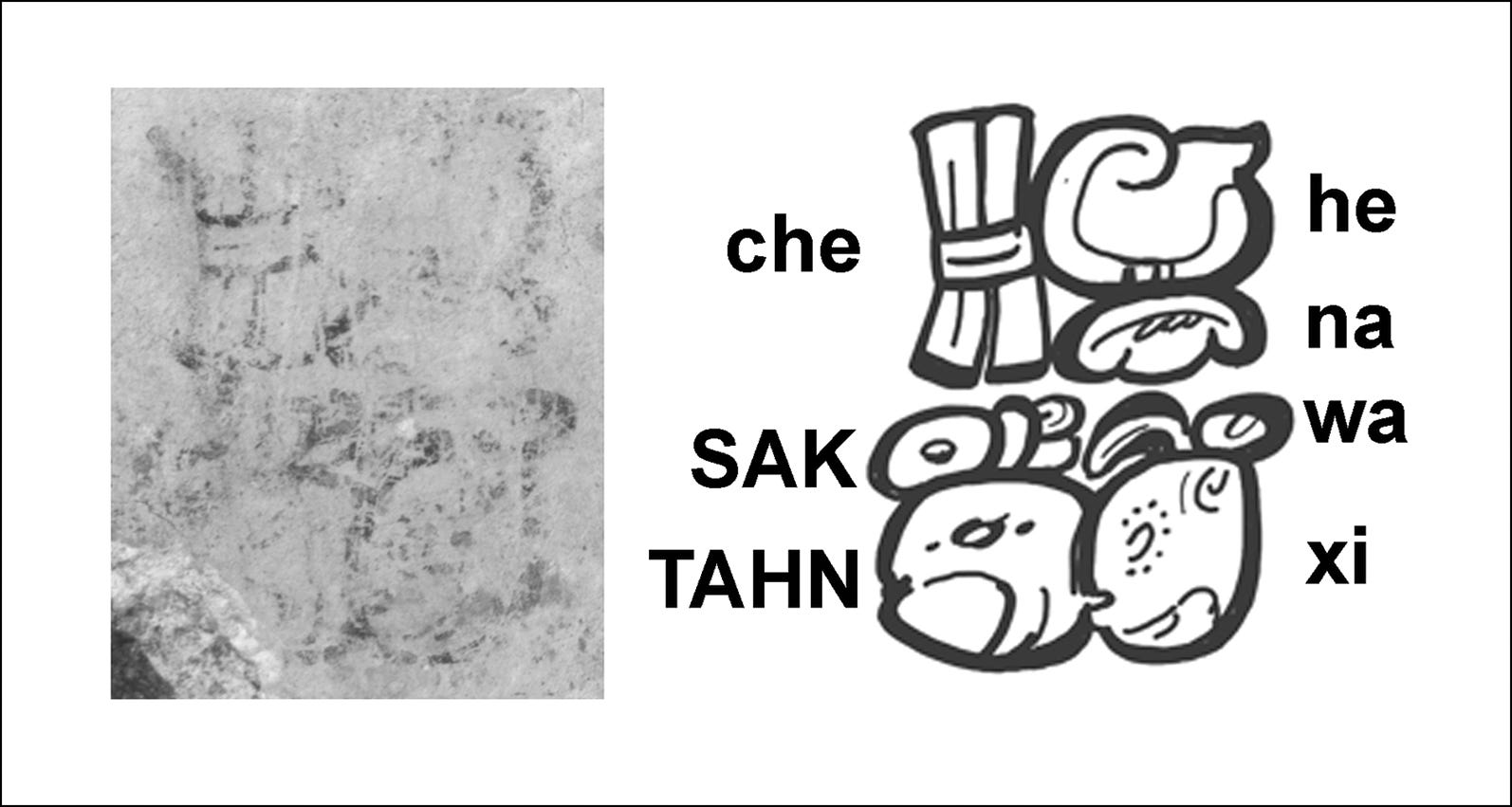
The glyphs sit at the bottom of an inverted L, tucked into the corner of a room that nobody was ever meant to admire. Nine hieroglyphs of mathematics, then two more that don’t belong to any calendar system at all. So says, the text reads, followed by a name: Sak Tahn Waax. White-chested Fox. That’s it. That’s the whole announcement. No royal titles, no cosmic parentage, no k’atun-ending fanfare. Just a scribe, somewhere around 781 CE, writing down a formula and then putting his name on it, the way anyone might sign a worksheet. Franco D. Rossi, David Stuart, and Heather Hurst, the team that deciphered the text, are calling it the first known instance of a Classic Maya mathematician-astronomer claiming credit for intellectual work. Not an artist. Not a sculptor. Someone who did the math. That distinction matters more than it might sound like it should. A room full of scratch paper Structure 10K-2 at Xultun, Guatemala, is a small masonry building that archaeologists opened in 2010 after it had spent roughly a millennium buried under fill. Its interior walls were painted with portraits of seated men bearing the title taaj, “obsidian,” a designation for ranked specialists. One wall shows the Xultun ruler Yax We’n Chan K’inich dressed as a maize deity with a scorpion’s tail. It’s a formal room, in other words, or it started as one. What happened next is the interesting part. Someone kept coming back and writing on it. Painting numbers over the portraits. Reusing patched plaster surfaces for fresh calculations. By the time the room went out of use, it held more than 50 discrete texts crowded into the northeast corner and along the east wall: a lunar table, columns of “super numbers” divisible by both the Mars and Venus cycles, a ring number, and dense little clusters of calendrical arithmetic that have almost nothing to do with the room’s original decorative program. Rossi, Stuart, and Hurst read this as a workspace, not a monument. The kind of place where someone was training in calendrical calculation, possibly while making bark-paper codex books, of which only four pre-Columbian examples survive anywhere, all centuries younger than this room and none of them archaeologically excavated. If that reading holds, 10K-2 is the closest thing we have to a Classic-period scriptorium caught mid-use, walls covered in the equivalent of scratch paper. Scratch paper, notably, tends not to get signed. Most of it doesn’t say who did the arithmetic. Text 19 does. Reading a formula that was never meant to be permanent Reconstructing it took more than a decade. The east wall’s plaster had suffered from root growth and water infiltration, and much of Text 19 survives only as faint pigment traces. The team layered flatbed scans, infrared photography, and dStretch-processed imaging to pull 11 glyph blocks out of a surface that, to the naked eye, mostly looks like eroded stone. What emerged is a sequence of five dates connected by four intervals, expressed in the...
0:00SPEAKER_01Imagine for a second that you are They're brushing away.
0:03SPEAKER_01Away centuries of damp soil and tree roots in the dense, incredibly humid jungle of Guatemala.
0:08SPEAKER_00Oh, and it is humid, like overwhelmingly humid.
0:11SPEAKER_01Right, exactly.
0:12SPEAKER_01So you're digging through all that and you uncover a wall,
0:14SPEAKER_01just an interior wall of a small buried room that has been completely sealed off
0:18SPEAKER_01from the world for over 1,200 years.
0:21SPEAKER_00A literal time capsule.
0:22SPEAKER_01Yeah, a time capsule.
0:23SPEAKER_01But on this wall, faintly visible through the dirt, you don't find...
0:27SPEAKER_01And, you know.
0:28SPEAKER_01Know, a grand proclamation of a king conquering a rival city.
0:32SPEAKER_00Right.
0:32SPEAKER_00Or a stylized depiction of God's demanding tribute, which is usually what you'd expect.
0:36SPEAKER_01Exactly.