
Evolutionary Insights by Anthropology.net · Anthropology.net
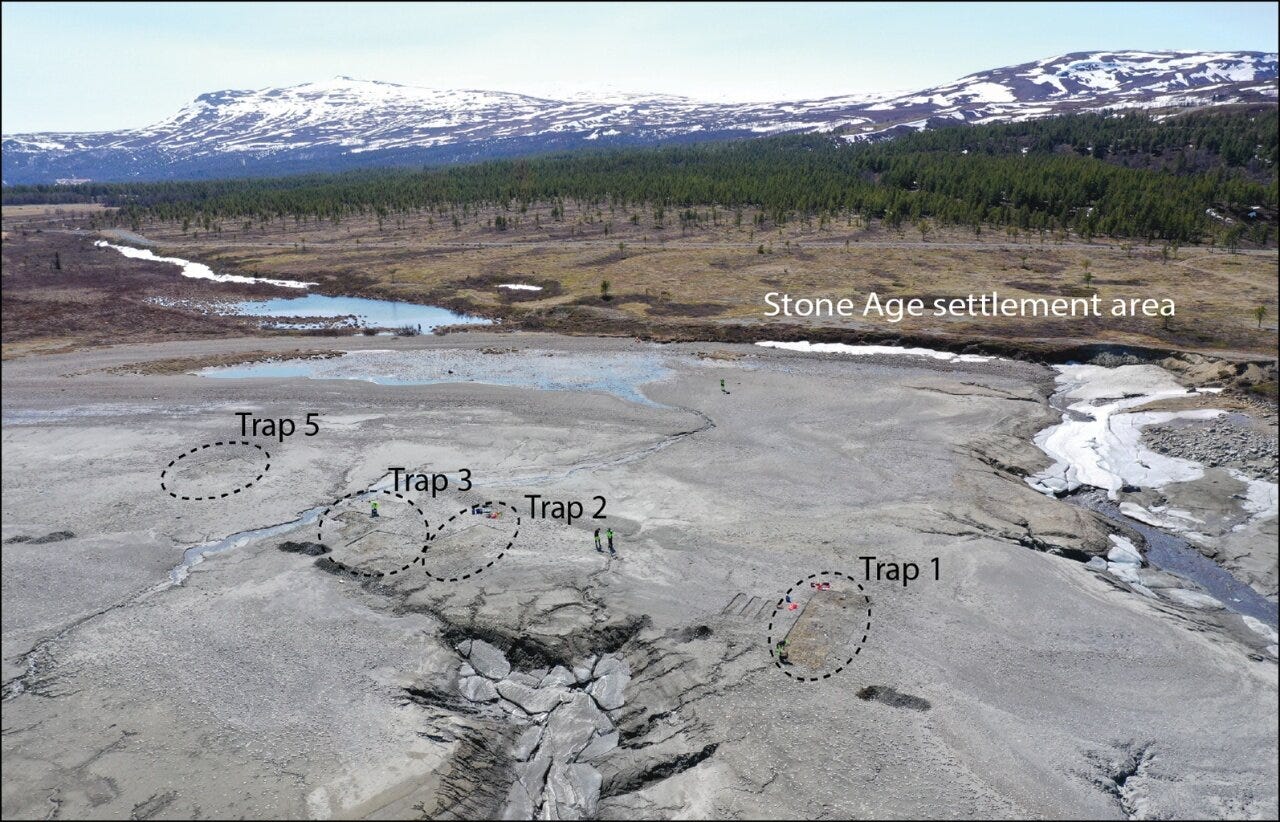
A drained lakebed in the mountains of Jotunheimen doesn’t look like much: gray silt, exposed stone, the odd meltwater channel cutting through it. But in 2022, when the water level at Lake Tesse dropped for its usual spring maintenance, someone walking the exposed mud spotted wood poking out of the ground. Not driftwood. Poles. Dozens of them, still standing upright where they’d been driven into the lakebed, arranged in a tight circular chamber with a fence of angled supports leading into it. A fish trap. That alone wouldn’t be remarkable. People have been building lattice-wall fish traps in Scandinavia for millennia, and the type is well documented from wetland sites across northwestern Europe going back to around 4000 BC. What made this one strange was the radiocarbon date. The trap was closer to 4950 BC. And it sat in a lake that, by every reconstruction of the region’s glacial and hydrological history, should not have had fish in it at all. A landscape with a locked door Lake Tesse sits at 854 meters above sea level in the central Norwegian mountains, fed and drained by a river system that eventually reaches the Oslofjord. The ice sheet that covered this terrain for most of the last glacial period didn’t finish retreating from the area until around 8400 BC. Once it did, the landscape opened up fast, both to colonizing plants and animals and to the hunter-fisher-gatherer groups moving in from the coasts. Fish followed too, but only where they could. In the lowlands, trout, pike, and a couple dozen other species swam upstream from the sea and from the shrinking freshwater and brackish remnants of the Baltic as relative sea levels dropped through the Early Holocene. Above a certain elevation, that migration hit a wall. Literally: waterfalls and steep gradients along the Tessa River made it physically impossible for fish to swim up into Lake Tesse from the watercourses below. Historically, the lower stretches of that same river system supported around twenty-five species. The upper stretches, cut off by the falls, supported exactly one: brown trout. Not because brown trout were better adapted to alpine conditions than everything else. Because brown trout were the only species that ever got up there, and they didn’t get up there on their own. That’s the setup the new paper, published in Antiquity by Axel Mjærum and colleagues at the University of Oslo, is working with. If fish couldn’t climb the falls, and Lake Tesse had fish anyway, something else put them there. The obvious candidate, in a lake that’s been renowned since the twentieth century as one of Norway’s most productive trout fisheries (it once yielded close to nine tonnes of fish a year before it was dammed for hydro-power in the 1940s), is people. The trap dating just pushes back how far that “something else” goes. Considerably. What the poles actually show The excavation recovered four traps in total, with 73 individual poles subjected to dendrological and radiocarbon analysis. The...
0:00SPEAKER_00So I want you to just take a second and imagine standing at the edge
0:03SPEAKER_00of this completely pristine mountain lake.
0:06SPEAKER_01Oh, that sounds pretty nice right about now.
0:08SPEAKER_00Right.
0:08SPEAKER_00It's gorgeous.
0:10SPEAKER_00The air is super thin.
0:11SPEAKER_00It's crisp.
0:12SPEAKER_00The water is just totally transparent.
0:14SPEAKER_00And you're standing exactly 854 meters above sea level
0:19SPEAKER_00in these really rugged mountains in Norway.
0:21SPEAKER_01That is a serious hike.
0:22SPEAKER_00It is.
0:23SPEAKER_00And the time is...
0:25SPEAKER_00Roughly 8,000 or 9,000 years ago.
0:28SPEAKER_00So this is not long after the massive glaciers of the last ice age have finally melted away.