
Evolutionary Insights by Anthropology.net · Anthropology.net
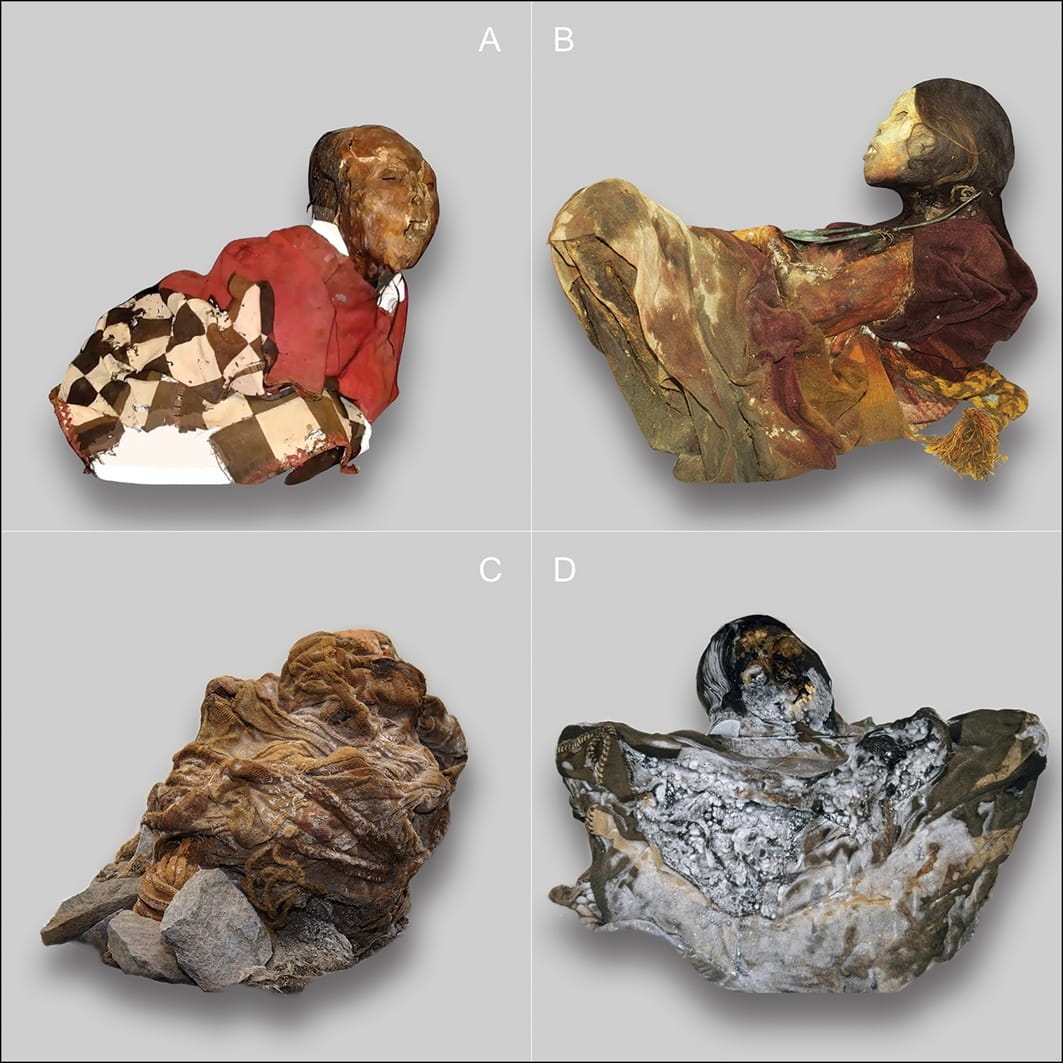
The last centimeter of hair from a girl of about eight, buried on the volcano Chuscha in Argentina during the Inca Empire, holds a chemical missing from the five centimeters grown before it. That chemical is cocaethylene, which the liver makes when cocaine and alcohol are in the blood together. Its arrival suggests that in roughly the final month of her life this child was drinking heavily while taking coca. Earlier tests on the same mummy found no cocaine at all. The result comes from new drug testing on Inca mummies, and it complicates a picture many readers carry of the capacocha, the rite in which the Incas sacrificed children and young women to serve as messengers to the gods. The colonial chronicles read almost like a recipe, with chicha (maize beer) to calm the child and crushed coca placed in the mouth before the killing. From there it is easy to assume one state ritual with one drug routine. This paper supports part of that picture and raises doubts about the rest, though less firmly than its press release suggests. What drugs were found in the Inca mummies? Dagmara Socha of the University of Warsaw, Marzena Sykutera of Nicolaus Copernicus University in Toruń and six colleagues report in Antiquity that coca markers turned up in all six hair samples they tested and the alcohol marker in four of those six. Harmine, an alkaloid linked to ayahuasca, appeared in one nail from one person. They searched for ten compounds in eight individuals from five volcanoes in Peru and Argentina. None of the eight showed harmaline, mescaline (from San Pedro cactus), N,N-DMT or bufotenine (from Anadenanthera and Virola), or scopolamine or atropine (from Brugmansia and Datura). Two of the eight came from Ampato in Peru: Ampato #1, a girl of 14 known as the Ampato Maiden (the press release calls her the Lady of Ampato, or Juanita), and Ampato #4, a girl of about 10. Sara Sara, also in Peru, gave a girl of about 14. In Argentina, Chuscha gave the girl of about eight, Quehuar a girl of about 10, and Llullaillaco three children: the Doncella, about 14; the Younger Girl, about six; and the Boy, seven. The main text gives no date for any of them, only the span of the Inca Empire, from the late thirteenth century to 1572 CE. The method depends on keratin, the protein in hair and nails, which traps compounds circulating in the body. Hair grows outward from the scalp, with each centimeter standing for about a month, so a strand can be read as a rough timeline. Nails can’t, because compounds enter them by more than one route. The team washed each sample, then ran an extract through liquid chromatography-tandem mass spectrometry, which separates the compounds in a sample and identifies each by its mass and the fragments it breaks into. Results come in picograms per milligram (pg/mg), or trillionths of a gram in each thousandth of a gram of sample. The results span about four orders of magnitude. Cocaine measured 16,740 pg/mg in the Doncella, who was also found with a...
0:00SPEAKER_01I want you to imagine for just a second that you are standing at, well,
0:06SPEAKER_016,715 meters above sea level.
0:07SPEAKER_00Which is incredibly high.
0:08SPEAKER_01Right, it is.
0:09SPEAKER_01You are near the summit of this freezing wind-scoured Andean peak.
0:14SPEAKER_01The air is so incredibly thin, your lungs are just burning.
0:17SPEAKER_00Yeah, the cold up there is absolute.
0:19SPEAKER_01Exactly.
0:21SPEAKER_01And you are holding a message for a god.
0:24SPEAKER_00It is a profound image.
0:25SPEAKER_01It really is.
0:26SPEAKER_01And, you know, today is November 3rd, 2026.
0:29SPEAKER_01A massive embargo has just lifted on a study published in the journal Antiquity.
0:34SPEAKER_01And we finally have newly declassified toxicological data from 500-year-old Inca mummies.
0:41SPEAKER_00It is a remarkable piece of research, honestly.