
Evolutionary Insights by Anthropology.net · Anthropology.net
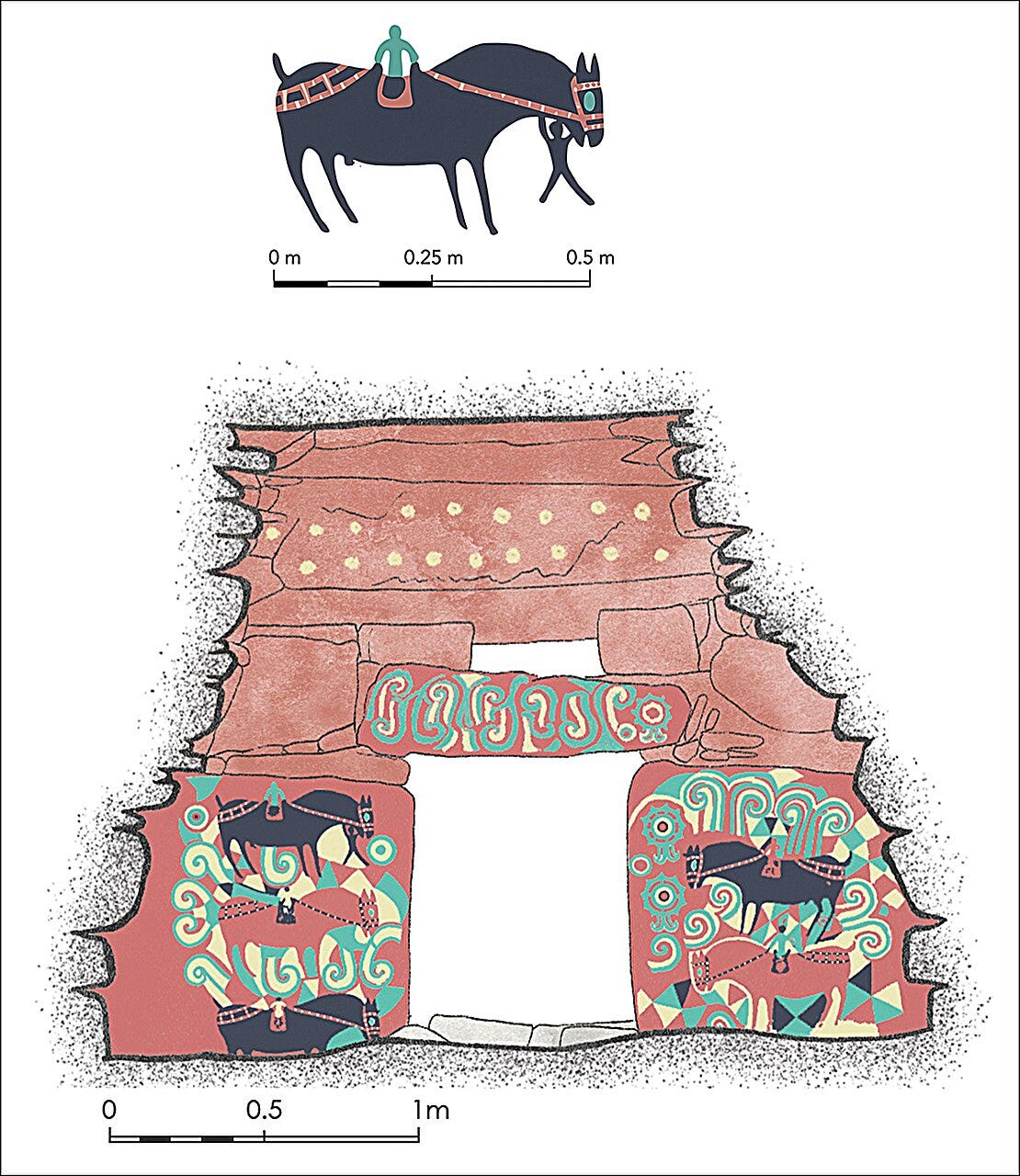
At the Ōzuka tomb, five horses parade across the stone gateway leading into the burial chamber. Their eyes are large and deliberate. Their harnesses are picked out in careful color. You can tell, from the way the artist rendered their bodies, which animals are male and which are female. Riding them are six human figures, and every one of them is a stick. No faces. No sex. One rider is drawn at roughly a quarter the size of his own horse. This wasn’t a failure of skill. The same hands that gave the horses anatomical precision chose, apparently on purpose, to leave the people blank. A new study by Claudia Zancan, published in Antiquity, argues that this wasn’t an isolated quirk of one tomb but a consistent regional pattern across the decorated tombs of Kyushu, Japan’s southernmost island, and that the pattern tells us something specific about how these communities thought about death. A Regional Style That Refused to Individualize Kyushu sits closest to the Korean Peninsula of any part of Japan, and during the sixth and seventh centuries it absorbed plenty of continental influence. Across the water, Koguryŏ tombs painted the dead as dominant, detailed figures towering over their servants and animals, exactly the kind of imagery you’d expect from an elite burial tradition that wanted to broadcast the status of the person inside. Kyushu had access to that visual vocabulary. It didn’t use it. Zancan’s study systematically catalogued anthropomorphic figures across 38 decorated tombs, 20 painted and 18 rock-cut, and found the same thing again and again: human figures rendered smaller than the objects around them, stripped of individualizing detail, and, in every single case in the sample, impossible to sex. Not one figure across the entire corpus shows primary or secondary sexual characteristics, even in tombs where the artists were clearly capable of that level of detail. Compare that to contemporary Kyushu funerary sculpture like sekijin stone figures or the haniwa of the Kanto region, both of which do occasionally mark sex and social role. The anonymity in the tomb paintings looks like a choice, not a limitation. This matters because the period itself was a moment of real transformation in Japanese mortuary practice. Older Kofun-period burials were sealed pits, built once and closed for good. The horizontal stone chambers that appear in the Late Kofun period could be reopened, over and over, for successive interments. A tomb stopped being a monument to one death and became a space for ongoing ritual. Zancan’s argument is that the imagery inside these chambers reflects that shift. If a tomb is going to be reopened for generations, its decoration doesn’t need to commemorate the specific person laid to rest last. It needs to do something else. Borrowing a classification system originally built for Iberian rock art, Zancan mapped where the human figures actually sit within the architecture of each tomb, and three locations kept recurring. On the...
0:00SPEAKER_01Imagine,
0:01SPEAKER_01just for a moment,
0:02SPEAKER_01that you are standing out in the humid,
0:04SPEAKER_01blindingly bright air of the Japanese countryside.
0:07SPEAKER_00Oh, yeah.
0:07SPEAKER_00The humidity there is no joke.
0:09SPEAKER_01Right.
0:09SPEAKER_01It's intense.
0:10SPEAKER_01It's summer.
0:11SPEAKER_01The cicadas are just screaming in the trees.
0:13SPEAKER_01The sun is beating down on the back of your neck.
0:16SPEAKER_01And you're standing in front of this narrow opening.
0:19SPEAKER_01And it's been carved directly into the side of an earth mound.
0:22SPEAKER_01Right.
0:23SPEAKER_01You take a breath, you duck your head, and you step inside.