
Evolutionary Insights by Anthropology.net · Anthropology.net
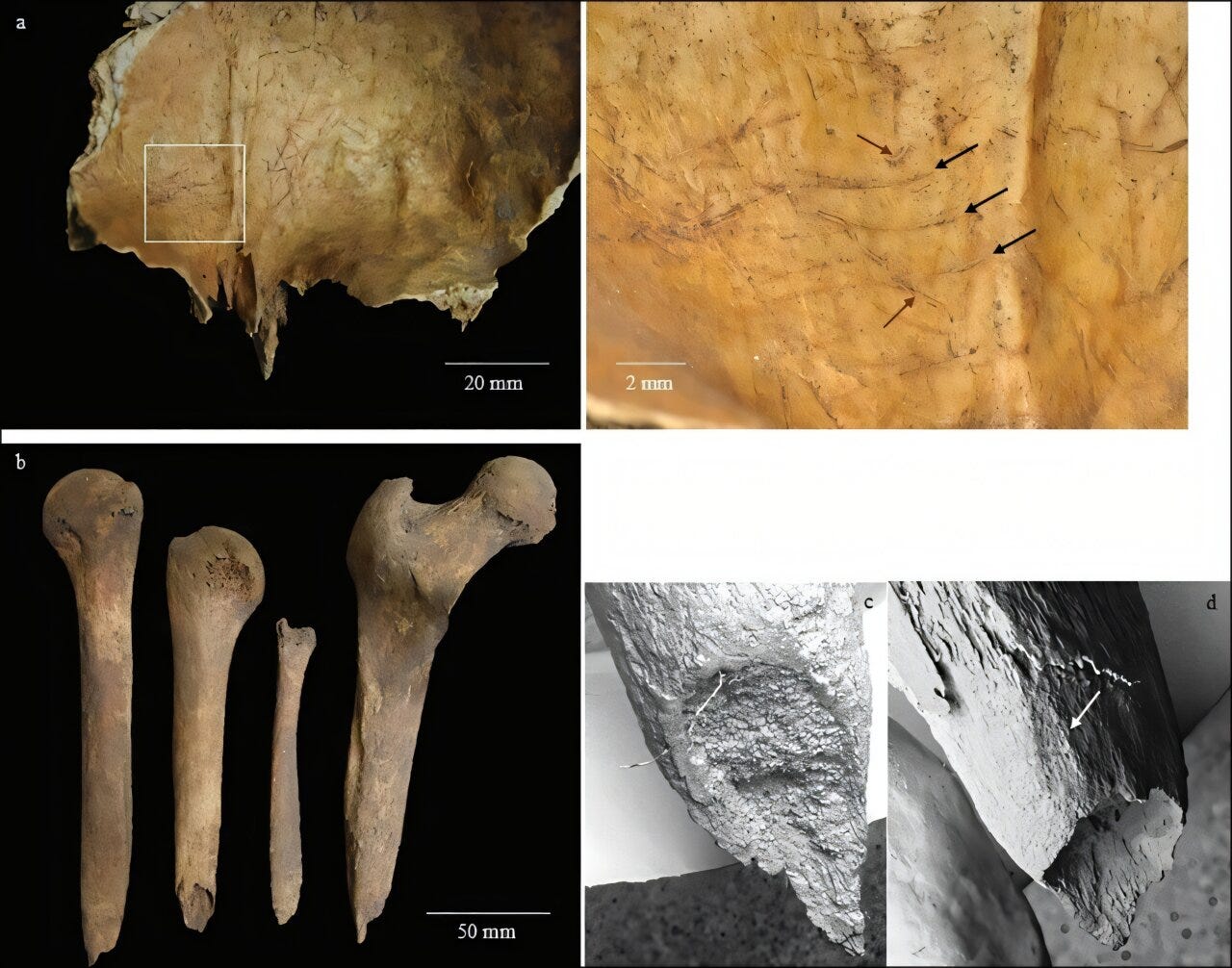
Sometime in the decades bracketing the turn of the millennium — after Julius Caesar’s expeditions to Britain but before the Roman legions reached Scotland — a woman’s body was taken apart. Her brain was removed. The base of her skull shows a fracture pattern inconsistent with any known accident: not a fall, not a collapse, not a drop from a height. The break radiates across the right occipital bone in a way the researchers who reanalyzed her remains describe as most consistent with an intentional targeted impact. Whether that blow came at or just before death is unclear. What happened next is somewhat easier to read. The interior surface of her frontal bone carries straight, parallel striations — fine incisions running across the inside of her skull, made with a sharp implement while the bone was fresh. Brain removal, probably shortly after death. Then her long bones were worked. Both humeri, the left ulna, the left femur: all present in the grave as fragments, roughly half their original length. They weren’t gnawed. The cut surfaces don’t match rodent activity. Instead, the cortical bone has been stripped back and the exposed inner material whittled to a sharp, pointed end. One femoral fragment shows something more: a flat, smoothed margin at the tip, as if the point had been pressed and worn against another surface. Use-wear, on a human thighbone. After all of this, every modified bone was laid back into anatomically correct position within a low stone cairn on the Durness Peninsula, at the far north-western edge of the Scottish mainland. Reassembled. Deliberate. The site is called Loch Borralie. The woman — Individual 1 in the published analysis by Laura Castells Navarro and colleagues at the University of York, published in Antiquity — was probably over thirty years old at death, most likely female based on ancient DNA. Beside her, slightly later in the stratigraphy, lay a juvenile of about fifteen. These are the only two bodies found in the cairn. A body between worlds One of the persistent puzzles of Iron Age Britain is that most people, archaeologically speaking, simply disappear. Formal cemeteries with tidy inhumations are rare; the period runs roughly from 800 BC to the Roman conquest in AD 43, and across most of that span and most of that geography, archaeologists struggle to find the dead at all. The favoured interpretation is that excarnation or exposure was common — bodies left to decompose, scatter, return to the landscape — leaving little trace. What survives tends to be stranger. Human remains turn up under house floors, in grain storage pits, at settlement boundaries. Not buried so much as incorporated. The dead, in this reading, remained active within the world of the living: their bones kept, circulated, modified, deployed. North-west Scotland and the Northern and Western Isles preserve the clearest evidence for this, partly because the environmental conditions are good for bone survival. Mummification has been identified at...
0:00SPEAKER_01I want you to just picture the far northwest of Scotland for a second.
0:03SPEAKER_01We are standing on the Durness Peninsula.
0:06SPEAKER_00Oh yeah, it is a truly wild place.
0:07SPEAKER_01Right.
0:08SPEAKER_01It's incredibly rugged.
0:09SPEAKER_01It's just completely windswept.
0:11SPEAKER_01The weather there, it doesn't just happen around you.
0:15SPEAKER_01It kind of actively fights you.
0:16SPEAKER_00Yeah, that's a good way to put it.
0:17You have this icy swell of the North Atlantic just crashing
0:21against these sheer cliffs.
0:23SPEAKER_01And then you have these
0:25Rolling stretches of this very specialized alkaline sand dune
0:29environment.
0:30SPEAKER_01It's known as Macher.