
Evolutionary Insights by Anthropology.net · Anthropology.net
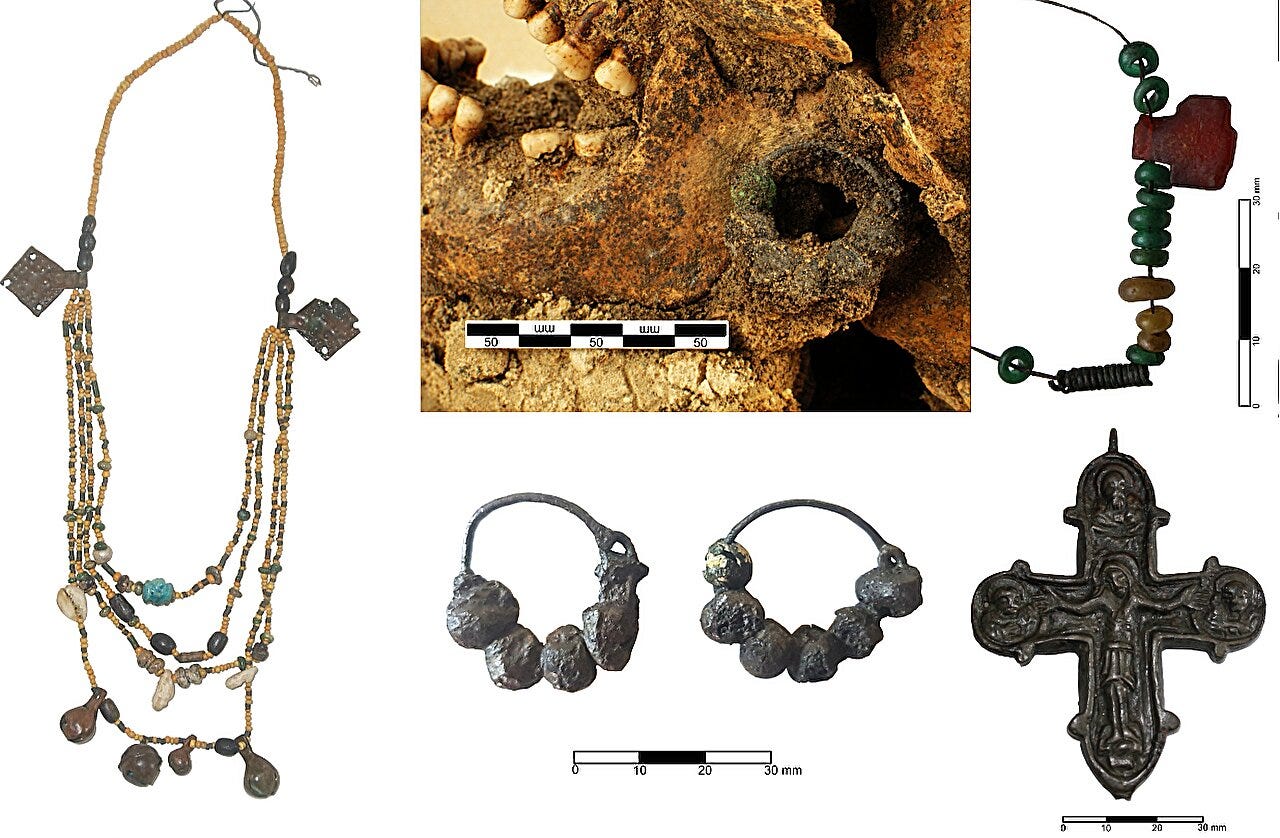
Grave 311 held an eighteen-year-old whose teeth didn’t match their bones. That mismatch is the whole story, so it’s worth sitting with it before anything else. A second molar forms in early childhood, between roughly three and eight years old, and once it’s mineralized it stays chemically frozen at that age forever. Bone collagen is different. It keeps remodeling throughout life, so it mostly records the years just before death. In this one skeleton, the two tissues told opposite stories. The dentine carried a strong signal of C4 plants, almost certainly millet, the kind of signature you’d expect from a diet common across parts of southeastern Europe. The bone collagen showed nothing of the sort, just the C3-dominated cereal diet, rye and buckwheat, typical of everyone else buried in medieval Vilnius. Strontium and oxygen values from the enamel pointed the same direction as the childhood carbon signal, away from the Vilnius region entirely, toward baselines more consistent with present-day Ukraine or southern Poland. Put plainly: this person grew up somewhere far to the south, moved to Vilnius sometime in adolescence, and adjusted their diet to match. They died there, buried according to strict Christian custom, with no grave goods at all. That’s a striking amount of individual biography to pull out of a skeleton. But the reason it matters goes beyond one traveler’s life story. Lithuania was, famously, the last pagan state in Europe. Grand Duke Jogaila didn’t formally adopt Catholicism until 1387. Before that, the standard picture is of a country still cremating its dead, still worshipping outside the Christian framework that had already swallowed the rest of the continent. Grave 311 belonged to a cemetery that shouldn’t, by that picture, have existed yet. The cemetery is on Bokšto Street in Vilnius’s old town, part of a district medieval chroniclers called the Civitas Ruthenica, the Ruthenian city. Archaeologists excavated more than 500 intact graves there over eight years, and the burial customs are unambiguously Christian: bodies laid supine, oriented east to west, cross pendants and enkolpions turning up in some graves, cremation entirely absent. Radiocarbon dating places the cemetery’s use across roughly 150 years, spanning the second half of the thirteenth century through the fourteenth, meaning this Orthodox Christian community was burying its dead in a formally pagan city for a century and a half before Catholicism ever arrived. That much was already known from the archaeology. Byzantine-style jewelry, the chaplets, the decorative headpieces made from ornaments stitched to leather and cloth, closely resembled fashions from Halych-Volhynia, a region of the former Kievan Rus’ now split between western Ukraine and southern Poland. The material culture argued for a connection. What it couldn’t do was prove that any given skeleton had actually made that journey rather than simply adopted the style secondhand. That’s the gap isotope analysis...
0:00SPEAKER_01I want you to imagine,
0:00SPEAKER_01just for a second, the map of Europe back in the 13th and 14th centuries.
0:05SPEAKER_01Right, yeah.
0:06SPEAKER_01Just picture the borders in your head,
0:07SPEAKER_01because by this point,
0:09SPEAKER_01practically the entire continent has been swept by Christianity.
0:13SPEAKER_00Oh, really?
0:14SPEAKER_01You've got these powerful kings,
0:15SPEAKER_01these massive sprawling empires,
0:17SPEAKER_01the huge stone cathedrals stretching up toward the sky.
0:21SPEAKER_01And it looks like this monolithic block of, well,
0:24SPEAKER_01of shared religion and culture,
0:27SPEAKER_01except for one famous,
0:29SPEAKER_01incredibly stubborn holdout right in the middle of the Baltic region.
0:32SPEAKER_00Lithuania.