
Evolutionary Insights by Anthropology.net · Anthropology.net
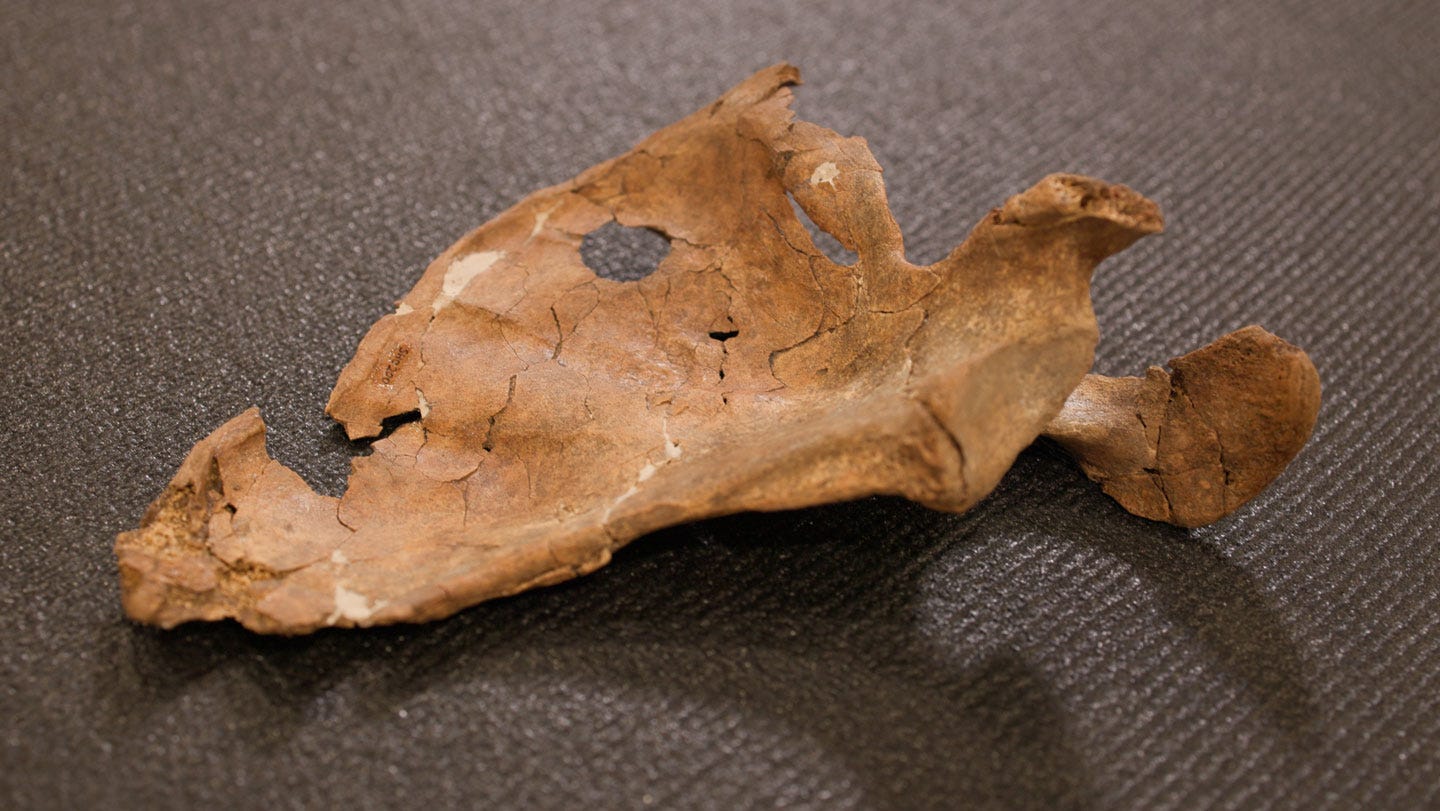
Seven and a half meters down in Shanidar Cave, in the Zagros Mountains of Iraqi Kurdistan, the left shoulder blade, or scapula, of a Neanderthal had lain for some 75,000 years with a hole through it. The bone was too soft to pick up. The excavators soaked it where it lay with an acrylic consolidant, Paraloid B72 dissolved in acetone, backed it with cotton gauze, and cut it out of the ground inside a block of its own sediment; it had come through nearly whole, which is rare for a bone so thin in places that it is almost translucent. The hole sits low on the back of the blade, in the broad hollow anatomists call the infraspinous fossa. It is about 15 millimeters across and very nearly a perfect circle, and at least three hairline cracks run out from its rim. “It’s so round, it’s like, what is it?” That was Emma Pomeroy’s first thought, she told Science News. Pomeroy, a biological anthropologist at the University of Cambridge, is lead author of a study published October 15 in Scientific Reports that describes these bones, dug up in 2019 and 2022, and the person they belonged to, a Neanderthal the team calls Shanidar A. Anyone raised on the phrase Stone Age pictures a killing in this period done with stone, a flake of flint knapped to a point and bound to a shaft. Neanderthals did use weapons like that, but a hafted stone point leaves a different mark. When archaeologists drive replica stone points into carcasses, the wounds come out oval or lozenge-shaped, sometimes a narrow slot, following the flattened section of the blade, whereas a sharpened wooden shaft, round in section, leaves a circle. Shanidar has encouraged the stone picture before. A man excavated there in the 1950s, known as Shanidar 3, has a narrow puncture in his left ninth rib, and in 2009 Steven Churchill, an evolutionary anthropologist at Duke University, and his colleagues tried to reproduce it by driving replica Mousterian and Levallois points into the chests of pig carcasses, using a calibrated crossbow to control the energy of each strike. They judged the wound most consistent with a light, stone-tipped projectile and, because early modern humans were in western Asia at around that time and may already have had throwing weapons, raised the possibility that one of them threw it. The rib had started to heal, so Shanidar 3, who died roughly 50,000 years ago, some 25,000 years after Shanidar A, seems to have lived for weeks after he was hit. The older bone points to a different weapon. The University of Cambridge’s announcement presents the new hole as possibly the first evidence that sharpened wooden spears were used anywhere in the prehistoric Middle East, and possibly the earliest example in the hominin fossil record of lethal violence between individuals with a wooden spear, a second claim the paper itself stops short of. On October 7, in Science Advances, Palmira Saladié and colleagues at the Catalan Institute of Human Paleoecology and Social Evolution described 597 pieces...
0:00SPEAKER_00So have you ever found yourself just completely, utterly captivated by a cold case?
0:06SPEAKER_01Oh, absolutely.
0:07SPEAKER_00Right.
0:07SPEAKER_00Like, you know the feeling.
0:08SPEAKER_00You're looking at the scattered evidence,
0:10SPEAKER_00you're staring at forensic photos,
0:12SPEAKER_00and you're just trying to piece together the final moments of a life.
0:14SPEAKER_01Yeah.
0:15SPEAKER_01You want to know the victim, the weapon, the motive, the whole timeline of how it went down.
0:20SPEAKER_00Exactly.
0:21SPEAKER_00And usually when we talk about this stuff,
0:22SPEAKER_00we are looking at cases that are, well, maybe a few decades old.
0:26SPEAKER_00Or maybe a century if you're looking at something historical like Jack the Ripper.
0:30SPEAKER_01Sure.
0:30SPEAKER_01Those are the classics.