
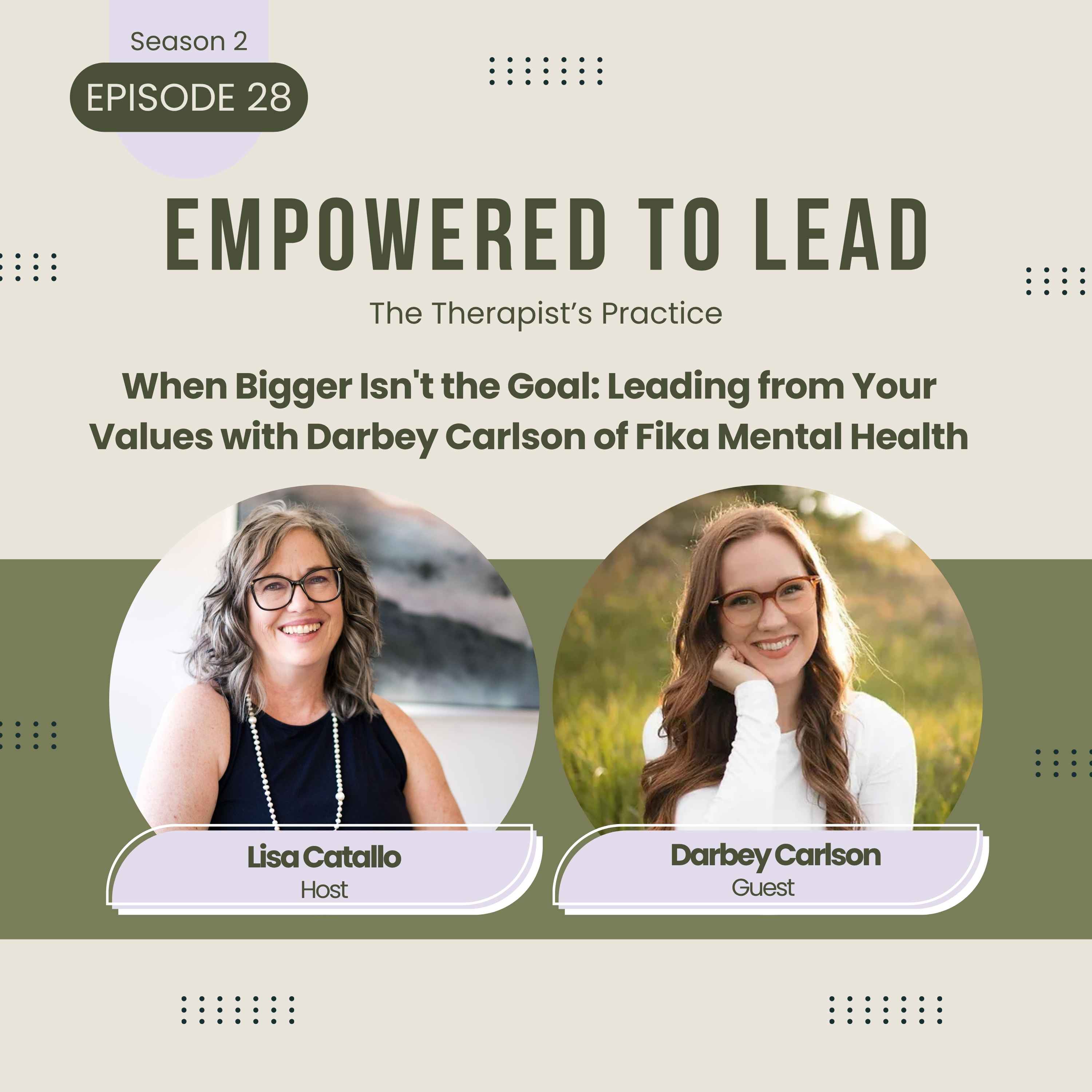
Empowered to Lead · Lisa Catallo
Not every growth story ends with growing. Darbey Carlson of Fika Mental Health shares how her practice expanded to seventeen people almost entirely by accident, the moment she paused to ask how it all actually felt, and why choosing to slow down can be the most values-aligned decision a group practice owner makes. What You’ll Hear: How a practice can grow to 17 people almost by accident, and the moment that finally prompts a pause The 10 to 12 therapist shift, where the culture changes and how to catch up to it Detaching from hustle culture and the quiet belief that you are always supposed to want more Being told she was too available, and what guarding your energy actually protects Why naming your why and your values keeps your decisions from running on autopilot Resources Mentioned on this Episode - Fika Mental Health on Instagram: @fikamentalhealth - Fika Mental Health website: www.fikamentalhealth.com - GPO Network, the free Facebook group for Canadian group practice owners: Join here - Group Practice Connection membership: Join here Featured Guest: Darbey Carlson I’m a Registered Psychotherapist and Yoga Teacher who blends mind body approaches through additional training and experience in EMDR, ADHD, trauma, somatic work, and attachment based therapy. I founded Fika Mental Health around the idea of intentionally carving out space to pause, reconnect, and care for ourselves through therapy and wellness. My work focuses on creating spaces where people can drop the mask, feel more grounded in their nervous systems, better understand their attachment patterns, and settle into their human experience with greater self understanding. Connect with Darbey: Website: www.fikamentalhealth.com Social Media: @fikamentalhealth Meet the Host: Lisa Catallo Lisa is a Canadian psychotherapist, group practice owner, and business coach with over eight years of experience leading a thriving, values-driven practice. She works with therapists who are ready to step into their role as confident, ethical, and intentional leaders—without burning out or getting buried in the day-to-day. Lisa’s coaching focuses on building sustainable group practices through efficient systems, effective leadership, and a deep respect for time and energy. Her approach is calm and encouraging, offering grounded guidance that helps therapists move from overwhelm to clarity—so they can lead with confidence and purpose. Whether she’s supporting someone just starting to grow a team or helping a seasoned leader reclaim their role as CEO, Lisa brings a blend of insight, structure, and heart to everything she does. When she’s not coaching or connecting with therapists, you’ll find her hanging out with her children and grandchildren, reading, walking by the water, or dreaming up new ways to make business feel a little lighter. Connect with the Host: Website: www.grouppracticenetwork.ca Instagram: instagram.com/grouppracticenetwork Facebook:...
0:05Lisa Catallo: You're listening to Empowered to Lead, the therapist practice. I'm Lisa Catallo, therapist, business coach, and your go-to for all things leadership and sustainable practice growth. This is your space for real talk, smart strategies, and grounded support to help you lead with confidence, work with intention, and build a business that actually works for you. Let's dive in.
0:32Welcome back to the Empowered to Lead podcast. I am so glad that you're here. I'm looking forward to the conversation that we're going to have today with Darbey Carlson. This summer we are spending time with real group practice owners. Not that I ever talked to fake ones, but just getting the story behind different people's experiences. And what I took was some of the pain points or some of the topics that I'm hearing group practice owners talk about, and let's spend the summer just really connecting and getting. How did you do this? Or here's somebody else's take on it. And so today we're talking to Darby, talking about different ways of growing your group practice and what her experience has been with that, so welcome, Darbey. I'm looking forward to our conversation today. I'm so glad that you took some time out of your schedule to share a bit of your story.
1:33Darbey Carlson: Yeah, thank you for having me. I'm super excited to be here. A little nervous, but I think that's also super normal. And yeah, happy to kind of talk about what my experience has been. Yeah, so I want to hear a little bit about your journey as a group practice owner. But always the first question that I ask is, how would you describe yourself as a leader? Yeah. So when I was thinking about this question, the first thing I did was actually ask some of the people on my team because I was like, I don't. I mean, I guess I lead myself, but I was curious to see what they would say. Because I think when I think about how I might describe myself, I really try to be someone who is values driven, and I really try to bring in like my own authenticity. And so when I was getting some of those messages back, those themes were really resonating, which was really huge for me. Just because I think it did reflect that the way that I'm trying to lead or kind of exist in the spaces where I'm like a participant in my practice was and has been coming through. So there was some words around authentic and human and patient, and it was just interesting to kind of see the relationships through the lens of the individuals that I do work alongside or have come to know. So I think just blending that a little bit. Any surprises as you went through that? I mean, I think it's maybe not giving myself enough credit sometimes because I'm kind of in that imposter syndrome space a little bit where I'm like, oh, like this is what I say I'm going to do. Am I doing it? So I think it was like a nice surprise and maybe like a little bit of a point of reflection as well, where I can give myself again like that. I said that credit of like, oh, you're doing a good job in the spaces that you're trying to exist within,
3:24Lisa Catallo: yeah. And when authenticity is one of your core values, to hear it related back to you, hey, like, oh, that yeah, that feels good.
3:36Darbey Carlson: I did share with my dad. He was like, look at these all these nice messages they got, and he was like, "Oh, you're going to be happy for like a week now, aren't you?
3:44Probably.
3:46Lisa Catallo: I when I did my practicum, our supervisor gave us a box to put cards in or notes from clients. This was before COVID, and everything is electronic, but you should print some of those off and put it into a box somewhere for some of the hard days to just get. I am good. Yeah, yeah. Gotta go back to and use as an anchor, like print it and put it on the wall in front of you. Yeah, I just imagine if you're having a difficult conversation, pointing C. Yeah, like actually, there's the evidence. Awesome. So tell me a little bit about your journey to starting a group practice and what it's been like to be an owner.
4:34Darbey Carlson: Yeah. So my journey, I feel like I describe it as a little bit non traditional, just in the sense that I didn't plan to be where I am. So when I was in solo practice, I found that I was just missing out on sharing space when it came to like learning with other people and getting to kind of maybe debrief or be more vulnerable. And so I started to notice that, and then. Found a couple individuals that I thought were really cool fits and just really connected with me, and so that started a few years ago. And then from there, I had someone ask like, "Oh, like, can you take a student on? And I was kind of just like, "Sure, why not? Because that's very much who I've been for a long time. I'm like, "Yeah, I could probably handle that. So things that look like opportunities to try something new or just again support somebody in something that they're trying to achieve, and then from there, most of our growth has been from students choosing to stay on, which is always like a really awesome compliment. But then I also kind of got into the space of going, okay, so like here is the next student onboarding, and then like I'll find two more, and like each season I'm bringing on more students, and I never really stopped to go. Okay, like there's a lot of people on our team. How is the ceiling for me? So we've grown to this point, and like everyone on our team is really awesome. Some of the growth also came from just noticing a couple different gaps in maybe how services are provided publicly as well, and wanting to create something that clients could connect with. We do have a couple other team members, like a dietitian and some nurse practitioners. But it's been this very like organic, gradual expansion that's happened. Yes, it's been really natural, but again, I've never been someone to sit down and like create a business plan or really connect with my numbers or have like growth goals or numbers-based goals. So I think like I've kind of joked in
6:34other spaces before where like other business owners might look at me and roll their eyes and I'm like, I don't know, I'm just here. But it's it's worked and like systems have developed as we've moved along, and and it's kind of that like pause and connecting with myself and going, okay, like how does this feel right now? Is this something that feels sustainable? And then trying to reorient to that, which is kind of where I am today. But yeah, just all that to be said. I got here and I didn't think too much about it, which is where I now am trying to do more of that,
7:07Lisa Catallo: Of thinking about it.
7:08Darbey Carlson: Yeah, that blueprint idea.
7:11Lisa Catallo: Okay, yeah, yeah. We were joking before we recorded that that's opposite of what I tell everybody. Yeah,
7:18Darbey Carlson: I am sorry in advance.
7:22Lisa Catallo: So people are probably wondering, like, how big is your group? Because you you said like you just keep adding people. Where are you at now?
7:30Darbey Carlson: Yeah, so we are 17. Yeah, it's a big group of us, and I've decided that with the onboarding that I've done more recently, I'm actually going to maybe slow down or pause my student program, so that would be pausing growth, which I'm really comfortable with, just because I find that the bigger the scaling goes, the less time that maybe I have to connect with pieces that really feel valuable to me, and really not wanting to lose that, so that could be something like like relationships and making sure that we're still like creating opportunities to learn and to train together or to connect. So really being people oriented in something that feels like again one of my values and balancing that because I think that that feels more important to me right now than, again, continuing to grow because then I really lose on lose out on what feels really rewarding, and then even like some of those connections that I was talking about, like being able to ask questions, like, hey, like how would you describe me as a leader? Where that might be something really vulnerable or requires some honesty, like always making sure that that is still something that we get to connect with.