
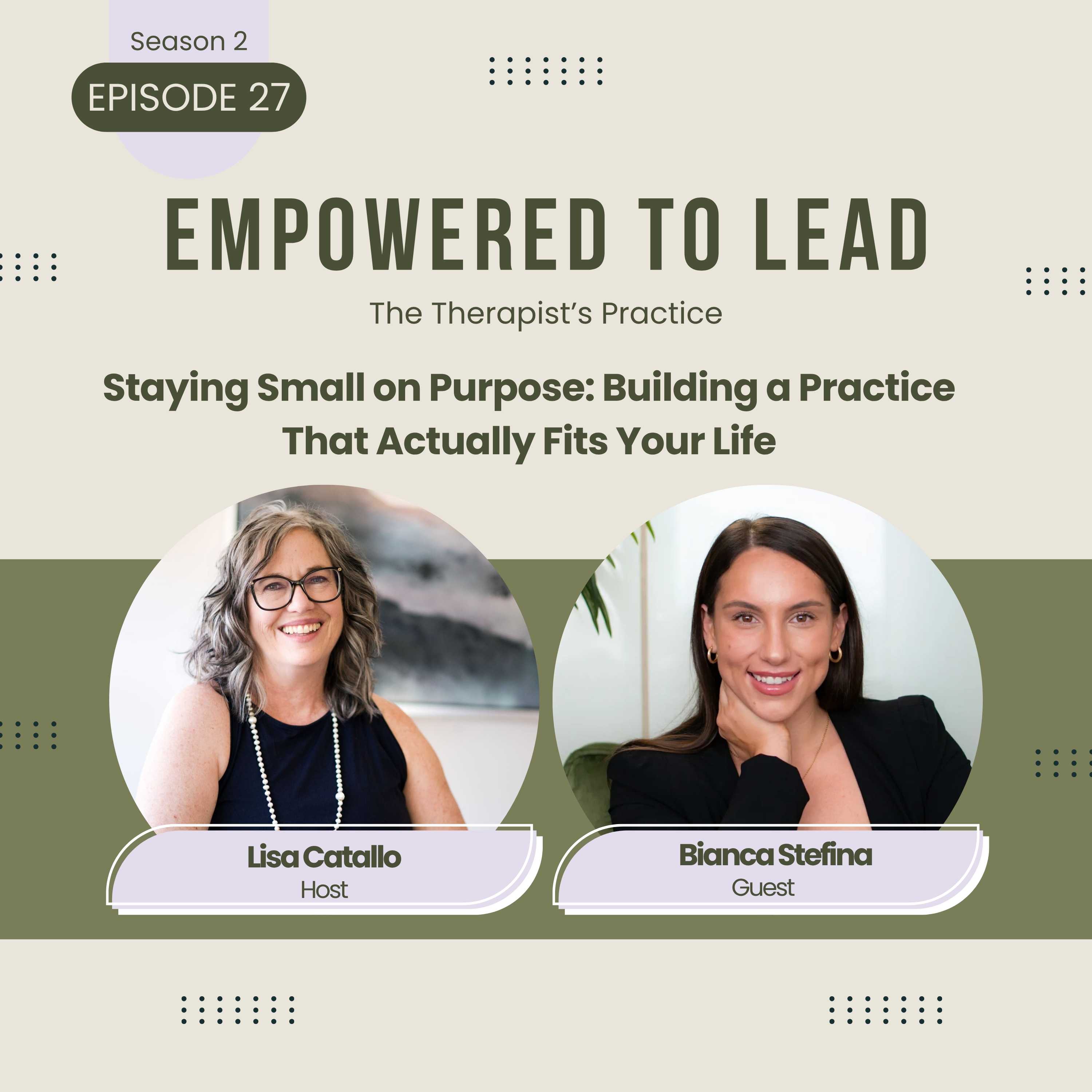
Empowered to Lead · Lisa Catallo
Not every group practice owner wants to scale to seven figures, and Bianca Stefina is here to say that is more than okay. In this honest, refreshing conversation, Bianca shares how she built Mindfully Me Psychotherapy Clinic in Ontario from a cold coffee pitch to a steady team of practitioners she genuinely trusts, all while navigating burnout, multiple roles, and the question of who she is outside of her work. What You’ll Hear: How Bianca filled her private practice caseload within six months by speaking passionately about what she actually believes in clinically Why she chose a mixed business model with both renters and contractors, and how it has kept her turnover rate at just two people in four years What staying small actually looks like in practice, and why the intimacy of a smaller team has been a feature, not a limitation The moment burnout hit hard enough that it became the turning point for how she thinks about sustainability and leadership Why she is moving toward hiring admin support, and the life moments that finally made her ready to let go of that role A genuinely honest reflection on the hamster wheel of growth culture in the coaching space, and what it means to sit in what you have built Resources Mentioned on this Episode - Mindfully Me Psychotherapy Clinic: mindfully-me.ca - Instagram: @mindfully_me - Run It Like a CEO Audit: grouppracticenetwork.ca/ceo-audit - Group Practice Connection membership: grouppracticenetwork.ca/the-group-practice-connection Featured Guest: Bianca Stefina is a Certified Clinical Trauma Specialist, Clinical Supervisor, Founder of Mindfully Me Psychotherapy Group Practice and Co-owner of the Corporate Resilience Advantage. Bianca specializes in complex trauma, high performers and first responders in her psychotherapy practice using Brainspotting, IFS, Somatic work and EMDR. Bianca believes in memory reconsolidation at the core of her clinical work offering deep, transformative healing for her clients beyond talk therapy alone. Bianca also prides herself in being an ethical group practice with a value of people over profit. Bianca enjoys taking a leadership role in the clinical world through professional consultations on ethical and sustainable business practices for therapists and recently offering clinical supervision from a trauma based lens. Connect with Bianca: Mindfully Me Psychotherapy Clinic: mindfully-me.ca Instagram: @mindfully_me Meet the Host: Lisa Catallo Lisa is a Canadian psychotherapist, group practice owner, and business coach with over eight years of experience leading a thriving, values-driven practice. She works with therapists who are ready to step into their role as confident, ethical, and intentional leaders—without burning out or getting buried in the day-to-day. Lisa’s coaching focuses on building sustainable group practices through efficient systems, effective leadership, and a deep respect for time and energy. Her approach is calm and encouraging, offering grounded...
0:05Lisa Catallo: You're listening to Empowered to Lead, the therapist practice. I'm Lisa Catello, therapist, business coach, and your go-to for all things leadership and sustainable practice growth. This is your space for real talk, smart strategies, and grounded support to help you lead with confidence, work with intention, and build a business that actually works for you. Let's dive in.
0:32Welcome back to the Empowered to Lead podcast. This is a podcast for mental health practice owners and multidisciplinary clinic owners, and one of the things that we are doing this summer is just meeting with regular clinic owners and hearing their stories. And so, what I really want through this podcast is for you to know, as a business owner, as a CEO, that you are not alone. And so, we all have different choices that we make for our businesses, how we show up in them, and whether we stay small or get big. And sometimes we get imposter syndrome because we want to stay small, but we hear these people that have multiple sites. And so Bianca Steffina is joining me today, and she is one of those that has chosen to stay smaller, and so just really want to hear about your story. I'm so glad that you're here. It's been a while since I've seen you face to face, so I'm excited just to interact and hear a little bit more about where your practice is now. So let's start with who are you and a little bit of your journey with being a group practice owner.
1:43Bianca Stefina: Sure, thanks for having me, Lisa. You have been instrumental in my group practice journey, and I'm so grateful that I found you back in 2022 because you were really the catalyst that helped me feel confident into building the what now is really me psychotherapy clinic. So my journey. So I guess quick background about me. I worked in community mental health since I was 20 years old, and I'm now 30. So, for the past 10 years, I've worked in community mental health in all different domains, from residential to clinical to youth justice to this education setting, and then it led me into private practice back in 2020 or 2021 actually was private practice, and I started my private practice, and I have some pretty unique credentials as well, which I I will maybe touch upon for those RSSWs who might be joining in from Ontario. But I was in private practice, and quite literally in six months, I filled my caseload to a full scale. I could leave my full time job at the school board, and I was working in private practice. It was amazing. I was so grateful for it. And I do think one of the things as well for the listeners, if you're struggling to find who you are in your voice and trying to stick out among you know the 1000s of therapists out there, it's really finding what you're passionate in in and what you're passionate about, and allowing that to really just soar. And when you really start to speak out on things that you're incredibly passionate about, you will attract the right people. And that's within my practice. So six months filled my practice, helped a couple other people fill theirs because I was working in a group practice-ish setting. It was more of collaboration approach rather than like a split fee, and I helped some other people build theirs. And then I got to the point where I was referring out into the community about like three to four referrals, almost a week out into the community. It was asinine at that point, and I'm so
3:39grateful. And there were some other things that I did too for marketing, and then I I sat there and I said, okay, I want to trust that the individuals that I'm referring out to really believe in the same mental health pieces that I do. I truly believe in challenging the Western pathogenic approach to mental health. I believe in a very holistic view, and I specialize in trauma. My title is a certified clinical trauma specialist, and I specialize in experiential therapy, so IFS, EMDR, brain spotting, all of the things that I say really get to the root, and really looks at a person's whole life. And it's what did they learn from their experiences, and how is it showing up in their current day functioning? Which you know, DSM five will call symptoms, and again, this approach doesn't work for everybody. But the clientele I work with, it does work with. So I was speaking out about this on social media, and a lot of people started the referrals kind of came flowing in. So then I was starting to put my feet out there in the community of other professionals who've kind of spoke the same language before trauma care. This is right at the beginning before nervous system regulation, quote unquote, exploded. Right, this is so back in 2021, where we're just getting, you know, some some people online were talking about nervous system, talking about the autonomic nervous system. So that's kind of what I started in really my education in 2020 was all about. So they start to look for professionals in the community that really had extensive trauma informed training and trauma treatment. I found one. She was later my business partner, and she was wonderful. And I just threw the. I came across you, and I threw the idea out there. Of I literally took her for coffee. Well, I took down two espressos. She's never met me in her life. Was sent to her referrals in the past. Lady has never met me in her life, and I'm like for coffee. She's like, okay. And she actually works
5:29down the street from me, where I was renting space. I just pitched this idea to her. Never met the lady, Robin. If you're listening, I love you.
5:35But I literally said, will you put up a group practice with me? And the thing with being an RSSW as well in Ontario work granted the ability to have third-party billing, so our supervisors at that time we can bill underneath our supervisors for services provided for most insurance companies. So a big piece of this was that I needed an MSW supervisor or an RP one to strengthen my clinical skill set, two to make sure I'm doing things properly, but three, be able to have my services more accessible for client. So I pitch this idea to her. She looks at me. She goes, "Yeah, like hi, nice to meet you too. I'm going to be really transparent with you. I have plans to move out of the country actually within the next six months. And I'm like, "Are you for the opportunity? So I left, and I was like, "Okay, going back to the drawing board, and then essentially she texted me that night and said, "You know what, Bianca? The wheels are turning. Let's meet again. And we started looking for office space. In that July, I remember writing in my journal, and I came across it. I said, "I I own a beautiful practice space with like-minded practitioners. It has beautiful windows. We are making an impact in the community and really challenging the narrative of mental health. I wrote that journal entry in July. We started looking for office space, and october 1, we signed our first commercial lease, and it was incredible. And at the time, before I had met you, I was thinking, you know what? I didn't really know about the split fee business model. I was just going to invite other practitioners in to rent space from me to help me pay the rent, and then I came across you, and then I started to think about how much I love leading, and I have some histories while teaching psychology at the postsecondary level with the program I graduated from, and I've always wanted to be a teacher. It's so funny. Before I became a therapist, I've always wanted to be a teacher, and my
7:21parents thought that would be my career path as well. But as I started to get into your group coaching program, that is phenomenal. If anyone's on the fence about it, highly, highly recommend it. Not sponsored.
7:33Lisa Catallo: I haven't paid her for that. Not sponsored. This is not my work beginning.
7:39Bianca Stefina: You know, I highly recommend it because it was such digestible, real information for me. And I don't know if we'll talk about this later about some of the other group practice coaches. Obviously, like some of the marketing tactics that they use that I don't fully agree with. Regardless, though, yeah, I found you, and then I learned about the different business models. And the thing about micro practice that some people I'm really interested to share because I actually have a really unique dynamic. I have some renters who are so near and dear to me. They are amazing practitioners who have already been established in the community that I looked up to. They were clinicians with years of experience, EMDR, somatic experiencing, brain spotting, art therapy, all of the things that I knew that I wanted to bring into my realm, and then I have some virtual clinicians, and then I have some in-person clinicians who are both all of them are on a split feet. So that's I have a little bit of a mixed business model, and I want to talk a little bit about that. Maybe if someone's a little bit apprehensive to bringing on these people, or perhaps having this big overhead cost, what is actually sustainable, and what could help you feel a little bit more comfortable? So yeah, that's and we opened up our doors, and it kind of grew since then. And I essentially poached some therapists in the community, and I didn't poach them. I just met with them, and I said, "Hey guys, we'll be up a group practice. And it's it's something to note too. Before I actually had approached some of these practitioners, I started posting about. I was doing some trainings for CYC assets about the polyvagal theory, window of tolerance, working with children and youth. And a lot of these therapists had actually signed up, but they were local to me. So then they would message me after and be like, "Hey, can I come by your office and just pick your brain? And that's who I actually reached out to
9:22to ask to join my practice. And as of today, I have five full-time renters. And with that also being said, it's important to like to note that some of those renters started on a split fee, and this is a very unique way I do business. And I understand that if it's not for other business owners, but for me, and what I'll get into as well about, I guess, the way that I run my business is that I am not solely a group practice owner, and in the future, that might be the role that I step into. But I'm also a full-time therapist, trauma therapist, paying 27 clients a week. I'm also a clinical supervisor, and I have a second business. With a friend in the field, the corporate resilience advantage, and we do corporate trainings, and I do some EAP corporate trainings. So I have a couple like I, and so with that being said, my group practice is a source of passive income and a source of passion. But I wouldn't say it's my full identity as a group practice owner. Does that make sense?
10:21Lisa Catallo: Yeah, yeah. So just renters right now. Then no contractors.
10:26Bianca Stefina: Okay. Tractors. I have okay four in-person contractors ICs, and then I have three virtually. So I do have seven, but most of them are part-time, and they have community mental health jobs. Which, if you're maybe a clinician that's at a group practice. Something I've also kind of seen a lot in some other individuals coming to my practice, where they were told at their group practices that they weren't allowed to work anywhere else, but they were nice. And I remember our our conversation. Yep, that's a big no no, and that is really inappropriate. So I've, you know, what one of my contractors has her own private practice on the side, and we have a very good relationship. And I trust her that any referrals that I send to her, she keeps within the practice. Yeah, and and there's been times where she was full of my practice. Nobody else really had the expertise that she did. I sent it to her private practice. So, and I truly believe, and there might be some business, really big business people listening to this and saying, "Well, like, you know, are you going to get the results that you want? And I think when we go into a little bit about my leadership style and my values in business, I am a little bit different than I would say the full business model. And right now, it's working for me, but you know, maybe in the future we tune things, we look at things. But right now, everything has worked really beautifully. Where I've kept my clinicians, I've only had my turnover rate has been two clinicians, which one I had to let go. And this is when we opened in 2022, so I had to let one of them go, which probably remember my panic too. Yes, I remember that. And one of them deciding it wasn't a good fit. She went back to her community mental health job. But sister, I've kept all my ICs for four years. That's awesome. Thank you. And yeah, was the biggest thing is I didn't want. I'm a big relationship person, and I want a revolving door of
12:26therapists and everything that comes with that. Is a therapist leaves, and then they bring one. Is that obviously? And again, this is the way that I practice. I do if the client has established a relationship with the therapist they're working with. Of course, I'm not going to be the one to say you know they have to there you they have to stay in the clinic and I try to work really it's a fine line between having therapists come to you and build up their private and perhaps leave with a full client loo yeah right because I've seen that happen yeah this knock on wood not for me I stopped it before it got there or they, you know, and I don't. There's a fine line, so I just am really intentional about the people that I bring on, and I try to get their intentions up front, which people can be deceitful, of course, you know, yeah. But that's kind of, yeah. So that's kind of, I guess, my long-winded answer is right now we have four renters, and I have 12345678, ICs, and I have pretty small office space. However, not everybody is full time, and it seems to be working for the last years or four years. It's worked decently in my favor.
13:38Lisa Catallo: There's so many questions I have, but let's start with the question that I ask everybody: How would you describe yourself as a leader? I think you've alluded to it a little bit, but a formal answer to that question,
13:53Bianca Stefina: I would say mindful, which goes right into our kind of our title of the practice is mindfully me, and I would say I want to be conscious, I want to be regulated, and I want to be mindful. And I think all of those things combined really truly make a leader that leads by example. And I really wanted to make decisions out of a place of okay, I'm calm and regulated. I didn't want to make decisions out of places of scarcity because I've been around individuals who have made decisions out of scarcity mindset, and I've seen the way that it's gone against their personal values and the things that got them in afterwards when it came to ethics and boundaries, and you know some things that were crossing some really fine lines. So for me, and you know what's crazy too, and I'm really into energy as well, and some people can relate to this message. But I found when I really started to put time and effort into myself, and truly the way that I showed up, more so about like the business things, about just really focusing on my mental health, my physical. Health in my regulation. That's when things started to flow a little bit more naturally, and maybe that's just me being like woo woo. But I found that when I really focused on the things that I could control outside of the things that I couldn't control, and really showed up with my best intentions, the business followed really successfully, which is really interesting to me.