
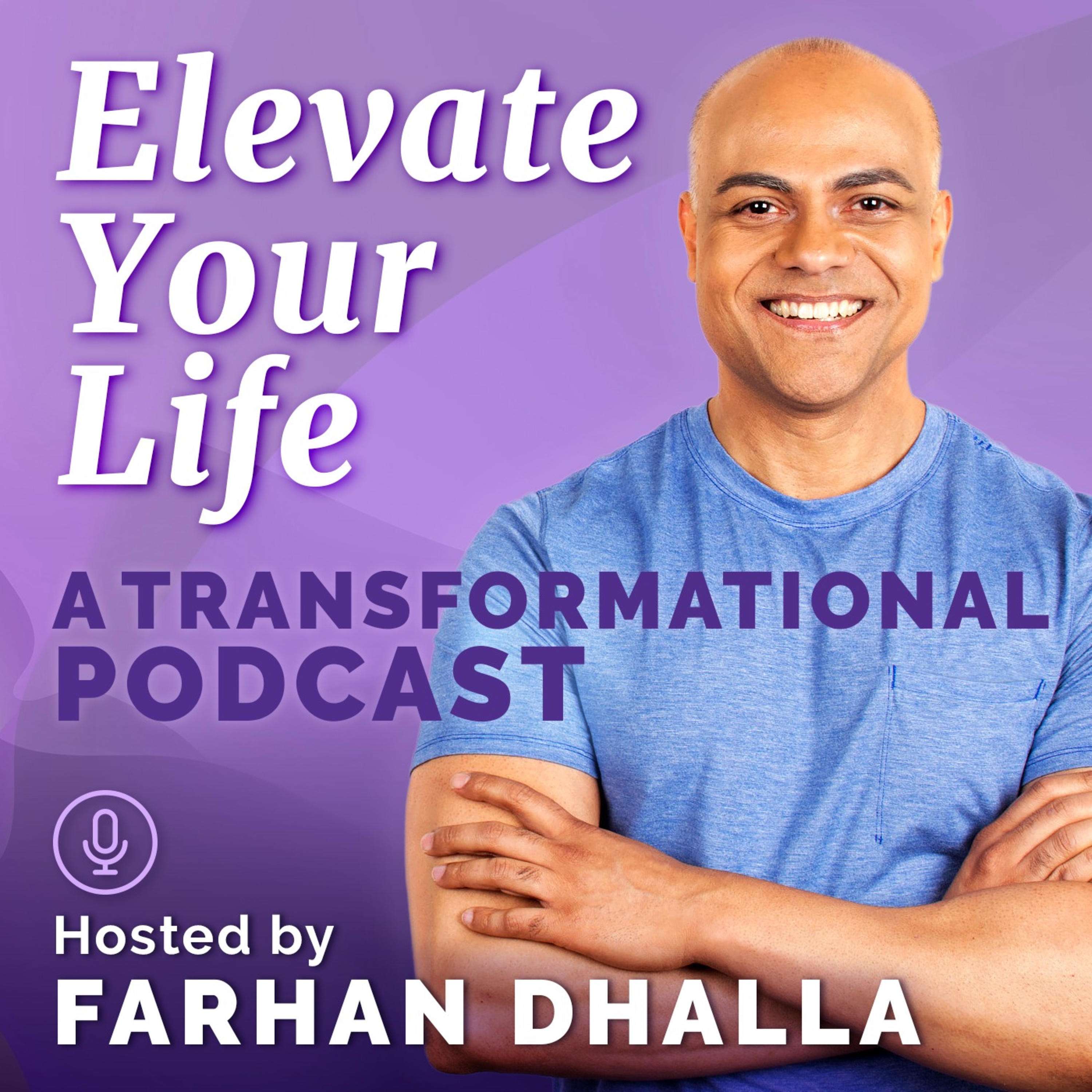
Elevate Your Life: A Transformational Podcast · Farhan Dhalla
Guest host Kalpana Gananathan puts Farhan in the hot seat in this special episode. Farhan shares his healing journey, childhood, career, spiritual awakening, caregiving experience, gratitude practice, overcoming limiting beliefs, and the inspiration behind his podcast. Farhan discusses the creation of a platform for underrepresented voices, serving the legacy of others, healing and transformational stories, self-reflection and intentional living, empowerment through thought and choice, and letting go and surrendering to the universe. Follow Me on Instagram Follow Kalpana on Instagram Chapters 00:00 The Healing Journey 09:10 Caregiving and Surrender 14:25 Gratitude and Intention 45:50 Podcasting and Queer Relief 52:02 Self-Reflection and Intentional Living 59:12 Empowerment through Thought and Choice 01:17:36 Letting Go and Surrendering to the Universe
Kalpana: Welcome to Elevate Your Life. This is Farhan's podcast where he usually interviews guests. But guess what? Today Farhan himself is our guest. And without any delays, let's talk to the host of this podcast, or should I say the interviewee today? Farhan: The guest. Yeah, I guess I'm the guest. ⁓ well thank you for having me on my show and for having me as a guest. And ⁓ thank you for suggesting this. ⁓ yeah, I've been a guest on other people's shows, but never mind. So I'm a bit nervous. I'm not sure what to expect, but I'm gonna let you lead. This is your show right now. You you get to be the host of the day. Kalpana: Thank you for allowing me this opportunity. For those of you that don't know what Farhan does, Farhan interviews people on their magical journey of healing. Can I say Farhan? Is that what you do? Farhan: Yeah, this season in particular, yeah. But we've had several guests on the show. Depending on the season, you know, we can talk about that. But this particular season is about people who've had transformational healings, doing Dr. Joel's work. And also, you know, the intention for this season is to help people live their best life. Kalpana: Beautiful. So, for those of you that don't know, my name is Kalpana, and I was on Farhan's show about two months ago, where he interviewed me about my journey of healing through Dr. Joe's work. And as I was talking to him during this show, I realized that Farhan has so much to offer in terms of his own journey of healing. So let's start with Farhan, tell us a little bit about yourself. Tell us about a little bit about your childhood. Let's learn a little bit about your ⁓ about your career, about what you love to do. Tell us. Farhan: Most ⁓ wow. Okay. How much time do we have? Well, I think okay, so yeah, so I was born in Darislan, Tanzania, which is on the east coast of Africa. Came to Canada in nineteen seventy-three at the age of two. Canada's been home for about fifty-three, fifty-four years. ⁓ I'm fifty-five now. You can do the math. I'm not very good at that. But what I love to do and what I think I'm good at is I'm a physiotherapist. I've worked as a therapist for almost thirty years now. I've had the privilege of working with some of Canada's world's greatest athletes, including Olympians, Pan American, and Commonwealth athletes. ⁓ As a personal trainer, I've worked in the fitness industry ⁓ and also as a fitness instructor since the age of 18. I got my start at the North York YMCA, which started off as a part-time job that turned into a career, went on to become A Canadian Rebok master trainer and I've traveled the world ⁓ speaking and teaching workshops for Rebok as well as fitness programs that I've developed. And I've also had the privilege of working with some Bollywood stars like Dipika Patacon and Janita Gandhi. ⁓ so I sort of have this non-traditional sort of path that South Asians take. And to get there, I had to break a lot of boundaries and doors open because when I started. There wasn't one South Asian in my industry when I pursued a career in fitness that wasn't considered a real job if you were South Asian. And even getting on television, I was on the show In Shape Would Share a Man for Seven Seasons and was probably the first South Asian to do a fitness show. ⁓ and if I'm wrong, please correct me. ⁓ I know there's some salutes out there will probably research that, but good luck trying to find anyone because I know when I turned on the TV, there was no one ever that looked like me. And I've had the fortune, fortunate experience of ⁓ blending my career as a physiotherapist, as a fitness professional, and also with my spiritual pursuits. And now I yeah, now I can add podcasting to my list of things. Kalpana: So that's an interesting Yes. So when I look at your journey for hand, right, I find it very interesting because you went from doing a bunch of different things which seem so unconnected. And the last thing someone would combine in this process is spirituality. And when we started this episode, and I guess it happened also at my previous episode, was that we were having technical difficulties, and the first thing that you could think of was not To go to technical support. You had a completely different way of dealing with it. Can you tell the audience what you did? Farhan: Yeah. So when I first started teaching fitness, I was also, well, at some point when I was teaching fitness, I was also going through a spiritual awakening and diving into that side of my life, you know, meditating, reading, studying spiritual teachers. And I guess when you do that, your frequency changes. And one of the ways you learn about your frequency is through your relationship with electronics. And what was happening, and this is a crazy story, but when I would put on a microphone, whether I would be teaching an aerobics class or doing a presentation or teaching anywhere around the world, I would fry the batteries. And even if it was a brand new battery and I couldn't wear watches, the the battery would literally die in about 30 minutes. And it drove me crazy. I couldn't understand what was happening. And whenever I was at any event, ⁓ I would always have to say to them, please keep a brand new battery nearby. And they would say to me, But sir, there's a brand new battery in the power pack. You should be fine. And I said, Trust me. And sure enough, half an hour into my presentation, as I was teaching, the the battery would die. And so I had to learn to ground my energy. And basically that. You know, if you live in a country where you can walk outside barefoot and feel the earth underneath you, great, that's one way to do it. But I live in Canada and sometimes that's not possible, especially in our winters. ⁓ but I just learned through one of my spiritual teachers a grounding technique where you p put your feet on on the ground and literally visualize roots from your feet growing into the earth, just like trees or plants grow into the earth. And then just allowing yourself to be sort of Anchor the way a tree would be rooted so that no matter how strong a wind or whatever perturbation wouldn't knock the tree out. So you're literally rooted and grounded, and then just allowing the energy, the excess energy to dissipate and then drawing energy from the earth. So as I developed that practice, I stopped frying batteries and I could start wearing watches again. And so sometimes when I'm working with people such as yourself who are also high frequency, who have a high vibration. Kalpana: Yeah. Farhan: and who just radiate all this energy, it can, you know, mess with our electronics. So right before you and I were starting your episode and even today, we had some technical issues and ⁓ we did a grounding exercise and lo and behold it went away. Kalpana: It ran away, right? And do you know what I just heard from you yet again today? Is that I have at least six watches sitting on my counter that are not working. And I never put two and two together. I never put it together because I have been consistent with my meditations and breath work and really focused since my move to Riyadh, right? You know that I live now live in Riyadh, Saudi Arabia. And Farhan: Yeah. They're not working. Right. Yes. Kalpana: never com c connected the two because what happened was I had about six or seven watches that I brought with me from Toronto and they were all not working. So I took them back, put new batteries in, brought them back. Not one is working. All of them fried. And I didn't connect the dots until you just spoke about it now. Farhan: Yeah, anything that touches you that has a battery, you can likely pry. ⁓ so try the grounding exercise on a daily basis and it should make the difference. And it worked for me. And it, you know, it took the anxiety off when, you know, you're at an international event and all of a sudden you have this at this audience in front of you, and your microphone stops working, and then they're all waiting for you to change the battery, and then it took all that anxiety out. ⁓ but now you get to enjoy your watches too. Kalpana: Yes, you know what? That's a good one. I will definitely remember that one, right? When we spoke, this was during my interview, right? And I don't even know how it came about. You said something really profound. You said something about caring for your mother. Can you tell us a little bit about that journey? Farhan: Yeah. Mm-hmm. You know, it's interesting. No one has, at least to my knowledge, and it wasn't on mine, on their vision board that one day they want to be a caregiver. And one of the prayers that I had been saying for a number of years is, God, I say yes to your greatest plan and your highest vision for me. And when you say that and you're really willing to surrender, opportunities show up in your life that you could not have possibly predicted, planned. Or envisioned. It's literally what Dr. Joe would say is creating from the unknown. And when you release that prayer and you trust the unknown, it will provide for you opportunities that will lead for your highest and greatest good, for your growth, for your development. ⁓ and I've seen how it played out in my career. So, for example, you know, a few times when I said it, opportunities came out to Be a personal trainer to a dipicapaticone, a Bollywood star. And that was not on my radar. That was not something that I had planned. That was not something that was on my vision board. But then it came to me. And so coming off sort of that experience and continuing with the prayer, I was thinking, I'm gonna get another exciting opportunity that could take me around the world, whatever it may have you. but then it was about being a caregiver to my mom. And When that opportunity came up and I realized what was happening, I said, okay, I am going to step into this 100%. I'm gonna give all of my being to my mom's care. And for five years, until she transitioned, I was her full time caregiver. This was also during the period of COVID and lockdowns, and mom being high risk, ⁓ We had very minimal support from the outside world, other than medical practitioners. No one was allowed to come over. we couldn't risk exposing her, and I couldn't work. prior to that, I was also a caregiver to my father, but that was a different time period where there weren't restrictions. And so there was more family support at that time. and I continued to work, but What I noticed when I was caregiving for my dad is that working and taking care of can't taking care of him took a huge toll on me. And I had multiple jobs. I was physiotherapist, I was traveling the world, presenting, I was also writing. I couldn't do all those things. ⁓ and so something had to give. So I cut down on the travel around the time when I was working with ⁓ as a physiotherapist and taking care of my dad. But when it came to mom, There was no option but to take care of her ⁓ full time. And I want to say this was probably the greatest experience of my life. I think that when you're a caregiver, do you really know how much you have to offer another person? You really have a sense of how much love you have in your heart and what your capacity is, because nothing prepares you for it. There's no You know, reading manuals, going to YouTube, learning. You're in a state of fight or flight the entire time. You're not sleeping. situations happen in the middle of the night. Several times I was woken to find her on the floor, or her her needing help for whatever reason. You're always sleeping with one eye open, on high alert. you're afraid to leave the house because anything can happen. You don't want to leave them alone. You have to make sure they're supervised. Your entire life evolves around their care. As much of a quote unquote sacrifice, you know, it it feels like I'm describing. I want to say it didn't feel that way, more than anything. It was the greatest opportunity to be of service. And the greatest thing that I got from that is time. Time with my mom. Time that I would not have gotten if it wasn't for COVID. Time that I got with her, sitting on the couch, holding hands, watching Golden Girls. Or Fuller House, you know, comedies that we loved, time with her watching reality shows like Say Yes to the Dress and Renovation and organizing shows. Those were the things that we loved to do. And getting those three kisses from her every night before we went to bed, those were some of the most precious times. And I am eternally grateful for that. Kalpana: So, Farhan, like what you're describing is so intensely beautiful, and yet I can only imagine how challenging those times must have been. So, that period in time, what did you do in terms of a spiritual practice that somebody can take away as they are watching you talk? Farhan: Mm-hmm. That's a great question. The one thing besides a spiritual practice, and I'll touch on that in a second, is that I made sure I went to the gym or did some form of physical activity. So when a support worker came over, that was my time. And I used that for me. So for me, the importance of physical movement really helped me navigate the physical and emotional stress of that. And when gyms were closed, I worked out at home. Whatever I could do to maintain some form of physical activity, I did. In terms of spiritual practice, mom and I said prayers together every day. 7 30 is our prayer time. And so together we would say our prayers every day. And then she taught me certain prayers to say at bedtime, certain thaspis, as we say, where we recite mantras with our prayer beads. And one of the practices that she taught me was a prayer to recite for all our loved ones on the other side. And so that was. ⁓ a practice that I I did every night. And then I would have a practice of gratitude. Every morning when I woke up, I would wait to hear her alarm. And when I would hear it go off and she would turn it off, I knew I had another day. And so I would say thank you for that because I knew that I had at least one more, because there was no guarantees. Of how much time we had, we just never knew. ⁓ and so that was basically all the capacity and energy that I had in that moment. Everything else was dedicated towards her care. Kalpana: Do you continue to practice your gratitude since her transitioning? Farhan: Mm-hmm. Even more so now. the first things that I do when I open my eyes is say thank you. I'm grateful for every breath I've ever had in my life. and throughout the day, I will find opportunities to be grateful for something. when I sit down to have a meal, I express gratitude for the food that I'm eating. I express gratitude. For the patience that I'm seeing, I express gratitude for my body for all it does for me. every system in my body. ⁓ when I shower, I put my hands on each body part, expressing gratitude and love for every part of my body, every muscle, every organ. I express gratitude for abundance, whether it shows up in love, finances, when I'm at the gym. I express gratitude for my workouts. I express gratitude like constantly. And then again, when I before I go to sleep, I express gratitude for all that I have, but also for what's coming. I always say thank you for the known and also for the unknown. I also express gratitude for things that are on my vision board, for things that have appeared. And then there are things that are in the future that haven't appeared. Gratitude is, as Dr. Joe says, the greatest state of receiving. And so I've amplified gratitude in every aspect of my life. Kalpana: Farhan, you seem to have had a very intentional life, right? For the most part. Like you seem to have that fine balance between the known world and the unknown world, right? Like you know that you have you can predict certain things, and yet you have had you seem to have had this faith about trusting the unknown. Farhan: Mm-hmm. Kalpana: Do you think that's what brought you to Dr. Joe? Tell us about your journey to finding Dr. Joe's work. Farhan: When my mom transitioned, I was in grief counseling. And I had five grief counselors. And when I say that I needed support, it wasn't just grief counseling, but just to give you an idea, I leaned into getting help with five grief counselors. And each one was helping me in different areas of my life. And one in particular. Was from the UK and was helping me with my professional life. Keep in mind, I hadn't worked in five years. I hadn't seen patients, I hadn't been training clients, I wasn't doing much of anything professionally. ⁓ there was no romantic life, there was no dating, there was nothing, right? So when mom transitioned, I grieved her, but I was also grieving the life that I knew in the identity of being a caregiver because that was gone now. Mom wasn't gone, she transitioned, but caregiving died. Right? So my identity as caregiving had died. So what was next? And one of the questions that one of my care ⁓ grief counselors asked is, What are you passionate about? And I couldn't answer that. I had no idea. I could not answer that question. And it took me a while to sort of start to figure out how to get operational again because I had to re-enter the workforce. So what we did was we mapped out a plan for me to get back into physiotherapy where I wasn't running my own business where I could work for a clinic where the patients were booked for me. I would just show up, treat patients, and be on my way. I didn't have to worry about the operational aspects, the management. ⁓ marketing, all that stuff that goes into running a business, right? I didn't have the capacity to do that. So I got to the place where I could get operational and functional, meaning I could get up, I could make a meal, I could go to the gym, maybe do a meditation, I could get to work, I could come home and repeat. I could get my groceries, I can get my banking. And all of that had to be broken down in steps mentally. Because literally, when you're in intense grief, you can't think into the future. You're literally getting in. through each moment of your life moment by moment. And then I got to that place where I could do that without having to think about it. But then I wanted to get into the space of what is next for me? How do I now recreate my life? Because there are no restrictions or limitations. I don't have mom to care for her. And there was like this open book where I could write anything. But I had no idea completely what I fully wanted to do. And so I was reintroduced to Dr. Joe. And when I say reintroduced, I'd been introduced to him before. And as you know, you and I were at the same Hay House retreat where Dr. Joe spoke. And that was a turning point for you, as you know, you mentioned on the episode with when I interviewed you. But I had seen Dr. Joe in What the Bleep Do We Know. Kalpana: Yes. Farhan: watched a couple of YouTube videos over the years. And then one day a patient of mine came to the clinic and she had just come back from a Dr. Joe retreat. And the look on her face, the brightness, and you know, her encouragement ⁓ on on on I should be doing this or I should do this. ⁓ and also one of the healers that I'd worked with, who I did Body Talk with, ⁓ to help me with some of my healing with grief and whatnot. She had also mentioned that she was a regular ⁓ attendee to Dr. Joel's retreat and encouraged me to go. So I made the decision in 2024 to go to Orlando and I picked up Supernatural before that. ⁓ it showed up on my Facebook that there was a sale on Supernatural, and I think it was like 10 bucks. And I was like, okay, I'm just gonna grab the book and start reading, right? So I started reading the book. I started looking at Dr. Joe's progressive course and and I dove in. I dove in a hundred and ten percent. And look where we are now. I've had a dramatic feeling. ⁓ Kalpana: We are now. So tell us about what happened in Orlando. I want to know what happened in Orlando. Farhan: Something very unexpected happened in Orlando. And I Yeah. Kalpana: What a surprise. Did you just say you went to a you had an unexpected hm keep going. Farhan: Yeah, yeah. Yeah, and I yeah, I if you want the full details, ⁓ in my episode on season four and one, I dive into the whole healing journey. But I had gone in with certain intentions, ⁓ as far as, you know, Dr. Joe. ⁓ you know, part of it was I had a back injury and I wanted, you know, some healing in regards to that. But on the very first day or second day, I think it was, I was getting up from a chair after we were going for a break and my back went out on me completely. so long story short, I was suffering with intense back pain throughout that entire retreat. I managed to find medications and patches to help me through the pain. But through the guidance of one of Dr. Joe's staff, ⁓ they alerted me to do some deep dive into. you know, the origin of it. And what I learned was in a meditation that I had been suffering from abandonment issues. And what resulted from that, which I discovered when I came back in an X-ray, was that I had a scoliosis in my lumbar spine. And so that set me off on a major, major healing journey. ⁓ I had no idea that an incident that happened with my dad, you know, made me think Or perceive that he was leaving us, which he wasn't. I was only two and a half years old. We had we'd come to Canada, and my parents decided this wasn't working out for us. It was too hard here. And so my dad said, I'm gonna go back to Tanzania, I'm gonna get settled, and then I'll come back for you. Well, when we were at the airport dropping him off, my two-year-old thought he was leaving us and he wasn't coming back. Nobody told me the plans, right? They weren't saying, Dad's gonna go and then we're gonna go join him. And so years later, this manifested in my physical injury. But what I didn't correlate was how all my re relationships were impacted by that. Because I developed a subconscious belief that everybody that loves me is just gonna leave me. And so none of my relationships worked out. And now I knew why. And so going to that retreat brought my awareness to where my healing needed to take place. And so when I got back, I immersed myself into the meditations even more, ⁓ focused on releasing that subconscious block, giving myself self-love, as I describe in detail in that episode. And then December 2025, I had just come back from another Dr. Joe retreat in Cancun. And at that time, I was a healy. So basically I was the recipient of healing in three sessions. And that, along with all the work that I was doing, had a profound impact on me. And when I came back, I had an x-ray that showed that the scoliosis was corrected completely. Kalpana: So Farhan, I think I don't know if I can speak for many others, but one of the things that happened to me when I came back from my first Dr. Joe was I went into this thought process of, ⁓ my gosh, how did I miss this about myself? And then I began to began to walk my journey, right? From with all of those thoughts and patterns. Did you were you able to see your patterns come up in front of you? Because my biggest struggle at that point in time. Leave alone the fact that, you know, I had brain fog and sleep depri deprivation and everything. My biggest thing was now I was coming up against myself in terms of seeing my patterns right in front of my eyes, something that I was completely in my blind spot. Right? Did you go through it or were you able to completely say, wait a second, that happened, so I'm changing? Because that is one of the questions that has been asked of me over and over. Farhan: Mm-hmm. Kalpana: When did you start to see changes? It was it overnight. Did you, did you the because in my case it was not a spontaneous remission because I went basically for the healing of Akash, my son, right? And then I realized that through my healing processes, how Akash got better. But I went through this really dark phase before it got better because there was a lot of self-doubt that that happened to it to me. Did that happen to you? Farhan: Mm-hmm. I think that's a bit of a loaded question. I'm gonna try to break it down as best as I can. when I had the the when I went into the meditation to ask what was the origin of where my back pain came from and that memory surfaced. I was two and a half years old when that happened. I don't remember any details about what life was like when I was two years old, three years old. So to have that memory surface was quite surprising. I had no idea that that memory was stored somewhere in my psyche. ⁓ and it made me aware of that how much our brains are aware of our histories and how things are eventually stored or immediately stored in our body. To bring that to the surface, I would had to have a very open mind. I had to be in the state of complete receptivity and openness to learn, you know, where that came from. Then if I were to look back and reflect on my relationships and the issues that I had, it did make sense to me afterwards, once I was aware of what my actual blind spot was. ⁓ and then the biggest thing is okay, you've been living with this subconscious belief for 50, I guess that time, three or four years of your life. How do you change that? That is something that is almost quote unquote normalized and wired in your DNA. But we do know from doing Dr. Joe's work is that you can change your beliefs, right? But you have to know what it is that you're changing. If I didn't know what that belief system was, I wouldn't have known what I needed changing, right? And with all the work that I'd done prior to that, nothing had led me to understand where that belief system or that limiting belief system had come from. None of the other works, none of the other meditations, none of you know working with other therapists. None of the books that I'd read. It was Dr. Jo's work and that particular retreat and the support, God bless her, of that staff member that made me look into it the way that, you know, she suggested. And if it wasn't for that, I wouldn't have known. So having said that. The real work begins now, you know, is in recognizing when you're falling into old patterns and you know, creating in the new neural networks. That doesn't happen overnight. So to rewire new programming requires a high level of consciousness by being conscious of your unconscious thoughts and then recognizing any sort of behavioral patterns, actions, thoughts, or words that take you down that path. And that doesn't necessarily happen overnight. Is healing instantaneous? Maybe for some. I think in my case, what I learned is that I was progressing in my healing because my symptoms were getting better to a certain point, right? but is the healing complete? I don't know. I think what I'll know is when I'm in my next relationship. I think that's when I'll really know for sure. And you know, I'm opening up, I'm surrendering, and Allowing for that space to happen. But I need to make sure that I feel safe enough to do so. And I've been working on that. Making sure that I have chosen to believe that my safety lies in my source and nothing else and no one else. Right. ⁓ and understanding that all my abundance, all my glory, everything is from my source, and that includes my safety, my security. And not on anyone else, so that if anyone comes or leaves, that doesn't change. Okay. And so I think that the only way I'll really know for sure is, you know, inshallah as we say in my next relationship. Kalpana: So if I were to ask you can you give a Farhan: That's my way of saying I'm single right now, by the way. Yeah. Kalpana: So first all, if I were to ask you, if I were to ask you, can you give us three different times or different ways that you have caught yourself going into unconscious patterns? What would the three that stand out for you, or maybe two that stand out for you, whatever is that number? Because for most of us, you just don't know what you don't know, right? A friend of mine always said, You don't know what you don't know, right? It is not until ⁓ you know, I delved really deep into myself that I realized that. We can be so unconscious even in the moment of consciousness. We can be so unaware while being aware because those are our blind spots. Like you just don't see what you don't see. Right? So can you give us can you think of three things where you've caught yourself and go, ⁓ that's a pattern. I need to break it. Farhan: Mm. Mm-hmm. That's a good question. That is an ongoing day-to-day process. And you literally have to have a filter going through your headspace. ⁓ and sometimes you catch them and sometimes you don't. I'm getting better at it, I wanna say. so one of the limiting beliefs that I've had is not being good enough, right? And I can think of times in my life where I had to. Kalpana: Yeah. Yes. Farhan: let go of any sort of imposter type syndromes. For example, when I entered the fitness world, you know, there was no salvations in my time period in that industry. And I was stepping into a world I didn't know whether it would accept me or not. Okay. ⁓ and historically speaking, I was Kalpana: Mm-hmm. Mm-hmm. Farhan: Told quite frankly that there isn't a world where there is space for someone South Asian in fitness or in media. When I was 11 years old and I wanted to get on into television and television commercials, and my parents supported it, we said, okay, let's do this. We went to acting school, and then when it came down to getting an agent, there was a a ⁓ children's agency that told me. And I was 11 years old or 12, ⁓ that I'm sorry we only want mostly white people. So I inherently started to believe that there was something wrong with me for being South Asian or brown. When I auditioned for In Shape with Sharon Man, the workout show. I didn't get the part initially because they told my I had an agent at the time that represented me in the fitness industry. ⁓ we were actually looking for a black person. And so there was this all this not if enoughism that's been, you know, sort of mirrored to me from a very young age. You're not brown enough, you're not, you know, you're not white enough, and now I I'm not black, whatever. So this idea of not being enough has been one of the biggest. limiting belief systems that I've have you know been working through. And so most recently as I was working on the podcast, and this has been, you know, an incredible passion project for me. And I absolutely am so honored to be able to share people's stories like yours and so many others and the marginalized people of the LGBTQ community, that there was a moment where I felt a huge sense of imposter syndrome where I felt I'm not good enough to be a podcaster. Keep in mind I've had no training. I'm learning as I go. Like I didn't go to school for this. you know, what makes me a good podcaster? And I and I got really critical of myself. And it was just this week and I had to stop and look back at all the things that I had to break that boundary, proving myself in the fitness industry. Going into field spaces where there was no one that looked like me, creating platforms for myself because nobody else would, including this podcast. and so I had to remind myself of all the times where I had overcome that belief. But have I overcome it completely? Maybe not, because it still pops up periodically. And so this work is an ongoing process. And whenever it comes up, you have to be very mindful to catch it and reframe it. Because the world will mirror back to you what you project. And I'm learning now more than ever. You know, I didn't know that as well as I do now, is the world is always always mirroring back to me what it is that I'm projecting. I'm the projector. And the world, including people, including media, is projecting all of that back to me. And so I'm stepping into my fullness. I am stepping into being my full authentic self. Kalpana: Course. Farhan: And I'm stepping into living my life to the fullest expression of my being, unapologetically, as I am, you know, regardless of my age, regardless of my color, regardless of my sexual identity, and all the things that make me unique. But it's it's an ongoing process. Kalpana: You know, Farhan, that was going to be my next question. What brought you to become a podcaster? Because you said, you know, ⁓ it there's something that I caught in what you said. We all come from this belief system that you need to have gone to school for a specific purpose before you can get to do that, right? You didn't go to school, yet you're a fitness instructor, right? You know when to film school, yet you're a podcaster. Farhan: Mm. Mm-hmm. Mm-hmm. Kalpana: Right? You so I think within each of us is that self-limiting belief that someone of authority needs to give us a certificate in order for us to do what we do. And as you are talking to me, you know, you talked about the mirroring. I'm realizing if someone asked me, What am I, I would say, I'm a teacher. Farhan: Mm-hmm. Kalpana: But if you see someone like me, I do a bunch of different things and then I ask myself, like, ⁓ like how am I supposed to say that I'm a published author? Because like that's not about what I s come across as, or for that matter, you know, I've been hosting Farhan: Does that make you uncomfortable? Is that why or Kalpana: Yes, I'm just like, like when people ask me this, right? They I'm always asked this question ⁓ Kalpna, what are you? The first thing that'll come out of me is, ⁓ I'm a teacher, right? And I won't say anything beyond that in that introduction. And slowly people will get to know me and they're like, ⁓ my gosh, you've done such a lot of different things. And it's actually true. I have done a bunch of different things, right? Like I've published two children's books. They're just they've just come out now. Farhan: Mm-hmm. Kalpana: ⁓ I've done this thing called the intention setting workshop. I do a lot of ⁓ parent education workshops. I do this specifically for staff. I've done something for cross-cultural communication. Like I've done a bunch of different things, but I would never come out in the open and say, and almost like dim my own light. No, the world is not dimming my light. If anything, the world has given me this opportunity. But it's that self-talk. It's exactly that self-talk, like what you just said, right? About I've I didn't go to school, but here I am, I'm a podcaster, right? So can you tell us a little bit about how that idea got sparked in your mind and how you got started with it and where this journey has led you to? Farhan: Yeah, I love this question. So After mom transition, I turned to, as I said, grief counseling to support my grief journey. I turned to nature, I turned to writing, I did a lot of writing about my grief journey. ⁓ for a brief period of time, I turned to medications, but I was judged tremendously and about that. ⁓ and then a friend of mine suggested: why don't you do a podcast? And I thought about it. And the reason why I decided I was gonna do it is one, I wanted an outlet for my grief. And I wanted an outlet where I could express what I was feeling without people interrupting me, distracting me, trying to minimize the discomfort that I was feeling to take my pain away. There were very few people that could hold space for me and just be present and listen. I found it very frustrating. I stopped talking about my grief, my pain, my sadness to a lot of people because I found no one or very few people would just sit and listen and hold space. Everyone was going into fix-it mode. We gotta fix Farhan. We gotta fix him. We gotta help him through the pain. And I didn't want that. I was okay with feeling the way that I was feeling. And I thought. This would give me an outlet other than writing to express verbally everything that I was feeling. And I did not hold back. The second reason is I realize that people have a difficult time with talking about grief. And it is a universal experience. There isn't one person in their lifetime who will be exempt from the grief journey. And the loss could be a loved one, a pet, a job, whatever. You know, we're all going to experience a relationship, divorce, all of that. Every aspect of our life, to some degree, we will experience grief. Kalpana: Relationship. Farhan: With my mother, it was the most profound grief I had ever experienced in my life. I cannot even describe the I could try, but I would literally go for walks in malls crying. You know, they it was so bad. and so this was another form of an outlet, which meant I had to learn a whole new skill. I knew nothing. There's a whole technical side to podcasting, learning a a software program, recording, editing. How do I curate conversations? So again, there was no school for this. I relied on YouTube videos and a cousin of mine that was a ⁓ a podcaster who helped me through with the basics so I could get started. So I kind of just went off on my own and learned as I went. And I really wanted to have conversations with many of the people that helped me on my journey. And there were so many, I mean, five Greek counselors, that's just counseling. There were people that I spoke to who helped me with, you know, turning to music, meditation. And so, and friends, art, there were so many guests on there that in some way supported my grief journey. I also had two mediums on there. I have a lot of friends that are medium mediums and that do mediums professionally. And I myself have taken Courses and mediumship and training because I do have mediumistic abilities, though I don't do it for a living. I am an intuitive and I have done readings in the past. And I wanted to bring that element into it. I had also turned to religion. And so I had ⁓ an Islamic scholar talk about grief and Islam. I all those areas were areas that I had turned to to help with my grief. So initially Kalpana: Mm. Farhan: It was for those two reasons. I wanted to support other people that were going through grief, and I wanted another outlet. So I had all this energy that I channeled into podcasting. Then, after about eight episodes, I gave it a break because I had gone to work full-time at this point. And a really close friend of mine said, Forhan, you know, this would be a good time for you to maybe talk about your coming out journey. And you've never spoken about it. And You know, maybe your next season could be called queer relief. My first season was called Grief Relief. And the whole topic scared me, and I didn't do anything about it for like two months. I sat on it. There's only a few or a handful of people that know exactly what happened. And I thought, you know what? This is my chance now to help others who may be struggling. You know, I come from a community that's already marginalized, being South Asian, but at queer. To the equation. How many South Asian queer people do you know on television today? Right? Like, I can think of a couple like Tal Tan France and Cal Penn, but that's more of recent, right? Like growing up, I had no one. I couldn't even turn to Bollywood, name one openly gay actor in Bollywood. We're we're talking about a country with a billion people. You know, we know queer people in Bollywood. I've worked in Bollywood, I know that there are queer people. Kalpana: Zero Farhan: In the Bollywood industry, in front of the camera and behind, but not one person has ever, ever come out publicly. So I grew up in a world where there was no one in media in the Western world or in the eastern world that I could look up to. So I knew that this was an opportunity to create a platform to share the stories of the members of the BIPOC queer community. Who don't have a platform. And all our stories matter. And I think that if I knew someone that I could see when I was in high school that was South Asian and queer, would have made a world of difference to me to know that there's somebody else out there. There was no social media, there was no Facebook, no Instagram. So there was no one that I could turn to. And I lived in complete isolation and fear for my entire, you know. You know, childhood, teenager, as when I was a teenager, right up into my adulthood. I had no one I could turn to or look up to or see or read about. And so I thought this is a really good opportunity for me to create this platform. So season two was really about elevating the voices of the BIPOC queer community. And my God, I had some incredible guests. There were two gentlemen named ⁓ they're married, living in the states, Vebog Jane and Parag Meta, who were in a class action lawsuit to legalize same-sex marriage in India. I spoke to the I spoke to the United States' first ever openly gay imam. I mean, could you ever say gay and imam in one word? You know, a fascinating problem. Right. And Kalpana: Mm. I should came Yeah. Farhan: I had him back on on my second season, Imam Dai Abdullah. And unfortunately, two weeks after we recorded that episode, he transitioned. And so it made me realize that every conversation that I have is in some way gonna be memorialized. Kalpana: It is one hundred percent. Farhan: And and serves as everyone's legacy. So what's my legacy? What am I leaving behind? And how can I help others in the service of their legacy? You mentioned that I am intention, I'm intentional about everything. Well, it became even more intentional. It wasn't just about elevating these people's voices, but in some way serving their legacy in a way in which would leave behind something for people. To look up to after we're gone. And even while we're here in Earth, but even after we're gone. And then each season has evolved with me as I've evolved. And so after my healing journey, it made absolute sense to share that. And when I met all these incredible people through Dr. Joe's community, through Facebook and at retreats, there were so many people who had these incredible healing transformations. And I thought these are stories we need to get out. These are stories that could help so many people. There could be others out there that don't realize that they have the capacity to heal themselves, but don't know how, that there are other options. And I'm not negating the medical community, but there are options beyond the medical community. And I'm not just talking about health. I'm talking about emotional transformation. I'm talking about, you know, lifestyle transformation. There are no limits. And so this season has really given me an opportunity to dive in with each guest to learn their story and how their transformation has changed their lives. And with each guest, I've learned one thing. They all have transformed, yes, but they now want to live a life of meaning where they can help others do the same, much like you with your book, this podcast. And so I've The incredible space now to share their stories, to amplify their their transformational stories, but to help spread the message that there's others out there that are willing to help. You know, much like yourself, Mark Rug, who healed of terminal stage four pancreatic cancer, you know, he he's more than willing to help others through their healing journey. And if he can do it, you can too. And so Kalpana: Yes, one. Farhan: Yeah. And I think that if I stay small in my imposter minded self, I will be blocking myself from being the fullest version of who I am. And I'm doing my best to step into that each and every day. And all I can do is is surrender to where this is all going and just ask the universe to guide me one episode at a time, one guest at a time, as to where this podcast is gonna go in the future. I don't know, but I do see a bigger picture now. And when I look back at how it all started, from the intention of helping others through grief and to be able to share my story and where it has grown to, I would not have known that this was going to happen. There is no way. Kalpana: You know, Farhan, you bring about such a potent point, right? So one of the questions that I always got asked was, which meditation did you do to heal your child? Right? And I've always said that it was less about which meditation I did, but more about what I did with the information that I learned through Dr. Jo. And the biggest thing that I learned with Dr. Jo is how to catch myself falling from grace on A daily basis. And recently I was talking to somebody, and I was I was invited on a Zoom call to speak to a whole bunch of people. And I said, What you all don't realize is that we've been speaking for two hours, and these two hours would have otherwise been spent maybe watching some news channel or scrolling through social media about doomsday prophecies. And I feel like Where's with someone like you, I know that you have a full-time job and you know you work out and you're very you live a very mindful life. Just by bringing people onto a podcast like yours, you are being so intentional with your time. What you are saying is, I find value in myself, in doing this for other people. And it is such a powerful message that you are sending. To people who are watching this across the globe. And I'm really grateful to be alive during these times where somebody sitting in some part of the world will have access to what you and I are having a conversation about today. And that you have invested your time, your energy, and your footprint into this moment in time on this day. This is like it's 6 15 p.m. in Riyadh. On the 6th of June 2026, which is you've memorialized, like you said, right? And you have memorialized this time with an energy that is going to impact people in the world. And it takes intention, it takes courage, it takes patience, because I think all of us lack that in some way or the other. And you have been able to do it with. like Dr. Zhou would say, a clear intention and an elevated emotion. This is amazing. I know that we've been speaking for almost fifty five minutes, and I know typically your podcasts are about an hour long. I have one last question for you. Farhan: Sure. And don't worry about the time. It's fine. This has been a great conversation. So yeah. Yeah. Yeah. Don't worry. Yeah. As long as you've asked all the questions you want. So I'm in the hot seat. I'm surrendering. You could fire away. You're in charge. Kalpana: Perfect. Okay, perfect. Then we can continue talking. And the reason I asked this for nine for Hari. Yes. Amazing. Amazing. And I'm truly hoping that you are enjoying this reverse journey that ch you started. Somebody else has put you on the hot seat. Farhan: Yeah, I am. I actually I really am. I'm glad we we were doing this. Kalpana: I am really glad because and this idea was you know, like you know, we were communicating back and forth after my episode, and I'm just like, hey, I know this is gonna sound crazy, it's your podcast, can I interview you? And as I was typing, I'm like, okay, he's gonna think you're crazy. Farhan: Yeah. No, not at all. I was a bit like, I don't know, should I do this? But then I thought, okay, why not? I didn't know to be honest, what I had left to share. I think that was, you know, what went through my mind is like, I don't know, what could I possibly but then having somebody ask Alice ask the questions may obviously, you know, bring out information that I I didn't realize I had that I wanted to express. So I'm really grateful that that we're having this conversation. And to have something else memorialized, you know, that will serve as my legacy. Kalpana: You know, it is it's a brand Yeah, that's what it is, right? And in this moment, what we are doing, Farhan, is that we are let me think about how I want to say this. In this moment, you and I are showing up in courage because I have never been a podcast host, but here I am on ⁓ an episode of interviewing somebody who's a podcaster, you know? So I'm really Farhan: Well, you may want to start your own podcast now. Like you know. Kalpana: So, of the million things that I have wanted to do, definitely podcasting is one fire. I can tell you that, right? Yes. And thank you. And honestly, like I know that I sent you a bunch of questions, but I have not looked at my phone at the questions at all. It's I'm literally rolling with time in terms of the way we have this conversation, right? Because I feel like you have such a powerful message to communicate. And Farhan: Hey. Well you're doing a great job. Yeah. Yeah. Yeah. Yeah. Kalpana: As an outsider who was quote unquote talking to you, like I know that we, you and I exchanged some messages over Messenger, but as an outsider, when we were ⁓ on my podcast, when you were interviewing me, I realized that you had so such a powerful story to tell, especially when someone looks at you from the outside, right? Like, and so you know, you don't even realize that your brain actually starts to form impressions about somebody. ⁓ and it becomes a story in your mind, I So the impression that I have in my head is Farhan is a podcaster, Farhan is a physiotherapist, Farhan is ⁓ you know, into fitness, and he is like a Bollywood celebrity. So all of this, this is like, you know, ⁓ someone is a huge celebrity, right? And it's almost like somebody who is a huge celebrity cannot have this aspect of, I need to heal myself. Because that's how it you know, you know what I'm saying? Because that's Farhan: Hmm. Kalpana: Let's just picture this about someone else. It's not you. Let's just pretend it's not you. Okay. Let's pretend this is someone like Bradley Cooper. Okay? Like, unless he came on a show and actually said, Well, I need healing, or you know, I went through this transformational journey. You're like, wait, you needed it for what? You know what I'm saying? Because it the your brain forms an impression about someone as someone. Farhan: You think their life is perfect and all put together and well, all we see is snapshots on Instagram or the cover of People magazine, right? We don't see the the depth of what's behind all that, yeah. Kalpana: We don't see it. Yeah. Yeah, right. And so when I and the reason I wanted to interview you is that I've been saying this for the last little while. I wish that we would look at ourselves like the way the world perceives us. And by that, what I mean is that. Farhan: Yeah. Kalpana: There are a whole bunch of people in this world that perceive us to be amazing. And then there are a whole bunch of people in this world who think you're absolutely garbage. Both stories are true at the same time. However, our brain will clue on to information about us being garbage more than us being amazing. Would you agree? Farhan: Mm, mm-hmm. Kalpana: Do you do you see what I'm saying? I'll give you an example of this, okay? I'll give you an example. If I say, Farhan: Hmm. Kalpana: all of us will believe a story that is negatively spoken about us than a positive story. And I'll give you an example. If somebody told me, ⁓ my gosh, Kalkna ADHD, do to do to do, she'll start one thing here, leave that, go and start that, leave that, go and start that, 100% I would surrender to that story. And yet ⁓ there are people who ⁓ my gosh, Kalkna is Kalkna. I can do I can do that, I can do that, I can do that, and I can do that. And that part of the story, I'm just like, really? That's really not me. It's really easy for me to belittle myself than believe a positive story about myself. And that's why I wanted to speak with you, because I think you have such a powerful story to tell in terms of saying, hey. I do my meditations, I take care of my body, I eat well, I have a spiritual practice, and you have all of these things to say. And yet you say something so powerful saying, I was struggling with grief, I was struggling with coming out. Like you've said so many different things. That is why I wanted to hear your story. That have you ever looked at yourself at the way the world looks at you? Farhan: Mm-hmm. Kalpana: as someone who's so well rounded in every sense of the way. Farhan: Have I looked at myself as the way the world looks at me? I I mean, I think for one thing, the world is always mirroring back to me where I'm at, for sure. But I get to decide how I feel about it. And that's where my power lies. Kalpana: Mm. Farhan: I have worked in the fitness industry, which is very physical. And much of it is dependent on appearances. Most of it is dependent on appearances. And before I applied to become an a fitness presenter, which is where you're on stage and you're you're leading other instructors in continuing education and you're traveling the world, you know, teaching workshops. Kalpana: Mm-hmm. Yes. Yeah. Farhan: ⁓ someone said to me, You'd be great at it. You look great in shorts. And I thought, ⁓ okay. So it wasn't about my education, it wasn't about my knowledge or how well I could teach. And then I heard and then I heard somebody else say, ⁓ and this is before I was out publicly, the gay instructors are all the best instructors. I love them the most. And I thought, ⁓ And then when I was in the industry, Kalpana: Yeah yeah. Farhan: ⁓ I was stereotyped as having somebody who must know yoga and must know about Ayurveda, which I was like okay. So, you know, some of what people will say to you is from their place of projection. Actually, everything what people say to you is from their place of projection. And where you're at in your truth will determine how that lands with you and how it makes you feel. And you get to decide that. ⁓ Kalpana: I think it's Farhan: Already given credit as being a great instructor, even though I wasn't out, you know. I think some people knew at that time, so great. You know, other things I was recently helping out with a wedding and I was put in charge of a lot of the ceremonies. Well, I've never done that in my life, but the expectation was, I think, you know, I don't want to say this like I'm judging them for saying it, but the expectation was gay men are really good at. Kalpana: Uh-huh. Farhan: you know, weddings and cater like, you know, catering, decorating, whatever, ⁓ dressing well and all that. So I I step into a world where there are certain expectations based on how people have boxed me, on my sexual identity, my color, and my age. Right? Those are three major things. But I get to decide what's true and what's not. And my inner being is always communicating to me where my truth resides. I get to decide how I feel about me before anyone else does. And I I'm now learning not to let myself be defined by other people's projections. You know, if somebody says something negative, had nothing to do with me. If somebody says something positive, probably has nothing to do with me too. If I'm constantly dependent on what other people have to say, then my state of wellness will be dependent on other people's opinions. I recently posted a clip of a promo from one of my episodes with ⁓ one of my guests. This was just two days ago. And somebody wrote in the comments something to something along the lines of the fact that I was ugly and specifically about me. And so I thought, interesting. And I got to the place where not only did I not let it bother me. But I actually send the person love because I knew that that comment came from a place of their pain. And what they needed for me was not a clapback or a block. I left the comment because it didn't bother me. ⁓ but I just sent them love. And I consciously now day-to-day practice sending love. When I'm standing in line at the grocery store, if I'm standing in line waiting at a at a bank or whatever. Kalpana: Yeah. Farhan: if I'm at the gym and I see other people around me working out, I just consciously send them love. They don't know who I am. They don't necessarily know, you know, have spoken to me. it doesn't matter. If I wanna live in a world that's friendly, I get to just decide how that is. But how I show up is gonna determine my experience. And so ultimately it's my contribution that matters, not what other people are contributing to me. Easier said than done. Mm-hmm. Yeah. Yeah. I think it's easier said than done, and it's a practice. Yes, I got mad at the person who cut me off and was honking at me. You know, for no reason. Like I don't know what that was about. And it upset me. but Kalpana: So first sorry, sorry, I don't mean to interrupt you. Go ahead, and then I'll ask, yeah. Yeah, yeah. Farhan: I had to decide whether I was gonna give my power to them. And if I was, was it worth it? Because all that energy could go towards the creation of my heart's desires. And why am I allowing someone I don't even know, you know, to impact me in a way in which where I'm losing power and giving it to them, where I could be using that towards things that I desire and I want. Kalpana: Farhan, have you always been this person, or do you remember when you began changing to become this person who can, for lack of a better word, regulate themselves and not attach their identity to the world? Do you remember when you started to change when it comes came to that? Farhan: I wanna say when I started reading Louis Louise Hay's book, You Can Heal Your Life, that was probably one of the first books that I read at the time of what I wanna say is my awakening. that is when I really understood or began to understand the power of thought and how it impacts your body and your relationships. you know, that is an amazing book to start if you're looking for. Kalpana: Can hit a light. Yeah. Farhan: Just understanding the power of our thought. And then I think that my readings, including ⁓ the book The Secret and watching the movie The Secret, and then reading books like The Law of Attraction by Esther and Jerry Hicks, you know, and even now, as I recently was listening to the audiobook The Power by Rhonda Barnes, who all who was the original writer of The Secret, ⁓ I'm learning more and more about Kalpana: Yeah. Farhan: How powerful my thoughts are. But that was probably the beginning, as with Louise Hayes books. But I want to say that I've been deepening a lot of that learning, you know, with Dr. Joe and where I'm at today, and just being more hyper-vigilant about my thoughts and knowing what. What choices I have in how I want to experience my life, because ultimately it is my choice. If I want to choose victimhood, that's my choice. If I want to choose empowerment, that's my choice. And the law of the universe is not judging it, it's just responding. You know, and the consequences of which are accordingly, whether you choose victimhood or whether you choose empowerment. Now I start every day. Looking into the mirror and looking into my eyes and hugging my heart and saying, I love you. I really, really love you. And I'm so proud of you. And then I spend the rest of the day making sure that my actions are aligned with those words. Am I judging my body? You know, when I'm working out, you know, am I judging the way my arms look when I'm working out? Or or am I aligned with that person who loves themselves? Am I feeding my body? Kalpana: Beautiful. Yeah. Yeah. Farhan: In alignment with the person who loves themselves? Am I treating myself through thoughts, words, and actions with alignment with that person? You know, you could set the intention, but then the work begins the rest of the day. It's much like in your meditations. You could sit there and be completely zen for that one hour. And then when you get up and you open your eyes and you're in 3D. And then you turn on the news or you see something on Twitter that could potentially trigger you or make you upset, you have a choice. Are you going to give your power to that situation that you have no control over most of the time? That's beyond your control, or are you gonna choose to be in a state of alignment? It's it's it's ongoing. Kalpana: Yeah. Yeah. You know, it's funny to say this because I I really like the way, Farhan, that you're focused on the word choice. Because I think at every point in our life we are making choices, whether we are aware of it or not. And just yesterday I wrote this down. I'm gonna read about to you, and it is it's something so yeah. Success without failure is an impossibility, I wrote, right? And the reason I felt this is because the minute you choose, for example, in this moment I've been feeling very successful at being engaged in this podcast. That means I have failed at doing something else, right? Because I have failed at scrolling on Instagram. You're always failing at something, but you can be those failures can be good for you. Right? I would rather be successful in a podcast with Farhan than be successful in a person scrolling mindlessly. And this is not a criticism. What I'm saying is that in every moment we're making that choice of success or failure. without even realizing that we are making a success or failure choice. And in your case, you seem to be so intentional in those choices. You're intentional with your working out, you're intentional with what you're talking, what the way I'm assuming that you do eat very well as well. So at every step of the way, you're showing up for yourself as someone that is rooted in success. of doing things that we are good at doing. Farhan: Hmm. Maybe I don't see it as success. I maybe I I think the words that I ask myself is, is this coming from a place of alignment? And I think that if you're not in alignment, you know what that feels like, right? Kalpana: And that's just the way again it should just be protected. Yeah. Mm-hmm. Mm-hmm. Farhan: It can feel disappointing, it can feel how can you know, it could feel worrisome, it could feel fear-based, whereas when you're in alignment, you feel good. That's your first feedback when you're in alignment is do I feel good? ⁓ the next level for me as far as alignment, which has been the part of my work. Kalpana: the thing. Feedback. Farhan: That's been more aware has been brought to my awareness even more so is am I having fun? Am I having fun? And if I'm not, then what can I do to have fun? You know, why am I not having fun? So what can I do to have fun? ⁓ I suppose that feels Kalpana: Yes. Farhan: For me, an easier way to live life by as opposed to comparing myself to success or failure. Failure may feel disappointing. I don't know. maybe when you're not in alignment, that could be some form of failure. But I I I routinely ask myself now, is is what I'm doing in alignment? Am I aligned with source? Am I in a state of fear? Am I in a state of lack? Are my thoughts rooted in not having versus having? You know, do I see forget the cup being half full or half empty? What am I doing to fill it? What am I doing to fill it? You know, that's how I how I navigate things more so. You know, we we talked about the idea of time, and I was talking about this with ⁓ a friend of mine who suggested something. Kalpana: Mm-hmm. Farhan: That I try and I said, I don't know where to fit this in my day. And she brought to my attention, she said, you know, you talk a lot about time like you don't have a lot of time. So I wanna shift that idea of time being unlimited. That time is not, you know, like in the human world, we see time as a construct with limitation. And so I even was viewing time with a limited belief system. So I'm shifting that. so yeah, it's it's It's it's bringing more and more awareness all the time into my state of being. ⁓ every day. Every day. Kalpana: This is amazing. Farhan, is there anything else that you have to tell the audience that are listening to what you have to say? Farhan: Mm. Kalpana: If okay, let's let's let me rephrase that. Okay, let me rephrase that. Okay. I'll ask this question. Okay, I'm gonna rephrase Yes, I do have a specific Farhan: Yeah, I think that yeah. Tell me, do you have a specific question? Yeah. Mm-hmm. Kalpana: In a nutshell, if you were to give a message to the person that is listening to this podcast in a very simple manner, what is that one message you would say? Farhan: Mm-hmm. Let it go. Let it go. Let it go. I f and you know, I'm working on this too. And I gave examples of what happened when I said the prayer, you know, dear God, I say yes to your greatest plan and your highest vision for me. Kalpana: That is who it is. Farhan: But I also know that there's things that I want, and I've been controlling wanting those things by wanting them, by efforting, by doing. Where what I'm learning now is if you've set an intention and you've you know asked the universe for something with your heart's desire, you don't have to do much more else other than trust. Let it go, surrender, and allow the universe to guide whatever steps need to take place if needed, or just deliver it to you. You know, I I'm yeah, I'm seeing more examples of that where I have set an intention, let it go. And you know, one of the examples I can think of is that comes to mind is with a guest that I've had recently on my podcast named Chris Hummel. Kalpana: Beautiful. Farhan: ⁓ I set the intention that I wanted a gay hockey player to be a guest on my show for Pride Month. And I went on Instagram, tried to find a couple, and I messaged some and they I didn't hear back, I didn't get a response, and then I just let it go. And then in walked this guy into my clinic as a patient. Who happened to be a gay hockey player and also perform drag? Kalpana: My gosh. Farhan: Okay, he came to me and you know, and I said it on my episode, I work in an area where there is not a very large LGBTQ 2S plus population. Very minimal. Like very minimal. The idea that and I've never, to my knowledge, had a drag performer as a patient. I've had many hockey players, NHL, you know, recreational league. diff different levels of professional leagues. But to have a gay hockey player who also performed drag, I didn't even ask for the drag component. That was like icing on the cake. I didn't even think or could conceive that a person could play hockey and perform drag. Like you those two worlds did not even exist together as far as I knew. And when he came in and I was taking their history and I thought, what in the actual hell? Right? Like, and not just that, but I I happened to be at a performance where he performed and it was the same guy I'd seen perform. You know, it's all the details are on the episode. You can't make this stuff up. And so, you know, when I think of the synchronicities that took place, because in my clinic, we have five therapists. He could have picked any clinic in Toronto. He could have ended up with any therapist in my clinic. He ended up with me. And now he was a guest on my show. Kalpana: Great. Yeah, yeah. Farhan: I just set the intention go and Kalpana: Okay. ⁓ Farhan: Right? So there is a force so powerful that if we just learn to trust more and let it go, can do all the work for us. We'll still have to do our part, you know. If there was any part of this that the universe felt that I needed to do to learn from, the steps would have been shown to me. But it you know, but in this case. Kalpana: Yes. Farhan: He just showed up. I was like, ⁓ my god. It's nuts. So if I could leave you with three words, I would just say, let it go. Kalpana: Let it go it is. Let it go it is, Farhan. This is awesome. It this has been an absolute honor to share space with you. It is truly a divine opportunity for me to be doing this as something back for you. I wish you all the very best. Farhan: Thank you. Kalpana: May God give you this opportunity to have such a positive impact on people's life, like the way you have had online in this short span of knowing you. And I'm so immensely grateful. Farhan: Thanks. Well, I wanna express my gratitude for you suggesting this and for the way you showed up today. I mean, for someone who's never done this before, I would not have known. You didn't even think twice about it when you sent me the invitation and said, I want to interview you. I had no idea what experience you've ever had in doing anything like this. You showed up as a true professional and showed to me, and hopefully. the listeners today of what can happen when we get out of our own Right when we get out of our own way. And I'm gonna always remember this. I'm gonna listen to this many times. And I will always have gratitude for you and for this opportunity. And you know what? It was fun. I wanted to have fun. I set the intention to have fun. And I will say this was a lot of fun. So yeah. Thank you. Kalpana: It was fun. You didn't enjoy this. This was a lot of fun, Horan. I I'm so immensely grateful for this. Yes. Thank you. Thank you for this. Farhan: Come back again and be a guest and also come back again and and be a host if you ever want to talk to me again. I will give you my seat with pleasure. Kalpana: Yes I If you're ever like, ⁓ my gosh, I need to interview this person, but I have a sore throat, I'll interview them for you. No problem at all. Because I loved this, right? I really did enjoy it. And thank you. Thank you. I really do appreciate it. And you can stop recording now and then I'll share a little story with you before I let you go, right? When I said thank you, thank you. Farhan: For sure. Yeah. You look great. Okay, thanks everyone. We'll see you next time.
More Elevate Your Life: A Transformational Podcast episodes →