
ECH Institute Podcast · ECH Institute Inc.
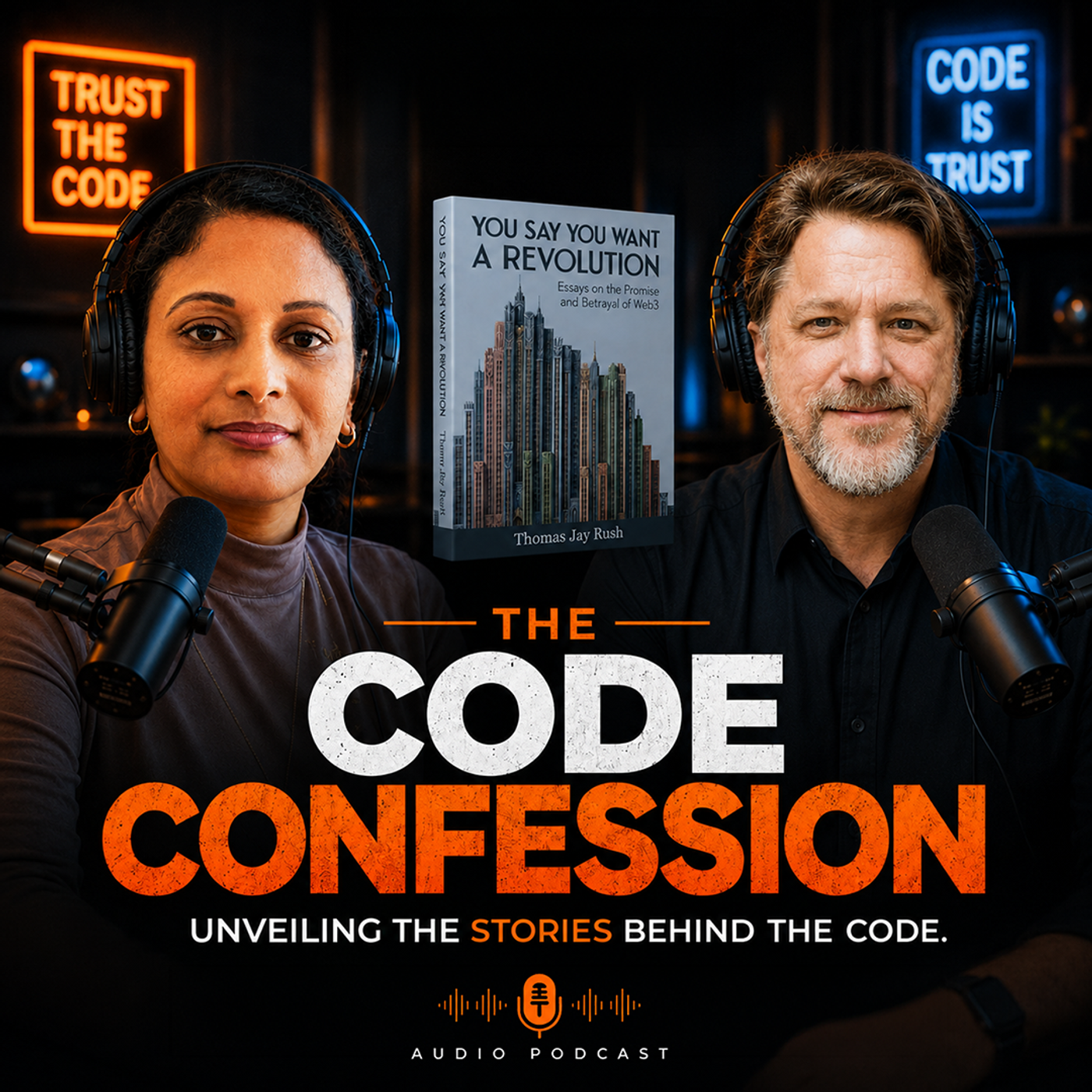
In this episode of the The Code Confession (TCC) series, we sit down with Thomas Jay Rush to explore the revolutionary potential of Bitcoin and the decentralization movement. We dive deep into the philosophy behind "You Say You Want a Revolution" book, examining how blockchain technology isn't just about finance, it's about a fundamental shift in how we organize society and value. 🌐 Useful Links https://trueblocks.io/ https://revolution.stonylanepress.com/essays/mantras-for-decentralized-open-data/ Grab Thomas's eBook on Amazon for a special podcast-exclusive price of $4.95 (normally $9.99) for a limited time! Link to the eBook: https://www.amazon.com/dp/B0FDZH542H 🎙️ Featuring Guest Speaker: Thomas Jay Rush: https://twitter.com/tjayrush 👥 ECH Institute Team Host: Pooja Ranjan – https://twitter.com/poojaranjan19 Podcast Producer: Akash – https://twitter.com/lookupforsky Coordinator: Meenakshi Singh – https://twitter.com/Meenakshiy2k 🕒 Chapters 0:00 - Introduction to Thomas Jay Rush and the TCC series 2:15 - The philosophy behind "You Say You Want a Revolution" 8:40 - Bitcoin as a tool for societal decentralization 15:20 - Tech vs. Culture: How blockchain bridges the gap 22:10 - The evolution of the crypto movement 30:45 - Challenges to global decentralized systems 45:30 - Future outlook: What's next for the revolution? 55:10 - Closing thoughts and where to find Thomas Jay Rush 📚 Additional Resources https://www.youtube.com/playlist?list=PL4cwHXAawZxrhbMXuCqMsCiwx1lwu_cNs https://www.youtube.com/playlist?list=PL4cwHXAawZxol9byqFxx_-mdfpZRehRks https://www.youtube.com/playlist?list=PL4cwHXAawZxr020waJCI0dZAfPAW2naK1 🌐 Official Websites • ECH Institute – https://echinstitute.org/ 💸 Support ECH Institute Donate: https://www.echinstitute.org/donate 📲 Follow ECH Institute X/Twitter: https://twitter.com/ECHInstitute Warpcast: https://warpcast.com/ethcatherders Medium: https://medium.com/ethereum-cat-herders Discord: https://discord.gg/H2eYpKCxxm #Crypto #Blockchain #Decentralization #Web3 #TechCulture #ThomasJayRush #ECHInstitute #Bitcoin
Akash Kshirsagar: Bitcoin showed us the path. It showed us that you can create a system that is truly fair, that cannot be hacked, that records its own history in its own self every block. It can be trusted perfectly because it doesn't have to be trusted. There's nothing to trust. It's just the math works and it just works. So I believe that this technology could be a worldwide economic system because it's that powerful. By the end of the ten years, I concluded that we Literally just built exactly what we had before, but it's worse because I'm transacting my money on this public thing. Welcome to the Code Confession. My guest today spent a decade building tool to make Ethereum blockchain readable from your own machine. He has received Ethereum Foundation grants, Molok Dow grants, and he is someone who really believes in something that can be sustained for 10 years or more. He holds a master's of fine arts and poetry and used to teach writing at a community college. His name is Thomas J. Rash. He's a founder of TrueBlocks and he has just published a book. You Say You Want a Revolution. It's a 75 essays on the promise and betrayal of Web3. We would love to hear what is in the store. Welcome, Thomas. Great. It's great to be here. Thanks for inviting me. It's been a long time that we had chatted, but it's good to have you here because I know you have been very closer to the governance and I assume that this book may have something in there for us to follow. I tried. Very well. I would want to start somewhere unexpected. You hold an MFA in poetry and an MS in computer science. Most people pick one lane. What does writing poetry teach you about writing code and vice versa? Well, I think that what happened to me is I was a a software engineer for twenty years. But I always read basically everything I could find and loved stories. I loved novels and short stories. So about age fifty, I said, okay, I I've been telling myself I'm gonna be a writer and I so I have to go be a writer. So I I basically quit computer science. I had my own software company prior to that. So I'd kind of put it on autopilot so the company kept running for the time when I was studying writing. And I just went and started studying writing and I found that I could not write a story because I just didn't have the kind of brain that would write a story. And what I found is that I could write poetry because that's just how my brain was. I was just I loved words, I loved wordplay, I loved sound. So about halfway through that process I discovered I'm I'm a poet. I'm not a novelist. But I always also wrote essays all the time. So I was doing that and I'm the kind of person who will switch from, you know, plan A to plan B on a dime. And now I'm going down the path to plan B and plan A is gone. I don't even think about it. So that happened to me with writing. And ten years after doing that, I kind of lifted my head up and I was looking around with my son. My son and I kind of got into Ethereum right at the right at the same exact time, right when the Dow was first starting. And I had spent a lot of time in the early web in like the nineteen nineties, really, really into the web because it had a lot of the same aspects as what I was hearing from the Ethereum or the blockchain community at the time, which is decentralized the information, share information. Everyone can be a publisher of information. And one of the reasons why I didn't care about throwing that away when I went to become a writer was because we really didn't realize any of those dreams from the early web two or web one days. So all of these concepts in web three were very familiar to me from fifteen years earlier, right? So when I heard of Web3 and I heard all these people talking about all this stuff that we were gonna change the world, it's gonna be better, it's gonna be a great place. I naively said, I don't need to be a writer anymore. I'm gonna go become a technologist again and I just threw the writing career out the window and went for that. And then I woke up ten years after that and I said, ⁓ my God, I just spent ten years doing this. I really love writing and I wanna be a writer again, so That's what I've been doing for about the last year or so. I get maniacally focused on something and I just stick to it. So yeah. ⁓ it's pretty interesting, journey, like back and forth from software to poetry, then poetry back to coding and then back to writing. What they have in common is revision. It's like I revise my code just as often as I revise a poem. I might rewrite a poem twenty times and I I might rewrite my code fifty times or something like that. So yeah. It's very similar work actually. Now I can see the connection here. Very well. Well, ⁓ I have met so many people who are mostly talking about the future of ⁓ technology, right? It's always good to go back and look into the basis from where we started. So talking to someone like you gives me a sense of like how stable we were and how thoughtfully we are ⁓ progressing. I'm curious you also taught students for quite some time. What was your discipline? Was it ⁓ poetry or literature? It was sort of essay writing. So a new college student has to know how to write an essay. So I was teaching essay writing. When someone asked you how to write a good essay, what would be your one sentence answer? I guess I would say be interesting, which is a silly thing to say, but you have to know where you're going before you start, kind of. You have to know what the last sentence is, maybe or something. What are you trying to tell me, right? And then back up to the beginning and say, give me what you're going to tell me right from the start, and then show me why, and then conclude. So that's that's the essay I was teaching then. My essays in this book are different because a lot of them are super technical. So I'm writing like software essays. And then some of them, maybe about half of them, are sort of me trying to express this enthusiasm or this ⁓ belief that we We actually do have a technology here, blockchain, that can change the world because it's so profoundly different than what we were doing up until that point, basically. So a lot of what I wrote in this book are essays maybe not the first year college essay that you might see, but I think some of the essays touch on poetic thoughts as well, which I kind of enjoyed doing as well, 'cause that's just part of my nature to do it that way. So which maybe is confusing to some people, but that's okay. This book contains seventy-five essay across ten years of your journey and that's a lot of public thinking outlined. I'm curious to hear what is that writing taught you and building software did not. Well, I guess the thing that is so different between the two for me is I mean there's nothing personal in my software, right? I mean, maybe the names of the variables I choose to use are personal because I might name a variable by my friend's last name or something like that for no reason at all, just because it's fun. But in the essays, I frequently bring in my personal experience because I want to start with a personal experience that's maybe outside of blockchain or related to blockchain because I want to ground it in something that people can understand without being technical. So the writing part of my blockchain experience is bringing a personal experience into why these things matter to me. You know, why do I care? You know, I'm sit one maybe one of the essays that didn't make it into the book is me worrying about my daughter watching ⁓ YouTube or or Instagram and you know, hearing news about how it's detrimental to children and I'm worried about that. And then I turn it to can we use blockchain to solve that problem? And and what kind of happened to me is I believed it the first two years that we had already solved the problem. Because we had this blockchain technology. But then the more and more I kind of sat a little bit on the sidelines and watched what was happening, they're building the I I concluded by the end, by the end of the 10 years, I concluded that we literally just built exactly what we had before. But it's worse because I'm transacting my money on this public thing. And if you think I'm exposed now, you think my child is exposed now, wait until those companies have Every single transaction I've ever made in my life. Because I believe that this technology could be a worldwide economic system, right? Because it's that powerful. So then I started trying to write about my, I guess you'd call it disappointment or my fear or something like that. Like we're not building the right thing. We have to we have to really think about what we're building because every time I turn around, there's a HTTPS in my behavior. I'm literally giving away this information about myself. And ⁓ I'm just the kind of person who looks at that and says, that's just messed up. That can't possibly be a good idea. So what happened to me is at the end of ten years, I kind of took a little bit of a break and I looked at these essays that I had written and I realized that what I saw there was my immense enthusiasm for the ideas the first two or three years. And then just a steady decline. This has gone the wrong direction. We we should and and trying to say that, I was fifty five years old and I learned that trying to say that in a community that kinda didn't want to hear it, you know? Because if we admit to ourselves that we ⁓ maybe aren't building exactly the right thing, it's gonna cost money to people and that's not a good thing. So it kind of started to get like that a little bit by the end. And then at a certain point I just said, whatever. I'm just gonna say what I believe to be true. So yeah, the the word betrayal in the subtitle of the book was not an easy thing to put in there really, right? And I don't mean to say that Other people are betraying me, right? That's not what I'm trying to say. What I'm saying is we are all kind of betraying this idea that we had back in twenty sixteen. We all knew what we were doing in twenty sixteen and show me where that is now. You know, I don't really see it. So yeah. Right. And of course we will get into the details of it. I understand this writing gave you an opportunity to include your personal experience and your Technology knowledge as well as some emotion that you feel for the community for for the people here. So let's get into the book right away now. So the first chapter is about the Tao Awakening. It all began in twenty sixteen. So we saw that there was a startup and it suddenly raised hundred fifty million in thirty days. What was it like to watch that happen in the real time? Maybe we can talk a little bit more about it and then we'll get into the later part of it. I think I kind of heard of Ethereum in December of twenty fifteen and there were just a little bit of rumblings about this thing called the DAO. I guess there were a couple DAO experiments prior to that. And then I was teaching as I said before and I kind of quit my job in January of twenty sixteen. And the next four months were the most incredible thing I've ever experienced because almost all of them were brand new ideas that I had never heard of. I had studied Bitcoin prior And I kind of understood Bitcoin, but when you look at Ethereum, it has this thing that Bitcoin doesn't have, which is programmability. So I'm a software engineer, I'm a programmer, I understand the DAO, what they're writing, you know, I'm I'm reading every line of the Dow code and it's open source, which is all new to me, all that stuff's new to me. And then I s met Griff Green, I'm sure you know Griff Green. And he was the I forget what his title was, the the nin the Dow Ninja Warrior or something like that. And he invited anyone who wanted to joined to try to use the Dow software before it was actually officially released on test nets and stuff like that. And I was doing that and it was the most insane, incredible thing that I've ever done. And just so exciting and so cool because all the things I knew from nineteen ninety two and nineteen ninety three and ninety four when the web was born were coming back, right? Okay. And then May first, twenty sixteen, which is exactly ten years prior to when I released this book, by the way. The DAO goes live, right? And one of the things that everybody said back then was it's a public ledger. So anyone can watch anything. And of course, me being me, I'm writing all this software that's trying to get data off of this node software. Right. And I don't think anyone expected a hundred and fifty million dollars in a month. I think everybody's mind was blown, right? And ⁓ just so exciting and so cool. And everybody was writing all this software and doing all these websites to help people understand what was happening and And then of course, seventeen days in or something like that, in June of twenty sixteen, the hack and by this time I had made a lot of friends in the space because I was active on all the boards and everything like that. And my friend Alexi from Aragon, he posts something that says something like, I think the Dow is being drained. And then he takes a train to work and he doesn't post again until like forty five minutes later. Yeah, I'm pretty sure the Dow is being drained. And it's like, ⁓ my God. And then And then just the most incredible thing I've ever seen in my life. You have this many billions or millions of dollars were on the chain at the time. I don't really remember the number, but they decide to fork the chain, right? ⁓ maybe a month or so later or something like that. A month and a half later or something. And they fork the chain and I wake up one morning and I have twice as many tokens. ⁓ I have the same number of tokens on one chain, the same number of tokens on another chain. And everybody just expected Ethereum Classic to go to zero immediately, right? But my son who was in it was watching the Ethereum Classic chain and he comes in, he he's like probably f fifteen or something. He comes in and he says, Dad, it's going it's going up. It's going up. Right? And ⁓ now we have these coins on both chains and one was like twenty six dollars, I think, and one was like maybe sixteen or something, right? So I have twice as much money as I had like the day before because the chain forked and just The concept of like this ⁓ you know, and prior to that I had a whole six, eight, ten, twelve months of this is gonna change the world. This is gonna be a worldwide economic system that my money could just double like that was cr just mind blowing, right? So just so excit it was just so exciting. Right. Yeah, and that was a crazy concept at that time. I believe people used to believe that, okay, if I put money on any chain and it goes for a split, I'm gonna have double the money. I I think that also happened with BTC as well. There was Chain split and same way we did it. Just crazy. Well, y that was one of my questions. Like were you invested in that? Like did you be a part of that? And yeah, good to know. And it also helped. Yeah, a little bit, but I mean we were not in a big way, invested in time, I would say. Yeah. So and of course we sold it way too early, not like a lot of people, but Nobody knew at that time. Exactly. So that was really exciting. Mm-hmm. But then I I think you asked me in before about what the kind of the the reason why Trueblocks was born. Literally I remember the minute that it was born. You know, after this hack, there were all these people who are super technical. They understand the chain, they understand the data. And they all wrote software, Python or, you know, JavaScript or something, that queried the chain, tried to create a history of what happened. Came up with basically what you might call an accounting of what happened to the ch to the hack during the hack, where the money went, who has how much money and or you know, who has how much coins in the DAO. And three different people that I truly respected because they were just brilliant ⁓ data people. They honestly just reported three different numbers. And I'm like, I'm like, how is that even possible? I'm like, why is that? Why did that happen? How did that happen? So then I dug into that code. As deeply as probably anybody on the planet, I think. And I I kind of had to understand how this thing that we knew was perfect to eighteen decimal places and public could come up with three different answers to the same question. And and that's when TrueBlocks was born, because I'm like I'm not like I can do better. I didn't say that. I said I don't understand why it doesn't work. I have to kind of figure out why it doesn't work. So that's what Trueblocks is or was, or you know, that's what I tried to build with Trueblock. Yeah, I I noticed that it was mentioned in the ⁓ essay summary there that on seventeenth June, sixty million dollars disappeared and you mentioned that it was very difficult to comprehend that why three people vary with their opinion when they are looking at the same letter. So that's a very good beginning of the project. Maybe you can talk a little bit more about it and share what does TrueBlog do today. And ⁓ how does it work? Okay, I'll try. It's co it's kind of hard to explain. And ⁓ and I'll tell you what, these essays are literally me trying to explain that problem. Kind of. So we all know what a transaction is. I send money to a smart contract or I send money to my friend or something like that. And that's very obvious and very easy to see. And we all know about logs on the chain where you know, when something happens somebody throws a an event and we can read the event and look at it. And The reason why these three people all had different views of what happened was because there's something called an internal transaction. Or it used to be called an internal transaction, where I might send a transaction to a smart contract and it might send money to someone else. So it's kind of inside of the operation of the smart contract. Or I might send an address to a blacklist or something on a smart contract. And that would preclude me from participating in some process or something. And maybe the writer of the smart contract didn't think to send an event in that case. So you get all this behavior that's happening in the operation of smart contracts that isn't in event data and it isn't in the top level transaction data. It's what's called a trace. Okay. So and if you were looking at the geth software back in those days. The traces were extremely low level. They were like very, very, very low level. And those three different people were kind of treating them in an ad hoc way because there was no real definition of what it meant. It wasn't a formal definition of what the tracing was. The tracing was just something that fell out of the software, maybe for debugging purposes, but it wasn't really ever designed to be something that came out for accounting purposes. So there was all kinds of differences between what those three people did. And that's what I kind of understood. And then my solution was: well, the first thing I need is a list of every single place on the chain where any address appears. So I call them address appearances. And that is in top-level transactions, in logs, and importantly, in every trace. And it took me like four or five years to kind of get to the point. It's actually impossible to answer that question just because of the nature of hexadecimal data. It's just literally not possible to do. But I created a system that was much better than what I think most people have created, to be perfectly honest. Because I was able to get to the point where I could accurately report on every transaction or every every transfer of every asset, which was the thing that I was after was if you want to have a worldwide accounting system. You have to know about every transfer of every asset. And that and that was why I always was so focused on eighteen decimal place accurate, you know, perfectly balanced. You have to know from one transaction to the next exactly what your balances are in every account. And it took five years and then I said, Look at this. And it total silence. Total silence. I mean, not really. I got Ethereum Foundation grants and stuff like that because I was doing something I think that people understood was important. But ⁓ everybody else was like, ⁓ look, I can go to this website and download my transactions and I get my accounting for my taxes and I even did that because I wanted to see what that looked like. And I did it one year and I paid like three thousand dollars or something. And I found a mistake using TrueBlocks within like five seconds of of downloading their data because they never solved the problem. And the and then I'm like getting really disillusioned because it's like, what are you building if you're not building a perfect accounting system, right? Then that's perfectly all right. So one funny question on ⁓ true block. How do you say it is fundamentally different from any other explorer? Like what would you share of f with our audience why they should use TrueBlock? Well, it what it does is it goes into every trace. Okay. And by doing that We're looking at every time an address appears on the chain in these traces, we're recording that it happened, that something happened. We don't record what happened because if we know that something happened in a transaction, we can always query later when we decide that we want to query for that address. ⁓ and in that way we get a system that works on a small machine. Because all we do is record where things happened and then Later when you tell me it's your address that you're interested in, you can query and find everything that ever happened to you on your machine. And I can find out everything that happened to me on my machine. So TrueBlocks does that. It it finds everything that ever happened. And by doing that, it creates a perfect accounting for where the assets were transferred. And now the trouble with all of this and the thing that there's an article in the book called the 10 worst ideas of TrueBox. And one of them is that we decided that you had to run a node. You had to run node software on your own machine. And the reason for that is because if you want to dig into the traces, you need the speed, first of all, you know, so if it's running on your own machine, you're not competing with other people to use the software. So it's way, way, way faster. And the other thing is the Web3 API companies decided about five years ago We're not going to give you access to traces because it's so onerous as far as if you want to query traces. It's such a heavy burden on their system that they just stop doing it. Or they sell access to the traces. So, you know, now I'm on this ride where I'm saying we have a worldwide accounting system that anyone can see. If you pay web two companies to give you access to their traces, or you have to run your own node, which is a nearly impossible. So then I'm starting to get a little bit like, all right, what I'm gonna do is I'm gonna write up everything I've done, I'm gonna write it down so somebody can see it in the future, and this isn't gonna work. So that's kinda what happened to TrueBlocks basically in the end. It worked because I could do a perfect accounting on any address. It worked, but it had to be on my machine because I was running a node and I was had all the software and stuff. So who do you say would be the ⁓ the right user for TrueBlocks? Is it everybody or people who are way more interested in accounting part of it? I've always used the word accounting, but what and that always has financial data in it. But you can actually account for smart contract state changes with our system. So in the very, very beginning, when I believed that we were going to change the world, it was because we were going to create systems or companies or organizations where anyone could look into every state change in the organization, not just the money, but You know, the voting power, the voting, the the groupings, anything you want. And you can only do that if you know every transaction, if you know every place where something changed. ⁓ so I always use the word accounting, but I shouldn't probably do that. I should use some other word that accounts for state changes, not necessarily financial changes. And that's why I was so excited in the Dow to begin with, when we all believed that you could get perfect access to the data, because we were going to create an organization that was completely transparent. And ⁓ if you have to pay web two companies to get access to traces, you don't have a transparent system. So, you know, it never made sense. Yeah, ⁓ I think ⁓ account is good in a way because we still talk about account abstraction, so that makes sense for people who can relate it. Well, ⁓ your book says ⁓ the Tao Awakening and you call it as like a founding trauma. That is kind of strong word trauma. Do you still feel it that way after ten years? It's like the greatest thing I ever saw in my life, kind of. And it crushed this belief that I had that we could fix the world. Kind of. But like the technology itself is still as great as it ever was the first day if we actually implement what we what we believe we're building. Ten years later, I've seen so many other crazy things. I'm not sure it's still the right word, really, because it was it was a huge event, but compared to some of the other things that have happened in the space, you know. FTX and so forth. Maybe it's not as big a trauma. And especially for people that actually you know lost something significant. I I didn't really lose anything, so I don't know if I'd call it a trauma at this point. Right. And and in the later part it was mentioned, again, there was a bold claim that RPC is not enough. For someone who uses every day and thinks that everything is fine, how would you say that's not enough? Well, the RPC ⁓ is great for what it does, but If you look at the documentation for the RPC, the trace the trace endpoints for the RPC are not standardized. They kind of are de facto standardized. So most of the node software has the same things. But especially when I was writing probably that one thing that you're referring to, there was only one node software that had these additional trace remember I said that the Go client, geth, had this very, very low level. And then there was another client called Parity that had what I call the trace endpoints. And the trace endpoints that Parity have have sort of become the de facto standard, but it's not part of the documentation. There may or may not be testing against it, but it's not like a requirement of the protocol. And I believe that the tracing is what's necessary to get every appearance of every address, which I believe is necessary to build applications against the software that are not reliant on some big data. provider. I believe that if you had a node software that gave you access to every appearance, the software that you could write would be amazing because you're on your own machine and it's very, very, very fast. And that's what I tried to do in the sort of last two years of my grant work was to create applications on top of this enhanced RPC that I built. So I added indexing to the RPC, sort of. I didn't add it inside the software. I added it out outside the node software. And ⁓ by doing that, I was able to build applications that were really amazing. And I made a bunch of videos that you can watch. ⁓ maybe we can link to them in the in the show notes, where I'm literally pulling every possible thing that happened on my own accounts, ⁓ all my NFT purchases, of which there were maybe ten or something. Every transaction I ever got, every grant I ever got from Gitcoin, all the ENS stuff I ever did, all in a single application on my local computer, which if I wanted to go and review my own Gitcoin history, I'd probably have to go to Gitcoin. If I want to review my own ENS history, I'd probably have to go to ENS dot com or something like that. And those are web two companies. So I wanted to build a web three, a pure web three on my desktop access to myself. And by the time I got to the end of the grant, ⁓ that's what I had built. And of course it was nearly impossible to run and very hard to install and Because I was a small operator without a whole team and because to get a team you kinda have to get a V C. To get a V C you're gonna have to show how you're gonna make some profit off of your, you know, users or something and it just wasn't appealing to me. Permissionless accounting in a public goods way. Yeah, exactly. And and that to me was what I found when I first came in the space in twenty fifteen. That was exactly what we I thought we were building, right? Yeah. Right. And I understand at the time there were many other founders who were trying to build the same world that people think of. A perfect world where we can have all these information easily accessible and everybody is there responsible for maintaining it. I was ⁓ looking into ⁓ the blurbs that has been added on your website with respect to the book and Rotke founder Leftarysis. He mentioned the users won't the data or the whole thing was pointless. Is that the one sentence version of True Block Philosophy or would you have different version of it or want to push it back? Pretty close. He and I connected completely. I met him first during the DAO 'cause he was a developer on the DAO. So I was probably reading his code and I was like, you know, talking to him about his code. So we've been friends for a long time. And ⁓ he built a piece of software that had this exact same thing that I was talking about, which is, you know, on your desktop. It's gonna run against now I think he originally said to him it's going to run against a local Ethereum node because I think he understood exactly like I did when everybody first started using Ethereum you had to download the missed browser. I don't know if you remember the missed browser. And what happened when you started the missed browser was it started geth. And there was a reason for that because that's decentralized. Right? So he knew that. He understood that right from the very beginning. And he ran into the same problems. Like why do we not have access to the data in a way that makes it so I can he wanted to write an accounting software that was on the desktop, which is kind of exactly what I was doing. He was lucky, I'll say it this way, he was lucky that he didn't stick to running a node software, right? Because I can download Rocky and not have a node on my on my desktop. ⁓ and he gets users because he makes that you know, he took that compromise and it's perfectly fine. But ⁓ Somewhere along his process he said, I'm not going to write an accounting software anymore because I can't reconcile the data. So he doesn't even call himself accounting software. He calls himself a portfolio manager, which is I'm going to show you the front of chain balances of everything. And he has some processes in his code where he tries to reconcile and produce you know, profit and loss and balance sheets over time. And they're not accurate because they can't be accurate, because they don't have traces, because they didn't find appearances. Right? And he and I talked about this a thousand times. So and he kept saying to me, he understood what I built. And he's like, How can I use this? And I was like, you know, it's all documented, you can try to use it. But it was it was like too much of a effort. I was making all effort all the time and trying to support users was a little bit past my skill set. So But anyway, he's great and ⁓ his idea is right. It's correct. Because Like I was saying about my daughter, if I can't have a system where my daughter can interact on social media without being exposed to things that are to her detriment, that's a terrible system. And we're building a system where it's more obvious what she's doing than it was before because everybody can see this chain. So when he says, you know, your own if we're not if it's not your data, then what are we even building? It's like, yeah, exactly. Right. And and then I would push back against that and say, Where is that happening? Show me where that happens. Nowhere, nowhere in the space does that happen. Except for the few people who are running nodes and trying to write software that runs against a node software. Because I think in the end that's the only way it can possibly work, to have your own data is to never give it away. You basically never give it away. Because you protect yourself behind the node software, and everything you do externally is private. Unless you choose to let it out, but then that's you choosing to go out. So yeah, it's close. It's close to what I built. I would also say be accurate would be the other thing. You know, eighteen decimal place on chain. Why not eighteen decimal place off chain? Eighteen decimal places. That's that's like precision. I mean it's like probably nine decimal places more than we actually need, but that's that's fine. That was a choice somebody made, so Yeah. I I understand like at this point as well, crypto accounting is something very complicated, it's a complex subject. So I'm very much appreciative of all efforts in this direction because the way ⁓ adoption is going on, we will soon reach a point where everybody would need accounting software so anything that can help manage that. That's right. I I think the best part of talking to people ⁓ who are kind of OGs are like we we learn about something that most of the people may have forgotten about misbrowser, about parity clients and There is a history behind whatever is here today in Ethereum and all of these are contributors. So it's always good to hear backstories about them. Yeah, and I kind of accidentally produced the history because I was writing a monthly blog. Right? This was all a monthly blog. So I kind of got to the end of ten years and I said, Wow, look at this. It's actually a history of what was going on. And you can see the progression of Ethereum through these essays. Yep, that's interesting. Well, let's talk about another section of your book which is the long grind. I think this section will be for all the builders who have shipped a public good and watched it go unused. I I think they would be in a in a position to maybe relate it with this section. So if you are writing grant reports, you have growing doubts and the title of the section comes down to one question you keep circling again and again in the book. That is the tool work. Where are the users? What? Did the PDF actually feel like from inside it? Yeah, it's a very interesting question. And if you had asked that of a regular person, they would have a answer like, ⁓ it was really hard, or something like that. But I think I have something about the way I internally think. I didn't even pay attention because I was like so down the rabbit hole into what I was building. And it was important to me that, you know, I was saying all these things in the world. We should do this, we should do this, we should do this. I could I couldn't say that and not write the code, right? So I I was down in the code. And I didn't really lift up, I didn't look up until ten years. And that's kind of the way I am, sort of. I learned that when I went and did writing or poetry for ten years. It was the same, same exact thing. And I I ⁓ probably when I was thirty, I would have said, That's a bad idea. But by the time I was fifty, I'm saying if I don't do that ⁓ then that's gonna be a bad idea. So that's why I went and became a poet, right? Because I had always wanted to do that and I just had to do it. And the same thing here. I I got captured by that beautiful idea at the beginning of the DAO where we're gonna change the world. We're gonna make the world better. And ⁓ I my head was just down and I didn't I kind of I knew that I didn't have any users or very few if any users. I knew that a lot of the things I say were saying was kind of off the beaten path perhaps, right? But I didn't like I didn't think past that maybe I guess. Mm that's interesting. I think Ethereum is built because of passionate people like you. Like we don't think about users. We thought about the problem and trying to find a solution. Users will come across. Yeah. But then you see like all the web two I'll call them web two solutions come and they're simple to use and they're straightforward and they're very obvious. And ninety nine point nine nine nine percent of all users are gonna use them. Because they're easy. And I saw this happen with the web one as well, because back then everybody was supposed to run a server and you were supposed to serve your own data out to people. And ⁓ it was just too hard. So people just used these applications like Facebook and so forth to share their own data, basically. Not realizing that they're giving away their life secrets, basically. So Yeah. I'm surprised at my own self for not having known that that was gonna happen from the beginning. I I blindly fell into this, you know, belief system that difficult to I mean you were always an educator, ⁓ someone who believes in software and tried to teach things. You were not a businessman in the first place, right? That's right. No, never. Yeah. No. I'm not I'm not a businessman, no. Never, never. Right. Yeah. Well well you have received multiple grants, grants from Ethereum Foundation, Molong Tao as you have already mentioned. But s adoption still did not follow. Obviously your research was sponsored, your research was supported. When you look back now, do you think TrueBlock had a product problem, a distribution problem or problem with the ecosystem? Well, it absolutely had a product problem because I required people to run a node software and that was just way too hard of a burden. And for one of I I think the first grant I ever wrote was I'm gonna study how to put indexing into one of the node softwares and I worked with Alexia at Aragon for about a year on that. And ⁓ I probably could have done it if I had more ⁓ more of a forceful personality, I guess I might say. You know, I didn't ⁓ you know, if you if you have a team of ten or twelve or fifteen people and fourteen of them are all working on us on the same thing kind of and then you have some guy over there's like we should do this, right? That's a tough sell. Right. So I never got it into the node software, but I was able to write a specification that basically said, if you were to put it into a node software, this is how it might work. I didn't say this is how it has to work, but just here's a suggestion about how it might work. And that specification didn't make it into my book because it's literally as long as the book. So I'm I'm gonna try to write a second book that kind of gives a like a super technical explanation of how one might do what I'm saying you could do. Because I think that's a little bit of a missing piece behind TrueBlocks. Even though it's already written, I just wanna put it in a book form just to have it at Amazon so anybody can get it kind of. By the way, if you're enjoying this ⁓ podcast, buy my book. Of course. We are gonna share our links where people can go buy it directly. This book is especially good for people who aren't aware of Ethereum history because as I'm proceeding through the essays I feel like there are so many things that I myself was not aware of being in this ecosystem for over a decade now. Like ⁓ around twenty sixteen, seventeen I also be interesting for like our future generation. Yeah. Thanks for documenting it. Yep. Well ⁓ moving on to the next part of it. ⁓ I As I mentioned that I was going through the comments that is added on the website. So Kevin Owaki, the founder of Gitcoin, he wrote that Ethereum wasn't built in a straight line. It was a messy and contradictory. So do you think the messiness of the ecosystem protected TrueBlocks from competition or is it the messiness that kept the user away? What kind of messiness is he talking about here? I think it's the node software is is very, very messy. I mean it's it's excellent. at what it does, which is keep the chain moving forward. Excellent at that. Of course it is because it's been working 10 years without a failure, right? It's a it's an amazing piece of software. But it has a second function. It has that's its main function is running the chain. The other function is delivering its data. Okay. And I think that part failed. So that part was super, super messy, the the delivery of the data. And we can see that in the three failed reconciliations of the DAO, right? And in steps all these web two providers to solve that problem through web two mechanisms. So that all all that stuff was messy. It's like the the people who built the node software built node software to keep up with the chain. And they did a perfect job because it works and it's perfect. But they did a poor job of the RPC, which is the delivery of the data. And that's where I think the messiness came in. Because even if you ran the node software on your own machine. You couldn't get the data. So it was useless to run if you wanted data. So yeah, I think it was very messy in ⁓ TrueBlocks itself because I required the node. But really in the RPC, I I think that's where the the effort wasn't focused. And I can make that claim because the RPC has basically not changed since the first version. It's basically the same exact thing. It might have had little tweaks here and there. But and and I haven't really paid attention to it in the last ⁓ probably two years or so. So I don't know if it's changed since, but ⁓ it's just a clear indication to me that they don't even think of the fact that people have to run the node software if you want to have your own data and if you want to protect your own self, right? So it's very messy. Very, very messy. Yeah. Yeah, it sometimes feels to me like you started way too early. At that time not many users were there who would care about data, who would care about these transactions, but I think this is the time when people do Well, I think, you know, it's so interesting as these banks start approaching this thing and ⁓ you know, stable coins become the sort of the the thing we're going to put on the chain. I think it's infinitely more important now than it was then because we're gonna build a system That's only run by the banks. And if you think the bank is gonna change the code in a way that protects your privacy in ten years, you're crazy. You're literally crazy if you think that's gonna happen. There's zero chance that if the banks take this thing over, that they're gonna put privacy into it. None. I mean people are still hopeful with ZK and other privacy layers that are coming up, but yeah. Let's say the banks don't have ZK in it until it's ready. Which you know, maybe three, five, ten years or something. And then the ZK guys come along and say, Hey banks, do you wanna put this in there? And they're gonna say, No. And and there's not gonna be any recourse because they're the only ones running this system that's so you know, worldwide. It's just this is I can kinda ⁓ unfortunately I can see the future. Umf ⁓ unfortunately. So Yeah, no, you're right. You're right. People say that. Yep. Yep. Well, let's move on to the most interesting part of it. You say that essay on the promise and betrayal of web three. So let's talk about the prisoner's dilemma. You write that the machine learns to talk while human keeps defecting. What does defection look like in Ethereum ecosystem specifically? Who is defecting from what? Well, this idea of the prisoner's dilemma was always right at the very forefront in the very beginning for me, right? Because if you look at just Bitcoin it encourages people to participate with their own skin in the game. You have to put a machine on the network and you're participating in trying to compete for creating a block. Right? And that solves the problem of how do you get people to run node software? You get them to run node software by creating a system that encourages them to run node software in their own best interest. And it worked, I think see one of the things that happened to me, I I found Bitcoin and I didn't understand it at all. And I read everything I could read about Bitcoin going back all the way to like nineteen seventies, right? Every paper I could find. I read probably a hundred and fifty papers. And all of these technologies were there. Nineteen seventies, nineteen eighties, nineteen nineties, blockchain came in nineteen ninety-one, consensus algorithms in nineteen eighties, cryptography in nineteen seventies. They were all there. In fact, on the first paper ever written about cryptography, In the introduction, it says this could be used for digital money. That's in the first paper. So everybody knew it could be about money, right? And it doesn't happen until 30 years later with Bitcoin. And why did it happen? Because it encouraged people to participate. And it gave a system that couldn't be cheated. And the fact that it couldn't be cheated is directly related to the prisoner's dilemma, where if we think the system can be cheated, we cheat. Because we know that if they cheat and we don't or defect, if they defect and we don't, then we're at a disadvantage. And we we know that. And we know it intimately in everything we do in our lives, I think. So Bitcoin comes along. I think it literally solved the prisoner's dilemma. And I think that Ethereum Wanted to think that that's exactly what it did as well. Now Bitcoin in the end didn't really work quite right because two people produce all the blocks, so it's a little bit of a disappointment in that way. But the idea of the prisoner's dilemma was at the core of why blockchain was interesting. And it's not a coincidence that it's money at this point, because money requires us to believe that the system is fair. And we look at Bitcoin and it's mathematically truly obviously fair. So we join the system and we Want to participate. And that's why Bitcoin rises up out of nothing to become a worldwide currency. Right? I I think. These are my opinions. I'm just saying this, right? And that's what I thought when we first built the Dow. And then what happened with the DAO, little I don't think a lot of people remember this, but about three weeks before the DAO was published out to the to the chain, they added a feature called a curators to the DAO. And this established five or six individual people who could sort of negate a transaction in the DAO. And I think that literally just dematerialized the prisoner's dilemma solution because I became an outsider that's not one of the privileged few. So I it took a little chunk of my belief out of it. And then the DAO fails and We're lucky that the curators had some access that maybe they wouldn't have had if they hadn't been given that special privilege and they saved us. I'm paraphrasing them kind of filling in details that may not exist, but ⁓ that was the perception, right? That ⁓ my God, we're so glad we had these special privileged users. And now every DAO has to have special privileged users from now until the end. And we never got back to the place where it was like the whole community has to participate wholeheartedly. Which they will participate wholeheartedly if there is no special privilege. The prisoner's dilemma was always something I wrote about all the time because I thought that's you know, I I think that these cryptocurrencies, they rise up out of nothing. They come out of nowhere because people believe that they're fair. And you know, if you look at like almost everything happened, all the hacks and all the money and all the crazy nonsense happened in the web two part of that thing. And the chain itself had a couple bugs here and there, but You know, all the stuff that we f hate about blockchain happens in the web two part because some guy has a key laying on his computer or some g you know. So ⁓ yeah. To me that was always the most important thing was the solution to the prisoner's dilemma because that I think that's why money rises up out of this thing out of nowhere. And that and that's what was so beautiful to me. And then I just watched it not happen the whole the whole time through. So yeah, prisoner's dilemma was a big deal for me. Right. I mean I am loving all these stories, I'm sure for people who would read the book overall will enjoy a lot. Yeah. I'm going to touch base on a couple of more points. Like you mentioned when the cryptography paper was there, they mentioned it could be used for digital money, right? Similarly I find that in the book it it mentions that the code remains wanting for dreamers who still believe the original promise was worth keeping. And that's kind of remarkably hopeful ending. Where does that hope come from? Math, I would say, because that's what Bitcoin did, right? Bitcoin showed us the path, you know. It showed us that you can create a system that is truly fair, that cannot be hacked, that ⁓ records its own history in its own self, every block and is publicly available and it can be trusted perfectly because it doesn't have to be trusted. There's nothing to trust. It just the math works and it just works, right? So that's where the sort of optimism comes from because that idea it's never going away again. We know it's because it's a fantastically beautiful idea. Right? Now we're gonna bump along and make this messy nonsense that doesn't work and doesn't work and doesn't work. And then eventually maybe three generations from now, the AI will help us figure out that it this is how it should work, hopefully. Right. Yeah, ⁓ I think For audience who may not be aware, we did have a podcast with ⁓ Ali Benson from Stock, where he also talked about a couple of ⁓ similar concepts. Math is there behind everything here, which gives us the hope, which gives us the positivity that it is going to happen. It's certainty that we are looking for. Yeah, I think that's the fundamental thing that you can't take away, right? That you know, all the people that worked on all this stuff through fifty years and came to Bitcoin, they showed us how to do it. And and that's the really beautiful thing, I think. Indeed, it is beautiful. Well, if someone listens to this episode and goes straight to the book, which one of the seventy-five essays is the truest version of what you believe right now? And which one did you write that you are not sure but you still agree with it? This is the book, by the way. ⁓ I guess like ⁓ there's two essays at the very, very end. One is called The ten best ideas in TrueBlocks, and what is called the 10 worst ideas in Trueblocks. And ⁓ I believe them both equally because perfect accounting off chain to me is just such an obvious idea. If you have perfect accounting on chain, you have to have it off chain. And and usage to me becomes obvious to everybody if you get perfect accounting off chain. Because it's cheaper, it's never wrong. You don't have to hire people to reconcile things. You can save ⁓ you know. trillions of dollars on accounting software or whatever. And then the the worst idea is asking people to run node software. Especially node software that has an inadequate RPC. So and I believe that that's true too, right? That was a bad idea. I mean to me it was the only idea, the only way it works, but getting other people to run software is impossible. Unless you pay them, which Bitcoin did. And I was never gonna put a coin on anything I did because I just saw all this nonsense related to coins. I I bought a very early ICO and within like a month the guy spent nine million dollars on some some licensing deal or something. It's like what the Yeah. So it's I guess all the essays are just kinda pointing out that there was this beautiful idea that we fell short on. And I I'm not like criticizing people because it's hard. But ⁓ I'm just laying it down on paper so that, you know, three generations from now somebody can pick up something, maybe learn something or think about something. Yeah, I think that's ⁓ noble thing that you're doing right here, documenting all of these. Well, ⁓ the last section on the website is about the island. So when you look back what was built, the grant report, the mini DAP framework, and ⁓ in retrospective, what is the most honest moment? How do you feel about it? Well, I'll tell you what, I met the most amazing people, just every single person I met in this space. The space is so amazing because it's math and it's Something that no one's coming to by accident. Like they come here because they're fascinating people that want to understand something that's fascinating. So if the only reason I built Trueblocks was to get to meet these amazing people and sit in a room with them and talk to them, not about Trueblocks, but about all these ideas that we're talking about, I'm so proud of having done that. I don't I no regrets whatsoever. I built a software company thirty-five, forty years ago on the web. And I had users and it did okay. It never was a blockbuster or anything like that, but it provided my my income to for my you know, partial. My wife worked as well, but I understand what it means to have users. So I you know, I kind of didn't really care about users because they're a pain in the ass, to be honest. So yeah. I I feel like I'm very proud of what I built and I wrote I wrote a document that explained it as best I could and yeah. Yeah, if I can maybe ⁓ pick your brain a little bit more on on the same topic here. For for someone listening right now, suppose he's a developer and he's ⁓ three years down the line building the public good but nobody is using it. What do you actually have to say to them? Yeah, I think I know this is probably not what you want to hear, but here's what I'll say, okay? You have to understand your own head. Like I understood my own head when I was fifty years old. It took me that long. And I went to become a poet. And then I understood my own head that I wanted to do open source software for the public good. And these are the two best things I've done in my entire life, right? So that was right for me. And I no regrets whatsoever, none. You know, when I was thirty and I was worried about my kids and stuff like that, maybe it's not really possible for me to do that. And then I might have said, Well, this isn't working. I need to get users to pay for my software, right? So it's kind of a And each person's gonna be different because different people are different, right? Different people like me are just gonna do it because that's just what it is. Right. I'd say be yourself yeah, do what you know you're gonna do anyway. And just d don't be second guessing yourself, I guess. Yeah. And we need a lot of passionate people in order to build some robust ecosystem for our next generation. Yeah. I'm also very proud of being part of Ethereum Cat herders for this long I believe that the community has given A s a lot. I have learned a lot. I I get to meet so many people which I would not have met otherwise. Yeah. Right, no, no. As a one of these adients. Yeah, yeah. And it's a great community too, because it's not a ⁓ sniping at each other like Bitcoin might be, right? It's a very supportive community. ⁓ always has been from and I think that comes directly from the th ⁓ from ⁓ Vitalik. 'Cause he's I've never seen him one time say anything like argument you know, he He says what he thinks, but he's not argumentative or sniping at people, which is great. I think it comes from there. So yeah. Yep. I mean I have seen how many of his proposals did not go through upgrade. So it's not that he's gonna dictate Ethereum. So yeah, right, yeah, exactly. Right. Well, ⁓ that's kind of conclude to our major section of question answers and what we want to get to know about the book. I now have a few rapid fire questions. Just for fun. Okay. Alright. So we try to get what you think about it. It could be one word, one sentence, or whatever that comes to your mind first. The Ethereum upgrade of folk that changed your thinking the most. The merge. And I think as part of that they changed the reward. They didn't change the amount of the reward, but they burned half of it or or something. I never quite understood exactly what happened there. But I think what happened is the miners got half as much reward as they were getting. prior to that thing. And this is a perfect example of the power of the developers to literally dictate. And and that same thing happened in Bitcoin where the the system itself dictates what they're gonna pay for the service of security. And that was a really powerful thing to see, right? And the miners had no choice. They just said, ⁓ I'm gonna still making money. And that is another example of the prisoner's dilemma where we know that as a group We can dictate the price and we're all working together as a group to decide on the price that we're gonna pay. It's not a competitive environment about how much we're gonna pay. So that to me was a perfect example of a group dynamic where ⁓ you know, the the group decided what the price was gonna be. So that probably sticks out to me as the most important hard fork, I think. Yeah. And ⁓ just for people to know, I think we are talking about the Lannan upgrade where the EAP one five five nine was deployed. It actually ⁓ managed ⁓ miners incentive and in the merge we moved from proof of work to proof of stake. But yes, that was like fundamental in in this direction. Nobody has thought that it is very much possible. And I remember the time very clearly because ETH cat herders, Ethereum cat herders were Talking to miners, talking to developers. That's where the name that maybe the name came from. Yeah. Yeah, literally that's what we were doing. I remember that. Yeah. That was so fun. Yeah. Well, ⁓ my next question is, ⁓ the tool in the ecosystem that you wish you would have built if not the true blocks. I guess I'd say two probably, like Gitcoin or Giveth. Like those to me were always I mean they were messy too. Very messy. Like crazy messy but ⁓ Gibbeth especially for me was really, really special. Really special. Because it was from the very first minute it was about the group dynamic, really, right? And that was always really amazing. And you know, and it it it's a bump that's a bumpy ride that the Gibbeth. So I was a little bit involved in a lot of that stuff. Not not intimately involved, but I was friends with Griff and everything. And ⁓ that that probably is the thing because he so consistent He's just gonna build something for the public good, basically. So yeah. Maybe that one, yeah. Yeah, and both are doing great. I know there are so many projects which are surviving, which survived because of Giveth and Gitcoin grants. Yeah, totally. Me included. Me included, yeah. Yeah, cat herders too. Yeah, yeah, yeah. That's right. Yep. All right. ⁓ Something that you would like to add to the book if you were writing it today. I'll I'll I'd come back seventy-five years from now and I'd write a essay called I Told You So. That's an interesting name as well. Well, anyway, we got glimpse of your next book a little bit. So we are hoping that you will come back with more. Well, my next book is poetry. Awesome. Yeah. Awesome. Cool. Cool. That's really wonderful, Thomas. We love this discussion and thank you so much for taking out time and talking about the book. So any message or anything special that you want to share with our audience? Math is gonna save us all. That's what I would say. Interesting. Yes, math is important and it is going to save us all. Thomas J. Rush, founder of TrueBlocks, Poet, Engineer, and now the author of 75 essays that documented what it costs to believe in something for 10 years. The book is you say you want a revolution. You can find it at revolution.stonylanepress dot com. We will share the link in the show notes. Thank you TJ for being on the Code Confession.