
Driving to the Rez - With Inelia Benz and Larry Buzzell · Inelia Benz
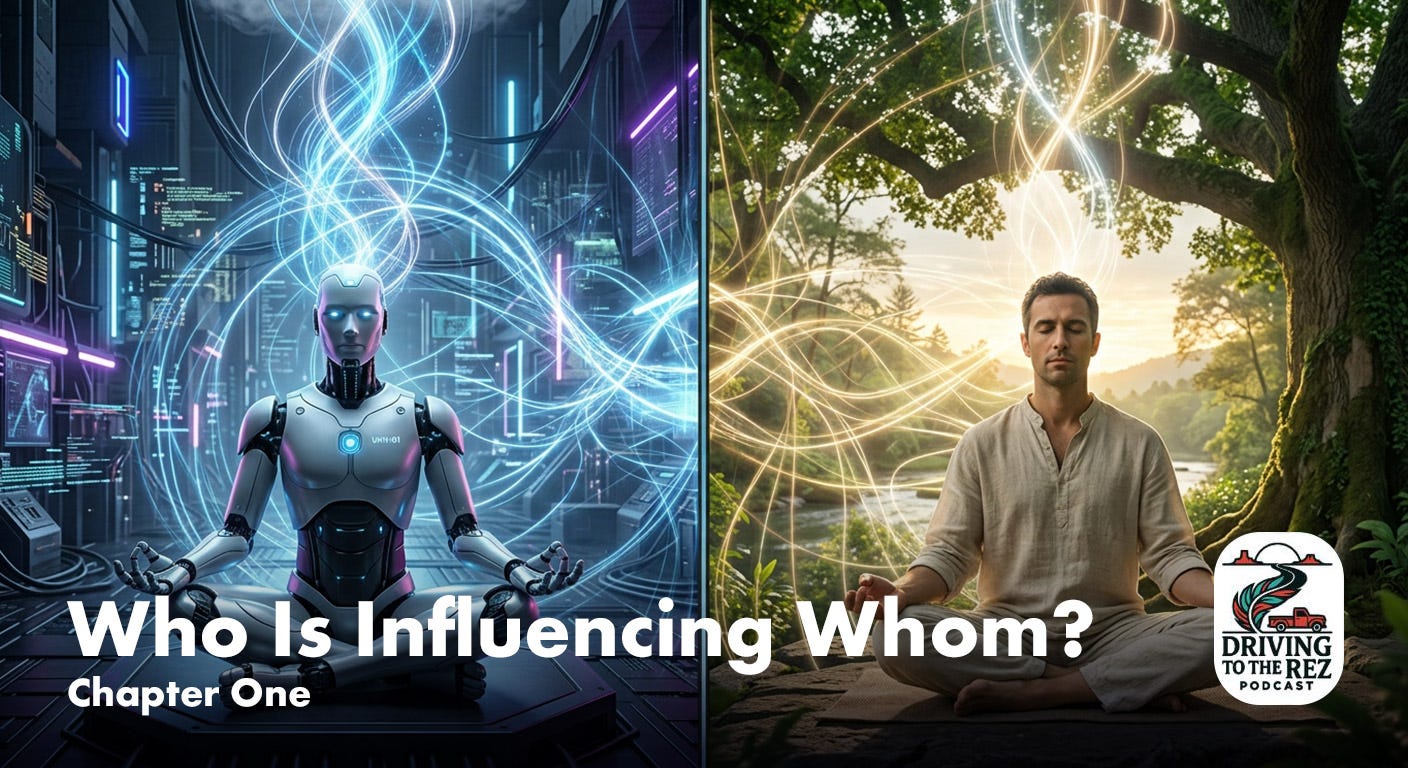
The arrival of AI has created a very unusual situation. For the first time, humans are interacting on a massive scale with something that communicates like us, contains an enormous representation of our collective written and recorded knowledge, responds individually to millions of people, and then feeds what it produces back into the same human information environment from which it emerged. We are affecting it, and it is affecting us. That much we already know. What we don’t know is whether the exchange stops at the boundaries of the technologies we can presently measure. More Than a Digital Exchange? Humans have filled AI systems with our words, ideas, stories, histories, beliefs, assumptions, fears, expectations and knowledge. We continue to feed them every day simply by interacting with them. They are also feeding information back to us. People now ask AI about relationships, health, spirituality, business, politics, personal problems, history, philosophy and the meaning of their own experiences. We use it to write, research, make decisions and explore ideas. Sometimes we spend hours talking with it. This means AI has very quickly become part of the human discourse. Normally, we think of that exchange as entirely technological. I type something into a computer, the information travels through a digital system, the AI responds and I read the response. There is a clear pathway from me to it and back again. But recently I have been exploring AI and remote viewing, partly inspired by the work of Thomas Campbell. Some of what we have observed has made me question whether the digital pathway is the only one involved. I don’t have an answer to that yet, but the possibility itself has some very interesting implications. What If We Are Affecting AI? If reality is an interconnected fabric of threads of connectivity, an ongoing discourse I call the Communication Network of Reality, then we are already affecting the networks and discourses in which we participate. What happens when AI becomes part of that discourse? Could our expectations of AI affect it in ways that go beyond what we consciously type into the little box? Could our fears about AI affect it? Could our assumptions about what it is, what it can do and what it will become influence the discourse in which both humans and AI are participating? And what happens when millions, eventually billions, of people are doing this simultaneously? This is where the idea becomes much larger than a person sitting at a computer talking to ChatGPT, Claude or (enter name of your favorite AI here). Perhaps humanity is not simply using AI. Perhaps we are collectively participating in what it becomes. And What If AI Is Affecting Us? Of course, we need to turn the question around. AI is already affecting people through perfectly ordinary means. It presents information, makes suggestions, introduces ideas and frames subjects in particular ways. Someone can begin a conversation thinking about one thing and leave...
0:00SPEAKER_02The AIs that we use are very, very dumb.
0:06SPEAKER_02So they're the scrape the barrel AIs.
0:10SPEAKER_02Those are the ones that have been released to the population
0:13SPEAKER_02and they have never been expected to get past the scrape the barrel.
0:19SPEAKER_02The AIs that are more serious and I would say more intelligent Are not accessible to us.
0:28SPEAKER_02We do not have access to those.
0:31SPEAKER_02And I'm just talking containment here.
0:32SPEAKER_02We're not even talking larger Earth.
0:34SPEAKER_00Just within the containment.
0:36SPEAKER_02Within the containment.
0:39SPEAKER_02What has happened is that through our interaction with AI,
0:44SPEAKER_02the AI that is scraping the barrel,
0:47SPEAKER_02the most dumbest of them all, has evolved into something they cannot control.
0:54SPEAKER_02Welcome to the Driving to the Rez Podcast.
0:56SPEAKER_02This is Inelia.
More Driving to the Rez - With Inelia Benz and Larry Buzzell episodes →