
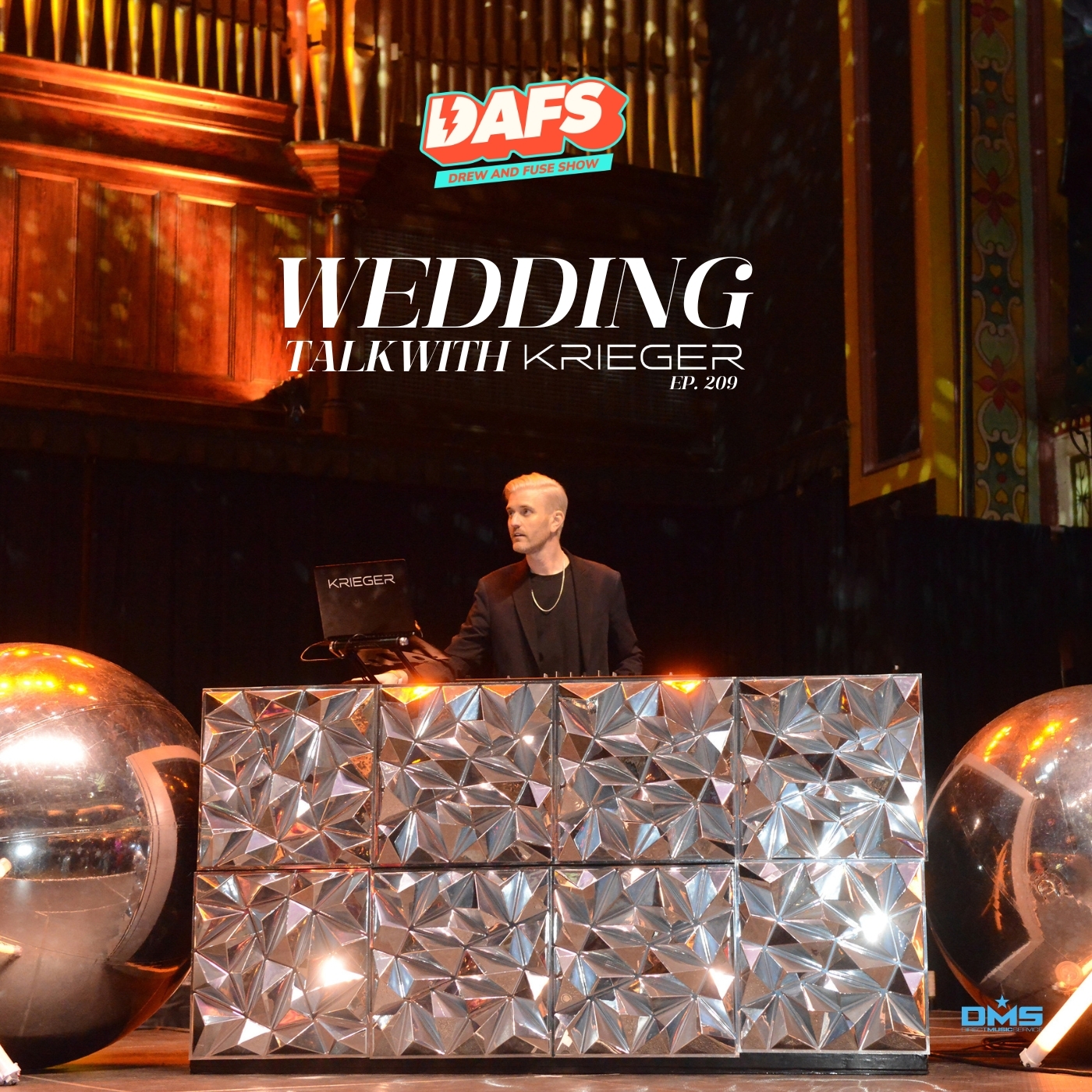
Drew And Fuse Show | DAFS · DrewAndFuseShow, Drew Pierce, Fuseamania
The conversation delves into the significance of networking and industry involvement for wedding DJs, the unique requirements of high-end weddings, and the role of DJ conferences and associations in professional development and business growth. The conversation covers the importance of networking and trust in the DJ industry, the incorporation of saxophone into DJing, the value of simplicity and elegance in high-end events, the need to separate talent from equipment, and a discussion on new gear and DJing trends..
Fuse: What up, Daft Punks? It is Wednesday. We are back. This is episode 209 of the Drew F Drew We can't even talk anymore, dude. I can't even talk. Wow. Wow, here we go. Drew Pierce: Yeah. Just redo it. You don't have to start it over. Just start talking. I'll edit it. Krieger: Start it over! Fuse: Alright. What the fuck is up, Dennis? just kidding. all right, all right. Episode 209, Drew and Fuse show. It is Wednesday. We are batch recording because I'm gonna be out of town. I know, I know. It must be nice. That's what's what everybody says when you tell them you go on vacation. It must be nice. Must be nice. Yeah. Drew Pierce: Ha ha ha. Krieger: It is. Drew Pierce: That's their bad, dude. I just say it's their bad. Fuse: Yeah, I'm like, you know what else is nice? Me fucking working every day for thirty days in a row. To get it to be must be nice. So that's that's that. Drew Pierce: It mo must be nice you think about your health and your mental awareness to go on vacation. Fuse: I'll tell you what would be nice. If somebody gave me some money for the vacation, that would be nice. Drew Pierce: You know, what would be nice for me is I need a back massage. I just feel like it look crooked, crinked out right now. But anyways. Fuse: You know who could give us money? Everybody that's listening right now. They could buy one of your cheat sheets. Drew Pierce: Yeah, go buy the cheat sheets. There's a five pack that is paid and they're very detailed. I d spent some time on And then there's a freebie that if you need to see exactly what's all involved and what it's all entailed, gives you full full blown explanation of top to bottom walkthrough and how I program a wedding and how I deal with all different scenarios from across the country. So there you go. Krieger: Can I just say how impressed I was with the Cheat Sheet? It was a lot more than I expected. It was thorough, it's very nice looking, and it's great cut. Like, it's actually stuff. Like, some of these song lists that the DJs post, you're like, on what planet am I playing these songs? But these are all, like, quality tracks that will work in a variety of scenarios. And I wasn't even asked to give this endorsement. I just really... Drew Pierce: Yeah. Ha ha ha. Krieger: I was really impressed, man. Fuse: Thank you. Krieger: It was very good, very good. Fuse: Thank you. Ladies and gentlemen, Krieger, make some noise. That's right. There he is. Drew Pierce: Thank you. Fuse: Thank you, Krieger. We appreciate you. That was a nice endorsement. Drew, what else do you got for the peeps? Anything? We got a DMS promo code, right? Drew Pierce: Mm. DMS. We got DMS promo code Drew Infuse. Is it Drew Infuse show? I don't even know what it is. Drew. Drew and Fuse. Go sign up. Go download a ton of stuff from some of the best editors in the country. Go d do that. And, you know, do it to it. then that's all I got. Let's introduce our guests. Fuse: That's right. Drew Infuse. It'll save you thirty percent off your first month at direct musicservice.com. Do it. Do it to it. Alright, we got we got a we got a great guest today. I don't know what the sound is. Let's see it. Alright, so we're gonna roll this video. Hold on. All right. We're gonna roll this video and then we're gonna introduce our guest. Here we go. Krieger: like that. Fuse: All right, today's guest is none other than DJ Krieger. Krieger: Thanks for having me guys. Thank you. Fuse: Wow. Wow. Hold the applause, please. Hold the applause. Drew Pierce: So last week we were talking and we were doing the catch up and I s said that I did a wedding with DJ Krieger and I was assistant for Krieger and when we were talking about having him on and we spent about I don't know eighteen hours that day g doing this wedding together. Probably more. I think it was I think it was a full twenty four hours of how how long it was. But we were talking and he has so many good ideas and so many things that helps elevate, you know, the stuff that he does. we wanna talk first just so the people get to know who you are. You do Krieger: Something like that, yeah. Drew Pierce: I mean I even this word even is weird, but you do a lot a lot of high end weddings, right? Your y your focus is kind of the more luxury high higher end weddings. maybe just give give the peeps a little rundown of what you do and the kind of stuff that weddings or events that you book. Krieger: Yeah, so I didn't set out to be a high-end wedding DJ when I started DJing 20 years ago. I kind of just through the meandering path of my career just, I don't want to say fell into it, but started growing towards it. But I definitely, I love high-end weddings. Obviously, the budgets are generally higher, which is nice, but... Drew Pierce: Yeah. Krieger: A of the clients, they actually trust you more. A lot of them give less direction because the analogy that I use are people who are always trying to save money are accustomed to hiring amateurs, whether it's someone to fix their house, wash their car, whatever it is. And when you hire amateurs, Fuse: Mm. Krieger: you might get in the habit of having to micromanage them because they're probably new, don't have lot of experience, don't know what they're doing. When you're used to hiring experts for things in your life, you are used to just trusting these people because they have the experience, they have the knowledge, and you trust that they're going to execute and do the job that they hired you for. And that is much more so the mindset with a lot of the clients for these higher-end weddings. Drew Pierce: And it's not just the clients itself, it's actually the professionals that you're working with. Because I would say I did a wedding with Andrea Appolito, and I remember asking her, you know, it wasn't it wasn't basic, it was like, Hey, you know Where do you want this or this? I was asking her something basic. And she stopped me and she said, Drew, I hired you because you're a pro. You do whatever you think is best. And it was like it was so refreshing coming from, you know, some of the other coordinators that are giving me sheets on exactly what to say because they don't trust me, you know. Krieger: Yeah, and they don't really know. Maybe they think they know, they, you know, and that's the thing about planners also is that even if a planner has been planning for as many years as I've been DJing, there's a good chance that I've DJed more weddings than she has planned just because of the nature of our business, our industry, a planner on average. Planners on averages, some will. Fuse: watch out planners. Watch out. He's about to he's about to Drew Pierce: Huh. Fuse: get ya. Krieger: But most, especially when you're doing a higher end, more elaborate wedding with more moving parts, more vendors, you're not doing 30, 40, 50, 70 weddings a year. You're doing maybe 10, 20 or so. So as DJs, we are generally in front of more crowds. see more, we have more experiences to know, hey, you know, I've seen this work before. I have seen this not work so well before. So. And that's a big part of being, doing the high end weddings. Obviously, experience is number one. If you just started DJing yesterday, you shouldn't expect to be jumping into high weddings really anytime soon. I think that you need to have a good number of years under your belt of experience so that you have the confidence to go in and not just dumb blind confidence, which... There are plenty of DJs out there with that that just think they're great, even though they don't really have the goods to back it up. But if you have been doing it a while and you are an expert in your craft, then having the confidence to say, and obviously being tactful about it, because at the end of the day, the planner is the one calling the shots and probably the one that you want to have the best relationship with, because that client's only gonna get married one time. But that planner will likely have maybe Fuse: Maybe. Krieger: Maybe. But if you're building your career around counting on your clients getting divorced and hiring you for their subsequent weddings, I don't know that's the best strategy. think you'd have an easier time building a career around building relationships with planners and vendors who are in the business, who are in the position to give you repeat business. Drew Pierce: Ha ha ha. Hmm. Fuse: Do you think that w so you know, they say, you know, half of all marriages end in divorces. Do you think that half of those divorces get remarried? And then would you say that you think half of those remarried use the same DJ? So we're talking about Krieger: Absolutely not. Absolutely not. First of all, I have also heard that statistic, the half of all marriages ended divorce. I have also heard that that statistic is grossly exaggerated and overrated and from some questionable sources. Regardless of what the number is, most people who are getting remarried are not doing the big wedding the second time. If they did the big wedding the first time, Maybe they'll do a big wedding in second. mean, some people are just worth hundreds of millions or billions of dollars. And so it's not an issue. Drew Pierce: Yeah. Fuse: I I don't think they're using the same DJ. They're the whoever the new the new person's gonna be like, Wait, you wanna book the same DJ? What what isn't that weird? Yeah. Krieger: You don't think so? If you were getting married for the second time and your fiance was like, I really loved this DJ, we used him the first time, you wouldn't want the same DJ from the first wedding? Fuse: Well, I've already done that. Drew Pierce: I wouldn't. Fuse: I don't know. Yeah, I don't think so. I'd be like maybe he was the jinx in the in the marriage. Maybe it wasn't the fact that, you know, all these other things, it was the DJ's fault. Krieger: Even Jinx! I mean, if Drew Pierce: Ha ha ha. Krieger: maybe she left the first husband for the DJ, I could see how you would not want him DJing your wedding now. But I don't know. I don't know if people are really that superstitious about it. Drew Pierce: Hey Fuse: Oof oof. Yeah. Alright, so what makes the wedding high end? Is it that you're there? Is it the amount of money? Is it that they have ice cream? What what what's the deal? Okay, so it's how much they're spending on the flowers. Drew Pierce: I put it on the flowers. I put on the flowers. If it has if there's if if you're basically living in a garden, then it's a high end wedding. If it's the s the flowers are scarce, then it's not. It's a lower end wedding. Krieger: I think that's actually not a bad metric, the flowers, I think by definition, when we're talking about high-end weddings, we're talking about overall budget, how much did everything cost? But you could have a high-budget wedding because you have a high guest count at a luxury hotel. And not only are they gonna have a high venue fee, but they're gonna have a high food and beverage minimum. So... Fuse: Sure. Krieger: Just your budget with just the hotel could be, you know, $100,000, $150,000, $200,000. Now, and some people do this, you may have blown your entire budget on the hotel because you wanted to get married at the St. Regis. You wanted to get married at, you know, the Four Seasons or whatever. And so now you don't have any money left. So now you're cutting corners and you're hiring cheap photographer, cheap florist, cheap DJ. Is that still a high-end wedding? I don't know, that's when it kind of gets into a gray area. But if you are spending a lot of money on the flowers, then you probably have a good amount of discretionary budget. flowers, flowers I think when you're planning a wedding are seen more as kind of a quintessential luxury item. I think most people know that at the end of the day, guests are not going to be able to recall from memory the floral arrangement. I think it makes a big statement when you walk into a room and you have beautiful floral designs, but I think people know that, you know, at the end of the day, if we need to cut, you know, to get the things that we want, we can probably cut a little bit from the floral budget. You know, if we're allocating, you know, $80,000 for flowers, maybe we can drop it to 70,000 and get that LED wall or something. Drew Pierce: Well well I think sometimes the coordinators don't wanna cut that because they're they're looking to get published. And the higher the the floral count, the the more likely they're gonna get published. I have a question. Krieger: Well, sure. Drew Pierce: Since I just did this wedding with you, and I was talking about on last week's episode about doing a walkthrough, how important it is to do a walkthrough, because like I said, no joking aside, we were probably there for 18, 20 hours. It was a very long day. and luckily Krieger had the foresight to hire you know, basically a grunt to do all the the heavy lifting. Krieger, no no, like no no. I'm being very serious about this. I I I was I was being like, hey, I got this. And Krieger's like, I don't think so. I think this is like a little b above our pay grade. So you I want you to talk about Krieger: I Yeah. Drew Pierce: The importance of doing your research on what the venue looks like, you know, how how did you see that? I mean, just off the website, you hadn't been there before. How were you able to what were some things that made you think, I'm gonna need more than just me and Drew? Krieger: Well, it wasn't just the website. And this goes back to having confidence and showing that you're competent as well. I had spoken to the planner extensively about the venue. Not only went to the website, but a lot of times, especially for these outdoor venues, just looking at the Google satellite map is super helpful. And honestly, I do that with... 99 % of the places that I work, especially if I'm doing a destination wedding and I can't do a venue visit in Atlanta or in Hawaii, I can see. I just had a call with a planner yesterday. And so we're going over the map. And she's like, OK, you see this lawn here next to the ocean? That's a reception. And everything is going to be. And so now I see how far all these places are. And you can literally measure the distance on Google Maps if you want to see how many feet everything is. And so I'm thinking, OK, how much time? And I do work at a lot of outdoor venues, obviously being here in Southern California, a lot of places in Malibu where sites are spread out, ceremonies on the other side of the property and cocktail hour is next to it. then, so I already have lot of experience. I know how long it takes to get from place to place. And I also know how long it's gonna take an assistant to break down my ceremony system when we're all at dinner. And so in my mind, I'm like, Okay, if Drew is the only guy helping me on this and he's across the other side of the property breaking down ceremony and cocktail hour, well, he's not going to be able to help me with things like Mike handoff for toasts or DJing while I'm going out and playing the saxophone. That was one of the big things that I wanted you for because the planner wanted more saxophone for this wedding. And I knew that in order to pull that off and be comfortable about it, I wanted to make sure that I had someone behind me that could just pick up the slack if I was out there or suddenly changed my mind and be like, hey, we're gonna play this song next. Because the assistants that I hire, can DJ during dinner, but they're not gonna, I'm not gonna trust them with beat mixing during a dance set. But yeah, I was looking at it and really kind of. planning it out in my head, kind of scheduling and thinking, how long is this gonna take? How long is this gonna take? And how badly do I need Drew to be by my side the majority of the night, as opposed to elsewhere, you know, breaking down sound systems. And also that's not a good use of your time, you know? Like anyone can break down a sound system, but very few people have the skill and experience that a DJ like you does. So you do, yeah, that you do. So... Drew Pierce: Or even setting up. Krieger: So I knew I wanted you close by and to have someone else just handle that. And the more I do this, the older I get, the more that I find that the fewer things that I have to worry about, the better a job I do DJing. If I don't have to worry about sound or lighting at all, I'm totally laser focused on the performance and reading the room and what songs I'm gonna be playing on the saxophone. And I'm not thinking, okay. Did we break down the ceremony sound system? Is it moved out of the way of a sprinkler system that might turn on unexpectedly? You know, are we good there? What else? Like just all these little things in the back of your mind, which don't occupy a ton of space at this point because we've been doing it so many times, it becomes second nature. But every little thing that's, it's like why Mark Zuckerberg, you know, famously wore gray t-shirts for years and years and years because he said, every decision, that you have to make is occupying a space in your brain. So if I get up in the morning and I don't have to think about what I'm gonna wear, I know it's gonna be a gray t-shirt, because that's, I just have a closet full of gray t-shirts. Yeah, it's a little weird, but the point was that it was kind of him attempting to, you know, really optimize his efficiency like a robot. Drew Pierce: Zuck weird? well basically what he's saying, guys, is experience. You know, you're y all these little things that he's learned over the over the years of you know, dude, the mic getting r getting hit by sprinklers has happened to me. Or like the you know, a thing. Luckily I had covered it, but like the sprinkler system did come on while I was DJing an after party. So it is all these mistakes and things that you Krieger: wow, you were DJing? my god. Drew Pierce: Yeah, yeah. Dude is I mean anytime I see a country club on a on a on a thing moving forward, it's always like, hire two assistants because I'm scared out of my mind. But what he's saying is yeah, it does come down to experience for a lot of these things and just chalking it up and learning all these Fuse: Were you the ninth green at nine o'clock? What what was up with that? Krieger: Yeah. Drew Pierce: all these different things. What I want to get into is how you move into high-end weddings and some of the something that I know you're amazing at is networking. And you were you were on the whip a board. just kind of explaining to these guys that you know we have a lot of listeners that don't do a lot of these higher end weddings and how important the networking is and being on the whip a board. maybe explain a little bit of what that entails. Krieger: Yeah. Yeah, because I think you're right. think... And I had this myself too when I started to go full-time and really ran my own business. I kept thinking, I just need to be better. I just need to be a better DJ. I need to work on my transitions. I need to have better song selections. But that's not it. It's the little things. It's the details. This planner from this past weekend, she loves the fact that I have different colored gaff tape, like that I have gray gaff tape and tan gaff tape to match the sidewalks or the carpets or things like that. Fuse: So you're telling me if I just get different colored gaff tape I can start charging thousands of dollars more? Krieger: Exactly. That's the only difference between the high end and the low end DJs are different colored gaff tape. think the idea is that if you can learn from every wedding that you do, every job you do, how could that have been better? And sometimes it's how could that have been simpler? And maybe simpler means how can I refine my setup? Or how can I say fewer words on the microphone? Fuse: Okay. I just wanted to make sure I heard it right. Krieger: because at a lot of these high end weddings, they don't want a guy who's chatty telling jokes, you know, running a monologue. So it's like, how do we get people's attention, get the message across, but use as few words as possible. Drew Pierce: Yeah, me and Krieger on the way home, the next day after we got some rest, we were both driving and we were talking about, you know, little little things you could change on the the setup to make it more efficient. And so it is it is about really focusing on those things and perfecting it every time. but yeah, I really want to get into this the networking and the WIPA thing. Like Krieger: Yeah. Drew Pierce: How the importance and how it it's a long game, right? Networking is a long game. A lot of people I talk to will go to one conference and be like, I didn't get anything out of that conference. It's like, dude, I've been going to conferences since almost 10 years now, and you know, it's paid off, but it's taken a long time. So talk about the long game, being on the board of Whipa and how important some of these these strategies are and how you did it. Krieger: It's a total long game. Yeah. So it's absolutely the long game. And it's also, you get out of it what you put into it. And that kind of talks to joining the board. So I have been involved with WIPA, which if you don't know, it's the Wedding Industry Professional Association. There are 20-some chapters across the country now. When I started, there were like 10. but they keep popping up in other cities. And you might not have a WIPA chapter in your local market. You might have a WIPA chapter in other things. WIPA is not kind of, you know, like WIPA Philadelphia is not exactly the same as WIPA SoCal. You know, each chapter has different strengths and weaknesses, but look at your market and see what opportunities there are to get involved. I got involved with WIPA. even before I started my business because someone who I really respect in the industry Pauline Perry who owns a catering company here in Los Angeles called Good Gracious she started WIPA back in 2008 and the reason they started it was because at that time weddings were not really seen as a professional industry that people really took seriously it was it was a lot of people who We're doing it as a hobby. You know, it was not glamorized or put on a pedestal that it is now that it has the opportunity to with social media. But even then, there were plenty of people who were working in the wedding industry full time, saying, hey, this is our job, this is our business, this is our career, and we're very serious about it. So they created this association to try to start to bring more clout to the wedding industry. to attract more like-minded people who also felt like they did and took it seriously and didn't treat this as a hobby or a side hustle and started to grow this association. And soon they had different chapters around different areas of the country and they have quarterly meetings every year. think they have, every chapter has something like six to 10 meetings in a year and you can just attend. as guest, or you could join as a member and get more involved, or you can volunteer your time and become part of a committee or a board. And this is true for really any association. ILEA, NACE is still pretty strong in a lot of markets. And also cities that don't have like a specific chapter of a larger national association. They usually have smaller things, you know, like there's a lot of things in New England. I don't think we have like a WIPA chapter per se, like in Vermont or Maine, but I know that there are a lot of wedding groups and associations that you can join and be a part of. And a lot of these groups have very little representation from DJs or really entertainment in general. So a lot of it are planners and photographers. Drew Pierce: Right. Krieger: Which by the way, don't sleep on photographers. Photographers can refer you business as well. A lot of times they're the first vendor that's hired. So if a client hires a photographer that they like, they obviously trust them. And so if they say, hey, you need to talk to Krieger, he's gonna, and they're gonna like it too because I asked the photographer, hey, where do you want toast to happen? DJ's never asked me that before. Well, it doesn't matter to me where the toasts are as long as it's not next to a speaker. Drew Pierce: Yeah. Do you Krieger: but where is it gonna look best for photos? Drew Pierce: what if they What if they put all your their bags right on top of your speakers? Do you do you say anything? Or do you because you want that referral, do you just let it I know you don't, but it was Krieger: What do you think? What do you think? You know me. You think I let anything go? You think I let, that doesn't bother me. Fuse: What if they ask you to bring your own DJ booth? What do you tell them then? Drew Pierce: Wait, I don't want to digress. I do want to bring that up later. but the the photographers they they they do they are important. I understand. They are important and sometimes they don't realize it. Fuse: No. Krieger: we could talk about that. Here's the thing, I don't want things in my way because if I'm kicking a bag, if I'm tripping over a bag all night, that's one more thing that's gonna distract me and not allow me to DJ at my best. And also, I want my setup to look nice. I spend a lot of time and having a good presentation. So no, I don't want their bags in the background and frankly, they shouldn't either. you know, they should want their bags in the background as well. And for the most part, most of them that I'm working with, it's not an issue, you know, they're not stupid. Drew Pierce: No, you're you're right. I I I'm joking because we we bring that up way too much on here. But you're you're talking about how important it is to be on on the WIPA, how to, you know, the networking that goes involved, donating time. I don't even have time. Like how do you find time and and do you also find that it has helped you being on the board, being able to get more weddings? Krieger: So I think, you know, not to say the old cliche adage, but you need to make the time. And I think that a lot of us DJs have ADHD. So we never have any time because we're always filling our time with something, something that's important, something that needs to be done. And realistically, the level of importance for some of these things really varies. And also the return Drew Pierce: Yeah. Krieger: on the investment of that time really varies a lot. And so if you force yourself, like if I have a board call every second Tuesday of the month, that's hard scheduled in my calendar. So I'm gonna make the time for that. I'm gonna plan around that. I'm not gonna be working on music then. I'm not gonna be going to the gym then. I'm not gonna be walking my dog then. I'm gonna make sure that I'm on that call. And anything that needs to happen, follow up. I'm gonna make sure that that happens. Not only because it's a commitment that I made, but also this is the impression that you're setting to all these people on the board who are trusting you. And if they think that you're a pain in the ass or unreliable on the board, then just imagine what they're gonna think of you as a business owner and as a vendor. And they're like, God, Krieger's a nightmare on the board. I would never wanna hire him for a wedding. But if, man, Drew Pierce: Right. Yeah. It's ten times worse than if you actually did the job. Krieger: Krieger really cares about WIPA. Krieger really puts in the extra time. He'll go above and beyond. He's having long conversations with local chapters to try to help them with whatever they're working on. know, Krieger is, because I think passionate people are not generally just passionate about one thing. You know, if you are just the type of person that, you know, honors your commitments and that you're a loyal and a trustworthy person, people are gonna assume that that's gonna bleed into other areas. And so if you're a good board member, you're probably a good business owner. Now, that's not true of everyone. There are some people that seem good on the board and are actually nightmares to work with. But for the most part, it's a fair generalization and it's certainly a generalization that people make, whether it's true or not. Fuse: What if What if they're good about being on the board but terrible at being a DJ? Krieger: I mean that's that's that happens too because you can I mean they're just like there are guys that are great business owners and that do all the right things and and and they're really nice guys and they're very well liked but their DJing is just kind of meh they're not bad but they just kind of fall flat I think that I mean now you know you're asking kind of a bigger question and we're kind of getting more into Fuse: Yeah. I'm I'm only it was only just Drew Pierce: I I don't w I don't wanna digress too much. I wanna stay on focus here. And he Krieger: Yeah. I will say, being Fuse: Yeah. Krieger: on the board specifically opened a lot of doors for me. I DJ'd a wedding in the Maldives because of relationship that I built being on the WIPA board. I DJ'd a wedding at Sundance, which was one of my highest netting and most fun after parties that I've ever DJ'd because of relationships that I built on the board. Because the other thing is, when you're joining the board, Drew Pierce: Well that's Krieger: you're probably working with planners and vendors that are on the higher end of things in their market because they care. They care. They want to be involved. There are some people that are just always looking to elevate and always looking to move to the next level. And those are the people that you want to surround yourself with, assuming you're one of those people as well. Obviously, there's a lot of complacency in the wedding industry and the DJ industry. People that are just like, Drew Pierce: They care. They care. It really is what it comes down to. Yeah. Krieger: man, I can't believe this is my job. It's like I'm printing money. I just show up and have fun and they're happy just, know, riding that line. But those of us who like have addictive personalities and are like, okay, cool, what's next? Okay, cool, what's next? Okay, cool, what's next? Are always trying to get to the next level. Those are the people that are gonna help you and you know, get into those higher end weddings. Fuse: So Krieger has gone to a lot of these conferences, the Whippas, the Engage, you know. but one thing Drew does have over Krieger is that he's in the nine timers club at DJ C and Krieger's only an eight timer. So Krieger, the question is a nine timer or is it ten timer? okay, okay. Drew Pierce: Ten timer. Nine timer. I thought I was a ten timer. Yeah, he's a nine timer. Krieger: I think I'm the nine-timer. Yeah, don't sell us short. Fuse: Sorry, my bad. My bad. I I was just the the butler, so I you know, so I don't really know what I'm talking about. I'm just the help. but are you going to DJ C to get your smoking jacket? Yeah. Drew Pierce: Yeah. Krieger: Oh, this year? I am planning to, yes. I'm not sure if I've signed up yet, but... Drew Pierce: Yeah. All right. So we We talk about the importance of WIPA. Me and Krieger met at one of the the second DJ C and the importance of going to DJ conferences, right? It it is it's important. Even if you just meet people, you get your little takeaways, right? What'd you say? That's just as important as the the Whipas. Krieger: So this is gonna be a bit of a hot take, but I think DJ conferences are very mixed across the board. And I would not be able to say with a clear conscience that yes, all DJ conferences are great and worth your time and advancing your career. It also depends on what you're looking to get out of a DJ conference and also how you see yourself. in the world of DJs. I've said this to you before, Drew. I feel like I'm just not a typical DJ. And so I don't get along with typical DJs the way that a lot of them do. I don't know. I feel like I'm hanging out with people trying to talk about sports or cars. It's just... Drew Pierce: Ha ha ha. Krieger: Just something that I'm just like, I have nothing to contribute to this conversation because I don't follow DJ culture. know, like I didn't get into DJing to be a DJ, you know? I don't really know how to explain it. And also, to be honest, I've always been kind of a competitive guy. And so I've always thought, okay, well, if this is where all the DJs are, Where can I be that is different that is gonna set myself apart from that? And that's what initially drew me to going to a conference like Engage, where the first time I went was 2019. And at that time it was like me and Brian B and maybe there were a couple other DJs. There are still very few DJs who go to this conference relative to other vendor categories. But... Fuse: Wait. So You're saying out of the box thinking has helped you advance your career. No, I Krieger: In my mind, and maybe I'm wrong, maybe this is wrong, but in my mind, I have always felt like I am much more likely to get hired from a wedding planner or a wedding venue than I am from another DJ. I mean, especially in the world where so many DJs in the wedding industry work for larger companies, they're just not gonna refer me They're gonna find one of their guys to do it. So building relationship with a DJ company, I think it's good to do. It's good karma. It's definitely, I believe a rising tide raises all ships. There's best practices you can share. There are definitely times when I reach out to Drew all the time. If I need something that he has that I don't have, or I need something extra or whatever, I think there are definite advantages. But if at end of the day, your goal is to book more business, You need to get in front of the people who are in a position to do that for you. And I just don't know that other DJs are. The other thing I will say about this is when I, 10 years ago, when I was starting my business, I was surprised at the caliber of DJs that I was meeting here in Southern California. Not saying that they don't exist, but the ones that I was meeting at these networking events, WIPA, ABC was a big one. I don't even know if ABC is around anymore, the Association of Bottle Consultants. But a lot of these guys, they were the nice guys, good guys, just solid, but very generic, kind of like cliche DJs. No one who is raising the bar, no one who you look at and be like, man, I wanna be more like that guy, that guy, man, he's really aspirational. Like, wow, doing stuff out of the box. It was just the same old stuff that you've been hearing for years. And I remember one guy was like, you don't play line dances. Well, what do you do when no one's dancing? I'm just like, bro, we are so far apart on so many things. And I remember thinking, well, where can I meet these guys that are working at a higher level? And honestly, the first DJ Collective that I attended was where I've, okay, here they are. Drew Pierce: Yeah. Ha ha ha. Krieger: They're not necessarily just showing up at your local networking event. They are the leaders of their markets and they are doing things at a higher level, at a different level. And some of these DJ conferences... Look, everybody has to start somewhere. There's no shade. And what you got to do to cut your teeth. But if you're listening to this podcast right now and you're thinking, well, geez, I've started DJing 10 years ago. Maybe you just started your own business. you know, the last few years, you know, maybe during COVID, you were like, I'm going to go out on my own or whatever. You are probably seeing a lot of DJs either on social media or just out and about because the majority of DJs out there are probably below your skill level. So I think it's important to have good relationships in your industry, in your community. But at the end of the day, if you don't have a lot of time, like you said, Drew, you need to be mindful of where you are spending that time and energy and resources and thinking about how can this pay off for me monetarily. Drew Pierce: Yeah. No, it's it's you're I hope everybody's paying attention 'cause he's giving a ton of d a ton of very important tips here. I know me and Fuse both got into this for D J and we didn't even think we could become make a freaking dime out of this. It was really just like, this is fun and then we just kept doing it and next thing you know, it's twenty years later, you know? And so everyone gets into it at different things. And I can say, you know, when I started going to the DJ Collective or some of these things is I don't put the right emphasis on the right things. You know, I'm terrible at business. You know, I I'm I'm a pretty good networker. You put me in front of people, I have no problem talking to people. But the the you know, definitely allocating your time to the networking and to DJing and just all of the different things that Krieger's saying is all very important. Really, what I'm getting at. Krieger: Thank you. Fuse: I agree. let's move on to talking some a little little saxy talk here. You know, one of the things that you do that's a little different compared to other DJs is that you play saxophone and this is something that you do, or you tell us a little bit about it. Krieger: Yeah. Yeah, so I started playing saxophone in fourth grade, in grade school, and then I played through high school in the marching band. And I was never first chair. I was never, you know, the best guy in school. The main reason that I stuck with it is because all my friends were in the marching band. I was one of those like band geeks. I liked it. I enjoyed it. But I never liked practicing. But the thing that I found now, ironically, is the more you practice, the better you get and the more you enjoy it also. Who knew? I know. But so after high school, it sat in the case for 10, 15 years, more or less. And then I would say it was probably about Drew Pierce: Knew who knew that was risky. Krieger: eight or ten years ago where it started to become a trend, at least here in Los Angeles and Southern California, it really kind of started, you know, popping up where people were adding horns to the DJ for something else, something different. And my initial thought was... Drew Pierce: We're all starting ska bands, DJ ska bands. Fuse: It when Bill Clinton took office and everybody saw that he played sax. Krieger: I think that was it, yeah. I'm here for it, some real big fish. Let's do it. Drew Pierce: Ha ha Krieger: My first thought was, I haven't played the saxophone in way too long. I'm not good enough to do this. So I'm just going to stick to DJing. And I hired saxophones when clients wanted that. And some of them were amazing. And I was like, yeah, I'm not this good. Some of them were not. Some of them were okay at best. And one thing that I found with a lot of them is a lot of them didn't know the music. So they're just like... Improving over whatever, just playing by ear, which, know, if you're an accomplished musician, you know, you can tell what key it's in, figure it out, okay, and you can play over it. But if you don't know the song, you don't really know where to come in, where to come out, what to play along to. Like, there are certain songs that I play, like, kind of fills in. So I'm playing around the vocal line, not trying not to step on it. There are other songs. where I'm doubling the vocal line, kind of like sax karaoke, where I'm playing along the whole time. Some songs where I do both. So it's different. Some songs you're using the saxophone more as a rhythm instrument and it's more just like kind of fun fills. People love it either way. Yeah. Drew Pierce: Wait, I have a question. I want to steer this. I want to steer this because I play with sax players, and you you touched on this very importantly. Some sax players just don't freaking get it, and some do. And I guess a lot of DJs are stepping into this new fusion market or playing with a sax player. What's something that, you know, if they're hiring a sax player, what could they tell the sax player to do? Because I think. You know, without proper instruction, the they don't even understand, right? I say play along with it and and then I go I go hear and they're just like soloing on top of Usher, yeah. And you're like, just play the stabs, like you don't have to do much, right? So what's something how would you you know, like say how do you incorporate it in your since you are a DJ and also the sax player, what's a good way to explain it to everybody? Krieger: Yeah. Drew Pierce: Like how to play or you do you understand what I'm saying? Krieger: Yeah, but it's a tough question to answer because it's so different for every song. I can't give you a how-to of how to play the saxophone. And honestly, it's something that I'm still figuring out. What I do now is not the same thing that I did five years ago. And the more that I practice and the more that I play... Drew Pierce: Right. Krieger: and the more that I think, that worked really well, or I didn't feel great about that so much. And obviously, chances are we're gonna be a much tougher critic on ourselves than the client or the guests are. But I don't know that there's like a formula or a script that you could tell a DJ, I mean, a saxophonist, you kind of have to see what they're doing, either in like... Drew Pierce: Okay, well then Krieger: promos or samples or just work with the guy and you either know this guy gets it, he knows the songs or this guy doesn't. Drew Pierce: Okay. Here's here's other questions. How important is it to set up I mean you're you're DJing and you're doing that, so I already know your answer, but for someone that just has a sax player coming and playing along, how important is it to do a a full blown sax set versus just having them incorporated as they see fit? Krieger: Well, everyone will probably give you a different answer on this. Drew Pierce: Well, I want your answer because I I I already know I like it more as seen fit. I like it more as I see fit and less as a less of a a full blown set. But I think you probably see a little differently. Krieger: Well, that's what you're going to get, fortunately. Here's the thing, I think at the end of the day, you as an artist need to lean in to your own instinct and your own gut more and more and more. And not just because you have the experience and the knowledge that you earned that right, but also the more that you do this and the more that you can follow your own instinct and kind of lean into your own style, you're going to attract clients that like your style and like your instinct. So for me, one of my big mottos that I say all the time is less is more. And most of the clients that I hire also feel this way. They don't want a ton of crazy dance floor lights. They don't want some DJ who's gonna be on the microphone the whole time, hyping up the crowd, telling people to dance, all this extra bullshit. I think that it's with all of these things that we have now and all of these... Options that you see when you're scrolling social media and you're planning your wedding. It's very easy to get caught up we need light up cowboy hats. We need LED foam sticks. We need this we need shutter shades We need a saxophonist and a violinist and a guitarist by the way, don't the guitar and the DJing thing Can we just stop with that? Okay Drew Pierce: Yeah, yes. You sound like Oprah. You get a guitarist, you get a saxophone player, everyone gets glow sticks. Krieger: You don't need it. Here's the thing. It's like, it's just extra junk. like when you just, you don't need all of these extra things. So for me, I would rather not have excessive saxophone. The thing that I really want to avoid is I don't want anyone at the party thinking, ugh, still with the saxophone, huh? We're still... Drew Pierce: What? Ha ha. Krieger: We're still doing this? Okay, I thought I feel like we're good on we... Is this guy gonna do this on every song? You know, to the point where they're like confused, like, are we supposed to be into this? Drew Pierce: Not Fuse: I agree though. Drew Pierce: I a thousand percent agree. yeah, it's it does not need to be every single song. Krieger: I would much rather them leave them wanting more or saying, hey, can you bring up the saxophone again? Can you do another song on the saxophone? And I think that there are songs that just work well with the saxophone and songs that don't. Like Uptown Funk is a great example of a song that you would think works well with the saxophone because there are horns in the song. But I don't, well, I don't really play Uptown Funk so much anymore because most clients don't want any Bruno Mars because they're sick to death of him. But Drew Pierce: Right. Also Right. Right. Krieger: You know, Uptown Funk doesn't really go anywhere melodically, right? It's a very rhythmic tone. He's really rapping through most of the record. It's produced by Mark Ronson, who has a very particular style of his own. So there's not really a lot that a saxophone, I feel, contributes to that song. So maybe we skip it for that one and we go with an ABBA song instead that is much more melodic and... there are a lot more places where, and a lot of options. I could double the melody if I want, I could play the fills if I want. And instead of just like playing the saxophone for the sake of having one, to me, that's a waste. You're wasting your time and you're disrespecting your guests. Drew Pierce: I I I wanna just wanna say I want a full circ circle moment here. The more to bring it back to what Krieger started with is the less is more. The higher end you get, the more people it's Instead of throwing shit at the wall, it's like taking it away. Right. Especially us DJs. We all want to be like, you know, this light or this effect or, you know, these things. It's like you don't even really need that. You t tell to spend the rest of the money on flowers so that it looks so it looks higher end. But Krieger: Yeah. Well, I wouldn't do that, but I do think a good question you can be asking yourself constantly is, what if this were simpler? And that can apply to so many things of your set, of your setup, of your performance, of just thinking what, I just watched some transition things, some guy was doing, remember the time into poison and... And like most of these transition reels, people are like, my God, that was great. That was amazing. Cool, cool. It was too much. It was way too much. It was way too drawn out. think that we can get confused also. And social media, it just makes this worse of reinforcing it because when we put out things like this, we're attracting the people who like it. And so you're creating an echo chamber and it's giving you an unrealistic representation of what the typical person really likes. You have to remember, when you're DJing a wedding, those people are not there for you. They're not there for the saxophone. They're not there for the music. They're there because they were invited to this wedding and the couple are people who are important to them. Now, yes, some of those people like to dance. Some of them like to go clubbing. Okay, okay, go ahead. Drew Pierce: I s well wait, wait, wait, I wanna I wanna add to it. I wanna add to what you're saying. I just saw this thing, I I just saw I just sent this TikTok to fuse and it this guy going, you know, the the the word plays and and the tone plays and all these are fantastic to get clients. You do have to watch what you're doing. You're saying this out loud, but you do have to watch who you're attracting, right? Because they do end up wanting to become your client. But in a in a in a live setting they don't always transition as well as we think in our head. right. The right. The the word play the over wordplay in a life. Yeah, yeah. We we've talked about it. But it is it it is a great way to get clients. I'm not saying don't do it. I'm just saying, you know, just like he's say saying who your clients are. Fuse: Yeah, they don't translate to the crowd always in a live setting. And we say it all the time. Yeah. Krieger: I think you can still do it, but just think like, what if this were simpler? What if I'm getting the same thing across, I'm still mashing up these two songs, but what if I do it in a more simple way that can be more efficient, more refined, and maybe more elegant? That's how you attract high-end clients, because high-end clients don't want a big bag of junk. They want one small, elegant thing. Fuse: I I mean, we were just saying recently the social media stuff, and it's just like you have guys that are constantly pumping out stuff that doesn't translate to anything other than a sloppy piece of content that you're like, who is this for? Who is this for? And it it it's it's what you're saying at the same time, like, you know When you're putting out stuff and you're attracting certain kinds of people, just because you're getting booked doesn't mean that those certain kinds of people are even at the event. So doing stuff that resonates with everybody is actually keeping it simple, you know? Krieger: The thing that you're not getting feedback on are all the people who saw that reel and rolled their eyes and immediately scrolled before you even got to the good part because they're like, this is terrible. I don't want this. And maybe that's a client that you would have really liked to to have. But if what you're putting out is junk. Drew Pierce: Well, we this is that's something we've beaten to the ground, but I wanna I wanna we're getting close to an hour here and I wanna circle back on something that we started w talk if you started talking about at d DJ C they had a panel up with planners and photographers and all this stuff and Everybody was, you know, praising the Joe Bunn booth because Joe was on the panel. And everybody's talking about everybody's talking about DJ furniture and DJ booths. And Krieger stands up and he's like, Why don't you just request a DJ booth? Like you're telling the coordinator because that's your vision. Now Krieger: Of Drew Pierce: I loved it. I think the way you were saying it might have rubbed the lady the wrong way. But it it I went to your wedding this last time and there was DJ booth set up for you in both locations and it looked fantastic and it was completely a hundred percent decorated towards the the the coordinator. How do you get in that conversation with either the coordinator or the the bride on hey I'm not just making you rent me more things, but like this is important. Krieger: Look, I'm not trying to take money out of Joe Bunn's pocket and all the people who have their booths and love them and put them on wheels and think they're the bees knees and this and that, know, cool, more power to you. I will say this. I will say this. Having a booth is not going to get you booked on more high end weddings, if that's your goal. If you think that you're clean set up with your special podium, Drew Pierce: Ha ha ha I'm not saying don't have I'm saying yeah. Fuse: I yeah. Yeah. Krieger: is what the high-end clients want. No, they don't care. They don't give a shit. And I have heard from several planners, high-end planners, planners that you would like to work with, that they're not even paying attention because they're gonna give you the booth that they want. Here's the conversation that it's on my writer like this. I have all the things on my writer broken down by category, and I explain why I need them on my writer too. Hopefully people are taking the time to read them. I know some people are not, but I got tired of having to explain why I need an umbrella to cover my gear from the shade. It's not just because I'm a diva and get sunburn easily, which those things are not false, but there are practical reasons behind these things. If you are planning throwing a so-called high-end wedding and you are hiring an outside rental company to provide things like specialty chairs, lounge furniture, bars for the bartenders, then what I suggest to you is add another six foot bar onto your rental order because they're gonna be there anyway, so you don't have to pay extra delivery or labor or anything like that. Another bar is gonna be a few hundred dollars, which in the grand scheme of your rental order is not gonna be a lot. mean, these rental orders for some of these weddings are tens. of thousands of dollars, sometimes even $100,000, depending. Drew Pierce: Probably a hundred and fifty bucks. But at least it matches. But yes. Krieger: Well, a nice bar, you're looking at more than $153, $5, $7. I mean, I've seen $800 bars before. It depends on the rental company. There are some high-end specialty rental companies out there. But at end of the day, if they are spending the time to execute this specific vision that they have, and they're spending the money to get the pieces that they want, then why not just add something else that comp... Drew Pierce: Okay. Krieger: Because some of these, it's an entire collection that all matches, you know? The bar matches the bar back, matches the lounge furniture, matches the tables. So why wouldn't you want a piece that's front and center in your whole design to match the rest of the aesthetic? It just doesn't make any sense not to. Drew Pierce: It's also it's also a great way to actually tell the planner and the bride the on how to get in the middle of the dance floor where we all want to be. Because you match now. And like you said, a lot of these coordinators don't even know what your booths look like or what booth you're gonna bring that day. So yeah, the podium might look nice, but does it really like match with some of these higher end things? And I would say the last at least five or six weddings that I've gone to. if I would have brought a a DJ booth, I wouldn't have been able to bring use it. I would have had to take all of my gear out out of it because they already had booths for me. So yeah, way easier. Fuse: And there's there's something to be said too like if you're listening to this and you're going, no, Krieger's not talking about your wedding that you're doing. He's not talking about that. He's talking about stuff that's above and beyond. You know, a lot of people are flying in. I th people, you know, they might the guests the couple might not even be from where the wedding is, you know, and and Krieger: Right. I'm not flying in a DJ booth. No, lot of, I have one in Hawaii next month and the couple is, I think they're in Northern California or maybe Southern California, I'm not sure. you know, everything is there on location and I just had the call with the planner yesterday and I asked for a six foot booth and great. The other thing I don't like about the podiums is they're too small. Now that's a personal preference for me. Some people are fine without a lot of, but I want somewhere where I can put my headphones, I can put my clipboard, where I have space to put. things behind the booth, know, somewhere, you know, if you can work with four feet of space and you're efficient, more power to you. But the other thing about the booth is that I feel like this is kind of a dangerous territory for DJs to really be leaning into because as it is, you're really confusing the value of what you provide. As it is, we're already providing speakers, lights most of the time also. And most of us are not breaking down the cost separation between the speaker cost, the lighting cost, and the talent cost. So you're bringing all of these things with one big price at the bottom. What's the value of those things? And so now your client starts assigning the value to the things. well, I'm paying $7,000 for this DJ package because he's bringing a booth. because he's bringing all these lights, because he's bringing all these speakers. So how much is your talent really worth? Because the message that you're sending there is that you're basically an AV company who is also gonna provide DJ services for free. Because if you start comparing how much, mean, because some of these guys are showing up with really nice speakers. You Evox 12s, you ought to rent a pair of Evox 12s from an AV company. They're not gonna give you the K-12 rate, you know? So you're showing up with high-end speakers, you're showing up with designer DJ booths, maybe good lights, maybe not good lights, whatever. If you were to get all that stuff from an AV company, their price might be about the same as yours, so essentially you're DJing for free. And I think that it's a really slippery slope because Spotify and all the music algorithms, it's already making it... Drew Pierce: Well I Krieger: really easy to diminish the value of the DJ. So the more emphasis that we put on our gear and our things is the less emphasis that we're putting on the talent, which is the actual thing that people are hiring us for, which if we aren't ourselves valuing it, how do we expect them to? Fuse: So what I will say is I will I bought a lot of stuff so I personally can put the emphasis on myself because a lot of the stuff, you know, and this is I'm not say we're talking about two different things in s in in some ways, but what I will say is the less that I have to Drew Pierce: I I didn't Krieger: Do you separate on the proposal? Is your talent fee separate? Fuse: I don't know. I don't typically deal with that stuff. Krieger: pardon me, pardon me. You don't know what your proposals Drew Pierce: Ha ha. Krieger: look like, bro, come on. Drew Pierce: He he's like me, he has he has a lot of people s selling about. Fuse: But all I'm saying is Yeah, and all I'm saying is the the the easier that life can get for myself, that was the reason I bought the booth. That was the reason I bought the Ape Labs lights, is just to make things when I have to bring it out myself as easy as possible. So but what I'm saying is with what you're saying is I agree. But I'm just saying that that's why I have some of that stuff. It doesn't always even get used. You know? Yeah, I yeah. I know. Krieger: stuff too. I have lights, have speakers, I have a whole storage unit of all the things. Fuse: I just know that somebody's gonna get in the comments and and say the same things. So that's why I'm putting it out here too. We're talking about things that in different ways, you know, when you're Krieger: I just think that as it is, there is a reasonable expectation in the industry for mobile DJs to provide speakers. It's kind of implicit with the name mobile DJs. And we have also taken on the responsibility of lighting. I think that's fine. Now, we seemingly have volunteered to take on the furniture rental company as well. Like, I'm sorry, but I don't want to rent a fucking U-Haul every time I have a wedding. Cause I'm bringing furniture with me. I'm not Raymour and Flanagan, okay? I wanna fit all this in my SUV. And honestly, I shouldn't have to. There's this like, I mean, every venue has tables, has chairs. Like what do you need me to bring my own for? Drew Pierce: There's all right. Wait wait, Mr. Flanagan, hold on one second. what I want to say is until I started until I started traveling and noticing what the A V company is, what's the name of most A V companies that's always that that one company? Yeah, yeah, yeah. Encore PSA V. Anyways, when I started seeing the stuff they provide, you know, if they do a ceremony, it's speakers on tripods with a Krieger: It's now Encore. PSAV has, I think, been absorbed by them. this Drew Pierce: handheld Krieger: pandemic skirt. Drew Pierce: wired wired ran all the way from the back. That's when I was like, okay, anything I bring is gonna be higher end than this. So yes, separating the two Yeah. They charge a lot for crap. So yes, Krieger: And they charge a pretty penny too. Encore is not cheap. Drew Pierce: Separating the two is definitely key. You can have all the stuff like Fuse does. You can have all the stuff like Krieger does. However, if you do separate it and and show the value in the talent versus the equipment, it is it is a valuable thing to separate. Fuse: getting low on time here. We gotta we we gotta wrap basically. Krieger is there anything Drew Pierce: Well we got the the we got we got the last gear. Let's let's just mention the gear thing and then we'll go into the thing. Fuse: Okay. All right. All right. All right, there's our new gear video. New gear today, CDJ fifteen hundred X. So they came out with a cheaper version of the CDJ 3000. Basically, it's more affordable. It's got some new features. Krieger, you're gonna love this feature. One of the features is that it syncs with a DJ request app to where guests Drew Pierce: Yeah, Krieger: Shut up. Are you kidding me right now? Drew Pierce: it does. No, you could you could you could put a you could put a QR code. This is this is fuse is saying the end of DJing with this. Fuse: I am not kidding you. Yep. The end of DJing is even growing even more near with this because again there is no tastemaking involved and now you're allowing the crowd to dictate more than it already does. the app that it works with is called GoBeat Cobeat. Cobeat dot alpha theta. So it's a Alpha Theta product. So you know, th there are a lot of other Drew Pierce: Shoeboxing. Krieger: I hate it. Drew Pierce: So instead of the phone, instead of the phone up here, it's now gonna just show up on your C DJ. Imagine doing a kid's junior high dance, it's just gonna be like flash, flash, flash, flash, flash, flash, like it just take over. I hope nobody finds out what it is. Fuse: It's gonna show up on your screen. Yeah. Krieger: Yeah, hard pass. Fuse: Dude, it it I it makes me not want to buy it at all. At all. Drew Pierce: I I saw it drop last night. I was up doing doing stuff and at twelve one Mojack's video came up and I was like, what is this? And you know, when you put side by side there, it is it's like all iPad and very little anything else. it's an interesting product. I don't hate it. I just been well, I mean, you hate that idea of that Fuse: Right. I do. Drew Pierce: that feature. It's gonna be in the X too. I hate to say it, but Fuse: Right. Which is stupid because like the X is a pro grade like the the three thousands are a pro grade k piece of equipment. So why are we not making pro moves? Like Diplo's not taking requests from the crowd when he's up there DJing. Drew Pierce: Too. That's fucked up, bro. That's fucked up. Of course he is. Yeah, they're really pushing the streaming bit. You have it to where you could get in there and do the streaming. It's it's an interesting product. I've been wanting a lower end CDJ that was stripped down. Like the three thousand X is crazy. I wish they would have just re-modded the three thousand. Right? And just stripped away everything like they did on this instead of making a full smaller unit with half the stuff that ought all in the software in the screen. I it's I would rather have the the jog wheel, but I'm sure Krieger: I mean, they're not super cheap either, 1700. Drew Pierce: Yeah. the the thing that's I I've been getting more into like people hitting me up for rentals because three thousands are hard to come by and with the rise of house music everybody's requesting right? But I I just don't even think I could see this on a rider. I could see it maybe in a smaller booth, but then even at that point you're getting a controller. Mojak said it best. It's like I can get the A Z for a hundred dollars cheaper than I can get a pair of these two and still not have the mixer. You know, so I'd probably still get the A Z. At least I have the Yeah, I'd probably still want the A Z over these things. so Fuse: I would. Yeah. Especially it seems like they're just they're they made a cheaper version that you wanna sit in your studio, you have these features. If I'm using it at home, I'm still getting that the AZ. I I d I don't understand it. So Drew Pierce: Yeah. Unless you're like really wanna play in an S eleven. If you really want to do that, even then, yeah, I'd probably still get the A Z, but Fuse: Sure. Krieger: I do like my S11. I think from a hardware standpoint, they do look a little higher end, but also that's just what I'm getting from the photos. You have to probably touch it to really get the feel. Drew Pierce: I do too. Fuse: I mean. Drew Pierce: Yeah. It's it's way smaller. I saw it side by side with the X and it's it's it's a little fella. so I'm I'm curious and and none of the and most of the most of the I'm sure at this point this is again, this is batched. It came out two weeks ago and I'm sure it's all all over the place. But in most of the promo material right now, they're not even saying the size of the wheel. They're just they're just highlighting the the screen being ten point one. Krieger: Yeah. Fuse: We all know the size matters. Drew Pierce: It's all iPad. All right. There's our new gear segment. We were really appreciate our guest Krieger here. you know, d I hope you guys are listening and taking notes. He he he said a ton of very, very valuable stuff if you're really looking to elevate your guys' networking. we didn't even Krieger: Thanks guys. Fuse: Yeah, and if you want to see the kind of events he's doing, look look at his Instagram. Give hit us where they can find you. Krieger: Krieger the DJ is my Instagram. K-R-I-E-G-E-R the DJ. Fuse: You'll see I'm DJing on bars from Atlanta to California to Hawaii. Drew Pierce: Fun fact, I was a lot of the weddings I'll get proposed will show a vision board and they typically use the picture of Krieger with the the bar booth. Is typically the DJ on the vision board. So Krieger: This picture, it was a wedding I DJed in Malibu, the venue's called Cielo Farms. It was actually a wedding planner's wedding. And that picture, I get DJs from all around the country messaging me, say, hey, my bride sent me this photo, said that they want this DJ booth. It's crazy. Drew Pierce: And and that just shows it right there. There's the DJ booth. You don't need a fancy booth. You could just you could you could get it. but this Fuse: Krieger does not only DJ on a bar, he sets the bar. So remember that. Drew Pierce: Ha ha ha. Krieger: nice, I like that. Drew Pierce: Anything else you wanna anything else you wanna talk about or not talk about? Anything else you wanna give them Kriegs where to look for you? Fuse: I can get it. I gotcha. Here we go. Ready? Krieger: I'd say my final thoughts are at the end of the day, it's about trust. You need to build trust within your community, whether that's with fellow DJs, with planners, with venues. And it's not about being a better DJ. It's about all the other little things that let people know that they can trust you to do the job at the end of the day. That's what's most important. Drew Pierce: I I still think it's about being a good DJ, but there's there's the there the other stuff's important too. But we've had this conversation for a full hour yesterday. Right. Krieger: Wiz is assuming, this is assuming you're already a good DJ. This is assuming that you're a good DJ. If you just started DJing, then you're probably not ready to be working at that level yet. But if you've been doing it a while and you think you're good and you want to take the next step, sometimes it's just about the leap. It's a lot of mindset stuff. I mean, there's more stuff that we didn't even talk about that we can get into, but... I know you said we're out of time. Drew Pierce: There's so mu there's actually a couple things that I wanted to talk about, we didn't get into but what if we we did ghost DJing? What if I just had somebody that it was a ghost DJ, right? They DJed all the stuff and I went out there Krieger: We didn't talk about hiring an assistant or anything like that. Fuse: No, we gotta save that. We gotta save it for the next one. Part two. Drew Pierce: I know. Krieger: Alright, part two. Drew Pierce: Uh-huh. All right, this has been amazing. go follow Kriegs. go buy some cheat sheets. Go sign up to DMS. sign up for the Patreon because we still kept that up even though we were on vacation. And we'll be back in live form probably the week after this and we'll be able to talk about by DJ's assemble and Fuse's vacation and all the all the other things. Fuse: Must be nice. Krieger: Wanna hear about that? Drew Pierce: All the must be nices. So All right. Fuse: Must be nice. Yeah. Yep. Alright guys. Krieger: Must be nice. Fuse: Thanks. This wraps up episode 209 with Krieger. thank you guys. We'll see you next week. Drew Pierce: Peace. Fuse: Thank you, all the fans out there. See See ya.