
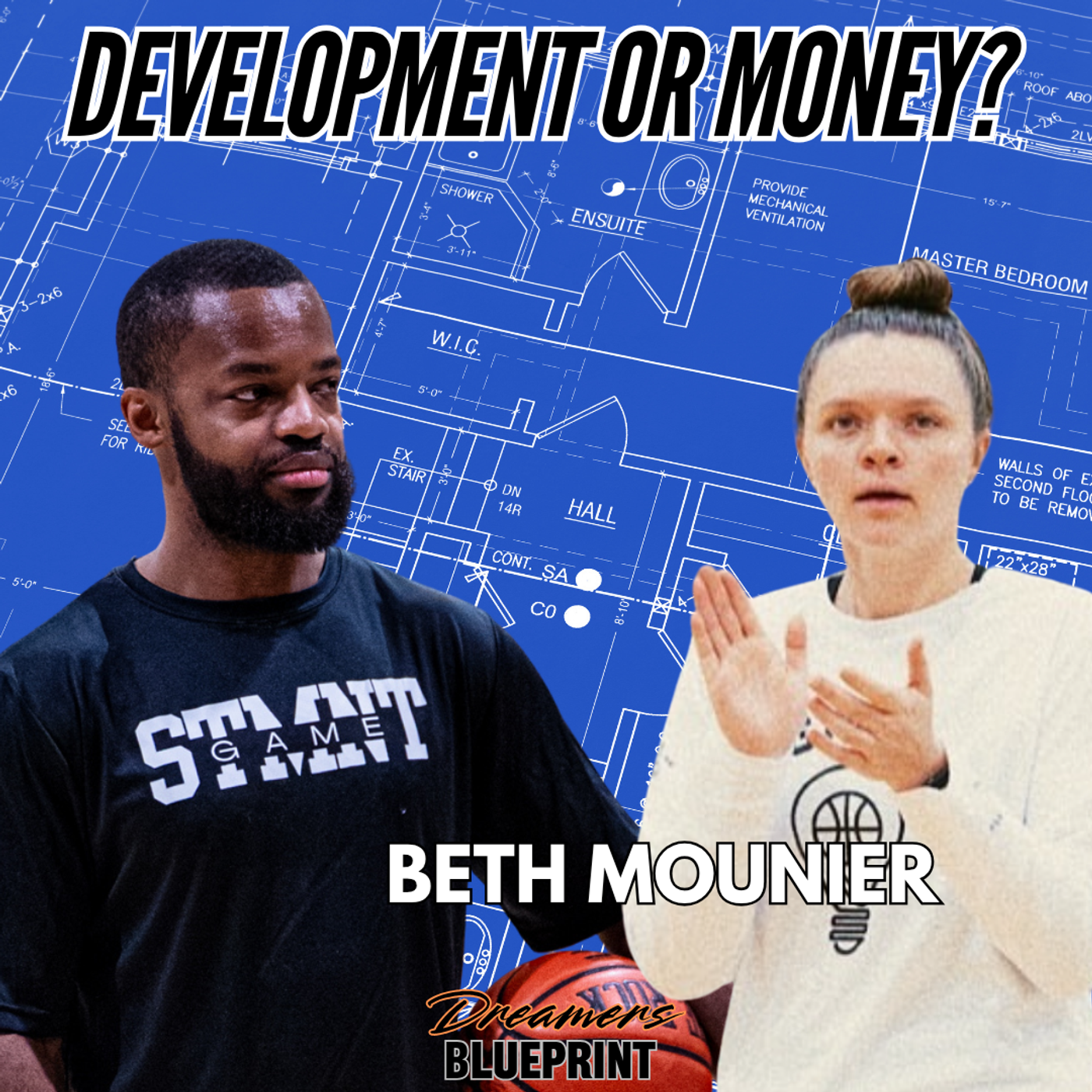
Dreamer's Blueprint · BeBall Jones
The conversation with Beth Mounier dives into uncomfortable truths about the basketball system and culture. Is it built for player development or profit? From training, to AAU and the culture in America vs Europe We talk on the mental and emotional burnout that all of these play on the players lives Chapters 00:00 Uncomfortable Truths About Basketball System and Culture 06:13 Development in High School Players 13:02 Balancing Year-Round Training and Other Sports 20:29 Incorporating Different Movements and Activities 27:51 The Pressure on Coaches and Parents 33:03 Underestimating Kids' Ability to Adapt 41:53 The Role of AAU Teams 53:39 American vs. European Basketball Culture 58:49 The Art of Basketball 01:07:26 AAU vs. Travel Basketball 01:19:31 Elite AAU and Development 01:25:21 Path to Pro Success
BeBall Jones: I know man, it's such a great question and you're looking for the answer. She got to wait till next week for the next episode. So this time it was such a long one, I had divided into two pieces. And the second piece, she answers this. But we get a little bit different in the second part. We get into more of the human development piece, the talk of balance and what work life balance or the balance as a player versus the parent looks like. We also get into rethinking what success looks like. But not just. What if you're the problem to your players development? Today I'm joined by Beth Mouillet. We're diving into some really uncomfortable truth about the basketball system and culture. The kind of truth that kind of make you question everything that you thought you knew about player development. We talk about the key piece that's missing and how we develop players. How the US system compares to the rest of the world. The real difference between AAU and travel basketball. These are not the same things. We break that down. We talk about the pressure that coaches and parents When we look at the system of basketball, the developmental space, is the system really built for development or is it really being built for the people in charge to make a profit? Beth Mounier: ⁓ Well, I think if you look at how it's being built, structure wise, you would have to say, ⁓ like the back end of it is so that the people in charge can profit. But, you know, so it's like the tournaments are hosting tournaments. Those are those people's full time jobs. And, you know, maybe the director of a program, some directors like that's their full time job. And so we would never expect. BeBall Jones: for players but it's us as people. as a player, what does success look like? As a parent, what does success look like? For us as trainers, what does that look like? So this is another great episode, another great interview, and that's part two continuing on from there. So if you wanna get into the rest of this episode, be patient, wait for it, we'll be back for part two. So keep it in the blueprint, see you next time in part two. put on young players and it's often without them really realizing and being cognizant of the fact that they're doing it. But we start with the biggest question. Is the current system built to develop players or is it to make money? This is a conversation that isn't about pointing fingers, not trying to put the blame on anybody, really just searching for the truth and imagining a better path for the players that we say that we're serving. So Vera felt like something's kind of off within the space of youth basketball and the culture overall. Beth Mounier: ⁓ any other type of business to operate without wanting to profit. ⁓ But I think one of questions is, okay, so that's the back end and that's the structure. Well, then what about the company, you know, that is youth sports, the industry that is youth sports could actually ⁓ be for profit and develop kids and develop people and develop families or not develop families, but help families along the way. BeBall Jones: It's the episode for you. Let's figure out together. Yeah, I think it's a tough spot to be in because we're in this space too. And so on one hand, you have to make profit. Like I'm not a nonprofit business. You're not a nonprofit business. We're working and doing it to be able to make a living so we can eat, we can have some place to live, so on and so forth. But there is a space where... Because it's created that way, you don't think about the development piece or the kids and the families coming first. And now the system's being settled to where everybody can make their money and make their bread, but we're leaving the most important piece around, which is the kids. And so when you look at some AU things in the tournaments, it's like, ⁓ snap, I gotta pay $50 every day to come to this tournament or this trainer is charging $200 a day to come train with them or whatever. I'm not saying it's right or wrong, but it's just, giving the truth of what it is. And so when you kind of have to look at it from both standpoints, how do you know when it's gone too far to make the profit or gone too far where it's just development and now the business is crashing? How do we figure out what the happy medium looks like and what it is? Beth Mounier: Yeah. Well, I think like, you know, as you were talking, I was thinking of different businesses like, like the bomb us the sock company where every sock you buy, they donate a pair of socks or Patagonia. We're like, okay. So like they, but those businesses are like international enterprises, right. And no one would want, I mean, like because they're as profitable as they are, they're able to do so much good. I don't know if it's like, what's the line because it's the same, you know, like the people acting at your local, like acting studio versus people who are paid to make movies. It's like, well, the guy who's making a movie, why wouldn't you charge what you can? Right? Like this is what it costs to have me in a movie. Right. And so, but like what they do with whatever they have were like the work that they produce. from that and I think a big thing is like what is like the heart posture behind it? So it's like, all right, so someone is paying you $250 for your hour. Like how present can you be in that hour? Because if one family pays that one time, because they just want to put their kid in the room as you, like can you show up and be great that day? And so I think what happens is people are charging whatever, but then they're not very good, right? So it's like. So the quality is diminished or you're like, okay, like for me for training is like, what can they do with me that they can't do in a gym on their own? Right. Either like we manipulate the court a certain way. We're teaching something new where it's like, you're getting something out of this hour that you couldn't have gotten out of an hour just by yourself in a gym. Right. And so then what is that worth? Right. But if you're cone drills and catching shoot and spot shooting and not really like coaching the shooting, but just getting up reps was like, yeah, that's like, you can do that on your own. Right. So I don't know if the question is like, what's the line? I think the question is like, how can we up the quality ⁓ output that or that kids are getting when they come to you, families are getting them when they come to you. So it feels like a good investment, something that's helping their kid grow ⁓ versus just something that's like taking from them and pulling from them and, and you could get somewhere else. BeBall Jones: Say something I've wrestled with. within my training and my business. And so if you look at like the calendar of what a player schedule would look like and life looks like. So start off with school ball. I kind of like the most important piece of what they do. So school ball is usually about from September till about February, including playoffs and stuff too. Maybe March, depending on where you're from and everything. But September, roughly a little bit of preseason stuff till about February. But then AAU picks up February, we're practicing everything. to March, maybe about May, regular AU stuff. But then if you got the elite camps and everything, talk with your line August, June, school ball scrimmages, they got all that going on. And you got camps and stuff going on. And then you have trainers. That's what we come in. It's like, how do you sprinkle in time with the trainer? Like we talked about the extras. When you talk about that schedule and you look at it, One. with the modern day version of what it looks like, how do you fit in development with the year round schedule with that, including the kid trying to play other sports and have the whole. physical iteration going on and being physically healthy and going through different movements and everything because you should play multiple sports, but then basketballs you run, should play multiple sports, but then you have baseball year round. So if that's the schedule, how do we kind of figure out the development piece that's most important for the player? Beth Mounier: Yeah, well, think, ⁓ like one of my first questions would be like, what age of a kid do you want us to like go? Like a high school kid is kind of what we're talking about. BeBall Jones: I was wrestling with this. ⁓ Let's go to high school for now. Beth Mounier: ⁓ Okay. ⁓ so I feel like typically by high school, sophomore year, junior year, for the most part, the kid has picked a sport, right? Like if we go back and we talk about middle school, which we can do our elementary school even, ⁓ that's like kind of a different conversation. But by the time they're in high school, ⁓ a lot of times like they've narrowed down, maybe they have one other sport, but usually at that point, like They're a little bit better at one. Their priority goes to one and they're kind of picking like, okay, I love volleyball. Like I'm going to do it on the school team, but you know, soccer is my main deal or lacrosse, you know, like whatever. And so like, if you're in that, this is my main sport. have aspirations to play college. ⁓ then again, that's kind of another different conversation versus just somebody who wants to. play and compete and play on their school team, right? But if they have the goal and the, the like maybe potential to play in college, well then like the extra training or the strength and conditioning or the practice in the morning practice in the evening, ⁓ that's like, long as they're driving it, right. And they can recover from it. Then it's like, you know, fit in where you can fit in. We I've had kids that you know, in the heart of their basketball season, I still see three to five times a week. Right. I also have kids who's like, they totally like I'll see him in the spring and neither one is good or bad. Right. But it's like, there's kids who's like, I've fixed my schedule so that I could do training in the day and then go to practice after. think where it gets a little bit tricky is like, who's driving the train. Right. So if someone is like, okay, I have a game. at six, but I want to come to you at noon, I get out of school early. It's like, okay, then we have to kind of pull back the intensity knowing they have a game. But it's like, you're just working within their, their schedule, right? And so there's no easy answer. think like for the most of our kids, the kids that I work with, they come one or two days a week tops, right? So it's like, if their AAU practice is Tuesday, Thursday, they might come Monday, Wednesday, right? They play. Friday, Saturday, Sunday, and then they're back. You know, there's someone who's like, you know, our team is having us come Monday, Wednesday, Friday. So I'm only going to come to you on Thursday. And it's like, whatever their schedule allows and their like family budget would permit is like, would like love for that extra time to come with me. But I think it's kind of like, and even if they're playing a different sport, like you said, I'm like, okay. There's a kid who's like play basketball, playing lacrosse and is going to come to me on Sunday, right? One day a week. Just like, Hey, we're not our main sport right now, but we just want to touch piece. So like, feels like we're still getting in the gym. So I think it's like ⁓ a family's choice and like a kid's dreams and aspirations will kind of guide like what really feels like extra and what really feels like just like part of your routine now. BeBall Jones: So now let's go to middle school and younger. I know it's kind of weird for me personally, the group middle school and younger all together, but I feel like it's close enough to where it makes sense. So high school, that's what you feel, you know, makes sense now, middle school and younger. would you say for that? Beth Mounier: Mm-hmm. ⁓ middle school and younger, I feel like, again, like some of the kids have big dreams and so like really early kind of like, I might be really good at this sport, right? But particularly like for me, elementary school is like, try as many sports as you can, because only from exposure to different things, will you actually find what you're good at or, or like to me, it's like you're like sampling, right? So it's like, okay, I sample soccer. I'm not very good at it. I sample volleyball. It's fun for me, but I'm not really good at it. Okay. I went and played basketball and it's like, it feels fun. I'm excited to come back. I'm learning pretty quickly and I'm not so bad. Like I'm playing with boys. I'm playing with girls. I'm like, right. And so it's like, you find something that you're like, ⁓ I'm, I'm good at this, right? Play handball at recess, play flag football and like capture the flag. it's like, you're just trying to find what is the thing that you want to dive into. Right. And so if in third grade, a kid is in, you know, one single sport was like, they haven't really sampled that many different things. And if your kid in third grade is tall, but your kid in ninth grade is five, five, right. Well, it's like, well, maybe if they had sampled other things, there'd be something else that they could could dive into and, you know, have like the I don't know, physical profile that might match that sport a little bit better. Right. So I think exposure to different things, not just like for sport excellence, right. But just so like, you could find something that you are interested in pursuing. Right. And it could not even be basketball or it could not even be a sport, right. It's like, I tried out for how to do choir in school and I really liked that. And so it's like, you're but only from trying different things and letting yourself kind of be new in different areas. Can you actually find something that you're like, all right, I want to double down on this and take a little bit more seriously. BeBall Jones: Yeah, because I've had a situation where I think it's usually on the boy side where it's like with basketball or basketball only. And I get it because that was me when I was younger, even though I could have played other sports. I was pretty athletic as a kid. But for me, I was just like, yeah, football. You got to be crazy to play football. You can take my hat off and I don't like that. And I did track. I was fast enough for it, but I didn't have any technique and stuff. So was like, all right, whatever. And then baseball was born to me so I never even thought about doing it. basketball is always my thing. So when it comes to training for it, when I see that that's their schedule, like said earlier, when it's basketball year round, then I'm like, That was best for the kid. And I think, like you said, are they driving it? But sometimes, you have to pull the kid back and say, hey, all right, cool. We know you love basketball, but let's pull you out for a month or two and put you in a other sport. Or opposite where just for the sake of you don't know how to really push yourself, we're going to put you in basketball, make you do extra stuff because you don't get it. So you want to be ready at basketball, but you don't understand what it takes. So we're going to make you go to the training. We're going to put you in extra classes for this and whatever. So how do you kind of figure out that developmental piece of pull the kid back because they're trying to go to 10 and say, hey, you you love basketball and as sixth grader, but let's do track. Let's do soccer. Let's do gym. Let's do tennis, whatever. Versus the kid is like, you say you to be great, but this is what it takes. How you kind of push that kid and pull the other kid back. Beth Mounier: Yeah, I just think like some of that is not our job. Right? Or like the only part you have control over is like, are you going to be available or not? Right? So for me, like if I want my kids to take breaks, and I know I need to take breaks, so I go out of town. Like you can't find me, I can't find you. I don't know if you're shooting or not, but you're not with me, right? Because there has to be some rhythms to it. And so we have a I'm trying to kid she's a senior and she's going to play the spring season AAU. And I'm like, okay, I will help you. But the second you pick a school, you're going to take two weeks off. Like you're going to have six months of off season, right? So kind of leveling with them of like, I can't control what you do, but I can control if I'm available or not. Right. And so even, you know, sometimes I have some middle school parents that's like, Oh, we have three weeks off between seasons. So we want to come with you all the time. And it's like, okay, that's cool. But I'm going to be gone for one of those weeks because it's in between my season too. Right. So I think like kind of like modeling, not, not balanced, but not modeling. Like, okay, we can really push in certain seasons, but if we're going to push that hard, we have to pull back and kind of like setting your schedule for that. But I don't think our job as a trainer is to parent the kids. You know, so it's like the, the parent is going to have to decide like, okay, we're going to push them into this. We're going to pull them into that. ⁓ but you feel very quickly, like when a kid feels, ⁓ forced to be in the gym, like it's not fun for them or for you. Right. And so saying like, okay, we're to pull this kid along cause they want to be great, but they're not working hard enough. It's like, what if you change that? And you're like, well, if you just, if you can get them in the gym, right, they might experience something different that frees them up. BeBall Jones: Yeah. Beth Mounier: to let them compete harder or get interested in being like, okay, I really like this. So I think it's just like the frame with which we view their development or like their process helps us like ⁓ adjust and attack their program different ways. BeBall Jones: I think there is a trade off to all of this stuff. And so you get to a point where it's like, hey, we're doing this year round, but there needs to be some level of a pullback or a push. I think, do you think we take enough account into Not just you specifically, but us as trainers and coaches and whatnot, into like a player's ability to recover. Because it's always different. Like if I had a Kobe workhorse, then he's good to go. But then you have, I often say somebody, but you have another player who isn't as physically built for that. Okay, we need to take more time around it. And then you see how the NBA is having a lot more of these. ⁓ bigger impact injuries, lot more Achilles, a lot more ACLs. How do we kind of figure out what that looks like now? Like, okay, yes, you want to train year round, but we got to look at the bigger picture in your overall health too, versus, oh, we got to call it to the kids because we don't want to get hurt. You know what I mean? Like, I feel like we get to where it's either really cold and we're going to baby you to make sure you don't get hurt. it's every time we go out, it's a 10 because we got to build with the toughness and physical toughness and everything. But there's a cost to this. So how do we kind of weigh out the cost of being like, Yes, you can work really hard and train and grind for this. And then on other hand, we don't want you to get hurt. Beth Mounier: Yeah, again, I think, like, the human body is like the more strength and maybe like adaptability and the tendons that you have, right? You can't prevent injury, but you can like reduce the chances of it being significant. Right? So I don't, so almost it's like, if you want to train this hard, it's almost like you have to do more, right? Where it's like, where you're actually going to have to go hit up the guy who does strength and conditioning in town. And you're to have to get stronger and you're going to have to care about your sleep because you're going to have to recover from this. ⁓ if you want to push that hard, right? So again, it's like, I think that the, the NBA is different because like the, mileage on their bodies is, is nuts, right? And the speed of the game and how often like they're hitting that negative step or kind of pushing off that back foot. Right? So if you have a calf strain and, you know, those guys are, are pros. pros where they have to make decisions about their bodies of if they want to play or not. Right? Like they might know, hey, your calf is trained, it increases your risk of Achilles tear. But they're like, I have to play this game. Right? And that's their decision really, as like professionals, right? Their body is their work. Right? And so they get to pick I want to play or not, someone is probably advising those guys like, man, your calf is really tight. You know? And so but on the youth level, it's like, yeah, exposure to different movements, but even some stuff as simple as like, what do you do in their warmup that helps them coordinate and move in different ways? You know, in Europe, sometimes it's like they play soccer for a warmup, football for a warmup, and then are in basketball practice, right? So is it like, do you need exposure to different movements and some level of like strength and stability in your body? Or do you need to go play a totally different sport for six months? Right? It's like, can we find ways to get some of those ⁓ boxes checked without being like, okay, go play soccer, you know? BeBall Jones: Yeah. Do you think enough of us are bold enough, I guess you can say, to kind of sprinkle that in there? Because I think I still see a lot of static stretching and a lot of, all right, everybody line up on the bass line and we're going to do the usual dynamic stretches. Do you think that is? still taboo I guess you can say to do something like that like all right we're all a soccer ball. Everybody's like what are doing with a soccer ball here? I thought we were playing basketball. You know it's a little weird because I'm here to get better at my layup or my jump shot or whatever. We're all a soccer ball. Beth Mounier: Mm-hmm. BeBall Jones: Do you think that enough coaches will take that leap and be like, okay, this is best for them. Once again, the prophet of it says, we do basketball, you're here for our, our basketball training versus the player says, I, when I play it, but the player needs this to get the different movement and the physical literacy of saying, ⁓ I don't have to sit here and go basketball training full out. So do you think that a trainer is willing to take that call? saying we can take five, 10 minutes to do this hula hoop I just made that up, you know, but. Can it try to take that cost of willing to do you think we're at that point yet? Beth Mounier: I think it would depend on like how many days a week are you seeing an athlete? Right, because it's like in the summertime, like I have a group of college kids whose they come like four or five days a week. Right. And so that feels like you're more responsible for the total volume of their week. So maybe it's like, hey, get here. Like, let's get here 15 minutes early. And it might not even be that it might be like yoga recovery or like, you know, we're running the curves or there's something that's like, cause that some of those games also just like loosens up their brain, right? To be like, all right, it worked. I came in tired. My body is sore. We played hard yesterday and now I'm here again. And so it's like figuring out ways to kind of break up their week. I think that if someone is coming to you one time a week for one hour, taking up some of that time is tricky, right? But like team coaches, right? You have 20 hours a week, essentially 18 hours a week. Yeah, why not sprinkle it in or something that kind of that builds up some different stuff or their strength and conditioning coaches, right? Which I don't like I don't do strength and conditioning with any of our athletes, but it's like those those people in their village, right? Could also introduce some of those movements. So it's like how can you kind of work with other groups? But could you play handball at lunch? Like I don't know what kids do at lunch anymore, but like you know, especially when we were younger, it's like, you know, we used to play games all the time at lunch and recess or whatever, where you're getting that exposure to different movements, again, without necessarily being on a different team. BeBall Jones: And then it goes into like the mental piece. Because I think that's the worst injury we can have is the mindset piece. And so you get to a point where, man, I've been playing basketball for the past 50 days in a row, and I'm kind of getting burnt out. Or you get to a point, especially in college, where it's like, man, this is my identity now. And I have an NIL deal on the I have a scholarship on the line. I have all this pressure on me. So. Beth Mounier: Mm-hmm. BeBall Jones: How do we kind of manage the mental and emotional burnout of all of that? Because I think identity is a big thing. The overall burnout, the pressure. And like you said, if a kid wants to be there versus the parents are dragging them there, you feel that. And so they get to a point where I'm going to do it because my folks want me to do it. But then they feel resentment. And if I get to a point where I can say no, I quit over it overall. Even though they love the game, but it feel like I was being dragged there. So how do we manage all the mental parts of it to where we're still doing the best we can for the kid. Beth Mounier: ⁓ so your question is how do we help manage their mental? BeBall Jones: Yeah. Beth Mounier: ⁓ I think like personally, what I think is like, we create an environment that people want to come to? Right. Because if you come and you have a good time and you're getting better and you're around people who are supporting you, ⁓ you're going to like to come there. Right. So like kids I work with, it's like their parents sometimes you're like, man, she comes out to the car excited every time, you know, or like we were here early because she can't wait to leave the house to get to you. Right? And so those types of environments, like promote ⁓ someone who's going to come in, work hard, make friends and send them back to their teams better. Right? And so if we can create an environment where like people can show up and try their best and work towards, you know, like finding different versions of themselves, then you're not going to like touch that burnout button with you that much. Right. think sometimes with like their, their teams or whatever, it's a different environment than like when they come to you, it's like, it's like, I always say sometimes like training to me, I want it to feel like you can come in and exhale. Right. Like, okay. School's been hard. Your team is tough. You're not playing your stress, like whatever, but you can come in here and you can like take deep breaths. Right. And you can enjoy it again as you're improving. And that helps their, their mental. a lot, right? And I think our position and depending on hours, think like the kid kind of invites you into the space they want you to be in, right? Like if they want more from you, like emotionally, then they sometimes like they'll let you know when they want you to speak into their life or not. Right? So it's like, if your team is hard, they need to be coming to me for a long time. Like me 15 years older than you. It's like, well, I can help you kind of reframe some of this stuff. I can help you work through some of this stuff because Like you don't have all the answers to the test you're taking right now, which is your sport at this level, right? So it's like helping them kind of work through some of those things just so they can go back in and approach it another day and, you know, get, get through the next month or get through the next week. then, you know, there's bumps and bruises all along the way, but it's like, kind of like what is our position in their development in different parts of their year. ⁓ It's kind of like you have to answer that for each athlete that you work with. BeBall Jones: Yeah, like he said, the environment that we create a change is so important because this literally just happened, I think this past weekend. So talking to a girl about training and she was like, oh, I forgot to tell you, I quit basketball. I'm like, that's crazy. Why? Mind you, she's like in middle school. she's, and she said seventh grade or eighth grade, one or two. I'm like, dang, that's crazy. Why are you quitting so soon? She ain't like the coach that was at the middle school. Beth Mounier: Mm-hmm. BeBall Jones: I'm like, what's up? She's like, time he came in, it's like his negative energy and he's talking to her a certain kind of way and she ain't like it. I'm like, dang. Like, and I know I can help her outside of that because I like to have fun too. You feel me? Like I'm not finna come in here and make you feel bad. Cause then I'ma feel bad. And this is swimming for nobody. And so I was like, man, just give me a shot, see what we can do. And then I think last year I had another guy who told me he quit. Why'd he quit? Cause of the coach. I didn't like how you were talking. He showed favoritism to another guy and all this stuff. I'm like, dang, I miss you, man. Like, it's so much fun having the guys in there. And so, and I thought about it the way I'm like, man, what is it that goes through their brain, the coaches' brain to do that? And I'm wondering if... is some of is out of fear. Like, are you fearful of, I have to push the kids because I don't want to get fired for my job? Or are the parents pushing the kids because I don't want to feel like I didn't do my part to make them succeed? So I have to make sure they're going, get all the training, get all the games, all the practice. I have to do everything at this level because they don't want to feel like they're not getting developed and they're being left behind. Because at this point, all the kids are coming out here doing animal mixtapes. stuff as a fourth grader and it's like, bro, what you doing with this, man? Why you got the hezzy lockdown looking like KD out there as a fourth man? Stop, you're making me look bad out here. And so when parents see that and they're like, ⁓ man, this whole team has a whole highlight package. The culture scene is like, man, my age team has to catch up. Do you feel like some of that is just the fear of... The parents saying my kids being left behind not good enough and the coach feeling that pressure from there into or is it something else that I'm missing? Beth Mounier: ⁓ I feel like when you were first talking about like the couple of kids who quit because of the player or because of the coach. ⁓ I think sometimes coaches, ⁓ like people, leaders of any organization, any group of people, it's like, they think that if I push you harder, I'm going to get more out of you. Right. And that exists to a certain extent, right. But it like, if that pushing isn't met with like the support and care. to kind of like handle that level of challenge, then it's gonna feel ⁓ like ⁓ the kid will feel anxious and will get burnt out faster, right? So it's not like the challenge is bad, but it's like the challenge met with no care is where it starts to feel really misaligned and it starts to feel like coach is talking to me some type of way and I don't like it and now I'm not playing, but I'm still getting yelled at. And now it starts to feel like an environment where like, why would I continue to be a part of it? Right. And like science studies show that like the number one determining factor on it, a kid has a positive experience with sport or not is their coach. Right. But coaches are not always informed on like, well, how do we actually motivate kids? All right. Or like, how do we create an environment where like they can be their best? And what is the push and pull between like system and freedom, right. And challenge and support. And so that is like, it's a lot of nuance that, you know, a middle school volunteer coach, like how can we expect them to be super knowledgeable in those things? And that's not a knock to middle school coaches. It's a knock to like, okay, you're getting, you're asking people to volunteer their time, energy and resources to coach your kids. But it's like, but we're not necessarily preparing them, not just with X's and O's, but with like, okay, how do we lead? Well, like you have this group of people in front of you who cares very much. what you say, how you say it, and how that makes me feel. Like, can we take a little bit of responsibility in that area too? And your second question is kind of like, okay, the parents expectations right now of their fourth graders, fifth graders is like higher than it's ever been. Right? Like we're, we're like missing the plot on like, what is the goal of fourth grade basketball? Probably to play fifth grade basketball. Right. And what What we're seeing right now is the difference between like, like what will make a, like an athlete better long-term versus what will make an athlete better in fourth grade. Right. Because if you sign up for five days a week of training and you're in every tournament and you do whatever, yes, you will get better in fourth grade. Like there's no question. Right. Cause it's, it's an accumulation of increased hours, increased exposure to the thing, but but if they tear their ACL in eighth grade, because they already are doing too much, well, what does that mean to their long term development? And so like parents, I think, like the expectation for their kid to be good, to be good right now, otherwise, they missed the mark is like higher than it's ever been. Right. And so that pressure that that puts on the kids, I don't know that like If you're talking about pressure on a coach, it's like, okay, maybe if you're coaching like the best, one of the best quote unquote middle school teams in the country, you feel that pressure, right? For the most part, like it just puts so much pressure on the kid and it's like, yeah, they love it right now. But the only like some things like you can only see how they play out in the longterm when you wait for the longterm and see what happens to that group of kids who is really good in third grade, which is where it's tough. BeBall Jones: Do you think that we underestimate kids' ability to adapt? Because like you said, we're putting all this pressure on them for it be the best fourth grader in the nation, ranked number one, or whatever. Because all the lists are coming out now super early. Class of 20, 45, ranking. And it's crazy. Beth Mounier: Yes, they're unborn. Yes. BeBall Jones: Exactly like that. They're already getting some. ⁓ I think your mom and dad might be there. So we're going to rank you that. But another conversation. So ⁓ do you think that we as adults, our group was all together, underestimate the kids ability to adapt? Because like, you have to be so skilled right now, fourth grade, right now, sixth grade, because if you miss out, you're not going to know how to do all these skills and all these moves. But I think. if we put them in the right environment and teaching them metal skills or how to learn, like learning how to learn basically, they'll adapt. So do you think that we're underestimating their ability to mentally adapt and learn the skills and learn the physical traits? Or are we just, if there's something to be said about them being left behind of the skill level. Beth Mounier: Run. I feel like the answer is both. Because again, like if I circle back to like, okay, ⁓ the point of youth sports, like real youth sports is like sampling, right? Then hopefully if you sample enough, you find one that you're good at or that you have like, ⁓ like you're interested in and like the learning comes quickly to you, right? So the progression happens faster, right? And so I think ⁓ If that's like the working theory that I'm trying to work off of then it it says like okay, like I might get Eighth grade and I'm like, okay, I really like basketball. I'm gonna double down on it and Then it's like do I have the I don't know like propensity to grow faster in that sport Because I like it. I'm interested in it. I want to pursue it But I do think So I think that, but it like, for me growing up, like I played basketball, that was like my favorite sport after eighth grade, I never like touched another sport. And even like seventh and eighth grade, like I was bad at every other one I played. Right. ⁓ so I liked it a lot. Like I played, my brother and I drove, we rode our bike to parks. We played in the backyard. We dribbled in the front yard. Like we played at lunch at school. We played after school. We played on our club team. ⁓ And you know, that worked out fine, but I wasn't good at the other sports is the point of what I was saying. Like I was so bad at the other things that it's like, okay, but if my mom would have been like, no, we want you to play soccer. Well, it's like, could I have gotten better at soccer for sure? But would I have been able to play college soccer? Like I couldn't imagine it because I didn't like it. I wasn't good at it. I don't like playing in the rain. Like And so I think sometimes when we're talking about like, all right, if they're in a sport that's just not for them, doesn't matter how much training you do. Like you might not make whatever arbitrary goal you have, but if the point of view sports can just be like, can I love it? Can I progress? Can I build community? Can I see myself getting better at something? And he's like, yeah, put them in a lot of things because you can, you can get that from sports, any sport that you play. think there's, sorry, I'm talking a long time right now, but I feel like there's, you know, if, if 1 % of youth athletes make it to college basketball, right. And if you go every level, it's like maybe 3%, right. So, but right now, like every single athlete thinks that they're part of the 3%, which is both the delusional confidence you need to actually become that. And like, it's just put so much unrealistic pressure on a third, fourth, fifth, sixth grader. When it's like, you just don't know what you're gonna become in the next five years. BeBall Jones: I've had this very loose working idea and maybe you can help me start to flesh it out better. And so I don't know what was the genesis of this idea, but I was like, why are we talking about college basketball with middle school kids? Kind like you were saying. Beth Mounier: Mm-hmm. BeBall Jones: we need to be doing this to get to college, we need doing this to get to the NBA. And I get it from the standpoint of you, like you said, it's the top 1%, the top 3%, I understand. But it gets to a point where you're putting, like you said, we're playing the seeds in their brain of like, ⁓ if I do this, I'll be a college athlete. Maybe. Not saying you won't, not saying you will, but maybe. And there's so many factors going into it. So I started thinking like, why don't we just kind of have them think in terms of... This helps you become a better human being and a better athlete and all of that. But for right now, this helps you get to seventh grade basketball. This helps you, like you're playing varsity right now. This helps you for next year in varsity. This helps you make JV. This helps you make AAU team, because you're trying to go from travel ball team to this elite AAU team. So how do we kind of do that? but at the same time you don't want to dumb them down from what is possible of the bigger picture. So what does that kind of look like to not push this bigger picture of, oh, this is what you do for college basketball as a sixth grader, but at the same time, you know because she's 6'4 right now. The odds you making it are a lot higher, but. You might not want to do that. You could be a volleyball player. So how do we kind of manage the bigger picture, bigger dream versus the next immediate goal for all the kids? Beth Mounier: Mm hmm. ⁓ I think like what if what if we could just help each kid become the best that they could be and like not put I Say like we're not supposed to be like predictors of their potential, right? We're just supposed to help them progress You know, so it's like I don't know like I don't know if you start training right now for the next five years like How could I possibly guess how good you'll be? Because I can't, because they say like, I heard this a couple months ago. It's like, potential is such an interesting thing because it's usually a projection of what you would do if you were in that situation. Right? It's not a prediction of what they'll do because they haven't done it yet. Right? So it's like, okay, you get this person who's six four and you're like, okay, like they're... potential is such an interesting thing because it's usually a projection of what you would do if you were in that situation. Right? It's not a prediction of what they'll do because they haven't done it yet. Right? So it's like, okay, you get this person who's six four Like you see it and you're like, man, if you could just, you could be like, hey, Wilson, but it's like, she's like, I don't want to do any of that, but like, I can't predict any of that stuff for you. ⁓ And it, ⁓ my ego is not involved in if you get a college scholarship or not. Like you see it and you're like, man, if you could just, you could be like, hey, Wilson, but it's like, she's like, I don't want to do any of that, you know? So, so we don't know. But if you get someone who's like, man, what if you're five, four right now, seventh grade girl, and you become five 11, like, well, that probably changes things, but like, I can't predict any of that stuff for you. And it, my ego is not involved in if you get a college scholarship or not. So I can just help you become. the best you can be for as long as like you're under my umbrella of care, then like whatever comes, whatever that turns into, whether you go from liking it to loving it to being ⁓ obsessed with it and to training every day, like that's your pursuit and your journey, right? So like, I don't talk to a lot of kids of like, if you want to play college basketball, you have to do this, right? It's like, you're gonna be the... So like, I don't talk to a lot of kids of like, if you want to play college you have do this, you're gonna be like the driver of your own ship. And I'm gonna help you as much as I can for as long as you trust me to be one of the people who helps you do it. But where that goes and where that takes you is, it's your process, right? It's your thing. So let's just like see how much we can get better. And then whatever comes of it will come of it. And I bet you once you hit the next mark, we're gonna find 100 more things that we have to get better at all over again. So. My engagement with you is always in the, do we be better? How do we be better? How do we be better? Right? Then how much better you become is a question mark. We won't know until time does its thing and we know, My engagement with you is always in the, do we be better? How do we be better? How do we be better? Right? Then how much better you become is a question mark. We won't know until time does its thing and we know, you know? BeBall Jones: Buh-bye. I got this AU team, right? And I'm trying to recruit this girl and she's pretty tall as a seventh grader. But if I don't sell her on I'm the answer to her, like getting the college ball, I can't get this girl in. You feel me? And that's how a lot of that's a lot of them think that's a lot of them sell the sales off. And it's like, oh, you come with me, you know, I can get you. I know all these coaches over here. And if we play in these tournaments and get in this circuit, we can do this and do that and get this exposure. And that's their ticket right there. But if I just tell you I can get you to be a better you, that's not a sexy ticket to have you come play on my AU team. ⁓ Beth Mounier: I don't coach AAU teams for that reason. And I've actually, talked, I have a business mentor and I was talking to him like within the last month. And I was like, man, like, don't you think I could put together a pretty good team? And he was like, you would never, cause you don't like to move in the way that would be required for you to get the kid from that team and get the kid from that team and do all that. He's like, you just don't like to, and I don't, I like to like do my best, come home, go to sleep, like go about my day and not worry about like, am I doing something that would make another coach unhappy or am I selling a parent wrong or am I lying? Like am I losing my integrity in the process? And so I don't like to touch that world, ⁓ which doesn't, which means like the way I move, like is not for everybody, right? Because I also, can't tell you that whatever's gonna happen. But I honestly, to the flip of that, I always feel like the kids who are really good, like parents who are like, all right, should my kid play on this team out of town or not? Or should I do this or that? And sometimes I'm like, if you have a kid who should be playing out of town, you would know. Because a lot of coaches would be calling your kid to see if they can get you to come play on their team out of town. And the really, really, really, really, really good kids, pay for you to do that. Right. The program has enough money that they're paying for your kid to fly out every weekend to be on that team. And so some of these questions, it's like they answer themselves. Like if your kid is that good, you would know. Right. And if your kid develops into being that good, you would know because your phone would be ringing all the time. Right. Coaches from every bordering state are going to try to get you to be on their team. And if you're not getting those calls, then be on your local team who plays regionally or nationally and be the best you can be. But some of these questions, like they answer themselves, you know. BeBall Jones: Yeah, I'm similar to you. No, no, no, like, I absolutely agree. And in terms of what you were saying about starting a team, I'm the exact same way. I've had, you know how parents are kind of like, I'm looking for my son to play for a team. ⁓ but we don't have a coach who thought about putting you in the scene. I'm like, thanks. I appreciate it. But it's a lot that goes into it. So. ⁓ Beth Mounier: What do you think about that? You think that's wrong? BeBall Jones: Sure, know, but in the back of my mind, like they're probably not going to follow through on it. So I'm just. Thank you, you know, we'll see, you know what mean? And recently had somebody kind of they're looking to start their own program and he was like, OK, he has the boy side out at the girl side and. I was like, cool. Let's see if it works. You know what mean? Like I just want to be able to train at the end of the day, I don't want to able to train. So whatever I can do to get back to training. Cool. And different conversations we had trying to figure it out. In my mind, I'm like very, I'm very cognizant of their development. Like, does this prepare them to get better? And I'm fairly aggressive with my ideology of it. So I I'm not gonna baby you when it is. We're girls who are playing against boys. I don't care. There's a good chance we'll play up a little bit sometimes too. I'm not gonna, in my mind, there's no backwards. So if we're fourth grade, we're playing fourth grade and up. There's no going down to play third grade. So different things like that, I think through my development. And some of that is you need to learn to get your head busted in. I'm completely fine with that. Like, you're not gonna get better by doing the head busting in all the time. Like sometimes you have to learn from those losses to figure out what to get better at. That humbles you real quick, the ego gets smaller. And because that's my ideology, a lot of parents don't want to hear that because I need to be ranked Beth Mounier: Mm-hmm. BeBall Jones: number one at this point. Well cool we're not going to be messing with because you need to be ranked number 101 to know we can get better you know what I mean and that's the part of process and then funny enough I ended up being like you remember when Colby talked about the Mamba team that he had A lot of stuff he was saying with that and it being like, dang, that sounded like me or I sound like whatever it is, know, respect to him. But I sound like him in that moment because I think he the first year they were terrible. Like it was atrocious. They were getting their heads blown in by like 70, by some things. But he's like, it's fine. I'm completely fine with it because next year we'll come back, we could beat by 50. Next time we come back, it's 30. Next time, ⁓ 15 point game. Next time we come back. Okay, we lost by five, let's cook now. So at a certain point, we're fourth graders getting beat by 40. By the time you see us in ninth grade, watch out now. And that's how I view it. And then for me personally, knowing the development of what it looks like, I want to have a commitment to say, not to say you can't play on other teams, but if you're me, you're with me. Because I don't want to see you have to do the rope-a-dope of in and out. I don't want to play that game. But that's not absolutely fair to some people because if I'm not the best fit, they should go. Beth Mounier: Mm-hmm. BeBall Jones: So that's kind of how I see it. And I'm kind of selfish in that standpoint of I want you to be with me, not from like the money standpoint or whatever, just because we want to be locked in. I don't want to sit in here and have to question, I going to have nine girls this time? Am going to have 12? Am I going to have five? Am going to have six? That's a big thing. I can't stand with AU. And so I would love to have the consistent development because that's what I care about. And I don't want to have, like you said, I don't have to do the whole recruitment thing of being like, I'll go to this game. Hey. I got a U-T, you want to play with me? I'm good, man. So at this point, I would just much rather just train and stick within that realm. Because I just don't have the capacity. I want to do all the recruitment and talking to this girl and going behind their back. Oh, you play with them? Come play with me. I've seen that be done. I don't want to go back to it. It's not for me, man. So if I did do a team, that's how I do it, is the development focus. Beth Mounier: But think good. Yeah. I think like Kobe is like, could you imagine? Okay. All my kids, friends, we're going to start this team together. Yep. We're going to be at Mamba Sports Academy five days a week. Um, I would have, I would assume I could never know for sure, but I would imagine like those kids, they're not like paying to be on a team. You know, it's like, so there would be no reason, like, why would you leave? Right? Like that's like. knowledge that's so much higher than anybody else, right? It's probably like a group of kids who's like their families. They really enjoy each other, you know, so it's like, so like you just said, it's like, so you stretch the timeline, right? Because he said, Okay, we might lose by 70 in fourth grade, but can you come back in fifth? Right? Like, can you stick with me and stick with each other and stick with your development long enough that it's like, we're gonna be seventh graders, eighth graders, ninth graders. And, you know, I think like every single kid who was on that team is a college basketball player, right? Minus, you know, like, so, so it's like, there's some piece of that development that like, that really worked, right? But it's like, how do you, or any coach, how do you create an environment? How do you create a world or a little ecosystem where like the kids don't want to leave, right? Because if they're having a good time, If they're enjoying each other, then they'll come back. But if they're losing and the coach is yelling at them and they don't feel like they're improving and their parents and the kids are bickering with each other, no one is going to stay through years of 70 point losses. You know, if the rest of the pieces aren't in order, right? So it's like the games are always, they're like checkpoints, right? Okay. We put a group of eight together. playing this tournament. We're not very good, right? As a checkpoint. But how is every other thing that you do in your week, in your months, in your seasons, gonna make sure that those kids come back and are like, you know what, we are improving. My kid loves it. She doesn't want to play anywhere else. And gosh, now we're four seasons in and now we're really competing with those teams. But like our ownership piece is like, how can we create a better environment where they don't want to leave? Or they leave and come back and we're like, hey, we're welcoming you back with open arms. Like, we're glad you're here. But like, you know, let's stick around for a while. But we have to create the conditions that people don't want to leave from, right? And that's our job. Like if they can stay in here long enough, can I promise you'll improve, right? And if we can take the responsibility of all of those pieces, then parents and their kids will be less likely to be like, okay, I'm going to go find the next thing. BeBall Jones: Yeah, that's something I have weighed out here and there. ⁓ Coaching is fun. I will say that I've enjoyed seeing that process. ⁓ And that's something that I think is very doable. If Kobe can do it, I can do it. That's kind of how I feel about certain stuff. If Kobe can do it, why not me? It's like, was I in the NBA? No. Am I 6'6"? No. Did I score 81 points in the game? No. But why can't I do the same thing? turns out you're laughing a little too much over there. But why can't I develop the same environment and foster a team like that? You feel me? So, but no, seriously, I think that's something I could do and... I know the right situation I have to come up. I keep thinking like if I did the training and I was the assistant coach and I had somebody else to be a head coach, that's the most ideal situation I could do. But we're still moving very ethically. I don't want to play the whole poaching girls from other teams. I don't want to that game. I don't care, man. I just want to train. So if she leaves, I understand. get it. Like you said, have the open arms to come back. So that's something I've weighed out here and there. I'm in a point in my life right now where I'm cutting off a lot of things to get more focused. So we'll see. This is gonna have to circle back to. But then if you watch on social media, they say A is the worst thing for basketball. So it's a whole other thing right there. Like, ⁓ A is the biggest problem in the US hoop culture. That's why the Euros are beating us and everybody overseas is better. And the training here is terrible because of that. What do you say about that? Beth Mounier: I know if that's, Well, I think like, so like American culture is much more individualistic than European culture. So my theory on why people from Europe, like that are NBA MVPs have been from there ⁓ is because, so I think like in the United States, you grow up in a very like individualistic system. Right. I want to be great. Me talking about all this stuff about wanting to be, have a great team. Like there's a lot of people who's like, ⁓ I'm I'm a me guy. I'm a like, I'm about me. So it's more ISO work, breakdown work, ⁓ creating separation for a jump shot, like all this stuff. And in, in Europe, the primary development, depending on, ⁓ like the specific country you're in, it's going to be and look different. Right. But generally speaking, it's more team oriented development. So they're better at reading the game, maybe schemes of the game tactics. So then when you layer that with, okay, so the baseline that we're getting is ⁓ IQ strategy tactic and the very, very, very, best of our players who are also skilled beyond any like measurable output where then like, so when they come over here, they blend both right where I'm both have this super, super, super high margin of skill and I've grown up in an environment that's super team oriented. Now I'm a total outlier on my IQ and skill coupled together. Right. But the majority of overseas players are really, really, really, really, really, really excellent role players. Right. But even most European teams, they'll go pull two people from the United States. who are gonna be their point guard and their primary scorer. So it's like they need both. So it's like, but the outlier of, okay, I get every single role, intricate detail of the team and I'm the most skilled. Like that's a wild combination for us to try to figure out. BeBall Jones: Man, if you just listen to social media and nothing else. You very seldomly get those ideas. And it's just like, we care about is 101, all we care about is me. And the Euros got team basketball, that's how we supposed to play. Coaches will amplify the Euro basketball, they're doing it better overseas, and that's the way you do it. But you don't say anything, we got that player ice oil at the top of the key, five seconds left, and you're let him do their thing. Then all of a sudden, America basketball has it right. You got the guy who can take the team, put them on his back, and will you win? All of a sudden, something's good about American basketball. It's perfectly fine then. And so I think there's the weird... ⁓ viewpoint of it of kind of this echo chamber like someone threw out that idea because Yonis won MVP and then Jokic won MVP and it's like Luca coming over here killing, Wamby's killing. I don't see doing something better about overseas basketball and it's like yes they have some aspects better but we have some aspects that's great too like you just said. I think it's like you said the perfect blend of it can be doable but social media is only telling like the loudest voice is just a half of saying that we're doing everything wrong. I don't think we're doing anything wrong. think we can just make it better. that's the... ahead. Beth Mounier: Well, I mean, just to that point, feel like kids in America, it's like they're more skilled than ever and they're not very good at playing the game of basketball. Right. And, but I'm saying like, I think why European culture right now, they have outliers who are coming to the United States and they're so much, and they're so much better. Like they're winning MVP after MVP after MVP is because they are coupling like the extreme skill that they have with like, unreal IQ and feel for the game. Right. And, and also in America, it's like, we can, you know, 900,000 kids play basketball and 300 make it and 800,000, whatever, whatever, whatever, don't. Then we're like, cool, but we got our 300. Right. So sometimes if you look at like, well, what are the numbers output of like, who's actually like, seeing the kid through their development pipeline and actually getting, you know, whatever the desired outcomes are. It's like, then we have to like look at all of this stuff with, with some, some nuance. There's so many, in the United States, like we have so many people. So we have so many people who don't make it, right? Like so many who is like, all right, you tried this super, uh, one-on-one style of basketball. You never made the extra pass. You never drove and kicked to the big and So it's like, you're not really playing a good brand of basketball, but it's like the best of the best who you can combine extreme IQ with a really high level of skill was like, yeah, they're always going to push their way to the front of any sort of kind of, kind of lineup. Cause that's the hardest thing to put together. Like, why do they never, why do they never double? Why is it so hard to double Luca? He's always going to make the right pass, right? Why is it hard to double LeBron? Cause he always makes the right play. Right. And so it's not because he can't find his way out of a double team is because he'd be a willing passer for the rest of his team to go play four on three, three on two. Right. So it's like, you, or Steph, right, I have the gravity of I'm everyone with me and then I can dump to you. Right. It's like, when you do both, then you meet this like game. That's like, it's really pretty to watch. And when they have to take over, it's like, they have that in them as well, but it's like both combined. We have so many kids who's like, you're just not willing to make the next pass, right? Because you'd rather miss, but you shot it, then kick to the open person who might have a better shot than you, more open, better rhythm. And like, we don't always learn from that stuff here anymore, you know? BeBall Jones: But that's something I've been thinking of like. Oh, the kids these days don't know basketball. Kids these days don't have high IQ. How are they supposed to learn? Isn't that your job as the coach to teach them this stuff? Isn't it your job to put them in situations to understand location on the floor, to understand what these movements are? The coaches want to fuzz at the kids and say, oh, these kids don't know anything. And I had to pause a couple of times to think that, like, man, I was in seventh grade, did know this stuff? No, I was dumb. I was just playing. I didn't know anything. But guess what? My coach was like, oh, this This is the nail. This is what we do at the nail. As a point guard, your job is to get the ball at this free throw line, push it to the other free throw line. Once you get there, you don't have anything, now you pull it back out, run the offense. And then when you grab the ball, your butt to the sideline, you're pushing it, get to middle floor, you're doing this. Like all the small intricate things that you learn, you got from the coach. But nowadays the coaches want to say the kids don't know anything. So is it the kids fault that they're playing one on one basketball and don't know that game and have high IQ? Or is it the coaches fault? ⁓ that's the tough one that people don't want to look at. So that's the thing that bothers me of like all the kids don't know anything. Beth Mounier: Mm-hmm. BeBall Jones: Whose fault is that? You know what I mean? Like don't blame the kids for not doing anything. I got to a point where I don't care if it's a college kid or you don't know it, that's my fault. That's my bad. Let's rewind, take ourselves back and let's teach you this. It's not their fault, it's mine. You're paying me to teach you basketball, essentially. Whether that's skill, whether that's movement, whether that's vocabulary, whatever it is, my job is to teach you. So if you don't know something, that's 100 % on me. Beth Mounier: Totally. BeBall Jones: I take all the responsibility and blame. But that's the thing that bothers me because all the kids don't know anything. Well, whose fault is it? Did you know everything when you were in seventh grade, when you played middle school basketball, high school basketball? OK, how did you learn? So now all of a sudden, the kids are supposed to learn about themselves? So that's what bothers me when I hear that stuff. Because kids playing one on one, well, did you teach me how to play one on one? Of course. Did you teach me how to play ten basketball? That's where it annoys me hearing all this stuff because you're not teaching them the game but you want to f*** out them for not doing it. I don't know man. Got so many coaches just having an opinion without doing the full work of it. But who am I? Beth Mounier: Yeah. No, I agree with you 100%. What I think is interesting to look at, your first question was, all right, are the systems built for profit or are the systems built for development? And so, okay, so you start an AAU team, right? And it grows faster than you think. And so now you've got to hire three other coaches. Can you name three people right now that you would hire that would be as good a teachers as you? who would be under you and want to coach for your team. Could you name three? BeBall Jones: Nah, maybe one. Beth Mounier: Okay. So who do you hire maybe to be your coach? Like the, maybe Sally Lou's dad would volunteer to coach the team. Right. Okay. So, okay. Sally Lou plays for free. Her dad coaches the team for free or like that trade of services. Right. Well, how good is he? Right. What is your expectation of him to be able to teach these things? How are you developing the coaches under you that they'd actually know the stuff that you know? Right. Meanwhile, so he's working for, say, $1,500 for three months. Let's just say, right. So that means he's got a full-time job. He's got a family, at least one kid who he's bringing to practice. Like what, how is he supposed to know the game at a high enough level to teach it well to a group of kids? Right. So like system wise, why is some of this stuff like problematic is because when okay, so let's say I'm an AAU director, right? This is my full-time job. Let's say we have eight teams and every season like baseline profit wise I need to make 12 grand. Let's just say like these are just make I don't coach a team these make believe numbers, right? All right. So I got eight teams. I have to bring in at least eight grand 12 grand. So now how much can I pay a coach? Right? How much am I going to charge the kids? How much am I going to pay coach? How much does the gym cost? Right? Maybe 18, I get a discount on the tournament. The tournaments are expensive because gym rentals are expensive. Right? So the tournament people have to make money, but the gym that they're renting is $250 an hour. Right? The janitorial fees are $500 at the end of the tournament. So like all this stuff adds up. Right? So then I'm here doing my budget that says, okay, I got to bring in four grand a month. 12 grand over a season. So now I only have $1,200 to pay a coach for three months, right? Who are you going to get that's going to get who's going to be willing to work for $400 a month? Right? They all are going to have other jobs or they're going to be brand new out of college or out of high school, maybe still in college. So you, you cannot get the level of teacher that you would want to get if you're paying them. like $12 an hour for their time. You know, so that's my problem with like the budget and profit of all of like, all of these systems is like, how could you expect somebody, you would never expect your like intern at a company to be as knowledgeable as the CEO. Right? So, and like, but companies who's like, I'm attracting top talent, I'm hiring top talent. and I'm retaining top talent, right? Well, then those companies, you're going to have better people and they're going to build better teams under them. But if I'm directing it, well, I don't want to make less than 12 grand. So I'm either going to have to charge the families more so I can pay coach more, or I'm going to have to hire or get a volunteer coach so that like, so the, like the, the, the math and the money of the systems have to also work for all the people involved. And these teams though, have been operating like this forever, right? Like there've been private sports companies building teams, putting them in rec leagues and tournaments for 50 years, right? So it's the same, it's been the same problem, but we don't look at it with the lens of like, all right, how good is that guy supposed to be? So my volunteer dad is supposed to know that we got to teach our point guard to get their butt to the sideline so they can see up the floor and hit ahead. He played in middle school. Like he never learned what you learned playing high school college basketball because he played on his eighth grade B team, but loves his daughter and wants to coach the team. BeBall Jones: So. You understand this. There was a point where AAU was like, it was tough. So you knew AAU was the thing. It was like, man, you playing AAU, not travel ball. Let's start off with this. There's AAU and there's travel basketball, two separate worlds. Beth Mounier: Mm-hmm. BeBall Jones: Travel basketball, anybody, everybody. That's like advanced rec ball. That's the next level of rec ball. Rec ball is like neighborhood stuff, cool. Travel ball, very similar thing, just the older grades. Now, AAU, ⁓ you're hooping. You know you're hooping. That's where the circuit comes in, the EYBL, Three Stripes, and everybody else. That's where that comes in. If you're at AAU, you're really hooping. But. Beth Mounier: Mm-hmm. BeBall Jones: the filter system of getting to AAU means you're really, really good. And there was a point where... That was the filter. It's like travel basketball and AAU. It's a big jump there. But I think we got to the point where it's got shorter and shorter. And now some people don't even know the difference between AAU and travel basketball. They think it's the same thing. So now it's just, you're playing AAU and they think you're travel basketball. Or you're playing travel basketball and you think you're playing AAU. I think we need to get back to that point. Where's AAU, the creme de la creme, the top tiers, the... Pretty much, if you're playing AAU, you're playing college ball, pretty much. Even if it's JuCo, even if it's D2, you're playing college basketball, essentially. I think to get back to travel basketball, like, you might, you might not, but we're here. And I think with that separation of who we have there, so, sad to lose dad when a coach, cool. We got this little rec league team over here. We need somebody fill in the seat and substitute the girls. That's pretty much all we need you to do. That's fine. Oh, AAU? All right, sir, what's your credentials? We have this going on. We need to make sure that you know how to talk to kids, talk to parents, talk to refs, make sure that you have a certain level of understanding. Oh, you don't have it? All right, cool. Here's an education system where we can actually get you to learn these things and get you through that system. There's no that in place. I feel like we need that. Now, what does that look like? Wrong brother to ask. I haven't thought that through that far in the process. But I think that needs to happen because that helps out a lot of these issues. Beth Mounier: Thank BeBall Jones: to where we don't have such and such. I always start my program. I went from one or two teams that I can manage. Now I have six teams. I can't manage six teams. Hey, Beth, you know somebody I can have? I got a girl that just graduated. She's available. Can she coach? She played. All right, cool, close enough. And there's no teaching process because you think, ⁓ because they play at a high level, they automatically qualify to teach it. That's two different worlds again. So that's my gripe with it. I don't feel like there is a, because the barrier of entry is so low for it that bothers me a lot. I get it. It's beautiful for access to be able to do it. But I think we need to have like, sure you can get into it, but you can't get that high. Like we're not just finna let anybody off the street be a doctor. And I'm trying to compare the arenas that we're talking about here. But it needs to be some level of qualification to graduate you to be doing certain stuff. And I think if A, you get to that point where we separate it again from travel basketball, then we also have like the process and system actually develop for the coaches, the players can actually develop now too. Cause I went through the lens of everything is about development. You have to view the business totally different now. It looks totally different if I want to this player better, but most of it does just come down to profit. And I get it. I'm getting it wrong. I understand it. The dogs have to make sense. You have to. know, feed yourself, I understand. I'm fighting that battle too. But it gets to a point where we're going backwards now. set all that aside, we need to separate. Beth Mounier: I think you're right. I like, ⁓ I like that idea. just looked up, what year EYBL started and it was 2010. And so I was in, I was a sophomore in high school and I remember like there, cause I grew up in California. So I remember maybe like one team, GBL had like Jordan, Canada. I think that was what the team name was. Like they were, ⁓ one of the first EYBL teams. Right. And they came and you remember 2010, like, okay, like the best players were the only kids who got elite socks. Like, and they were the only kids who got the EYBL special. And there was, it was always some bright shoe. Like the lime green Kobe that came out or like what, like KD or like whatever it was. And so there was like, ⁓ a level of like, and they're still playing, like you said, like, so we played travel ball. So they're still playing in the. LA tournaments. But then you know, when they go to Boo Williams, or they go to Peach Jam, or they go to whatever, like, well, it looked like the first year only 42 teams were invited to those tournaments. Right? So that was like, the real real real deal. Like this is the national championship. Right? This is the best AU team on like in the country this year at this point in time. Right? And they would come back and you'd be like, ⁓ my god, they have elite socks. And like, you couldn't buy them in the stores in the beginning. And then they were like $20 a pair. And so there was like an aspiration of like, I'm not as good as them. Right. Like I, and I can't even get the stuff they're wearing, you know, or like, can't, I can't even buy that. And so, you know, like you're not at the level you're at and that doesn't really like diminish you, but it does kind of put in perspective, like how good these other people are. And then I think if I were to like, just question what happened is like, okay. So if you go to these, the. TOC like tournament champions. There's one court that's like the real EYBL court, right? Like all the, it's hardwood floor, it's got better lighting, it's got whatever. And then there's 25 other courts around the perimeter where everybody else is playing, right? So there still is almost this like little bit of structure of like, okay, 42 teams are here. But then also there's a thousand teams who are at this tournament. And so. Well, like, what's the line? Where's the balance? Like, I don't know. But I like, I really like that idea of like, how you name something kind of sets it apart. And it's almost like to be, and it is right. you know, out here on the West Coast, right? Like J kid, that's a, that's a top team, you know, Cal Stars, that's a Nike team, ⁓ you know, Tria Hope, like, so then you have these programs that is like, you know, those are the top programs. And You know, if you're not on one of those seams, right? So I like what you're saying though about like just kind of redefining and travel basketball is great. Like kids played college basketball from the travel basketball, but you know, you're not confusing it sort of with like, and I like the structure you put in of like, all right, if you're going to be a EYBL team, if you're going to be an EYBL coach or, you know, like Adidas coach, well then here's our kind of like learning development for you. think that it's an interesting. thought process to it for sure. BeBall Jones: We have a similar thing here in the South. So, what's the team name? So, on the girl side, we have Essence. I hate it when I forget his other team name. FBC that's the name so have FBC and they have a couple of them like Once again, if you're playing FBC in essence, you're doing something right? And then I'm not gonna name the other team come say something not as positive about them But there's the idea if you're playing for this team, you're doing something really well, like, you know But then you have a whole bunch of other names not to discredit them again, but it's a separation there, you know and The thing I respect about those two is because, ⁓ you playing with FPC, you playing with Essence. I get it now. We're different. I understand. Play this. The thing that I dislike with the other team, from what I understand, I'll say this, from what I understand about them, they have... A team, B team, C team. Let's say that for example. A team competes with the Essence and FBC type of teams. B team, they're cool, some of them can, some of them can't. The C team is like, have potential. Going back to my example, hey, I'm telling you on the idea of getting exposure to be able to get in front of the South Carolinas, the Yukons, the Dukes, and so on and so forth, the LSUs. But you have to pay me $1,000 ⁓ per weekend to train and practice and everything. But some of that money, once again, I don't know this for sure, is going towards the scholarships of the A and B teams. And that's why I'm like, hmm, interesting. So rather than genuinely getting sponsorships for the girls, you're kind of back-end funneling the money to pay for these other teams or the other girls that you have. Not a fan of that. You know what mean? Because now if my girl's on the C team, you're trying to kiss my butt. You'd be like, yeah, maybe we'll get you an opportunity to get in front of college coaches and so on and so forth. And if they're in the third, you do things right, boom, boom, boom. You can move to the A team or the B team. But nine times out of ten, you're not doing it. Why? Because you don't have a system in place to train, really practice and develop them that way. Not saying it's all on them, but if you're selling me this dream, you should have a system in place to do this stuff. Sometimes it happens, sometimes it doesn't. That's more so on the girl rather than the program. And I'm not a fan of that. And so hearing stuff like that, I'm like, I can't, I can't respect that, bro. Like, mind you, I've heard he's, he's a good person. which is cool, but the business and ethics of what he does, I disagree with. And so there needs to be some level of crackdown on that too. Cause once you can get your money, I'm not finna get your money. I don't care. Just know I won't operate with you. But there's a level of like, we have to figure out what that looks like too. And he pulls the wool over people's eyes and like, yeah, man, we'll get her in front of coaches eyes. We'll get her the exposure, but. she really needs the development. Where's the conversation in that? But it's not the sexy conversation to have because they don't have that. And it's not as easy to sell that because there's no guarantee in that. And I don't know if a lot of coaches would undertake that hit to say, we're going to do our best to can to develop her and get her better for that opportunity there. But then you're trying to pay a hefty price for that. But you're selling me on this pipe dream of being able be on the A team or the B team. So there is some of that down here too, but it's also some. wolves and sheep clothing identity going on too, from what I hear, you know, allegedly, I throw that out there, of that being done. So I really think this should be like a very hard line of like the J kids, ⁓ Steph Curry team, like Curry team plays down here sometimes too. Like you need to be a very hard separator of elite AAU, OKAAU, in travel basketball. Like it used to be a very hard line to know where you're at and what we're doing. Cause that goes back to like the whole, uh, everybody gets a gold star mentality. It's like, I think that's what part of the issue came in with that. So we get back to like, no, it's okay. You failed. It's all right. You lost. So that's kind of why I speed it up. Beth Mounier: Mm hmm. Mm hmm. I think just to be just to be like, devil's advocate on this, right? Of like, okay, so again, so I'm a program director, and I run the numbers on what a team will cost. And I go, okay, like, let's just use round numbers, like, let's say cost $1,000 to play on the team. Right now. If I say, okay, but if I charge, you know, 1250, then I'm going to be able to have one scholarship spot. And maybe in three years, I'd like that scholarship spot to be from outside fundraising. But maybe in this first year, I have to figure out how to get these two kids in who, and it kind of what you're talking about, like on the A team. So it might not be like finance determined. It might just be like skill level determined, right? Of like, you're playing for free because you're this. ⁓ but I think again, like, think that's always been done where, you know, either you have disproportionate talent or your family has a situation where they can't pay and then it coaches, you know, blueprint. Cause again, it's like they're small business owners, right? Which we don't want to look at. Like we don't like we like coaching and it's, you know, I don't even know, they're small business owners, right? So they have to figure out, ⁓ how did the dollars make sense? How does the talent make sense? What can we do? And so they're trying to come up with all these different solutions. And it might be like, hey, if we have a ⁓ C and a D team, then we might be able to get three more kids on scholarship for the A team. And if that's the only way the A team competes, like is that and you might, I might say that and you might be like, yeah, I still think it's bad. I think it's unethical and that's the end of the line. But if it's like, okay, this is our, this is our model. Like we have these grassroots teams that funnel kind of some of the, the not funnel, but like some of their profit goes directly to the, the 18 budget. Right. So that the 18 can operate like. Is that just a business move where I think what you're talking about where like the ethics gets really confusing is like the false expectations of potential like upward progress, right? Where our time isn't in the C team, our investment isn't in the C team, but we're telling you it is. And like the mismatch of like, I expected more from this experience is where I think like all of that, like families are can get so upset at team because they're not getting the same level of care and attention and resources that they've been told that they would have. And that's where I think it becomes really tricky. And it goes all the way back to the beginning where I'm like, if you have to provide a level of service and a level of care towards the people in front of you that they love to come are excited to be there and want to come back. BeBall Jones: If that is the business model, be a friend about that. Then I think you, but that is now you're putting in my hands as the parent, as the player to say, Hmm, do I mind finding some other kid sponsorship? Basically, do I mind doing that? When you could just be like, Hey, parents, we're just looking for other people who have the funds to help out. Cause you never know somebody to be like, I'll take care of the whole team. Sure. You felt my, but this goes back to having system in place to where, because you've helped my girl so much, who's on the C team, B team, D, I don't care if you go all the way down to G. Because you've helped my girls so much, I don't mind investing back into the system that you've done. But do you have a system set up to have that actually be done? Once again, it's alleged. This is coming from girls I've talked to who play on this organization and parents and stuff. So I don't have the. exact full story of this, but I wouldn't find it too farfetched to this actually being done. Not just here, but a lot of other places too. And so if that's the model you have in place and you're forthright about it, then who am I to complain? Because parents know what they're doing at that point. But if you're selling me this pipe dream and telling me, we're going to have your girl be in A, B, and C, and X, Y, and Z to get her there, but then you're not actually doing that, now we have an issue. And so once again, because I understand business Beth Mounier: Mm-hmm. BeBall Jones: has to make money. We're not operating as nonprofits. Like I said, we're small business owners. And because of that, we have to make the money make sense. But if you're forthright about it and being very upfront, like, this is what we're doing. This what you get into. You signed up for it. OK, cool. But I don't know if everybody's doing that, though, because the hit of taking that no means a hit to your pockets now. It goes back to the first question. Are we here for development or are we here for profit? And I don't see a lot of people, I don't know if a lot of people are actually viewing it through that way. Cuz I think if we genuinely looked at all of this as development first, profit second, I think we look at a totally different basketball system. Beth Mounier: Mm-hmm. BeBall Jones: There's a lot we can keep getting into with this, man. ⁓ and time's already well spent. So let's run it out with this. If you had a kid and you're like, ideally, of course you want your girl to make it to the W, your son to make it to NBA, are you with me? Let's just say, no, just saying if if, if we want the best for our kid and we could, we have the potential to make him, make him there, you know, what would your ideal plan look like to get him from birth to pro? You know what I mean? Like, what would you do if you had a kid to kind of set them up for the optimum success? Let's say that you want to be as successful as possible. Beth Mounier: mean, finish your question. Yeah. BeBall Jones: to reach the highest level possible, whatever that is, what would you kind of do to have that layout for them?