
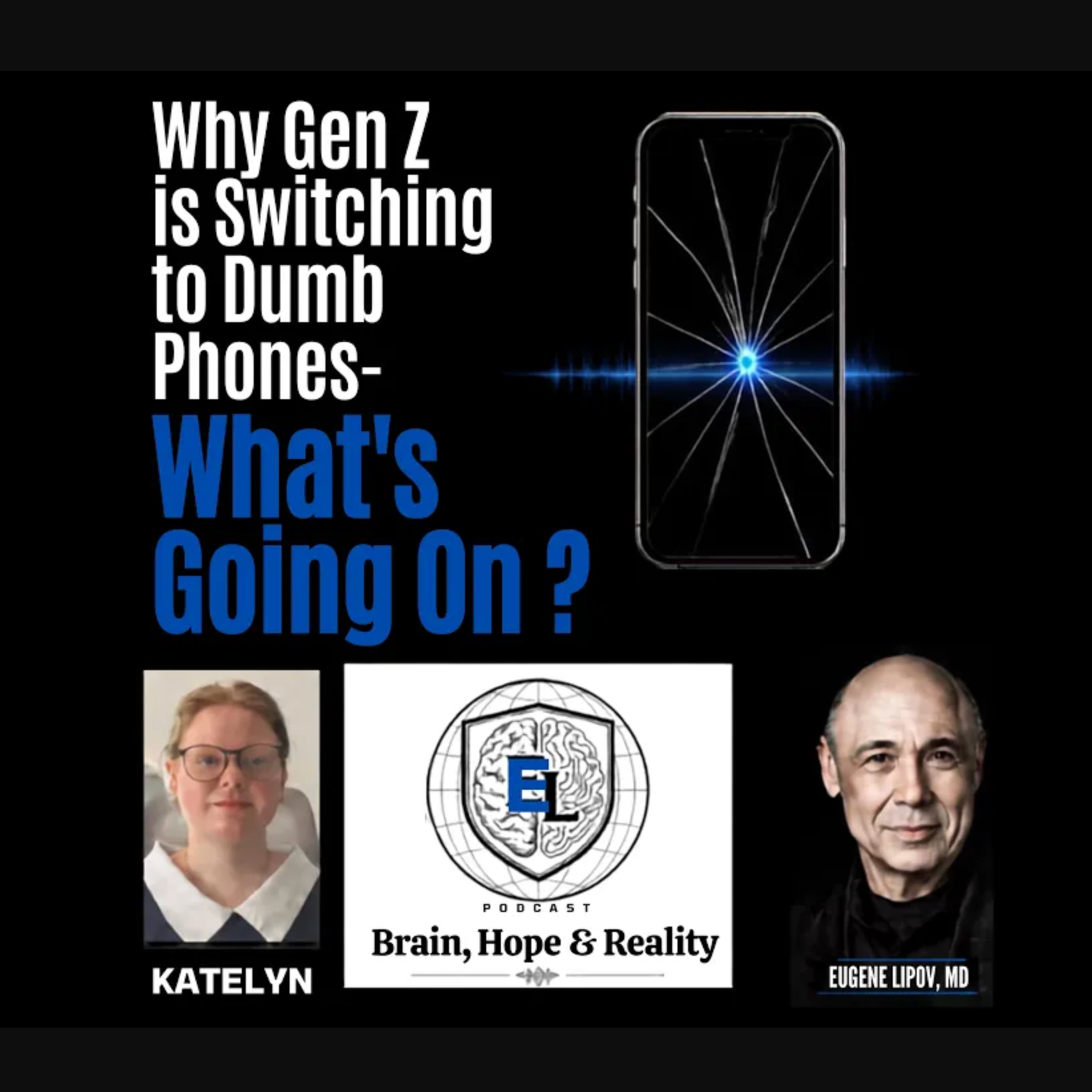
Dr. Eugene Lipov | Brain Hope Reality & Digital Toxicity · Dr. Eugene Lipov
Anxiety, social media addiction, digital toxicity, digital brain rot, doomscrolling, phone addiction, Gen Z mental health, Gen Alpha mental health, PTSD, fight-or-flight, sympathetic nervous system, digital Tourette’s, social contagion, sleep problems, dumb phones, grayscale mode, screen time and the effects of social media on the brain are the focus of this episode of Brain, Hope & Reality with Eugene Lipov, MD and Katelyn. Why can anxiety feel intensely physical? Can repeated social-media exposure influence behavior? Why are young people turning to dumb phones? And what happens when the fight-or-flight system stays activated? Eugene Lipov, MD and Katelyn discuss anxiety symptoms, feeling of doom, social media fatigue, digital addiction, functional tic-like behaviors sometimes called “digital Tourette’s,” mimetic behavior, technoference, digital PTSD, dopamine, norepinephrine, cortisol, sleep, attention, smartphone addiction, grayscale phones, Focus Mode and reducing screen time. A central theme is simple: psychology has biology behind it. Anxiety can be experienced through the body as racing heart, chest tightness, stomach discomfort, shaky hands, difficulty breathing, dizziness and a powerful sense of dread or impending doom. The conversation explores how the sympathetic nervous system—or fight-or-flight system—may contribute to these sensations. The episode also examines how behaviors repeatedly seen online may influence other people, including discussion of sudden functional tic-like behaviors reported among some young social-media users. The conversation then turns to practical solutions. Can you make your smartphone boring? Can grayscale reduce the urge to scroll? Can Focus Modes and removing apps from your home screen create enough friction to interrupt automatic behavior? And what happens when you remove the phone from your bedroom completely? Katelyn shares strategies for recognizing anxiety in the body and managing it with grounding, breathing, physical sensation and behavioral techniques. The discussion also covers SMART goals, monitoring screen time, nature, hobbies and replacing passive scrolling with activities that engage your brain. CHAPTERS 0:00 The Biology Behind Psychology 1:52 Unpacking Anxiety Types 2:53 The Rise of Mimetic Disease 5:27 The Truth About Stimming 10:23 Agoraphobia in the Digital Age 13:29 The Dumb Phone Movement 21:28 Why Gen Z Is Seeking Disconnection Subscribe to Brain, Hope & Reality for conversations about anxiety, PTSD, digital toxicity, brain science, the autonomic nervous system and practical ways to improve mental health. Where do you feel anxiety first—your chest, stomach, breathing, head or somewhere else? #Anxiety #DigitalToxicity #DigitalBrainRot #SocialMediaAddiction #PhoneAddiction #Doomscrolling #GenZ #GenAlpha #MentalHealth #PTSD #FightOrFlight #ScreenTime
Dr. Eugene Lipov: Welcome to Brain Hope Reality Podcast, where we discuss PTSD, brain recovery, and digital toxicity. Welcome everybody to the next episode of Brain Hope Reality. I'm your host, Eugene Lipov. We have a really interesting guest today, Caitlin. I met her on the podcast. Hello, Miss Caitlin. I was very impressed with her understanding of psychology and you have psychological background, some training, correct? Yes, I have a bachelor's in psychology. That's pretty cool. I think it's really psychology is really interesting. So my s ⁓ son is kind of working on the same thing actually. He's almost done. So I I really like especially people young people understanding what's going on with themselves. And my particular angle is all psychology is biology. I try to understand how is the biological systems working with the brain. I that's why I you know You have a unique combination of being young and have psychological background. And I'm sure you know all about social media drama that's going on. Yes. Right. So I thought we could talk about a couple of things today. One is anxiety. I'm very interested in anxiety. I've had it since I've been probably five. ⁓ part of the reason I was so interested in treating it is because I had it myself. My mother took her life, so I'm very cognizant of what happens. You know, unfortunately the family it's problematic. And then today is quite an interesting day for us to have this interview because Met there was a very large lawsuit against Meta for seventeen billion dollars that settlement that basically what the court was said is Instagram and Facebook was designed to get people hooked. It's not just willpower weakness. So I thought we can take it at talk about it in the second part of the show, if that's okay. Yeah, of course. Cool. So I thought Since you have the background in that, I thought maybe maybe for the viewers you can kind of talk about different types of anxiety. It's not just one type, right? Yeah, there are multiple different ⁓ kinds of anxiety. ⁓ I mean I personally think that it goes f a little bit further than what's in the current DSM. ⁓ you know, I think that there are a lot of it it goes beyond just generalized and social ⁓ I think it's it can go a lot further and social media definitely plays a role into it. I think that there's an issue ⁓ where a lot of people tend to self diagnose with certain mental health disorders because they see a lot of other people experience them on social media and it creates an issue of almost a pseudo mass psychosis in a way. Well, okay, so if if I may let me ask you question. So one so when I was doing research for my book, ⁓ what I came across is mimetic disease. Are you familiar with that term? ⁓ no. So mimetic disease, that was coined about two years ago. So memes, I'm sure you know all about memes, right? So when you watch a meme, that's either funny or scary or whatever, you can actually absorb the information. So and people can develop psychological disorders like you were talking about. So one of the oddest thing I've read about, they talked about digital tourette. So you've heard of Tourette's I'm sure the tweaks and all of that stuff, right? Yes. So that described in women, kinda adolescent women during COVID. So during COVID a number of women went to emergency rooms with Tourette syndrome. And then neurologists were totally confused because usually tourette starts with younger people and it's usually males. So they're going, what was the commonality? And they found out that people were watching, watching the hosts on social media with Tourette's and they were emulating them. So it's called the functional tourette, meaning it's not real. But there's actually functional Mara evidence that some of the functional disease or people that you can't really see it. actually truly does exist, you can see it in the brain scan. And the reason they think it happens, if you have an equineuron or your neurons, when you watch somebody doing something, the part of your brain does something similar. So there was a study done where they took college students, two both of them were on scanners, one of them was getting electric shock. The brain change that happened in the person who got electric shock and the one who was observing was pretty much the same. So we as humans have tens of synchronization. So that's exactly what you're talking about. So when somebody, let's say, cannot sleep and they're saying, I'm very anxious, I can't breathe, and somebody who starts watching them wasn't like that in the beginning, they could be like that at the end. Is that very crazy, right? Yeah, I definitely think that that's like a very prominent thing that's been happening. ⁓ especially like in a lot of spaces. I think that it happens with a lot of other disorders as well. ⁓ especially ⁓ I'm I'm thinking autism particularly. ⁓ there have been a lot of people who like have developed symptoms of autism but aren't they don't meet the diagnostic criteria in the DSM. and I think it has a lot to do with them observing ⁓ like actual autistic people online and emulating those behaviors because Terms that are have previously been very specific to autism, such as like special interests and ⁓ like stimming and other things, have been introduced to the mainstream media and now neurotypical or like non-autistic people are claiming to be like actively doing these things in the same way that an autistic person would. Can I ask a question? What's stimming? I'm not familiar with that term. ⁓ it's ⁓ like it's a self s so stimming is a repetitive self soothing self soothing behavior. so ⁓ one of the most ⁓ common or like stereotypical examples is when autistic people flap their hands when they're excited. ⁓ that's a form of ⁓ self soothing behavior. And it's it's always it's typically like a very repetitive behavior. Sometimes it can be vocal. so, you know, like singing to yourself, that's something. And everybody does repetitive self soothing behaviors, but I there's been an uptick of people claiming to do it a lot more frequently and like people have been saying that they They they've been using it to excuse public outbursts and other disruptive ⁓ like things that they do and they use ⁓ this disorder that they are not diagnosed with as an excuse to do these things. And I think it has a lot to do with the way that these things are being ⁓ like published on social media, like publicized. That's fascinating. Let me ask you a question. Can you c compare and contrast that type of behavior to Tourette's? Because Tourette's also outbursts, right? And they have twitches and things like that. Yeah, and so I think I think it it definitely it can be compared to Tourette's. I think the difference might be something to do with like neurology, most likely. ⁓ that would be my guess. I mean, I'm I'm not a neurologist, so I wouldn't. No, I'm I'm not one either, but I can I consider myself a neuroscientist. Self taught. I'm not saying I have a degree in it, but I know I know quite a bit about the brain. But it does fascinating. So I never really thought about it. So one of the big things, at least when I was in medical school in eighty four, way before you were born. So the big thing to rats was vocal spas spasms. So they have vocal cord spasms and profanity. Screaming profanities and things like that. Is that also happened with autistic ⁓ self modulation things? So not in the same way that Tourette's would. So my understanding of Tourette's is that it ⁓ like a tick is almost like a sneeze where you can't really control what you're doing. With self with stimming or these self soothing behaviors, oftentimes you can control when you do it and it it Obviously it depends on the severity of the disorder. ⁓ like a somebody with more profound autism might have more difficulty controlling the behavior than somebody with like less profound autism. But it is typically like a a ⁓ it's ⁓ you can control more what it is. So you're not going to feel that urge to scream a ⁓ like pr ⁓ profanity at somebody like Like in a in or something. It'll be more like you fidget with a toy repetitively or you're jumping up and down or like climbing on things. That's a that's one ⁓ that happens a lot. Throwing yourself off of things, it tends to be a lot more like physically stimulating, I guess. In a way, feedback. So basically what you're saying, doing this kind of behavior, ⁓ ultimately people are trying to stay as calm as they can. Right. So you're saying they're trying to chill themselves down. Yeah, it's it's a way of emotion it's a it's a form of emotional regulation. Huh. Fascinating. Thank you. You taught me something new today. So let me ask you this question. How about how does agoraphobia fit into this kind of thinking? Because again, there's melt multiple types of anxieties, right? Yeah. ⁓ I think agoraphobia c is also like something that is has probably become a lot more common because of social media. People can't they think that they are getting the same connection online to p other people as they do in their own lives. And so my my guess, based off of one paper I wrote when I was in college, ⁓ people tend to believe that online connection gives them the same form of gratification ⁓ and it fulfills that same biological need for human connection as like an in person conversation which is not true at all. and that that that I know for a fact. That you can't even duplicate it. Just replace it. And so they try ⁓ I it I think it becomes this perpetual cycle, almost ⁓ like an addiction cycle. ⁓ where somebody is trying to fulfill this need through social media but they can't quite get there and so they have this constant like ⁓ I I need this connection because they're trying to use it to replace an actual biological need for human connection. And I think that that can play a lot into the agoraphobia because the people who use social media as a way to fulfill that need ⁓ will tend to delve deeper and deeper into it as that need is not being met in the way that they're trying to meet it. And you probably get frustrated. So agoraphobia of course is being afraid of open spaces, right? Mm-hmm. And there is all type of phobias. Right, so being afraid of the spy b spiders, all all of that. So it kind of comes from the same origin, you feel uncomfortable. So basically, you know, my particular expertise is fighting flight nervous system, right? Sympathetic nervous system. That that's that's what I kind of been working on for the last twenty years. ⁓ so ba the way I look at it is when somebody is anxious, you just your fight and flight nervous system is wrapped up and continues to stay wrapped up. But it cannot it doesn't turn off, right? It's on. So if somebody has a horrible experience, let's say military experience or something like that, so then there is actually brain change that happens that the system gets turned on and stays on. So then the anxiety is kind of similar. You're always on and you cannot there's no place to relax, right? So what what are some of the ⁓ approaches that we've seen that people let's say your age have been successfully using to treat ⁓ anxiety? ⁓ I think that there there's been an uptick in ⁓ like therapy, especially dialectable behavioral therapy, ⁓ which helps with it gives people tools to manage anxiety in the moment. But I think that there has also been an uptick in people rejecting technology as a way to try and manage stress and anxiety. ⁓ there is a whole movement online ⁓ where people are starting to switch to what are what have been dubbed dumb phones. Right. and those do not like have access to the internet essentially. It is the cell phone equivalent of a landline. Are you familiar with the percentage? How many people have done that in Gen Z? Not exactly. Seventeen percent. One seventh. That's a huge number, right? Yeah, that's a that's a really significant amount of people. and I th I know a lot there are a lot of people who have a desire to do it, ⁓ like a lot more. than that seventeen percent that have a desire to do it ⁓ but find it very difficult because of their job. I know I'm definitely a part of that. ⁓ right. You know, I because my job is social media. So I have to be on the social media. So that's a good question then. How do you navigate both? How do yourself like how do you go to sleep? You need to get some sleep, right? Yeah. So for me, I have tried my best to make my f my iPhone into a dumb phone. and I have I I only have access to certain apps at certain times of the day. ⁓ so I only have access to social media during my work hours. Outside of that, I can't be on it. And so that is one of the things that definitely helps. And then I think there like there tends to be a lot of excuses people come up with for reasons why they can't do it. But I think that there are a lot of ways you like you know, you don't have to delve fully into buying a whole different device for this. You can use your current phone and turn it into a tool rather than like a entertainment like you're right device. So ⁓ I'll give you my two favorites. I'm curious to see which if you had if you had to give advice somebody under ten dollars or under twenty dollars, or what what would be your two top things that you think you can do like today to help somebody control the urges? I think you could even even for free, you could ⁓ I I think Samsung has similar features, but I know f for iPhone I'm more familiar with ⁓ the two things that you could probably do today are one, set up focus modes throughout the day, ⁓ that remove apps from your home screen and it sets up a barrier, ⁓ one one level of you have to scroll even more to get to an app. So it makes you stop and think. Yeah, it creates friction. And so you have to stop and think about whether you actually want to be on that app and that will help. stop you from doing it. ⁓ so set up focus modes and then two, turn your phone to grayscale. Get rid of the color because the color is what's sucking you in. You want your phone to be as boring as possible. Right. So I agree with that. So in fact I'll tell you my two top things. So actually let me ask you a last question and I'll tell you my two top two. Sleep and having like my big thing is no phone in the bedroom. Right. Yeah. So what do you think the number one excuses why people keep their phone in the bedroom? The alarm clock, always. It's always the alarm clock. Right. So basically my recommendation you go on Amazon, you can buy an alarm clock for twelve dollars, analog. It has a handle. A lot a lot of a lot of you just haven't seen it and have two little bells. So the reason it's so important to get and I totally the gray mode is amazing. ⁓ private time is also great. There's like a seventeen thing we we're gonna be releasing soon. Seventeen different things you can do on an iPhone which cost nothing. You're just reprogramming it. Also, there is a number of ⁓ breaking apps. I I assume you know the term breaking, right? Yes. So there's a number of apps. I have one coming out which will take advantage of some new stuff, which I think will be better. If you're interested, I'll I'll send you some so you can try it out. But you know, one of the big things that I think is gonna be really helpful. is people look at screen time, right? So let's say when my phone tells me you have seven hours of screen time, I use zero social media. Like I I'm not in that. I have people help me with that, but I certainly don't use it. A I don't I don't know how to use it and I don't want to use it particularly much. It is a good way to communicate but I have people helping me. But the key point is when you disconnect from everything around you, you can keep your attention, right? So they're talking people are talking about attention economy and our attention being sucked away from us. So the sleep, that's why you don't want to have your cell phone with you when you're sleeping, because ⁓ I just need to check my message. ⁓ I forgot to do this. ⁓ maybe something else happened that's really bad or something really good, right? But you're always you're always scrolling and when you have the light hitting your eyes, it suppressed melatonin production, then you can't sleep as well. Right? Yeah. So do what what c how do you wake up? Do you do you use your phone or do you use analog clocks? How how do you keep track of it? So some one of the tricks that I've learned actually is your biological clock is an amazing tool. ⁓ you essentially have a built in alarm clock in your brain. ⁓ if you know how to train it properly. So for me, I go to bed at the same time every night. I go to bed at twelve AM every single night. And I wake up at eight AM every single day without fail, without an alarm. ⁓ so as if you one of the things when you're first starting out, if you want to try this, ⁓ for the viewers, is Before you go to sleep, tell yourself in your head, wake up at eight, wake up at eight, or whatever time you want to wake up. ⁓ and repeat that as you're falling asleep and your biological clock will automatically do that for you. You it might be a little bit difficult the first few times. I'd recommend starting it like on a weekend or on a break when you don't have work. ⁓ but definitely like your biological clock can do a lot more than you think it can. Well I agree with you. From medical perspective, if you can train your body to do this, if you can also eat around the same time, exercise around the same time, it stabilizes cortisol levels and your sympathetic system really comes down. So your fight and flight system is not as active, things like that. That really is very, very important. So by the way, speaking of breaking, we were talking about that. What percent do you think of Gen Z are interested in breaking their phones if they can? I mean, I'd assume that it would be around thirty, twenty five to thirty. I've seen numbers as high as seventy. Wow So the question the question I wanted to ask you is why do you think because usually, you know, when kids or young adults or things like that, usually they like to use all the latest technology. Why are there what what is the signal that Body's sending to them that hey, I need to switch to a dumb phone or I need to break my smartphone. What do you think the signal is? So something that I've researched personally is social media fatigue. so people who are constantly online get a have like a stress response. to like seeing their feeds that like their social media feeds. They they're going through it and it's either people tend to build their algorithm ⁓ in one or in one of two ways. Either to trigger dopamine or to trigger cortisol. It either makes you happy or it stresses you out. and so Or both Yeah, or both. Yeah. There there can be a combination of both. But I I think people tend to v pick one or the like they try to pick one or the other. ⁓ and people when when you're constantly getting those ⁓ hormones like released in your brain, it it you get and then when you don't have it, you know, and you're addicted to it, eventually you get tired of it. ⁓ and a lot of a lot of Gen Z have been experiencing this fatigue where they it it it becomes physically exhausting to be on these social media sites. ⁓ you know, I think it's the exhaustion that's leads them to wanna get the dumb phone and Yeah. I think it's it's it's triggering like physical responses that are like similar to like certain mental health disorders ⁓ right that are making the i it makes you feel physically bad. And so you try to e even if it's a subconscious thing where one day you don't know why you want to do it, you just want to do it. And it it's because you feel physically bad and you want to feel better. Right. So you're saying that You feel physically bad, you don't realise it, but then somehow you don't use the phone to go, Hey, I feel better. Let's do more of that. Is that what you're saying? Yeah, but by the way, the as far as the stress response, norepinephrine is the first thing. So you got neurotransmitter of dopamine and neuropinephrine, right? Neuropinephrine when you're writing from the tiger and then the cortisol kicks in. You're right. And long term cortisol really can really exhaust you, for sure. And it can lead to diabetes, all type of problems, high blood pressure, all type of problems that you know, this is we're talking about now young people. So the next question I want to talk about is anxiety and alpha generation. What do you think the rates anxiety there at? I think that they're probably close to a hundred percent, like ninety seven, ninety eight percent. I think that almost all of the alpha generation who have been raised on social media right have ex because you see it similarly in Gen Z. Like for me, I was born like A year or two before the first iPhone came out, and about three years before YouTube was invented. And so I didn't have the intensity of social like social media was still brand new when I was a child. And s I but a lot of the alpha generation, social media already is so ingrained into our culture as a world as like all of humanity has ingrained social media into our culture so much that all of these kids are going to be growing up feeling that impact, whether it is directly or indirectly. Because a lot a lot of the time you also see parents who claim to raise their children without technology, without social media, without even like TV or anything. But they're filming their children and posting about the fact that their children aren't online online. It's a little bit counterintuitive there. And the children are gonna feel the impacts of that whether the parents realize it or not. Well I think there's something there are two things I I was gonna you know, the parents will see it. ⁓ and so here's two things. One is the biggest predictor of behavior of children is what the parents do. If the parent pulls out a cell phone, guess what? The child will do the same thing, right? Have you heard the term technique? Yes. So that's one of my favorite terms. So it's technology and interference together, right? So what do you think of that as far as you know the effect on the mother and the child? I think that technology can severely interfere with parenting. I think a lot of parents Will a lot of parents believe that like handing their child an iPad as a way to keep them quiet and docile is like beneficial to them because all they know is like my child is supposed to be quiet and behave right now. ⁓ and so they hand an iPad to make it easier on them. But they're not teaching their children how to regulate their emotions. They are not teaching their children how to behave in a public setting. And so a lot of these children are now growing up to be like very dysregulated. ⁓ a lot of them are are beh I think behind in their emotional development. ⁓ and then I think that there is also like that's why you see a lot of children acting out. ⁓ a lot of teachers are struggling a lot with gen alpha ⁓ because of their behavior and it's because they don't know how to behave because they were ne it was never displayed to them. The only behavior they were able to observe as a child was through a screen. And a lot of that behavior is exaggerated and so they are now acting in the same way that a YouTuber would. Well, the other thing I I found interesting is there are some evidence. It's not conclusive yet, but there's some evidence that shows that the cognitive function is reducing. If you don't read books, right, ⁓ and if you don't do physical things and everything is being force fed to you, you don't and also if you depend on Chad GPT to have done all the thinking, you never exercise your brain muscle. What do you think of all that? Yeah, I mean there have been college professors ⁓ there is one college professor who said she teaches ⁓ calculus and she said that her students didn't know algebra. There is a yeah, you're in college calculus and you don't know basic algebra. And then there's also the literacy crisis. People don't know how to read anymore. And it's it's a really big issue. I know in even in my college classes, when I was in school, they Most of the people in my classes were 100% reliant on AI to do all of their assignments. None of them actually paid attention. They just inputted the assignment into Chat GPT and submitted whatever the AI spit back out at them. ⁓ I personally refuse to do that. I don't use AI, but a lot of people do, and I think that it's gonna create an issue where professionals are like serious professionals aren't gonna have the proper education because they were just using AI. So you're gonna find like I mean, I don't know about doctors, but I I definitely believe that lawyers for sure, that's that's gonna be one profession where they're just going to it you're gonna find lawyers that don't know how to do their job because they were reliant on AI for their arguments. They're gonna be arguing like a computer. It's already happening. Actually there is a number of at least I'm I'm aware of at least one case where somebody was disbarred, basically they took away his license. 'Cause he wrote all the opinions using his AI. That that really is yeah, that's not really great. Yeah, and it's again it's the same thing. ⁓ if you don't use it, you lose it. Right? If you don't read, that creates a problem. And if you don't if you can't calculate, that becomes a problem. Yeah. So what I would like to do if you don't mind you and I talked about little video I put together. So I thought we can run the video and kinda record that and I'll put like a real video in later if that's okay. Yeah. And I'm just curious to see your commentary. And the idea behind this was basically to have people think about what anxiety feels like and what how we can talk about it. Maybe we can talk about some options if that's okay. Yeah. Okay, let's just run it. This is what clinical anxiety actually feels like. Anxiety never lets you sleep. Racing thoughts. There is no off-switch. Anxiety can feel physical. Racing heart rate, chest, shaky hands, upset stomach, trouble breathing, dizziness. What can you do about anxiety? Slow your breathing. Grind yourself impression. Protect your sleep. Don't fight it alone. Want understand why this is happening and what actually helps. Watch my full episode on anxiety. I thought. Because like you said, like So what do you think of just identifying physically what's how what's happening with you? It's semitic semitic psychology. I think that it's incredibly important. ⁓ if you don't know what's physically happening in your body and you can't actually feel your emotions properly, there's no way for you to work through them and learn how to like properly regulate yourself. So I think that knowing what's happening and like knowing how you feel physically and emotionally at the same time is one of the best tools that you can use, ⁓ in order to combat these disorders. ⁓ what would be your if you could Talk to let's say Gen Z or Alflo Gen w you know, somebody my age, a lot older, ⁓ what would be like how do you identify it in yourself mentally and physically? If you can just give like five point guide maybe or whatever. And then we'll talk about treatment. Yeah, I think if you really sit down and focus on your body, ⁓ if you can I think If you can identify where in your body you're feeling it. 'Cause most people will feel anxiety in a certain part of their body. Right. In my case it's the chest, for example. Yeah. And, you know, some people will feel it in their arms, some people will feel it in their legs, some people feel it in their head. ⁓ I think for me, I feel it in my stomach a lot. I I tend to get like the pit in my stomach. and so I think identifying where it is is important. ⁓ and then I think that identifying how it feels because some people feel anxiety as like a tightness. Some people feel anxiety as like of emptiness and like a huge sense of dread in the same way that you would feel when you get really nervous. Or, you know, some people might feel it as physical pain, like a headache or something. ⁓ and so I think identifying where it is and how it feels for you is one of the like most because then you can learn how to like work through it in a way that works for you. So basically identifying the feeling and where you feel in your body. Let's say it's hard to breathe and you have chest pain and you have feeling of doom. That's one of my favorites. ⁓ and then identify, hey, this is my anxiety. My body's telling me something and now we have to do something about it. Is that fair? Yes. So let's talk about some of the options. I'll tell you my my top three. You tell me yours first. What do you think ⁓ I think I think my ⁓ favorite I R D B T skills ⁓ one of them is the s like senses. So you sp spot five things you can see, four things you can hear, three things or like I think three things you can smell, two things you can touch, and like one thing you can taste. and you go through that and it helps to ground you. I think breathing exercises are also really helpful. ⁓ box breathing is one of them where you ⁓ in for four, hold for four, out for four, hold for four, and you repeat that. and I think that ⁓ part of the grounding also is ⁓ and my third thing would be like physical sensation. So I tap my fingers like this a lot. as a way to keep me grounded. And with that you can also repeat a mantra. So if if you have like a four syllable ⁓ so like mine I tend to do is I am okay or I am safe here. ⁓ That's cool. I like that. Simple. You don't need any devices. You always have to Yeah and you can and you can repeat the mantra in your head as well. You don't even have to say it out loud and you can just tap your fingers and no one's gonna question what you're doing. I think that's that's a good point. ⁓ also in like deep yoga breathing, right? Yoga breathing, meditation is one of my favorites. Part of the reason I love meditation is because it's the only thing that's been shown to grow nerve tissue in your brain, make your brain bigger. That's something we haven't really touched on, but you know, I I wrote a sub stack that the brain actually there have been some studies that shows brain shrinkage following social media use. So brain rod being real. The point is there is a observable changes in your brain and long term anxiety can hurt your brain, right? So I think identifying that's why that this little ⁓ video was supposed to tell people it's like, you know, it's possible to get better. Identify identification is first, right? In medicine, diagnosis first, treatment second. So you wanna know just feeling bad it just doesn't really quite cut it, right? Being anxious, being depressed, the different problems that can they connect it. A lot of times you're anxious, you could be depressed and so on. But I think anxiety is a huge thing. Our society, so many people are anxious, right? And there's so much scary stuff out there, and all those little things. I wrote a paper that I told you about, PTSD, which I know a lot about, and digital PTSD, or getting like PTSD like symptoms, post-traumic stress disorder from scrolling, you think how could that possibly happen? Every time you have a little scary thing you're looking at and all of that, it activates a fight-to-flight system. If you do it enough times, it can lead to the same thing. That underlying condition is activation of sympathetic nervous system and inflammation. There is some evidence to that, which is to me, it's just absolutely crazy that actually happens. ⁓ Any other things you think y we can give the audience any tools? I heard you were developing some kind of toolkit for people. Yeah, so I ⁓ one thing that I did while I was in school was developed an intervention strategy for reducing social media usage. ⁓ Can you just give us an overview of how that works? Yeah, so basically what you would do is ⁓ f track your the hours that you would spend on social media on your phone for a week. ⁓ and then do like reflect on that, see if you want to fully like cut it out or if you want to reduce it, like figure out what works best for you in your current circumstance. and then use your screen time as a way of ⁓ as a way of mon as a way of like motivating yourself to to continue it. So one this first step would be to create a SMART goal. Figure out why you want to reduce your social media usage. And then after that you would track it for a week ⁓ and see what what you're at like it'll and how it'll help put it in perspective how much you actually use social media. And then continue using your smart goal and tracking your social media usage and trying like remove it from your phone screen, delete the apps if you can. ⁓ but it at the very least remove it from your home screen so you can't look at it. ⁓ and it creates that level of fi friction to ⁓ be able to see it. And ⁓ keep tracking your your screen time. That is one of my biggest things is if you track your screen time, you will be you will see it going down as you as you move through this process. You'll see your screen time Yeah. And you it'll help to motivate you ⁓ along with your goals as to why and eventually you'll find that you won't even reach for it. It's it's you're it won't even be a conscious effort of not going for it or not using it. You just won't you won't want to. You won't have that desire. How long well I have two questions associated with that. Number one, what would be the two reasons you would you would think people if I could tell somebody say Here's two reasons why you wanna stop doing social media. I have my own, I'm curious to see yours. What would be the main reason? What reasons I think the two main reasons would be one that it severely impacts mental health. it it can cause a lot of mental health disorders to manifest, as well as physical health disorders. ⁓ it can Lead to to the manifestation of a lot of autoimmune disorders. That's definitely one thing I know about. and I think that the second reason would be that it gives you more time in your day. We waste so much time scrolling through social media and that time could be spent ⁓ interacting with people in real life. Engaging in hobbies that improve your know ⁓ that help you gain knowledge or improve your creativity or ⁓ like do movement as well. Like that's one thing. People sit down all day on their phones rather than being outside moving your bodies and these things are causing your mental and physical health to decline. And so I think No question. I think you're a hundred percent right. So so here is here's my two. Number one, to me, if I'm autoimmune by the way is a fascinating that you know about that. Very few people know that. So when fighting flight nervous system is overactivated, that it actually de ⁓ it breaks the immune system. So people with PTSD really have problems with that. But what happens is also sleep disorders, right? That's all connected. So the problem is to me, like brain shrinkage is real. So, you know, like when I was being interviewed on Fox News it was the anchor said, I cannot get it out of my head that brain shrinkage is real. It's like, ⁓ my God, I I wanna hold on to my brain. I said, Yes, obviously you you wanna hold on to your brain as much as you can, and you wanna hold down as much of your brain as possible. So the other thing is my wife and I went to ⁓ this big philosopher, ⁓ Stoicism. Have you ever heard of Stoicism? Philosophy? Yeah. But so basically there. Their big things, I didn't realize it, but it's having a resurgence. ⁓ twenty five hundred years ago they were basically saying you need to have control of your emotions, you know, don't get overreactive to things. And just that particular perspective can reduce addiction, which is really great. But the one of the big things, what if you had if you know you have a year left to live, how would you live it? That's their big thing. In this case, if you know you have a year year to live, how much doom scrolling would you do? the same question you asked. It just it's such a blatant way of asking the same thing. It's like what are you spending your time on? And you know, unfortunately our attention is for sale in a lot of those apps. So you wanna have you're gonna do more of whatever the attention you're paying attention to, right? And then as you said, you need you need to have a life, you know, it's like people are not dating as much and there is less of this going on and it's our culture is really in trouble. And I think those kind of information that you're giving, I think huge and I'm gonna try to propagate it. I mean if you could help us that'd be amazing. It's actually I mean it fits your generation, right? You know, people like us, yeah. I'm sixty eight, I I'm a j you know, baby boomer. We ⁓ we you know it's like social media came out when I was in my forties. I was like, Okay, that's really it's it's a young person's game, really not that interested in that. But I mean it's but I find The effect of social media, very serious. I mean it's no joke. And Alpha Generation, I think those guys were are the first ones who were born into that culture. And the parents who put you know iPads in front of their children. I I saw this beautiful kid, one year old, by the lake, he has a headset and ⁓ a s phone screwed into the stroller and can't even see the lake. The other part Nature, right? Nature is an antidote to a lot of this stuff. Being out in nature when it's quiet and it's peaceful and walking in nature is amazing. I assume you know this, right? Yes. It's pretty straightforward. What are your hobbies, by the way? I'm just curious to see what kind of hobbies you have that maybe that would help other people to think about it. Yeah, I mean for me I do a lot of different things. I'm a musician, ⁓ so I play guitar. ⁓ I go on a walk every morning. I take at least half an hour to go outside and I don't look at my phone during that. ⁓ I crochet, I draw, ⁓ journal a lot. I'm I'm really into bullet journaling. ⁓ what is that? I don't know. It's a it's a type of like artistic planning. I guess you essentially create your own planner in a in a journal with like Doodles and everything, so it's yeah, it's fun. ⁓ But you're using your brain, right? I mean you're actively doing using your brain. Yeah. ⁓ and then like there are also things like Sudoku puzzles, crosswords. I do them all the time. Yeah, I d I also do those. ⁓ and like that's another thing. If you're trying to quit social media, ⁓ sometimes the act of be at first, at least, the act of being on your phone can help ease that like desire a little bit. So when you pick up your phone, instead of clicking on Instagram, go to a Sudoku app and engage your brain in that way. And eventually it'll it'll help you not want to be on social media anymore. You're gonna start reaching for the more engaging and mentally stimulating things. I think what you described is substitution, right? So instead of smoking, you have to put something in your hand And you're squeezing something or doing something like that, it's substitution, something that's healthier. So smoking was a big thing in my day. People are still arguing kinda how dangerous it was. It's pretty obvious now. But substitution, exactly. Do something more positive. Doesn't have to be a phone. So you know, that thing is like I think using your social media if you need to do it on a computer is much less addictive. It's not as fun. It's not as scroll, scroll, scroll. 'Cause a computer you can't really you can't drag this whole thing into bed. Funk different story. Completely. Completely different story. Cool. So I thought if you don't mind, maybe you can give us final message, what you think would be a great thing. And ⁓ hopefully this is just one of many connections that we can do to help people. Yeah, I think my final message would be delete social media if you can. ⁓ and if you can't Limit the hours that you ha are using it to the hours that you absolutely have to be using it. and gray mode, right? Gray mode. Make your make your phone as uninteresting as possible. ⁓ and stay off of your phone as much as possible and connect with the world around you. Touch grass. It it really does help. Hug a tree. I do that sometimes. It really does help ground you and it it will help with anxiety. ⁓ you know, those are words to live by. ⁓ I'm gonna turn off the recording and then Fearabai will chuck for a second. Yeah.
More Dr. Eugene Lipov | Brain Hope Reality & Digital Toxicity episodes →