
Disturbing History · Disturbing History-True Stories
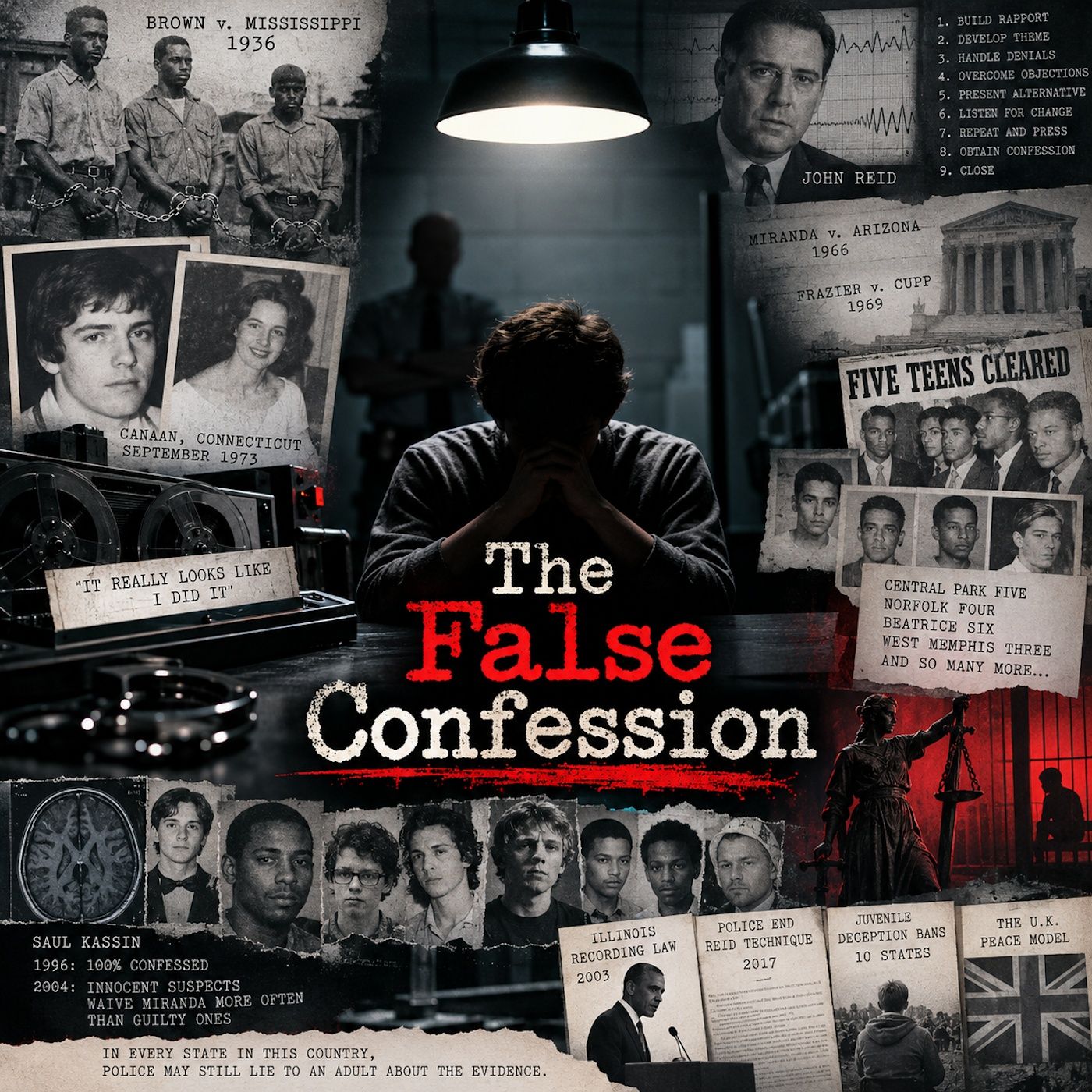
You'd never confess to a crime you didn't commit, right? Out of the first 375 people in the United States cleared by DNA evidence after a conviction, 102 of them had. In this episode of Disturbing History, Brian looks at how an innocent person ends up in an interrogation room saying the words, who built the room, and what it did to a long list of real people whose names belong in the record. The episode opens with Peter Reilly, an 18-year-old in Canaan, Connecticut, who came home from a church meeting in September 1973 and found his mother dead. After roughly 25 hours of questioning and a polygraph he was told he'd failed, Reilly began telling state police that it really looked like he'd done it. The tape of that interrogation survived, and so did the witness statements that put him miles away, which sat undisclosed in a prosecutor's file for four years. From there the story goes back to the 1936 Supreme Court case Brown v. Mississippi, where three Black tenant farmers were whipped into confessing and a deputy testified it wasn't too much for a Negro, and forward to the Chicago polygraph examiner John Reid, whose nine-step technique replaced the third degree and still dominates American police training. Reid's own signature case, the 1955 confession of Darrel Parker in Lincoln, Nebraska, turned out to be false when a career criminal's deathbed admission came to light decades later. The episode covers Miranda v. Arizona, the 1969 Frazier v. Cupp decision that made it legal for police to lie about evidence in all 50 states, and the research of psychologist Saul Kassin, including the 1996 experiment in which 100 percent of innocent college students signed a confession under the right conditions, and the 2004 study showing that innocent suspects waive their Miranda rights far more often than guilty ones do.Then the cases. The Central Park Five, questioned for up to 30 hours and told they could go home. The Norfolk Four, where a detective later convicted of extortion kept adding sailors to a rape and murder that DNA tied to one man acting alone. The Beatrice Six in Nebraska, where a sheriff's psychologist taught suspects that repressed memories of a murder could surface in dreams, and five of them pleaded guilty to a crime committed by a man who'd been excluded years earlier by a blood-typing error. Earl Washington Jr., with an IQ around 69, who came within nine days of execution in Virginia on a confession that got the victim's race, height, and number of wounds wrong. Christopher Ochoa and Richard Danziger in Austin, Jeffrey Deskovic in Peekskill, 14-year-old Michael Crowe in Escondido, Juan Rivera in Waukegan, Marty Tankleff on Long Island, Damon Thibodeaux on Louisiana's death row, Huwe Burton in the Bronx, the Dixmoor Five, the West Memphis Three, Brendan Dassey, and the torture victims of Chicago's Area Two under Commander Jon Burge. The episode closes with what has changed since: the Illinois recording law sponsored in 2003 by a state...
0:01Speaker 1Some stories were never meant to be told. Others were
0:04Speaker 1buried on purpose. This podcast digs them all up. Disturbing
0:10Speaker 1history peels back the layers of the past to uncover
0:12Speaker 1the strange, the sinister, and the stories that were never
0:16Speaker 1supposed to survive. From shadowy presidential secrets to government experiments
0:21Speaker 1that sound more like fiction than fact, this is history
0:24Speaker 1they hoped you'd forget. I'm Brian, investigator, author, and your
0:30Speaker 1guide through the dark corners of our collective memory. Each week,
0:34Speaker 1I'll narrate some of the most chilling and little-known tales
0:36Speaker 1from history that will make you question everything you thought
0:39Speaker 1you knew. And here's the twist. Sometimes, the history is
0:44Speaker 1disturbing to us. And sometimes, we have to disturb history
0:48Speaker 1itself just to get to the truth. If you like
0:51Speaker 1your facts with a side of fear, if you're not
0:53Speaker 1afraid to pull at threads others leave alone, you're in