
Diabetics Doing Things Podcast · Diabetics Doing Things
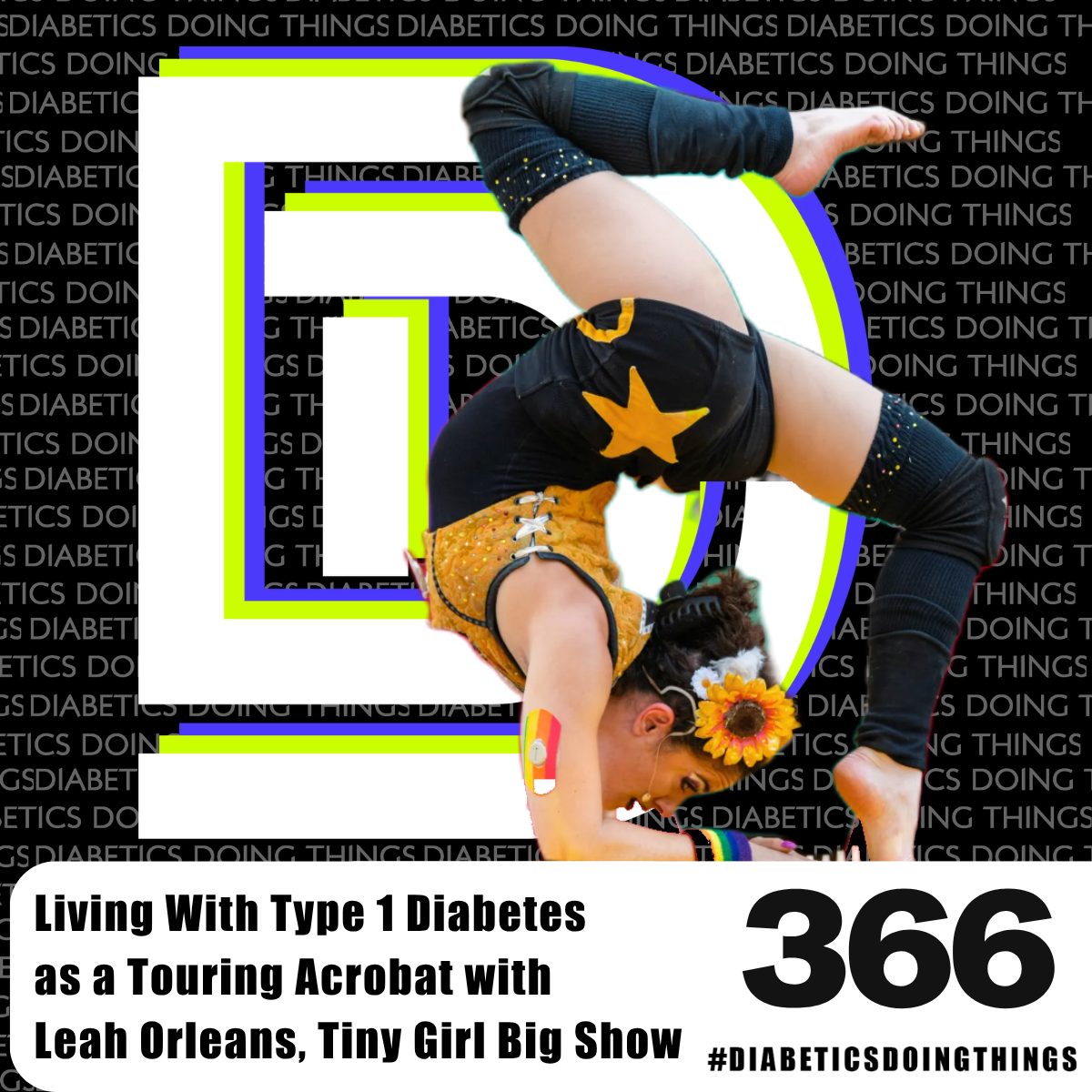
Leah Orleans shoots a bow and arrow with her toes, juggles fire, puts knives on her face, and performs around 300 shows a year as Tiny Girl Big Show. In her late twenties, in the middle of a tour, she landed in the ER with an A1C of 14. A few months later, a well-meaning doctor asked what other skills she had, and suggested she start looking for a desk job. She didn't. Instead, she got loud about it. Leah started writing comedy about diabetes (it turns out it's a genuinely funny word), performed a song called "Diabuddies" using a giant cardboard pancreas, and now when she asks "Who's diabetic?" from the stage, hands go up all over the crowd. We talk about the $2,000-a-month reality of living with type 1, how the logistics skills of a touring performer turned out to be life-saving, and why she has convinced food vendors near her stages to keep an insulin pen in their fridge for her. (They've never said no.) We also get into the Big Nonprofit Insulin Party happening in Brooklyn on Friday, October 23, benefiting Project Insulin, the nonprofit working to sell insulin at cost. And we land on a question I keep coming back to: what are you optimizing for? If you've ever been told to trade the life you want for the one that feels safe, this conversation is for you. Chapters 00:00 Welcome and meet Tiny Girl Big Show 03:01 From touring acrobat to an A1C of 14 05:26 Following your passion versus healthcare security 06:13 Turning a $2,000 monthly bill into logistics 07:31 Diabetics are everywhere, even at Ren Faires 08:57 Why "diabetes" is a hilarious word 10:25 Diabuddies and a giant cardboard pancreas 11:22 Health content doesn't have to be sterile 13:13 The Big Nonprofit Insulin Party in Brooklyn 14:24 Why Project Insulin's mission hits home 17:02 The doctor who said find a desk job 20:10 Advice: pick the problems you want to solve 22:43 Systems, habits, and insulin in strangers' fridges 24:12 What are you optimizing for? 28:25 Where to find Leah and her diabetes content Resources: Tiny Girl Big Show Website & Schedule Tiny Girl Big Show Instagram The Big (Non-Profit) Insulin Party Tickets Youtube Channel
0:00Rob HoweHello listeners, welcome back to another episode of Diabetics Doing Things. We're telling the amazing stories of people with type 1 diabetes from all over the world. And I'm very excited for today's guest. Her name is Leah Orleans. You may know her as Tiny Girl Big Show across social media, where she has over 1 million followers across all of her platforms. We talk a lot about her early days of diagnosis and how she lives a creative life. And when I say she lives a creative life, I'm talking a really creative life. She's living life on the road. She's doing 300 shows a year as part of Renaissance. festivals. She's living authentically. She's having fun. And she is also, as we learned, a little bit of a logistics expert because she's living on the road 24-7 with type 1 diabetes. And most importantly, we want to promote that she is putting on the big nonprofit insulin party, which is presented by Tiny Girl Big Show. And it is a fundraiser, a chaotic diabetic fundraiser show benefiting Project Insulin, which is advocating for an affordable future. So Project Insulin is working on creating a new insulin that is affordable and will be sold at cost, hopefully change what it means to live with diabetes here, or at least to access insulin here in the United States. So all of the proceeds from the show, Friday, October 23rd, the big nonprofit insulin party in Brooklyn, New York, presented by Tiny Girl Big Show. So give it up for Leah Orleans. Guys, who was MVP of the chat? tiny girl big show what's happening thanks for thanks for joining the show it's an honor and a pleasure it's fun i've been following your stuff for a while since i got diagnosed really and i'm really glad we were able to connect special yeah me as well you are i think we're gonna have a really great winding conversation today and we got some really cool stuff coming up that i want to make sure that we promote and there's also some opportunities for people who hear this podcast who are in the right area to be able to see you perform in a t1d community capacity very soon
2:02Leah Orleansi'm so excited it's the coolest merging of my wild and wacky career and my wild and wacky chronic illness both things at the same time i love your tape that you've got to show the tape to the thanks my girlfriend did this and it's ridiculous and she just we didn't have a proper SkinGrip shout out to SkinGrip for always keeping me attached but whenever she's around when i need to do a site change she just doodles all over it so there's like so cool an angry spooky upside down
2:30Rob Howeman here on my Dexcom and for those listening at home it's a collage of epic proportions of different SkinGrip tape this one has polka dots on it yeah this is gonna be great for the clips for this for social so yeah if you're if you're listening the podcast is also available on video on YouTube. So check it out there. So Leah, let's talk a little bit about, I love the perspective that you're taking what you're given and turning it into something beautiful and turning it into art. Let's connect that to your diagnosis story. You were diagnosed in your late 20s. Why don't
2:59Leah Orleansyou walk us through what was going on at that time? For those of you who don't know, I am a touring acrobat. So I have a show that travels all across the country. I drive most of the time, but I also fly sometimes. I'm on the road for about eight months a year and I've been this way for 15 years. So my life is very mobile. I love it. It fits my personality and my lifestyle, and it supported me through so many things. I perform, and I emcee, and I host, and I speak, and I do a lot of on-mic entertainment. And then I also have kind of an internet personality that comes with that on socials. So I'm creating content all the time. And I was already doing all of this before diagnosis. This was just who I was as a person. In my late 20s, very healthy athlete i'm a professional athlete circus performer gymnast type kind of body and suddenly things stop working right i start to get weird vision my weird stuff is happening with my pee that the listener and i are not close enough to know about but it's weird although it's like is there
4:00Rob Howeis there anyone who would know more closely what you're talking about than the listener because you know that's true you know what you're right you've probably looked down and gone why is this
4:09Leah Orleansso foamy, right? Why is my pee bubbling? Why is it effervescent, right? That wasn't a good sign. I get my a bunch of blood work done and everything is fine except for my A1C. So here we are at 14. I wind up in the ER. I'm in the middle of a tour in between performing weekends. I shoot a bow and arrow with my toes. So I'm active, you know, like I'm doing crazy things. I'm like in the doctor's office. Like, can I go back to work this weekend? And they're like, yeah, I guess if you've been doing this up to this point. So fast forward a few months, I'm diagnosed as diabetic. I don't have health care. That is, you know, good. I wind up with a billion dollars of bills and I am faced with the very real reality is that we are all just corporal bodies. But I keep performing. I decide to be loud about what I do. So I'm a comedian as well and I'm talking a lot about myself and my world and my illnesses in my show. And before I know it, people are like, me too, me too, me too. And now I have this amazing group of fans that are diabetic and they show up and I say, who's diabetic? And hands go up and it's so cool. And we get to connect and share and share resources too, which is really cool. That's the past four years in a diabetic nutshell.
5:26Rob HoweSo there's this tension, right? Like when you're a creative person and you're diagnosed with something like type 1 diabetes that's going to require health care for the rest of your life, there's this tension to be like, okay, well, how do I choose what to do next? Do I still continue to live my creative life? Do I follow my passions? Do I stay true to who I am? Or do I shut some of
5:46Leah Orleansthat down for safety and security on the other side of it? I had doctors tell me that I couldn't do what I do, you know, left to right. And I had other diabetics tell me that I couldn't do what I do or people that knew someone who was diabetic. My aunt's cousin's cat is diabetic. You shouldn't be an acrobat, right? Like that story. My aunt's cousin's cat has a job and like they, you know, require healthy, they got to stay gainfully employed, you know? Oh, I am my aunt's cousin's cat's dependent, actually. They're the one that gets health insurance. That's good. Which is how I can make it through as an acrobat. I mean, I was forced to have to be completely blunt and transparent to make a lot more money really quickly. I had to, you know, I had, I suddenly had a $2,000 a month bill to live, right? What my gear costs, what my equipment costs, how I need to be able to get a lot of them in advance. There's a lot of weird stuff I have to do to make that work. It's a logistical nightmare. But lucky for me, I guess I like logistics. I really do like that. And I already live a life that requires a high prioritization of know where your stuff is at all times because you're moving anyway. So if I know where my microphone equipment is and my circus gear and my irreplaceable one of a kind unicycle is, right, then I also know where my
6:59Rob Howecancel this so i got to kind of use that skill to save my life which is it's interesting how like those skills or personality traits that we have as people show up again for us when we need them you know like they're obviously in order to be a traveling performer you've got to know where your stuff is you got to have logistics like you're your own tour manager you're your own stage manager you know your own props master like all these things have to come into play and it's amazing how those skills are sort of applicable i do before we move on from your story though i want to touch base on this because you said once I started to live out my life with diabetes and make it known that I was diabetic other people started showing up like these are people who are already in the
7:38Leah Orleansstands are already in the the theaters who were then raising their hands we're everywhere we are we're infiltrated we're in that conference room we're in that gym yeah and I'm performing for large crowds too at renaissance fairs if your listeners don't go to renaissance fairs it's like a big outdoor festival where people can come dressed up in fantasy wear if they want it's kind of like somewhere between the Six Flags, a farmer's market, and like a haunted house where there's like a theme. But it's huge. And some Renaissance fairs that I work have 15,000 people a day. So there are these large spaces and I'm performing on these stages with big audiences. So I could be performing for three, four, five, 600 people. So the percentage of one of them being diabetic is very high. Pretty high. It's just so cool, especially because I wear my gear out. if it's warm enough outside, which it usually is. You can see my pump. You can see my Dexcoms on my arms. And people go, you know, they point. They're like, it's me too. And we do this. It's great.
8:37Rob HoweIs that something that you did intentionally? Like, obviously, I think you're focused on the show and you're doing what you need to do for your diabetes to give you the space to be you. Were you surprised at all when people saw your devices and came up and like said, hey, like me too, or brought their devices and showed you, after the show or connected with you in that way? Or did that come about organically?
8:57Leah OrleansIt made me cry every time. And it still does all the time. But it's very moving because I'm kind of this larger-than-life character when I'm up there, too. I'm juggling fire. I'm putting knives on my face. I'm doing scary, dangerous things. And kind of silly comedy. And I akin my character to a Nickelodeon female villain who kind of has that, like, she could do anything. she likes to play with danger but you love her and she's not a bad guy she's just mischievous and that also now having a chronic illness too it does add to the character which is silly but beautiful but it's also because she's a few steps above me as a person as well so i know that a lot of my comedy writing style and my writing style of how i want my show to go is personal. I talk about my personal life all the way on stage anyway. So if I'm wearing a weird ass looking thing, why not do material about it? Also, diabetes is a hilarious word. Like, it sounds funny. There are certain words that sound funnier than other words, and they make for better jokes. Words with hard K sounds and E sounds are funnier. And diabetes diabetes is hilarious and it i started writing comedy about it and it got laughs and i was like great let's go like why not because it's always top of mind for us right like so yeah and like any way to just get a laugh sure and it's inspirational too i find i find myself inspired to write about it and my partners as well like we wrote a whole diabetes song called Diabuddies that Chloe wrote and put together about how diabetes works. And it's like a four minute long school of rock style, giant cardboard cutouts. We have like a big fake pancreas. And it's really, really funny. And we take you through how diabetes is and then it gets really, really dark. And it's one of my favorite routines. Yeah. Being able to do it's really special.
11:00Rob HoweBut again, you're tapping into something that's true for you and pouring your heart into it, bringing your community into it with your team and your writers and your partners. And then welcoming your audience into that and treating it as an awareness moment where it is something scary. I think a lot of people can get stuck on that fear, but then also being able to laugh about it and kind of take that power away. But through the art of being silly and also being true to yourself.
11:23Leah OrleansYeah, we learn it better. And I think so much health stuff is done through the lens of PowerPoints and minimalist logos and trade shows and stuffy boardrooms and sterile hospitals. And like, why does it have to be that way? It can be branded in bright colors and be fun. And I'm seeing more and more diabetes industry people slowly looking that way, too. The younger generation is interested in that. What Rachel's doing with Chronically Illness is huge. just creating a space for queer diabetics, which, yeah, that's like super niche. But you know how quickly those people feel good and listen to and at home and loyal to the brand and interested in what they have to offer because they feel like this is for them? Because diabetes is so misunderstood. And I know we know this. I've probably talked about it all the time.
12:13Rob HoweNo, but I think we want to feel seen. We want to know that there's space for us. We want to feel loved. And also we want to feel authentic.